Management Information Systems 
BCO-216 
Fall 2014 
(Enterprise IT in Action) 
Raymond Gao, MBA
Agenda 
• (1st half) 
– Why company need good data? 
– Enterprise Architecture 
• N-Tier (3-Tier) Architecture 
• MVC Patterns 
– DBMS 
• (2nd half) 
– Larry Ellison / Oracle
It’s all about Data! It’s about making good decisions!
Why is good data so important?* 
Think about Corporated Value Chains 
Companies need good data to make decisions. They should be: 
1. High Quality 
a. Accurate 
b. Relevancy: Data Overflow / Quality Filters 
2. Timely / Up-to-date 
a. When to get them? 
3. Easy to Digest 
a. Business Analytics / BI 
4. Well Managed 
a. Who gets what? Different jobs requires different data. 
b. Protected (IP Risks) 
Think: Who, What, Why, When, and How?
The Project Management Pyramid*
Importance of IT Architects* 
1. Purpose 
a. Bridging gaps between technology and business 
b. Clearly state problems and proposed solutions 
2. Best Practices 
a. Patterns 
b. Reuse 
c. Risk identification 
3. Value 
a. High Quality at Lower Cost 
b. Manage Change 
c. Communication
Classic 3-Tier Architecture * 
Architects design workable system 
at highest level. 
Source: Wikipedia: http://en.wikipedia.org/wiki/Multitier_architecture
MVC Pattern * 
Good transactions are ACID.
MVC Chief Benefits * 
• Separation of Concerns* 
– Better Reusability 
– More robustness 
– Customizable look & feel on a common Dataset. 
• Facilitating Specialization* 
– Developers gain expertise through activity specialization & focus 
• UI / Logic 
• Data management / administration 
• Parallel Tasking* 
– Development by Separate Teams at the Same time 
– More Consistency 
– Faster development speed
Organizing Data in a File Environment 
• File organization concepts 
– Database: Group of related files 
– File: Group of records of same type 
– Record: Group of related fields 
– Field: Group of characters as word(s) or number 
• Describes an entity (person, place, thing on which we store information) 
• Attribute: Each characteristic, or quality, describing entity 
– Example: Attributes DATE or GRADE belong to entity COURSE
A computer system organizes 
data in a hierarchy that starts 
with the bit, which represents 
either a 0 or a 1. Bits can be 
grouped to form a byte to 
represent one character, 
number, or symbol. Bytes can 
be grouped to form a field, and 
related fields can be grouped to 
form a record. Related records 
can be collected to form a file, 
and related files can be 
organized into a database. 
FIGURE 6-1 
THE DATA HIERARCHY
Organizing Data in a Traditional File Environment 
• Problems with the traditional file environment (files maintained separately by different departments) 
– Data redundancy: 
• Presence of duplicate data in multiple files 
– Data inconsistency: 
• Same attribute has different values 
– Program-data dependence: 
• When changes in program requires changes to data accessed by program 
– Lack of flexibility 
– Poor security 
– Lack of data sharing and availability
The use of a traditional 
approach to file processing 
encourages each functional 
area in a corporation to 
develop specialized 
applications. Each 
application requires a 
unique data file that is 
likely to be a subset of the 
master file. These subsets 
of the master file lead to 
data redundancy and 
inconsistency, processing 
inflexibility, and wasted 
storage resources. 
TRADITIONAL FILE PROCESSING
• Database 
The Traditional Database Approach to Data Management 
– Serves many applications by centralizing data and controlling redundant data 
• Database management system (DBMS) 
– Interfaces between applications and physical data files 
– Separates logical and physical views of data 
– Solves problems of traditional file environment 
• Controls redundancy 
• Eliminates inconsistency 
• Uncouples programs and data 
• Enables organization to central manage data and data security
A single human resources database provides many different views of data, depending on the information 
requirements of the user. Illustrated here are two possible views, one of interest to a benefits specialist and one 
of interest to a member of the company’s payroll department. 
FIGURE 6-3 
HUMAN RESOURCES DATABASE WITH MULTIPLE VIEWS
The Database Approach to Data Management 
• Relational DBMS (RDBMS)* 
– Represent data as two-dimensional tables 
– Each table contains data on entity and attributes 
• Table: grid of columns and rows 
– Rows (tuples): Records for different entities 
– Fields (columns): Represents attribute for entity 
– Key field: Field used to uniquely identify each record 
– Primary key: Field in table used for key fields 
– Foreign key: Primary key used in second table as look-up field to identify records from original table
A relational database organizes 
data in the form of two-dimensional 
tables. Illustrated 
here are tables for the entities 
SUPPLIER and PART showing 
how they represent each entity 
and its attributes. Supplier 
Number is a primary key for 
the SUPPLIER table and a 
foreign key for the PART table. 
FIGURE 6-4 
Relational Database Tables
The Database Approach to Data Management 
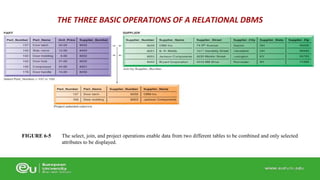
• Operations of a Relational DBMS 
– Three basic operations used to develop useful sets of data 
• SELECT: Creates subset of data of all records that meet stated criteria 
• JOIN: Combines relational tables to provide user with more information than available in individual tables 
• PROJECT: Creates subset of columns in table, creating tables with only the information specified
SQL Language Primer* (DML vs. DDL) 
• DDL (Data Definition Language) - Deals with the Structure of RDBMS 
– http://en.wikipedia.org/wiki/Data_definition_language 
• DML* (Data Manipulation Language) - Deals the data 
– http://en.wikipedia.org/wiki/Data_manipulation_language 
– The CRUD* Operation 
• Create 
• Read 
• Update 
• Delete
The select, join, and project operations enable data from two different tables to be combined and only selected 
attributes to be displayed. 
FIGURE 6-5 
THE THREE BASIC OPERATIONS OF A RELATIONAL DBMS
The Database Approach to Data Management 
• Capabilities of database management systems 
– Data definition capability: Specifies structure of database content, used to create tables and define characteristics 
of fields 
– Data dictionary: Automated or manual file storing definitions of data elements and their characteristics 
– Data manipulation language: Used to add, change, delete, retrieve data from database 
• Structured Query Language (SQL) 
• Microsoft Access user tools for generating SQL 
– Many DBMS have report generation capabilities for creating polished reports (Crystal Reports)
Microsoft Access has a rudimentary data dictionary capability that displays information about the size, format, 
and other characteristics of each field in a database. Displayed here is the information maintained in the 
SUPPLIER table. The small key icon to the left of Supplier_Number indicates that it is a key field. 
FIGURE 6-6 
MICROSOFT ACCESS DATA DICTIONARY FEATURES
Illustrated here are the SQL statements for a query to select suppliers for parts 137 or 150. They produce a list 
with the same results as Figure 6-5. 
FIGURE 6-7 
EXAMPLE OF AN SQL QUERY
Illustrated here is how the query in Figure 6-7 would be constructed using Microsoft Access query building 
tools. It shows the tables, fields, and selection criteria used for the query. 
FIGURE 6-8 
AN ACCESS QUERY
• Designing Databases 
– Conceptual (logical) design: abstract model from business perspective 
– Physical design: How database is arranged on direct-access storage devices 
• Design process identifies: 
– Relationships among data elements, redundant database elements 
– Most efficient way to group data elements to meet business requirements, needs of application programs 
• Normalization 
– Streamlining complex groupings of data to minimize redundant data elements and awkward many-to-many 
relationships 
The Database Approach to Data Management
An unnormalized relation contains repeating groups. For example, there can be many parts and suppliers for 
each order. There is only a one-to-one correspondence between Order_Number and Order_Date. 
FIGURE 6-9 
AN UNNORMALIZED RELATION FOR ORDER
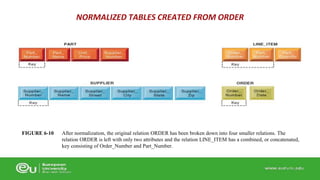
After normalization, the original relation ORDER has been broken down into four smaller relations. The 
relation ORDER is left with only two attributes and the relation LINE_ITEM has a combined, or concatenated, 
key consisting of Order_Number and Part_Number. 
FIGURE 6-10 
NORMALIZED TABLES CREATED FROM ORDER
The Database Approach to Data Management 
• Referential integrity rules 
• Used by RDMS to ensure relationships between tables remain consistent 
• Entity-relationship diagram 
• Used by database designers to document the data model 
• Illustrates relationships between entities 
• Caution: If a business doesn’t get data model right, system won’t be able to serve business well
This diagram shows the relationships between the entities SUPPLIER, PART, LINE_ITEM, and ORDER that 
might be used to model the database in Figure 6-10. 
FIGURE 6-11 
AN ENTITY-RELATIONSHIP DIAGRAM
Using Databases to Improve Business Performance and Decision Making 
• Big data 
• Massive sets of unstructured/semi-structured data from Web traffic, social media, sensors, and so on 
• Petabytes, exabytes of data 
• Volumes too great for typical DBMS 
• Can reveal more patterns and anomalies
Using Databases to Improve Business Performance and Decision Making 
• Business intelligence infrastructure 
– Today includes an array of tools for separate systems, and big data 
• Contemporary tools: 
– Data warehouses 
– Data marts 
– Hadoop 
– In-memory computing 
– Analytical platforms
Using Databases to Improve Business Performance and Decision Making 
• Data warehouse: 
– Stores current and historical data from many core operational transaction systems 
– Consolidates and standardizes information for use across enterprise, but data cannot be altered 
– Provides analysis and reporting tools 
• Data marts: 
– Subset of data warehouse 
– Summarized or focused portion of data for use by specific population of users 
– Typically focuses on single subject or line of business
A contemporary business 
intelligence infrastructure 
features capabilities and 
tools to manage and 
analyze large quantities and 
different types of data from 
multiple sources. Easy-to-use 
query and 
reporting tools for casual 
business users and more 
sophisticated analytical 
toolsets for power users 
are included. 
COMPONENTS OF A DATA WAREHOUSE
Using Databases to Improve Business Performance and Decision Making 
• Hadoop 
– Enables distributed parallel processing of big data across inexpensive computers 
– Key services 
• Hadoop Distributed File System (HDFS): data storage 
• MapReduce: breaks data into clusters for work 
• Hbase: NoSQL database 
– Used by Facebook, Yahoo, NextBio
Using Databases to Improve Business Performance and Decision Making 
• In-memory computing 
– Used in big data analysis 
– Use computers main memory (RAM) for data storage to avoid delays in retrieving data from disk storage 
– Can reduce hours/days of processing to seconds 
– Requires optimized hardware 
• Analytic platforms 
– High-speed platforms using both relational and non-relational tools optimized for large datasets
Using Databases to Improve Business Performance and Decision Making 
• Analytical tools: Relationships, patterns, trends 
– Tools for consolidating, analyzing, and providing access to vast amounts of data to help users make better business 
decisions 
• Multidimensional data analysis (OLAP) 
• Data mining 
• Text mining 
• Web mining
Using Databases to Improve Business Performance and Decision Making 
• Online analytical processing (OLAP) 
– Supports multidimensional data analysis 
• Viewing data using multiple dimensions 
• Each aspect of information (product, pricing, cost, region, time period) is different dimension 
• Example: How many washers sold in East in June compared with other regions? 
– OLAP enables rapid, online answers to ad hoc queries
The view that is showing is 
product versus region. If you 
rotate the cube 90 degrees, the 
face that will show product 
versus actual and projected 
sales. If you rotate the cube 90 
degrees again, you will see 
region versus actual and 
projected sales. Other views are 
possible. 
MULTIDIMENSIONAL DATA MODEL
Using Databases to Improve Business Performance and Decision Making 
• Data mining: 
– Finds hidden patterns, relationships in datasets 
• Example: customer buying patterns 
– Infers rules to predict future behavior 
– Types of information obtainable from data mining: 
• Associations 
• Sequences 
• Classification 
• Clustering 
• Forecasting
Using Databases to Improve Business Performance and Decision Making 
• Text mining 
– Extracts key elements from large unstructured data sets 
• Stored e-mails 
• Call center transcripts 
• Legal cases 
• Patent descriptions 
• Service reports, and so on 
– Sentiment analysis software 
• Mines e-mails, blogs, social media to detect opinions
The Modern* Database Approach to Data Management 
• Non-relational databases: “NoSQL”: Schema-lite Approach* 
– More flexible data model 
– Data sets stored across distributed machines 
– Easier to scale 
– Handle large volumes of unstructured and structured 
data (Web, social media, graphics) 
• Databases in the cloud 
– Typically, less functionality than on-premises DBs 
– Amazon Relational Database Service, Microsoft SQL Azure 
– Private clouds
Big Data, Big Rewards 
• Describe the kinds of big data collected by the organizations described in this case. 
• List and describe the business intelligence technologies described in this case. 
• Why did the companies described in this case need to maintain and analyze big data? What business benefits did they 
obtain? 
• Identify three decisions that were improved by using big data. 
• What kinds of organizations are most likely to need big data management and analytical tools?
Using Databases to Improve Business Performance and Decision Making 
• Databases and the Web 
– Many companies use Web to make some internal databases available to customers or partners 
– Typical configuration includes: 
• Web server 
• Application server/middleware/CGI scripts 
• Database server (hosting DBMS) 
– Advantages of using Web for database access: 
• Ease of use of browser software 
• Web interface requires few or no changes to database 
• Inexpensive to add Web interface to system
Users access an organization’s internal database through the Web using their desktop PCs and Web browser 
software. 
FIGURE 6-14 
LINKING INTERNAL DATABASES TO THE WEB
• Establishing an information policy 
Managing Data Resources 
– Firm’s rules, procedures, roles for sharing, managing, standardizing data 
– Data administration 
• Establishes policies and procedures to manage data 
– Data governance 
• Deals with policies and processes for managing availability, usability, integrity, and security of data, especially 
regarding government regulations 
– Database administration 
• Creating and maintaining database
• Ensuring data quality 
Managing Data Resources 
– More than 25% of critical data in Fortune 1000 company databases are inaccurate or incomplete 
– Redundant data 
– Inconsistent data 
– Faulty input 
– Before new database in place, need to: 
– Identify and correct faulty data 
– Establish better routines for editing data once database in operation
• Data quality audit: 
Managing Data Resources 
– Structured survey of the accuracy and level of completeness of the data in an information system 
• Survey samples from data files, or 
• Survey end users for perceptions of quality 
• Data cleansing 
– Software to detect and correct data that are incorrect, incomplete, improperly formatted, or redundant 
– Enforces consistency among different sets of data from separate information systems
2nd Half 
Oracle & Larry Ellison
Larry Ellison - Corporate IT
THANK YOU! 
email: raymond.gao@euruni.edu 
Twitter: @raygao
Miscellaneous

7 - Enterprise IT in Action

  • 1.
    Management Information Systems BCO-216 Fall 2014 (Enterprise IT in Action) Raymond Gao, MBA
  • 2.
    Agenda • (1sthalf) – Why company need good data? – Enterprise Architecture • N-Tier (3-Tier) Architecture • MVC Patterns – DBMS • (2nd half) – Larry Ellison / Oracle
  • 3.
    It’s all aboutData! It’s about making good decisions!
  • 4.
    Why is gooddata so important?* Think about Corporated Value Chains Companies need good data to make decisions. They should be: 1. High Quality a. Accurate b. Relevancy: Data Overflow / Quality Filters 2. Timely / Up-to-date a. When to get them? 3. Easy to Digest a. Business Analytics / BI 4. Well Managed a. Who gets what? Different jobs requires different data. b. Protected (IP Risks) Think: Who, What, Why, When, and How?
  • 5.
  • 6.
    Importance of ITArchitects* 1. Purpose a. Bridging gaps between technology and business b. Clearly state problems and proposed solutions 2. Best Practices a. Patterns b. Reuse c. Risk identification 3. Value a. High Quality at Lower Cost b. Manage Change c. Communication
  • 7.
    Classic 3-Tier Architecture* Architects design workable system at highest level. Source: Wikipedia: http://en.wikipedia.org/wiki/Multitier_architecture
  • 8.
    MVC Pattern * Good transactions are ACID.
  • 9.
    MVC Chief Benefits* • Separation of Concerns* – Better Reusability – More robustness – Customizable look & feel on a common Dataset. • Facilitating Specialization* – Developers gain expertise through activity specialization & focus • UI / Logic • Data management / administration • Parallel Tasking* – Development by Separate Teams at the Same time – More Consistency – Faster development speed
  • 10.
    Organizing Data ina File Environment • File organization concepts – Database: Group of related files – File: Group of records of same type – Record: Group of related fields – Field: Group of characters as word(s) or number • Describes an entity (person, place, thing on which we store information) • Attribute: Each characteristic, or quality, describing entity – Example: Attributes DATE or GRADE belong to entity COURSE
  • 11.
    A computer systemorganizes data in a hierarchy that starts with the bit, which represents either a 0 or a 1. Bits can be grouped to form a byte to represent one character, number, or symbol. Bytes can be grouped to form a field, and related fields can be grouped to form a record. Related records can be collected to form a file, and related files can be organized into a database. FIGURE 6-1 THE DATA HIERARCHY
  • 12.
    Organizing Data ina Traditional File Environment • Problems with the traditional file environment (files maintained separately by different departments) – Data redundancy: • Presence of duplicate data in multiple files – Data inconsistency: • Same attribute has different values – Program-data dependence: • When changes in program requires changes to data accessed by program – Lack of flexibility – Poor security – Lack of data sharing and availability
  • 13.
    The use ofa traditional approach to file processing encourages each functional area in a corporation to develop specialized applications. Each application requires a unique data file that is likely to be a subset of the master file. These subsets of the master file lead to data redundancy and inconsistency, processing inflexibility, and wasted storage resources. TRADITIONAL FILE PROCESSING
  • 14.
    • Database TheTraditional Database Approach to Data Management – Serves many applications by centralizing data and controlling redundant data • Database management system (DBMS) – Interfaces between applications and physical data files – Separates logical and physical views of data – Solves problems of traditional file environment • Controls redundancy • Eliminates inconsistency • Uncouples programs and data • Enables organization to central manage data and data security
  • 15.
    A single humanresources database provides many different views of data, depending on the information requirements of the user. Illustrated here are two possible views, one of interest to a benefits specialist and one of interest to a member of the company’s payroll department. FIGURE 6-3 HUMAN RESOURCES DATABASE WITH MULTIPLE VIEWS
  • 16.
    The Database Approachto Data Management • Relational DBMS (RDBMS)* – Represent data as two-dimensional tables – Each table contains data on entity and attributes • Table: grid of columns and rows – Rows (tuples): Records for different entities – Fields (columns): Represents attribute for entity – Key field: Field used to uniquely identify each record – Primary key: Field in table used for key fields – Foreign key: Primary key used in second table as look-up field to identify records from original table
  • 17.
    A relational databaseorganizes data in the form of two-dimensional tables. Illustrated here are tables for the entities SUPPLIER and PART showing how they represent each entity and its attributes. Supplier Number is a primary key for the SUPPLIER table and a foreign key for the PART table. FIGURE 6-4 Relational Database Tables
  • 18.
    The Database Approachto Data Management • Operations of a Relational DBMS – Three basic operations used to develop useful sets of data • SELECT: Creates subset of data of all records that meet stated criteria • JOIN: Combines relational tables to provide user with more information than available in individual tables • PROJECT: Creates subset of columns in table, creating tables with only the information specified
  • 19.
    SQL Language Primer*(DML vs. DDL) • DDL (Data Definition Language) - Deals with the Structure of RDBMS – http://en.wikipedia.org/wiki/Data_definition_language • DML* (Data Manipulation Language) - Deals the data – http://en.wikipedia.org/wiki/Data_manipulation_language – The CRUD* Operation • Create • Read • Update • Delete
  • 20.
    The select, join,and project operations enable data from two different tables to be combined and only selected attributes to be displayed. FIGURE 6-5 THE THREE BASIC OPERATIONS OF A RELATIONAL DBMS
  • 21.
    The Database Approachto Data Management • Capabilities of database management systems – Data definition capability: Specifies structure of database content, used to create tables and define characteristics of fields – Data dictionary: Automated or manual file storing definitions of data elements and their characteristics – Data manipulation language: Used to add, change, delete, retrieve data from database • Structured Query Language (SQL) • Microsoft Access user tools for generating SQL – Many DBMS have report generation capabilities for creating polished reports (Crystal Reports)
  • 22.
    Microsoft Access hasa rudimentary data dictionary capability that displays information about the size, format, and other characteristics of each field in a database. Displayed here is the information maintained in the SUPPLIER table. The small key icon to the left of Supplier_Number indicates that it is a key field. FIGURE 6-6 MICROSOFT ACCESS DATA DICTIONARY FEATURES
  • 23.
    Illustrated here arethe SQL statements for a query to select suppliers for parts 137 or 150. They produce a list with the same results as Figure 6-5. FIGURE 6-7 EXAMPLE OF AN SQL QUERY
  • 24.
    Illustrated here ishow the query in Figure 6-7 would be constructed using Microsoft Access query building tools. It shows the tables, fields, and selection criteria used for the query. FIGURE 6-8 AN ACCESS QUERY
  • 25.
    • Designing Databases – Conceptual (logical) design: abstract model from business perspective – Physical design: How database is arranged on direct-access storage devices • Design process identifies: – Relationships among data elements, redundant database elements – Most efficient way to group data elements to meet business requirements, needs of application programs • Normalization – Streamlining complex groupings of data to minimize redundant data elements and awkward many-to-many relationships The Database Approach to Data Management
  • 26.
    An unnormalized relationcontains repeating groups. For example, there can be many parts and suppliers for each order. There is only a one-to-one correspondence between Order_Number and Order_Date. FIGURE 6-9 AN UNNORMALIZED RELATION FOR ORDER
  • 27.
    After normalization, theoriginal relation ORDER has been broken down into four smaller relations. The relation ORDER is left with only two attributes and the relation LINE_ITEM has a combined, or concatenated, key consisting of Order_Number and Part_Number. FIGURE 6-10 NORMALIZED TABLES CREATED FROM ORDER
  • 28.
    The Database Approachto Data Management • Referential integrity rules • Used by RDMS to ensure relationships between tables remain consistent • Entity-relationship diagram • Used by database designers to document the data model • Illustrates relationships between entities • Caution: If a business doesn’t get data model right, system won’t be able to serve business well
  • 29.
    This diagram showsthe relationships between the entities SUPPLIER, PART, LINE_ITEM, and ORDER that might be used to model the database in Figure 6-10. FIGURE 6-11 AN ENTITY-RELATIONSHIP DIAGRAM
  • 30.
    Using Databases toImprove Business Performance and Decision Making • Big data • Massive sets of unstructured/semi-structured data from Web traffic, social media, sensors, and so on • Petabytes, exabytes of data • Volumes too great for typical DBMS • Can reveal more patterns and anomalies
  • 31.
    Using Databases toImprove Business Performance and Decision Making • Business intelligence infrastructure – Today includes an array of tools for separate systems, and big data • Contemporary tools: – Data warehouses – Data marts – Hadoop – In-memory computing – Analytical platforms
  • 32.
    Using Databases toImprove Business Performance and Decision Making • Data warehouse: – Stores current and historical data from many core operational transaction systems – Consolidates and standardizes information for use across enterprise, but data cannot be altered – Provides analysis and reporting tools • Data marts: – Subset of data warehouse – Summarized or focused portion of data for use by specific population of users – Typically focuses on single subject or line of business
  • 33.
    A contemporary business intelligence infrastructure features capabilities and tools to manage and analyze large quantities and different types of data from multiple sources. Easy-to-use query and reporting tools for casual business users and more sophisticated analytical toolsets for power users are included. COMPONENTS OF A DATA WAREHOUSE
  • 34.
    Using Databases toImprove Business Performance and Decision Making • Hadoop – Enables distributed parallel processing of big data across inexpensive computers – Key services • Hadoop Distributed File System (HDFS): data storage • MapReduce: breaks data into clusters for work • Hbase: NoSQL database – Used by Facebook, Yahoo, NextBio
  • 35.
    Using Databases toImprove Business Performance and Decision Making • In-memory computing – Used in big data analysis – Use computers main memory (RAM) for data storage to avoid delays in retrieving data from disk storage – Can reduce hours/days of processing to seconds – Requires optimized hardware • Analytic platforms – High-speed platforms using both relational and non-relational tools optimized for large datasets
  • 36.
    Using Databases toImprove Business Performance and Decision Making • Analytical tools: Relationships, patterns, trends – Tools for consolidating, analyzing, and providing access to vast amounts of data to help users make better business decisions • Multidimensional data analysis (OLAP) • Data mining • Text mining • Web mining
  • 37.
    Using Databases toImprove Business Performance and Decision Making • Online analytical processing (OLAP) – Supports multidimensional data analysis • Viewing data using multiple dimensions • Each aspect of information (product, pricing, cost, region, time period) is different dimension • Example: How many washers sold in East in June compared with other regions? – OLAP enables rapid, online answers to ad hoc queries
  • 38.
    The view thatis showing is product versus region. If you rotate the cube 90 degrees, the face that will show product versus actual and projected sales. If you rotate the cube 90 degrees again, you will see region versus actual and projected sales. Other views are possible. MULTIDIMENSIONAL DATA MODEL
  • 39.
    Using Databases toImprove Business Performance and Decision Making • Data mining: – Finds hidden patterns, relationships in datasets • Example: customer buying patterns – Infers rules to predict future behavior – Types of information obtainable from data mining: • Associations • Sequences • Classification • Clustering • Forecasting
  • 40.
    Using Databases toImprove Business Performance and Decision Making • Text mining – Extracts key elements from large unstructured data sets • Stored e-mails • Call center transcripts • Legal cases • Patent descriptions • Service reports, and so on – Sentiment analysis software • Mines e-mails, blogs, social media to detect opinions
  • 41.
    The Modern* DatabaseApproach to Data Management • Non-relational databases: “NoSQL”: Schema-lite Approach* – More flexible data model – Data sets stored across distributed machines – Easier to scale – Handle large volumes of unstructured and structured data (Web, social media, graphics) • Databases in the cloud – Typically, less functionality than on-premises DBs – Amazon Relational Database Service, Microsoft SQL Azure – Private clouds
  • 42.
    Big Data, BigRewards • Describe the kinds of big data collected by the organizations described in this case. • List and describe the business intelligence technologies described in this case. • Why did the companies described in this case need to maintain and analyze big data? What business benefits did they obtain? • Identify three decisions that were improved by using big data. • What kinds of organizations are most likely to need big data management and analytical tools?
  • 43.
    Using Databases toImprove Business Performance and Decision Making • Databases and the Web – Many companies use Web to make some internal databases available to customers or partners – Typical configuration includes: • Web server • Application server/middleware/CGI scripts • Database server (hosting DBMS) – Advantages of using Web for database access: • Ease of use of browser software • Web interface requires few or no changes to database • Inexpensive to add Web interface to system
  • 44.
    Users access anorganization’s internal database through the Web using their desktop PCs and Web browser software. FIGURE 6-14 LINKING INTERNAL DATABASES TO THE WEB
  • 45.
    • Establishing aninformation policy Managing Data Resources – Firm’s rules, procedures, roles for sharing, managing, standardizing data – Data administration • Establishes policies and procedures to manage data – Data governance • Deals with policies and processes for managing availability, usability, integrity, and security of data, especially regarding government regulations – Database administration • Creating and maintaining database
  • 46.
    • Ensuring dataquality Managing Data Resources – More than 25% of critical data in Fortune 1000 company databases are inaccurate or incomplete – Redundant data – Inconsistent data – Faulty input – Before new database in place, need to: – Identify and correct faulty data – Establish better routines for editing data once database in operation
  • 47.
    • Data qualityaudit: Managing Data Resources – Structured survey of the accuracy and level of completeness of the data in an information system • Survey samples from data files, or • Survey end users for perceptions of quality • Data cleansing – Software to detect and correct data that are incorrect, incomplete, improperly formatted, or redundant – Enforces consistency among different sets of data from separate information systems
  • 48.
    2nd Half Oracle& Larry Ellison
  • 49.
    Larry Ellison -Corporate IT
  • 50.
    THANK YOU! email:raymond.gao@euruni.edu Twitter: @raygao
  • 51.