DIFFERENT DATA
MODELS
Create By : Madusha Udayangani
Esoft Metro campus (kurunegala)
HND com- 15
10086
•A data model is a conceptual representation of the data
structures that are required by a database.
•To use a common analogy, the data model is equivalent
to an architect's building plans.
•A data model is independent of hardware or software
constraints.
DATA MODELING
IMPORTANCE OF DATA MODELS
• Data models
 Representations, usually graphical, of complex real-
world data structures
 Facilitate interaction among the designer, the
applications programmer and the end user
• End-users have different views and needs for data
• Data model organizes data for various users
TYPE OF DATA MODELS
• FILE BASED APPROACH
• Hierarchical Model
• Network Model
• Relational Model
• ER Model
• Object Oriented Model
• Object Relational Model
• Deductive / Inference Model
FILE BASED APPROACH
• A collection of un-related files and a collection of application
programs that perform services for the end-users, such as the
production of reports. Each program defines and manages its
own data.
1.Traditionally each department in a company would maintain its own
collection of files.
2.The data processing department would write programs for each
application each office needed performed.
•Separation and isolation of data
•Duplication of data
•Incompatible File Formats
•Data dependence
•Fixed queries/proliferation of application programs
•Inability to generate timely reports
LIMITATIONS OF THE FILE-BASED
APPROACH
HIERARCHICAL MODEL
• Oldest data base model. (1950’s)
• Tree structure is most frequently occurring relationship.
• organize data elements as tabular rows
Advantages
• Simplicity
• Data security
• Data Integrity
• Efficiency : When contains large no of relations
Disadvantages
• Implementation complexity
• Database management problem : maintaining difficult
• Lack of structural independence
• programming complexity
Network Model
• Graph structure
• Allow more connection between nodes
• Ex: A employee work for two department is not possible in
hierarchical model, but here it is possible
Advantages
• Conceptual simplicity
• handle more relationships
• Ease of data access
• Data integrity
•Data independence
• Database standards
Disadvantages
• System Complexity
• Absence of structural independence
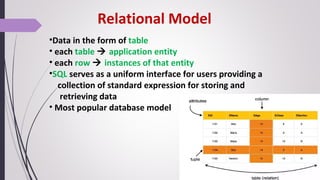
Relational Model
•Data in the form of table
• each table  application entity
• each row  instances of that entity
•SQL serves as a uniform interface for users providing a
collection of standard expression for storing and
retrieving data
• Most popular database model
Formal Relational terms Informal Equivalence
Relation Table
Tuple Row/record
Cardinality of relation Number of rows
Attribute Columns/field
Degree of relation Number of columns
Primary Key Unique identifier
Domain A pool of values from
which the values of
specific attributes of
specific relations are
taken
Advantages
• Structural independence
• Conceptual simplicity
• Design , implementation , maintenance and
usage ease
•Query capability
•Very powerful
•Flexible
•Easy to use query capability
The main highlights of relations model
•Data is stored in tables called relations.
•Relations can be normalized.
•In normalized relations, values saved are atomic values.
•Each row in a relation contains a unique value.
•Each column in a relation contains values from a same
domain.
Comparison between
hierarchical model, network
model and relational model
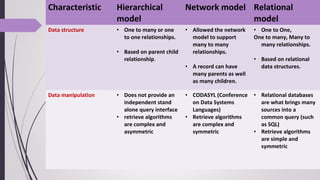
Characteristic Hierarchical
model
Network model Relational
model
Data structure • One to many or one
to one relationships.
• Based on parent child
relationship.
• Allowed the network
model to support
many to many
relationships.
• A record can have
many parents as well
as many children.
• One to One,
One to many, Many to
many relationships.
• Based on relational
data structures.
Data manipulation • Does not provide an
independent stand
alone query interface
• retrieve algorithms
are complex and
asymmetric
• CODASYL (Conference
on Data Systems
Languages)
• Retrieve algorithms
are complex and
symmetric
• Relational databases
are what brings many
sources into a
common query (such
as SQL)
• Retrieve algorithms
are simple and
symmetric
Characteristic Hierarchical
model
Network model Relational model
Data integrity • Cannot insert the
information of a
child who does not
have any parent
• Multiple
occurrences of child
records which lead
to problems of
inconsistency during
the update
operation
• Deletion of parent
results in deletion of
child records
• Does not suffer
form any insertion
anomaly.
• Free from update
anomalies
• Free from delete
anomalies
• Does not suffer
from any insert
anomaly.
• Free form update
anomalies
• Free from delete
anomalies
 
why relational model best fits
the DAD assignment scenario
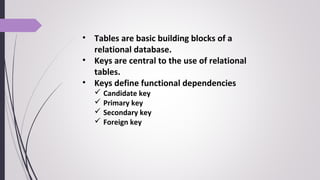
• Tables are basic building blocks of a
relational database.
• Keys are central to the use of relational
tables.
• Keys define functional dependencies
 Candidate key
 Primary key
 Secondary key
 Foreign key
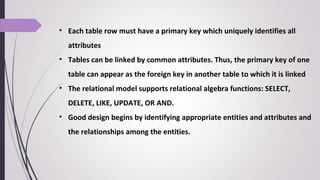
• Each table row must have a primary key which uniquely identifies all
attributes
• Tables can be linked by common attributes. Thus, the primary key of one
table can appear as the foreign key in another table to which it is linked
• The relational model supports relational algebra functions: SELECT,
DELETE, LIKE, UPDATE, OR AND.
• Good design begins by identifying appropriate entities and attributes and
the relationships among the entities.
REFERENCES
- http://www.tutorialspoint.com/dbms/pdf/dbms_data_models.pdf
- What are some advantages of using the database management
system approach rather than the file system approach? - Quora
www.quora.com
- http://www.teach-
ict.com/as_as_computing/ocr/H447/F453/3_3_9/database_design/miniwe
b/pg8.htm#
www.teach-ict.com
Create By : Madusha Udayangani
Esoft Metro campus (kurunegala)
HND com- 15
10086

Different data models

  • 1.
    DIFFERENT DATA MODELS Create By: Madusha Udayangani Esoft Metro campus (kurunegala) HND com- 15 10086
  • 2.
    •A data modelis a conceptual representation of the data structures that are required by a database. •To use a common analogy, the data model is equivalent to an architect's building plans. •A data model is independent of hardware or software constraints. DATA MODELING
  • 3.
    IMPORTANCE OF DATAMODELS • Data models  Representations, usually graphical, of complex real- world data structures  Facilitate interaction among the designer, the applications programmer and the end user • End-users have different views and needs for data • Data model organizes data for various users
  • 4.
    TYPE OF DATAMODELS • FILE BASED APPROACH • Hierarchical Model • Network Model • Relational Model • ER Model • Object Oriented Model • Object Relational Model • Deductive / Inference Model
  • 5.
    FILE BASED APPROACH •A collection of un-related files and a collection of application programs that perform services for the end-users, such as the production of reports. Each program defines and manages its own data. 1.Traditionally each department in a company would maintain its own collection of files. 2.The data processing department would write programs for each application each office needed performed.
  • 6.
    •Separation and isolationof data •Duplication of data •Incompatible File Formats •Data dependence •Fixed queries/proliferation of application programs •Inability to generate timely reports LIMITATIONS OF THE FILE-BASED APPROACH
  • 7.
    HIERARCHICAL MODEL • Oldestdata base model. (1950’s) • Tree structure is most frequently occurring relationship. • organize data elements as tabular rows
  • 8.
    Advantages • Simplicity • Datasecurity • Data Integrity • Efficiency : When contains large no of relations Disadvantages • Implementation complexity • Database management problem : maintaining difficult • Lack of structural independence • programming complexity
  • 9.
    Network Model • Graphstructure • Allow more connection between nodes • Ex: A employee work for two department is not possible in hierarchical model, but here it is possible
  • 10.
    Advantages • Conceptual simplicity •handle more relationships • Ease of data access • Data integrity •Data independence • Database standards Disadvantages • System Complexity • Absence of structural independence
  • 11.
    Relational Model •Data inthe form of table • each table  application entity • each row  instances of that entity •SQL serves as a uniform interface for users providing a collection of standard expression for storing and retrieving data • Most popular database model
  • 12.
    Formal Relational termsInformal Equivalence Relation Table Tuple Row/record Cardinality of relation Number of rows Attribute Columns/field Degree of relation Number of columns Primary Key Unique identifier Domain A pool of values from which the values of specific attributes of specific relations are taken
  • 13.
    Advantages • Structural independence •Conceptual simplicity • Design , implementation , maintenance and usage ease •Query capability •Very powerful •Flexible •Easy to use query capability
  • 15.
    The main highlightsof relations model •Data is stored in tables called relations. •Relations can be normalized. •In normalized relations, values saved are atomic values. •Each row in a relation contains a unique value. •Each column in a relation contains values from a same domain.
  • 16.
    Comparison between hierarchical model,network model and relational model
  • 17.
    Characteristic Hierarchical model Network modelRelational model Data structure • One to many or one to one relationships. • Based on parent child relationship. • Allowed the network model to support many to many relationships. • A record can have many parents as well as many children. • One to One, One to many, Many to many relationships. • Based on relational data structures. Data manipulation • Does not provide an independent stand alone query interface • retrieve algorithms are complex and asymmetric • CODASYL (Conference on Data Systems Languages) • Retrieve algorithms are complex and symmetric • Relational databases are what brings many sources into a common query (such as SQL) • Retrieve algorithms are simple and symmetric
  • 18.
    Characteristic Hierarchical model Network modelRelational model Data integrity • Cannot insert the information of a child who does not have any parent • Multiple occurrences of child records which lead to problems of inconsistency during the update operation • Deletion of parent results in deletion of child records • Does not suffer form any insertion anomaly. • Free from update anomalies • Free from delete anomalies • Does not suffer from any insert anomaly. • Free form update anomalies • Free from delete anomalies
  • 19.
      why relational modelbest fits the DAD assignment scenario
  • 20.
    • Tables arebasic building blocks of a relational database. • Keys are central to the use of relational tables. • Keys define functional dependencies  Candidate key  Primary key  Secondary key  Foreign key
  • 21.
    • Each tablerow must have a primary key which uniquely identifies all attributes • Tables can be linked by common attributes. Thus, the primary key of one table can appear as the foreign key in another table to which it is linked • The relational model supports relational algebra functions: SELECT, DELETE, LIKE, UPDATE, OR AND. • Good design begins by identifying appropriate entities and attributes and the relationships among the entities.
  • 22.
    REFERENCES - http://www.tutorialspoint.com/dbms/pdf/dbms_data_models.pdf - Whatare some advantages of using the database management system approach rather than the file system approach? - Quora www.quora.com - http://www.teach- ict.com/as_as_computing/ocr/H447/F453/3_3_9/database_design/miniwe b/pg8.htm# www.teach-ict.com
  • 24.
    Create By :Madusha Udayangani Esoft Metro campus (kurunegala) HND com- 15 10086