Data Resource
Management
And DSS
Introduction
 Data is vital organizational resource, which needs to be managed like other
important business assets.
 Managing data resource is an important managerial task in any organization
today.
 In all information system data must be organized and structured in some
logical manner so that they can be accessed easily, processed efficiently,
retrieved quickly and managed effectively.
 A database management can be done through the software known as the
database management system.
 It is designed to define, manipulate, retrieve and manage data in database.
Fundamental concepts
 Character: The most logical element is a character, which consists of a single
alphabetic, numeric, or other symbol. E.g. a, 1, * etc.
 Field: field or data item also known as column. A field consists of a grouping
of related character. E.g. First_name, salary, city etc.
 Record: A record represents a collection of attributes that describes a single
instance of an entity. E.g. person’s payroll which consists of data fields
describing attributes such as person’s name, rate of pay etc.
 File: A group of related records is a data file. When it is independent of any
other files related to it, a single table may be referred to as a flat file.
 Database: A database is an integrated collection of logically related data
elements. A database contains data elements describing entiites and
relationship among entities.
Database Structures
 The relationship among the many individual data elements stored in
databases are based on one of several logical data structures, or models.
 DBMS are packages are designed to use a specific data structure to provide
end user with quick, easy access to the information stored in database.
 The fundamental data structures are:
Hierarchical model
 It is one of the oldest method for organizing and storing data and is still used
by some organization.
 It is organized in a pyramid fashion, like the branches of tree extending
downwards.
 It has a parent child relationship where a parent can have more than a
children.
 They can be accessed and updated rapidly.
 They are so rigid that adding a new field or record requires that the entire
database be redefined.
Network Model
 Represents complex logical relationship and allows many-to-many
relationship.
 It is more like graph than tree in structure.
 A network model consists of collection of record which are interrelated to
each other with the help of relationship.
 children can have multiple parents and parents can have multiple children.
E-R model
 An entity- relationship model is a systematic way of describing and defining a
business process.
 The E-R model is a way of graphically representing the logical relationships of
entities in order to create database.
 The data modelers prepares the ER diagram and is verified with the
functional domain experts to ensure that all the requirements are properly
incorporated in the conceptual design.
 We can easily map ER diagram to a relational schema.
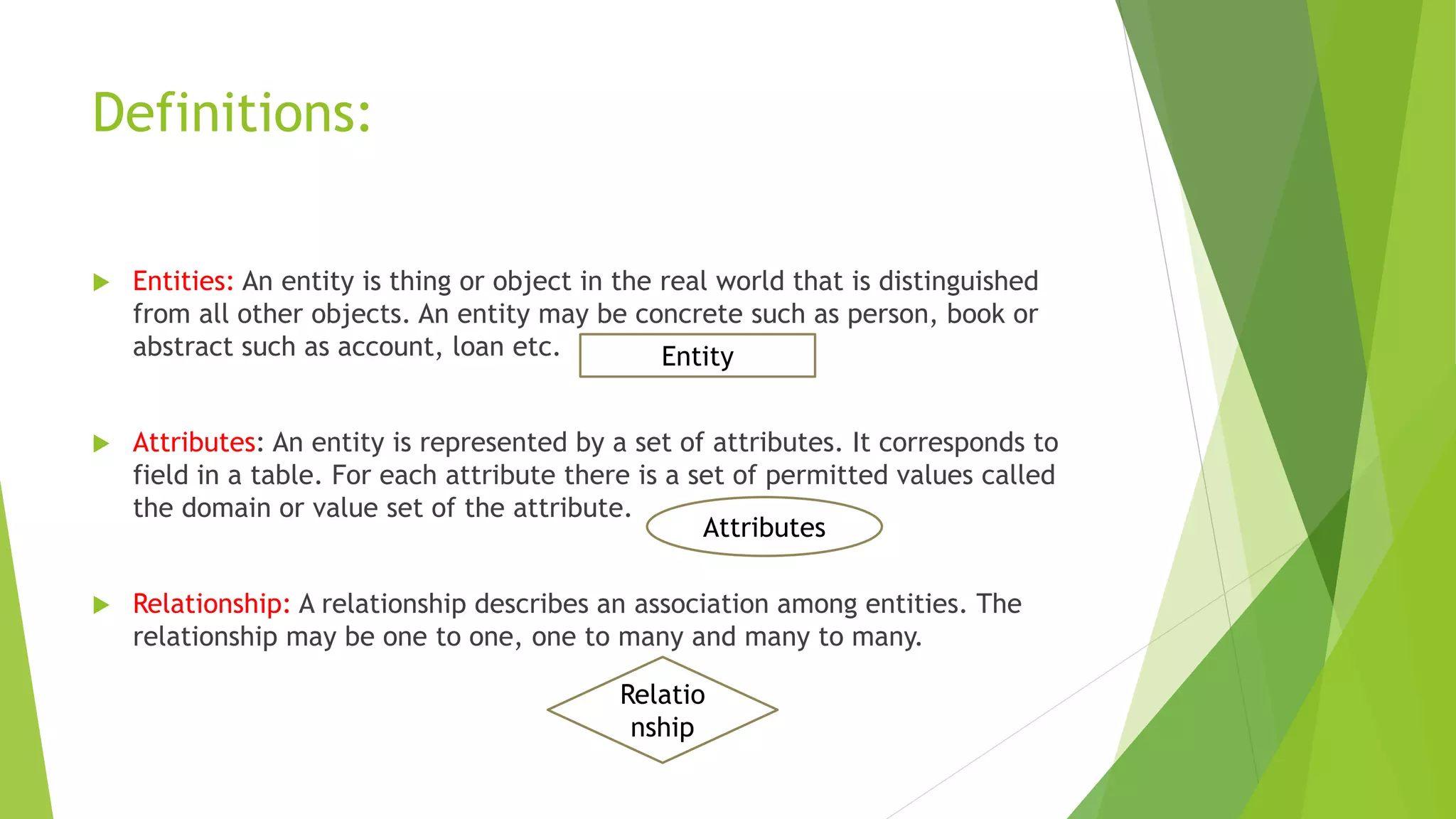
 The basic construct of ER model are entity, attributes and relationship.
Definitions:
 Entities: An entity is thing or object in the real world that is distinguished
from all other objects. An entity may be concrete such as person, book or
abstract such as account, loan etc.
 Attributes: An entity is represented by a set of attributes. It corresponds to
field in a table. For each attribute there is a set of permitted values called
the domain or value set of the attribute.
 Relationship: A relationship describes an association among entities. The
relationship may be one to one, one to many and many to many.
Entity
Attributes
Relatio
nship
Relationship between entities
 One to one (1:1) : one instance of an entity is associated with one other
instance of another entity (B). Eg. A student is identified by unique student_id
 One to Many (1:N): one instance of an entity A is associated many instances of
entity B. A company with many employees.
 Many to many (N:N): one instance of entity A is associated with many instance
of entity B and one instance of entity B is associated with many instance of
entity A. eg. A project is associated with many employees and a employee is
associated with many projects.
Relational Model
 Relational data model is the primary data model, which is used widely around
the world for data storage and processing. This model is simple and it has all
the properties and capabilities required to process data with storage
efficiency.
 Concepts
 Tables − In relational data model, relations are saved in the format of Tables.
This format stores the relation among entities. A table has rows and columns,
where rows represents records and columns represent the attributes.
 Tuple − A single row of a table, which contains a single record for that
relation is called a tuple.
Continued
 Relation instance − A finite set of tuples in the relational database system
represents relation instance. Relation instances do not have duplicate tuples.
 Relation schema − A relation schema describes the relation name (table
name), attributes, and their names.
 Relation key − Each row has one or more attributes, known as relation key,
which can identify the row in the relation (table) uniquely.
 Attribute domain − Every attribute has some pre-defined value scope, known
as attribute domain.
Keys in Database
 Super key: A superkey is a combination of columns that uniquely identifies any row
within a relational database management system (RDBMS) table.
 For example, imagine a table used to store customer master details that contains
columns such as:
 Customer name
 Customer ID
 Social security number (SSN)
 Address
 Date of birth
 A certain set of columns may be extracted and guaranteed unique to each
customer. Examples of superkeys are as follows:
 Name+SSN+Birthdate
 ID+Name+SSN
continued
 Candidate key: A candidate key is a column, or set of columns, in a table that
can uniquely identify any database record without referring to any other
data. Each table may have one or more candidate keys.
 For example, a bank’s database is being designed. To uniquely define each
customer’s account, a combination of the customer’s ID or social security
number (SSN) and a sequential number for each of his or her accounts can be
used. So, Mr. Andrew Smith’s checking account can be numbered 223344-1,
and his savings account 223344-2. A candidate key has just been created.
continued
 A primary key is a special relational database table column (or combination of
columns) designated to uniquely identify all table records.
A primary key’s main features are:
 It must contain a unique value for each row of data.
 It cannot contain null values.
 e.g., surname and date of birth in bank’s account.
Continued
 Composite Key: A composite key, in the context of relational databases, is a
combination of two or more columns in a table that can be used to uniquely
identify each row in the table. Uniqueness is only guaranteed when the
columns are combined; when taken individually the columns do not guarantee
uniqueness.
 Now assume that the table has separate columns for the account type (C for
checking, S for savings and so on), followed by another column for the year
and month of the account’s creation, and another column for a sequential
number within that month. if, you combine all the three columns, then you
do end up with a unique record for each and every account. A hypothetical
account number in our example would be "C 200807 001" for the first account
created in July 2008, which is a checking account. Another is "S 201003 004"
for the fourth account created in March 2010, this time a savings account.
Continued
 Foreign Key: A foreign key is a column or group of columns in a relational
database table that provides a link between data in two tables. It acts as a
cross-reference between tables because it references the primary key of
another table, thereby establishing a link between them.
 if there are two tables, customer and order, a relationship can be created
between them by introducing a foreign key into the order table that refers to
the customer ID in the customer table. The customer ID column exists in both
customer and order tables. The customer ID in the order table becomes the
foreign key, referring to the primary key in the customer table.
Object oriented database
 Object oriented programming paradigm was applied to database technology,
creating a new database model known as object database.
 Considered as one of the key technologies of a new generation of multimedia
web- based application.
 Object consists of data values describing the attributes of entity and the
operation that can be performed upon the data.
 Object oriented database can be used to store data from a variety of media
sources, such as photographs and text, and produce work as output in
multimedia format.
 It use small reusable chunk of software called objects.
Continued
 Object consists of two elements:
 1. A piece of data (sound, text, graphic)
 2. instruction or software program called methods for what to do with the
data in the object.
 It is costly to develop but the ability to mix and match reusable objects
provides incredible multimedia capability.
 To put objects into relational databases, they must be described in terms of
simple string, integer, or real number data. For instance in the case of an
airplane. The wing may be placed in one table with rows and columns
describing its dimensions and characteristics. The fuselage may be in another
table, the propeller in another table, tires, and so on.
 Breaking complex information out into simple data takes time and is labor
intensive. Code must be written to accomplish this task.
Multidimensional databases
 A multidimensional database uses the concept of a data cube (also referred to
as a hypercube) to represent the dimensions of data currently available to its
user(s).
 The multidimensional database concept is designed to assist with decision
support systems.
 This detailed organization of the data allows for advanced and complex query
generation while providing outstanding performance in certain cases when
compared to traditional relational structures and databases.
 This type of database is usually structured in an order that optimizes OLAP
and data warehouse applications.
Database Language
 Language used for defining, accessing and controlling database is known as
database language.
 A database language must provide for both logical schema specification and
modification and for retrieval and update .
 The types of database language are:
Data definition language (DDL)
 It is a language to define data structure and modify data.
 DDL command can be used to add, remove, or modify database and tables.
 The DDL commands and their purpose are:
 CREATE: to create objects in database
 ALTER: alters the structure of database
 DROP: deletes objects from database
 TRUNCATE: removes all records from table
 COMMENT: add comment
 RENAME: rename an object
Data manipulation language (DML)
 Consists of command that permits users to manipulate data in database.
 It involves inserting data into database tables, retrieving existing data,
deleting data from existing table and modifying existing data.
 The DML command and their purpose are:
 SELECT: Retrieve data from table
 INSERT: insert data into table
 UPDATE: Updating existing data within a table
 DELETE: deletes all record from a table
Data Control Language (DCL)
 It is used to control access to data stored in a database.
 provides administrator with the flexibility to set and remove database
permission.
 The DCL command and their purpose are:
 GRANT: add new permission to database user
 REVOKE: remove database access from previously granted access
 DENY: prevent user from receiving a particular permission.
Data resource management
 Today’s business resources cannot survive or succeed without quality data
about their internal operation and external environment.
 The huge organization information is stored individually or globally and it is
essential to analyze every bit of information they can extract from their huge
data warehouse.
 Data resource management is a managerial activity that applies information
system technologies like database management, data warehousing and other
data management tools to the task of managing an organization’s data
resources.
 Organization and their managers need to practice data resource management
technologies and methods to manage an organization’s data assets to meet
the business information requirements.
Types of databases
Development in Information technology and its business application have resulted
in the evolution of several major types of databases.
The major conceptual categories of databases may be found in many
organizations.
Operational database
 It stores data needed to support the business process and operation of a
company.
 They are also known as subject database, transaction database and
production databases.
 E.g. are customer database, human resource database, inventory database,
and other database containing data generated by business operations.
Distributed databases
 Many organization replicate and distribute database copies or parts of
databases to network server at a variety of sites.
 The distributed database resides on network servers on world wide web,
corporate intranets and extranets, or on any company network.
 The primary aim of distributed database is protection of data and meet the
storage requirements.
 The primary challenge is to maintain data accuracy and integrity.
 The updating of data in distributed system can be done in two ways
replication and duplication.
External database
 Access to information from external databases is available from commercial
online services from many sources on the world wide web.
 Websites provides an endless variety of hyperlinked pages of multimedia
documents in hypermedia database to access.
 One can view or download abstract or complete copies of hundreds of
newspaper, magazines, newsletter, research paper, and other published
material.
 Using google and other search engine is an example for use of external
database.
Hypermedia databases
 A website stores information in hypermedia database consisting of
hyperlinked pages of multimedia.
 From data management point of view the set of interconnected multimedia
pages on the web site is a database of interrelated hypermedia page
elements, rather than interrelated data records.
 The web server software acts as a database management system to manage
the transfer of hypermedia files for downloading by the multimedia plug-in of
web browser.
Data warehouse
 The data warehouse stores data that have been extracted from the various
operational, external and other database of an organization.
 They store current and historical data and are used for creating analytical
reports for knowledge workers throughout the enterprise. Examples of reports
could range from annual and quarterly comparisons and trends to detailed
daily sales analysis.
 The data stored in the warehouse is uploaded from the operational systems
(such as marketing, sales, etc.)
 Data warehouse may be divided into data marts, which holds subsets of data
from the warehouse that focus on specific aspect of company such as a
department or a business process.
Continued…..
 The data from various operational and external database are captured,
cleaned , transformed into data that can be better used for analysis.
 The data in data warehouse is static due to complex pattern or historical
trends that might be otherwise go unnoticed with dynamic data that change
constantly.
Data Mining
 In data mining the data warehouse are analyzed to reveal hidden patterns and
trends in historical business activity.
 Data mining can discover new correlations, patterns, and trends in vast
amounts of business data stored in data warehouse.
 This analysis can be used to help managers make decisions about strategic
changes in business operation to gain competitive advantages in the market
place.

Decision support in Business
 To succeed in business today, companies need information system that can
support the diverse information and decision-making needs of their managers
and business professionals.
 The type of information required by decision makers in a company is directly
related to the level of management decision making and the amount of
structure in the decision situations they face.
 The level of managerial decision making that must be supported by
information technology in successful organization are:
Strategic Management (SM)
 Board of directors executive committee of the CEO and top executives
develop overall organizational goals, policies and objectives as part of
strategic planning process.
 They also monitor the strategic performance of the organization and its
overall direction in political, economic and competitive business
environment.
Tactical Management (TM)
 Business professionals in self directed teams as well as business unit managers
develop short and medium range plans, schedules and budgets and specify the
policies, procedures and business objectives for their subunits of the
company.
 They also allocate resource and monitor the performance of their
organizational subunits, including departments, division, process teams,
project teams and other workgroups.
Operational Management
 The members of self directed teams or operating managers develop short
range plans such as weekly production schedules.
 They directs the use of resources and the performance of tasks according to
procedures and within budgets and schedules they establish for the team and
other workgroups of the organization.
Information Quality
 The characteristics of information products makes them valuable and useful
to anyone.
 People need information of high quality that is information products whose
characteristics, attributes or qualities make the information more valuable to
them.
 Information should be having three dimension of time, content and form.
Time dimension
 The important of information is valuable within the given time frame. It is
summarized as:
 Timeliness: provided when needed.
 Concurrency: Up to date when provided.
 Frequency: As often as needed.
 Time Period: about past, present and future time periods.
Content dimensions
 It is important to have complete content of any information. It is summarized
as:
 Accuracy: free from errors
 Relevance: related to need of a specific recipient
 Completeness: All information necessary should be provided
 Conciseness: only necessary information
 Scope: can have broad or narrow scope
 Performance: reveal performance by measuring activities accomplished,
progress made and resources accumlated
Form dimension
 The structure and format of information is equally important. It is
summarized as:
 Clarity: Easy to understand
 Detail: can be provided in detail or summary form
 Order: predetermined sequence
 Presentation: presented in narrative, numeric, graphic or other forms
 Media: form of printed paper documents, video display or other media.
Decision Structure
 Decision made at the operational management level tend to be more
structured, those at the tactical level are more semi-structured and those at
the strategic level are more unstructured.
 Structured decision involves situation in which the procedure to follow, when
a decision is needed can be specified in advance. E.g. Inventory reorder
decision
 Unstructured decision involves decision situation in which it is not possible to
specify in advance the most of the decision procedure to follow. Long term
strategic decision are unstructured.
 Some business decision procedure can be pre specified but not enough to lead
to a definite recommended decision. E.g. decision involved in starting new
line of ecommerce service.
continue
 Information system must be designed to produce variety of information
products to meet the changing needs of decision makers throughout an
organization.
 Decision at strategic level may look decision support system to support their
more unstructured planning and policymaking responsibilities.
 Decision at operational level may depend on MIS to supply more pre-specified
internal reports that support their more structured responsibilities in day to
day operations.
Decision support trends
 Using information system to support business decision making have been one
of the primary thrust of the business use of information technology.
 Traditional managerial focus originating in classic management information
system, decision support system and executive information system expanded
during 90’s.
 The trend expanded with the dramatic growth of internet, intranet and
extranet. The E-business and E-commerce also expanded the information and
decision support use.
 Business Intelligence(BI) is rapidly becoming the mainstream idea for business
decision making in the modern organization.
 Business are responding with a variety of personalized and Proactive web
based analytical technique to support the decision making.
Decision support system
 Computer based information system that provides interactive information
support to managers and business professionals during the decision making
process.
 It use analytical models, specialized databases, a decision maker’s own
insight and judgements, and an interactive computer based modeling process
to support semi structured business decision.
 Decision support system are able to support directly the specific types of
decisions and the personal decision making styles and need of individual
executives, managers, and business professionals.
Components of DSS
 DSS rely on model bases, databases as vital system resources.
 A DSS model base is a software component that consists of model used in
computational and analytical routines that mathematically express
relationship among variables.
 It might contains linear programming models, multiple regression forecasting
models, and capital budgeting present value models.
 Such models may be stored in form of spreadsheet model or template, or
statistical and mathematical programs or programs module.
 Business become more aware of the power of decision support system and
they are using them ever in increasing areas of business.
Geographical information and data
visualization system
 Special categories of DSS that integrates computer graphics with other DSS
features.
 A geographical IS is a DSS that uses geographical database to construct and
display maps, as well as other graphic display.
 Many companies are using GIS as well as GPS devices to help them choose new
retail store location, optimize distribution routes, analyze demographics of
their target audience.
 Data visualization systems represents complex data using interactive, three
dimensional, graphical forms such as charts, graphs, and maps.
Online analytical processing
 Online analytical processing enables managers and analysts to interactively
examine and manipulate large amounts of detailed and consolidated data
from many perspective.
 It involves analyzing complex relationship among thousand or even millions of
data item stored in data marts, data warehouse, and other multidimensional
database to discover patterns, trends and exception conditions.
 Online analytical processing involves several basic analytical operations,
including Consolidation, drill- down and Slicing and dicing.
Continue
 Consolidation: Aggregation of data which involves simple roll ups or complex
groupings involving interrelated data. E.g. data about sales can be rolled to
district level then rolled up to regional level.
 Drill- down: OLAP can go in the reverse direction and automatically display
detailed data that comprise Consolidated data known as drill down. E.g. Sales
by individual product or sales rep that make up region’s sales could be easily
accessed.
 Slicing and Dicing: the ability to look database from different viewpoint. One
slice might show all sales of the product type within a region and another
might show all sales by sales channel within each product type.
Use of decision support system
 A decision support system involves an interactive analytical modeling process.
Four basic types of analytical modeling activities are involved in using
decision support system.
 What if analysis
 Sensitivity analysis
 Goal seeking analysis
 Optimization analysis
Data resource management

Data resource management

  • 1.
  • 2.
    Introduction  Data isvital organizational resource, which needs to be managed like other important business assets.  Managing data resource is an important managerial task in any organization today.  In all information system data must be organized and structured in some logical manner so that they can be accessed easily, processed efficiently, retrieved quickly and managed effectively.  A database management can be done through the software known as the database management system.  It is designed to define, manipulate, retrieve and manage data in database.
  • 3.
    Fundamental concepts  Character:The most logical element is a character, which consists of a single alphabetic, numeric, or other symbol. E.g. a, 1, * etc.  Field: field or data item also known as column. A field consists of a grouping of related character. E.g. First_name, salary, city etc.  Record: A record represents a collection of attributes that describes a single instance of an entity. E.g. person’s payroll which consists of data fields describing attributes such as person’s name, rate of pay etc.  File: A group of related records is a data file. When it is independent of any other files related to it, a single table may be referred to as a flat file.  Database: A database is an integrated collection of logically related data elements. A database contains data elements describing entiites and relationship among entities.
  • 4.
    Database Structures  Therelationship among the many individual data elements stored in databases are based on one of several logical data structures, or models.  DBMS are packages are designed to use a specific data structure to provide end user with quick, easy access to the information stored in database.  The fundamental data structures are:
  • 5.
    Hierarchical model  Itis one of the oldest method for organizing and storing data and is still used by some organization.  It is organized in a pyramid fashion, like the branches of tree extending downwards.  It has a parent child relationship where a parent can have more than a children.  They can be accessed and updated rapidly.  They are so rigid that adding a new field or record requires that the entire database be redefined.
  • 7.
    Network Model  Representscomplex logical relationship and allows many-to-many relationship.  It is more like graph than tree in structure.  A network model consists of collection of record which are interrelated to each other with the help of relationship.  children can have multiple parents and parents can have multiple children.
  • 9.
    E-R model  Anentity- relationship model is a systematic way of describing and defining a business process.  The E-R model is a way of graphically representing the logical relationships of entities in order to create database.  The data modelers prepares the ER diagram and is verified with the functional domain experts to ensure that all the requirements are properly incorporated in the conceptual design.  We can easily map ER diagram to a relational schema.  The basic construct of ER model are entity, attributes and relationship.
  • 10.
    Definitions:  Entities: Anentity is thing or object in the real world that is distinguished from all other objects. An entity may be concrete such as person, book or abstract such as account, loan etc.  Attributes: An entity is represented by a set of attributes. It corresponds to field in a table. For each attribute there is a set of permitted values called the domain or value set of the attribute.  Relationship: A relationship describes an association among entities. The relationship may be one to one, one to many and many to many. Entity Attributes Relatio nship
  • 11.
    Relationship between entities One to one (1:1) : one instance of an entity is associated with one other instance of another entity (B). Eg. A student is identified by unique student_id  One to Many (1:N): one instance of an entity A is associated many instances of entity B. A company with many employees.  Many to many (N:N): one instance of entity A is associated with many instance of entity B and one instance of entity B is associated with many instance of entity A. eg. A project is associated with many employees and a employee is associated with many projects.
  • 12.
    Relational Model  Relationaldata model is the primary data model, which is used widely around the world for data storage and processing. This model is simple and it has all the properties and capabilities required to process data with storage efficiency.  Concepts  Tables − In relational data model, relations are saved in the format of Tables. This format stores the relation among entities. A table has rows and columns, where rows represents records and columns represent the attributes.  Tuple − A single row of a table, which contains a single record for that relation is called a tuple.
  • 13.
    Continued  Relation instance− A finite set of tuples in the relational database system represents relation instance. Relation instances do not have duplicate tuples.  Relation schema − A relation schema describes the relation name (table name), attributes, and their names.  Relation key − Each row has one or more attributes, known as relation key, which can identify the row in the relation (table) uniquely.  Attribute domain − Every attribute has some pre-defined value scope, known as attribute domain.
  • 14.
    Keys in Database Super key: A superkey is a combination of columns that uniquely identifies any row within a relational database management system (RDBMS) table.  For example, imagine a table used to store customer master details that contains columns such as:  Customer name  Customer ID  Social security number (SSN)  Address  Date of birth  A certain set of columns may be extracted and guaranteed unique to each customer. Examples of superkeys are as follows:  Name+SSN+Birthdate  ID+Name+SSN
  • 15.
    continued  Candidate key:A candidate key is a column, or set of columns, in a table that can uniquely identify any database record without referring to any other data. Each table may have one or more candidate keys.  For example, a bank’s database is being designed. To uniquely define each customer’s account, a combination of the customer’s ID or social security number (SSN) and a sequential number for each of his or her accounts can be used. So, Mr. Andrew Smith’s checking account can be numbered 223344-1, and his savings account 223344-2. A candidate key has just been created.
  • 16.
    continued  A primarykey is a special relational database table column (or combination of columns) designated to uniquely identify all table records. A primary key’s main features are:  It must contain a unique value for each row of data.  It cannot contain null values.  e.g., surname and date of birth in bank’s account.
  • 17.
    Continued  Composite Key:A composite key, in the context of relational databases, is a combination of two or more columns in a table that can be used to uniquely identify each row in the table. Uniqueness is only guaranteed when the columns are combined; when taken individually the columns do not guarantee uniqueness.  Now assume that the table has separate columns for the account type (C for checking, S for savings and so on), followed by another column for the year and month of the account’s creation, and another column for a sequential number within that month. if, you combine all the three columns, then you do end up with a unique record for each and every account. A hypothetical account number in our example would be "C 200807 001" for the first account created in July 2008, which is a checking account. Another is "S 201003 004" for the fourth account created in March 2010, this time a savings account.
  • 18.
    Continued  Foreign Key:A foreign key is a column or group of columns in a relational database table that provides a link between data in two tables. It acts as a cross-reference between tables because it references the primary key of another table, thereby establishing a link between them.  if there are two tables, customer and order, a relationship can be created between them by introducing a foreign key into the order table that refers to the customer ID in the customer table. The customer ID column exists in both customer and order tables. The customer ID in the order table becomes the foreign key, referring to the primary key in the customer table.
  • 19.
    Object oriented database Object oriented programming paradigm was applied to database technology, creating a new database model known as object database.  Considered as one of the key technologies of a new generation of multimedia web- based application.  Object consists of data values describing the attributes of entity and the operation that can be performed upon the data.  Object oriented database can be used to store data from a variety of media sources, such as photographs and text, and produce work as output in multimedia format.  It use small reusable chunk of software called objects.
  • 20.
    Continued  Object consistsof two elements:  1. A piece of data (sound, text, graphic)  2. instruction or software program called methods for what to do with the data in the object.  It is costly to develop but the ability to mix and match reusable objects provides incredible multimedia capability.  To put objects into relational databases, they must be described in terms of simple string, integer, or real number data. For instance in the case of an airplane. The wing may be placed in one table with rows and columns describing its dimensions and characteristics. The fuselage may be in another table, the propeller in another table, tires, and so on.  Breaking complex information out into simple data takes time and is labor intensive. Code must be written to accomplish this task.
  • 21.
    Multidimensional databases  Amultidimensional database uses the concept of a data cube (also referred to as a hypercube) to represent the dimensions of data currently available to its user(s).  The multidimensional database concept is designed to assist with decision support systems.  This detailed organization of the data allows for advanced and complex query generation while providing outstanding performance in certain cases when compared to traditional relational structures and databases.  This type of database is usually structured in an order that optimizes OLAP and data warehouse applications.
  • 22.
    Database Language  Languageused for defining, accessing and controlling database is known as database language.  A database language must provide for both logical schema specification and modification and for retrieval and update .  The types of database language are:
  • 23.
    Data definition language(DDL)  It is a language to define data structure and modify data.  DDL command can be used to add, remove, or modify database and tables.  The DDL commands and their purpose are:  CREATE: to create objects in database  ALTER: alters the structure of database  DROP: deletes objects from database  TRUNCATE: removes all records from table  COMMENT: add comment  RENAME: rename an object
  • 24.
    Data manipulation language(DML)  Consists of command that permits users to manipulate data in database.  It involves inserting data into database tables, retrieving existing data, deleting data from existing table and modifying existing data.  The DML command and their purpose are:  SELECT: Retrieve data from table  INSERT: insert data into table  UPDATE: Updating existing data within a table  DELETE: deletes all record from a table
  • 25.
    Data Control Language(DCL)  It is used to control access to data stored in a database.  provides administrator with the flexibility to set and remove database permission.  The DCL command and their purpose are:  GRANT: add new permission to database user  REVOKE: remove database access from previously granted access  DENY: prevent user from receiving a particular permission.
  • 26.
    Data resource management Today’s business resources cannot survive or succeed without quality data about their internal operation and external environment.  The huge organization information is stored individually or globally and it is essential to analyze every bit of information they can extract from their huge data warehouse.  Data resource management is a managerial activity that applies information system technologies like database management, data warehousing and other data management tools to the task of managing an organization’s data resources.  Organization and their managers need to practice data resource management technologies and methods to manage an organization’s data assets to meet the business information requirements.
  • 27.
    Types of databases Developmentin Information technology and its business application have resulted in the evolution of several major types of databases. The major conceptual categories of databases may be found in many organizations.
  • 28.
    Operational database  Itstores data needed to support the business process and operation of a company.  They are also known as subject database, transaction database and production databases.  E.g. are customer database, human resource database, inventory database, and other database containing data generated by business operations.
  • 29.
    Distributed databases  Manyorganization replicate and distribute database copies or parts of databases to network server at a variety of sites.  The distributed database resides on network servers on world wide web, corporate intranets and extranets, or on any company network.  The primary aim of distributed database is protection of data and meet the storage requirements.  The primary challenge is to maintain data accuracy and integrity.  The updating of data in distributed system can be done in two ways replication and duplication.
  • 30.
    External database  Accessto information from external databases is available from commercial online services from many sources on the world wide web.  Websites provides an endless variety of hyperlinked pages of multimedia documents in hypermedia database to access.  One can view or download abstract or complete copies of hundreds of newspaper, magazines, newsletter, research paper, and other published material.  Using google and other search engine is an example for use of external database.
  • 31.
    Hypermedia databases  Awebsite stores information in hypermedia database consisting of hyperlinked pages of multimedia.  From data management point of view the set of interconnected multimedia pages on the web site is a database of interrelated hypermedia page elements, rather than interrelated data records.  The web server software acts as a database management system to manage the transfer of hypermedia files for downloading by the multimedia plug-in of web browser.
  • 32.
    Data warehouse  Thedata warehouse stores data that have been extracted from the various operational, external and other database of an organization.  They store current and historical data and are used for creating analytical reports for knowledge workers throughout the enterprise. Examples of reports could range from annual and quarterly comparisons and trends to detailed daily sales analysis.  The data stored in the warehouse is uploaded from the operational systems (such as marketing, sales, etc.)  Data warehouse may be divided into data marts, which holds subsets of data from the warehouse that focus on specific aspect of company such as a department or a business process.
  • 33.
    Continued…..  The datafrom various operational and external database are captured, cleaned , transformed into data that can be better used for analysis.  The data in data warehouse is static due to complex pattern or historical trends that might be otherwise go unnoticed with dynamic data that change constantly.
  • 34.
    Data Mining  Indata mining the data warehouse are analyzed to reveal hidden patterns and trends in historical business activity.  Data mining can discover new correlations, patterns, and trends in vast amounts of business data stored in data warehouse.  This analysis can be used to help managers make decisions about strategic changes in business operation to gain competitive advantages in the market place. 
  • 35.
    Decision support inBusiness  To succeed in business today, companies need information system that can support the diverse information and decision-making needs of their managers and business professionals.  The type of information required by decision makers in a company is directly related to the level of management decision making and the amount of structure in the decision situations they face.  The level of managerial decision making that must be supported by information technology in successful organization are:
  • 36.
    Strategic Management (SM) Board of directors executive committee of the CEO and top executives develop overall organizational goals, policies and objectives as part of strategic planning process.  They also monitor the strategic performance of the organization and its overall direction in political, economic and competitive business environment.
  • 37.
    Tactical Management (TM) Business professionals in self directed teams as well as business unit managers develop short and medium range plans, schedules and budgets and specify the policies, procedures and business objectives for their subunits of the company.  They also allocate resource and monitor the performance of their organizational subunits, including departments, division, process teams, project teams and other workgroups.
  • 38.
    Operational Management  Themembers of self directed teams or operating managers develop short range plans such as weekly production schedules.  They directs the use of resources and the performance of tasks according to procedures and within budgets and schedules they establish for the team and other workgroups of the organization.
  • 39.
    Information Quality  Thecharacteristics of information products makes them valuable and useful to anyone.  People need information of high quality that is information products whose characteristics, attributes or qualities make the information more valuable to them.  Information should be having three dimension of time, content and form.
  • 40.
    Time dimension  Theimportant of information is valuable within the given time frame. It is summarized as:  Timeliness: provided when needed.  Concurrency: Up to date when provided.  Frequency: As often as needed.  Time Period: about past, present and future time periods.
  • 41.
    Content dimensions  Itis important to have complete content of any information. It is summarized as:  Accuracy: free from errors  Relevance: related to need of a specific recipient  Completeness: All information necessary should be provided  Conciseness: only necessary information  Scope: can have broad or narrow scope  Performance: reveal performance by measuring activities accomplished, progress made and resources accumlated
  • 42.
    Form dimension  Thestructure and format of information is equally important. It is summarized as:  Clarity: Easy to understand  Detail: can be provided in detail or summary form  Order: predetermined sequence  Presentation: presented in narrative, numeric, graphic or other forms  Media: form of printed paper documents, video display or other media.
  • 43.
    Decision Structure  Decisionmade at the operational management level tend to be more structured, those at the tactical level are more semi-structured and those at the strategic level are more unstructured.  Structured decision involves situation in which the procedure to follow, when a decision is needed can be specified in advance. E.g. Inventory reorder decision  Unstructured decision involves decision situation in which it is not possible to specify in advance the most of the decision procedure to follow. Long term strategic decision are unstructured.  Some business decision procedure can be pre specified but not enough to lead to a definite recommended decision. E.g. decision involved in starting new line of ecommerce service.
  • 44.
    continue  Information systemmust be designed to produce variety of information products to meet the changing needs of decision makers throughout an organization.  Decision at strategic level may look decision support system to support their more unstructured planning and policymaking responsibilities.  Decision at operational level may depend on MIS to supply more pre-specified internal reports that support their more structured responsibilities in day to day operations.
  • 45.
    Decision support trends Using information system to support business decision making have been one of the primary thrust of the business use of information technology.  Traditional managerial focus originating in classic management information system, decision support system and executive information system expanded during 90’s.  The trend expanded with the dramatic growth of internet, intranet and extranet. The E-business and E-commerce also expanded the information and decision support use.  Business Intelligence(BI) is rapidly becoming the mainstream idea for business decision making in the modern organization.  Business are responding with a variety of personalized and Proactive web based analytical technique to support the decision making.
  • 46.
    Decision support system Computer based information system that provides interactive information support to managers and business professionals during the decision making process.  It use analytical models, specialized databases, a decision maker’s own insight and judgements, and an interactive computer based modeling process to support semi structured business decision.  Decision support system are able to support directly the specific types of decisions and the personal decision making styles and need of individual executives, managers, and business professionals.
  • 47.
    Components of DSS DSS rely on model bases, databases as vital system resources.  A DSS model base is a software component that consists of model used in computational and analytical routines that mathematically express relationship among variables.  It might contains linear programming models, multiple regression forecasting models, and capital budgeting present value models.  Such models may be stored in form of spreadsheet model or template, or statistical and mathematical programs or programs module.  Business become more aware of the power of decision support system and they are using them ever in increasing areas of business.
  • 49.
    Geographical information anddata visualization system  Special categories of DSS that integrates computer graphics with other DSS features.  A geographical IS is a DSS that uses geographical database to construct and display maps, as well as other graphic display.  Many companies are using GIS as well as GPS devices to help them choose new retail store location, optimize distribution routes, analyze demographics of their target audience.  Data visualization systems represents complex data using interactive, three dimensional, graphical forms such as charts, graphs, and maps.
  • 50.
    Online analytical processing Online analytical processing enables managers and analysts to interactively examine and manipulate large amounts of detailed and consolidated data from many perspective.  It involves analyzing complex relationship among thousand or even millions of data item stored in data marts, data warehouse, and other multidimensional database to discover patterns, trends and exception conditions.  Online analytical processing involves several basic analytical operations, including Consolidation, drill- down and Slicing and dicing.
  • 51.
    Continue  Consolidation: Aggregationof data which involves simple roll ups or complex groupings involving interrelated data. E.g. data about sales can be rolled to district level then rolled up to regional level.  Drill- down: OLAP can go in the reverse direction and automatically display detailed data that comprise Consolidated data known as drill down. E.g. Sales by individual product or sales rep that make up region’s sales could be easily accessed.  Slicing and Dicing: the ability to look database from different viewpoint. One slice might show all sales of the product type within a region and another might show all sales by sales channel within each product type.
  • 52.
    Use of decisionsupport system  A decision support system involves an interactive analytical modeling process. Four basic types of analytical modeling activities are involved in using decision support system.  What if analysis  Sensitivity analysis  Goal seeking analysis  Optimization analysis