MANAGING
  DATA
RESOURCES
OBJECTIVES


   Why do businesses have trouble finding the
    information they need in their information
    systems?

   How does a DBMS improve the organization of
    business information?

   What are the managerial requirements of a
    data-base environment?

   What new technologies make databases more
    accessible and useful?
ORGANIZING DATA IN A TRADITIONAL FILE
                      ENVIRONMENT

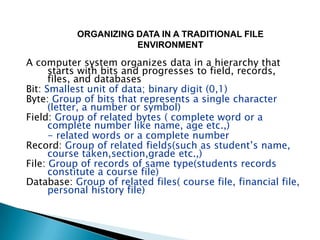
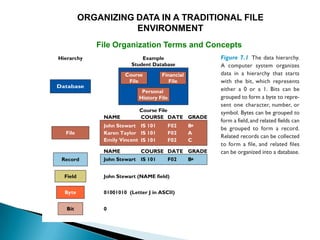
A computer system organizes data in a hierarchy that
      starts with bits and progresses to field, records,
      files, and databases
Bit: Smallest unit of data; binary digit (0,1)
Byte: Group of bits that represents a single character
      (letter, a number or symbol)
Field: Group of related bytes ( complete word or a
      complete number like name, age etc.,)
      - related words or a complete number
Record: Group of related fields(such as student’s name,
      course taken,section,grade etc.,)
File: Group of records of same type(students records
      constitute a course file)
Database: Group of related files( course file, financial file,
      personal history file)
ORGANIZING DATA IN A TRADITIONAL FILE
           ENVIRONMENT
   File Organization Terms and Concepts
ORGANIZING DATA IN A TRADITIONAL FILE
                    ENVIRONMENT
          File Organization Terms and Concepts

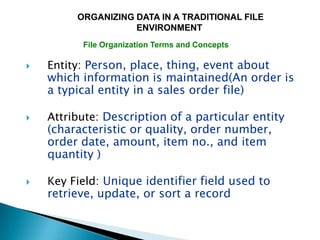
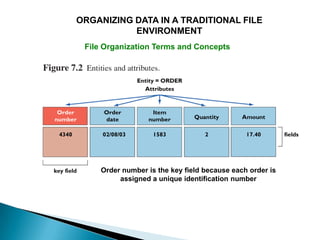
   Entity: Person, place, thing, event about
    which information is maintained(An order is
    a typical entity in a sales order file)

   Attribute: Description of a particular entity
    (characteristic or quality, order number,
    order date, amount, item no., and item
    quantity )

   Key Field: Unique identifier field used to
    retrieve, update, or sort a record
ORGANIZING DATA IN A TRADITIONAL FILE
                    ENVIRONMENT
            Problems with the Traditional File Environment

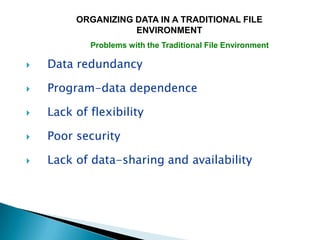
   Data redundancy

   Program-data dependence

   Lack of flexibility

   Poor security

   Lack of data-sharing and availability
ORGANIZING DATA IN A TRADITIONAL FILE
           ENVIRONMENT
  Problems with the Traditional File Environment
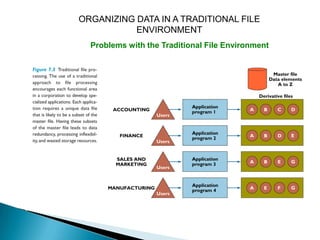
   Data Redundancy-It is the presence of duplicate data in
    multiple data files.
   Program Data Independence – it is the tight relationship
    between data stored in files and the specific programs
    required to update and maintain those files.

   Lack of Flexibility-A traditional file system can deliver
    routine scheduled reports after expensive programming
    efforts, but it cannot deliver ad hoc reports to respond to
    anticipated information requirements in a timely fashion.

   Poor security – Because there is little control of
    management of data, access to and dissemination of
    information may out of control

   Lack of data sharing and availability –It is not easy to
    obtain information because pieces of information in
    different files and different parts of the organisation
    cannot be related to one another, it is virtually impossible
    information to be shared or accessed in a timely manner.
ORGANIZING DATA IN A TRADITIONAL FILE
           ENVIRONMENT
 File Organization Terms and Concepts


     Order number is the key field because each order is
          assigned a unique identification number
THE DATABASE APPROACH TO DATA MANAGEMENT

            Database Management System (DBMS)

Database
• A collection of data organized to service many applications at
  the same time by storing and managing data so they appear
  to be at one location
• A collection of data organized to service many applications
  efficiently by centralising the data and minimising redundant
  data.
• A single data base service multiple applications
• Ex: Instead of a Corporation storing employee data in
  separate information systems and separate files for
  personnel, payroll and benefits , the Corpotation could create
  a single common human resources database
THE DATABASE APPROACH TO DATA MANAGEMENT


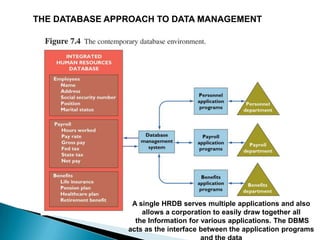
                 A single HRDB serves multiple applications and also
                    allows a corporation to easily draw together all
                  the Information for various applications. The DBMS
                acts as the interface between the application programs
THE DATABASE APPROACH TO DATA MANAGEMENT
             Database Management System (DBMS)
Database technology can cut through many of the problems a
  traditional file organization creates

DBMS is a special software to create and
 maintain a database and enable
 individual business applications to
 extract the data they need without
 having to create separate files or data
 definitions in their computer programs.
THE DATABASE APPROACH TO DATA MANAGEMENT
              Database Management System (DBMS)
Database technology can cut through many of the problems a
  traditional file organization creates
The Database Management System (DBMS) is simply a software
• which creates and maintains databases
• that permits an organisation to cdntralise data, manage them
  efficiently and provide access to the stored data by
  application programs.
• Eliminates most of the data definition statements found in
  traditional programs
• Acts as interface between application programs and physical
  data files
• Separates logical and physical views of data
THE DATABASE APPROACH TO DATA MANAGEMENT
              Database Management System (DBMS)
Database technology can cut through many of the problems a
  traditional file organization creates
The logical view presents data as they would be percieved by end
  users or business specialists whereas
Physical view shows how data are actually organised and
  structured on physical storage media
There is only one physical view of the data but different logical
  views. The DBMS software makes the physical database
  available for different logical views presented for various
  application programs
An employee retirement benefits program might use a logical
  view of the human resources data base that requires only the
  employees name, address, social security number, pension
  plan, and retirement benefits data.
7.2 THE DATABASE APPROACH TO DATA MANAGEMENT

           Database Management System (DBMS)

Components of a Database
• Data Definition Language:
  – Specifies content and structure of
    database and defines each data element
• Data Manipulation Language:
  – Manipulates data in a database
• Data Dictionary:
  – Stores definitions of data elements, and
    data characteristics
THE DATABASE APPROACH TO DATA
         MANAGEMENT

                 Types of Databases


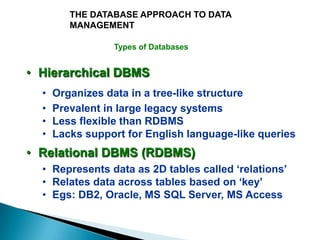
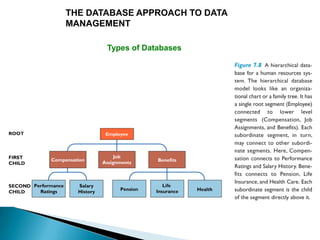
• Hierarchical DBMS
  •   Organizes data in a tree-like structure
  •   Prevalent in large legacy systems
  •   Less flexible than RDBMS
  •   Lacks support for English language-like queries
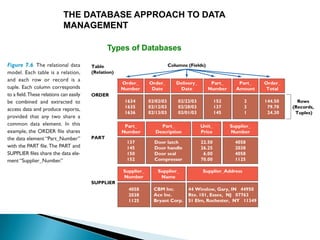
• Relational DBMS (RDBMS)
  • Represents data as 2D tables called ‘relations’
  • Relates data across tables based on ‘key’
  • Egs: DB2, Oracle, MS SQL Server, MS Access
THE DATABASE APPROACH TO DATA
MANAGEMENT

       Types of Databases
THE DATABASE APPROACH TO DATA
MANAGEMENT

       Types of Databases
THE DATABASE APPROACH TO DATA
     MANAGEMENT

             Types of Databases


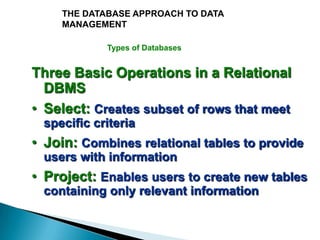
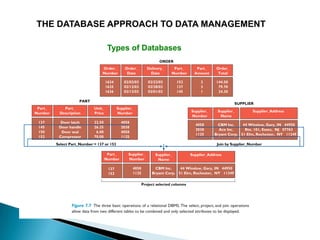
Three Basic Operations in a Relational
  DBMS
• Select: Creates subset of rows that meet
 specific criteria
• Join: Combines relational tables to provide
 users with information
• Project: Enables users to create new tables
 containing only relevant information
THE DATABASE APPROACH TO DATA MANAGEMENT

            Types of Databases
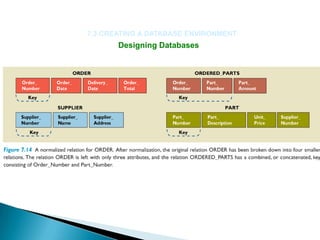
CREATING A DATABASE ENVIRONMENT


                   Designing Databases


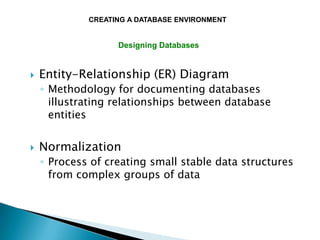
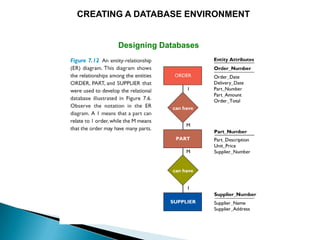
   Entity-Relationship (ER) Diagram
    ◦ Methodology for documenting databases
      illustrating relationships between database
      entities


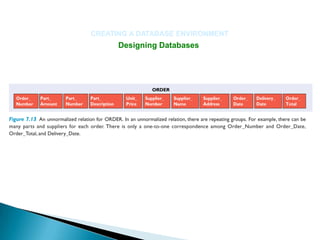
   Normalization
    ◦ Process of creating small stable data structures
      from complex groups of data
CREATING A DATABASE ENVIRONMENT


       Designing Databases
CREATING A DATABASE ENVIRONMENT
      Designing Databases
7.3 CREATING A DATABASE ENVIRONMENT
       Designing Databases
7.4 DATABASE TRENDS
             Multidimensional Data Analysis

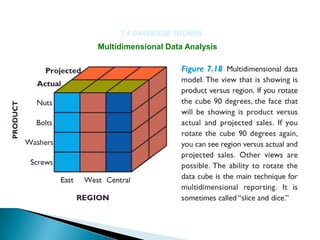
On-line Analytical Processing (OLAP)

   Multidimensional data analysis

   Supports manipulation and analysis of
    large volumes of data from multiple
    dimensions/perspectives
7.4 DATABASE TRENDS
Multidimensional Data Analysis
7.4 DATABASE TRENDS
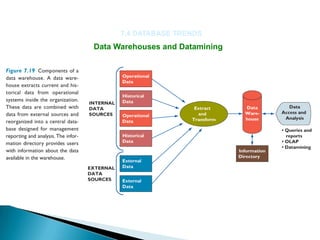
             Data Warehouses and Datamining

Data Warehouse
   Consolidates current and historical data
   Supports query tools for management
    decision making

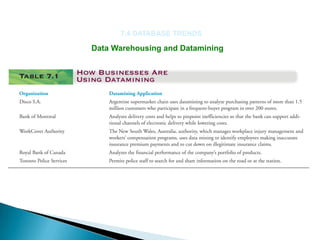
Datamining
   Tools for finding hidden patterns and
    relationships in large pools of data
7.4 DATABASE TRENDS
Data Warehouses and Datamining
7.4 DATABASE TRENDS

Data Warehousing and Datamining
7.4 DATABASE TRENDS

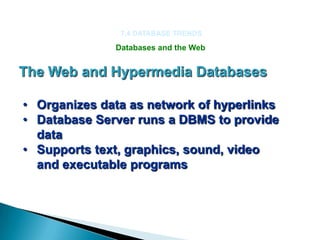
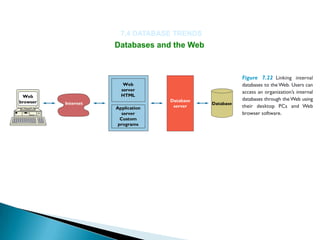
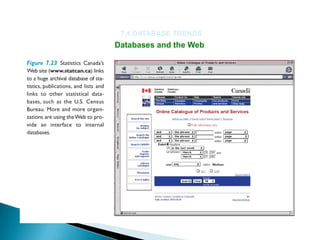
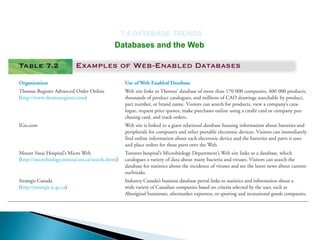
              Databases and the Web


The Web and Hypermedia Databases

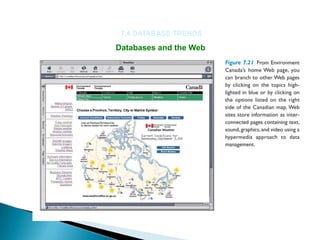
• Organizes data as network of hyperlinks
• Database Server runs a DBMS to provide
  data
• Supports text, graphics, sound, video
  and executable programs
7.4 DATABASE TRENDS

Databases and the Web
7.4 DATABASE TRENDS
Databases and the Web
7.4 DATABASE TRENDS
Databases and the Web
7.4 DATABASE TRENDS
Databases and the Web
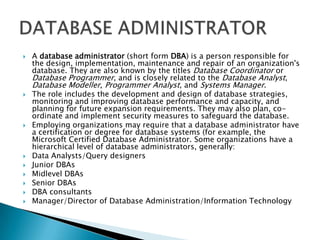
   A database administrator (short form DBA) is a person responsible for
    the design, implementation, maintenance and repair of an organization's
    database. They are also known by the titles Database Coordinator or
    Database Programmer, and is closely related to the Database Analyst,
    Database Modeller, Programmer Analyst, and Systems Manager.
   The role includes the development and design of database strategies,
    monitoring and improving database performance and capacity, and
    planning for future expansion requirements. They may also plan, co-
    ordinate and implement security measures to safeguard the database.
   Employing organizations may require that a database administrator have
    a certification or degree for database systems (for example, the
    Microsoft Certified Database Administrator. Some organizations have a
    hierarchical level of database administrators, generally:
   Data Analysts/Query designers
   Junior DBAs
   Midlevel DBAs
   Senior DBAs
   DBA consultants
   Manager/Director of Database Administration/Information Technology
SKILLS:
 Strong organizational skills
 Strong logical and analytical thinker
 Ability to concentrate and pay close attention to
  detail
 Ability to think broadly and consider impacts across
  systems and within the organization
DUTIES:
 Transferring Data
 Replicating Data
 Maintaining database and ensuring its availability to
  users
 Maintaining the data dictionary
 Controlling privileges and permissions to database
  users
 Monitoring database performance
 Database backup and recovery
 Database security Stop
   The Database Analyst's role is to direct, evaluate,
    review, and manage database resources and
    services across the organization while ensuring
    high levels of data quality. This individual is also
    responsible for developing, implementing, and
    overseeing database policies and procedures to
    ensure the integrity and availability of databases
    and their accompanying software. Where
    required, the Database Analyst will design,
    install, monitor, maintain, and performance tune
    production databases.
   Database design is the process of producing a detailed data model of a database. This logical
    data model contains all the needed logical and physical design choices and physical storage
    parameters needed to generate a design in a Data Definition Language, which can then be used
    to create a database. A fully attributed data model contains detailed attributes for each entity.
   The term database design can be used to describe many different parts of the design of an
    overall database system. Principally, and most correctly, it can be thought of as the logical
    design of the base data structures used to store the data. In the relational model these are the
    tables and views. In an object database the entities and relationships map directly to object
    classes and named relationships. However, the term database design could also be used to
    apply to the overall process of designing, not just the base data structures, but also the forms
    and queries used as part of the overall database application within the database management
    system (DBMS).[

   In a majority of cases, a person who is doing the design of a database is a person with
    expertise in the area of database design, rather than expertise in the domain from which the
    data to be stored is drawn e.g. financial information, biological information etc. Therefore the
    data to be stored in the database must be determined in cooperation with a person who does
    have expertise in that domain, and who is aware of what data must be stored within the
    system.
   This process is one which is generally considered part of requirements analysis, and requires
    skill on the part of the database designer to elicit the needed information from those with the
    domain knowledge. This is because those with the necessary domain knowledge frequently
    cannot express clearly what their system requirements for the database are as they are
    unaccustomed to thinking in terms of the discrete data elements which must be stored. Data to
    be stored can be determined by Requirement Specification.[

Dbms9

  • 1.
  • 2.
    OBJECTIVES  Why do businesses have trouble finding the information they need in their information systems?  How does a DBMS improve the organization of business information?  What are the managerial requirements of a data-base environment?  What new technologies make databases more accessible and useful?
  • 3.
    ORGANIZING DATA INA TRADITIONAL FILE ENVIRONMENT A computer system organizes data in a hierarchy that starts with bits and progresses to field, records, files, and databases Bit: Smallest unit of data; binary digit (0,1) Byte: Group of bits that represents a single character (letter, a number or symbol) Field: Group of related bytes ( complete word or a complete number like name, age etc.,) - related words or a complete number Record: Group of related fields(such as student’s name, course taken,section,grade etc.,) File: Group of records of same type(students records constitute a course file) Database: Group of related files( course file, financial file, personal history file)
  • 4.
    ORGANIZING DATA INA TRADITIONAL FILE ENVIRONMENT File Organization Terms and Concepts
  • 5.
    ORGANIZING DATA INA TRADITIONAL FILE ENVIRONMENT File Organization Terms and Concepts  Entity: Person, place, thing, event about which information is maintained(An order is a typical entity in a sales order file)  Attribute: Description of a particular entity (characteristic or quality, order number, order date, amount, item no., and item quantity )  Key Field: Unique identifier field used to retrieve, update, or sort a record
  • 6.
    ORGANIZING DATA INA TRADITIONAL FILE ENVIRONMENT Problems with the Traditional File Environment  Data redundancy  Program-data dependence  Lack of flexibility  Poor security  Lack of data-sharing and availability
  • 7.
    ORGANIZING DATA INA TRADITIONAL FILE ENVIRONMENT Problems with the Traditional File Environment
  • 8.
    Data Redundancy-It is the presence of duplicate data in multiple data files.  Program Data Independence – it is the tight relationship between data stored in files and the specific programs required to update and maintain those files.  Lack of Flexibility-A traditional file system can deliver routine scheduled reports after expensive programming efforts, but it cannot deliver ad hoc reports to respond to anticipated information requirements in a timely fashion.  Poor security – Because there is little control of management of data, access to and dissemination of information may out of control  Lack of data sharing and availability –It is not easy to obtain information because pieces of information in different files and different parts of the organisation cannot be related to one another, it is virtually impossible information to be shared or accessed in a timely manner.
  • 9.
    ORGANIZING DATA INA TRADITIONAL FILE ENVIRONMENT File Organization Terms and Concepts Order number is the key field because each order is assigned a unique identification number
  • 10.
    THE DATABASE APPROACHTO DATA MANAGEMENT Database Management System (DBMS) Database • A collection of data organized to service many applications at the same time by storing and managing data so they appear to be at one location • A collection of data organized to service many applications efficiently by centralising the data and minimising redundant data. • A single data base service multiple applications • Ex: Instead of a Corporation storing employee data in separate information systems and separate files for personnel, payroll and benefits , the Corpotation could create a single common human resources database
  • 11.
    THE DATABASE APPROACHTO DATA MANAGEMENT A single HRDB serves multiple applications and also allows a corporation to easily draw together all the Information for various applications. The DBMS acts as the interface between the application programs
  • 12.
    THE DATABASE APPROACHTO DATA MANAGEMENT Database Management System (DBMS) Database technology can cut through many of the problems a traditional file organization creates DBMS is a special software to create and maintain a database and enable individual business applications to extract the data they need without having to create separate files or data definitions in their computer programs.
  • 13.
    THE DATABASE APPROACHTO DATA MANAGEMENT Database Management System (DBMS) Database technology can cut through many of the problems a traditional file organization creates The Database Management System (DBMS) is simply a software • which creates and maintains databases • that permits an organisation to cdntralise data, manage them efficiently and provide access to the stored data by application programs. • Eliminates most of the data definition statements found in traditional programs • Acts as interface between application programs and physical data files • Separates logical and physical views of data
  • 14.
    THE DATABASE APPROACHTO DATA MANAGEMENT Database Management System (DBMS) Database technology can cut through many of the problems a traditional file organization creates The logical view presents data as they would be percieved by end users or business specialists whereas Physical view shows how data are actually organised and structured on physical storage media There is only one physical view of the data but different logical views. The DBMS software makes the physical database available for different logical views presented for various application programs An employee retirement benefits program might use a logical view of the human resources data base that requires only the employees name, address, social security number, pension plan, and retirement benefits data.
  • 15.
    7.2 THE DATABASEAPPROACH TO DATA MANAGEMENT Database Management System (DBMS) Components of a Database • Data Definition Language: – Specifies content and structure of database and defines each data element • Data Manipulation Language: – Manipulates data in a database • Data Dictionary: – Stores definitions of data elements, and data characteristics
  • 16.
    THE DATABASE APPROACHTO DATA MANAGEMENT Types of Databases • Hierarchical DBMS • Organizes data in a tree-like structure • Prevalent in large legacy systems • Less flexible than RDBMS • Lacks support for English language-like queries • Relational DBMS (RDBMS) • Represents data as 2D tables called ‘relations’ • Relates data across tables based on ‘key’ • Egs: DB2, Oracle, MS SQL Server, MS Access
  • 17.
    THE DATABASE APPROACHTO DATA MANAGEMENT Types of Databases
  • 18.
    THE DATABASE APPROACHTO DATA MANAGEMENT Types of Databases
  • 19.
    THE DATABASE APPROACHTO DATA MANAGEMENT Types of Databases Three Basic Operations in a Relational DBMS • Select: Creates subset of rows that meet specific criteria • Join: Combines relational tables to provide users with information • Project: Enables users to create new tables containing only relevant information
  • 20.
    THE DATABASE APPROACHTO DATA MANAGEMENT Types of Databases
  • 21.
    CREATING A DATABASEENVIRONMENT Designing Databases  Entity-Relationship (ER) Diagram ◦ Methodology for documenting databases illustrating relationships between database entities  Normalization ◦ Process of creating small stable data structures from complex groups of data
  • 22.
    CREATING A DATABASEENVIRONMENT Designing Databases
  • 23.
    CREATING A DATABASEENVIRONMENT Designing Databases
  • 24.
    7.3 CREATING ADATABASE ENVIRONMENT Designing Databases
  • 25.
    7.4 DATABASE TRENDS Multidimensional Data Analysis On-line Analytical Processing (OLAP)  Multidimensional data analysis  Supports manipulation and analysis of large volumes of data from multiple dimensions/perspectives
  • 26.
  • 27.
    7.4 DATABASE TRENDS Data Warehouses and Datamining Data Warehouse  Consolidates current and historical data  Supports query tools for management decision making Datamining  Tools for finding hidden patterns and relationships in large pools of data
  • 28.
    7.4 DATABASE TRENDS DataWarehouses and Datamining
  • 29.
    7.4 DATABASE TRENDS DataWarehousing and Datamining
  • 30.
    7.4 DATABASE TRENDS Databases and the Web The Web and Hypermedia Databases • Organizes data as network of hyperlinks • Database Server runs a DBMS to provide data • Supports text, graphics, sound, video and executable programs
  • 31.
  • 32.
  • 33.
  • 34.
  • 35.
    A database administrator (short form DBA) is a person responsible for the design, implementation, maintenance and repair of an organization's database. They are also known by the titles Database Coordinator or Database Programmer, and is closely related to the Database Analyst, Database Modeller, Programmer Analyst, and Systems Manager.  The role includes the development and design of database strategies, monitoring and improving database performance and capacity, and planning for future expansion requirements. They may also plan, co- ordinate and implement security measures to safeguard the database.  Employing organizations may require that a database administrator have a certification or degree for database systems (for example, the Microsoft Certified Database Administrator. Some organizations have a hierarchical level of database administrators, generally:  Data Analysts/Query designers  Junior DBAs  Midlevel DBAs  Senior DBAs  DBA consultants  Manager/Director of Database Administration/Information Technology
  • 36.
    SKILLS:  Strong organizationalskills  Strong logical and analytical thinker  Ability to concentrate and pay close attention to detail  Ability to think broadly and consider impacts across systems and within the organization DUTIES:  Transferring Data  Replicating Data  Maintaining database and ensuring its availability to users  Maintaining the data dictionary  Controlling privileges and permissions to database users  Monitoring database performance  Database backup and recovery  Database security Stop
  • 37.
    The Database Analyst's role is to direct, evaluate, review, and manage database resources and services across the organization while ensuring high levels of data quality. This individual is also responsible for developing, implementing, and overseeing database policies and procedures to ensure the integrity and availability of databases and their accompanying software. Where required, the Database Analyst will design, install, monitor, maintain, and performance tune production databases.
  • 38.
    Database design is the process of producing a detailed data model of a database. This logical data model contains all the needed logical and physical design choices and physical storage parameters needed to generate a design in a Data Definition Language, which can then be used to create a database. A fully attributed data model contains detailed attributes for each entity.  The term database design can be used to describe many different parts of the design of an overall database system. Principally, and most correctly, it can be thought of as the logical design of the base data structures used to store the data. In the relational model these are the tables and views. In an object database the entities and relationships map directly to object classes and named relationships. However, the term database design could also be used to apply to the overall process of designing, not just the base data structures, but also the forms and queries used as part of the overall database application within the database management system (DBMS).[  In a majority of cases, a person who is doing the design of a database is a person with expertise in the area of database design, rather than expertise in the domain from which the data to be stored is drawn e.g. financial information, biological information etc. Therefore the data to be stored in the database must be determined in cooperation with a person who does have expertise in that domain, and who is aware of what data must be stored within the system.  This process is one which is generally considered part of requirements analysis, and requires skill on the part of the database designer to elicit the needed information from those with the domain knowledge. This is because those with the necessary domain knowledge frequently cannot express clearly what their system requirements for the database are as they are unaccustomed to thinking in terms of the discrete data elements which must be stored. Data to be stored can be determined by Requirement Specification.[