Management Information Systems 
BCO-216 
Fall 2014 
(Infrastructure and Cloud Computing) 
Raymond Gao, MBA
Agenda 
• (1st half) 
– History of Technology & famous principles 
– What is IT Infrastructure? 
• (2nd half) 
– Cloud Computing 
– Case Study: Facebook
• IT infrastructure: 
IT Infrastructure 
– Set of physical devices and software required to operate enterprise 
– Set of firm-wide services including: 
• Computing platforms providing computing services 
• Telecommunications services 
• Data management services 
• Application software services 
• Physical facilities management services 
• IT management, education, and other services 
– “Service platform” perspective 
• More accurate view of value of investments
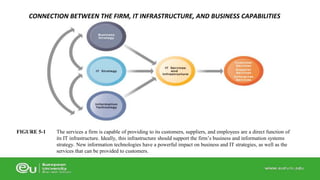
CONNECTION BETWEEN THE FIRM, IT INFRASTRUCTURE, AND BUSINESS CAPABILITIES 
The services a firm is capable of providing to its customers, suppliers, and employees are a direct function of 
its IT infrastructure. Ideally, this infrastructure should support the firm’s business and information systems 
strategy. New information technologies have a powerful impact on business and IT strategies, as well as the 
services that can be provided to customers. 
FIGURE 5-1
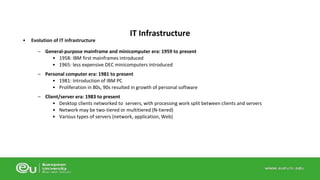
• Evolution of IT infrastructure 
IT Infrastructure 
– General-purpose mainframe and minicomputer era: 1959 to present 
• 1958: IBM first mainframes introduced 
• 1965: less expensive DEC minicomputers introduced 
– Personal computer era: 1981 to present 
• 1981: Introduction of IBM PC 
• Proliferation in 80s, 90s resulted in growth of personal software 
– Client/server era: 1983 to present 
• Desktop clients networked to servers, with processing work split between clients and servers 
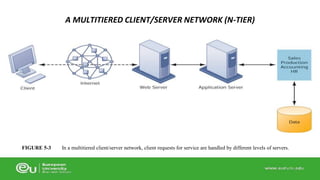
• Network may be two-tiered or multitiered (N-tiered) 
• Various types of servers (network, application, Web)
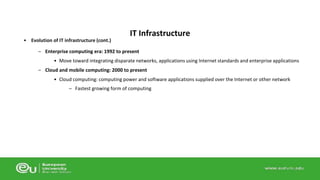
• Evolution of IT infrastructure (cont.) 
IT Infrastructure 
– Enterprise computing era: 1992 to present 
• Move toward integrating disparate networks, applications using Internet standards and enterprise applications 
– Cloud and mobile computing: 2000 to present 
• Cloud computing: computing power and software applications supplied over the Internet or other network 
– Fastest growing form of computing
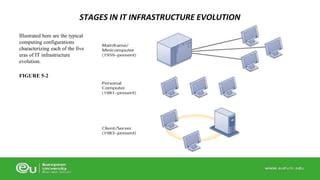
Illustrated here are the typical 
computing configurations 
characterizing each of the five 
eras of IT infrastructure 
evolution. 
FIGURE 5-2 
STAGES IN IT INFRASTRUCTURE EVOLUTION
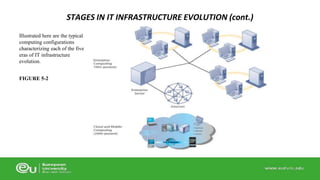
Illustrated here are the typical 
computing configurations 
characterizing each of the five 
eras of IT infrastructure 
evolution. 
FIGURE 5-2 
STAGES IN IT INFRASTRUCTURE EVOLUTION (cont.)
A MULTITIERED CLIENT/SERVER NETWORK (N-TIER) 
In a multitiered client/server network, client requests for service FIGURE 5-3 are handled by different levels of servers.
IT Infrastructure 
• Technology drivers of infrastructure evolution 
– Moore’s law and microprocessing power * 
• Computing power doubles every 18 months 
– Law of Mass Digital Storage 
• The amount of data being stored each year doubles 
Who is Gordon Moore?* 
The Co-Founder of Intel 
http://en.wikipedia.org/wiki/Gordon_Moore
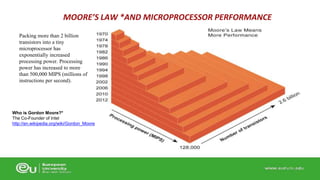
MOORE’S LAW *AND MICROPROCESSOR PERFORMANCE 
Packing more than 2 billion 
transistors into a tiny 
microprocessor has 
exponentially increased 
processing power. Processing 
power has increased to more 
than 500,000 MIPS (millions of 
instructions per second). 
Who is Gordon Moore?* 
The Co-Founder of Intel 
http://en.wikipedia.org/wiki/Gordon_Moore
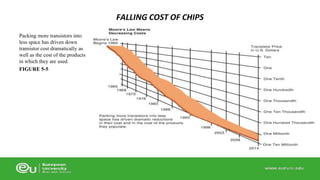
Packing more transistors into 
less space has driven down 
transistor cost dramatically as 
well as the cost of the products 
in which they are used. 
FIGURE 5-5 
FALLING COST OF CHIPS
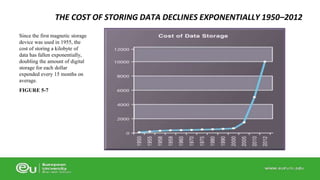
Since the first magnetic storage 
device was used in 1955, the 
cost of storing a kilobyte of 
data has fallen exponentially, 
doubling the amount of digital 
storage for each dollar 
expended every 15 months on 
average. 
FIGURE 5-7 
THE COST OF STORING DATA DECLINES EXPONENTIALLY 1950–2012
IT Infrastructure 
• Technology drivers of infrastructure evolution (cont.) 
– Metcalfe’s Law and network economics* 
Value or power of a network grows exponentially as a function of the number of network members 
As network members increase, more people want to use it (demand for network access increases) 
• Who is Robert Metcalfe? The guy invented Ethernet & Founder of 3COM 
http://en.wikipedia.org/wiki/Robert_Metcalfe
IT Infrastructure 
• Technology drivers of infrastructure evolution (cont.) 
– Declining communication costs and the Internet 
• An estimated 2.3 billion people worldwide have Internet access 
• As communication costs fall toward a very small number and approach 0, utilization of communication and 
computing facilities explodes
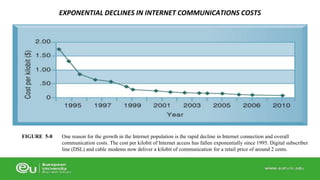
One reason for the growth in the Internet population is the rapid decline in Internet connection and overall 
communication costs. The cost per kilobit of Internet access has fallen exponentially since 1995. Digital subscriber 
line (DSL) and cable modems now deliver a kilobit of communication for a retail price of around 2 cents. 
FIGURE 5-8 
EXPONENTIAL DECLINES IN INTERNET COMMUNICATIONS COSTS
IT Infrastructure 
• Technology drivers of infrastructure evolution (cont.) 
– Standards and network effects 
• Technology standards: 
– Specifications that establish the compatibility of products and the ability to communicate in a network 
– Unleash powerful economies of scale and result in price declines as manufacturers focus on the 
products built to a single standard
Infrastructure Components 
• IT Infrastructure has seven main components 
1. Computer hardware platforms 
2. Operating system platforms 
3. Enterprise software applications 
4. Data management and storage 
5. Networking/telecommunications platforms 
6. Internet platforms 
7. Consulting system integration services
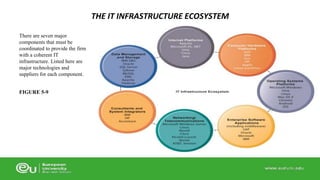
There are seven major 
components that must be 
coordinated to provide the firm 
with a coherent IT 
infrastructure. Listed here are 
major technologies and 
suppliers for each component. 
FIGURE 5-9 
THE IT INFRASTRUCTURE ECOSYSTEM
• Computer hardware platforms 
– Client machines 
Infrastructure Components 
• Desktop PCs, mobile devices—PDAs, laptops 
– Servers 
• Blade servers: ultrathin computers stored in racks 
– Mainframes: 
• IBM mainframe equivalent to thousands of blade servers 
– Top chip producers: AMD, Intel, IBM 
– Top firms: IBM, HP, Dell, Sun Microsystems
• Operating system platforms 
– Operating systems 
Infrastructure Components 
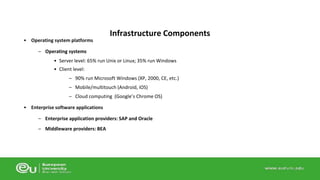
• Server level: 65% run Unix or Linux; 35% run Windows 
• Client level: 
– 90% run Microsoft Windows (XP, 2000, CE, etc.) 
– Mobile/multitouch (Android, iOS) 
– Cloud computing (Google’s Chrome OS) 
• Enterprise software applications 
– Enterprise application providers: SAP and Oracle 
– Middleware providers: BEA
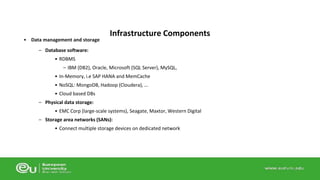
• Data management and storage 
– Database software: 
• RDBMS 
Infrastructure Components 
– IBM (DB2), Oracle, Microsoft (SQL Server), MySQL, 
• In-Memory, i.e SAP HANA and MemCache 
• NoSQL: MongoDB, Hadoop (Cloudera), ... 
• Cloud based DBs 
– Physical data storage: 
• EMC Corp (large-scale systems), Seagate, Maxtor, Western Digital 
– Storage area networks (SANs): 
• Connect multiple storage devices on dedicated network
Infrastructure Components 
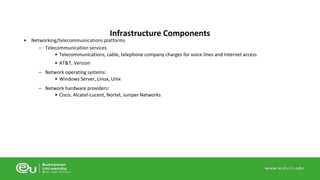
• Networking/telecommunications platforms 
– Telecommunication services 
• Telecommunications, cable, telephone company charges for voice lines and Internet access 
• AT&T, Verizon 
– Network operating systems: 
• Windows Server, Linux, Unix 
– Network hardware providers: 
• Cisco, Alcatel-Lucent, Nortel, Juniper Networks
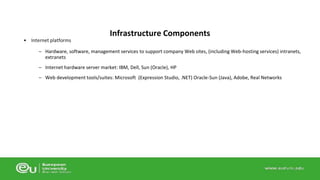
• Internet platforms 
Infrastructure Components 
– Hardware, software, management services to support company Web sites, (including Web-hosting services) intranets, 
extranets 
– Internet hardware server market: IBM, Dell, Sun (Oracle), HP 
– Web development tools/suites: Microsoft (Expression Studio, .NET) Oracle-Sun (Java), Adobe, Real Networks
Infrastructure Components 
• Consulting and system integration services 
– Even large firms do not have resources for full range of support for new, complex infrastructure 
– Software integration: ensuring new infrastructure works with legacy systems 
– Legacy systems: older TPS created for mainframes that would be too costly to replace or redesign 
– Accenture, IBM Global Services, EDS, Infosys, Wipro
• Grid computing 
Contemporary Hardware Platform Trends 
– Connects geographically remote computers into a single network to combine processing power and create virtual 
supercomputer 
– Provides cost savings, speed, agility 
• Virtualization 
– Allows single physical resource to act as multiple resources (i.e., run multiple instances of OS) 
– Reduces hardware and power expenditures 
– Facilitates hardware centralization
Contemporary Software Platform Trends 
• Software outsourcing and cloud services 
– Three external sources for software: 
• Software packages and enterprise software 
• Software outsourcing 
– Contracting outside firms to develop software 
• Cloud-based software services 
– Software as a service (SaaS) 
– Accessed with Web browser over Internet 
– Service Level Agreements (SLAs): formal agreement with service providers
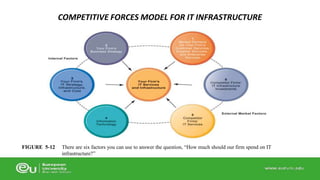
There are six factors you can use to answer the question, “How much should our firm spend on IT 
infrastructure?” 
FIGURE 5-12 
COMPETITIVE FORCES MODEL FOR IT INFRASTRUCTURE
2nd Half 
Cloud Computing
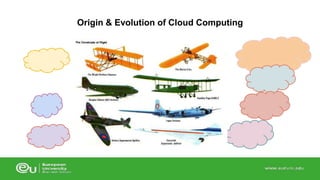
Origin & Evolution of Cloud Computing
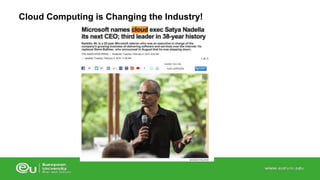
Cloud Computing is Changing the Industry!
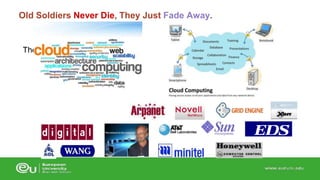
Old Soldiers Never Die, They Just Fade Away. 
The seed was sown ...
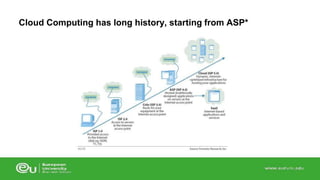
Cloud Computing has long history, starting from ASP*
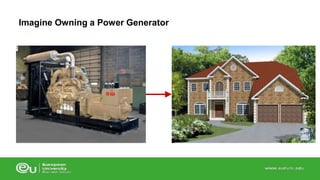
Imagine Owning a Power Generator
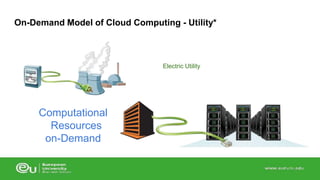
On-Demand Model of Cloud Computing - Utility* 
Computational 
Resources 
on-Demand 
Electric Utility
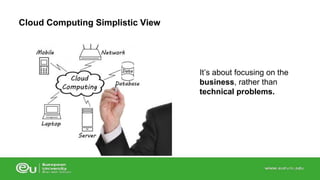
Cloud Computing Simplistic View 
It’s about focusing on the 
business, rather than 
technical problems.
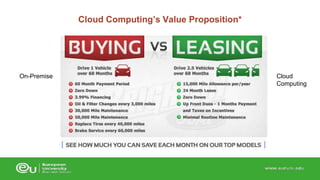
Cloud Computing’s Value Proposition* 
On-Premise Cloud 
Computing
Benefits of Cloud Computing* 
• Financial Incentives 
– OpEx Vs. CapEx 
– TCO (Design + Development + Maintenance Costs) 
• Speed 
– Agility - Go Faster from Concept to Product 
– More Iterations == Comprehensive Coverage of Problem / Visibility 
• Reliability 
– Fewer Downtimes 
– Smooth Recovery and Disaster Prevention Guardians 
• Efficiency 
– Focus on primary business processes instead of technical problems 
– Training & Flatter Learning Curve
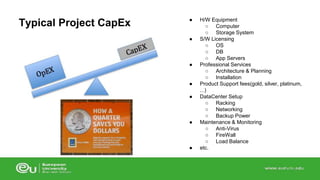
Typical Project CapEx ● H/W Equipment 
○ Computer 
○ Storage System 
● S/W Licensing 
○ OS 
○ DB 
○ App Servers 
● Professional Services 
○ Architecture & Planning 
○ Installation 
● Product Support fees(gold, silver, platinum, 
...) 
● DataCenter Setup 
○ Racking 
○ Networking 
○ Backup Power 
● Maintenance & Monitoring 
○ Anti-Virus 
○ FireWall 
○ Load Balance 
● etc.
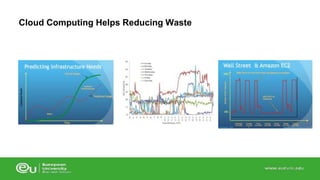
Cloud Computing Helps Reducing Waste
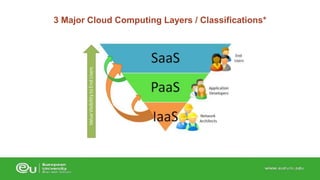
3 Major Cloud Computing Layers / Classifications*
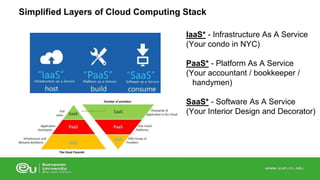
Simplified Layers of Cloud Computing Stack 
IaaS* - Infrastructure As A Service 
(Your condo in NYC) 
PaaS* - Platform As A Service 
(Your accountant / bookkeeper / 
handymen) 
SaaS* - Software As A Service 
(Your Interior Design and Decorator)
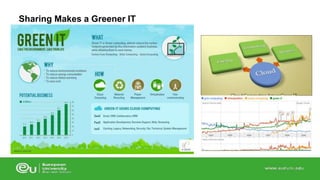
Sharing Makes a Greener IT
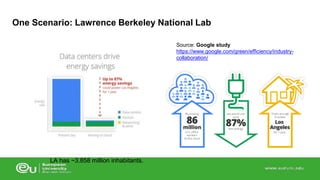
One Scenario: Lawrence Berkeley National Lab 
Source: Google study 
https://www.google.com/green/efficiency/industry-collaboration/ 
LA has ~3.858 million inhabitants.
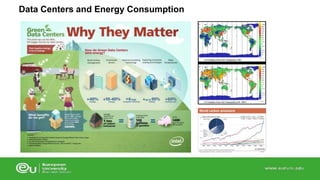
Data Centers and Energy Consumption
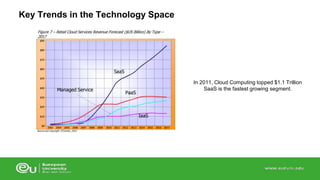
Key Trends in the Technology Space 
In 2011, Cloud Computing topped $1.1 Trillion 
SaaS is the fastest growing segment.
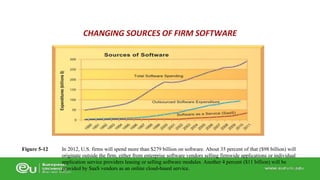
In 2012, U.S. firms will spend more than $279 billion on software. About 35 percent of that ($98 billion) will 
originate outside the firm, either from enterprise software vendors selling firmwide applications or individual 
application service providers leasing or selling software modules. Another 4 percent ($11 billion) will be 
provided by SaaS vendors as an online cloud-based service. 
Figure 5-12 
CHANGING SOURCES OF FIRM SOFTWARE
Management Issues 
• Dealing with platform and infrastructure change 
– As firms shrink or grow, IT needs to be flexible and scalable 
– Scalability: 
• Ability to expand to serve larger number of users 
– For mobile computing and cloud computing 
• New policies and procedures for managing these new platforms 
• Contractual agreements with firms running clouds and distributing software required
• Management and governance 
Management Issues 
– Who controls IT infrastructure? 
– How should IT department be organized? 
• Centralized 
– Central IT department makes decisions 
• Decentralized 
– Business unit IT departments make own decisions 
– How are costs allocated between divisions, departments?
• Making wise infrastructure investments 
Management Issues 
– Amount to spend on IT is complex question 
• Rent vs. buy, cloud computing 
• Outsourcing 
– Total cost of ownership (TCO) model 
• Analyzes direct and indirect costs 
• Hardware, software account for only about 20% of TCO 
• Other costs: Installation, training, support, maintenance, infrastructure, downtime, space, and energy 
– TCO can be reduced 
• Use of cloud services, greater centralization and standardization of hardware and software resources
Management Issues 
• Competitive forces model for IT infrastructure investment 
1. Market demand for firm’s services 
2. Firm’s business strategy 
3. Firm’s IT strategy, infrastructure, and cost 
4. Information technology assessment 
5. Competitor firm services 
6. Competitor firm IT infrastructure investments
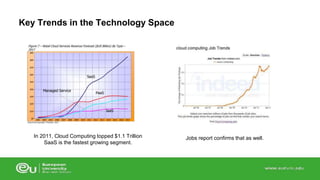
Key Trends in the Technology Space 
In 2011, Cloud Computing topped $1.1 Trillion 
SaaS is the fastest growing segment. 
Jobs report confirms that as well.
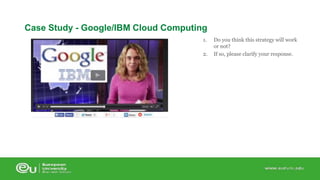
Case Study - Google/IBM Cloud Computing 
1. Do you think this strategy will work 
or not? 
2. If so, please clarify your response.
THANK YOU! 
email: raymond.gao@euruni.edu 
Twitter: @raygao
Miscellaneous
• Open-source software: 
Contemporary Software Platform Trends 
– Produced by community of programmers 
– Free and modifiable by user 
– Examples: Apache web server, Mozilla Firefox browser, OpenOffice 
• Linux 
– Open-source OS 
– Used in mobile devices, local area networks, Web servers, high-performance computing
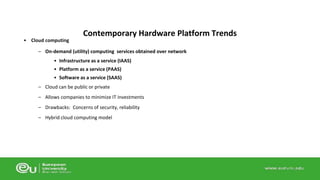
• Cloud computing 
Contemporary Hardware Platform Trends 
– On-demand (utility) computing services obtained over network 
• Infrastructure as a service (IAAS) 
• Platform as a service (PAAS) 
• Software as a service (SAAS) 
– Cloud can be public or private 
– Allows companies to minimize IT investments 
– Drawbacks: Concerns of security, reliability 
– Hybrid cloud computing model
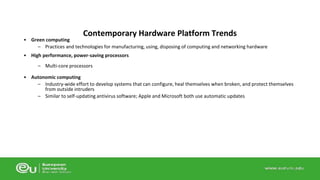
• Green computing 
Contemporary Hardware Platform Trends 
– Practices and technologies for manufacturing, using, disposing of computing and networking hardware 
• High performance, power-saving processors 
– Multi-core processors 
• Autonomic computing 
– Industry-wide effort to develop systems that can configure, heal themselves when broken, and protect themselves 
from outside intruders 
– Similar to self-updating antivirus software; Apple and Microsoft both use automatic updates
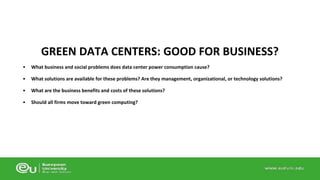
GREEN DATA CENTERS: GOOD FOR BUSINESS? 
• What business and social problems does data center power consumption cause? 
• What solutions are available for these problems? Are they management, organizational, or technology solutions? 
• What are the business benefits and costs of these solutions? 
• Should all firms move toward green computing?
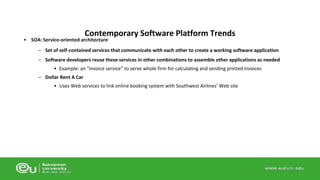
Contemporary Software Platform Trends 
• SOA: Service-oriented architecture 
– Set of self-contained services that communicate with each other to create a working software application 
– Software developers reuse these services in other combinations to assemble other applications as needed 
• Example: an “invoice service” to serve whole firm for calculating and sending printed invoices 
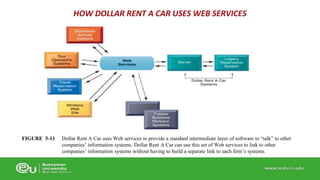
– Dollar Rent A Car 
• Uses Web services to link online booking system with Southwest Airlines’ Web site
• Software for the Web 
– Java: 
Contemporary Software Platform Trends 
• Object-oriented programming language 
• Operating system, processor-independent 
– HTML/HTML5 
• Web page description language 
• Specifies how text, graphics are placed on Web page 
• HTML5 is latest evolution 
– Includes animation and video processing functionality previously provided by third party add-ons such 
as Flash
• Web Services 
Contemporary Software Platform Trends 
– Software components that exchange information using Web standards and languages 
– XML: Extensible Markup Language 
• More powerful and flexible than HTML 
• Tagging allows computers to process data automatically
Dollar Rent A Car uses Web services to provide a standard intermediate layer of software to “talk” to other 
companies’ information systems. Dollar Rent A Car can use this set of Web services to link to other 
companies’ information systems without having to build a separate link to each firm’s systems. 
FIGURE 5-11 
HOW DOLLAR RENT A CAR USES WEB SERVICES
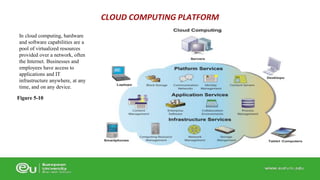
In cloud computing, hardware 
and software capabilities are a 
pool of virtualized resources 
provided over a network, often 
the Internet. Businesses and 
employees have access to 
applications and IT 
infrastructure anywhere, at any 
time, and on any device. 
Figure 5-10 
CLOUD COMPUTING PLATFORM
Contemporary Software Platform Trends 
• Software outsourcing and cloud services (cont.) 
– Mashups 
• Combinations of two or more online applications, such as combining mapping software (Google Maps) with 
local content 
– Apps 
• Small pieces of software that run on the Internet, on your computer, or on your cell phone 
– iPhone, Android 
• Generally delivered over the Internet

5 - Infrastructure and Cloud Computing

  • 1.
    Management Information Systems BCO-216 Fall 2014 (Infrastructure and Cloud Computing) Raymond Gao, MBA
  • 2.
    Agenda • (1sthalf) – History of Technology & famous principles – What is IT Infrastructure? • (2nd half) – Cloud Computing – Case Study: Facebook
  • 3.
    • IT infrastructure: IT Infrastructure – Set of physical devices and software required to operate enterprise – Set of firm-wide services including: • Computing platforms providing computing services • Telecommunications services • Data management services • Application software services • Physical facilities management services • IT management, education, and other services – “Service platform” perspective • More accurate view of value of investments
  • 4.
    CONNECTION BETWEEN THEFIRM, IT INFRASTRUCTURE, AND BUSINESS CAPABILITIES The services a firm is capable of providing to its customers, suppliers, and employees are a direct function of its IT infrastructure. Ideally, this infrastructure should support the firm’s business and information systems strategy. New information technologies have a powerful impact on business and IT strategies, as well as the services that can be provided to customers. FIGURE 5-1
  • 5.
    • Evolution ofIT infrastructure IT Infrastructure – General-purpose mainframe and minicomputer era: 1959 to present • 1958: IBM first mainframes introduced • 1965: less expensive DEC minicomputers introduced – Personal computer era: 1981 to present • 1981: Introduction of IBM PC • Proliferation in 80s, 90s resulted in growth of personal software – Client/server era: 1983 to present • Desktop clients networked to servers, with processing work split between clients and servers • Network may be two-tiered or multitiered (N-tiered) • Various types of servers (network, application, Web)
  • 6.
    • Evolution ofIT infrastructure (cont.) IT Infrastructure – Enterprise computing era: 1992 to present • Move toward integrating disparate networks, applications using Internet standards and enterprise applications – Cloud and mobile computing: 2000 to present • Cloud computing: computing power and software applications supplied over the Internet or other network – Fastest growing form of computing
  • 7.
    Illustrated here arethe typical computing configurations characterizing each of the five eras of IT infrastructure evolution. FIGURE 5-2 STAGES IN IT INFRASTRUCTURE EVOLUTION
  • 8.
    Illustrated here arethe typical computing configurations characterizing each of the five eras of IT infrastructure evolution. FIGURE 5-2 STAGES IN IT INFRASTRUCTURE EVOLUTION (cont.)
  • 9.
    A MULTITIERED CLIENT/SERVERNETWORK (N-TIER) In a multitiered client/server network, client requests for service FIGURE 5-3 are handled by different levels of servers.
  • 10.
    IT Infrastructure •Technology drivers of infrastructure evolution – Moore’s law and microprocessing power * • Computing power doubles every 18 months – Law of Mass Digital Storage • The amount of data being stored each year doubles Who is Gordon Moore?* The Co-Founder of Intel http://en.wikipedia.org/wiki/Gordon_Moore
  • 11.
    MOORE’S LAW *ANDMICROPROCESSOR PERFORMANCE Packing more than 2 billion transistors into a tiny microprocessor has exponentially increased processing power. Processing power has increased to more than 500,000 MIPS (millions of instructions per second). Who is Gordon Moore?* The Co-Founder of Intel http://en.wikipedia.org/wiki/Gordon_Moore
  • 12.
    Packing more transistorsinto less space has driven down transistor cost dramatically as well as the cost of the products in which they are used. FIGURE 5-5 FALLING COST OF CHIPS
  • 13.
    Since the firstmagnetic storage device was used in 1955, the cost of storing a kilobyte of data has fallen exponentially, doubling the amount of digital storage for each dollar expended every 15 months on average. FIGURE 5-7 THE COST OF STORING DATA DECLINES EXPONENTIALLY 1950–2012
  • 14.
    IT Infrastructure •Technology drivers of infrastructure evolution (cont.) – Metcalfe’s Law and network economics* Value or power of a network grows exponentially as a function of the number of network members As network members increase, more people want to use it (demand for network access increases) • Who is Robert Metcalfe? The guy invented Ethernet & Founder of 3COM http://en.wikipedia.org/wiki/Robert_Metcalfe
  • 15.
    IT Infrastructure •Technology drivers of infrastructure evolution (cont.) – Declining communication costs and the Internet • An estimated 2.3 billion people worldwide have Internet access • As communication costs fall toward a very small number and approach 0, utilization of communication and computing facilities explodes
  • 16.
    One reason forthe growth in the Internet population is the rapid decline in Internet connection and overall communication costs. The cost per kilobit of Internet access has fallen exponentially since 1995. Digital subscriber line (DSL) and cable modems now deliver a kilobit of communication for a retail price of around 2 cents. FIGURE 5-8 EXPONENTIAL DECLINES IN INTERNET COMMUNICATIONS COSTS
  • 17.
    IT Infrastructure •Technology drivers of infrastructure evolution (cont.) – Standards and network effects • Technology standards: – Specifications that establish the compatibility of products and the ability to communicate in a network – Unleash powerful economies of scale and result in price declines as manufacturers focus on the products built to a single standard
  • 18.
    Infrastructure Components •IT Infrastructure has seven main components 1. Computer hardware platforms 2. Operating system platforms 3. Enterprise software applications 4. Data management and storage 5. Networking/telecommunications platforms 6. Internet platforms 7. Consulting system integration services
  • 19.
    There are sevenmajor components that must be coordinated to provide the firm with a coherent IT infrastructure. Listed here are major technologies and suppliers for each component. FIGURE 5-9 THE IT INFRASTRUCTURE ECOSYSTEM
  • 20.
    • Computer hardwareplatforms – Client machines Infrastructure Components • Desktop PCs, mobile devices—PDAs, laptops – Servers • Blade servers: ultrathin computers stored in racks – Mainframes: • IBM mainframe equivalent to thousands of blade servers – Top chip producers: AMD, Intel, IBM – Top firms: IBM, HP, Dell, Sun Microsystems
  • 21.
    • Operating systemplatforms – Operating systems Infrastructure Components • Server level: 65% run Unix or Linux; 35% run Windows • Client level: – 90% run Microsoft Windows (XP, 2000, CE, etc.) – Mobile/multitouch (Android, iOS) – Cloud computing (Google’s Chrome OS) • Enterprise software applications – Enterprise application providers: SAP and Oracle – Middleware providers: BEA
  • 22.
    • Data managementand storage – Database software: • RDBMS Infrastructure Components – IBM (DB2), Oracle, Microsoft (SQL Server), MySQL, • In-Memory, i.e SAP HANA and MemCache • NoSQL: MongoDB, Hadoop (Cloudera), ... • Cloud based DBs – Physical data storage: • EMC Corp (large-scale systems), Seagate, Maxtor, Western Digital – Storage area networks (SANs): • Connect multiple storage devices on dedicated network
  • 23.
    Infrastructure Components •Networking/telecommunications platforms – Telecommunication services • Telecommunications, cable, telephone company charges for voice lines and Internet access • AT&T, Verizon – Network operating systems: • Windows Server, Linux, Unix – Network hardware providers: • Cisco, Alcatel-Lucent, Nortel, Juniper Networks
  • 24.
    • Internet platforms Infrastructure Components – Hardware, software, management services to support company Web sites, (including Web-hosting services) intranets, extranets – Internet hardware server market: IBM, Dell, Sun (Oracle), HP – Web development tools/suites: Microsoft (Expression Studio, .NET) Oracle-Sun (Java), Adobe, Real Networks
  • 25.
    Infrastructure Components •Consulting and system integration services – Even large firms do not have resources for full range of support for new, complex infrastructure – Software integration: ensuring new infrastructure works with legacy systems – Legacy systems: older TPS created for mainframes that would be too costly to replace or redesign – Accenture, IBM Global Services, EDS, Infosys, Wipro
  • 26.
    • Grid computing Contemporary Hardware Platform Trends – Connects geographically remote computers into a single network to combine processing power and create virtual supercomputer – Provides cost savings, speed, agility • Virtualization – Allows single physical resource to act as multiple resources (i.e., run multiple instances of OS) – Reduces hardware and power expenditures – Facilitates hardware centralization
  • 27.
    Contemporary Software PlatformTrends • Software outsourcing and cloud services – Three external sources for software: • Software packages and enterprise software • Software outsourcing – Contracting outside firms to develop software • Cloud-based software services – Software as a service (SaaS) – Accessed with Web browser over Internet – Service Level Agreements (SLAs): formal agreement with service providers
  • 28.
    There are sixfactors you can use to answer the question, “How much should our firm spend on IT infrastructure?” FIGURE 5-12 COMPETITIVE FORCES MODEL FOR IT INFRASTRUCTURE
  • 29.
    2nd Half CloudComputing
  • 30.
    Origin & Evolutionof Cloud Computing
  • 31.
    Cloud Computing isChanging the Industry!
  • 32.
    Old Soldiers NeverDie, They Just Fade Away. The seed was sown ...
  • 33.
    Cloud Computing haslong history, starting from ASP*
  • 34.
    Imagine Owning aPower Generator
  • 35.
    On-Demand Model ofCloud Computing - Utility* Computational Resources on-Demand Electric Utility
  • 36.
    Cloud Computing SimplisticView It’s about focusing on the business, rather than technical problems.
  • 37.
    Cloud Computing’s ValueProposition* On-Premise Cloud Computing
  • 38.
    Benefits of CloudComputing* • Financial Incentives – OpEx Vs. CapEx – TCO (Design + Development + Maintenance Costs) • Speed – Agility - Go Faster from Concept to Product – More Iterations == Comprehensive Coverage of Problem / Visibility • Reliability – Fewer Downtimes – Smooth Recovery and Disaster Prevention Guardians • Efficiency – Focus on primary business processes instead of technical problems – Training & Flatter Learning Curve
  • 39.
    Typical Project CapEx● H/W Equipment ○ Computer ○ Storage System ● S/W Licensing ○ OS ○ DB ○ App Servers ● Professional Services ○ Architecture & Planning ○ Installation ● Product Support fees(gold, silver, platinum, ...) ● DataCenter Setup ○ Racking ○ Networking ○ Backup Power ● Maintenance & Monitoring ○ Anti-Virus ○ FireWall ○ Load Balance ● etc.
  • 40.
    Cloud Computing HelpsReducing Waste
  • 41.
    3 Major CloudComputing Layers / Classifications*
  • 42.
    Simplified Layers ofCloud Computing Stack IaaS* - Infrastructure As A Service (Your condo in NYC) PaaS* - Platform As A Service (Your accountant / bookkeeper / handymen) SaaS* - Software As A Service (Your Interior Design and Decorator)
  • 43.
    Sharing Makes aGreener IT
  • 44.
    One Scenario: LawrenceBerkeley National Lab Source: Google study https://www.google.com/green/efficiency/industry-collaboration/ LA has ~3.858 million inhabitants.
  • 45.
    Data Centers andEnergy Consumption
  • 46.
    Key Trends inthe Technology Space In 2011, Cloud Computing topped $1.1 Trillion SaaS is the fastest growing segment.
  • 47.
    In 2012, U.S.firms will spend more than $279 billion on software. About 35 percent of that ($98 billion) will originate outside the firm, either from enterprise software vendors selling firmwide applications or individual application service providers leasing or selling software modules. Another 4 percent ($11 billion) will be provided by SaaS vendors as an online cloud-based service. Figure 5-12 CHANGING SOURCES OF FIRM SOFTWARE
  • 48.
    Management Issues •Dealing with platform and infrastructure change – As firms shrink or grow, IT needs to be flexible and scalable – Scalability: • Ability to expand to serve larger number of users – For mobile computing and cloud computing • New policies and procedures for managing these new platforms • Contractual agreements with firms running clouds and distributing software required
  • 49.
    • Management andgovernance Management Issues – Who controls IT infrastructure? – How should IT department be organized? • Centralized – Central IT department makes decisions • Decentralized – Business unit IT departments make own decisions – How are costs allocated between divisions, departments?
  • 50.
    • Making wiseinfrastructure investments Management Issues – Amount to spend on IT is complex question • Rent vs. buy, cloud computing • Outsourcing – Total cost of ownership (TCO) model • Analyzes direct and indirect costs • Hardware, software account for only about 20% of TCO • Other costs: Installation, training, support, maintenance, infrastructure, downtime, space, and energy – TCO can be reduced • Use of cloud services, greater centralization and standardization of hardware and software resources
  • 51.
    Management Issues •Competitive forces model for IT infrastructure investment 1. Market demand for firm’s services 2. Firm’s business strategy 3. Firm’s IT strategy, infrastructure, and cost 4. Information technology assessment 5. Competitor firm services 6. Competitor firm IT infrastructure investments
  • 52.
    Key Trends inthe Technology Space In 2011, Cloud Computing topped $1.1 Trillion SaaS is the fastest growing segment. Jobs report confirms that as well.
  • 53.
    Case Study -Google/IBM Cloud Computing 1. Do you think this strategy will work or not? 2. If so, please clarify your response.
  • 54.
    THANK YOU! email:raymond.gao@euruni.edu Twitter: @raygao
  • 55.
  • 56.
    • Open-source software: Contemporary Software Platform Trends – Produced by community of programmers – Free and modifiable by user – Examples: Apache web server, Mozilla Firefox browser, OpenOffice • Linux – Open-source OS – Used in mobile devices, local area networks, Web servers, high-performance computing
  • 57.
    • Cloud computing Contemporary Hardware Platform Trends – On-demand (utility) computing services obtained over network • Infrastructure as a service (IAAS) • Platform as a service (PAAS) • Software as a service (SAAS) – Cloud can be public or private – Allows companies to minimize IT investments – Drawbacks: Concerns of security, reliability – Hybrid cloud computing model
  • 58.
    • Green computing Contemporary Hardware Platform Trends – Practices and technologies for manufacturing, using, disposing of computing and networking hardware • High performance, power-saving processors – Multi-core processors • Autonomic computing – Industry-wide effort to develop systems that can configure, heal themselves when broken, and protect themselves from outside intruders – Similar to self-updating antivirus software; Apple and Microsoft both use automatic updates
  • 59.
    GREEN DATA CENTERS:GOOD FOR BUSINESS? • What business and social problems does data center power consumption cause? • What solutions are available for these problems? Are they management, organizational, or technology solutions? • What are the business benefits and costs of these solutions? • Should all firms move toward green computing?
  • 60.
    Contemporary Software PlatformTrends • SOA: Service-oriented architecture – Set of self-contained services that communicate with each other to create a working software application – Software developers reuse these services in other combinations to assemble other applications as needed • Example: an “invoice service” to serve whole firm for calculating and sending printed invoices – Dollar Rent A Car • Uses Web services to link online booking system with Southwest Airlines’ Web site
  • 61.
    • Software forthe Web – Java: Contemporary Software Platform Trends • Object-oriented programming language • Operating system, processor-independent – HTML/HTML5 • Web page description language • Specifies how text, graphics are placed on Web page • HTML5 is latest evolution – Includes animation and video processing functionality previously provided by third party add-ons such as Flash
  • 62.
    • Web Services Contemporary Software Platform Trends – Software components that exchange information using Web standards and languages – XML: Extensible Markup Language • More powerful and flexible than HTML • Tagging allows computers to process data automatically
  • 63.
    Dollar Rent ACar uses Web services to provide a standard intermediate layer of software to “talk” to other companies’ information systems. Dollar Rent A Car can use this set of Web services to link to other companies’ information systems without having to build a separate link to each firm’s systems. FIGURE 5-11 HOW DOLLAR RENT A CAR USES WEB SERVICES
  • 64.
    In cloud computing,hardware and software capabilities are a pool of virtualized resources provided over a network, often the Internet. Businesses and employees have access to applications and IT infrastructure anywhere, at any time, and on any device. Figure 5-10 CLOUD COMPUTING PLATFORM
  • 65.
    Contemporary Software PlatformTrends • Software outsourcing and cloud services (cont.) – Mashups • Combinations of two or more online applications, such as combining mapping software (Google Maps) with local content – Apps • Small pieces of software that run on the Internet, on your computer, or on your cell phone – iPhone, Android • Generally delivered over the Internet