15 - 1
operations management
Chapter 9
Operations scheduling/Short-Term
Scheduling
15 - 2
operations management
Scheduling Issues
 Scheduling deals with the timing of
operations
 The task is the allocation and
prioritization of demand
 Significant issues are
 The type of scheduling, forward or
backward
 The criteria for priorities
15 - 3
operations management
Scheduling
Flow
15 - 4
operations management
Forward and Backward
Scheduling
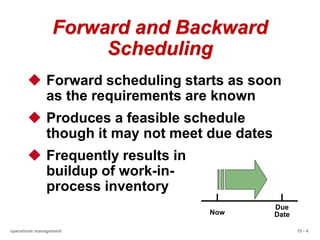
 Forward scheduling starts as soon
as the requirements are known
 Produces a feasible schedule
though it may not meet due dates
 Frequently results in
buildup of work-in-
process inventory
Due
Date
Now
15 - 5
operations management
Forward and Backward
Scheduling
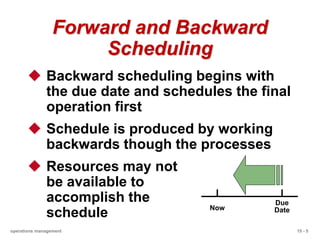
 Backward scheduling begins with
the due date and schedules the final
operation first
 Schedule is produced by working
backwards though the processes
 Resources may not
be available to
accomplish the
schedule
Due
Date
Now
15 - 6
operations management
Forward and Backward
Scheduling
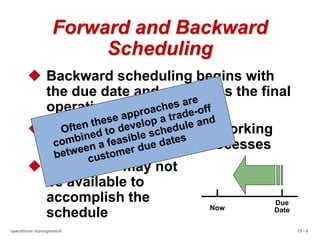
 Backward scheduling begins with
the due date and schedules the final
operation first
 Schedule is produced by working
backwards though the processes
 Resources may not
be available to
accomplish the
schedule
Due
Date
Now
15 - 7
operations management
Scheduling Criteria
1. Minimize completion time
2. Maximize utilization of facilities
3. Minimize work-in-process (WIP)
inventory
4. Minimize customer waiting time
Optimize the use of resources so
that production objectives are met
15 - 8
operations management
Loading Jobs
 Assign jobs so that costs, idle
time, or completion time are
minimized
 Two forms of loading
 Capacity oriented
 Assigning specific jobs to work
centers
15 - 9
operations management
Gantt Charts
 Load chart shows the loading and
idle times of departments,
machines, or facilities
 Displays relative workloads over
time
 Schedule chart monitors jobs in
process
 All Gantt charts need to be updated
frequently to account for changes
15 - 10
operations management
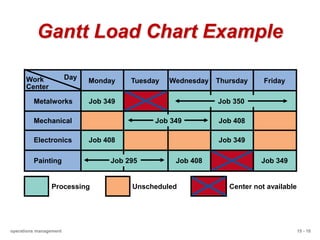
Gantt Load Chart Example
Day
Monday Tuesday Wednesday Thursday Friday
Work
Center
Metalworks
Mechanical
Electronics
Painting
Job 349
Job 349
Job 349
Job 408
Job 408
Job 408
Processing Unscheduled Center not available
Job 350
Job 349
Job 295
15 - 11
operations management
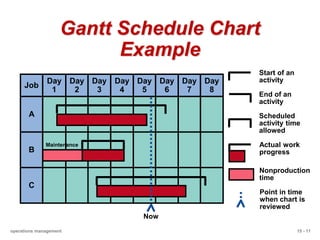
Gantt Schedule Chart
Example
Job
Day
1
Day
2
Day
3
Day
4
Day
5
Day
6
Day
7
Day
8
A
B
C
Now
Maintenance
Start of an
activity
End of an
activity
Scheduled
activity time
allowed
Actual work
progress
Nonproduction
time
Point in time
when chart is
reviewed
15 - 12
operations management
Sequencing Jobs
 Specifies the order in which jobs
should be performed at work centers
 Priority rules are used to dispatch or
sequence jobs
 FCFS: First come, first served
 SPT: Shortest processing time
 EDD: Earliest due date
 LPT: Longest processing time
15 - 13
operations management
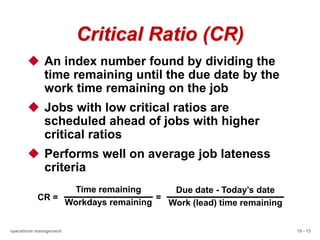
Critical Ratio (CR)
 An index number found by dividing the
time remaining until the due date by the
work time remaining on the job
 Jobs with low critical ratios are
scheduled ahead of jobs with higher
critical ratios
 Performs well on average job lateness
criteria
CR = =
Due date - Today’s date
Work (lead) time remaining
Time remaining
Workdays remaining
15 - 14
operations management
Critical Ratio Example
Job
Due
Date
Workdays
Remaining Critical Ratio
Priority
Order
A 30 4 (30 - 25)/4 = 1.25 3
B 28 5 (28 - 25)/5 = .60 1
C 27 2 (27 - 25)/2 = 1.00 2
Currently Day 25
With CR < 1, Job B is late. Job C is just on schedule
and Job A has some slack time.
15 - 15
operations management
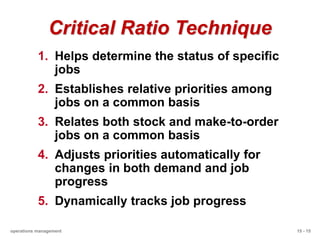
Critical Ratio Technique
1. Helps determine the status of specific
jobs
2. Establishes relative priorities among
jobs on a common basis
3. Relates both stock and make-to-order
jobs on a common basis
4. Adjusts priorities automatically for
changes in both demand and job
progress
5. Dynamically tracks job progress

7 chapter 9 Short-Term Scheduling.ppt

  • 1.
    15 - 1 operationsmanagement Chapter 9 Operations scheduling/Short-Term Scheduling
  • 2.
    15 - 2 operationsmanagement Scheduling Issues  Scheduling deals with the timing of operations  The task is the allocation and prioritization of demand  Significant issues are  The type of scheduling, forward or backward  The criteria for priorities
  • 3.
    15 - 3 operationsmanagement Scheduling Flow
  • 4.
    15 - 4 operationsmanagement Forward and Backward Scheduling  Forward scheduling starts as soon as the requirements are known  Produces a feasible schedule though it may not meet due dates  Frequently results in buildup of work-in- process inventory Due Date Now
  • 5.
    15 - 5 operationsmanagement Forward and Backward Scheduling  Backward scheduling begins with the due date and schedules the final operation first  Schedule is produced by working backwards though the processes  Resources may not be available to accomplish the schedule Due Date Now
  • 6.
    15 - 6 operationsmanagement Forward and Backward Scheduling  Backward scheduling begins with the due date and schedules the final operation first  Schedule is produced by working backwards though the processes  Resources may not be available to accomplish the schedule Due Date Now
  • 7.
    15 - 7 operationsmanagement Scheduling Criteria 1. Minimize completion time 2. Maximize utilization of facilities 3. Minimize work-in-process (WIP) inventory 4. Minimize customer waiting time Optimize the use of resources so that production objectives are met
  • 8.
    15 - 8 operationsmanagement Loading Jobs  Assign jobs so that costs, idle time, or completion time are minimized  Two forms of loading  Capacity oriented  Assigning specific jobs to work centers
  • 9.
    15 - 9 operationsmanagement Gantt Charts  Load chart shows the loading and idle times of departments, machines, or facilities  Displays relative workloads over time  Schedule chart monitors jobs in process  All Gantt charts need to be updated frequently to account for changes
  • 10.
    15 - 10 operationsmanagement Gantt Load Chart Example Day Monday Tuesday Wednesday Thursday Friday Work Center Metalworks Mechanical Electronics Painting Job 349 Job 349 Job 349 Job 408 Job 408 Job 408 Processing Unscheduled Center not available Job 350 Job 349 Job 295
  • 11.
    15 - 11 operationsmanagement Gantt Schedule Chart Example Job Day 1 Day 2 Day 3 Day 4 Day 5 Day 6 Day 7 Day 8 A B C Now Maintenance Start of an activity End of an activity Scheduled activity time allowed Actual work progress Nonproduction time Point in time when chart is reviewed
  • 12.
    15 - 12 operationsmanagement Sequencing Jobs  Specifies the order in which jobs should be performed at work centers  Priority rules are used to dispatch or sequence jobs  FCFS: First come, first served  SPT: Shortest processing time  EDD: Earliest due date  LPT: Longest processing time
  • 13.
    15 - 13 operationsmanagement Critical Ratio (CR)  An index number found by dividing the time remaining until the due date by the work time remaining on the job  Jobs with low critical ratios are scheduled ahead of jobs with higher critical ratios  Performs well on average job lateness criteria CR = = Due date - Today’s date Work (lead) time remaining Time remaining Workdays remaining
  • 14.
    15 - 14 operationsmanagement Critical Ratio Example Job Due Date Workdays Remaining Critical Ratio Priority Order A 30 4 (30 - 25)/4 = 1.25 3 B 28 5 (28 - 25)/5 = .60 1 C 27 2 (27 - 25)/2 = 1.00 2 Currently Day 25 With CR < 1, Job B is late. Job C is just on schedule and Job A has some slack time.
  • 15.
    15 - 15 operationsmanagement Critical Ratio Technique 1. Helps determine the status of specific jobs 2. Establishes relative priorities among jobs on a common basis 3. Relates both stock and make-to-order jobs on a common basis 4. Adjusts priorities automatically for changes in both demand and job progress 5. Dynamically tracks job progress