8 - 1
Operations management
Chapter 5.
Facilities Location
Strategies
8 - 2
Operations management
Chapter 5 Facilities
Location Strategy
The objective of location strategy is
to maximize the benefit of location
to the firm
8 - 3
Operations management
Location and Costs
 Location decisions based on low
cost require careful consideration
 Once in place, location-related
costs are fixed in place and
difficult to reduce
 Determining optimal facility
location is a good investment
8 - 4
Operations management
Location and Innovation
 Cost is not always the most important
aspect of a strategic decision
 Four key attributes when strategy is
based on innovation
 High-quality and specialized inputs
 An environment that encourages
investment and local rivalry
 A sophisticated local market
 Local presence of related and
supporting industries
8 - 5
Operations management
Nature of Location Decisions
 Long-term decisions
 Decisions made infrequently
 Decision greatly affects both fixed
and variable costs
 Once committed to a location,
many resource and cost issues
are difficult to change
8 - 6
Operations management
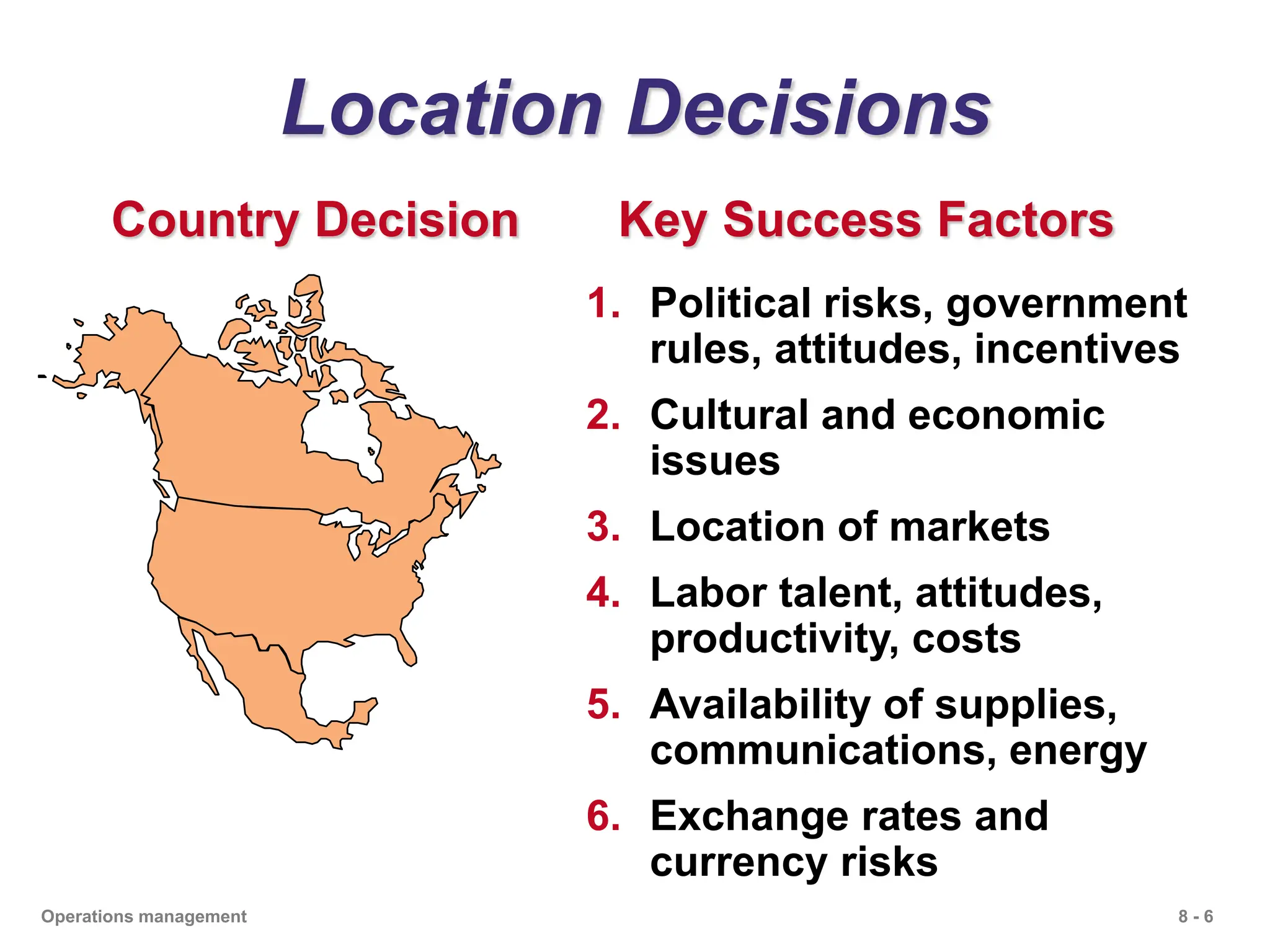
Location Decisions
Country Decision Key Success Factors
1. Political risks, government
rules, attitudes, incentives
2. Cultural and economic
issues
3. Location of markets
4. Labor talent, attitudes,
productivity, costs
5. Availability of supplies,
communications, energy
6. Exchange rates and
currency risks
8 - 7
Operations management
Location Decisions
Region/
Community
Decision
Key Success Factors
1. Corporate desires
2. Attractiveness of region
3. Labor availability and costs
4. Costs and availability of utilities
5. Environmental regulations
6. Government incentives and
fiscal policies
7. Proximity to raw materials and
customers
8. Land/construction costs
MN
WI
MI
IL IN
OH
8 - 8
Operations management
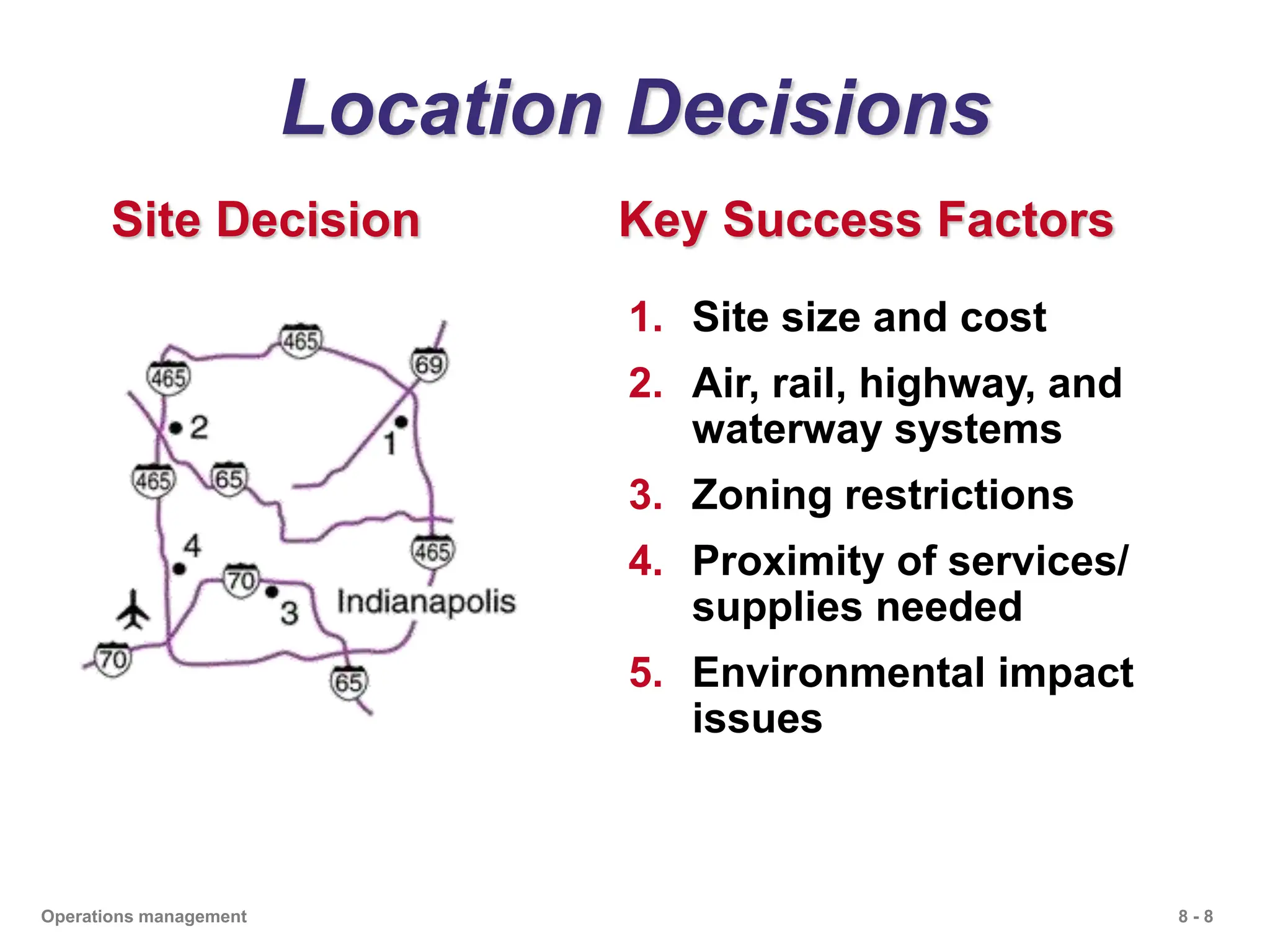
Location Decisions
Site Decision Key Success Factors
1. Site size and cost
2. Air, rail, highway, and
waterway systems
3. Zoning restrictions
4. Proximity of services/
supplies needed
5. Environmental impact
issues
8 - 9
Operations management
Factors That Affect
Location Decisions
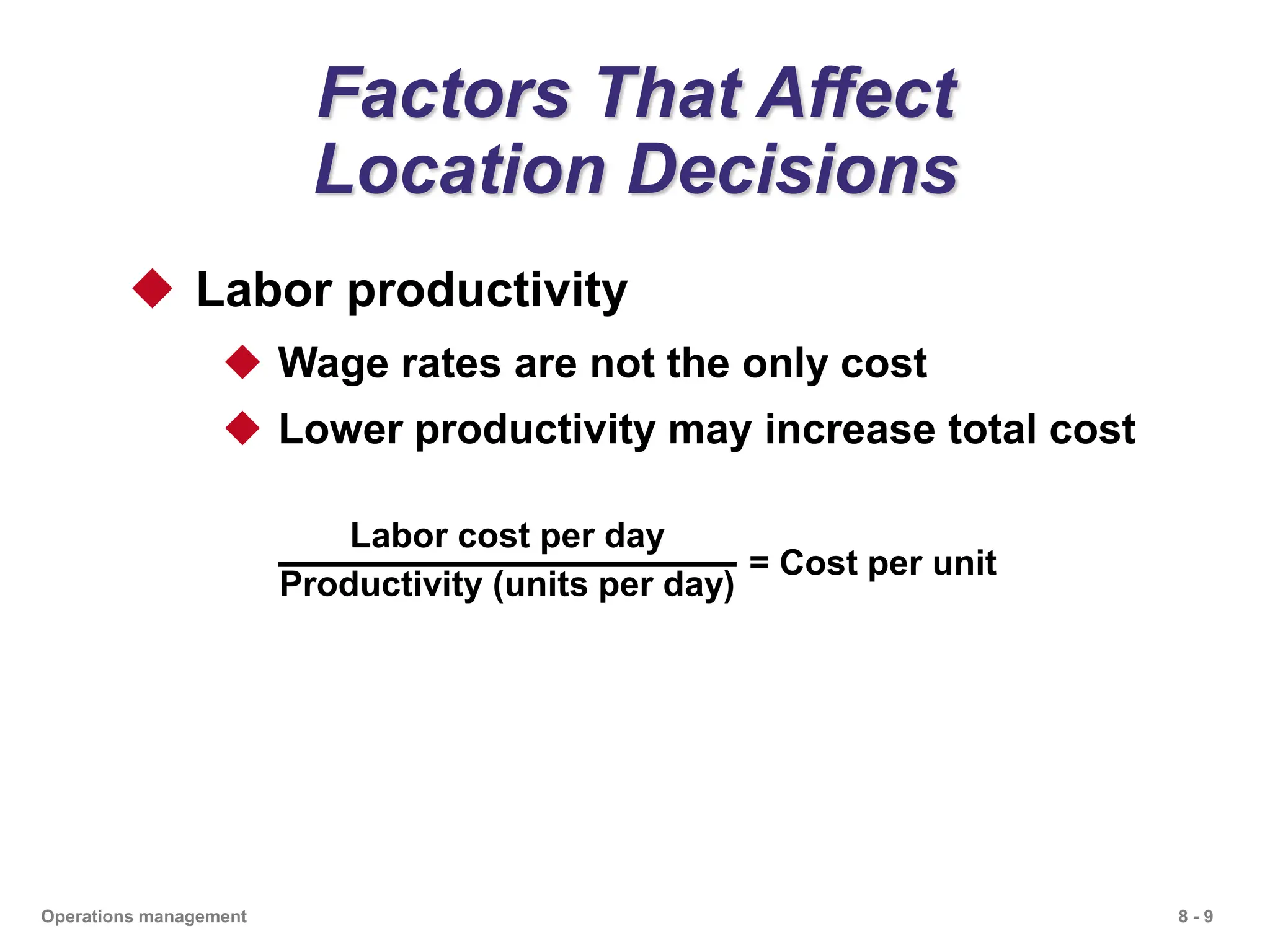
 Labor productivity
 Wage rates are not the only cost
 Lower productivity may increase total cost
Labor cost per day
Productivity (units per day)
= Cost per unit
8 - 10
Operations management
Factors That Affect
Location Decisions
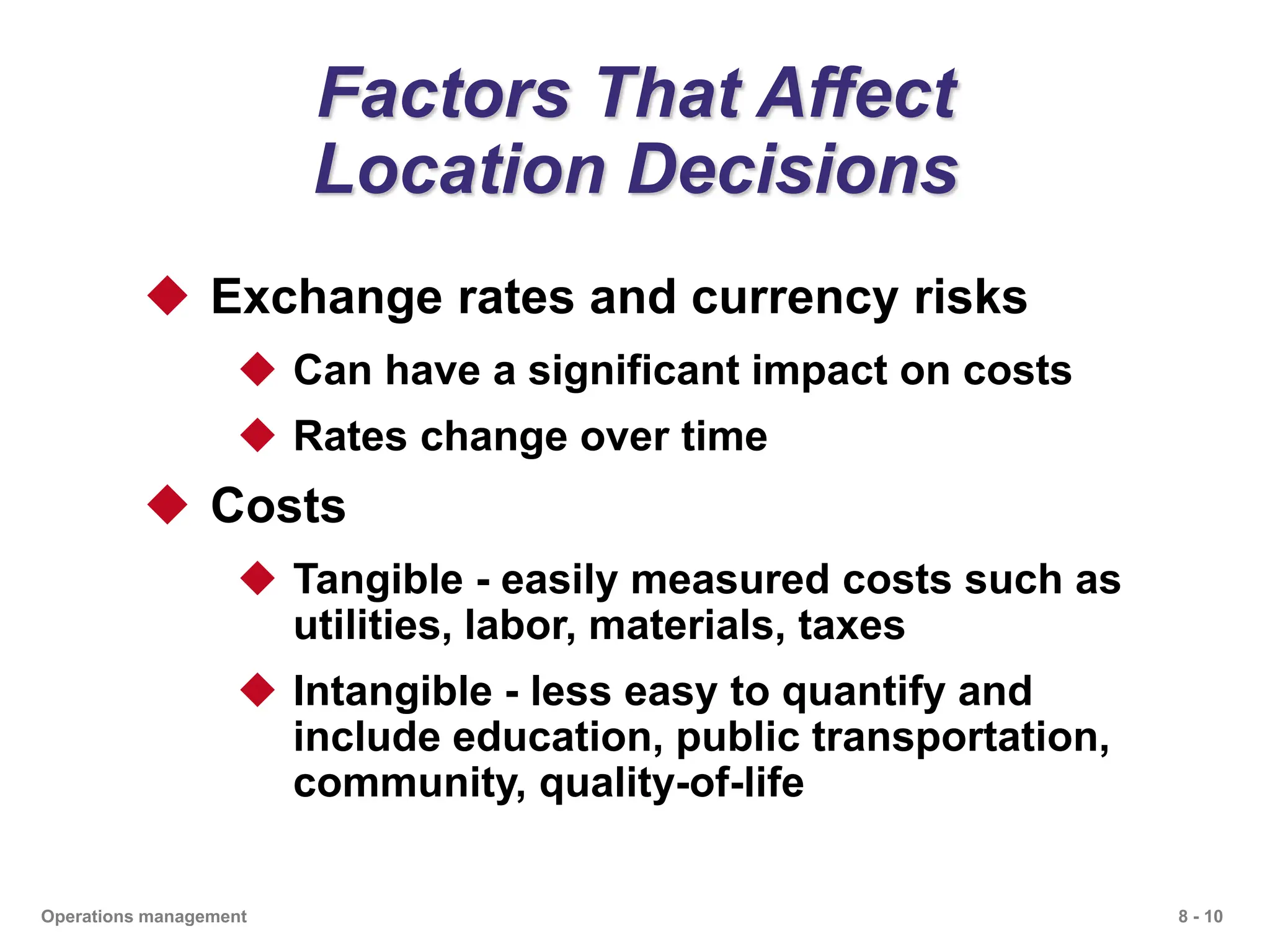
 Exchange rates and currency risks
 Can have a significant impact on costs
 Rates change over time
 Costs
 Tangible - easily measured costs such as
utilities, labor, materials, taxes
 Intangible - less easy to quantify and
include education, public transportation,
community, quality-of-life
8 - 11
Operations management
Factors That Affect
Location Decisions
 Exchange rates and currency risks
 Can have a significant impact on cost
structure
 Rates change over time
 Costs
 Tangible - easily measured costs such as
utilities, labor, materials, taxes
 Intangible - less easy to quantify and
include education, public transportation,
community, quality-of-life
Location
decisions based
on costs alone
can create
difficult ethical
situations
8 - 12
Operations management
Factors That Affect
Location Decisions
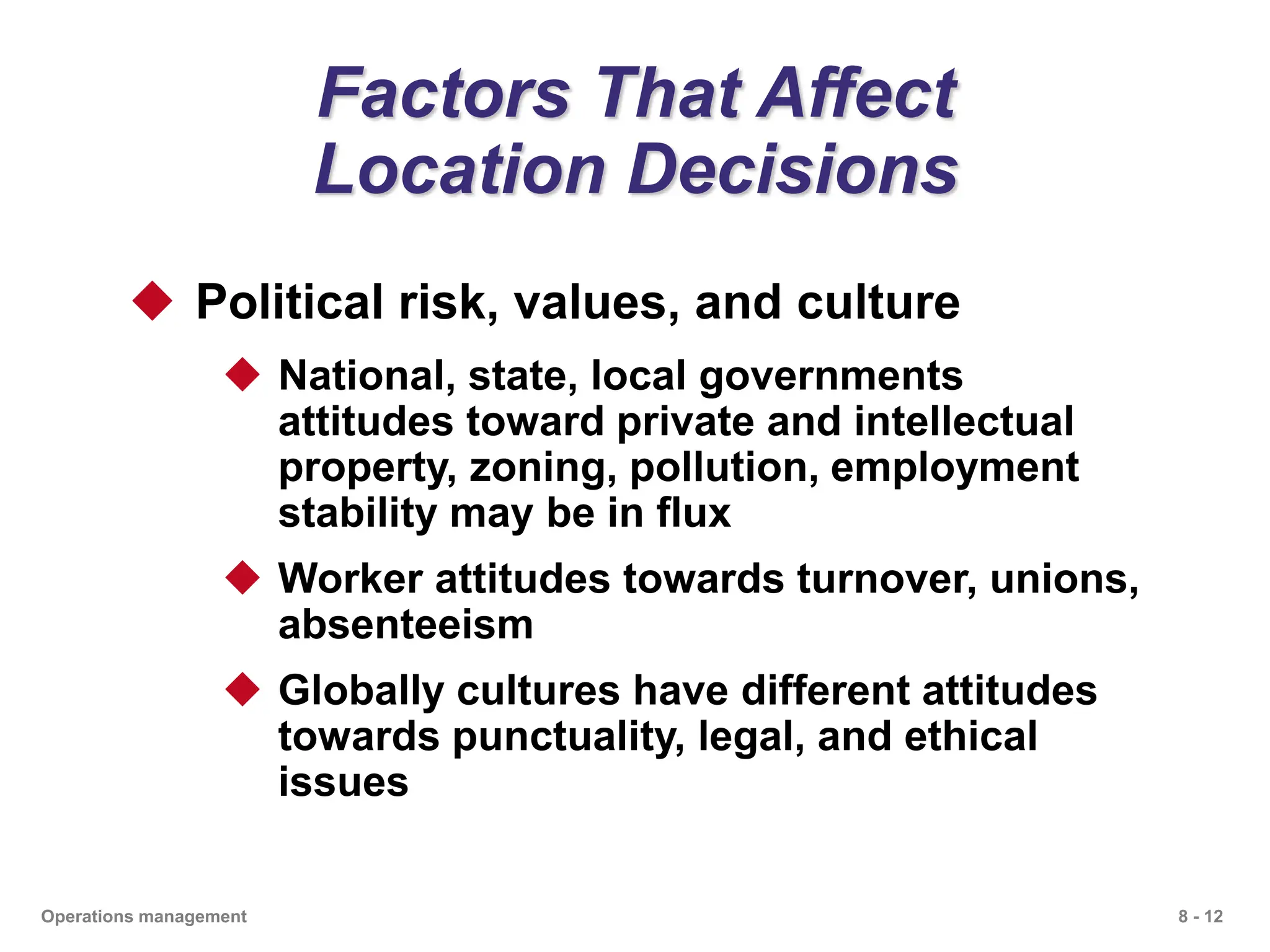
 Political risk, values, and culture
 National, state, local governments
attitudes toward private and intellectual
property, zoning, pollution, employment
stability may be in flux
 Worker attitudes towards turnover, unions,
absenteeism
 Globally cultures have different attitudes
towards punctuality, legal, and ethical
issues
8 - 13
Operations management
Factors That Affect
Location Decisions
 Proximity to markets
 Very important to services
 JIT systems or high transportation costs
may make it important to manufacturers
 Proximity to suppliers
 Perishable goods, high transportation
costs, bulky products
8 - 14
Location Evaluation Methods
1. Factor-rating method
2. Locational break-even analysis
3. Center of gravity method
4. Transportation model
Operations management
8 - 15
Operations management
Factors That Affect
Location Decisions
 Proximity to competitors
 Called clustering
 Often driven by resources such as natural,
information, capital, talent
 Found in both manufacturing and service
industries
8 - 16
Operations management
Factor-Rating Method
 Popular because a wide variety of factors
can be included in the analysis
 Six steps in the method
1. Develop a list of relevant factors called key
success factors
2. Assign a weight to each factor
3. Develop a scale for each factor
4. Score each location for each factor
5. Multiply score by weights for each factor for
each location
6. Recommend the location with the highest
point score
8 - 17
Operations management
Factor-Rating Example
Key Scores
Success (out of 100) Weighted Scores
Factor Weight France Denmark France Denmark
Labor
availability
and attitude .25 70 60 (.25)(70) = 17.5 (.25)(60) = 15.0
People-to-
car ratio .05 50 60 (.05)(50) = 2.5 (.05)(60) = 3.0
Per capita
income .10 85 80 (.10)(85) = 8.5 (.10)(80) = 8.0
Tax structure .39 75 70 (.39)(75) = 29.3 (.39)(70) = 27.3
Education
and health .21 60 70 (.21)(60) = 12.6 (.21)(70) = 14.7
Totals 1.00 70.4 68.0
8 - 18
Operations management
Locational
Break-Even Analysis
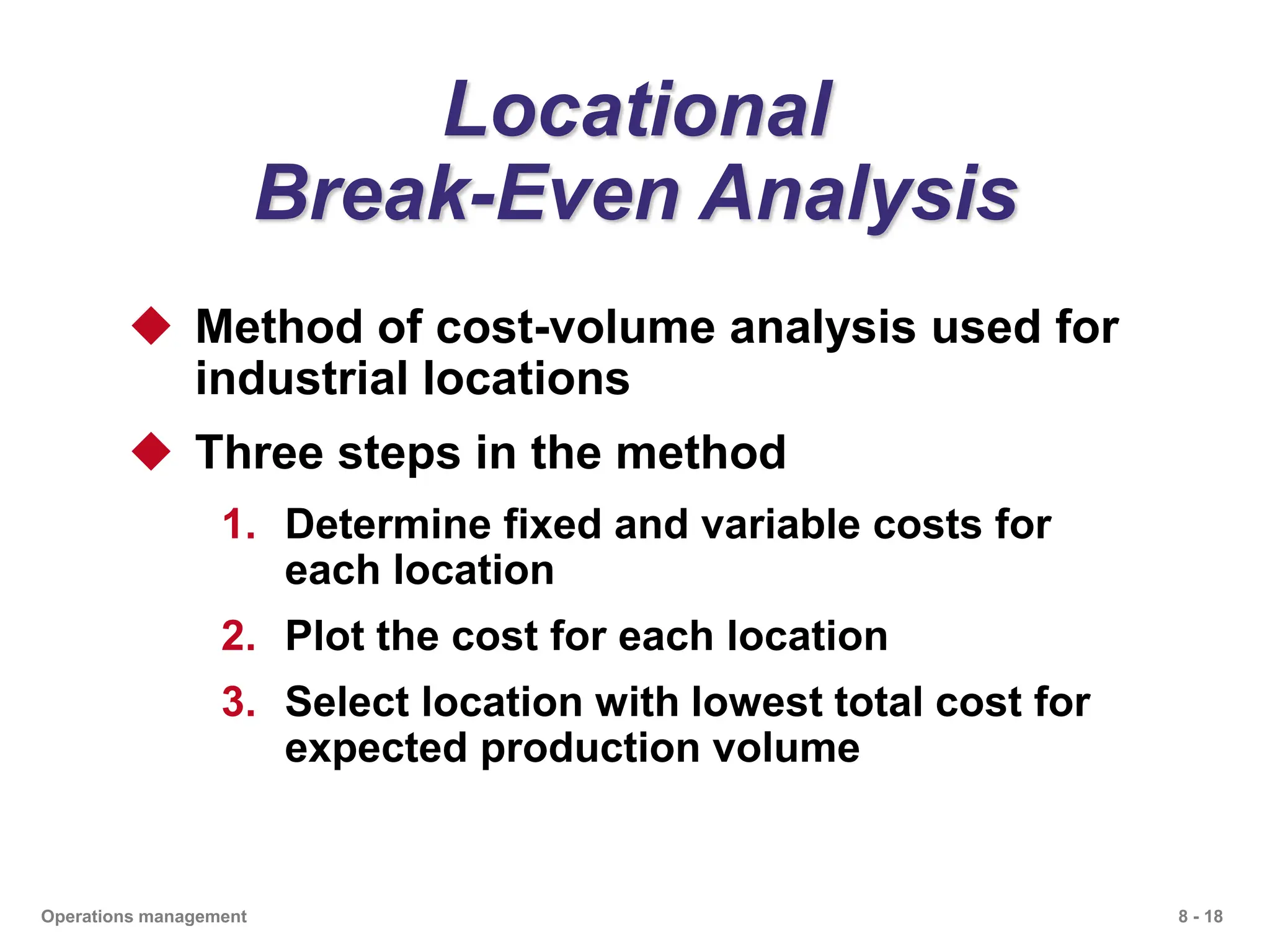
 Method of cost-volume analysis used for
industrial locations
 Three steps in the method
1. Determine fixed and variable costs for
each location
2. Plot the cost for each location
3. Select location with lowest total cost for
expected production volume
8 - 19
Operations management
Locational Break-Even
Analysis Example
Three locations:
Akron $30,000 $75 $180,000
Bowling Green $60,000 $45 $150,000
Chicago $110,000 $25 $160,000
Fixed Variable Total
City Cost Cost Cost
Total Cost = Fixed Cost + (Variable Cost x Volume)
Selling price = $120
Expected volume = 2,000 units
8 - 20
Operations management
Locational Break-Even
Analysis Example
–
$180,000 –
–
$160,000 –
$150,000 –
–
$130,000 –
–
$110,000 –
–
–
$80,000 –
–
$60,000 –
–
–
$30,000 –
–
$10,000 –
–
Annual
cost
| | | | | | |
0 500 1,000 1,500 2,000 2,500 3,000
Volume
Akron
lowest
cost
Bowling Green
lowest cost
Chicago
lowest
cost
8 - 21
Operations management
Center-of-Gravity Method
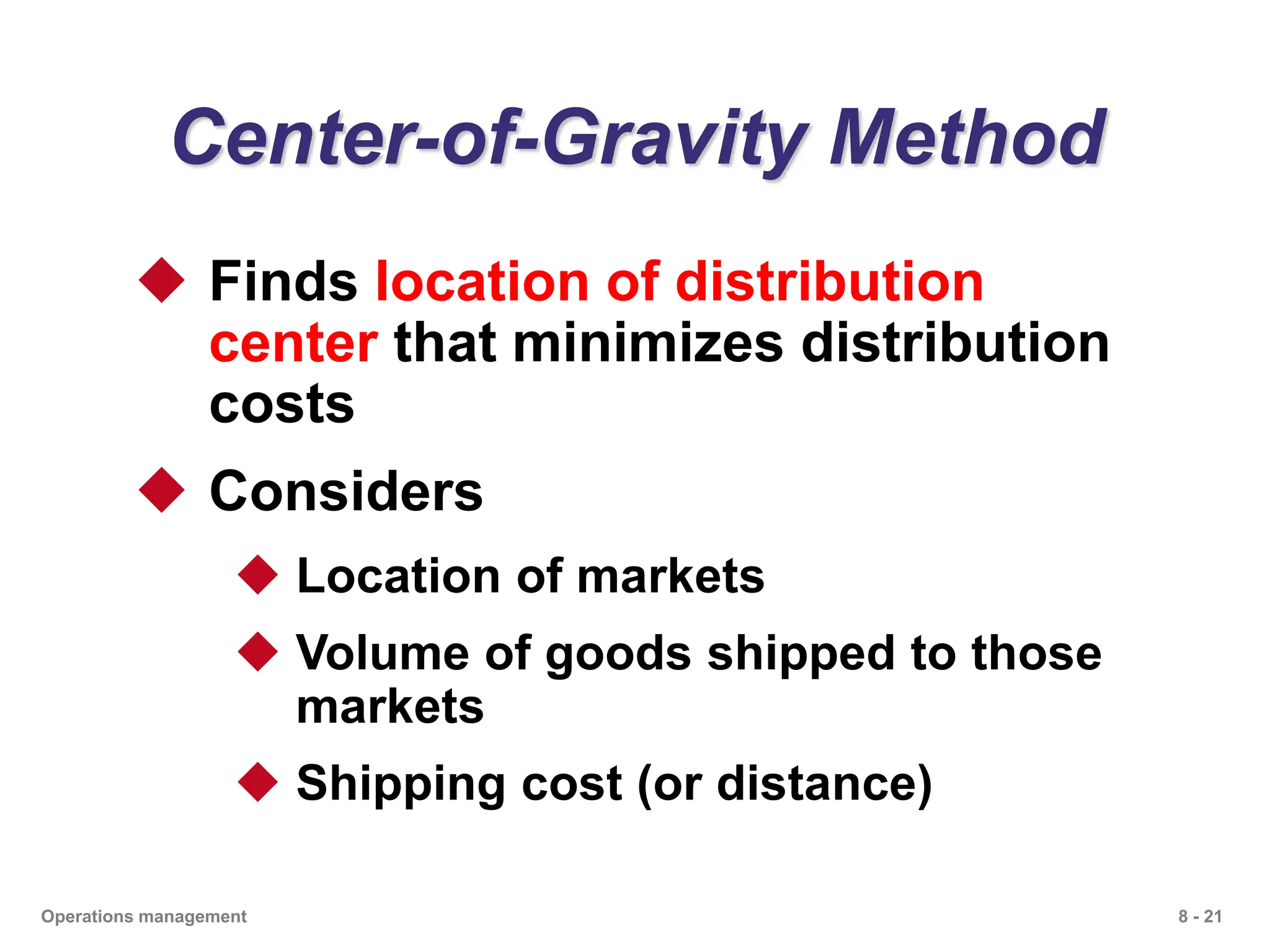
 Finds location of distribution
center that minimizes distribution
costs
 Considers
 Location of markets
 Volume of goods shipped to those
markets
 Shipping cost (or distance)
8 - 22
Operations management
Center-of-Gravity Method
 Place existing locations on a
coordinate grid
 Grid origin and scale is arbitrary
 Maintain relative distances
 Calculate X and Y coordinates for
‘center of gravity’
 Assumes cost is directly
proportional to distance and
volume shipped
8 - 23
Operations management
Center-of-Gravity Method
x - coordinate =
∑dixQi
∑Qi
i
i
∑diyQi
∑Qi
i
i
y - coordinate =
where dix = x-coordinate of location i
diy = y-coordinate of location i
Qi = Quantity of goods moved to
or from location i
8 - 24
Operations management
Center-of-Gravity Method
North-South
East-West
120 –
90 –
60 –
30 –
–
| | | | | |
30 60 90 120 150
Arbitrary
origin
Chicago (30, 120)
New York (130, 130)
Pittsburgh (90, 110)
Atlanta (60, 40)
8 - 25
Operations management
Center-of-Gravity Method
Number of Containers
Store Location Shipped per Month
Chicago (30, 120) 2,000
Pittsburgh (90, 110) 1,000
New York (130, 130) 1,000
Atlanta (60, 40) 2,000
x-coordinate =
(30)(2000) + (90)(1000) + (130)(1000) + (60)(2000)
2000 + 1000 + 1000 + 2000
= 66.7
y-coordinate =
(120)(2000) + (110)(1000) + (130)(1000) + (40)(2000)
2000 + 1000 + 1000 + 2000
= 93.3
8 - 26
Operations management
Center-of-Gravity Method
North-South
East-West
120 –
90 –
60 –
30 –
–
| | | | | |
30 60 90 120 150
Arbitrary
origin
Chicago (30, 120)
New York (130, 130)
Pittsburgh (90, 110)
Atlanta (60, 40)
Center of gravity (66.7, 93.3)
+
8 - 27
Operations management
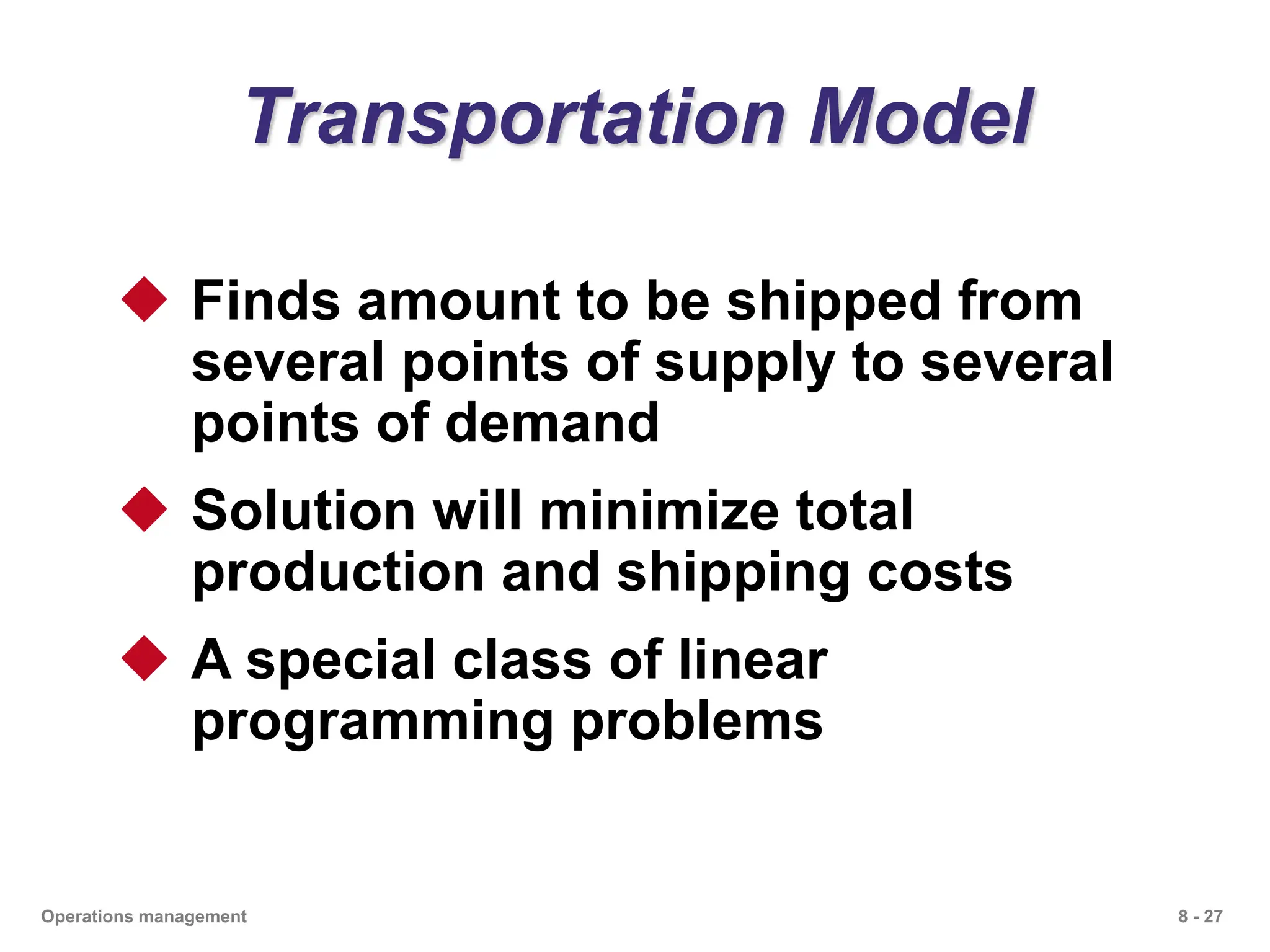
Transportation Model
 Finds amount to be shipped from
several points of supply to several
points of demand
 Solution will minimize total
production and shipping costs
 A special class of linear
programming problems
8 - 28
Operations management
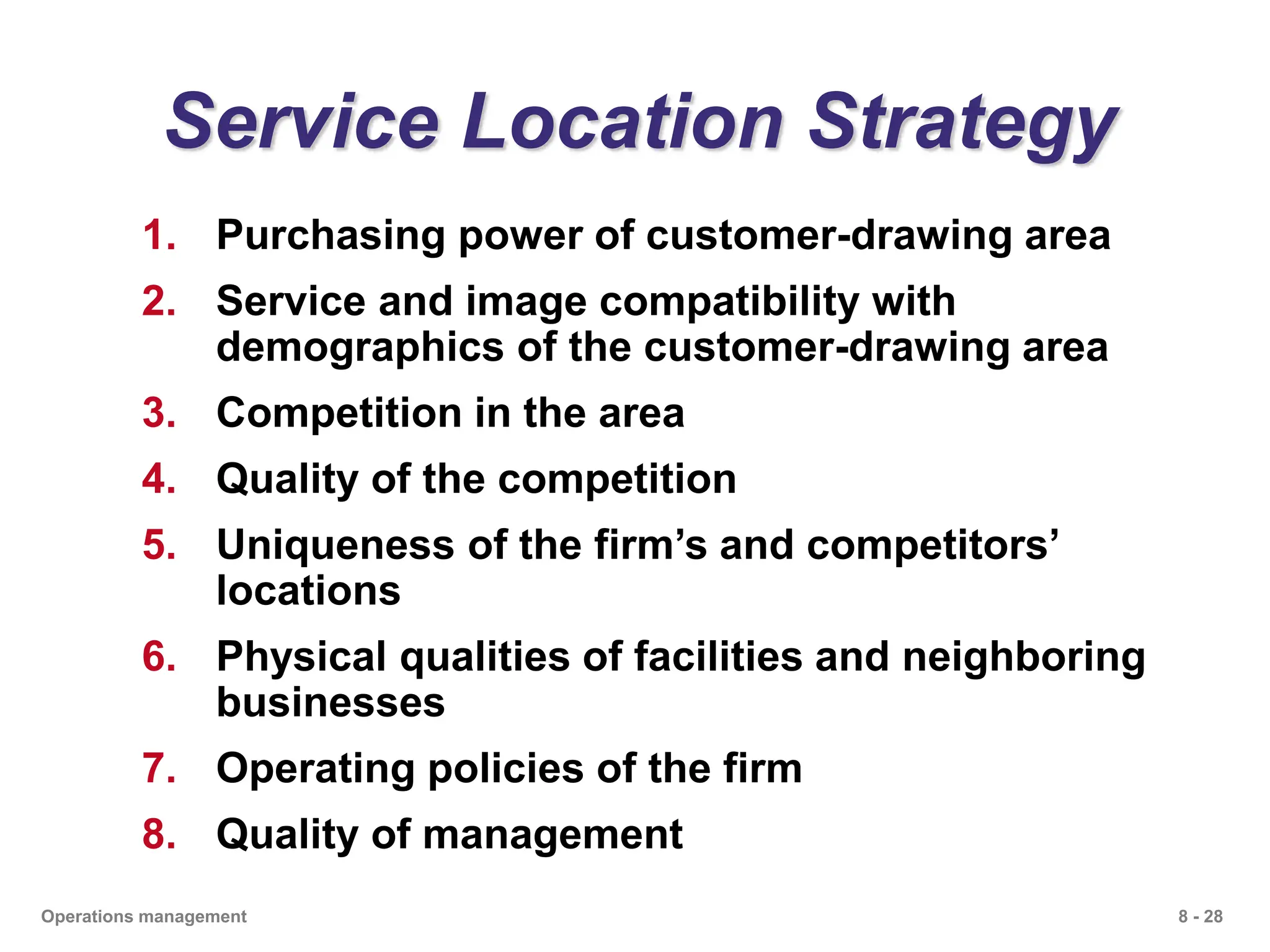
Service Location Strategy
1. Purchasing power of customer-drawing area
2. Service and image compatibility with
demographics of the customer-drawing area
3. Competition in the area
4. Quality of the competition
5. Uniqueness of the firm’s and competitors’
locations
6. Physical qualities of facilities and neighboring
businesses
7. Operating policies of the firm
8. Quality of management
8 - 29
Operations management
Location Strategies
Service/Retail/Professional Location Goods-Producing Location
Revenue Focus Cost Focus
Volume/revenue
Drawing area; purchasing power
Competition; advertising/pricing
Physical quality
Parking/access; security/lighting;
appearance/image
Cost determinants
Rent
Management caliber
Operations policies (hours, wage
rates)
Tangible costs
Transportation cost of raw material
Shipment cost of finished goods
Energy and utility cost; labor; raw
material; taxes, and so on
Intangible and future costs
Attitude toward union
Quality of life
Education expenditures by state
Quality of state and local
government
8 - 30
Operations management
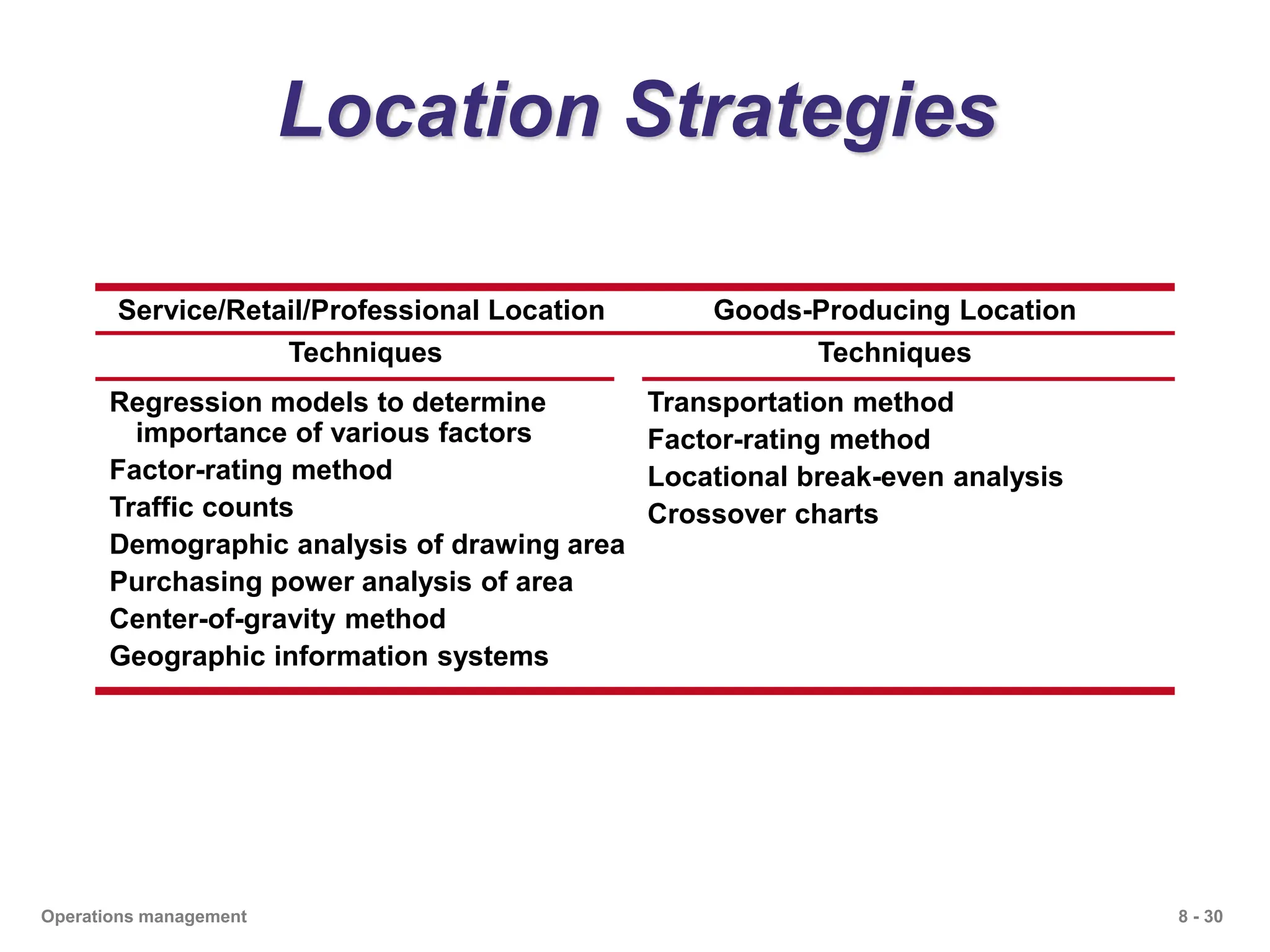
Location Strategies
Service/Retail/Professional Location Goods-Producing Location
Techniques Techniques
Regression models to determine
importance of various factors
Factor-rating method
Traffic counts
Demographic analysis of drawing area
Purchasing power analysis of area
Center-of-gravity method
Geographic information systems
Transportation method
Factor-rating method
Locational break-even analysis
Crossover charts
8 - 31
Operations management
Location Strategies
Service/Retail/Professional Location Goods-Producing Location
Assumptions Assumptions
Location is a major determinant of
revenue
High customer-contact issues are
critical
Costs are relatively constant for a
given area; therefore, the revenue
function is critical
Location is a major determinant of
cost
Most major costs can be identified
explicitly for each site
Low customer contact allows focus
on the identifiable costs
Intangible costs can be evaluated
8 - 32
Operations management
Geographic Information
Systems (GIS)
 Important tool to help in location analysis
 Enables more complex demographic
analysis
 Available data bases include
 Detailed census data
 Detailed maps
 Utilities
 Geographic features
 Locations of major services
8 - 33
Operations management
Geographic Information
Systems (GIS)

3 Chapter 5 facilities location.ppt

  • 1.
    8 - 1 Operationsmanagement Chapter 5. Facilities Location Strategies
  • 2.
    8 - 2 Operationsmanagement Chapter 5 Facilities Location Strategy The objective of location strategy is to maximize the benefit of location to the firm
  • 3.
    8 - 3 Operationsmanagement Location and Costs  Location decisions based on low cost require careful consideration  Once in place, location-related costs are fixed in place and difficult to reduce  Determining optimal facility location is a good investment
  • 4.
    8 - 4 Operationsmanagement Location and Innovation  Cost is not always the most important aspect of a strategic decision  Four key attributes when strategy is based on innovation  High-quality and specialized inputs  An environment that encourages investment and local rivalry  A sophisticated local market  Local presence of related and supporting industries
  • 5.
    8 - 5 Operationsmanagement Nature of Location Decisions  Long-term decisions  Decisions made infrequently  Decision greatly affects both fixed and variable costs  Once committed to a location, many resource and cost issues are difficult to change
  • 6.
    8 - 6 Operationsmanagement Location Decisions Country Decision Key Success Factors 1. Political risks, government rules, attitudes, incentives 2. Cultural and economic issues 3. Location of markets 4. Labor talent, attitudes, productivity, costs 5. Availability of supplies, communications, energy 6. Exchange rates and currency risks
  • 7.
    8 - 7 Operationsmanagement Location Decisions Region/ Community Decision Key Success Factors 1. Corporate desires 2. Attractiveness of region 3. Labor availability and costs 4. Costs and availability of utilities 5. Environmental regulations 6. Government incentives and fiscal policies 7. Proximity to raw materials and customers 8. Land/construction costs MN WI MI IL IN OH
  • 8.
    8 - 8 Operationsmanagement Location Decisions Site Decision Key Success Factors 1. Site size and cost 2. Air, rail, highway, and waterway systems 3. Zoning restrictions 4. Proximity of services/ supplies needed 5. Environmental impact issues
  • 9.
    8 - 9 Operationsmanagement Factors That Affect Location Decisions  Labor productivity  Wage rates are not the only cost  Lower productivity may increase total cost Labor cost per day Productivity (units per day) = Cost per unit
  • 10.
    8 - 10 Operationsmanagement Factors That Affect Location Decisions  Exchange rates and currency risks  Can have a significant impact on costs  Rates change over time  Costs  Tangible - easily measured costs such as utilities, labor, materials, taxes  Intangible - less easy to quantify and include education, public transportation, community, quality-of-life
  • 11.
    8 - 11 Operationsmanagement Factors That Affect Location Decisions  Exchange rates and currency risks  Can have a significant impact on cost structure  Rates change over time  Costs  Tangible - easily measured costs such as utilities, labor, materials, taxes  Intangible - less easy to quantify and include education, public transportation, community, quality-of-life Location decisions based on costs alone can create difficult ethical situations
  • 12.
    8 - 12 Operationsmanagement Factors That Affect Location Decisions  Political risk, values, and culture  National, state, local governments attitudes toward private and intellectual property, zoning, pollution, employment stability may be in flux  Worker attitudes towards turnover, unions, absenteeism  Globally cultures have different attitudes towards punctuality, legal, and ethical issues
  • 13.
    8 - 13 Operationsmanagement Factors That Affect Location Decisions  Proximity to markets  Very important to services  JIT systems or high transportation costs may make it important to manufacturers  Proximity to suppliers  Perishable goods, high transportation costs, bulky products
  • 14.
    8 - 14 LocationEvaluation Methods 1. Factor-rating method 2. Locational break-even analysis 3. Center of gravity method 4. Transportation model Operations management
  • 15.
    8 - 15 Operationsmanagement Factors That Affect Location Decisions  Proximity to competitors  Called clustering  Often driven by resources such as natural, information, capital, talent  Found in both manufacturing and service industries
  • 16.
    8 - 16 Operationsmanagement Factor-Rating Method  Popular because a wide variety of factors can be included in the analysis  Six steps in the method 1. Develop a list of relevant factors called key success factors 2. Assign a weight to each factor 3. Develop a scale for each factor 4. Score each location for each factor 5. Multiply score by weights for each factor for each location 6. Recommend the location with the highest point score
  • 17.
    8 - 17 Operationsmanagement Factor-Rating Example Key Scores Success (out of 100) Weighted Scores Factor Weight France Denmark France Denmark Labor availability and attitude .25 70 60 (.25)(70) = 17.5 (.25)(60) = 15.0 People-to- car ratio .05 50 60 (.05)(50) = 2.5 (.05)(60) = 3.0 Per capita income .10 85 80 (.10)(85) = 8.5 (.10)(80) = 8.0 Tax structure .39 75 70 (.39)(75) = 29.3 (.39)(70) = 27.3 Education and health .21 60 70 (.21)(60) = 12.6 (.21)(70) = 14.7 Totals 1.00 70.4 68.0
  • 18.
    8 - 18 Operationsmanagement Locational Break-Even Analysis  Method of cost-volume analysis used for industrial locations  Three steps in the method 1. Determine fixed and variable costs for each location 2. Plot the cost for each location 3. Select location with lowest total cost for expected production volume
  • 19.
    8 - 19 Operationsmanagement Locational Break-Even Analysis Example Three locations: Akron $30,000 $75 $180,000 Bowling Green $60,000 $45 $150,000 Chicago $110,000 $25 $160,000 Fixed Variable Total City Cost Cost Cost Total Cost = Fixed Cost + (Variable Cost x Volume) Selling price = $120 Expected volume = 2,000 units
  • 20.
    8 - 20 Operationsmanagement Locational Break-Even Analysis Example – $180,000 – – $160,000 – $150,000 – – $130,000 – – $110,000 – – – $80,000 – – $60,000 – – – $30,000 – – $10,000 – – Annual cost | | | | | | | 0 500 1,000 1,500 2,000 2,500 3,000 Volume Akron lowest cost Bowling Green lowest cost Chicago lowest cost
  • 21.
    8 - 21 Operationsmanagement Center-of-Gravity Method  Finds location of distribution center that minimizes distribution costs  Considers  Location of markets  Volume of goods shipped to those markets  Shipping cost (or distance)
  • 22.
    8 - 22 Operationsmanagement Center-of-Gravity Method  Place existing locations on a coordinate grid  Grid origin and scale is arbitrary  Maintain relative distances  Calculate X and Y coordinates for ‘center of gravity’  Assumes cost is directly proportional to distance and volume shipped
  • 23.
    8 - 23 Operationsmanagement Center-of-Gravity Method x - coordinate = ∑dixQi ∑Qi i i ∑diyQi ∑Qi i i y - coordinate = where dix = x-coordinate of location i diy = y-coordinate of location i Qi = Quantity of goods moved to or from location i
  • 24.
    8 - 24 Operationsmanagement Center-of-Gravity Method North-South East-West 120 – 90 – 60 – 30 – – | | | | | | 30 60 90 120 150 Arbitrary origin Chicago (30, 120) New York (130, 130) Pittsburgh (90, 110) Atlanta (60, 40)
  • 25.
    8 - 25 Operationsmanagement Center-of-Gravity Method Number of Containers Store Location Shipped per Month Chicago (30, 120) 2,000 Pittsburgh (90, 110) 1,000 New York (130, 130) 1,000 Atlanta (60, 40) 2,000 x-coordinate = (30)(2000) + (90)(1000) + (130)(1000) + (60)(2000) 2000 + 1000 + 1000 + 2000 = 66.7 y-coordinate = (120)(2000) + (110)(1000) + (130)(1000) + (40)(2000) 2000 + 1000 + 1000 + 2000 = 93.3
  • 26.
    8 - 26 Operationsmanagement Center-of-Gravity Method North-South East-West 120 – 90 – 60 – 30 – – | | | | | | 30 60 90 120 150 Arbitrary origin Chicago (30, 120) New York (130, 130) Pittsburgh (90, 110) Atlanta (60, 40) Center of gravity (66.7, 93.3) +
  • 27.
    8 - 27 Operationsmanagement Transportation Model  Finds amount to be shipped from several points of supply to several points of demand  Solution will minimize total production and shipping costs  A special class of linear programming problems
  • 28.
    8 - 28 Operationsmanagement Service Location Strategy 1. Purchasing power of customer-drawing area 2. Service and image compatibility with demographics of the customer-drawing area 3. Competition in the area 4. Quality of the competition 5. Uniqueness of the firm’s and competitors’ locations 6. Physical qualities of facilities and neighboring businesses 7. Operating policies of the firm 8. Quality of management
  • 29.
    8 - 29 Operationsmanagement Location Strategies Service/Retail/Professional Location Goods-Producing Location Revenue Focus Cost Focus Volume/revenue Drawing area; purchasing power Competition; advertising/pricing Physical quality Parking/access; security/lighting; appearance/image Cost determinants Rent Management caliber Operations policies (hours, wage rates) Tangible costs Transportation cost of raw material Shipment cost of finished goods Energy and utility cost; labor; raw material; taxes, and so on Intangible and future costs Attitude toward union Quality of life Education expenditures by state Quality of state and local government
  • 30.
    8 - 30 Operationsmanagement Location Strategies Service/Retail/Professional Location Goods-Producing Location Techniques Techniques Regression models to determine importance of various factors Factor-rating method Traffic counts Demographic analysis of drawing area Purchasing power analysis of area Center-of-gravity method Geographic information systems Transportation method Factor-rating method Locational break-even analysis Crossover charts
  • 31.
    8 - 31 Operationsmanagement Location Strategies Service/Retail/Professional Location Goods-Producing Location Assumptions Assumptions Location is a major determinant of revenue High customer-contact issues are critical Costs are relatively constant for a given area; therefore, the revenue function is critical Location is a major determinant of cost Most major costs can be identified explicitly for each site Low customer contact allows focus on the identifiable costs Intangible costs can be evaluated
  • 32.
    8 - 32 Operationsmanagement Geographic Information Systems (GIS)  Important tool to help in location analysis  Enables more complex demographic analysis  Available data bases include  Detailed census data  Detailed maps  Utilities  Geographic features  Locations of major services
  • 33.
    8 - 33 Operationsmanagement Geographic Information Systems (GIS)