OPERATIONS
SCHEDULING AND
SEQUENCING
OPERATIONS
SCHEDULING AND
SEQUENCING
OPERATIONS
SCHEDULING
AND SEQUENCING
MEET THE TEAM
ALIKI BIEN
ALMA GRACE
CAYUBIT ​
2
WHAT DO YOU THINK?
As a student, how do you
schedule your homework,
school projects, and study
activities? What criteria do you
use?
3
UNDERSTANDING
SCHEDULING AND
SEQUENCING
Scheduling refers to the assignment of start and completion times
to particular jobs, people, or equipment.
- Examples: Scheduling restaurant employees, airline crews and
planes, sports teams, factory jobs.
Sequencing refers to determining the order in which jobs or tasks
are processed.
- Examples: Emergency room patients, automobile models on an
assembly line, outgoing flights on runways.
4
SCHEDULING
APPLICATIONS AND
APPROACHES
Scheduling applies to all aspects of the value
chain, from planning and releasing orders in a
factory, determining work shifts for employees,
and making deliveries to customers.
Tools:
Spreadsheets
Software packages
Web-based tools
SCHEDULING APPLICATIONS
AND APPROACHES
STAFF SCHEDULING ATTEMPTS TO MATCH AVAILABLE
PERSONNEL WITH THE NEEDS OF THE ORGANIZATION
BY:
1. Accurately forecasting demand and translating it into the
quantity and timing of work to be done.
2. Determining the staffing required to perform the work by
time period.
3. Determining the personnel available and the full- and part-
time mix.
4. Matching capacity to demand requirements and developing
a work schedule that maximizes service and minimizes costs.
6
OBJECTIVES OF OPERATIONS SCHEDULING
• Making Efficient use of the labour.
• Making best possible use of the
equipments that are available for the
use.
• Increasing the profit.
• Increasing the output.
• Improving the service level.
7
• Maximizing the delivery performance
i.e meeting the delivery dates.
• Minimizing the inventory
• Reducing the manufacturing time.
• Minimizing the production costs.
• Minimizing the worker costs.
TYPES OF
SCHEDULING
Types of Operations Scheduling are as
follows:
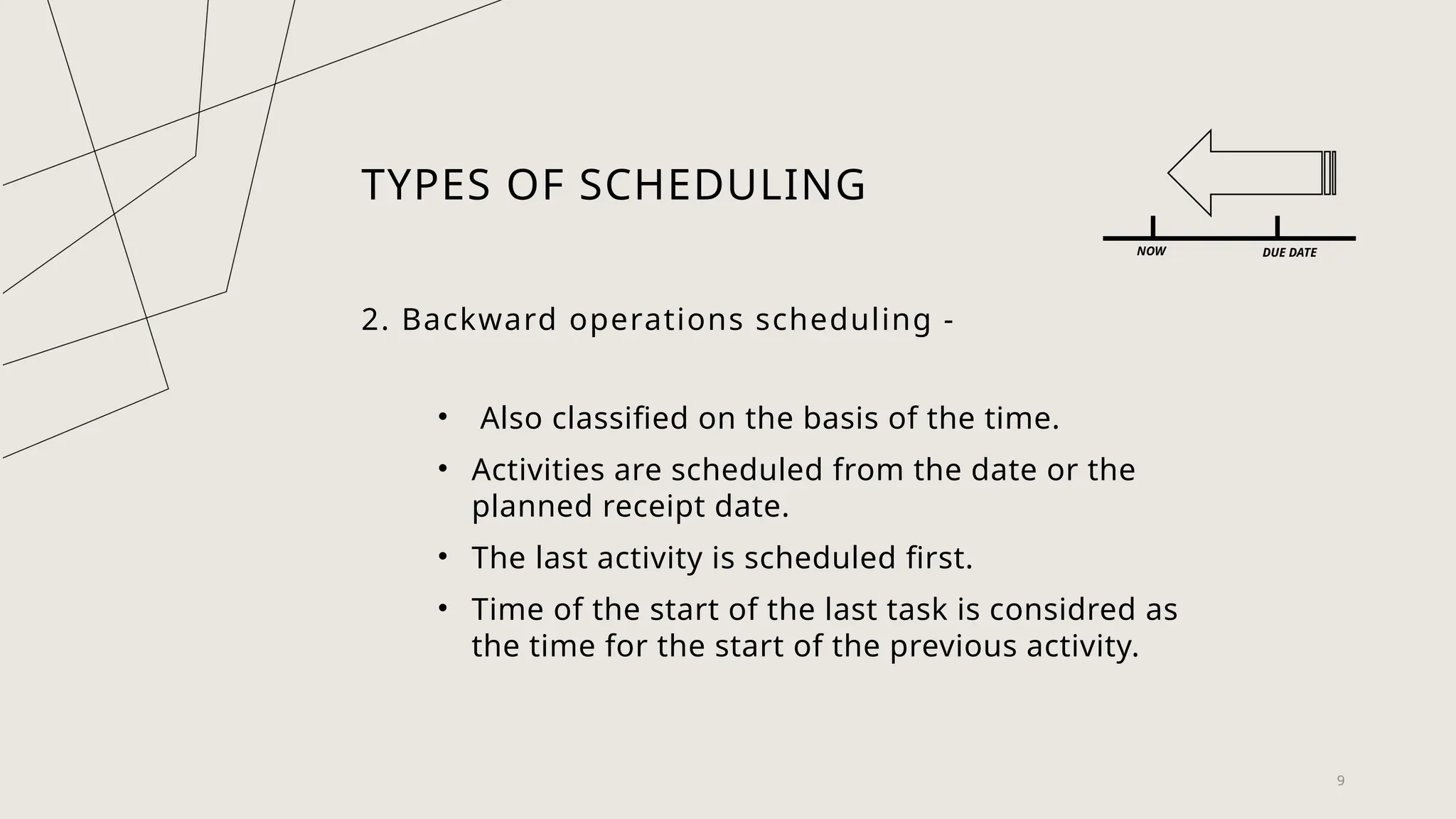
1. Forward operations scheduling -
• Classified on the basis of the time.
• All the activities are scheduled from the date of the
planned order release.
• First task of the job is scheduled.
• Its subsequent task is scheduled on the scheduled
completion of the first task.
• Like this, accordingly all the task of the job are
scheduled.
8
NOW DUE DATE
TYPES OF SCHEDULING
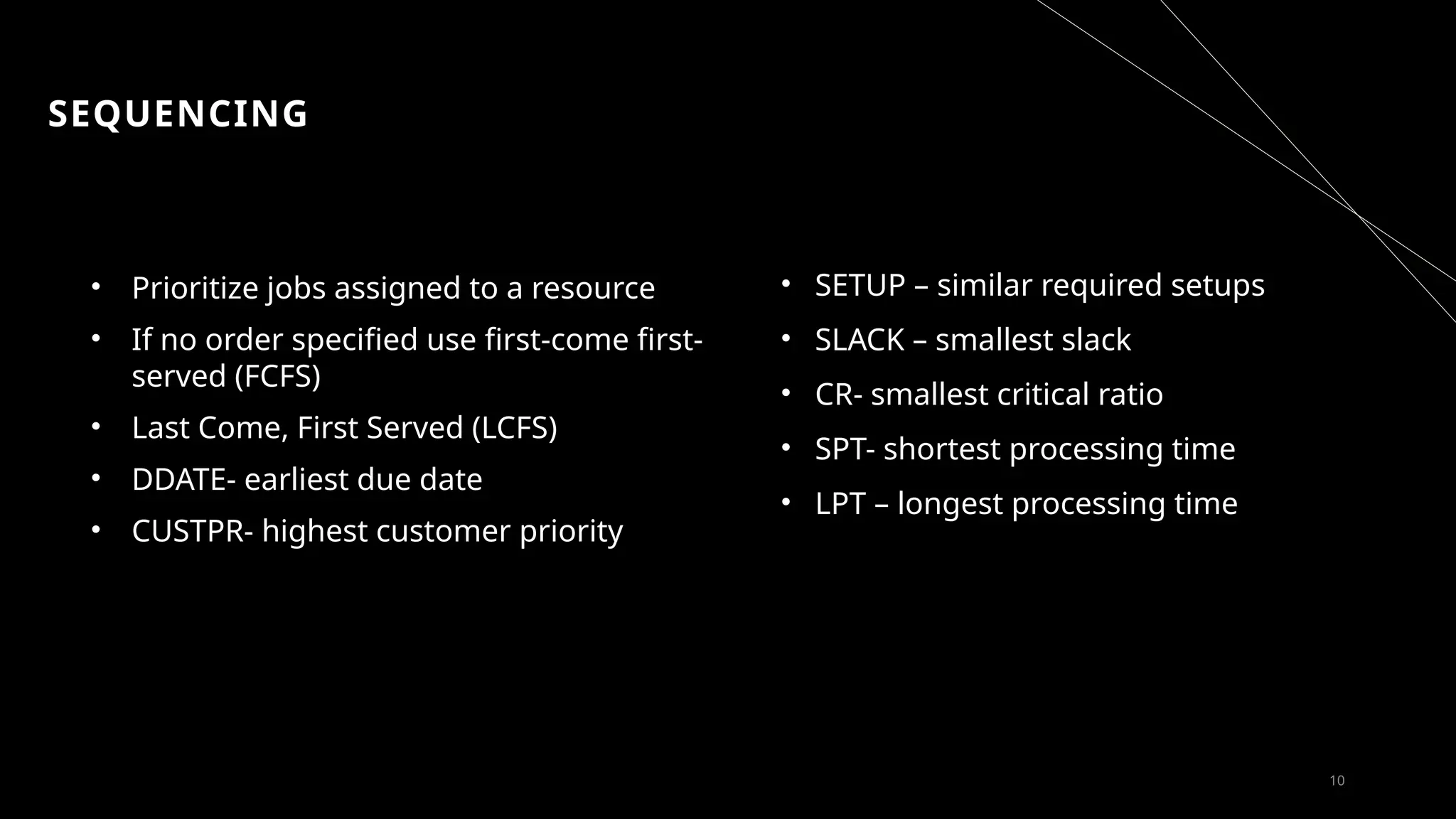
2. Backward operations scheduling -
• Also classified on the basis of the time.
• Activities are scheduled from the date or the
planned receipt date.
• The last activity is scheduled first.
• Time of the start of the last task is considred as
the time for the start of the previous activity.
9
DUE DATE
NOW
SEQUENCING
• Prioritize jobs assigned to a resource
• If no order specified use first-come first-
served (FCFS)
• Last Come, First Served (LCFS)
• DDATE- earliest due date
• CUSTPR- highest customer priority
10
• SETUP – similar required setups
• SLACK – smallest slack
• CR- smallest critical ratio
• SPT- shortest processing time
• LPT – longest processing time
SEQUENCING JOBS
• Operations schedules are short-term plans designed to
implement the slaes and operations plan
• An operation with divergent flows is often called a job
shop
- Low-to medium- volume production
- Utilizes job or batch processes
- The front office would be the equivalent for a service
provider
-Difficult to schedule because of the variability in job
routings and the continual introduction of new jobs to
be processed
11
12
SEQUENCING JOBS
• An operation with line flow is
often called a flow shop
- Medium-to high-volume production
-Utilizes line or continuous flow processes
- The back office would be the equivalent for a
service provider
- Tasks are easier to schedule because the jobs have
a common flow pattern through the system
PRIORITY SEQUENCING
RULES
• First-come, First-served (FCFS)
• Earliest due date (EDD)
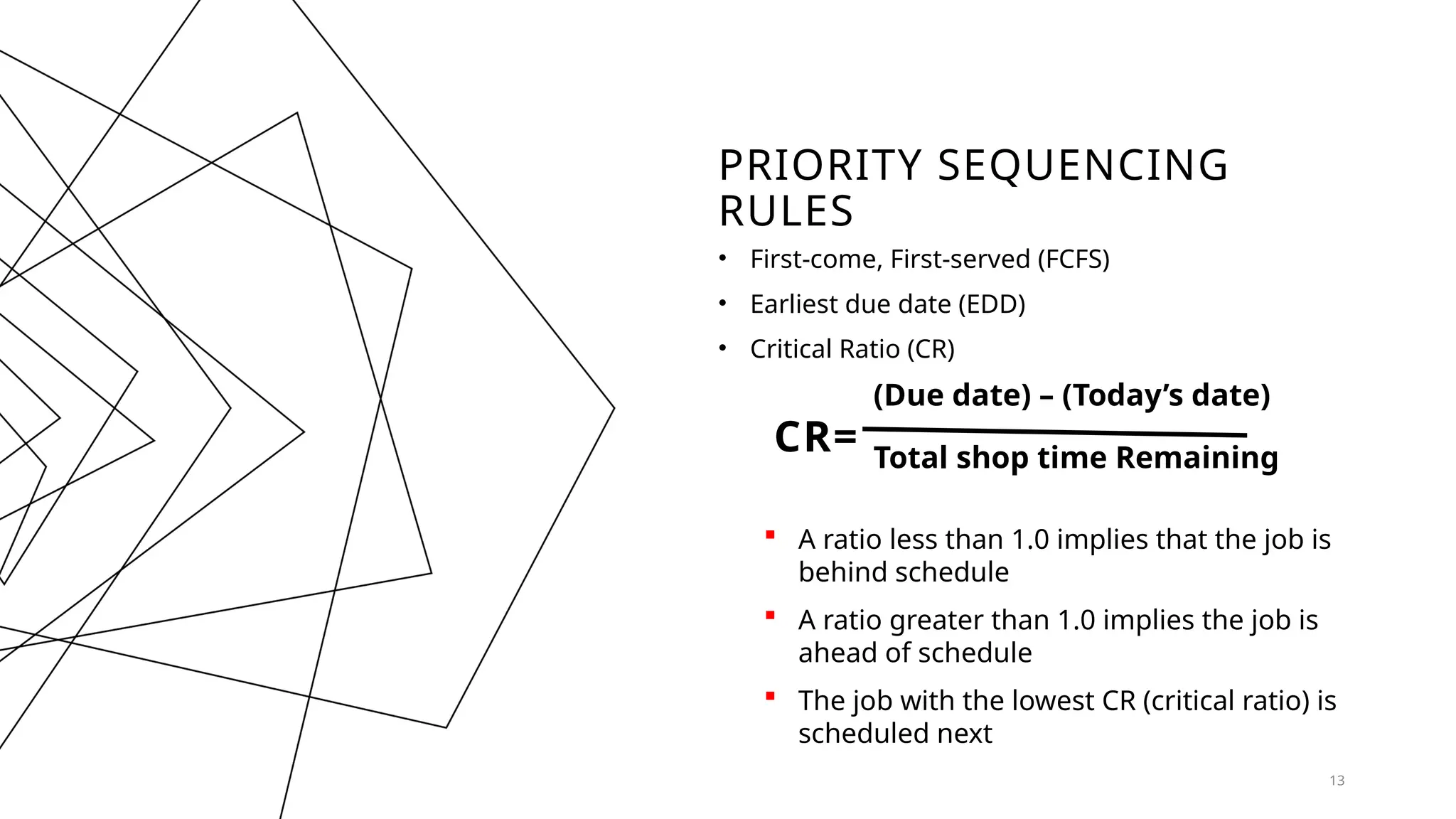
• Critical Ratio (CR)
CR=
(Due date) – (Today’s date)
13
Total shop time Remaining
 A ratio less than 1.0 implies that the job is
behind schedule
 A ratio greater than 1.0 implies the job is
ahead of schedule
 The job with the lowest CR (critical ratio) is
scheduled next
14
PRIORITY SEQUENCING
RULES
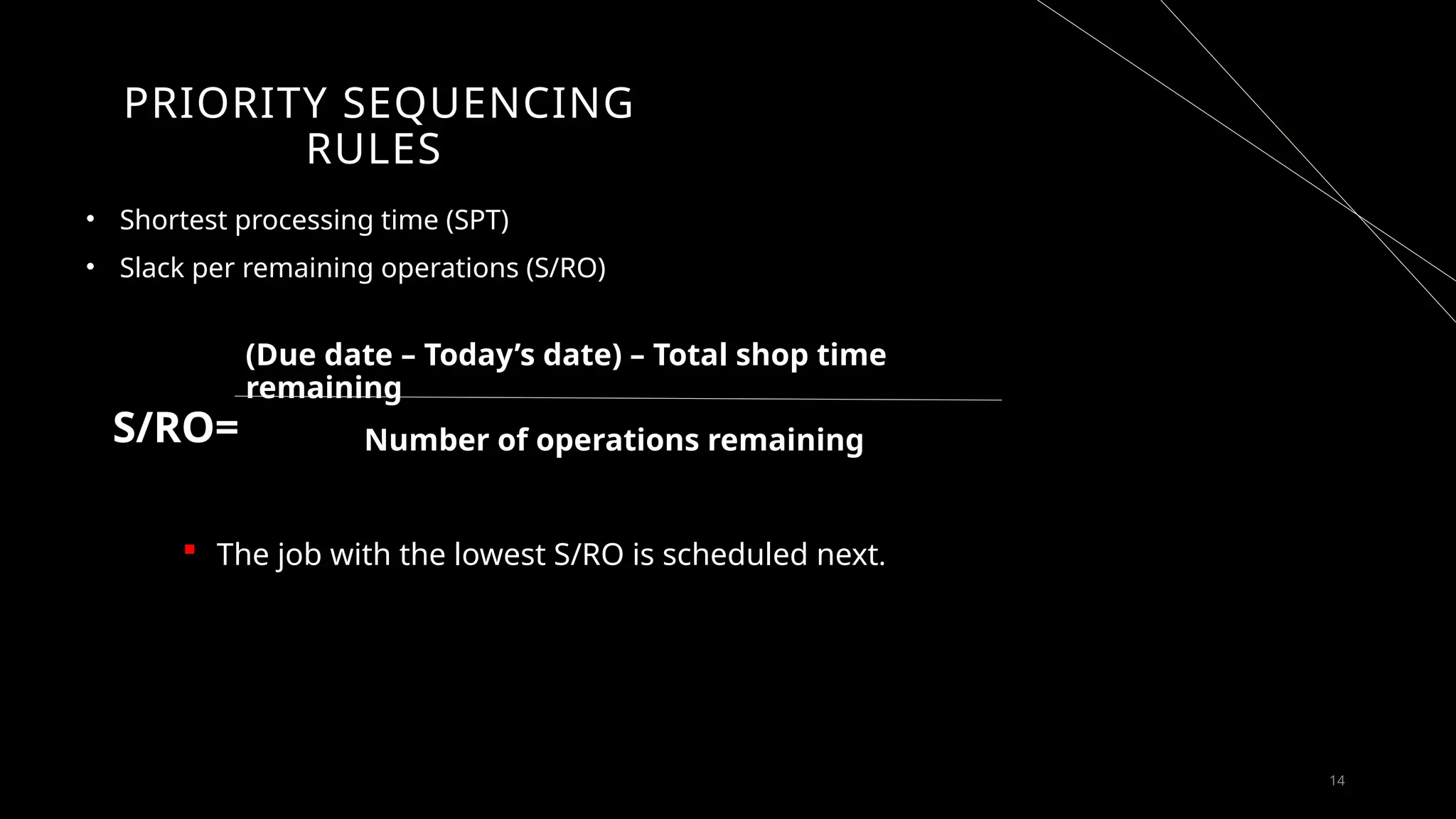
• Shortest processing time (SPT)
• Slack per remaining operations (S/RO)
S/RO=
(Due date – Today’s date) – Total shop time
remaining
Number of operations remaining
 The job with the lowest S/RO is scheduled next.
scheduled next
SEQUENCING ONE WORKSTATION
15
• Single-dimension rules
• A job’s priority assignment based
only on information waiting for
processing at the individual
workstation (e.g FCFS, EDD, and
SPT)
16
MULTIPLE-DIMENSION
RULES
• The priority rules CR and S/RO incorporate
information about the remaining workstations
S/RO is better than EDD with respect to the
percentage of jobs past due but usually worse than
SPT and EDD with respect to average job flow
times.
CR results in longer job flow times than SPT, but CR
also results in less variance in the distribution of
past due hours.
No choice is clearly best; each rule should be
tested in the environment for which it is intended.
MULTIPLE WORKSTATIONS
• Identifying the best priority rules to use at a
particular operation in a process is a complex
problem because the output from one operation
becomes the input to another
• Computer simulation models are effective tools to
determine which priority rules work best in a
given situation
17
SCHEDULING A TWO-STATION FLOW SHOP
• In single- workstation scheduling, the makespan is the same
regardless of the priority rule chosen
• In the scheduling of two or more workstations in a flow shop,
the makespan varies according to the sequence chosen
• Determining the makespan has two advantages
18
- The group of jobs is completed in the minimum time
- The utilization of the two-station flow shop is maximized
SCHEDULING JOBS FOR MULTIPLE
WORKSTATIONS
• Priority sequencing rules can be used to schedule more than one
operation. Each operation is treated independently.
• Identifying the best priority rule to use at a particular operation in a
process is a complex problem because the output from one process
becomes the input form another.
• Computer simulation models are effective tools to determine which
priority rules work best in a given situation.
• When a workstation becomes idle, the priority rule is applied to the
jobs waiting for that operation, and the job with the highest priority is
selected.
• When the ioperation is finished, the job is moved to the next operation
in its routing, where it waits until it again has the highest priority.
19
SCHEDULING PROBLEMS
• One machine, many jobs
- Total time is independent of
sequence
- SPT minimizes average flow time
• Two machine, many jobs
- All jobs follow same sequence –
Johnson’s Rule
-Jobs have different sequence –
Jackson’s Rule
-Johnson’s 3 machine rule
• Three machine, many jobs
• Four machine, many jobs
JOHNSON’S RULE
• Minimizes makespan when scheduling a group
of jobs on two workstations
21
Step 1: Scan the processing time at each
workstation and find the shortest processing
time among the jobs not yet scheduled. If two or
more jobs are tied, choose one job arbitrarily.
Step 2: If the shortest processing time is on
workstation 1, schedule the corresponding job
as early as possible. If the shortest processing
time is on workstation 2, schedule the
corresponding job as late as possible
Step 3: Eliminate the last job scheduled from
further consideration. Repeat steps 1 and 2 until
all jobs have been scheduled.
22
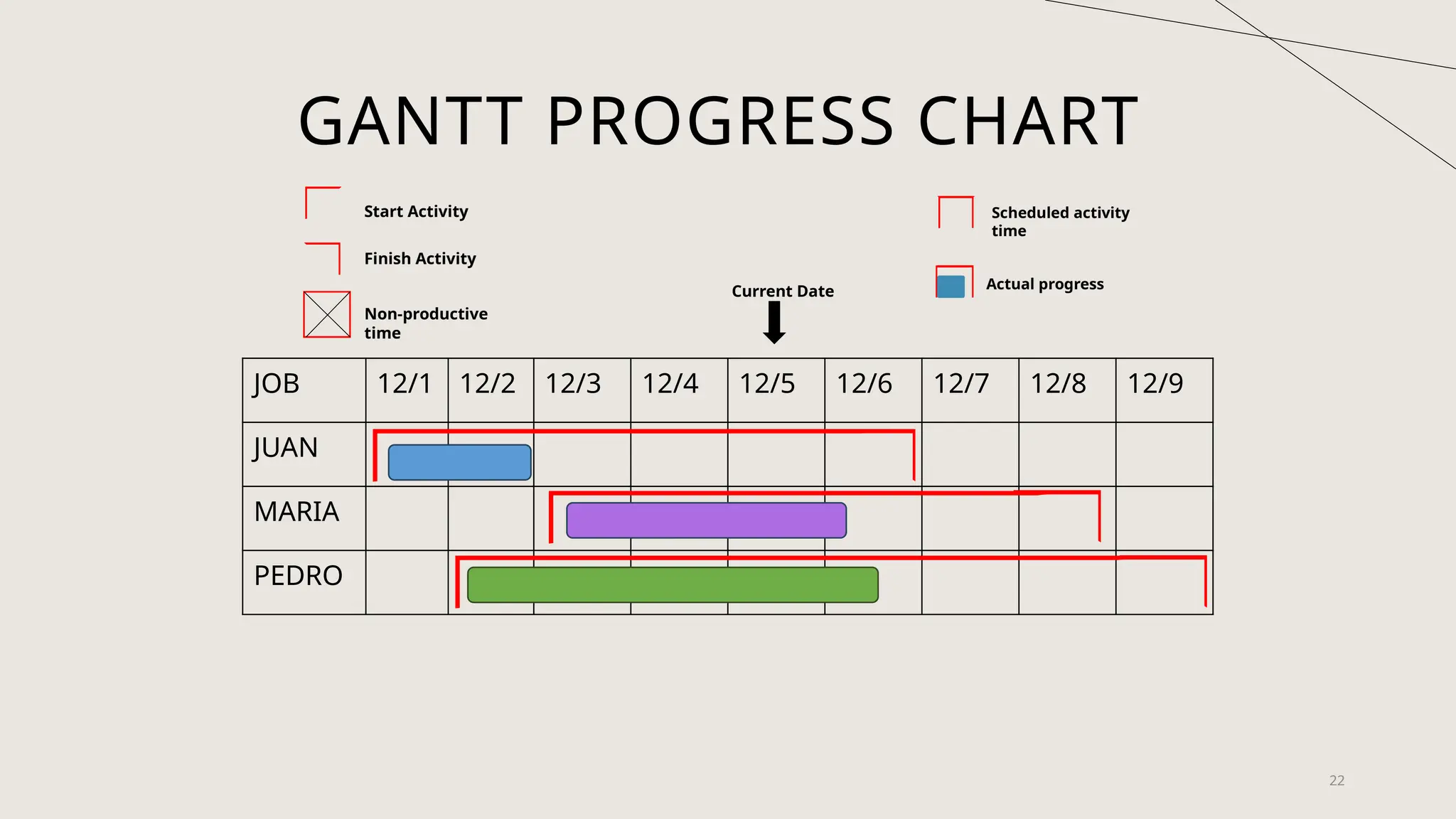
GANTT PROGRESS CHART
JOB 12/1 12/2 12/3 12/4 12/5 12/6 12/7 12/8 12/9
JUAN
MARIA
PEDRO
Current Date
Start Activity
Finish Activity
Non-productive
time
Scheduled activity
time
Actual progress
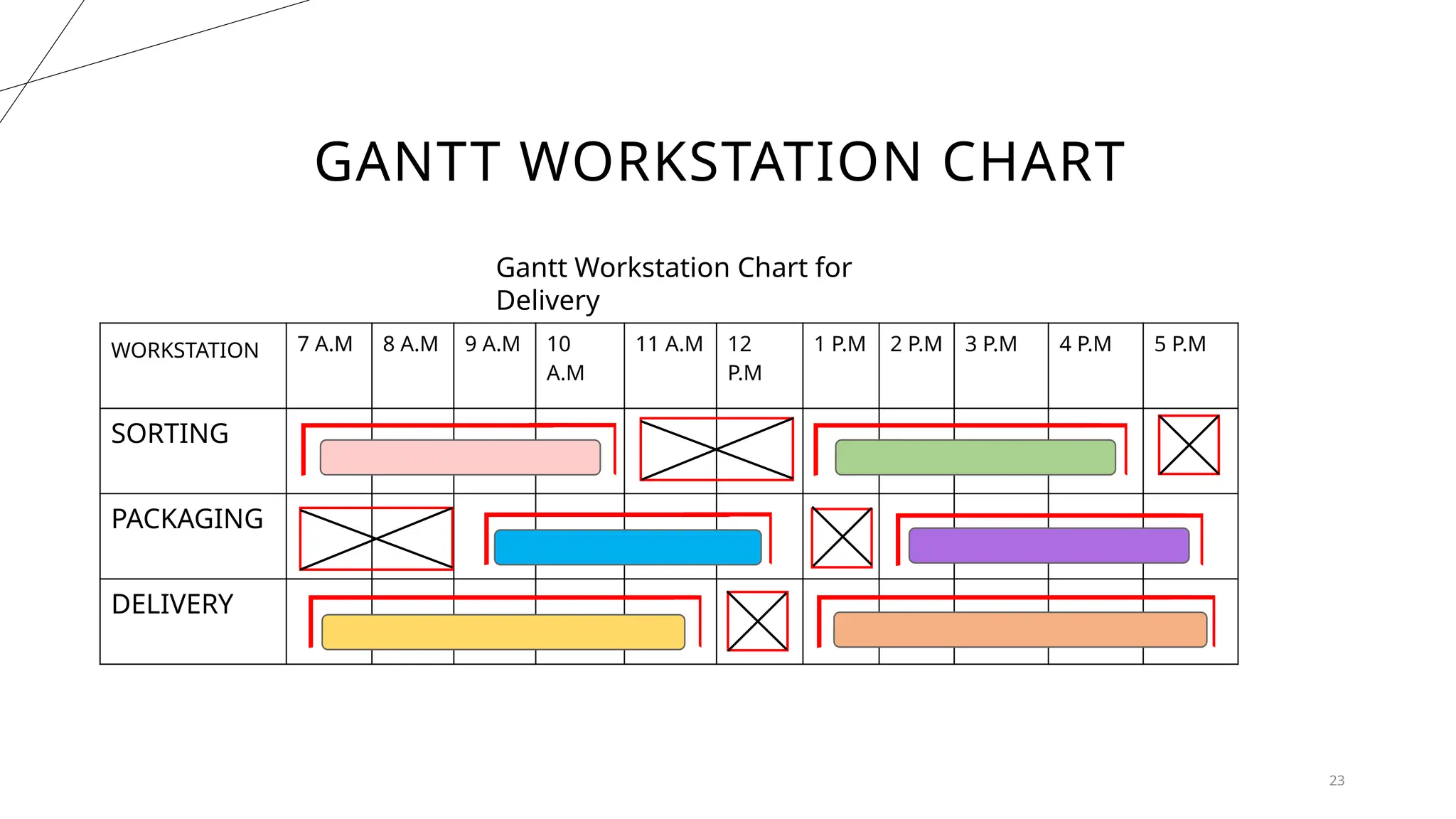
GANTT WORKSTATION CHART
23
WORKSTATION 7 A.M 8 A.M 9 A.M 10
A.M
11 A.M 12
P.M
1 P.M 2 P.M 3 P.M 4 P.M 5 P.M
SORTING
PACKAGING
DELIVERY
Gantt Workstation Chart for
Delivery
THANK YOU
24

OPERATIONS-SCHEDULING-AND-SEQUENCING.pptx

  • 1.
  • 2.
    MEET THE TEAM ALIKIBIEN ALMA GRACE CAYUBIT ​ 2
  • 3.
    WHAT DO YOUTHINK? As a student, how do you schedule your homework, school projects, and study activities? What criteria do you use? 3
  • 4.
    UNDERSTANDING SCHEDULING AND SEQUENCING Scheduling refersto the assignment of start and completion times to particular jobs, people, or equipment. - Examples: Scheduling restaurant employees, airline crews and planes, sports teams, factory jobs. Sequencing refers to determining the order in which jobs or tasks are processed. - Examples: Emergency room patients, automobile models on an assembly line, outgoing flights on runways. 4
  • 5.
    SCHEDULING APPLICATIONS AND APPROACHES Scheduling appliesto all aspects of the value chain, from planning and releasing orders in a factory, determining work shifts for employees, and making deliveries to customers. Tools: Spreadsheets Software packages Web-based tools
  • 6.
    SCHEDULING APPLICATIONS AND APPROACHES STAFFSCHEDULING ATTEMPTS TO MATCH AVAILABLE PERSONNEL WITH THE NEEDS OF THE ORGANIZATION BY: 1. Accurately forecasting demand and translating it into the quantity and timing of work to be done. 2. Determining the staffing required to perform the work by time period. 3. Determining the personnel available and the full- and part- time mix. 4. Matching capacity to demand requirements and developing a work schedule that maximizes service and minimizes costs. 6
  • 7.
    OBJECTIVES OF OPERATIONSSCHEDULING • Making Efficient use of the labour. • Making best possible use of the equipments that are available for the use. • Increasing the profit. • Increasing the output. • Improving the service level. 7 • Maximizing the delivery performance i.e meeting the delivery dates. • Minimizing the inventory • Reducing the manufacturing time. • Minimizing the production costs. • Minimizing the worker costs.
  • 8.
    TYPES OF SCHEDULING Types ofOperations Scheduling are as follows: 1. Forward operations scheduling - • Classified on the basis of the time. • All the activities are scheduled from the date of the planned order release. • First task of the job is scheduled. • Its subsequent task is scheduled on the scheduled completion of the first task. • Like this, accordingly all the task of the job are scheduled. 8 NOW DUE DATE
  • 9.
    TYPES OF SCHEDULING 2.Backward operations scheduling - • Also classified on the basis of the time. • Activities are scheduled from the date or the planned receipt date. • The last activity is scheduled first. • Time of the start of the last task is considred as the time for the start of the previous activity. 9 DUE DATE NOW
  • 10.
    SEQUENCING • Prioritize jobsassigned to a resource • If no order specified use first-come first- served (FCFS) • Last Come, First Served (LCFS) • DDATE- earliest due date • CUSTPR- highest customer priority 10 • SETUP – similar required setups • SLACK – smallest slack • CR- smallest critical ratio • SPT- shortest processing time • LPT – longest processing time
  • 11.
    SEQUENCING JOBS • Operationsschedules are short-term plans designed to implement the slaes and operations plan • An operation with divergent flows is often called a job shop - Low-to medium- volume production - Utilizes job or batch processes - The front office would be the equivalent for a service provider -Difficult to schedule because of the variability in job routings and the continual introduction of new jobs to be processed 11
  • 12.
    12 SEQUENCING JOBS • Anoperation with line flow is often called a flow shop - Medium-to high-volume production -Utilizes line or continuous flow processes - The back office would be the equivalent for a service provider - Tasks are easier to schedule because the jobs have a common flow pattern through the system
  • 13.
    PRIORITY SEQUENCING RULES • First-come,First-served (FCFS) • Earliest due date (EDD) • Critical Ratio (CR) CR= (Due date) – (Today’s date) 13 Total shop time Remaining  A ratio less than 1.0 implies that the job is behind schedule  A ratio greater than 1.0 implies the job is ahead of schedule  The job with the lowest CR (critical ratio) is scheduled next
  • 14.
    14 PRIORITY SEQUENCING RULES • Shortestprocessing time (SPT) • Slack per remaining operations (S/RO) S/RO= (Due date – Today’s date) – Total shop time remaining Number of operations remaining  The job with the lowest S/RO is scheduled next. scheduled next
  • 15.
    SEQUENCING ONE WORKSTATION 15 •Single-dimension rules • A job’s priority assignment based only on information waiting for processing at the individual workstation (e.g FCFS, EDD, and SPT)
  • 16.
    16 MULTIPLE-DIMENSION RULES • The priorityrules CR and S/RO incorporate information about the remaining workstations S/RO is better than EDD with respect to the percentage of jobs past due but usually worse than SPT and EDD with respect to average job flow times. CR results in longer job flow times than SPT, but CR also results in less variance in the distribution of past due hours. No choice is clearly best; each rule should be tested in the environment for which it is intended.
  • 17.
    MULTIPLE WORKSTATIONS • Identifyingthe best priority rules to use at a particular operation in a process is a complex problem because the output from one operation becomes the input to another • Computer simulation models are effective tools to determine which priority rules work best in a given situation 17
  • 18.
    SCHEDULING A TWO-STATIONFLOW SHOP • In single- workstation scheduling, the makespan is the same regardless of the priority rule chosen • In the scheduling of two or more workstations in a flow shop, the makespan varies according to the sequence chosen • Determining the makespan has two advantages 18 - The group of jobs is completed in the minimum time - The utilization of the two-station flow shop is maximized
  • 19.
    SCHEDULING JOBS FORMULTIPLE WORKSTATIONS • Priority sequencing rules can be used to schedule more than one operation. Each operation is treated independently. • Identifying the best priority rule to use at a particular operation in a process is a complex problem because the output from one process becomes the input form another. • Computer simulation models are effective tools to determine which priority rules work best in a given situation. • When a workstation becomes idle, the priority rule is applied to the jobs waiting for that operation, and the job with the highest priority is selected. • When the ioperation is finished, the job is moved to the next operation in its routing, where it waits until it again has the highest priority. 19
  • 20.
    SCHEDULING PROBLEMS • Onemachine, many jobs - Total time is independent of sequence - SPT minimizes average flow time • Two machine, many jobs - All jobs follow same sequence – Johnson’s Rule -Jobs have different sequence – Jackson’s Rule -Johnson’s 3 machine rule • Three machine, many jobs • Four machine, many jobs
  • 21.
    JOHNSON’S RULE • Minimizesmakespan when scheduling a group of jobs on two workstations 21 Step 1: Scan the processing time at each workstation and find the shortest processing time among the jobs not yet scheduled. If two or more jobs are tied, choose one job arbitrarily. Step 2: If the shortest processing time is on workstation 1, schedule the corresponding job as early as possible. If the shortest processing time is on workstation 2, schedule the corresponding job as late as possible Step 3: Eliminate the last job scheduled from further consideration. Repeat steps 1 and 2 until all jobs have been scheduled.
  • 22.
    22 GANTT PROGRESS CHART JOB12/1 12/2 12/3 12/4 12/5 12/6 12/7 12/8 12/9 JUAN MARIA PEDRO Current Date Start Activity Finish Activity Non-productive time Scheduled activity time Actual progress

  • 23.
    GANTT WORKSTATION CHART 23 WORKSTATION7 A.M 8 A.M 9 A.M 10 A.M 11 A.M 12 P.M 1 P.M 2 P.M 3 P.M 4 P.M 5 P.M SORTING PACKAGING DELIVERY Gantt Workstation Chart for Delivery
  • 24.