1
Chapter 15
Scheduling
2
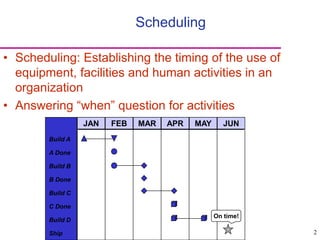
• Scheduling: Establishing the timing of the use of
equipment, facilities and human activities in an
organization
• Answering “when” question for activities
Scheduling
Build A
A Done
Build B
B Done
Build C
C Done
Build D
Ship
JAN FEB MAR APR MAY JUN
On time!
3
High-Volume Systems
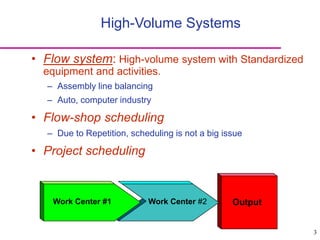
• Flow system: High-volume system with Standardized
equipment and activities.
– Assembly line balancing
– Auto, computer industry
• Flow-shop scheduling
– Due to Repetition, scheduling is not a big issue
• Project scheduling
Work Center #1 Work Center #2 Output
4
High-Volume Success Factors
• Process and product design
• Preventive maintenance
• Rapid repair when breakdown occurs
• Optimal product mixes
– Most profit subject to capacities = LP
• Minimization of quality problems
• Reliability and timing of supplies
5
Intermediate-Volume Systems
• Outputs are between standardized high-
volume systems and made-to-order job
shops
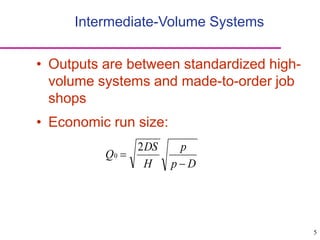
• Economic run size:
D
p
p
H
DS
Q


2
0
6
Scheduling Low-Volume Systems
• Low volume systems
– Minimal repetition
– Schedule from scratch every time
• Loading - assignment of jobs to process
centers
• Sequencing - determining the order in
which jobs will be processed
– Sequencing vs. Scheduling
7
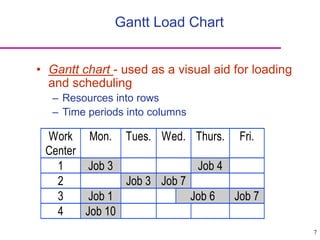
Gantt Load Chart
• Gantt chart - used as a visual aid for loading
and scheduling
– Resources into rows
– Time periods into columns
Work
Center
Mon. Tues. Wed. Thurs. Fri.
1 Job 3 Job 4
2 Job 3 Job 7
3 Job 1 Job 6 Job 7
4 Job 10
8
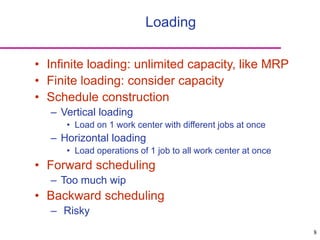
• Infinite loading: unlimited capacity, like MRP
• Finite loading: consider capacity
• Schedule construction
– Vertical loading
• Load on 1 work center with different jobs at once
– Horizontal loading
• Load operations of 1 job to all work center at once
• Forward scheduling
– Too much wip
• Backward scheduling
– Risky
Loading
9
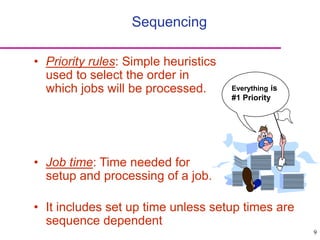
Sequencing
• Priority rules: Simple heuristics
used to select the order in
which jobs will be processed.
• Job time: Time needed for
setup and processing of a job.
• It includes set up time unless setup times are
sequence dependent
Everything is
#1 Priority
10
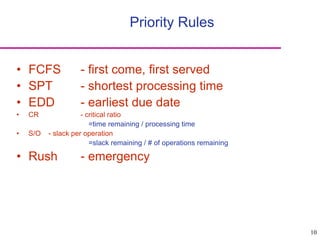
Priority Rules
• FCFS - first come, first served
• SPT - shortest processing time
• EDD - earliest due date
• CR - critical ratio
=time remaining / processing time
• S/O - slack per operation
=slack remaining / # of operations remaining
• Rush - emergency
11
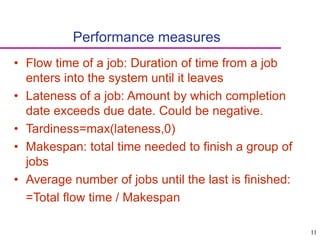
Performance measures
• Flow time of a job: Duration of time from a job
enters into the system until it leaves
• Lateness of a job: Amount by which completion
date exceeds due date. Could be negative.
• Tardiness=max(lateness,0)
• Makespan: total time needed to finish a group of
jobs
• Average number of jobs until the last is finished:
=Total flow time / Makespan
12
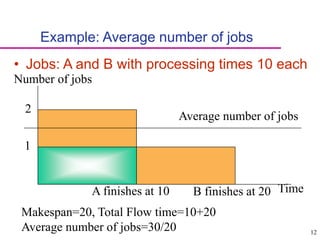
Example: Average number of jobs
• Jobs: A and B with processing times 10 each
A finishes at 10
Number of jobs
1
2
B finishes at 20 Time
Makespan=20, Total Flow time=10+20
Average number of jobs=30/20
Average number of jobs
13
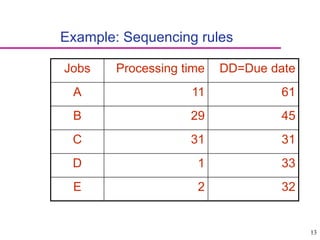
Example: Sequencing rules
Jobs Processing time DD=Due date
A 11 61
B 29 45
C 31 31
D 1 33
E 2 32
14
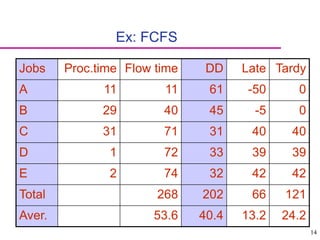
Ex: FCFS
Jobs Proc.time Flow time DD Late Tardy
A 11 11 61 -50 0
B 29 40 45 -5 0
C 31 71 31 40 40
D 1 72 33 39 39
E 2 74 32 42 42
Total 268 202 66 121
Aver. 53.6 40.4 13.2 24.2
15
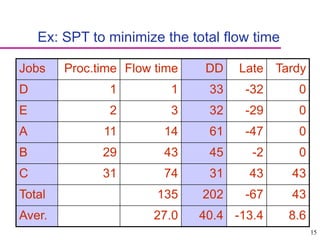
Ex: SPT to minimize the total flow time
Jobs Proc.time Flow time DD Late Tardy
D 1 1 33 -32 0
E 2 3 32 -29 0
A 11 14 61 -47 0
B 29 43 45 -2 0
C 31 74 31 43 43
Total 135 202 -67 43
Aver. 27.0 40.4 -13.4 8.6
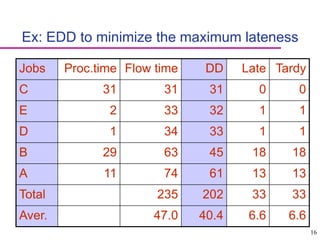
16
Ex: EDD to minimize the maximum lateness
Jobs Proc.time Flow time DD Late Tardy
C 31 31 31 0 0
E 2 33 32 1 1
D 1 34 33 1 1
B 29 63 45 18 18
A 11 74 61 13 13
Total 235 202 33 33
Aver. 47.0 40.4 6.6 6.6
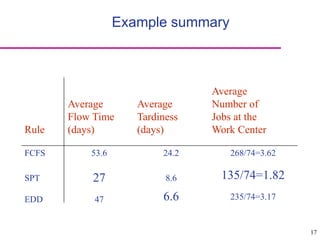
17
235/74=3.17
6.6
47
EDD
135/74=1.82
8.6
27
SPT
268/74=3.62
24.2
53.6
FCFS
Average
Number of
Jobs at the
Work Center
Average
Tardiness
(days)
Average
Flow Time
(days)
Rule
Example summary
18
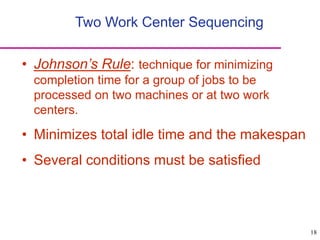
Two Work Center Sequencing
• Johnson’s Rule: technique for minimizing
completion time for a group of jobs to be
processed on two machines or at two work
centers.
• Minimizes total idle time and the makespan
• Several conditions must be satisfied
19
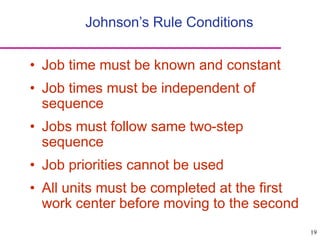
Johnson’s Rule Conditions
• Job time must be known and constant
• Job times must be independent of
sequence
• Jobs must follow same two-step
sequence
• Job priorities cannot be used
• All units must be completed at the first
work center before moving to the second
20
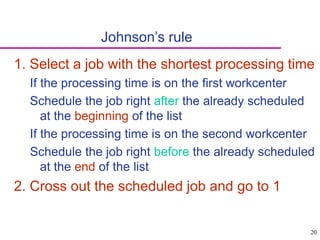
Johnson’s rule
1. Select a job with the shortest processing time
If the processing time is on the first workcenter
Schedule the job right after the already scheduled
at the beginning of the list
If the processing time is on the second workcenter
Schedule the job right before the already scheduled
at the end of the list
2. Cross out the scheduled job and go to 1
21
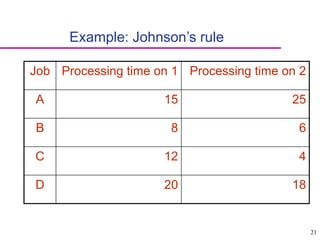
Example: Johnson’s rule
Job Processing time on 1 Processing time on 2
A 15 25
B 8 6
C 12 4
D 20 18
22
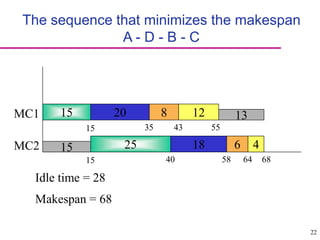
The sequence that minimizes the makespan
A - D - B - C
15
25
20
18
8
6
12
4
15
15 35
40
43
58
55
64 68
15
13
Idle time = 28
Makespan = 68
MC1
MC2
23
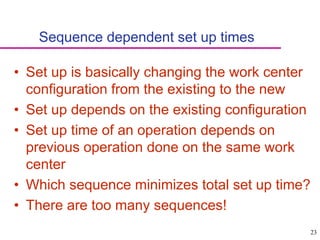
Sequence dependent set up times
• Set up is basically changing the work center
configuration from the existing to the new
• Set up depends on the existing configuration
• Set up time of an operation depends on
previous operation done on the same work
center
• Which sequence minimizes total set up time?
• There are too many sequences!
24
Scheduling Service Operations
• Bottleneck operations
• Appointment systems
– Controls customer arrivals for service
• Consider patient scheduling
• Reservation systems
– Estimates demand for service
• Scheduling the workforce
– Manages capacity for service
• Scheduling multiple resources
– Coordinates use of more than one resource

scheduling.ppt course not for industrial engineering students

  • 1.
  • 2.
    2 • Scheduling: Establishingthe timing of the use of equipment, facilities and human activities in an organization • Answering “when” question for activities Scheduling Build A A Done Build B B Done Build C C Done Build D Ship JAN FEB MAR APR MAY JUN On time!
  • 3.
    3 High-Volume Systems • Flowsystem: High-volume system with Standardized equipment and activities. – Assembly line balancing – Auto, computer industry • Flow-shop scheduling – Due to Repetition, scheduling is not a big issue • Project scheduling Work Center #1 Work Center #2 Output
  • 4.
    4 High-Volume Success Factors •Process and product design • Preventive maintenance • Rapid repair when breakdown occurs • Optimal product mixes – Most profit subject to capacities = LP • Minimization of quality problems • Reliability and timing of supplies
  • 5.
    5 Intermediate-Volume Systems • Outputsare between standardized high- volume systems and made-to-order job shops • Economic run size: D p p H DS Q   2 0
  • 6.
    6 Scheduling Low-Volume Systems •Low volume systems – Minimal repetition – Schedule from scratch every time • Loading - assignment of jobs to process centers • Sequencing - determining the order in which jobs will be processed – Sequencing vs. Scheduling
  • 7.
    7 Gantt Load Chart •Gantt chart - used as a visual aid for loading and scheduling – Resources into rows – Time periods into columns Work Center Mon. Tues. Wed. Thurs. Fri. 1 Job 3 Job 4 2 Job 3 Job 7 3 Job 1 Job 6 Job 7 4 Job 10
  • 8.
    8 • Infinite loading:unlimited capacity, like MRP • Finite loading: consider capacity • Schedule construction – Vertical loading • Load on 1 work center with different jobs at once – Horizontal loading • Load operations of 1 job to all work center at once • Forward scheduling – Too much wip • Backward scheduling – Risky Loading
  • 9.
    9 Sequencing • Priority rules:Simple heuristics used to select the order in which jobs will be processed. • Job time: Time needed for setup and processing of a job. • It includes set up time unless setup times are sequence dependent Everything is #1 Priority
  • 10.
    10 Priority Rules • FCFS- first come, first served • SPT - shortest processing time • EDD - earliest due date • CR - critical ratio =time remaining / processing time • S/O - slack per operation =slack remaining / # of operations remaining • Rush - emergency
  • 11.
    11 Performance measures • Flowtime of a job: Duration of time from a job enters into the system until it leaves • Lateness of a job: Amount by which completion date exceeds due date. Could be negative. • Tardiness=max(lateness,0) • Makespan: total time needed to finish a group of jobs • Average number of jobs until the last is finished: =Total flow time / Makespan
  • 12.
    12 Example: Average numberof jobs • Jobs: A and B with processing times 10 each A finishes at 10 Number of jobs 1 2 B finishes at 20 Time Makespan=20, Total Flow time=10+20 Average number of jobs=30/20 Average number of jobs
  • 13.
    13 Example: Sequencing rules JobsProcessing time DD=Due date A 11 61 B 29 45 C 31 31 D 1 33 E 2 32
  • 14.
    14 Ex: FCFS Jobs Proc.timeFlow time DD Late Tardy A 11 11 61 -50 0 B 29 40 45 -5 0 C 31 71 31 40 40 D 1 72 33 39 39 E 2 74 32 42 42 Total 268 202 66 121 Aver. 53.6 40.4 13.2 24.2
  • 15.
    15 Ex: SPT tominimize the total flow time Jobs Proc.time Flow time DD Late Tardy D 1 1 33 -32 0 E 2 3 32 -29 0 A 11 14 61 -47 0 B 29 43 45 -2 0 C 31 74 31 43 43 Total 135 202 -67 43 Aver. 27.0 40.4 -13.4 8.6
  • 16.
    16 Ex: EDD tominimize the maximum lateness Jobs Proc.time Flow time DD Late Tardy C 31 31 31 0 0 E 2 33 32 1 1 D 1 34 33 1 1 B 29 63 45 18 18 A 11 74 61 13 13 Total 235 202 33 33 Aver. 47.0 40.4 6.6 6.6
  • 17.
    17 235/74=3.17 6.6 47 EDD 135/74=1.82 8.6 27 SPT 268/74=3.62 24.2 53.6 FCFS Average Number of Jobs atthe Work Center Average Tardiness (days) Average Flow Time (days) Rule Example summary
  • 18.
    18 Two Work CenterSequencing • Johnson’s Rule: technique for minimizing completion time for a group of jobs to be processed on two machines or at two work centers. • Minimizes total idle time and the makespan • Several conditions must be satisfied
  • 19.
    19 Johnson’s Rule Conditions •Job time must be known and constant • Job times must be independent of sequence • Jobs must follow same two-step sequence • Job priorities cannot be used • All units must be completed at the first work center before moving to the second
  • 20.
    20 Johnson’s rule 1. Selecta job with the shortest processing time If the processing time is on the first workcenter Schedule the job right after the already scheduled at the beginning of the list If the processing time is on the second workcenter Schedule the job right before the already scheduled at the end of the list 2. Cross out the scheduled job and go to 1
  • 21.
    21 Example: Johnson’s rule JobProcessing time on 1 Processing time on 2 A 15 25 B 8 6 C 12 4 D 20 18
  • 22.
    22 The sequence thatminimizes the makespan A - D - B - C 15 25 20 18 8 6 12 4 15 15 35 40 43 58 55 64 68 15 13 Idle time = 28 Makespan = 68 MC1 MC2
  • 23.
    23 Sequence dependent setup times • Set up is basically changing the work center configuration from the existing to the new • Set up depends on the existing configuration • Set up time of an operation depends on previous operation done on the same work center • Which sequence minimizes total set up time? • There are too many sequences!
  • 24.
    24 Scheduling Service Operations •Bottleneck operations • Appointment systems – Controls customer arrivals for service • Consider patient scheduling • Reservation systems – Estimates demand for service • Scheduling the workforce – Manages capacity for service • Scheduling multiple resources – Coordinates use of more than one resource