15-1 Scheduling
William J. Stevenson
Operations Management
8th edition
15-2 Scheduling
CHAPTER
15
Scheduling
McGraw-Hill/Irwin
Operations Management, Eighth Edition, by William J. Stevenson
Copyright © 2005 by The McGraw-Hill Companies, Inc. All rights reserved.
15-3 Scheduling
 Scheduling: Establishing the timing of the
use of equipment, facilities and human
activities in an organization
 Effective scheduling can yield
 Cost savings
 Increases in productivity
Scheduling
15-4 Scheduling
High-Volume Systems
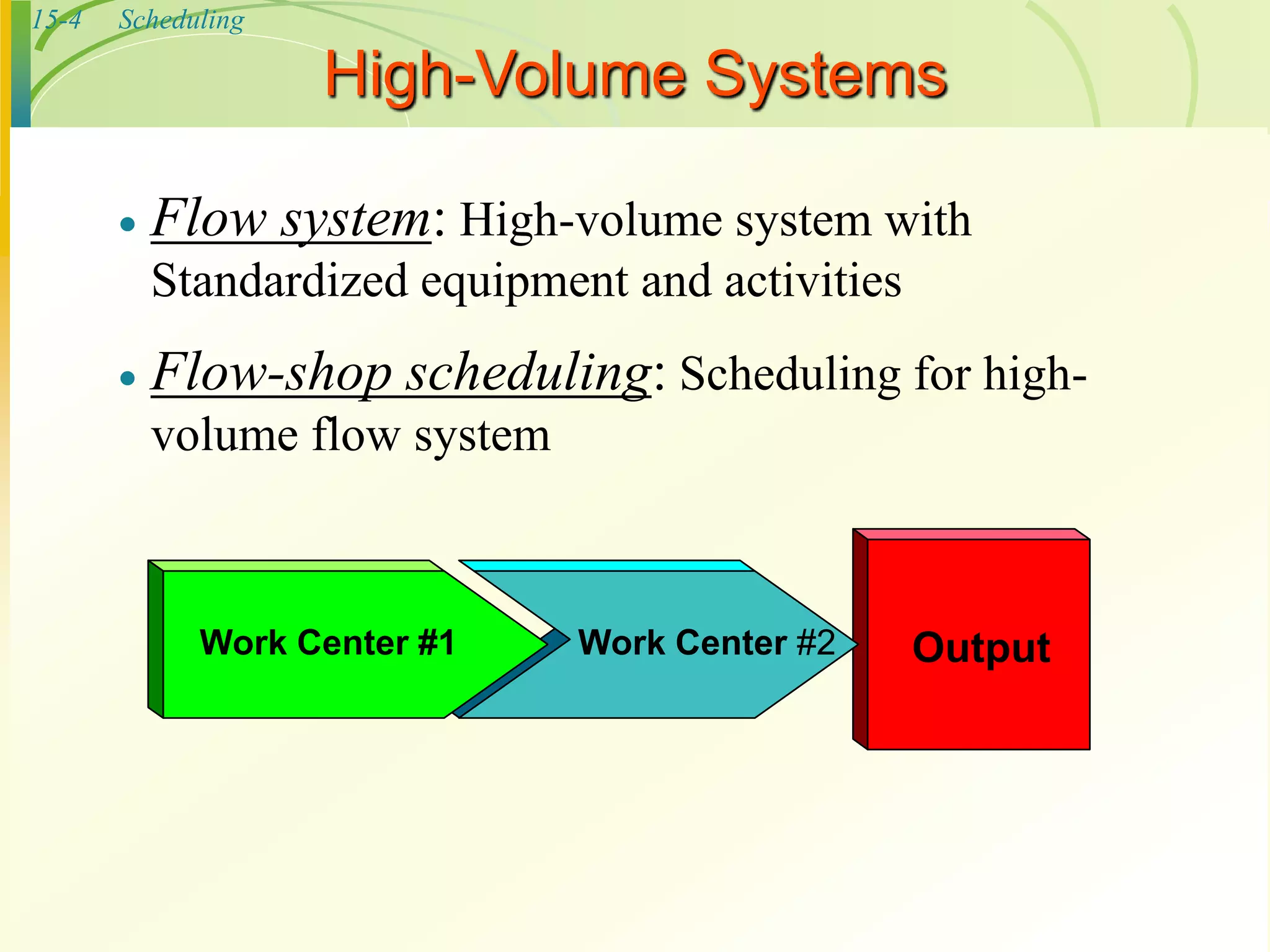
 Flow system: High-volume system with
Standardized equipment and activities
 Flow-shop scheduling: Scheduling for high-
volume flow system
Work Center #1 Work Center #2 Output
15-5 Scheduling
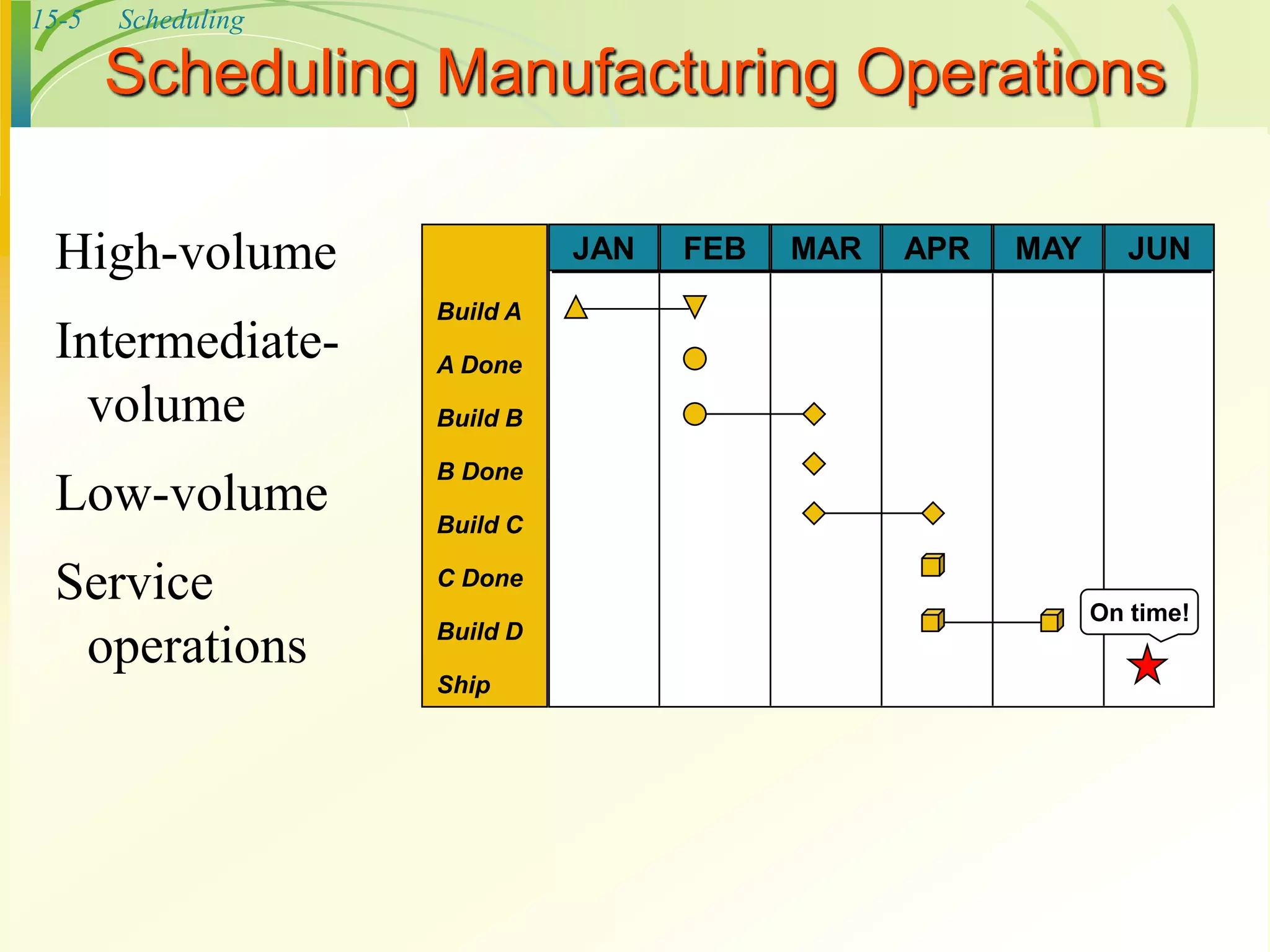
Build A
A Done
Build B
B Done
Build C
C Done
Build D
Ship
JAN FEB MAR APR MAY JUN
On time!
Scheduling Manufacturing Operations
High-volume
Intermediate-
volume
Low-volume
Service
operations
15-6 Scheduling
High-Volume Success Factors
 Process and product design
 Preventive maintenance
 Rapid repair when breakdown occurs
 Optimal product mixes
 Minimization of quality problems
 Reliability and timing of supplies
15-7 Scheduling
Intermediate-Volume Systems
 Outputs are between standardized high-
volume systems and made-to-order job shops
 Run size, timing, and sequence of jobs
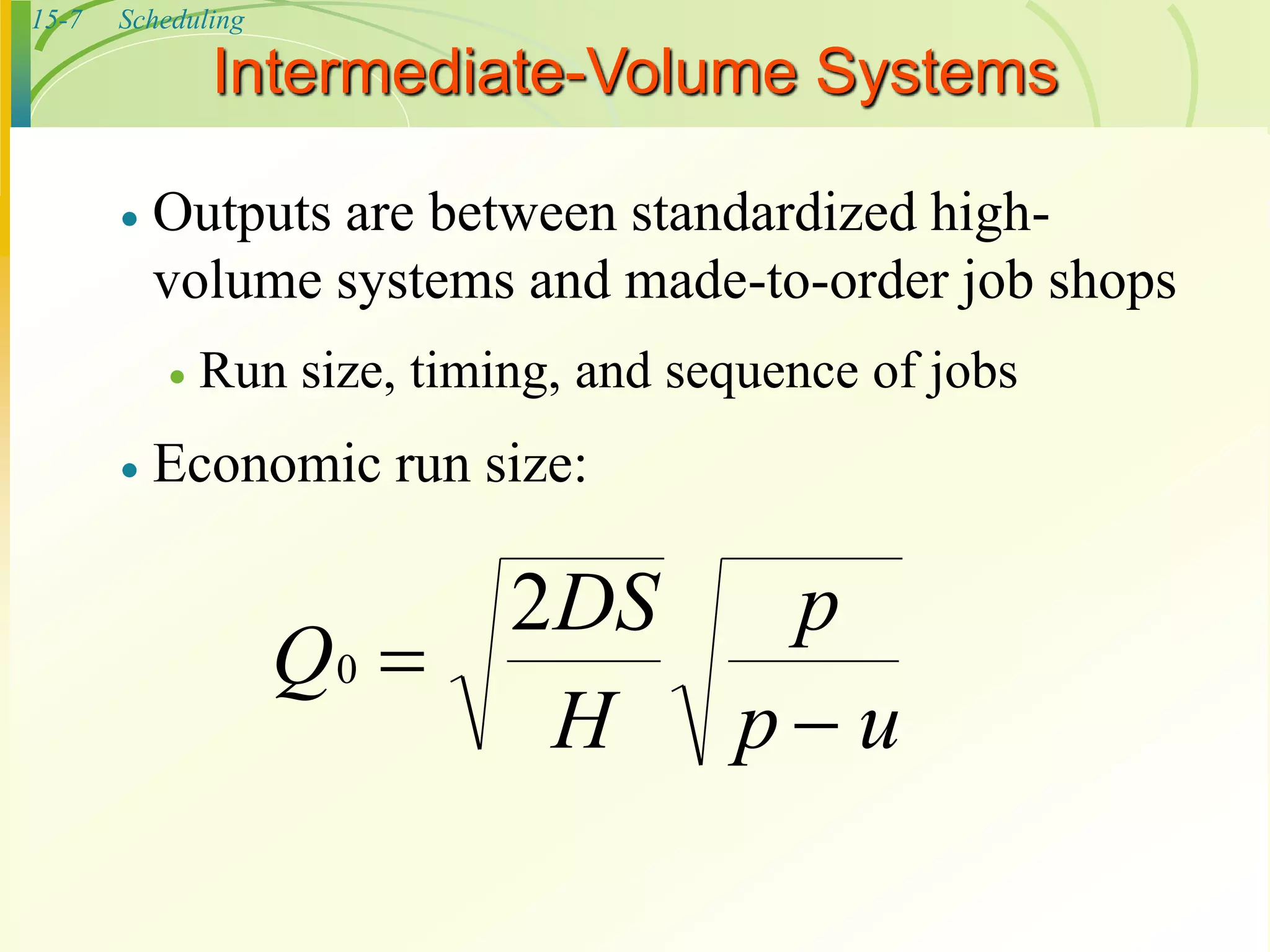
 Economic run size:
Q
DS
H
p
p u
0
2


15-8 Scheduling
Scheduling Low-Volume Systems
 Loading - assignment of jobs to process
centers
 Sequencing - determining the order in
which jobs will be processed
 Job-shop scheduling
 Scheduling for low-volume
systems with many
variations
in requirements
15-9 Scheduling
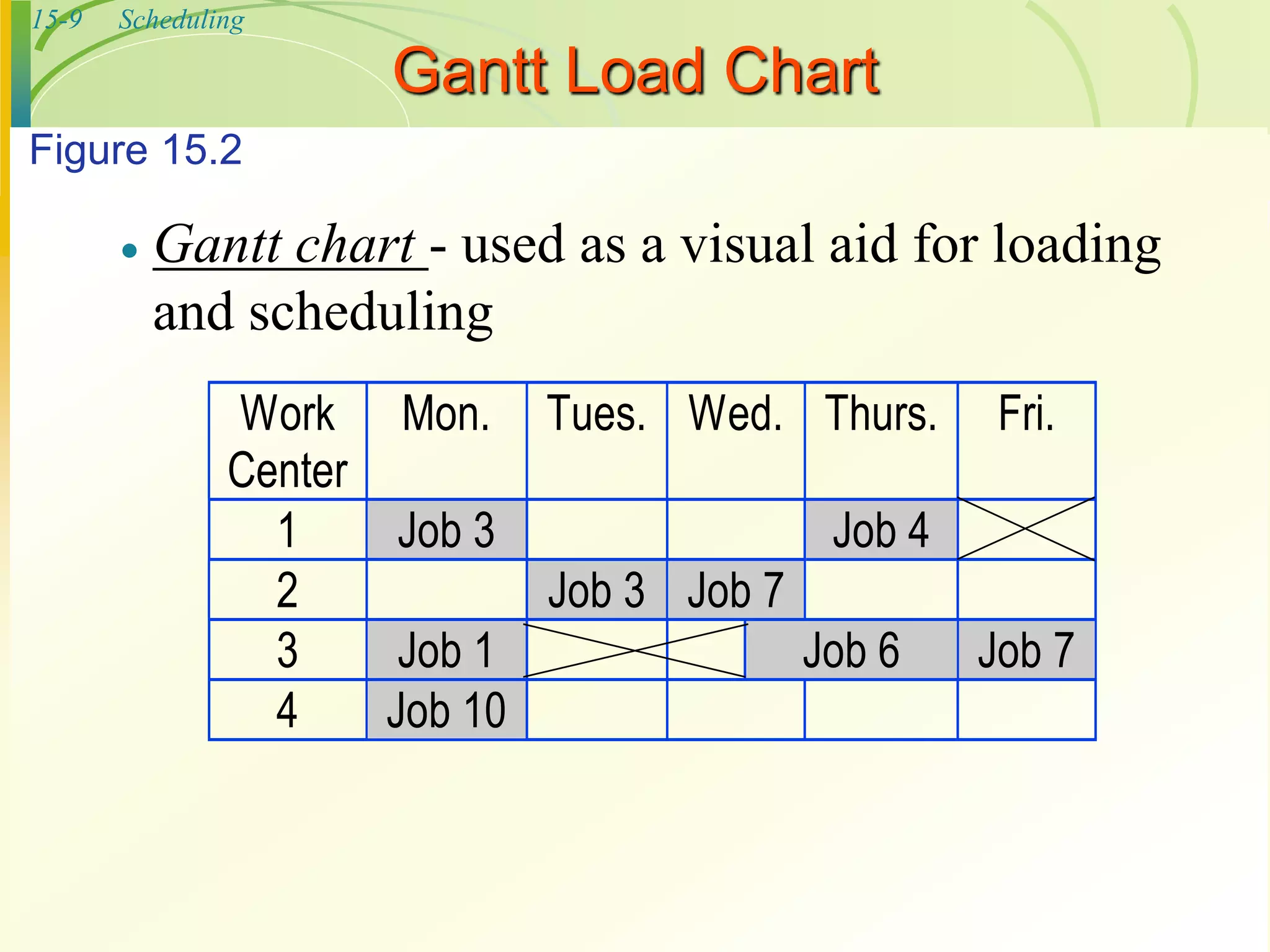
Gantt Load Chart
 Gantt chart - used as a visual aid for loading
and scheduling
Work
Center
Mon. Tues. Wed. Thurs. Fri.
1 Job 3 Job 4
2 Job 3 Job 7
3 Job 1 Job 6 Job 7
4 Job 10
Figure 15.2
15-10 Scheduling
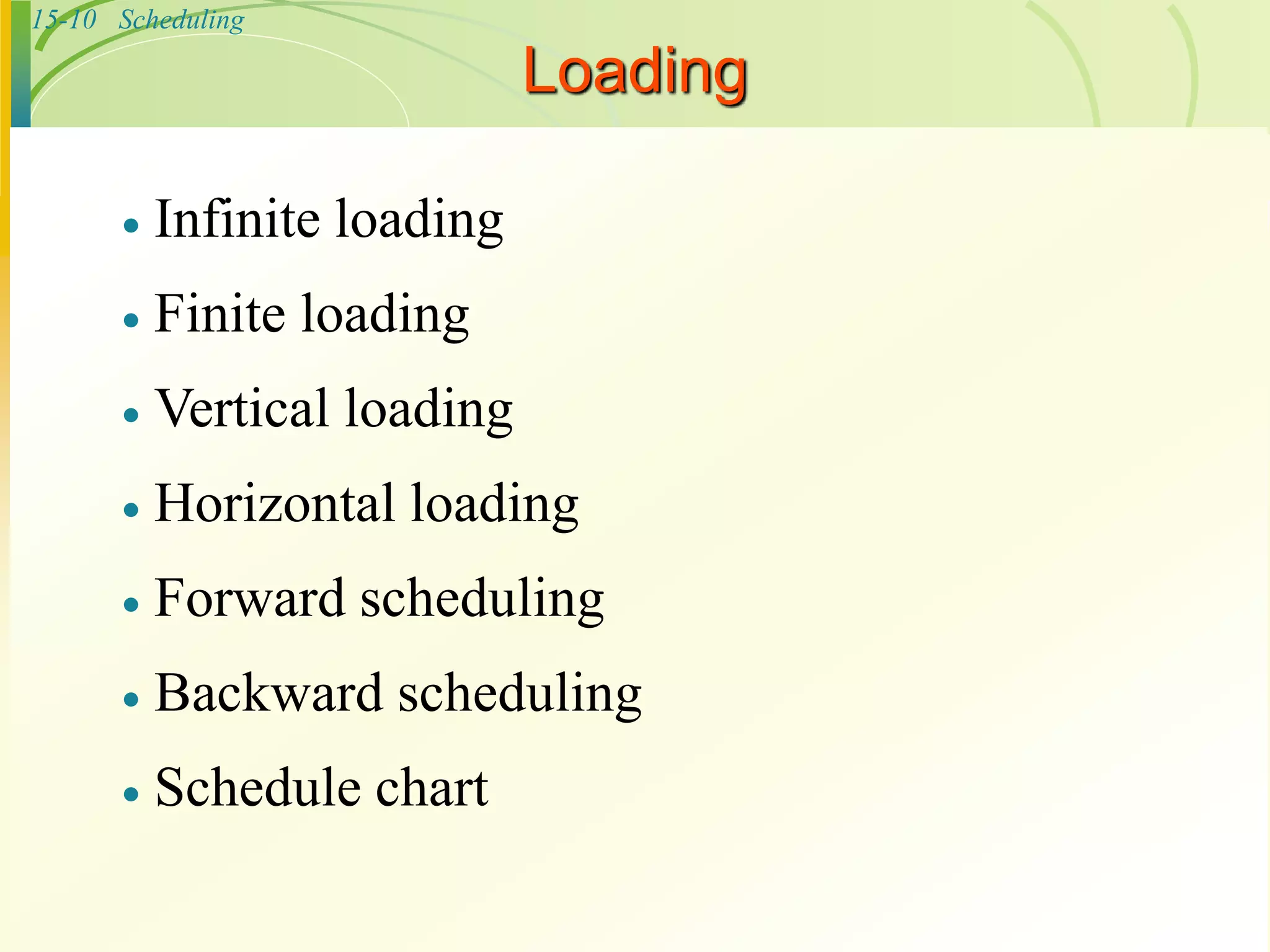
 Infinite loading
 Finite loading
 Vertical loading
 Horizontal loading
 Forward scheduling
 Backward scheduling
 Schedule chart
Loading
15-11 Scheduling
Sequencing
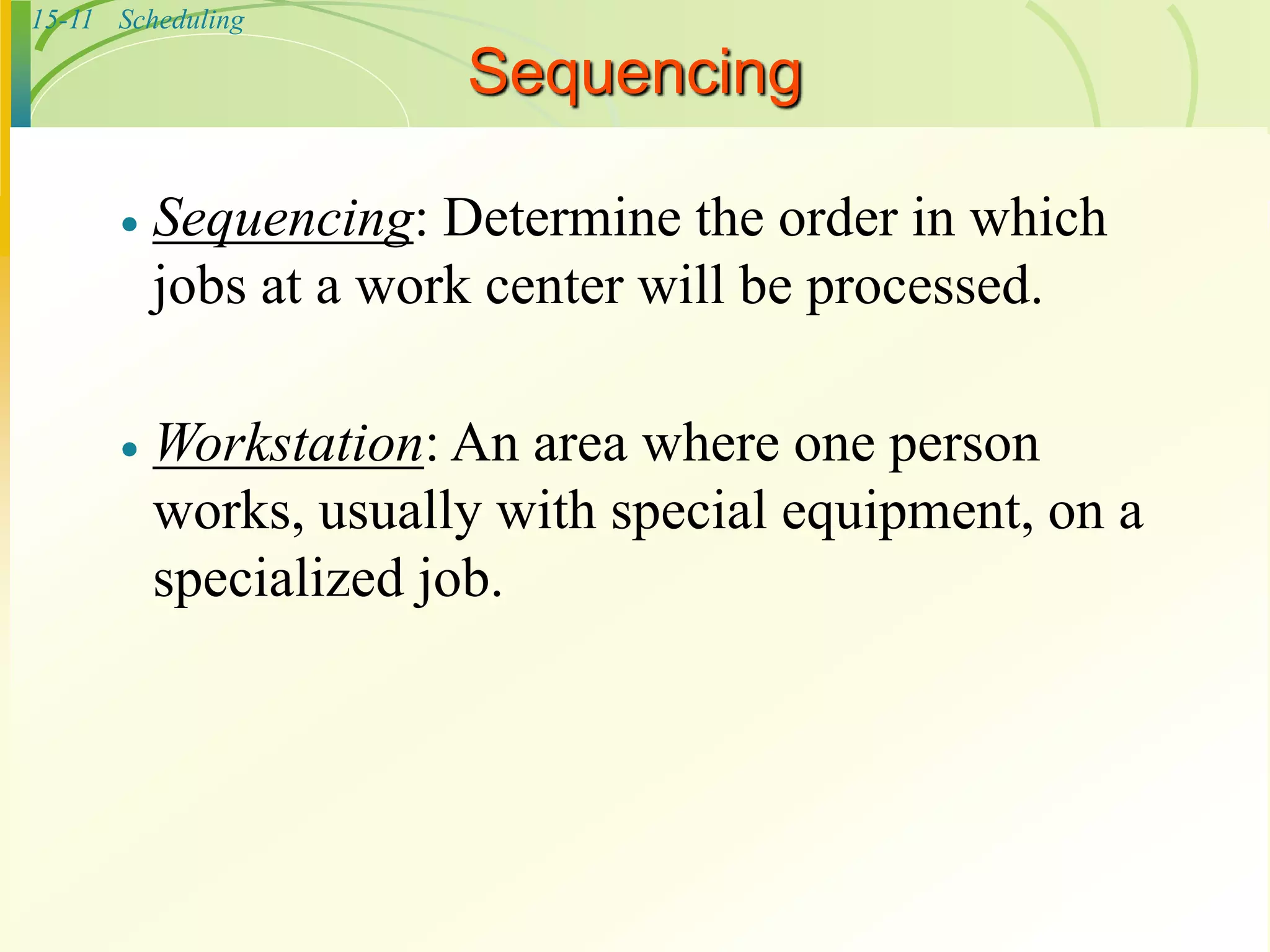
 Sequencing: Determine the order in which
jobs at a work center will be processed.
 Workstation: An area where one person
works, usually with special equipment, on a
specialized job.
15-12 Scheduling
Sequencing
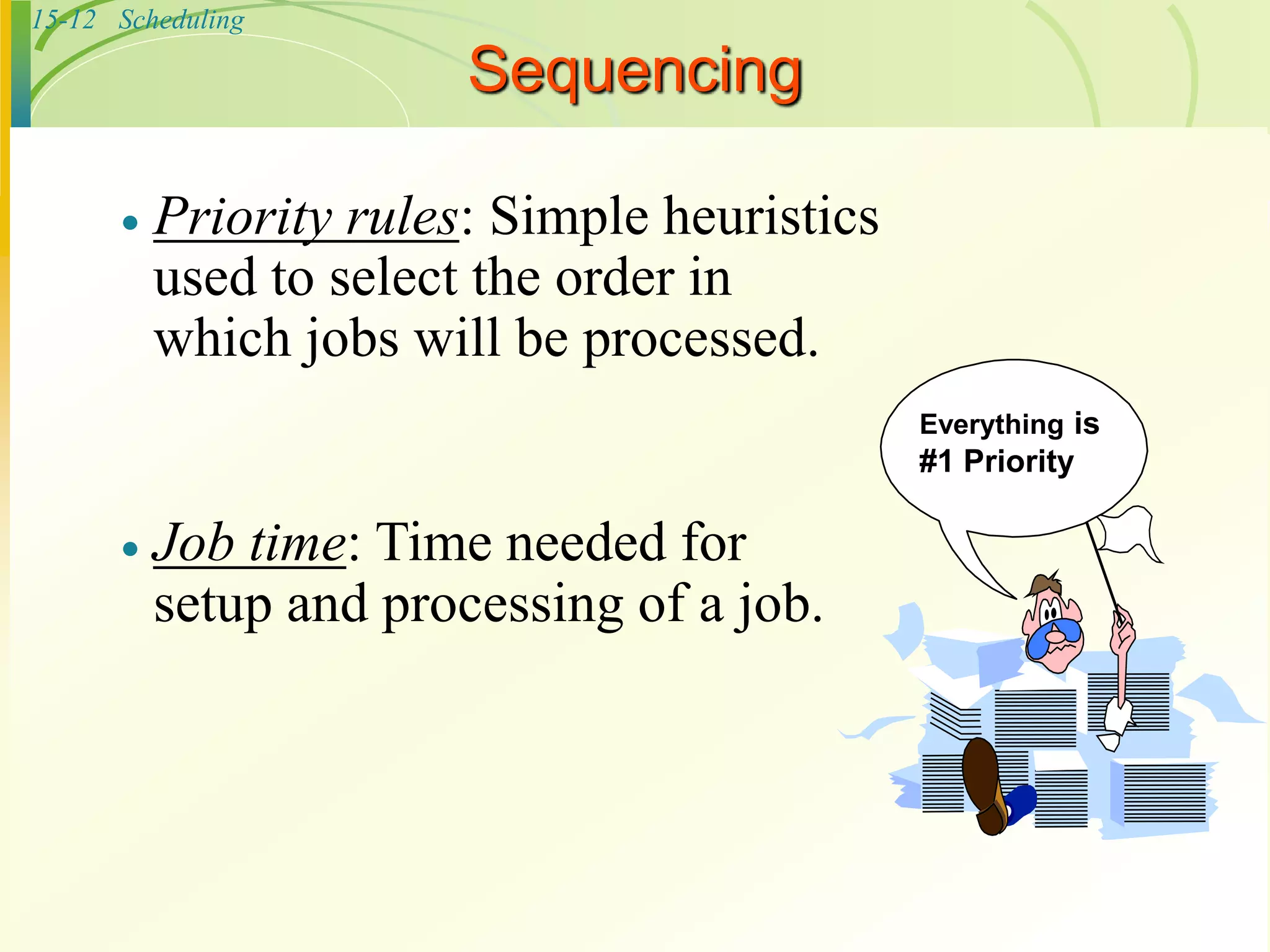
 Priority rules: Simple heuristics
used to select the order in
which jobs will be processed.
 Job time: Time needed for
setup and processing of a job.
Everything is
#1 Priority
15-13 Scheduling
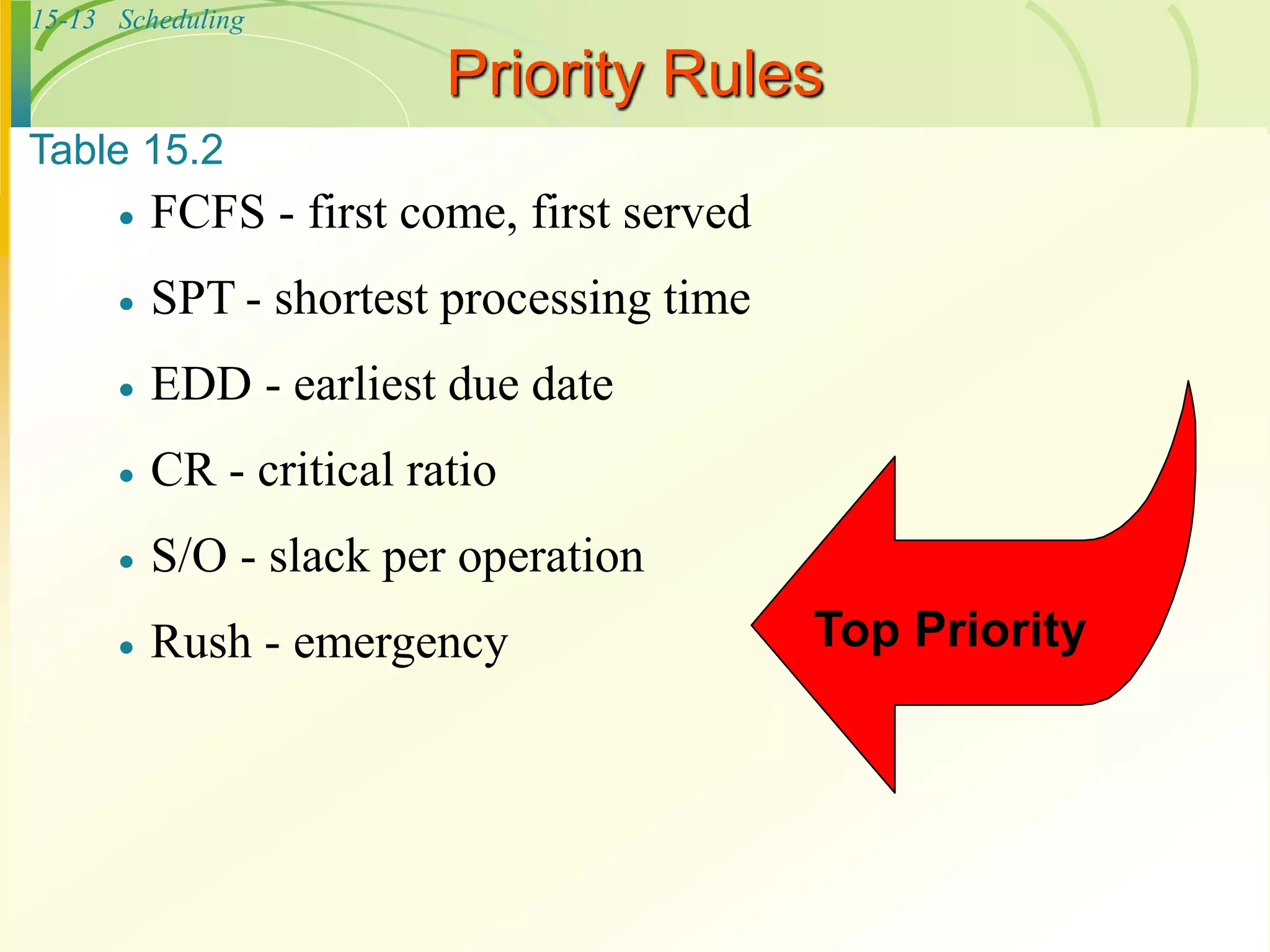
Priority Rules
 FCFS - first come, first served
 SPT - shortest processing time
 EDD - earliest due date
 CR - critical ratio
 S/O - slack per operation
 Rush - emergency Top Priority
Table 15.2
15-14 Scheduling
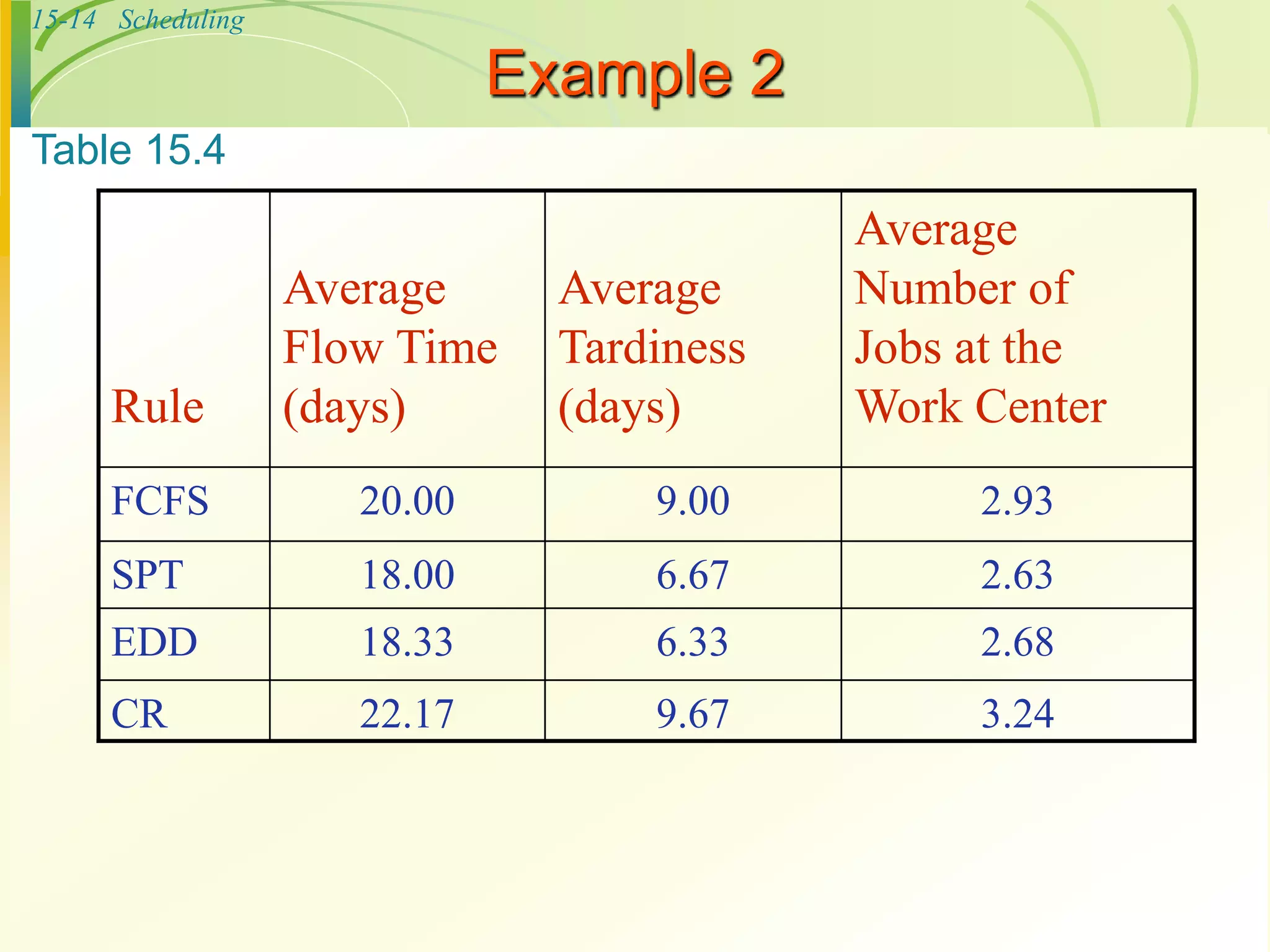
3.24
9.67
22.17
CR
2.68
6.33
18.33
EDD
2.63
6.67
18.00
SPT
2.93
9.00
20.00
FCFS
Average
Number of
Jobs at the
Work Center
Average
Tardiness
(days)
Average
Flow Time
(days)
Rule
Example 2
Table 15.4
15-15 Scheduling
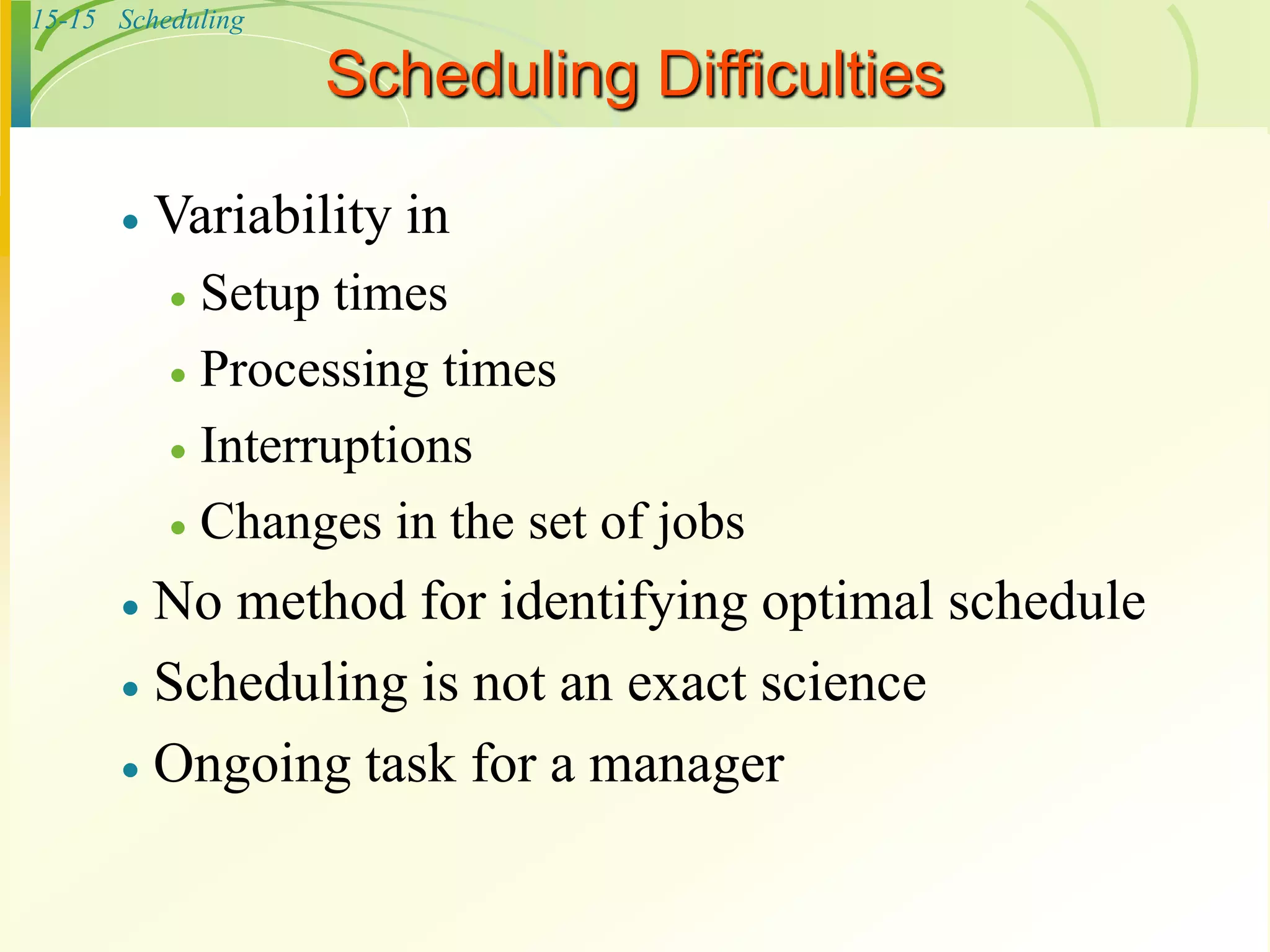
Scheduling Difficulties
 Variability in
 Setup times
 Processing times
 Interruptions
 Changes in the set of jobs
 No method for identifying optimal schedule
 Scheduling is not an exact science
 Ongoing task for a manager
15-16 Scheduling
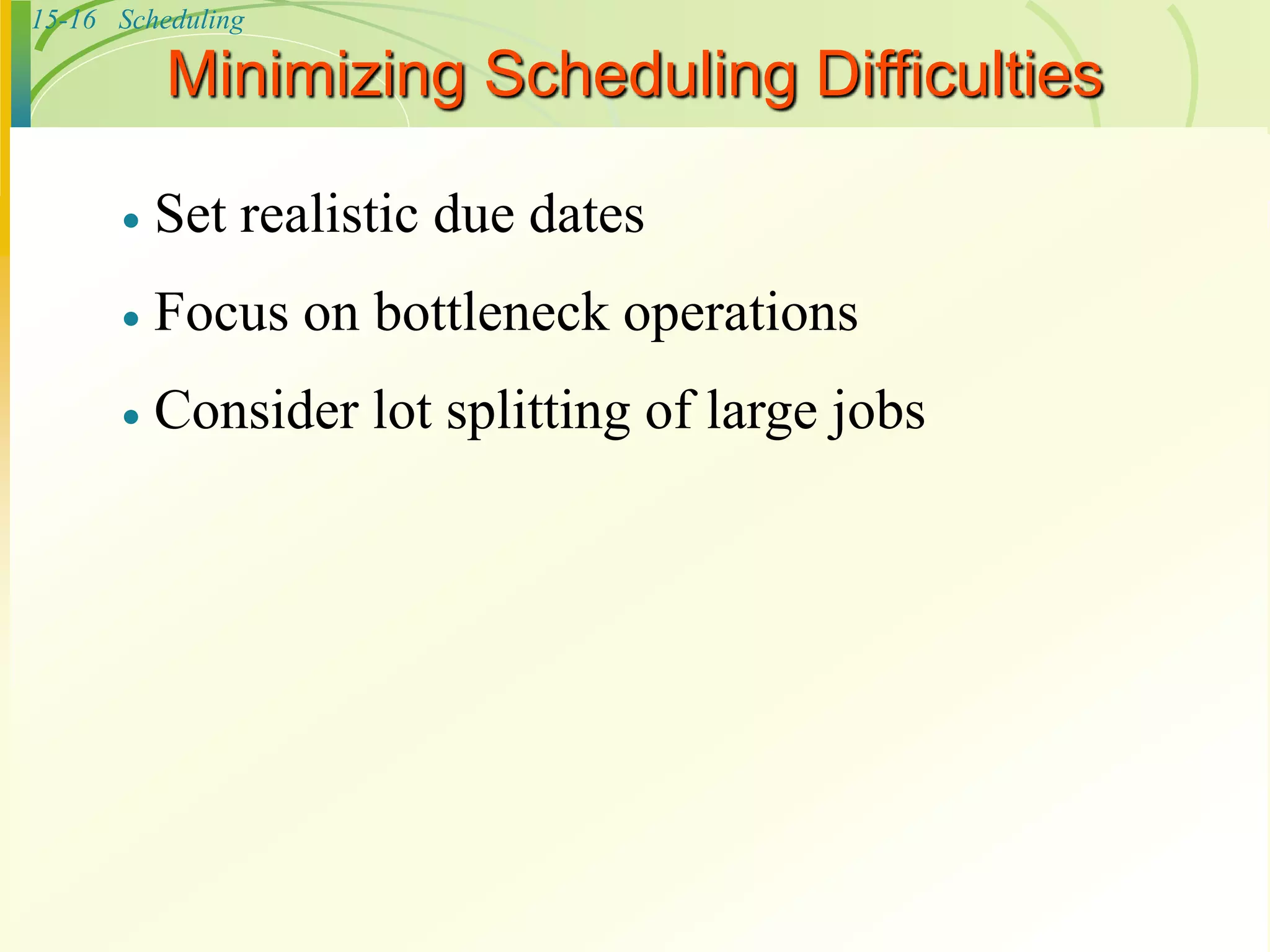
Minimizing Scheduling Difficulties
 Set realistic due dates
 Focus on bottleneck operations
 Consider lot splitting of large jobs
15-17 Scheduling
Scheduling Service Operations
 Appointment systems
 Controls customer arrivals for service
 Reservation systems
 Estimates demand for service
 Scheduling the workforce
 Manages capacity for service
 Scheduling multiple resources
 Coordinates use of more than one
resource
15-18 Scheduling
Cyclical Scheduling
 Hospitals, police/fire departments, restaurants,
supermarkets
 Rotating schedules
 Set a scheduling horizon
 Identify the work pattern
 Develop a basic employee schedule
 Assign employees to the schedule
15-19 Scheduling
Service Operation Problems
 Cannot store or inventory services
 Customer service requests are random
 Scheduling service involves
 Customers
 Workforce
 Equipment
15-20 Scheduling
Service Scheduling
SSU1
Overview—United Airlines

scheduling2.ppt