
Menstrual cycle
What is the menstrual cycle?
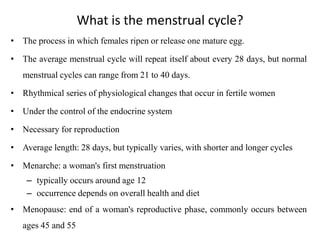
• The process in which females ripen or release one mature egg.
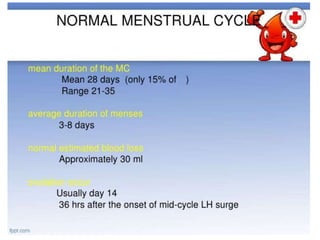
• The average menstrual cycle will repeat itself about every 28 days, but normal
menstrual cycles can range from 21 to 40 days.
• Rhythmical series of physiological changes that occur in fertile women
• Under the control of the endocrine system
• Necessary for reproduction
• Average length: 28 days, but typically varies, with shorter and longer cycles
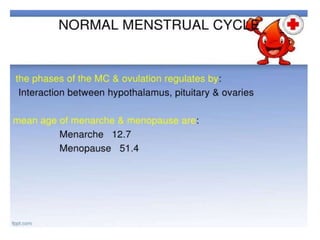
• Menarche: a woman's first menstruation
– typically occurs around age 12
– occurrence depends on overall health and diet
• Menopause: end of a woman's reproductive phase, commonly occurs between
ages 45 and 55
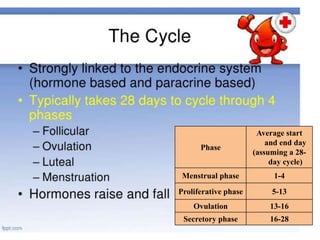
Phase
Average start
and end day
(assuming a 28-
day cycle)
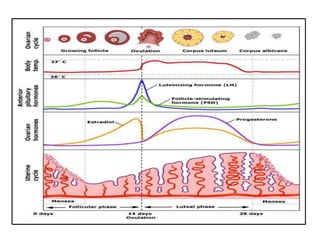
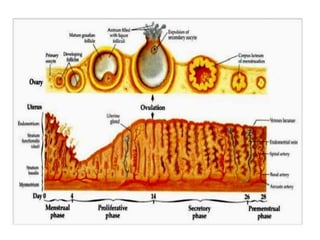
Menstrual phase 1-4
Proliferative phase 5-13
Ovulation 13-16
Secretory phase 16-28
FOLLICULAR PHASE
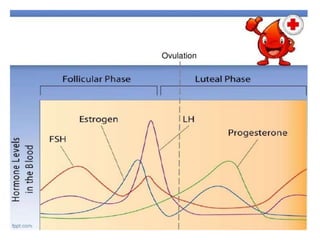
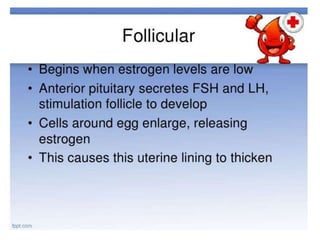
 Due to the rise of follicle stimulating hormone (FSH) during the first
days of the cycle, several ovarian follicles are stimulated
 Follicles compete with each other for dominance
 The follicle that reaches maturity is called a Graafian follicle
 As they mature, the follicles secrete increasing amounts of estrogen,
which thickens the new functional layer of endometrium in the uterus
 Estrogen also stimulates crypts in the cervix to produce fertile cervical
mucus
 At the end of this phase ovulation occurs
OVULATION
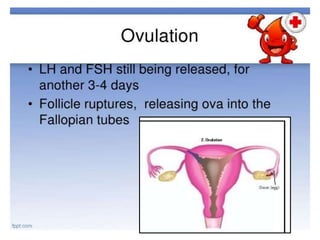
• During the follicular phase, estrogen suppresses production of luteinizing
hormone (LH) from the pituitary gland
• When the ovum has nearly matured, levels of estrogen reach a threshold above
which they stimulate production of LH (positive feedback loop)
• The release of LH matures the ovum and weakens the wall of the follicle in the
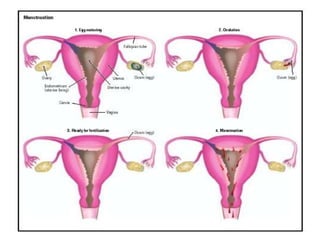
ovary, causing the fully developed follicle to release its secondary oocyte
• After being released from the ovary, the ovum is swept into the fallopian tube
LUTEAL PHASE
• Corpus luteum: solid body formed in an ovary after the ovum has been
released into the fallopian tube
• Produces significant amounts of progesterone, which plays a vital role in
making the endometrium receptive to implantation of the blastocyst
• High levels of E and P suppress production of FSH and LH that the corpus
luteum needs to maintain itself
• Falling levels of progesterone trigger menstruation and the beginning of the
next cycle
MENSTRUAL PHASE
 Menstruation
 menstrual bleeding, menses, period
 discharge of bloody fluid containing endometrial cells, glandular
secretions and blood cells, lasts 3 -5 days
 result of the previous menstrual cycle
 due to strong vasoconstriction and proteolytic activity, functional
stratum of endometrial tissue dies and is discharged during menstrual
bleeding
 Endometrium becomes very thin, but due to low estrogen levels,
hypophysis secretes more FSH
 FSH stimulates secretion of estrogen, and estrogen serves as proliferation
signal to the endometrial basal layer
Menstrual cycle
Menstrual cycle
Menstrual cycle
Menstrual cycle

Menstrual cycle

  • 1.
  • 2.
    What is themenstrual cycle? • The process in which females ripen or release one mature egg. • The average menstrual cycle will repeat itself about every 28 days, but normal menstrual cycles can range from 21 to 40 days. • Rhythmical series of physiological changes that occur in fertile women • Under the control of the endocrine system • Necessary for reproduction • Average length: 28 days, but typically varies, with shorter and longer cycles • Menarche: a woman's first menstruation – typically occurs around age 12 – occurrence depends on overall health and diet • Menopause: end of a woman's reproductive phase, commonly occurs between ages 45 and 55
  • 5.
    Phase Average start and endday (assuming a 28- day cycle) Menstrual phase 1-4 Proliferative phase 5-13 Ovulation 13-16 Secretory phase 16-28
  • 8.
    FOLLICULAR PHASE  Dueto the rise of follicle stimulating hormone (FSH) during the first days of the cycle, several ovarian follicles are stimulated  Follicles compete with each other for dominance  The follicle that reaches maturity is called a Graafian follicle  As they mature, the follicles secrete increasing amounts of estrogen, which thickens the new functional layer of endometrium in the uterus  Estrogen also stimulates crypts in the cervix to produce fertile cervical mucus  At the end of this phase ovulation occurs
  • 10.
    OVULATION • During thefollicular phase, estrogen suppresses production of luteinizing hormone (LH) from the pituitary gland • When the ovum has nearly matured, levels of estrogen reach a threshold above which they stimulate production of LH (positive feedback loop) • The release of LH matures the ovum and weakens the wall of the follicle in the ovary, causing the fully developed follicle to release its secondary oocyte • After being released from the ovary, the ovum is swept into the fallopian tube
  • 12.
    LUTEAL PHASE • Corpusluteum: solid body formed in an ovary after the ovum has been released into the fallopian tube • Produces significant amounts of progesterone, which plays a vital role in making the endometrium receptive to implantation of the blastocyst • High levels of E and P suppress production of FSH and LH that the corpus luteum needs to maintain itself • Falling levels of progesterone trigger menstruation and the beginning of the next cycle
  • 14.
    MENSTRUAL PHASE  Menstruation menstrual bleeding, menses, period  discharge of bloody fluid containing endometrial cells, glandular secretions and blood cells, lasts 3 -5 days  result of the previous menstrual cycle  due to strong vasoconstriction and proteolytic activity, functional stratum of endometrial tissue dies and is discharged during menstrual bleeding  Endometrium becomes very thin, but due to low estrogen levels, hypophysis secretes more FSH  FSH stimulates secretion of estrogen, and estrogen serves as proliferation signal to the endometrial basal layer