GAMETOGENESI
S AND
OVULATION
THEMBA HOSPITAL FCOG(SA) PART 1 TUTORIALS
BY DR N.E MANANA
INTRO
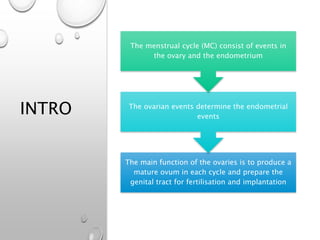
The main function of the ovaries is to produce a
mature ovum in each cycle and prepare the
genital tract for fertilisation and implantation
The ovarian events determine the endometrial
events
The menstrual cycle (MC) consist of events in
the ovary and the endometrium
FOLLICULOGENES
IS
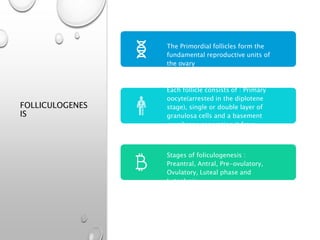
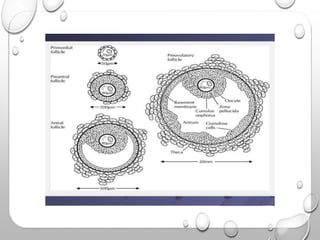
The Primordial follicles form the
fundamental reproductive units of
the ovary
Each follicle consists of : Primary
oocyte(arrested in the diplotene
stage), single or double layer of
granulosa cells and a basement
membrane separating it from
adjacent interstitial tissue
Stages of foliculogenesis :
Preantral, Antral, Pre-ovulatory,
Ovulatory, Luteal phase and
Luteolysis
PREANTRAL
DEVELOPME
NT
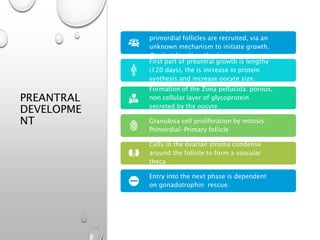
At various times in the MC a few
primordial follicles are recruited, via an
unknown mechanism to initiate growth.
Product line Hypothesis
First part of preantral growth is lengthy
(120 days), the is increase in protein
synthesis and increase oocyte size.
Formation of the Zona pellucida: porous,
non cellular layer of glycoprotein
secreted by the oocyte
Granulosa cell proliferation by mitosis:
Primordial-Primary follicle
Cells in the ovarian stroma condense
around the follicle to form a vascular
theca
Entry into the next phase is dependent
on gonadotrophin rescue.
ANTRAL
DEVELOPME
NT
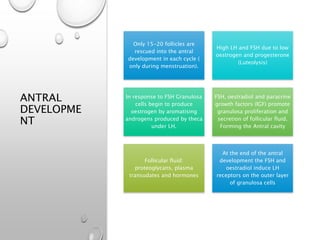
Only 15-20 follicles are
rescued into the antral
development in each cycle (
only during menstruation).
High LH and FSH due to low
oestrogen and progesterone
(Luteolysis)
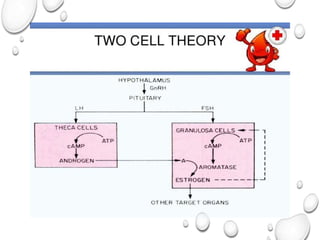
In response to FSH Granulosa
cells begin to produce
oestrogen by aromatising
androgens produced by theca
under LH.
FSH, oestradiol and paracrine
growth factors (IGF) promote
granulosa proliferation and
secretion of follicular fluid.
Forming the Antral cavity
Follicular fluid:
proteoglycans, plasma
transudates and hormones
At the end of the antral
development the FSH and
oestradiol induce LH
receptors on the outer layer
of granulosa cells
PRE-
OVULATORY
DEVELOPME
NT
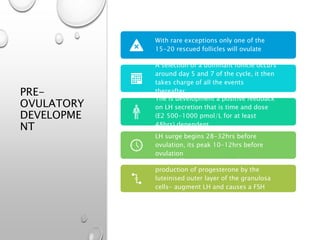
With rare exceptions only one of the
15-20 rescued follicles will ovulate
A selection of a dominant follicle occurs
around day 5 and 7 of the cycle, it then
takes charge of all the events
thereafter.
The is development a positive feedback
on LH secretion that is time and dose
(E2 500-1000 pmol/L for at least
48hrs) dependent.
LH surge begins 28-32hrs before
ovulation, its peak 10-12hrs before
ovulation
LH and E2 interact to stimulate the
production of progesterone by the
luteinised outer layer of the granulosa
cells- augment LH and causes a FSH
surge
OVULATIO
N
LH surge also increases local follicular
synthesis of prostaglandins, essential for
follicular rupture
FSH surge promotes mucification of the
cumulus cells thus freeing the oocyte, so
that it floats freely prior to ovulation
Rapid expansion of the follicular fluid
results in thinning of the peripheral rim of
the grunulosa cells and regression of theca
cells
Ovarian bulge (stigma) appears on the
surface, enzymatic dissolution leads to
rupture.
LUTEAL
PHASE
• Post ovulation the residual parts collapse
within the ovary
• Further luteinisation of the granulosa cells,
accompanied by vascularisation
• Filled with yellow carotenoid pigment and
lipid droplets, transforming into a powerful
steroidogenic cells, Max progesterone
production in the mid luteal phase
• Some luteinisation of theca cells also occur
• Progesterone production is dependent on the
optimum number of granulosa cells available,
LDL and LH
LUTEOLY
SIS
• LH cannot extend the life of the corpus
luteum indefinitely
• In the absence of fertilisation and
implantation the corpus luteum undergoes
luteolysis with 12 to 16days after ovulation
• Progesterone and oestrogen levels drop
sharply, endometrial breakdown and onset
of menstruation
• If fertilisation and implantation occur the
corpus luteum is rescued by HCG from
trophoblastic tissue to about 8weeks
ENDOCRINOLOG
Y
CYCLE REGULATION
• The hypothalmo-pituitary axis play an important but permissive
role in the MC
• With regards to reproduction the mc is controlled by the ovary
• Pulsatile gonadotropin secretion is controlled by a negative
feedback action of oestradiol except in mid cycle
• Length of the cycle is determined by the rate of maturation of
the dominant follicle
• Thus the dominant follicle is referred to as the ovarian clock
HYPOTHALAMUS
• Part of the diencenchephalon at the base of the brain, forming part of
the floor and lateral wall of the 3rd ventricle
• It is rich in connection with other parts of the brain and the pituitary
• It regulates the secretion of gonadotrophins via GnRH secreted by the
neurons found in the arcuate nucleus of the mediobasal and preoptic
arteria hypothalamus.
ENDOMETRI
AL CYCLE
The endometrium is dynamic, it undergoes
cyclic proliferation, differentiation and shedding
in response to gonadal steroids
This changes are to prepare the endometrium
during each cycle for implantation and
pregnancy
The endometrium consists of a functional layer
and a basal layer, functional layer- proliferative,
secretory and menstruation
Blood supply: uterine, arcuate, radial, basal and
spiral
PROLIFERATI
VE PHASE
• Soon after the onset of menstruation the is
proliferation of cells from the basal layer
• The repair process is complete by day 6,
secondary to autocrine and paracrine factors
from the stroma(et<2mm)
• Accompanied by progressive revascularisation
• Glands are narrow and tubular and have low
columnar epithelium
• Proliferation peak at days 8-10, corresponding
with the oestrogen peak, and increase
oestrogen receptors
• Just before ovulation the glandular epithelium
becomes taller and pseudostratified, stroma
proliferates but remain compact, glands
elongates and widen, spiral arteries coiled
SECRETO
RY PHASE
• Early changes are regulated by oestrogen and
progesterone
• Proliferation stops 3 days post ovulation, because of
progesterone down regulating oestrogen receptors
• Glandular epithelium, after ovulation the nuclear are
pushed towards the lumina by vacuoles
• Vacuoles increase in size and the glands become more
tortuous, at 4th day after ovulation the nuclear is
pushed basally
• Stromal cell enlarge and the is stromal oedema,
maximal 22-23day
• Decidual cells, secrete a wide range of substances
(growth factors and binding proteins)
MENSTRUATIO
N
• During lutuilysis growth is reduced and
dehydration of the stroma, leukocyte
infiltration and rhythmic vasoconstriction of
spiral arteries
• Ischaemia and necrotic functional
endometrium, with areas of haemorrhage
• Surface epithelium undergoes apoptosis and
disintegrates, mediated by lysosomal
enzymes and cytokines
• The functional layer is shed, usually
containing stromal, glandular tissue,
leukocytes and blood dissolved by fibrinolysis
THANK
YOU

Gametogenesis and ovulation

  • 1.
    GAMETOGENESI S AND OVULATION THEMBA HOSPITALFCOG(SA) PART 1 TUTORIALS BY DR N.E MANANA
  • 2.
    INTRO The main functionof the ovaries is to produce a mature ovum in each cycle and prepare the genital tract for fertilisation and implantation The ovarian events determine the endometrial events The menstrual cycle (MC) consist of events in the ovary and the endometrium
  • 3.
    FOLLICULOGENES IS The Primordial folliclesform the fundamental reproductive units of the ovary Each follicle consists of : Primary oocyte(arrested in the diplotene stage), single or double layer of granulosa cells and a basement membrane separating it from adjacent interstitial tissue Stages of foliculogenesis : Preantral, Antral, Pre-ovulatory, Ovulatory, Luteal phase and Luteolysis
  • 4.
    PREANTRAL DEVELOPME NT At various timesin the MC a few primordial follicles are recruited, via an unknown mechanism to initiate growth. Product line Hypothesis First part of preantral growth is lengthy (120 days), the is increase in protein synthesis and increase oocyte size. Formation of the Zona pellucida: porous, non cellular layer of glycoprotein secreted by the oocyte Granulosa cell proliferation by mitosis: Primordial-Primary follicle Cells in the ovarian stroma condense around the follicle to form a vascular theca Entry into the next phase is dependent on gonadotrophin rescue.
  • 5.
    ANTRAL DEVELOPME NT Only 15-20 folliclesare rescued into the antral development in each cycle ( only during menstruation). High LH and FSH due to low oestrogen and progesterone (Luteolysis) In response to FSH Granulosa cells begin to produce oestrogen by aromatising androgens produced by theca under LH. FSH, oestradiol and paracrine growth factors (IGF) promote granulosa proliferation and secretion of follicular fluid. Forming the Antral cavity Follicular fluid: proteoglycans, plasma transudates and hormones At the end of the antral development the FSH and oestradiol induce LH receptors on the outer layer of granulosa cells
  • 8.
    PRE- OVULATORY DEVELOPME NT With rare exceptionsonly one of the 15-20 rescued follicles will ovulate A selection of a dominant follicle occurs around day 5 and 7 of the cycle, it then takes charge of all the events thereafter. The is development a positive feedback on LH secretion that is time and dose (E2 500-1000 pmol/L for at least 48hrs) dependent. LH surge begins 28-32hrs before ovulation, its peak 10-12hrs before ovulation LH and E2 interact to stimulate the production of progesterone by the luteinised outer layer of the granulosa cells- augment LH and causes a FSH surge
  • 9.
    OVULATIO N LH surge alsoincreases local follicular synthesis of prostaglandins, essential for follicular rupture FSH surge promotes mucification of the cumulus cells thus freeing the oocyte, so that it floats freely prior to ovulation Rapid expansion of the follicular fluid results in thinning of the peripheral rim of the grunulosa cells and regression of theca cells Ovarian bulge (stigma) appears on the surface, enzymatic dissolution leads to rupture.
  • 10.
    LUTEAL PHASE • Post ovulationthe residual parts collapse within the ovary • Further luteinisation of the granulosa cells, accompanied by vascularisation • Filled with yellow carotenoid pigment and lipid droplets, transforming into a powerful steroidogenic cells, Max progesterone production in the mid luteal phase • Some luteinisation of theca cells also occur • Progesterone production is dependent on the optimum number of granulosa cells available, LDL and LH
  • 11.
    LUTEOLY SIS • LH cannotextend the life of the corpus luteum indefinitely • In the absence of fertilisation and implantation the corpus luteum undergoes luteolysis with 12 to 16days after ovulation • Progesterone and oestrogen levels drop sharply, endometrial breakdown and onset of menstruation • If fertilisation and implantation occur the corpus luteum is rescued by HCG from trophoblastic tissue to about 8weeks
  • 12.
  • 13.
    CYCLE REGULATION • Thehypothalmo-pituitary axis play an important but permissive role in the MC • With regards to reproduction the mc is controlled by the ovary • Pulsatile gonadotropin secretion is controlled by a negative feedback action of oestradiol except in mid cycle • Length of the cycle is determined by the rate of maturation of the dominant follicle • Thus the dominant follicle is referred to as the ovarian clock
  • 14.
    HYPOTHALAMUS • Part ofthe diencenchephalon at the base of the brain, forming part of the floor and lateral wall of the 3rd ventricle • It is rich in connection with other parts of the brain and the pituitary • It regulates the secretion of gonadotrophins via GnRH secreted by the neurons found in the arcuate nucleus of the mediobasal and preoptic arteria hypothalamus.
  • 15.
    ENDOMETRI AL CYCLE The endometriumis dynamic, it undergoes cyclic proliferation, differentiation and shedding in response to gonadal steroids This changes are to prepare the endometrium during each cycle for implantation and pregnancy The endometrium consists of a functional layer and a basal layer, functional layer- proliferative, secretory and menstruation Blood supply: uterine, arcuate, radial, basal and spiral
  • 16.
    PROLIFERATI VE PHASE • Soonafter the onset of menstruation the is proliferation of cells from the basal layer • The repair process is complete by day 6, secondary to autocrine and paracrine factors from the stroma(et<2mm) • Accompanied by progressive revascularisation • Glands are narrow and tubular and have low columnar epithelium • Proliferation peak at days 8-10, corresponding with the oestrogen peak, and increase oestrogen receptors • Just before ovulation the glandular epithelium becomes taller and pseudostratified, stroma proliferates but remain compact, glands elongates and widen, spiral arteries coiled
  • 17.
    SECRETO RY PHASE • Earlychanges are regulated by oestrogen and progesterone • Proliferation stops 3 days post ovulation, because of progesterone down regulating oestrogen receptors • Glandular epithelium, after ovulation the nuclear are pushed towards the lumina by vacuoles • Vacuoles increase in size and the glands become more tortuous, at 4th day after ovulation the nuclear is pushed basally • Stromal cell enlarge and the is stromal oedema, maximal 22-23day • Decidual cells, secrete a wide range of substances (growth factors and binding proteins)
  • 18.
    MENSTRUATIO N • During lutuilysisgrowth is reduced and dehydration of the stroma, leukocyte infiltration and rhythmic vasoconstriction of spiral arteries • Ischaemia and necrotic functional endometrium, with areas of haemorrhage • Surface epithelium undergoes apoptosis and disintegrates, mediated by lysosomal enzymes and cytokines • The functional layer is shed, usually containing stromal, glandular tissue, leukocytes and blood dissolved by fibrinolysis
  • 19.

Editor's Notes

  • #5 The recruitment is a continues process that is independent of gonadotrophins, un interrupted by childhood, pregnancy or lactation.