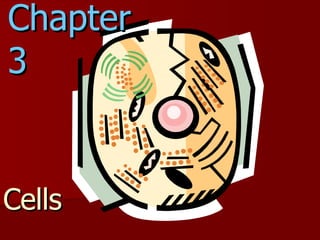
Chapter 3 Cells
Cells Section 3-1 H.W. Pg. 73 ques . 1-4 What are  cells ? -   Cells  are the smallest unit of living things, and are the building blocks of life. All living organisms are made up of cells. Some organisms are composed of many cells, like humans, animals, trees, and flowers.  These  multi celled  organisms can be seen without the use of a microscope. Other organisms are only composed of one  single cell , like bacteria or some algae, and they can only be seen with the use of a microscope.
Microscopes A  microscope  is an instrument used by scientists to study cells and other microscopic material. -  Microscopes are very critical to science. They allow us to explore a world that other wise was never known. -  Microscopes use  light  and  lenses  in order to magnify the object that you are looking at.  -  These lenses allow you to see an object at up to 100x its size.
History of the Cell Why do they call cells, cells? When the first microscope was created the first thing that scientists decided to look at was a piece of cork, which is made from trees. What they saw was a lot of small boxes that, to them resembled prison cells. Hence the name cells.
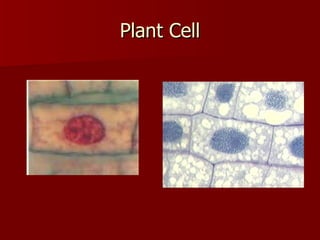
Plant Cell
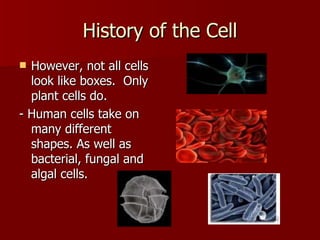
History of the Cell However, not all cells look like boxes.  Only plant cells do. - Human cells take on many different shapes. As well as bacterial, fungal and algal cells.
Cell Composition Every cell of an organism, as small as they are , is made up of even small parts. These smaller parts that make up a cell are called  organelles . What do you think organelle means? It means small organ.
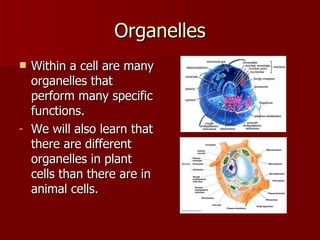
Organelles Within a cell are many organelles that perform many specific functions.  We will also learn that there are different organelles in plant cells than there are in animal cells.
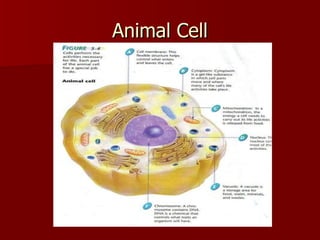
Organelles of an animal cell picture on pg. 66 The organelles of an animal cell that we will explore are: Cell membrane-  this covers the outside of the cell and controls what material enters and leaves the cell. Cytoplasm-  a gel like liquid that fills the cell.  All organelles move around in the cytoplasm and many cell activities occur here. Nucleus-  This is the brain or control center of the cell.  It controls all cell activity. Chromosomes - Found in the nucleus and contain our DNA or genetic make up. Mitochondria-  This organelle is responsible for converting our food and oxygen to energy, this is called  Cellular respiration . Called the Power house of the cell. Vacuoles - These are little storage areas in a cell that hold water, minerals, and food and waste.
Animal Cell
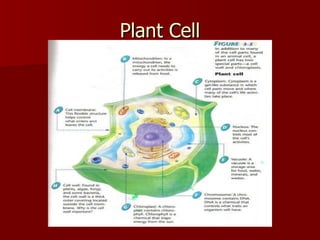
Organelles of a plant Cell A plant cell contains all of the organelles that are present in an animal cell plus two more: Cell Wall-  This is found in plants, algae, and fungi and it is a thick covering that surrounds the cell membrane.  It gives support to the cell and together all the cell walls of a plant gives structure to the whole organism. Chloroplast –  These organelles contain a chemical called  chlorophyll,  a pigment that traps sunlight and converts it into energy. It uses the sun light, water and CO2 to produce O2. This process is called  photosynthesis .
Plant Cell
The different jobs of cells Section 3-2 H.W. pg. 81 ques. 1-3 & pg. 86 ques. 1-4, 6-10 It is impossible for every cell in your body to be able to carry out every job that your body needs to have done. That’s why there are many different cells in our bodies that all have very  different, very specific jobs to do.
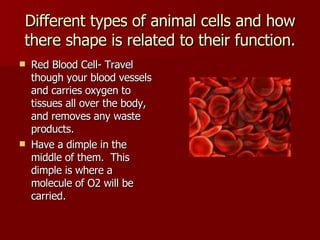
Different types of animal cells and how there shape is related to their function. Red Blood Cell- Travel though your blood vessels and carries oxygen to tissues all over the body, and removes any waste products. Have a dimple in the middle of them.  This dimple is where a molecule of O2 will be carried.
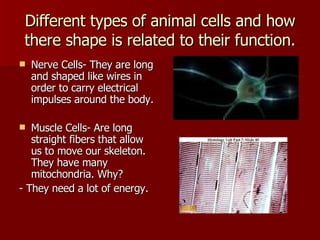
Different types of animal cells and how there shape is related to their function. Nerve Cells- They are long and shaped like wires in order to carry electrical impulses around the body. Muscle Cells- Are long straight fibers that allow us to move our skeleton.  They have many mitochondria. Why? - They need a lot of energy.
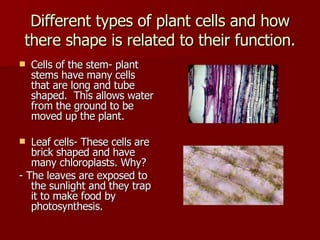
Different types of plant cells and how there shape is related to their function. Cells of the stem- plant stems have many cells that are long and tube shaped.  This allows water from the ground to be moved up the plant. Leaf cells- These cells are brick shaped and have many chloroplasts. Why? - The leaves are exposed to the sunlight and they trap it to make food by photosynthesis.
Cell organization All of these specific cells in your body, as well as in plants, are not just all thrown together.  You wouldn’t want to have liver tissue in you brain or a leg muscle cell in your stomach. All common cells are grouped together to form specific tissues. Ex: A lot of cells combine form to make  tissues .  Tissues  are groups of similar cells that perform similar work.  -   Tissues would than combine together with different tissues to form an  organ . An  organ  is a structure made up of two or more different types of tissue that work together. Ex: The stomach is an organ made up of muscle tissue, nerve tissue and blood tissue.
Cell organization Organs than come together to form organ systems. Ex: the mouth, stomach, intestines, and liver are all organs that make up the digestive system. Other systems include the respiratory, skeletal, and reproductive systems. -  Organs systems then give rise to organisms.
Test on Chapter 3 in one week

6th Grade Chapter 3

  • 1.
  • 2.
    Cells Section 3-1H.W. Pg. 73 ques . 1-4 What are cells ? - Cells are the smallest unit of living things, and are the building blocks of life. All living organisms are made up of cells. Some organisms are composed of many cells, like humans, animals, trees, and flowers. These multi celled organisms can be seen without the use of a microscope. Other organisms are only composed of one single cell , like bacteria or some algae, and they can only be seen with the use of a microscope.
  • 3.
    Microscopes A microscope is an instrument used by scientists to study cells and other microscopic material. - Microscopes are very critical to science. They allow us to explore a world that other wise was never known. - Microscopes use light and lenses in order to magnify the object that you are looking at. - These lenses allow you to see an object at up to 100x its size.
  • 4.
    History of theCell Why do they call cells, cells? When the first microscope was created the first thing that scientists decided to look at was a piece of cork, which is made from trees. What they saw was a lot of small boxes that, to them resembled prison cells. Hence the name cells.
  • 5.
  • 6.
    History of theCell However, not all cells look like boxes. Only plant cells do. - Human cells take on many different shapes. As well as bacterial, fungal and algal cells.
  • 7.
    Cell Composition Everycell of an organism, as small as they are , is made up of even small parts. These smaller parts that make up a cell are called organelles . What do you think organelle means? It means small organ.
  • 8.
    Organelles Within acell are many organelles that perform many specific functions. We will also learn that there are different organelles in plant cells than there are in animal cells.
  • 9.
    Organelles of ananimal cell picture on pg. 66 The organelles of an animal cell that we will explore are: Cell membrane- this covers the outside of the cell and controls what material enters and leaves the cell. Cytoplasm- a gel like liquid that fills the cell. All organelles move around in the cytoplasm and many cell activities occur here. Nucleus- This is the brain or control center of the cell. It controls all cell activity. Chromosomes - Found in the nucleus and contain our DNA or genetic make up. Mitochondria- This organelle is responsible for converting our food and oxygen to energy, this is called Cellular respiration . Called the Power house of the cell. Vacuoles - These are little storage areas in a cell that hold water, minerals, and food and waste.
  • 10.
  • 11.
    Organelles of aplant Cell A plant cell contains all of the organelles that are present in an animal cell plus two more: Cell Wall- This is found in plants, algae, and fungi and it is a thick covering that surrounds the cell membrane. It gives support to the cell and together all the cell walls of a plant gives structure to the whole organism. Chloroplast – These organelles contain a chemical called chlorophyll, a pigment that traps sunlight and converts it into energy. It uses the sun light, water and CO2 to produce O2. This process is called photosynthesis .
  • 12.
  • 13.
    The different jobsof cells Section 3-2 H.W. pg. 81 ques. 1-3 & pg. 86 ques. 1-4, 6-10 It is impossible for every cell in your body to be able to carry out every job that your body needs to have done. That’s why there are many different cells in our bodies that all have very different, very specific jobs to do.
  • 14.
    Different types ofanimal cells and how there shape is related to their function. Red Blood Cell- Travel though your blood vessels and carries oxygen to tissues all over the body, and removes any waste products. Have a dimple in the middle of them. This dimple is where a molecule of O2 will be carried.
  • 15.
    Different types ofanimal cells and how there shape is related to their function. Nerve Cells- They are long and shaped like wires in order to carry electrical impulses around the body. Muscle Cells- Are long straight fibers that allow us to move our skeleton. They have many mitochondria. Why? - They need a lot of energy.
  • 16.
    Different types ofplant cells and how there shape is related to their function. Cells of the stem- plant stems have many cells that are long and tube shaped. This allows water from the ground to be moved up the plant. Leaf cells- These cells are brick shaped and have many chloroplasts. Why? - The leaves are exposed to the sunlight and they trap it to make food by photosynthesis.
  • 17.
    Cell organization Allof these specific cells in your body, as well as in plants, are not just all thrown together. You wouldn’t want to have liver tissue in you brain or a leg muscle cell in your stomach. All common cells are grouped together to form specific tissues. Ex: A lot of cells combine form to make tissues . Tissues are groups of similar cells that perform similar work. - Tissues would than combine together with different tissues to form an organ . An organ is a structure made up of two or more different types of tissue that work together. Ex: The stomach is an organ made up of muscle tissue, nerve tissue and blood tissue.
  • 18.
    Cell organization Organsthan come together to form organ systems. Ex: the mouth, stomach, intestines, and liver are all organs that make up the digestive system. Other systems include the respiratory, skeletal, and reproductive systems. - Organs systems then give rise to organisms.
  • 19.
    Test on Chapter3 in one week