L.8 Skeletal system and
Nervous system CBSE
For more such informative
content go to
https://scifitechify.blogspot.c
om/
Movement - Locomotion
● The movement of the whole body of an organism from
one place to another is called locomotion.
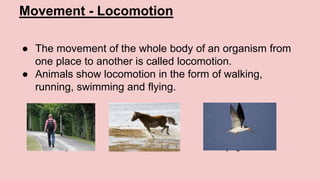
● Animals show locomotion in the form of walking,
running, swimming and flying.
A walking man A running horse A flying bird
Skeletal system
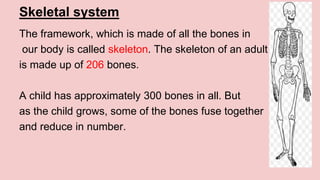
The framework, which is made of all the bones in
our body is called skeleton. The skeleton of an adult
is made up of 206 bones.
A child has approximately 300 bones in all. But
as the child grows, some of the bones fuse together
and reduce in number.
Functions of the skeleton.
1. It gives shape, support and strength to our body.
1. It gives protection to the delicate internal organs of the
body.
● The skull protects the brain.
● The rib cage protects the heart and lungs.
1. It helps to move our body with the help of muscles.
Parts of the skeleton
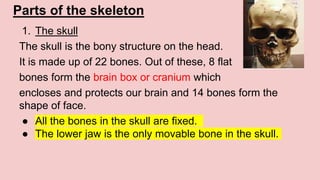
1. The skull
The skull is the bony structure on the head.
It is made up of 22 bones. Out of these, 8 flat
bones form the brain box or cranium which
encloses and protects our brain and 14 bones form the
shape of face.
● All the bones in the skull are fixed.
● The lower jaw is the only movable bone in the skull.
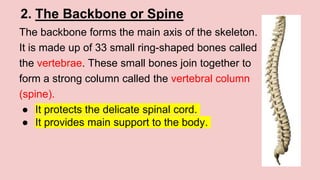
2. The Backbone or Spine
The backbone forms the main axis of the skeleton.
It is made up of 33 small ring-shaped bones called
the vertebrae. These small bones join together to
form a strong column called the vertebral column
(spine).
● It protects the delicate spinal cord.
● It provides main support to the body.
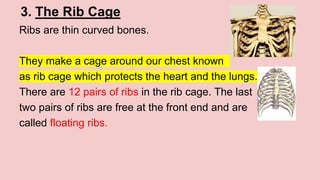
3. The Rib Cage
Ribs are thin curved bones.
They make a cage around our chest known
as rib cage which protects the heart and the lungs.
There are 12 pairs of ribs in the rib cage. The last
two pairs of ribs are free at the front end and are
called floating ribs.
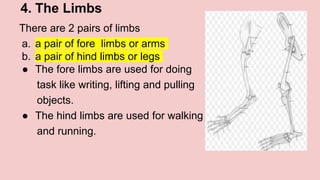
4. The Limbs
There are 2 pairs of limbs
a. a pair of fore limbs or arms
b. a pair of hind limbs or legs
● The fore limbs are used for doing
task like writing, lifting and pulling
objects.
● The hind limbs are used for walking
and running.
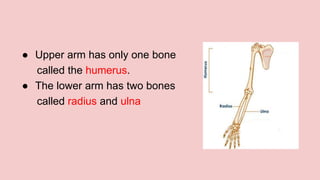
● Upper arm has only one bone
called the humerus.
● The lower arm has two bones
called radius and ulna
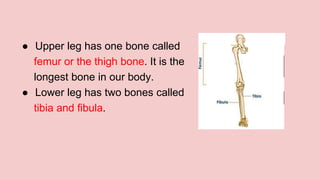
● Upper leg has one bone called
femur or the thigh bone. It is the
longest bone in our body.
● Lower leg has two bones called
tibia and fibula.
Cartilage
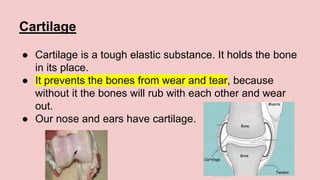
● Cartilage is a tough elastic substance. It holds the bone
in its place.
● It prevents the bones from wear and tear, because
without it the bones will rub with each other and wear
out.
● Our nose and ears have cartilage.
Joints
● The place where two or more bones join is called a
joint.
The joints in the body are divided into 3 main groups
● Immovable or fixed joints
● Slightly movable joints
● Freely movable joints
Immovable Joints
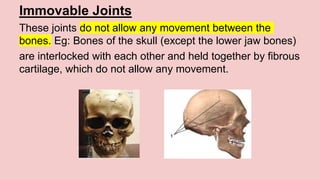
These joints do not allow any movement between the
bones. Eg: Bones of the skull (except the lower jaw bones)
are interlocked with each other and held together by fibrous
cartilage, which do not allow any movement.
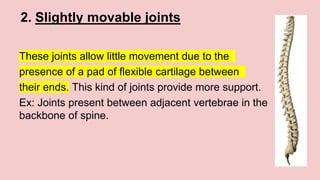
2. Slightly movable joints
These joints allow little movement due to the
presence of a pad of flexible cartilage between
their ends. This kind of joints provide more support.
Ex: Joints present between adjacent vertebrae in the
backbone of spine.
3. Freely movable Joints
Most of the joints in the human body are freely movable.
Movable joints are further classified depending on the type
and extent of movement they allow.
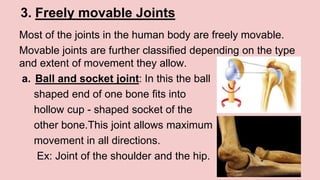
a. Ball and socket joint: In this the ball
shaped end of one bone fits into
hollow cup - shaped socket of the
other bone.This joint allows maximum
movement in all directions.
Ex: Joint of the shoulder and the hip.
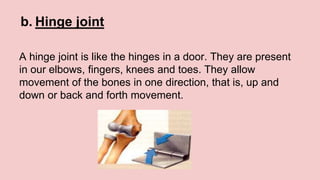
b. Hinge joint
A hinge joint is like the hinges in a door. They are present
in our elbows, fingers, knees and toes. They allow
movement of the bones in one direction, that is, up and
down or back and forth movement.
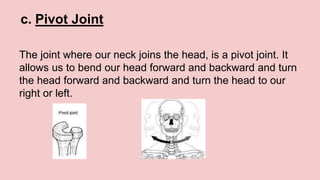
c. Pivot Joint
The joint where our neck joins the head, is a pivot joint. It
allows us to bend our head forward and backward and turn
the head forward and backward and turn the head to our
right or left.
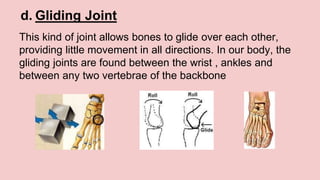
d. Gliding Joint
This kind of joint allows bones to glide over each other,
providing little movement in all directions. In our body, the
gliding joints are found between the wrist , ankles and
between any two vertebrae of the backbone
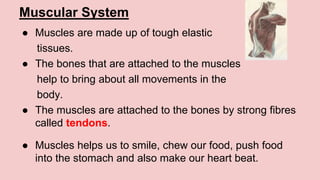
Muscular System
● Muscles are made up of tough elastic
tissues.
● The bones that are attached to the muscles
help to bring about all movements in the
body.
● The muscles are attached to the bones by strong fibres
called tendons.
● Muscles helps us to smile, chew our food, push food
into the stomach and also make our heart beat.
Our body has three types of muscles.
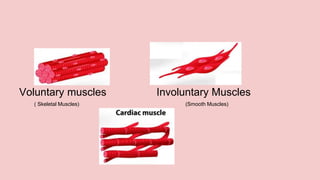
● Voluntary Muscles - The muscles that are under our
control are called voluntary muscles.
eg: Muscles in our arms and legs.
● Involuntary Muscles - The muscles that work but not
under our control are called involuntary muscles.
eg: Muscles in our stomach and intestine.
● Cardiac Muscles - These muscles are found in the
walls of heart and make our heart beat.They are not
under our control. They work throughout our life and
never get tired.
Voluntary muscles Involuntary Muscles
( Skeletal Muscles) (Smooth Muscles)
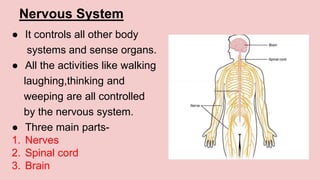
Nervous System
● It controls all other body
systems and sense organs.
● All the activities like walking
laughing,thinking and
weeping are all controlled
by the nervous system.
● Three main parts-
1. Nerves
2. Spinal cord
3. Brain
1. Brain
● All activities of our body are controlled by our brain.
● It has memory to store information and can recall the
information when needed.
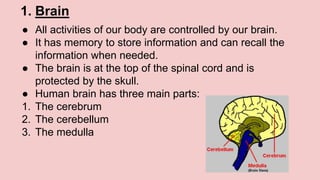
● The brain is at the top of the spinal cord and is
protected by the skull.
● Human brain has three main parts:
1. The cerebrum
2. The cerebellum
3. The medulla
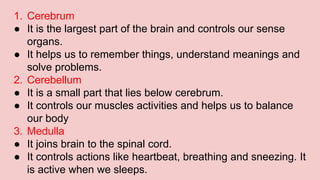
1. Cerebrum
● It is the largest part of the brain and controls our sense
organs.
● It helps us to remember things, understand meanings and
solve problems.
2. Cerebellum
● It is a small part that lies below cerebrum.
● It controls our muscles activities and helps us to balance
our body
3. Medulla
● It joins brain to the spinal cord.
● It controls actions like heartbeat, breathing and sneezing. It
is active when we sleeps.
Nerves
Our body has a network of nerves to carry messages
between the brain and other parts of the body.
Nerves are of three types:
1. Sensory Nerves : These carry messages from the
sense organs to the brain.
2. Motor nerves: These carry messages from the brain to
different body parts.
3. Mixed nerves: These nerves carry messages to the
brain as well as brings orders from the brain.
Spinal Cord
● It is a bunch of nerves that connects the brain with all
the body parts.
● It starts from the back portion of the brain and continues
down to the lower end of the backbone.
● It is protected by the vertebral column.
Reflex Actions
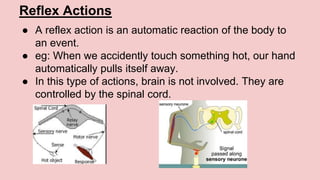
● A reflex action is an automatic reaction of the body to
an event.
● eg: When we accidently touch something hot, our hand
automatically pulls itself away.
● In this type of actions, brain is not involved. They are
controlled by the spinal cord.

Skeletal System and the Nervous System CBSE

  • 1.
    L.8 Skeletal systemand Nervous system CBSE For more such informative content go to https://scifitechify.blogspot.c om/
  • 2.
    Movement - Locomotion ●The movement of the whole body of an organism from one place to another is called locomotion. ● Animals show locomotion in the form of walking, running, swimming and flying. A walking man A running horse A flying bird
  • 3.
    Skeletal system The framework,which is made of all the bones in our body is called skeleton. The skeleton of an adult is made up of 206 bones. A child has approximately 300 bones in all. But as the child grows, some of the bones fuse together and reduce in number.
  • 4.
    Functions of theskeleton. 1. It gives shape, support and strength to our body. 1. It gives protection to the delicate internal organs of the body. ● The skull protects the brain. ● The rib cage protects the heart and lungs. 1. It helps to move our body with the help of muscles.
  • 5.
    Parts of theskeleton 1. The skull The skull is the bony structure on the head. It is made up of 22 bones. Out of these, 8 flat bones form the brain box or cranium which encloses and protects our brain and 14 bones form the shape of face. ● All the bones in the skull are fixed. ● The lower jaw is the only movable bone in the skull.
  • 6.
    2. The Backboneor Spine The backbone forms the main axis of the skeleton. It is made up of 33 small ring-shaped bones called the vertebrae. These small bones join together to form a strong column called the vertebral column (spine). ● It protects the delicate spinal cord. ● It provides main support to the body.
  • 7.
    3. The RibCage Ribs are thin curved bones. They make a cage around our chest known as rib cage which protects the heart and the lungs. There are 12 pairs of ribs in the rib cage. The last two pairs of ribs are free at the front end and are called floating ribs.
  • 8.
    4. The Limbs Thereare 2 pairs of limbs a. a pair of fore limbs or arms b. a pair of hind limbs or legs ● The fore limbs are used for doing task like writing, lifting and pulling objects. ● The hind limbs are used for walking and running.
  • 9.
    ● Upper armhas only one bone called the humerus. ● The lower arm has two bones called radius and ulna
  • 10.
    ● Upper leghas one bone called femur or the thigh bone. It is the longest bone in our body. ● Lower leg has two bones called tibia and fibula.
  • 11.
    Cartilage ● Cartilage isa tough elastic substance. It holds the bone in its place. ● It prevents the bones from wear and tear, because without it the bones will rub with each other and wear out. ● Our nose and ears have cartilage.
  • 12.
    Joints ● The placewhere two or more bones join is called a joint. The joints in the body are divided into 3 main groups ● Immovable or fixed joints ● Slightly movable joints ● Freely movable joints
  • 13.
    Immovable Joints These jointsdo not allow any movement between the bones. Eg: Bones of the skull (except the lower jaw bones) are interlocked with each other and held together by fibrous cartilage, which do not allow any movement.
  • 14.
    2. Slightly movablejoints These joints allow little movement due to the presence of a pad of flexible cartilage between their ends. This kind of joints provide more support. Ex: Joints present between adjacent vertebrae in the backbone of spine.
  • 15.
    3. Freely movableJoints Most of the joints in the human body are freely movable. Movable joints are further classified depending on the type and extent of movement they allow. a. Ball and socket joint: In this the ball shaped end of one bone fits into hollow cup - shaped socket of the other bone.This joint allows maximum movement in all directions. Ex: Joint of the shoulder and the hip.
  • 16.
    b. Hinge joint Ahinge joint is like the hinges in a door. They are present in our elbows, fingers, knees and toes. They allow movement of the bones in one direction, that is, up and down or back and forth movement.
  • 17.
    c. Pivot Joint Thejoint where our neck joins the head, is a pivot joint. It allows us to bend our head forward and backward and turn the head forward and backward and turn the head to our right or left.
  • 18.
    d. Gliding Joint Thiskind of joint allows bones to glide over each other, providing little movement in all directions. In our body, the gliding joints are found between the wrist , ankles and between any two vertebrae of the backbone
  • 19.
    Muscular System ● Musclesare made up of tough elastic tissues. ● The bones that are attached to the muscles help to bring about all movements in the body. ● The muscles are attached to the bones by strong fibres called tendons. ● Muscles helps us to smile, chew our food, push food into the stomach and also make our heart beat.
  • 20.
    Our body hasthree types of muscles. ● Voluntary Muscles - The muscles that are under our control are called voluntary muscles. eg: Muscles in our arms and legs. ● Involuntary Muscles - The muscles that work but not under our control are called involuntary muscles. eg: Muscles in our stomach and intestine. ● Cardiac Muscles - These muscles are found in the walls of heart and make our heart beat.They are not under our control. They work throughout our life and never get tired.
  • 21.
    Voluntary muscles InvoluntaryMuscles ( Skeletal Muscles) (Smooth Muscles)
  • 22.
    Nervous System ● Itcontrols all other body systems and sense organs. ● All the activities like walking laughing,thinking and weeping are all controlled by the nervous system. ● Three main parts- 1. Nerves 2. Spinal cord 3. Brain
  • 23.
    1. Brain ● Allactivities of our body are controlled by our brain. ● It has memory to store information and can recall the information when needed. ● The brain is at the top of the spinal cord and is protected by the skull. ● Human brain has three main parts: 1. The cerebrum 2. The cerebellum 3. The medulla
  • 24.
    1. Cerebrum ● Itis the largest part of the brain and controls our sense organs. ● It helps us to remember things, understand meanings and solve problems. 2. Cerebellum ● It is a small part that lies below cerebrum. ● It controls our muscles activities and helps us to balance our body 3. Medulla ● It joins brain to the spinal cord. ● It controls actions like heartbeat, breathing and sneezing. It is active when we sleeps.
  • 25.
    Nerves Our body hasa network of nerves to carry messages between the brain and other parts of the body. Nerves are of three types: 1. Sensory Nerves : These carry messages from the sense organs to the brain. 2. Motor nerves: These carry messages from the brain to different body parts. 3. Mixed nerves: These nerves carry messages to the brain as well as brings orders from the brain.
  • 26.
    Spinal Cord ● Itis a bunch of nerves that connects the brain with all the body parts. ● It starts from the back portion of the brain and continues down to the lower end of the backbone. ● It is protected by the vertebral column.
  • 27.
    Reflex Actions ● Areflex action is an automatic reaction of the body to an event. ● eg: When we accidently touch something hot, our hand automatically pulls itself away. ● In this type of actions, brain is not involved. They are controlled by the spinal cord.