

MOOCs: searching for a
viable Business Model
Yves Epelboin
Professor Emeritus
UPMC-Sorbonne-Universités, Paris
Yves.Epelboin@impmc.upmc.fr
Agenda
 MOOC or not MOOC?
 The real cost of a MOOC
 Cost efficiency of teaching: why to
invest in a MOOC?
 MOOCs in universities
 Conclusion
 MOOCs providers
EUNIS 2016 8-10 June 2016 Y.Epelboin
MOOCs: the alternative?
 The cost of Higher Education is becoming higher
and higher and all countries are looking for new
models.
 The European and US models cannot be
expanded anymore
 In less developed countries not enough
resources are available to build a full HE system
EUNIS 2016 8-10 June 2016 Y.Epelboin
MOOCs: the alternative?
 Three alternatives:
 Increasing the level of tuition fees and leaving the
burden to the students and their families.
 Example of England but not accepted anywhere
 Decreasing the cost of education, which is mainly
manpower, i.e. teachers salaries.
 Increasing the ratio students/teacher
EUNIS 2016 8-10 June 2016 Y.Epelboin
MOOCs: the alternative?
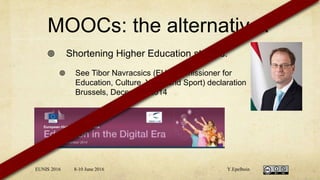
 Shortening Higher Education studies:
 See Tibor Navracsics (EU Commissioner for
Education, Culture, Youth and Sport) declaration
Brussels, December 2014
EUNIS 2016 8-10 June 2016 Y.Epelboin
A digital approach as the
solution?
 Increasing the Higher Education efficiency:
 Decreasing the labor costs
 Possibility to sell and reuse the courses
 Possibility to use less qualified teachers
 Increasing the students/teachers ratio
 Increasing the « teaching » efficiency
 Flipped learning approach
EUNIS 2016 8-10 June 2016 Y.Epelboin
The real cost of
a MOOC
Human resources
MOOC contents:
 Teachers
 Community managers
 MOOC development:
 Video specialists
 Web integrator and graphic artist
 Pedagogic instructor
 Project manager
A MOOC is a project
with many people,
which needs a
project manager
EUNIS 2016 8-10 June 2016 Y.Epelboin
Workload to build a MOOC
Example: 6-8 weeks course:
 Course with Math equations, graphics and
pictures
 Course being used 3 times
 Three categories of human resources: teachers,
academic and technical support
EUNIS 2016 8-10 June 2016 Y.Epelboin
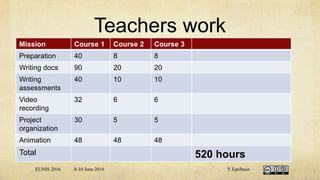
Teachers work
Mission Course 1 Course 2 Course 3
Preparation 40 8 8
Writing docs 90 20 20
Writing
assessments
40 10 10
Video
recording
32 6 6
Project
organization
30 5 5
Animation 48 48 48
Total 520 hours
EUNIS 2016 8-10 June 2016 Y.Epelboin
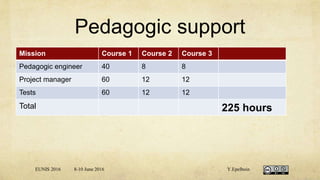
Pedagogic support
Mission Course 1 Course 2 Course 3
Pedagogic engineer 40 8 8
Project manager 60 12 12
Tests 60 12 12
Total 225 hours
EUNIS 2016 8-10 June 2016 Y.Epelboin
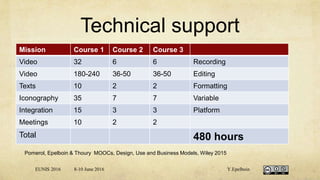
Technical support
Mission Course 1 Course 2 Course 3
Video 32 6 6 Recording
Video 180-240 36-50 36-50 Editing
Texts 10 2 2 Formatting
Iconography 35 7 7 Variable
Integration 15 3 3 Platform
Meetings 10 2 2
Total 480 hours
Pomerol, Epelboin & Thoury MOOCs, Design, Use and Business Models, Wiley 2015
EUNIS 2016 8-10 June 2016 Y.Epelboin
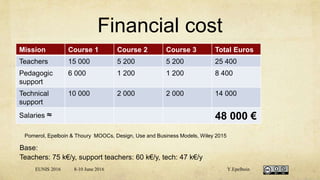
Financial cost
Mission Course 1 Course 2 Course 3 Total Euros
Teachers 15 000 5 200 5 200 25 400
Pedagogic
support
6 000 1 200 1 200 8 400
Technical
support
10 000 2 000 2 000 14 000
Salaries ≈ 48 000 €
Base:
Teachers: 75 k€/y, support teachers: 60 k€/y, tech: 47 k€/y
Pomerol, Epelboin & Thoury MOOCs, Design, Use and Business Models, Wiley 2015
EUNIS 2016 8-10 June 2016 Y.Epelboin
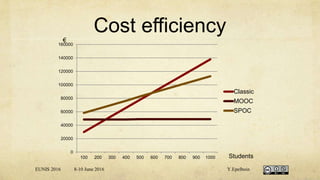
Cost efficiency
Students
€
0
20000
40000
60000
80000
100000
120000
140000
160000
100 200 300 400 500 600 700 800 900 1000
Classic
MOOC
SPOC
EUNIS 2016 8-10 June 2016 Y.Epelboin
Digital business models
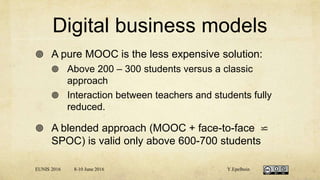
 A pure MOOC is the less expensive solution:
 Above 200 – 300 students versus a classic
approach
 Interaction between teachers and students fully
reduced.
 A blended approach (MOOC + face-to-face ⋍
SPOC) is valid only above 600-700 students
EUNIS 2016 8-10 June 2016 Y.Epelboin
Decreasing the cost of
teaching
 Using or reusing MOOCs to amortize the cost of
development of digital media
 A balance between face-to-face interaction and
personal work
EUNIS 2016 8-10 June 2016 Y.Epelboin
MOOCs and
universities
Financial facts
 1 ECTS = 1 MOOC (30 hours of work)
 One year ≃ 60 MOOCs!
 In universities MOOCs are used as SPOCs:
 Approach of financial interest if more than 600-
700 students are using the course (in 3 years).
 Never valid for classes < 200 – 250 students =>
cost sharing among many universities
EUNIS 2016 8-10 June 2016 Y.Epelboin
Possible Business plans
 Savings
 Large classes (mainly L1)
 Sharing costs: federation of universities for
smaller classes, mainly Masters or reusing
courses developed by others
 Manpower savings are more doubtful in
Research universities where academic are not
full time teachers.
EUNIS 2016 8-10 June 2016 Y.Epelboin
Possible business plans
 Saving through MOOCs and SPOCs are doubtful
in Higher Education, unless universities unite.
 Justification in using and developing MOOCs and
SPOCs must be found elsewhere
EUNIS 2016 8-10 June 2016 Y.Epelboin
Case # 1
EPFL (Switzerland) MOOCs@Africa
 Free access to MOOCs
 Certification: 30 €/ECTS, full cursus 8-12 ECTS followed
by a personal work (6-10 ECTS, 90€/ECTS)
 Exams in a partner center
 Partners: Coursera and edX
EUNIS 2016 8-10 June 2016 Y.Epelboin
Case # 2
Gestion de Projets (Ecole Centrale Lille)
 Free MOOC
 Second part with one or two ECTS by payment (50 – 150
€) with different levels of examinations and options
 Various options for continuous education (490-690 €)
http://mooc.gestiondeprojet.pm/
EUNIS 2016 8-10 June 2016 Y.Epelboin
MOOCs in Europe
 Decreasing the cost of education cannot justify
MOOCs & SPOCs
 ECTS exchange among universities remains
very limited thus aggregating universities to
assemble enough universities remains an
exception (Ex: the Bavarian Virtual University)
EUNIS 2016 8-10 June 2016 Y.Epelboin
MOOCs in Europe
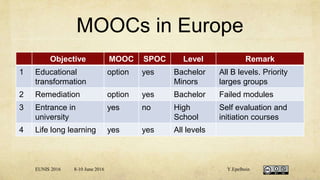
Objective MOOC SPOC Level Remark
1 Educational
transformation
option yes Bachelor
Minors
All B levels. Priority
larges groups
2 Remediation option yes Bachelor Failed modules
3 Entrance in
university
yes no High
School
Self evaluation and
initiation courses
4 Life long learning yes yes All levels
EUNIS 2016 8-10 June 2016 Y.Epelboin
MOOCs in Europe
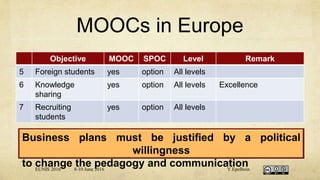
Objective MOOC SPOC Level Remark
5 Foreign students yes option All levels
6 Knowledge
sharing
yes option All levels Excellence
7 Recruiting
students
yes option All levels
Business plans must be justified by a political
willingness
to change the pedagogy and communicationEUNIS 2016 8-10 June 2016 Y.Epelboin
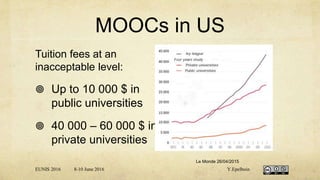
MOOCs in US
Tuition fees at an
inacceptable level:
 Up to 10 000 $ in
public universities
 40 000 – 60 000 $ in
private universities
Le Monde 26/04/2015
EUNIS 2016 8-10 June 2016 Y.Epelboin
Case # 1
Arizona State University (ASU)
 Universities consortium
 First year through MOOCs for less than 6000$
 Payment at the end
 Participation of edX
EUNIS 2016 8-10 June 2016 Y.Epelboin
Case # 2
Urbana Champaign university
 eMBA for 20 000$
1. First, selected Coursera specializations
2. Agreement of curriculum by Urbana
3. Finish as official MBA degree
Pay if success only!
EUNIS 2016 8-10 June 2016 Y.Epelboin
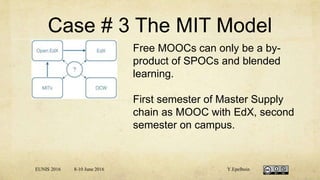
Case # 3 The MIT Model
Free MOOCs can only be a by-
product of SPOCs and blended
learning.
First semester of Master Supply
chain as MOOC with EdX, second
semester on campus.
EUNIS 2016 8-10 June 2016 Y.Epelboin
Case #4: University of
Illinois
« An accredited Masters program at an
accessible cost
Start by enrolling in any course or Specialization in
the sequence, and upgrade to the full accredited
program whenever you’re ready to apply. At $600
per credit-hour, the MCS-DS only costs $19,200 in
tuition for the complete 32 credit-hour degree. »
With Coursera
EUNIS 2016 8-10 June 2016 Y.Epelboin
Continuous education
The only field, with distance learning, where
teaching is being fully revolutionized.
 Use and reuse of the same courses for massive
numbers of students
 Optimization of absences for studies
 Possibilities to charge for education
EUNIS 2016 8-10 June 2016 Y.Epelboin
Will the universities participate to this transformation?
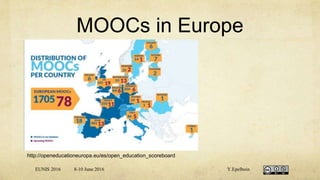
MOOCs in Europe
http://openeducationeuropa.eu/es/open_education_scoreboard
EUNIS 2016 8-10 June 2016 Y.Epelboin
In Europe
 No real models for the « big » providers
 Futurelearn: charity?
 FUN: funding by universities and state?
 MiriadaX: South America Market?
 Iversity: ECTS broker?
 EU in Brussels: only a hub
EUNIS 2016 8-10 June 2016 Y.Epelboin
Europe: continuous
education
 Numerous start-ups with models similar to
Udacity
 Revolutionizing the business of continuous
education
 Oriented towards courses directly linked to
employment
 Universities?
 Really involved in continuous education?
 No general rules for ECTS exchange.EUNIS 2016 8-10 June 2016 Y.Epelboin
A possible direction
 Freemium: minimum services for free
 With payment: payment for each additional
service
 Exercises and assessments (Coursera)
 Group tutoring
 Individual tutoring or small groups,
videoconferencing…
EUNIS 2016 8-10 June 2016 Y.Epelboin
Summary
An emerging business
model
 Free access to documents (similar to Coursera)
or for a low fee (freemium)
 Different levels of services for increasing fees
 Quizzes and home work
 Group tutoring
 Personal tutoring and video exchanges
 Universities?
EUNIS 2016 8-10 June 2016 Y.Epelboin
Searching for a business
model
 Not yet established for HE institutions
 Slow movement to introduce MOOCs in curricula
 No real thread for universities, at least at Master
and Doctorate levels.
 Fast transformation of continuous education
 A possible source of revenues for HE
 A big market for a new generation of
entrepreneurs
EUNIS 2016 8-10 June 2016 Y.Epelboin
Discussion
Annex:
MOOCs providers
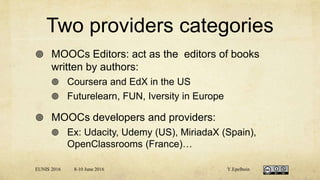
Two providers categories
 MOOCs Editors: act as the editors of books
written by authors:
 Coursera and EdX in the US
 Futurelearn, FUN, Iversity in Europe
 MOOCs developers and providers:
 Ex: Udacity, Udemy (US), MiriadaX (Spain),
OpenClassrooms (France)…
EUNIS 2016 8-10 June 2016 Y.Epelboin
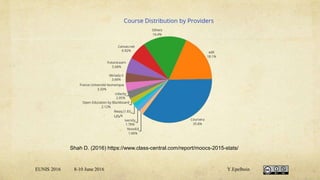
Shah D. (2016) https://www.class-central.com/report/moocs-2015-stats/
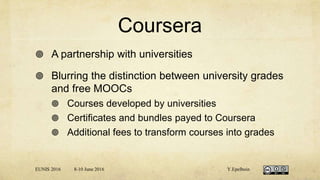
Coursera
 A partnership with universities
 Blurring the distinction between university grades
and free MOOCs
 Courses developed by universities
 Certificates and bundles payed to Coursera
 Additional fees to transform courses into grades
EUNIS 2016 8-10 June 2016 Y.Epelboin
Coursera: an evolving BM
 Revenues generated through selling different
levels of certifications
 Free access now limited to documents for most
MOOCs
 Certifications between from 10 – 100 $
 Specializations 250-500 $
EUNIS 2016 8-10 June 2016 Y.Epelboin
Udacity BM
 S. Thrun: « No money to make with universities »
 Thought for continuous education
 Courses on demand for companies
 Courses for self development and employment
EUNIS 2016 8-10 June 2016 Y.Epelboin

MOOCs: searching for a viable business model

  • 1.
    MOOCs: searching fora viable Business Model Yves Epelboin Professor Emeritus UPMC-Sorbonne-Universités, Paris Yves.Epelboin@impmc.upmc.fr
  • 2.
    Agenda  MOOC ornot MOOC?  The real cost of a MOOC  Cost efficiency of teaching: why to invest in a MOOC?  MOOCs in universities  Conclusion  MOOCs providers EUNIS 2016 8-10 June 2016 Y.Epelboin
  • 3.
    MOOCs: the alternative? The cost of Higher Education is becoming higher and higher and all countries are looking for new models.  The European and US models cannot be expanded anymore  In less developed countries not enough resources are available to build a full HE system EUNIS 2016 8-10 June 2016 Y.Epelboin
  • 4.
    MOOCs: the alternative? Three alternatives:  Increasing the level of tuition fees and leaving the burden to the students and their families.  Example of England but not accepted anywhere  Decreasing the cost of education, which is mainly manpower, i.e. teachers salaries.  Increasing the ratio students/teacher EUNIS 2016 8-10 June 2016 Y.Epelboin
  • 5.
    MOOCs: the alternative? Shortening Higher Education studies:  See Tibor Navracsics (EU Commissioner for Education, Culture, Youth and Sport) declaration Brussels, December 2014 EUNIS 2016 8-10 June 2016 Y.Epelboin
  • 6.
    A digital approachas the solution?  Increasing the Higher Education efficiency:  Decreasing the labor costs  Possibility to sell and reuse the courses  Possibility to use less qualified teachers  Increasing the students/teachers ratio  Increasing the « teaching » efficiency  Flipped learning approach EUNIS 2016 8-10 June 2016 Y.Epelboin
  • 7.
    The real costof a MOOC
  • 8.
    Human resources MOOC contents: Teachers  Community managers  MOOC development:  Video specialists  Web integrator and graphic artist  Pedagogic instructor  Project manager A MOOC is a project with many people, which needs a project manager EUNIS 2016 8-10 June 2016 Y.Epelboin
  • 9.
    Workload to builda MOOC Example: 6-8 weeks course:  Course with Math equations, graphics and pictures  Course being used 3 times  Three categories of human resources: teachers, academic and technical support EUNIS 2016 8-10 June 2016 Y.Epelboin
  • 10.
    Teachers work Mission Course1 Course 2 Course 3 Preparation 40 8 8 Writing docs 90 20 20 Writing assessments 40 10 10 Video recording 32 6 6 Project organization 30 5 5 Animation 48 48 48 Total 520 hours EUNIS 2016 8-10 June 2016 Y.Epelboin
  • 11.
    Pedagogic support Mission Course1 Course 2 Course 3 Pedagogic engineer 40 8 8 Project manager 60 12 12 Tests 60 12 12 Total 225 hours EUNIS 2016 8-10 June 2016 Y.Epelboin
  • 12.
    Technical support Mission Course1 Course 2 Course 3 Video 32 6 6 Recording Video 180-240 36-50 36-50 Editing Texts 10 2 2 Formatting Iconography 35 7 7 Variable Integration 15 3 3 Platform Meetings 10 2 2 Total 480 hours Pomerol, Epelboin & Thoury MOOCs, Design, Use and Business Models, Wiley 2015 EUNIS 2016 8-10 June 2016 Y.Epelboin
  • 13.
    Financial cost Mission Course1 Course 2 Course 3 Total Euros Teachers 15 000 5 200 5 200 25 400 Pedagogic support 6 000 1 200 1 200 8 400 Technical support 10 000 2 000 2 000 14 000 Salaries ≈ 48 000 € Base: Teachers: 75 k€/y, support teachers: 60 k€/y, tech: 47 k€/y Pomerol, Epelboin & Thoury MOOCs, Design, Use and Business Models, Wiley 2015 EUNIS 2016 8-10 June 2016 Y.Epelboin
  • 14.
    Cost efficiency Students € 0 20000 40000 60000 80000 100000 120000 140000 160000 100 200300 400 500 600 700 800 900 1000 Classic MOOC SPOC EUNIS 2016 8-10 June 2016 Y.Epelboin
  • 15.
    Digital business models A pure MOOC is the less expensive solution:  Above 200 – 300 students versus a classic approach  Interaction between teachers and students fully reduced.  A blended approach (MOOC + face-to-face ⋍ SPOC) is valid only above 600-700 students EUNIS 2016 8-10 June 2016 Y.Epelboin
  • 16.
    Decreasing the costof teaching  Using or reusing MOOCs to amortize the cost of development of digital media  A balance between face-to-face interaction and personal work EUNIS 2016 8-10 June 2016 Y.Epelboin
  • 17.
  • 18.
    Financial facts  1ECTS = 1 MOOC (30 hours of work)  One year ≃ 60 MOOCs!  In universities MOOCs are used as SPOCs:  Approach of financial interest if more than 600- 700 students are using the course (in 3 years).  Never valid for classes < 200 – 250 students => cost sharing among many universities EUNIS 2016 8-10 June 2016 Y.Epelboin
  • 19.
    Possible Business plans Savings  Large classes (mainly L1)  Sharing costs: federation of universities for smaller classes, mainly Masters or reusing courses developed by others  Manpower savings are more doubtful in Research universities where academic are not full time teachers. EUNIS 2016 8-10 June 2016 Y.Epelboin
  • 20.
    Possible business plans Saving through MOOCs and SPOCs are doubtful in Higher Education, unless universities unite.  Justification in using and developing MOOCs and SPOCs must be found elsewhere EUNIS 2016 8-10 June 2016 Y.Epelboin
  • 21.
    Case # 1 EPFL(Switzerland) MOOCs@Africa  Free access to MOOCs  Certification: 30 €/ECTS, full cursus 8-12 ECTS followed by a personal work (6-10 ECTS, 90€/ECTS)  Exams in a partner center  Partners: Coursera and edX EUNIS 2016 8-10 June 2016 Y.Epelboin
  • 22.
    Case # 2 Gestionde Projets (Ecole Centrale Lille)  Free MOOC  Second part with one or two ECTS by payment (50 – 150 €) with different levels of examinations and options  Various options for continuous education (490-690 €) http://mooc.gestiondeprojet.pm/ EUNIS 2016 8-10 June 2016 Y.Epelboin
  • 23.
    MOOCs in Europe Decreasing the cost of education cannot justify MOOCs & SPOCs  ECTS exchange among universities remains very limited thus aggregating universities to assemble enough universities remains an exception (Ex: the Bavarian Virtual University) EUNIS 2016 8-10 June 2016 Y.Epelboin
  • 24.
    MOOCs in Europe ObjectiveMOOC SPOC Level Remark 1 Educational transformation option yes Bachelor Minors All B levels. Priority larges groups 2 Remediation option yes Bachelor Failed modules 3 Entrance in university yes no High School Self evaluation and initiation courses 4 Life long learning yes yes All levels EUNIS 2016 8-10 June 2016 Y.Epelboin
  • 25.
    MOOCs in Europe ObjectiveMOOC SPOC Level Remark 5 Foreign students yes option All levels 6 Knowledge sharing yes option All levels Excellence 7 Recruiting students yes option All levels Business plans must be justified by a political willingness to change the pedagogy and communicationEUNIS 2016 8-10 June 2016 Y.Epelboin
  • 26.
    MOOCs in US Tuitionfees at an inacceptable level:  Up to 10 000 $ in public universities  40 000 – 60 000 $ in private universities Le Monde 26/04/2015 EUNIS 2016 8-10 June 2016 Y.Epelboin
  • 27.
    Case # 1 ArizonaState University (ASU)  Universities consortium  First year through MOOCs for less than 6000$  Payment at the end  Participation of edX EUNIS 2016 8-10 June 2016 Y.Epelboin
  • 28.
    Case # 2 UrbanaChampaign university  eMBA for 20 000$ 1. First, selected Coursera specializations 2. Agreement of curriculum by Urbana 3. Finish as official MBA degree Pay if success only! EUNIS 2016 8-10 June 2016 Y.Epelboin
  • 29.
    Case # 3The MIT Model Free MOOCs can only be a by- product of SPOCs and blended learning. First semester of Master Supply chain as MOOC with EdX, second semester on campus. EUNIS 2016 8-10 June 2016 Y.Epelboin
  • 30.
    Case #4: Universityof Illinois « An accredited Masters program at an accessible cost Start by enrolling in any course or Specialization in the sequence, and upgrade to the full accredited program whenever you’re ready to apply. At $600 per credit-hour, the MCS-DS only costs $19,200 in tuition for the complete 32 credit-hour degree. » With Coursera EUNIS 2016 8-10 June 2016 Y.Epelboin
  • 31.
    Continuous education The onlyfield, with distance learning, where teaching is being fully revolutionized.  Use and reuse of the same courses for massive numbers of students  Optimization of absences for studies  Possibilities to charge for education EUNIS 2016 8-10 June 2016 Y.Epelboin Will the universities participate to this transformation?
  • 32.
  • 33.
    In Europe  Noreal models for the « big » providers  Futurelearn: charity?  FUN: funding by universities and state?  MiriadaX: South America Market?  Iversity: ECTS broker?  EU in Brussels: only a hub EUNIS 2016 8-10 June 2016 Y.Epelboin
  • 34.
    Europe: continuous education  Numerousstart-ups with models similar to Udacity  Revolutionizing the business of continuous education  Oriented towards courses directly linked to employment  Universities?  Really involved in continuous education?  No general rules for ECTS exchange.EUNIS 2016 8-10 June 2016 Y.Epelboin
  • 35.
    A possible direction Freemium: minimum services for free  With payment: payment for each additional service  Exercises and assessments (Coursera)  Group tutoring  Individual tutoring or small groups, videoconferencing… EUNIS 2016 8-10 June 2016 Y.Epelboin
  • 36.
  • 37.
    An emerging business model Free access to documents (similar to Coursera) or for a low fee (freemium)  Different levels of services for increasing fees  Quizzes and home work  Group tutoring  Personal tutoring and video exchanges  Universities? EUNIS 2016 8-10 June 2016 Y.Epelboin
  • 38.
    Searching for abusiness model  Not yet established for HE institutions  Slow movement to introduce MOOCs in curricula  No real thread for universities, at least at Master and Doctorate levels.  Fast transformation of continuous education  A possible source of revenues for HE  A big market for a new generation of entrepreneurs EUNIS 2016 8-10 June 2016 Y.Epelboin
  • 39.
  • 40.
  • 41.
    Two providers categories MOOCs Editors: act as the editors of books written by authors:  Coursera and EdX in the US  Futurelearn, FUN, Iversity in Europe  MOOCs developers and providers:  Ex: Udacity, Udemy (US), MiriadaX (Spain), OpenClassrooms (France)… EUNIS 2016 8-10 June 2016 Y.Epelboin
  • 42.
    EUNIS 2016 8-10June 2016 Y.Epelboin Shah D. (2016) https://www.class-central.com/report/moocs-2015-stats/
  • 43.
    Coursera  A partnershipwith universities  Blurring the distinction between university grades and free MOOCs  Courses developed by universities  Certificates and bundles payed to Coursera  Additional fees to transform courses into grades EUNIS 2016 8-10 June 2016 Y.Epelboin
  • 44.
    Coursera: an evolvingBM  Revenues generated through selling different levels of certifications  Free access now limited to documents for most MOOCs  Certifications between from 10 – 100 $  Specializations 250-500 $ EUNIS 2016 8-10 June 2016 Y.Epelboin
  • 45.
    Udacity BM  S.Thrun: « No money to make with universities »  Thought for continuous education  Courses on demand for companies  Courses for self development and employment EUNIS 2016 8-10 June 2016 Y.Epelboin