LearningObject – CamilleAlvarez (LC2)
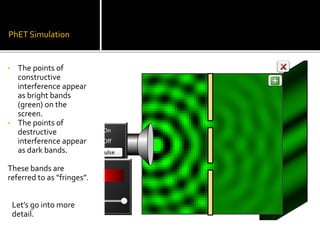
PhET Simulation
• The points of
constructive
interference appear
as bright bands
(green) on the
screen.
• The points of
destructive
interference appear
as dark bands.
These bands are
referred to as “fringes”.
Let’s go into more
detail.
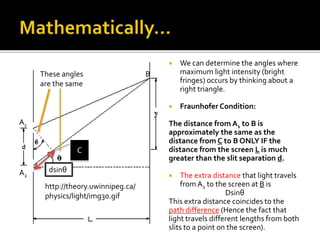
 We can determine the angles where
maximum light intensity (bright
fringes) occurs by thinking about a
right triangle.
 Fraunhofer Condition:
The distance from A1 to B is
approximately the same as the
distance from C to B ONLY IF the
distance from the screen L is much
greater than the slit separation d.
 The extra distance that light travels
from A2 to the screen at B is
Dsinθ
This extra distance coincides to the
path difference (Hence the fact that
light travels different lengths from both
slits to a point on the screen).
http://theory.uwinnipeg.ca/
physics/light/img30.gif
C
A1
A2
BThese angles
are the same
dsinθ
Assuming the light waves from the source are
in phase, the path difference for
 Constructive Interference:
Δx = mλ
 Destructive Interference:
Δx = (m+1/2)λ
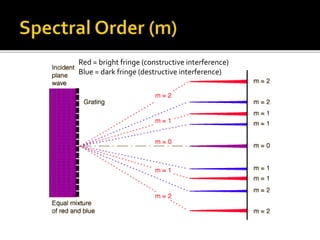
Red = bright fringe (constructive interference)
Blue = dark fringe (destructive interference)
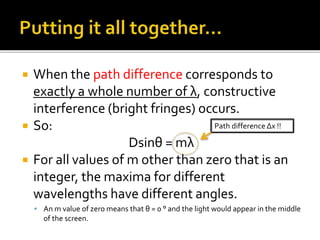
 When the path difference corresponds to
exactly a whole number of λ, constructive
interference (bright fringes) occurs.
 So:
Dsinθ = mλ
 For all values of m other than zero that is an
integer, the maxima for different
wavelengths have different angles.
 An m value of zero means that θ = 0 ° and the light would appear in the middle
of the screen.
Path difference Δx !!
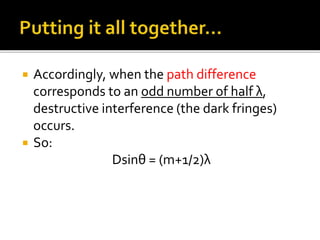
 Accordingly, when the path difference
corresponds to an odd number of half λ,
destructive interference (the dark fringes)
occurs.
 So:
Dsinθ = (m+1/2)λ
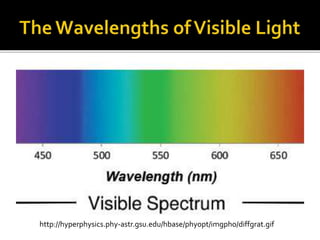
http://hyperphysics.phy-astr.gsu.edu/hbase/phyopt/imgpho/diffgrat.gif
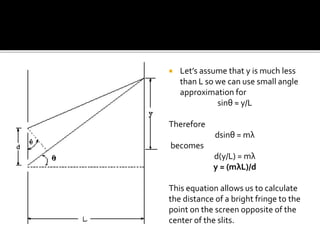
 Let’s assume that y is much less
than L so we can use small angle
approximation for
sinθ ≈ y/L
Therefore
dsinθ = mλ
becomes
d(y/L) = mλ
y = (mλL)/d
This equation allows us to calculate
the distance of a bright fringe to the
point on the screen opposite of the
center of the slits.
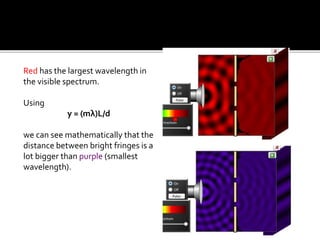
Red has the largest wavelength in
the visible spectrum.
Using
y = (mλ)L/d
we can see mathematically that the
distance between bright fringes is a
lot bigger than purple (smallest
wavelength).

Double-Slit Interference

  • 1.
  • 2.
    PhET Simulation • Thepoints of constructive interference appear as bright bands (green) on the screen. • The points of destructive interference appear as dark bands. These bands are referred to as “fringes”. Let’s go into more detail.
  • 3.
     We candetermine the angles where maximum light intensity (bright fringes) occurs by thinking about a right triangle.  Fraunhofer Condition: The distance from A1 to B is approximately the same as the distance from C to B ONLY IF the distance from the screen L is much greater than the slit separation d.  The extra distance that light travels from A2 to the screen at B is Dsinθ This extra distance coincides to the path difference (Hence the fact that light travels different lengths from both slits to a point on the screen). http://theory.uwinnipeg.ca/ physics/light/img30.gif C A1 A2 BThese angles are the same dsinθ
  • 4.
    Assuming the lightwaves from the source are in phase, the path difference for  Constructive Interference: Δx = mλ  Destructive Interference: Δx = (m+1/2)λ
  • 5.
    Red = brightfringe (constructive interference) Blue = dark fringe (destructive interference)
  • 6.
     When thepath difference corresponds to exactly a whole number of λ, constructive interference (bright fringes) occurs.  So: Dsinθ = mλ  For all values of m other than zero that is an integer, the maxima for different wavelengths have different angles.  An m value of zero means that θ = 0 ° and the light would appear in the middle of the screen. Path difference Δx !!
  • 7.
     Accordingly, whenthe path difference corresponds to an odd number of half λ, destructive interference (the dark fringes) occurs.  So: Dsinθ = (m+1/2)λ
  • 8.
  • 9.
     Let’s assumethat y is much less than L so we can use small angle approximation for sinθ ≈ y/L Therefore dsinθ = mλ becomes d(y/L) = mλ y = (mλL)/d This equation allows us to calculate the distance of a bright fringe to the point on the screen opposite of the center of the slits.
  • 10.
    Red has thelargest wavelength in the visible spectrum. Using y = (mλ)L/d we can see mathematically that the distance between bright fringes is a lot bigger than purple (smallest wavelength).