WAVE MOTION-2
DERIVATION OF SNELL’S LAW ON THE BASIS OF HUYGEN’S PRINCIPLE
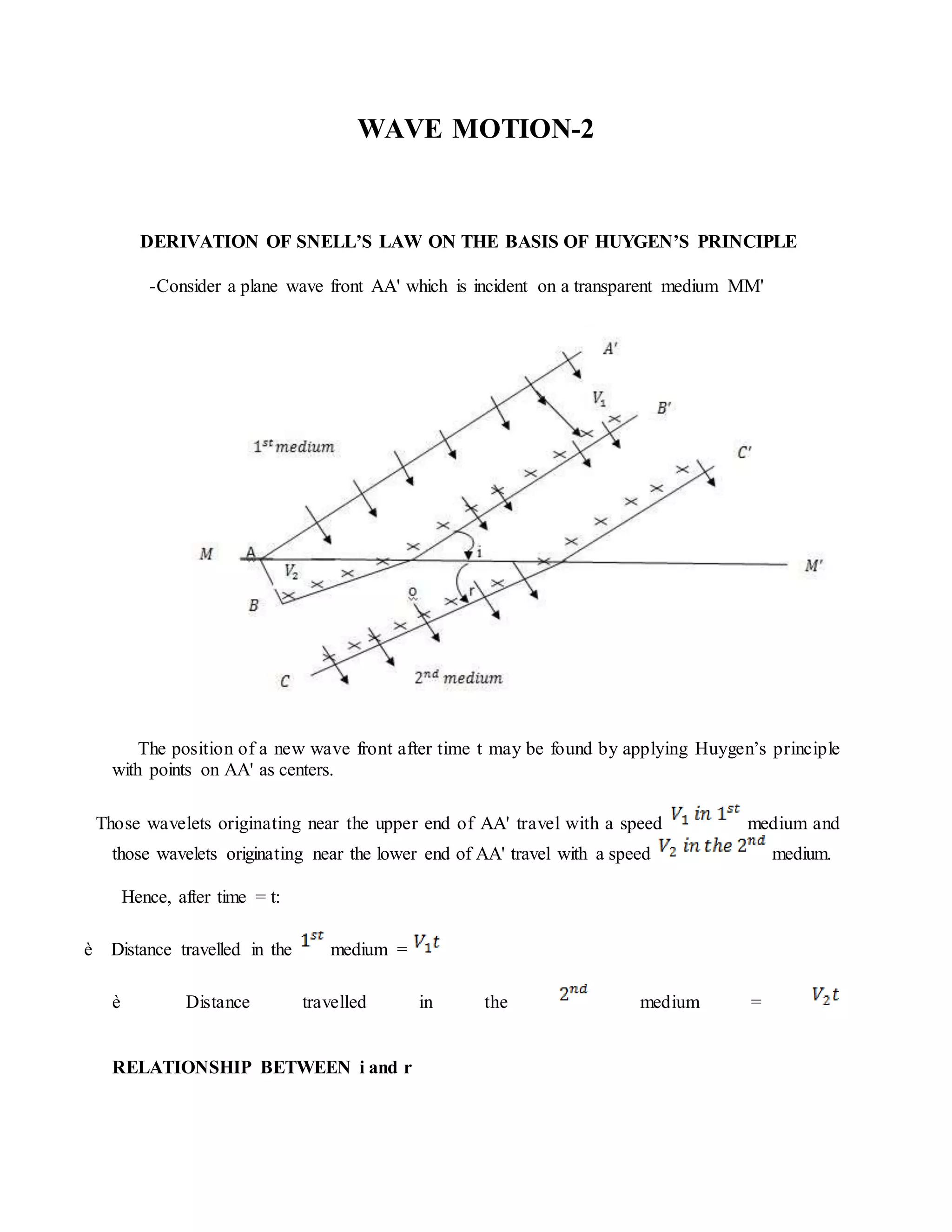
-Consider a plane wave front AA' which is incident on a transparent medium MM'
The position of a new wave front after time t may be found by applying Huygen’s principle
with points on AA' as centers.
Those wavelets originating near the upper end of AA' travel with a speed medium and
those wavelets originating near the lower end of AA' travel with a speed medium.
Hence, after time = t:
è Distance travelled in the medium =
RELATIONSHIP BETWEEN i and r
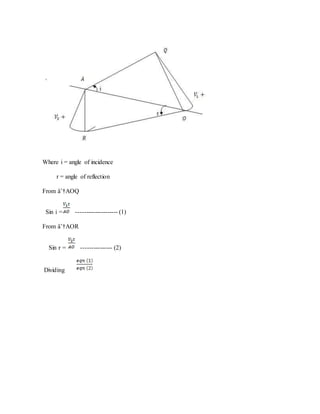
Where i = angle of incidence
r = angle of reflection
From ∆AOQ
Sin i = -------------------- (1)
From ∆AOR
Sin r = --------------- (2)
Dividing
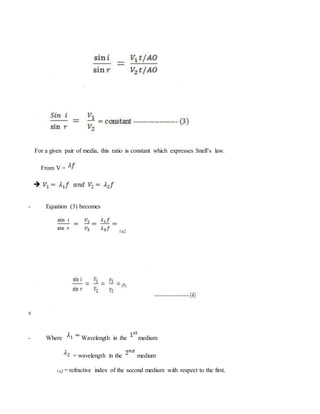
For a given pair of media, this ratio is constant which expresses Snell’s law.
From V =
- Equation (3) becomes
1η2
v
- Where Wavelength in the medium
= wavelength in the medium
1η2 = refractive index of the second medium with respect to the first.
Definition
-The refractive index (η) of material is the ratio of the sine of the angle of incidence to the sine of
the angle of refraction.
Problem 36
Monochromatic light of a wavelength 800nm enters a glass plate of refractive index 1.5
Calculate;
(i) The speed of light in glass
(ii) The frequency of the light
(iii) The wavelength of light in glass
Given that C = 3 1 and 1nm = 1 1 m
INTERFERENCE OF LIGHT WAVES
Interference is a situation in which two or more waves overlap in space.
In a region where two or more light waves cross, superposition occurs giving reinforcement
(addition) of the waves at some points and cancellation (subtraction) at others.
The resulting effect is called an interference pattern or system of fringes
Definition
Interference pattern/system of fringes is a set of light bands (fringes) and dark bands (fringes)
formed on a screen when interference of light waves occurs.
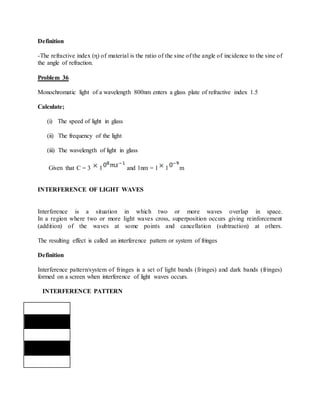
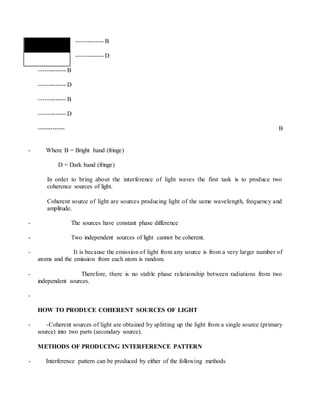
INTERFERENCE PATTERN
------------- B
------------- D
------------- B
------------- D
------------- B
------------- D
------------- B
- Where B = Bright band (fringe)
D = Dark band (fringe)
In order to bring about the interference of light waves the first task is to produce two
coherence sources of light.
Coherent source of light are sources producing light of the same wavelength, frequency and
amplitude.
- The sources have constant phase difference
- Two independent sources of light cannot be coherent.
- It is because the emission of light from any source is from a very larger number of
atoms and the emission from each atom is random.
- Therefore, there is no stable phase relationship between radiations from two
independent sources.
-
HOW TO PRODUCE COHERENT SOURCES OF LIGHT
- -Coherent sources of light are obtained by splitting up the light from a single source (primary
source) into two parts (secondary source).
METHODS OF PRODUCING INTERFERENCE PATTERN
- Interference pattern can be produced by either of the following methods
(1) Young’s double slit
(2) Lloyd’s mirror
(3) Fresnel’s biprism
(4) Newton’s rings
(5) Wedge fringes
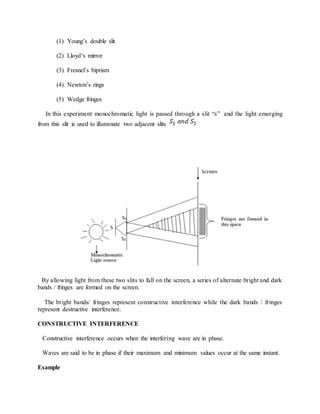
In this experiment monochromatic light is passed through a slit “s” and the light emerging
from this slit is used to illuminate two adjacent slits
By allowing light from these two slits to fall on the screen, a series of alternate bright and dark
bands / fringes are formed on the screen.
The bright bands/ fringes represent constructive interference while the dark bands / fringes
represent destructive interference.
CONSTRUCTIVE INTERFERENCE
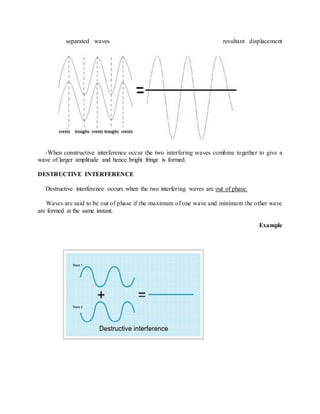
Constructive interference occurs when the interfering wave are in phase.
Waves are said to be in phase if their maximum and minimum values occur at the same instant.
Example
separated waves resultant displacement
-When constructive interference occur the two interfering waves combine together to give a
wave of larger amplitude and hence bright fringe is formed.
DESTRUCTIVE INTERFERENCE
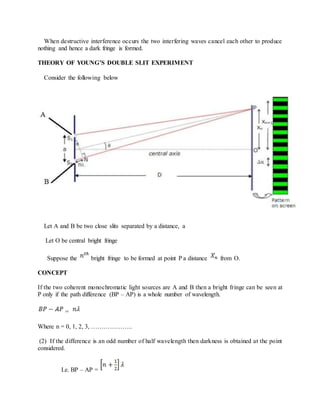
Destructive interference occurs when the two interfering waves are out of phase.
Waves are said to be out of phase if the maximum of one wave and minimum the other wave
are formed at the same instant.
Example
When destructive interference occurs the two interfering waves cancel each other to produce
nothing and hence a dark fringe is formed.
THEORY OF YOUNG’S DOUBLE SLIT EXPERIMENT
Consider the following below
Let A and B be two close slits separated by a distance, a
Let O be central bright fringe
Suppose the bright fringe to be formed at point P a distance from O.
CONCEPT
If the two coherent monochromatic light sources are A and B then a bright fringe can be seen at
P only if the path difference (BP – AP) is a whole number of wavelength.
=
Where n = 0, 1, 2, 3, ………………..
(2) If the difference is an odd number of half wavelength then darkness is obtained at the point
considered.
I.e. BP – AP =
here n = 0, 1, 2, 3, ………………………
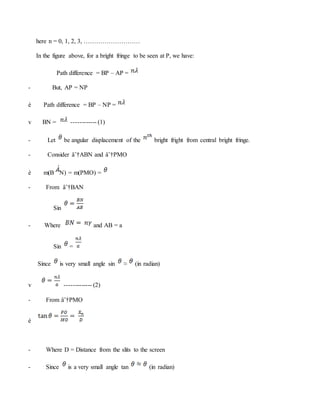
In the figure above, for a bright fringe to be seen at P, we have:
Path difference = BP – AP =
- But, AP = NP
è Path difference = BP – NP =
v BN = ------------ (1)
- Let be angular displacement of the bright fright from central bright fringe.
- Consider ∆ABN and ∆PMO
è m(B N) = m(PMO) =
- From ∆BAN
Sin
- Where and AB = a
Sin =
Since is very small angle sin ≈ (in radian)
v ------------- (2)
- From ∆PMO
è
- Where D = Distance from the slits to the screen
- Since is a very small angle tan (in radian)
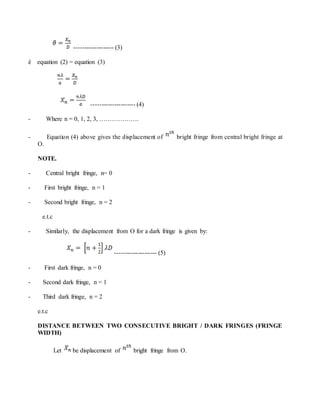
------------------- (3)
è equation (2) = equation (3)
--------------------- (4)
- Where n = 0, 1, 2, 3, ……………….
- Equation (4) above gives the displacement of bright fringe from central bright fringe at
O.
NOTE.
- Central bright fringe, n= 0
- First bright fringe, n = 1
- Second bright fringe, n = 2
e.t.c
- Similarly, the displacement from O for a dark fringe is given by:
-------------------- (5)
- First dark fringe, n = 0
- Second dark fringe, n = 1
- Third dark fringe, n = 2
e.t.c
DISTANCE BETWEEN TWO CONSECUTIVE BRIGHT / DARK FRINGES (FRINGE
WIDTH)
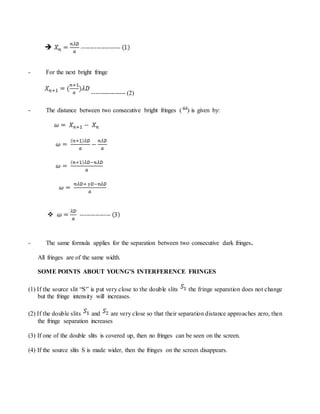
Let be displacement of bright fringe from O.
- For the next bright fringe
---------------- (2)
- The distance between two consecutive bright fringes ( ) is given by:
- The same formula applies for the separation between two consecutive dark fringes.
All fringes are of the same width.
SOME POINTS ABOUT YOUNG’S INTERFERENCE FRINGES
(1) If the source slit “S” is put very close to the double slits the fringe separation does not change
but the fringe intensity will increases.
(2) If the double slits and are very close so that their separation distance approaches zero, then
the fringe separation increases
(3) If one of the double slits is covered up, then no fringes can be seen on the screen.
(4) If the source slits S is made wider, then the fringes on the screen disappears.
(5) If white light is used instead of monochromatic light source then the central fringe at O is white
but the other bright fringe on either sides of the central fringe are colored with violet near “O”
and red far away from “O”.
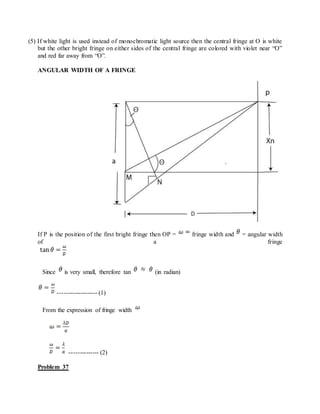
ANGULAR WIDTH OF A FRINGE
If P is the position of the first bright fringe then OP = fringe width and = angular width
of a fringe
Since is very small, therefore tan (in radian)
------------------- (1)
From the expression of fringe width
-------------- (2)
Problem 37
Two slits are at a distance of 0.2mm apart and the screen is at a distance of 1m. The third bright
fringe is found to be displaced 7.5mm from the central fringe. Find the wavelength of the light
used.
Problem 38
A yellow light from a sodium vapour lamp of wavelength 5893 is directed upon two narrow
slits of 0.1cm apart. Find the position on the screen 100cm away from the slits.
Problem 39
In Young’s experiment, the distance of the screen from the two slits is 1.0m. When light of
wavelength 6000 is allowed to fall on the slits the width of the fringes obtained on a screen is
2.0mm. Determine:
(i) The distance between the two slits and
(ii) The width of the fringes if the wavelength of the incident light is 4800 .
Problem 40
In double slit experiment, light has a frequency of 6 1 . The distance between the
centres of adjacent bright fringes is 0.75mm. What is the distance between the slits if the screen
is 1.5m away?
Given that the speed of light in free space 3 1 .
Problem 41
In a Young’s double slit experiment, two narrow slits 0.8mm apart are illuminated by the same
source of yellow light ( ). How far apart are the adjacent bright bands in the
interference pattern observed on a screen 2m away?
Problem 42
In young’s double slit experiment the angular width of a fringe formed on a distant screen is 0.1
. The wavelength of light used is 6000 . What is the spacing between the slits?
Problem 43
A beam of light consisting of two wavelength 6500 and 5200 is used to obtain interference
fringes in a Young’s double slit experiment.
(i) Find the distance of the third bright fringe on the screen from the central maximum to the
wavelength 6500 .
(ii) What is the least distance from the central maximum where the bright fringes due to
both the wavelengths coincide?
The distance between the slits is 2mm and the distance between the plane of the slits and the
screen is 120cm.
Problem 45
A Young’s double slit arrangement produces interference fringe for sodium light ( )
that are 0.20 apart. What is the angular fringe separation if the entire arrangement is immersed
in water? Given that refractive index of water = 4/3
Problem 46
In Young’s double slit experiment the distance between the slits is 1mm and the distance of the
screen from the slits is 1m. If light of wavelength 6000 is used, then find the distance between
the second dark fringe and the forth bright fringe.
FRINGE SHIFT
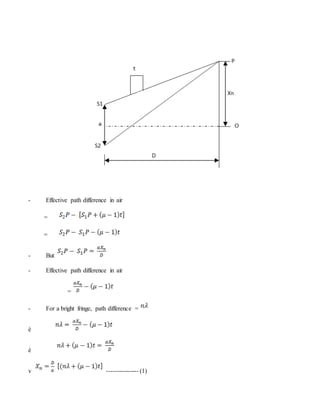
-When a thin transparent plate of thickness (t) and refractive index ( is introduced in the path
of one of the interfering waves ( say in the path P.) then the effective path in air is increased
by ( )t due to the introduction of the plate.
- Effective path difference in air
=
=
- But
- Effective path difference in air
=
- For a bright fringe, path difference =
è
è
v --------------- (1)
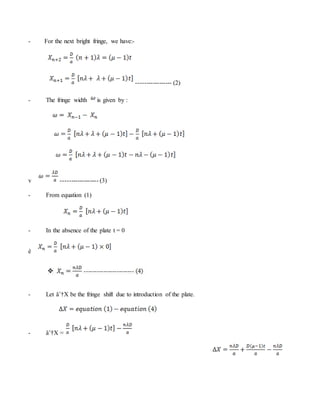
- For the next bright fringe, we have:-
----------------- (2)
- The fringe width is given by :
v ------------------ (3)
- From equation (1)
- In the absence of the plate t = 0
è
- Let ∆X be the fringe shift due to introduction of the plate.
- ∆X =
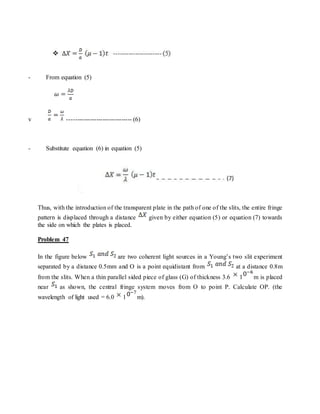
- From equation (5)
v ------------------------------- (6)
- Substitute equation (6) in equation (5)
Thus, with the introduction of the transparent plate in the path of one of the slits, the entire fringe
pattern is displaced through a distance given by either equation (5) or equation (7) towards
the side on which the plates is placed.
Problem 47
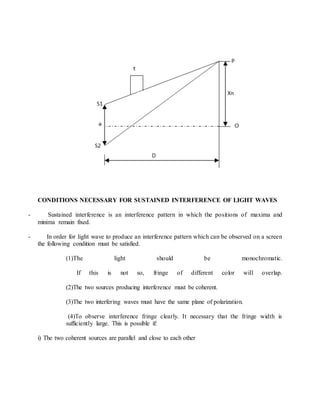
In the figure below are two coherent light sources in a Young’s two slit experiment
separated by a distance 0.5mm and O is a point equidistant from at a distance 0.8m
from the slits. When a thin parallel sided piece of glass (G) of thickness 3.6 1 m is placed
near as shown, the central fringe system moves from O to point P. Calculate OP. (the
wavelength of light used = 6.0 1 m).
CONDITIONS NECESSARY FOR SUSTAINED INTERFERENCE OF LIGHT WAVES
- Sustained interference is an interference pattern in which the positions of maxima and
minima remain fixed.
- In order for light wave to produce an interference pattern which can be observed on a screen
the following condition must be satisfied.
(1)The light should be monochromatic.
If this is not so, fringe of different color will overlap.
(2)The two sources producing interference must be coherent.
(3)The two interfering waves must have the same plane of polarization.
(4)To observe interference fringe clearly. It necessary that the fringe width is
sufficiently large. This is possible if:
i) The two coherent sources are parallel and close to each other
ii) The distance between slits and screen is reasonably large.
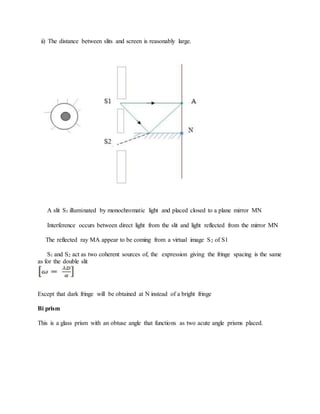
A slit S1 illuminated by monochromatic light and placed closed to a plane mirror MN
Interference occurs between direct light from the slit and light reflected from the mirror MN
The reflected ray MA appear to be coming from a virtual image S2 of S1
S1 and S2 act as two coherent sources of, the expression giving the fringe spacing is the same
as for the double slit
Except that dark fringe will be obtained at N instead of a bright fringe
Bi prism
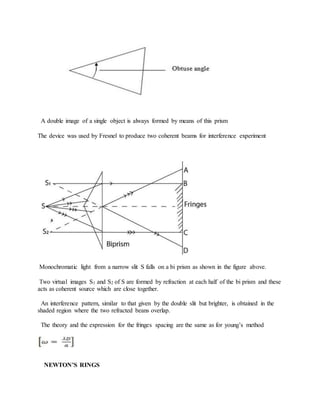
This is a glass prism with an obtuse angle that functions as two acute angle prisms placed.
A double image of a single object is always formed by means of this prism
The device was used by Fresnel to produce two coherent beams for interference experiment
Monochromatic light from a narrow slit S falls on a bi prism as shown in the figure above.
Two virtual images S1 and S2 of S are formed by refraction at each half of the bi prism and these
acts as coherent source which are close together.
An interference pattern, similar to that given by the double slit but brighter, is obtained in the
shaded region where the two refracted beans overlap.
The theory and the expression for the fringes spacing are the same as for young’s method
NEWTON’S RINGS
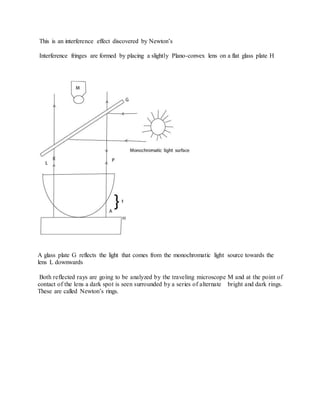
This is an interference effect discovered by Newton’s
Interference fringes are formed by placing a slightly Plano-convex lens on a flat glass plate H
A glass plate G reflects the light that comes from the monochromatic light source towards the
lens L downwards
Both reflected rays are going to be analyzed by the traveling microscope M and at the point of
contact of the lens a dark spot is seen surrounded by a series of alternate bright and dark rings.
These are called Newton’s rings.
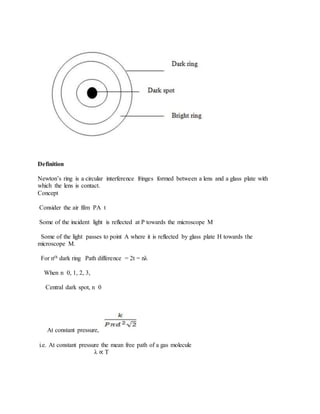
Definition
Newton’s ring is a circular interference fringes formed between a lens and a glass plate with
which the lens is contact.
Concept
Consider the air film PA t
Some of the incident light is reflected at P towards the microscope M
Some of the light passes to point A where it is reflected by glass plate H towards the
microscope M.
For nth dark ring Path difference = 2t = nλ
When n 0, 1, 2, 3,
Central dark spot, n 0
At constant pressure,
i.e. At constant pressure the mean free path of a gas molecule
λ ∝ T
At constant pressure the mean free path of a gas molecule is directly proportional to its absolute
temperature T.
λ = KT
Where K constant of proportionality
If λ1 and λ2 are mean free path of a gas molecule at temperature T1 and T2 respectively:
And λ1 = KT1
λ2 = KT2
2. Pressure P of the gas
From equation (3)
At constant temperature the mean free path of a gas molecule is inversely proportional to
pressure.
Pλ = K
Where K constant of proportionality
Generally, we may write
P1λ1= λ2P2
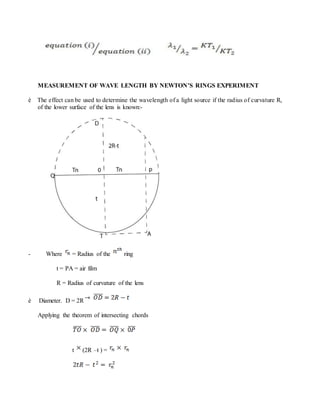
MEASUREMENT OF WAVE LENGTH BY NEWTON’S RINGS EXPERIMENT
è The effect can be used to determine the wavelength of a light source if the radius of curvature R,
of the lower surface of the lens is known:-
- Where = Radius of the ring
t = PA = air film
R = Radius of curvature of the lens
è Diameter. D = 2R
Applying the theorem of intersecting chords
t (2R –t ) =
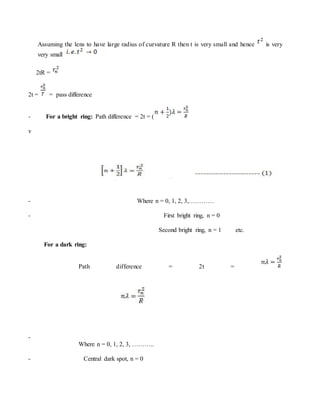
Assuming the lens to have large radius of curvature R then t is very small and hence is very
very small
2tR =
2t = = pass difference
- For a bright ring: Path difference = 2t = (
v
- Where n = 0, 1, 2, 3,…………
- First bright ring, n = 0
Second bright ring, n = 1 etc.
For a dark ring:
Path difference = 2t =
-
Where n = 0, 1, 2, 3, ………..
- Central dark spot, n = 0
- First dark ring, n = 1
- Second dark ring, n = 2 etc.
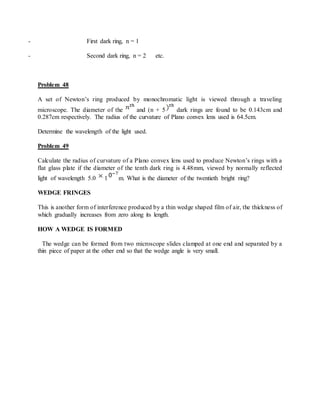
Problem 48
A set of Newton’s ring produced by monochromatic light is viewed through a traveling
microscope. The diameter of the and (n + 5 dark rings are found to be 0.143cm and
0.287cm respectively. The radius of the curvature of Plano convex lens used is 64.5cm.
Determine the wavelength of the light used.
Problem 49
Calculate the radius of curvature of a Plano convex lens used to produce Newton’s rings with a
flat glass plate if the diameter of the tenth dark ring is 4.48mm, viewed by normally reflected
light of wavelength 5.0 1 m. What is the diameter of the twentieth bright ring?
WEDGE FRINGES
This is another form of interference produced by a thin wedge shaped film of air, the thickness of
which gradually increases from zero along its length.
HOW A WEDGE IS FORMED
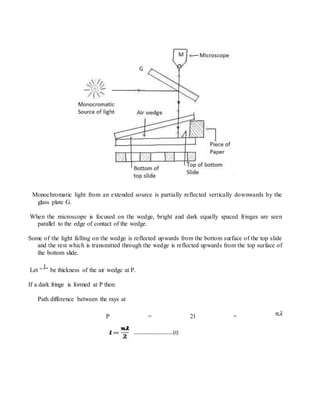
The wedge can be formed from two microscope slides clamped at one end and separated by a
thin piece of paper at the other end so that the wedge angle is very small.
Monochromatic light from an extended source is partially reflected vertically downwards by the
glass plate G.
When the microscope is focused on the wedge, bright and dark equally spaced fringes are seen
parallel to the edge of contact of the wedge.
Some of the light falling on the wedge is reflected upwards from the bottom surface of the top slide
and the rest which is transmitted through the wedge is reflected upwards from the top surface of
the bottom slide.
Let “ ” be thickness of the air wedge at P.
If a dark fringe is formed at P then:
Path difference between the rays at
P = 2l =
- Where n = 0, 1, 2, 3, …………………
- First bright fringe, n = 0
- Second bright fringe, n = 1
DETERMINATION OF ANGLE OF THE WEDGE
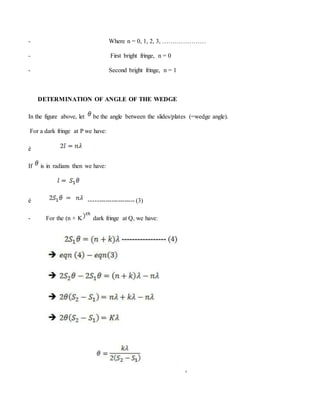
In the figure above, let be the angle between the slides/plates (=wedge angle).
For a dark fringe at P we have:
è
If is in radians then we have:
è ---------------------- (3)
- For the (n + K dark fringe at Q, we have:
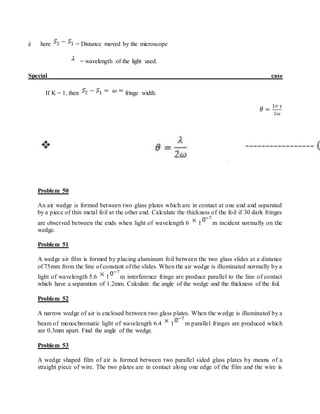
è here = Distance moved by the microscope
= wavelength of the light used.
Special case
If K = 1, then fringe width.
Problem 50
An air wedge is formed between two glass plates which are in contact at one end and separated
by a piece of thin metal foil at the other end. Calculate the thickness of the foil if 30 dark fringes
are observed between the ends when light of wavelength 6 1 m incident normally on the
wedge.
Problem 51
A wedge air film is formed by placing aluminum foil between the two glass slides at a distance
of 75mm from the line of constant of the slides. When the air wedge is illuminated normally by a
light of wavelength 5.6 1 m interference fringe are produce parallel to the line of contact
which have a separation of 1.2mm. Calculate the angle of the wedge and the thickness of the foil.
Problem 52
A narrow wedge of air is enclosed between two glass plates. When the wedge is illuminated by a
beam of monochromatic light of wavelength 6.4 1 m parallel fringes are produced which
are 0.3mm apart. Find the angle of the wedge.
Problem 53
A wedge shaped film of air is formed between two parallel sided glass plates by means of a
straight piece of wire. The two plates are in contact along one edge of the film and the wire is
parallel to this wedge. In such experiment, using light of wavelength 589nm, the distance
between the 7th and 169th dark fringes was 26.3mm and the distance between the junction of the
glass plates and the wire was 35.6mm. Calculate the angle of the wedge and the diameter of the
wire.
Problem 54
An air wedge is formed between two flat glass plates of length 45mm by using a spacer at one
end. Wedge fringes spaced 0.29mm apart are observed by reflection when light of wavelength
430nm is directed normally at the wedge. Calculate the angle of the wedge and the thickness of
the spacer.
APPLICATION OF INTERFERENCE
(1 (1) QUALITY TESTING OF OPTICAL SURFACES
Fringes of equal thickness are useful for testing the quality of optical components.
Example
In making of optical flats the plate under test is made to form an air wedge with a standard plane
glass surface.
Any uneven part of the surface which require more grinding will show up irregularities.
The grinding of a lens surface may be checked if it is placed on an optical flat and Newton’s
rings observed in monochromatic light.
(2) MAKING NON-REFLECTING GLASS / BLOOMING LENSES
In optical instruments containing lenses or prisms light is lost by reflection at each refracting
surface which results in reduced brightness of the final image.
The amount of light reflected at the surface can be appreciably reduced by coating it with a film of
transparent material example magnesium fluoride. The process is called Blooming.
Blooming is the process of depositing a transparent film of a substance such as magnesium
fluoride on a lens to reduce (or eliminate) the reflection of the light at the surface.
è The film is about one-quarter of a wavelength thick and has a lower refractive index than the
lens.
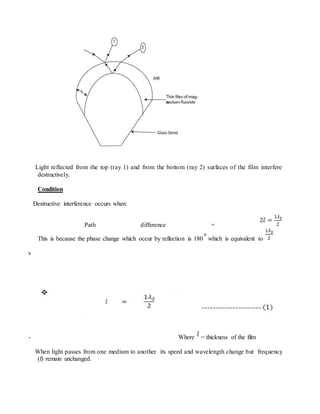
Light reflected from the top (ray 1) and from the bottom (ray 2) surfaces of the film interfere
destructively.
Condition
Destructive interference occurs when:
Path difference =
This is because the phase change which occur by reflection is 180 which is equivalent to
v
- Where = thickness of the film
When light passes from one medium to another its speed and wavelength change but frequency
(f) remain unchanged.
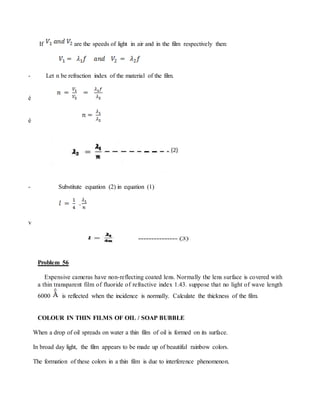
If are the speeds of light in air and in the film respectively then:
- Let n be refraction index of the material of the film.
è
è
- Substitute equation (2) in equation (1)
v
Problem 56
Expensive cameras have non-reflecting coated lens. Normally the lens surface is covered with
a thin transparent film of fluoride of refractive index 1.43. suppose that no light of wave length
6000 is reflected when the incidence is normally. Calculate the thickness of the film.
COLOUR IN THIN FILMS OF OIL / SOAP BUBBLE
When a drop of oil spreads on water a thin film of oil is formed on its surface.
In broad day light, the film appears to be made up of beautiful rainbow colors.
The formation of these colors in a thin film is due to interference phenomenon.
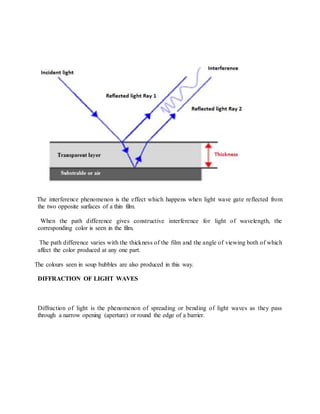
The interference phenomenon is the effect which happens when light wave gate reflected from
the two opposite surfaces of a thin film.
When the path difference gives constructive interference for light of wavelength, the
corresponding color is seen in the film.
The path difference varies with the thickness of the film and the angle of viewing both of which
affect the color produced at any one part.
The colours seen in soup bubbles are also produced in this way.
DIFFRACTION OF LIGHT WAVES
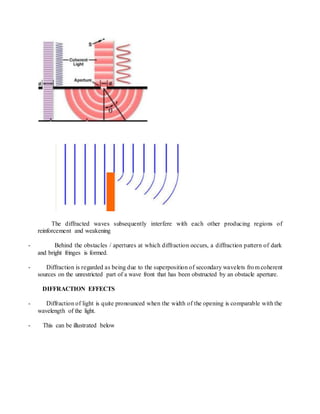
Diffraction of light is the phenomenon of spreading or bending of light waves as they pass
through a narrow opening (aperture) or round the edge of a barrier.
The diffracted waves subsequently interfere with each other producing regions of
reinforcement and weakening
- Behind the obstacles / apertures at which diffraction occurs, a diffraction pattern of dark
and bright fringes is formed.
- Diffraction is regarded as being due to the superposition of secondary wavelets from coherent
sources on the unrestricted part of a wave front that has been obstructed by an obstacle aperture.
DIFFRACTION EFFECTS
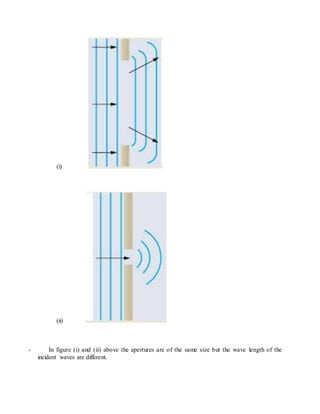
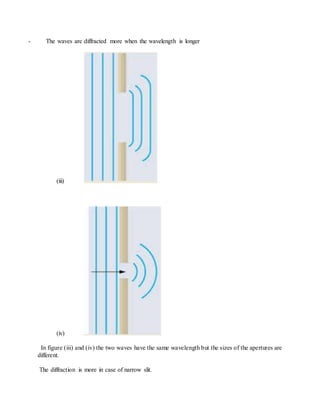
- Diffraction of light is quite pronounced when the width of the opening is comparable with the
wavelength of the light.
- This can be illustrated below
(i)
(ii)
- In figure (i) and (ii) above the apertures are of the same size but the wave length of the
incident waves are different.
- The waves are diffracted more when the wavelength is longer
(iii)
(iv)
In figure (iii) and (iv) the two waves have the same wavelength but the sizes of the apertures are
different.
The diffraction is more in case of narrow slit.
TYPES OF DIFFRACTION
Diffraction of light is of two types
(i) Fraunhofer diffraction
(ii) Fresnel diffraction
FRAUNHOFER DIFFRACTION
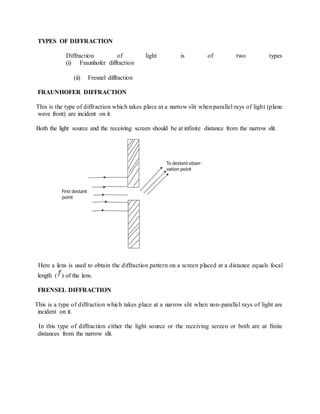
This is the type of diffraction which takes place at a narrow slit when parallel rays of light (plane
wave front) are incident on it.
Both the light source and the receiving screen should be at infinite distance from the narrow slit.
Here a lens is used to obtain the diffraction pattern on a screen placed at a distance equals focal
length ( ) of the lens.
FRENSEL DIFFRACTION
This is a type of diffraction which takes place at a narrow slit when non-parallel rays of light are
incident on it.
In this type of diffraction either the light source or the receiving screen or both are at finite
distances from the narrow slit.
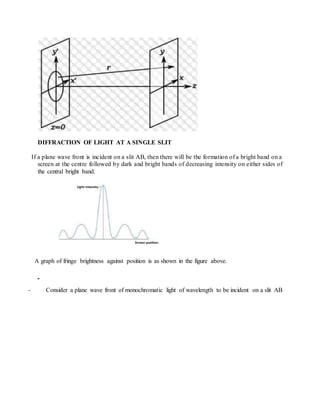
DIFFRACTION OF LIGHT AT A SINGLE SLIT
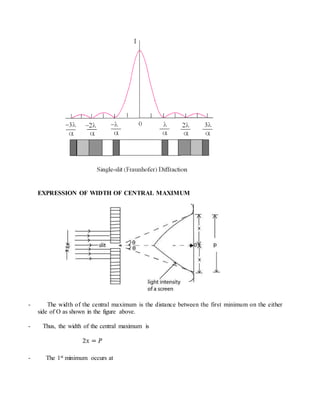
If a plane wave front is incident on a slit AB, then there will be the formation of a bright band on a
screen at the centre followed by dark and bright bands of decreasing intensity on either sides of
the central bright band.
A graph of fringe brightness against position is as shown in the figure above.
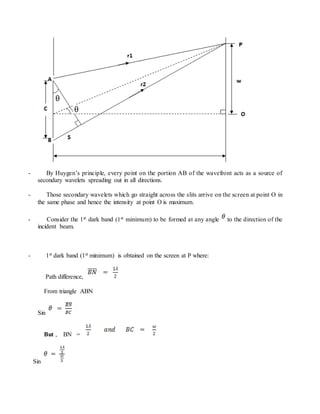
- Consider a plane wave front of monochromatic light of wavelength to be incident on a slit AB
- By Huygen’s principle, every point on the portion AB of the wavefront acts as a source of
secondary wavelets spreading out in all directions.
- Those secondary wavelets which go straight across the slits arrive on the screen at point O in
the same phase and hence the intensity at point O is maximum.
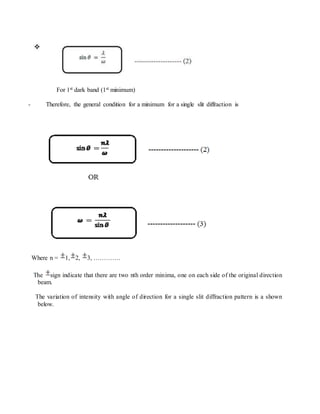
- Consider the 1st dark band (1st minimum) to be formed at any angle to the direction of the
incident beam.
- 1st dark band (1st minimum) is obtained on the screen at P where:
Path difference,
From triangle ABN
Sin
But , BN =
Sin
For 1st dark band (1st minimum)
- Therefore, the general condition for a minimum for a single slit diffraction is
Where n = 1, 2, 3, ………….
The sign indicate that there are two nth order minima, one on each side of the original direction
beam.
The variation of intensity with angle of direction for a single slit diffraction pattern is a shown
below.
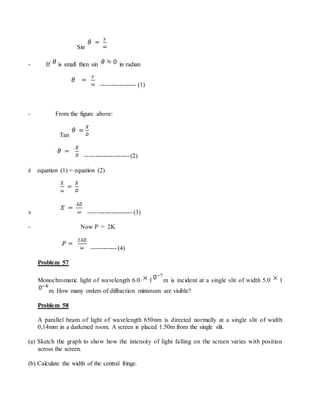
EXPRESSION OF WIDTH OF CENTRAL MAXIMUM
- The width of the central maximum is the distance between the first minimum on the either
side of O as shown in the figure above.
- Thus, the width of the central maximum is
- The 1st minimum occurs at
Sin
- If is small then sin in radian
----------------- (1)
- From the figure above:
Tan
--------------------- (2)
è equation (1) = equation (2)
v --------------------- (3)
- Now P = 2K
------------ (4)
Problem 57
Monochromatic light of wavelength 6.0 1 m is incident at a single slit of width 5.0 1
m. How many orders of diffraction minimum are visible?
Problem 58
A parallel beam of light of wavelength 650nm is directed normally at a single slit of width
0,14mm in a darkened room. A screen is placed 1.50m from the single slit.
(a) Sketch the graph to show how the intensity of light falling on the screen varies with position
across the screen.
(b) Calculate the width of the central fringe.
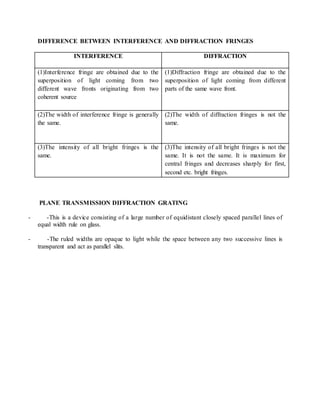
DIFFERENCE BETWEEN INTERFERENCE AND DIFFRACTION FRINGES
INTERFERENCE DIFFRACTION
(1)Interference fringe are obtained due to the
superposition of light coming from two
different wave fronts originating from two
coherent source
(1)Diffraction fringe are obtained due to the
superposition of light coming from different
parts of the same wave front.
(2)The width of interference fringe is generally
the same.
(2)The width of diffraction fringes is not the
same.
(3)The intensity of all bright fringes is the
same.
(3)The intensity of all bright fringes is not the
same. It is not the same. It is maximum for
central fringes and decreases sharply for first,
second etc. bright fringes.
PLANE TRANSMISSION DIFFRACTION GRATING
- -This is a device consisting of a large number of equidistant closely spaced parallel lines of
equal width rule on glass.
- -The ruled widths are opaque to light while the space between any two successive lines is
transparent and act as parallel slits.
Application
Diffraction gratings are used for producing spectra and for measuring wavelengths accurately.
THEORY
Suppose plane waves of monochromatic light of wave length fall on a transmission grating in
which the slit separation (called grating spacing) is d.
Let N be number of lines per meter of the grating (= Grating Constant)
- Consider wavelets coming from corresponding point A and B on two successive slits and
travelling at an angle to the direction of the incident beam.
è Path difference, BC = d
v
Where “n” is an integer giving the order of the spectrum.
Here reinforcement of the diffracted wavelets occurs in the direction and a maximum (bright
band) will be obtained.
The angular distribution of diffracted beams is as shown below:
NOTE
The actual number of orders possible for a given grating will depend on the width of the grating
spaced and the wavelength of the light used.
Since cannot be greater than (90 diffraction), then the maximum number of orders possible
for any given wavelength cannot be greater than the whole number value of n given by
“n” is maximum when sin = 1
è
Maximum number of orders possible
Problem 59
Monochromatic light of wavelength 600nm is incident normally on an optical transmission
grating of spacing 2.00 Calculate:
(a) The angular position of the maxima
(b) The number of diffracted beams which can be observed
(c) The maximum order possible
Problem 60
The limits of the visible spectrum are approximately 400nm to 700nm. Find the angular spread
of the first -order visible spectrum produced by a plane grating having 6000 lines per centimeter
when light is incident normally on the grating.
Problem 61
A grating has 500 lines per millimeter and is illuminated normally with monochromatic light of
wavelength 5.89 1 m.
(a) How many diffraction maxima may be observed?
(b) Calculate the angular separation.
Problem 62
What is the angular width of the first order spectrum produced by a diffraction grating of 5000
per cm when a parallel beam of while light is incident normally on it?
Problem 63
A monochromatic light of wavelength 2 1 falls normally on a grating which has 4 1
lines per cm.
(a) What is largest order of spectrum that can be visible?
(b) Find the angular separation between the third and fourth order image.
Problem 64
A diffraction grating with grating of 2 1 m is used to examine the light from the glaring
gas. It is found that the first order of violet light emerges at an angle of 11.8 and the first order
of red light emerges at angle of 15.8 . Calculate:
(a) The wavelength of the two lights.
(b)The angle at which nth order of red light will coincide with the (n+1 order of violet light.
Problem 65
A diffraction grating has 500 lines per mm when used with monochromatic light
of m at normal incidence. At what angles will bright diffraction images be
observed?
Problem 66
A slit 0.1mm wide is illuminated with a monochromatic light of wavelength 5000 . How wide is
the central maximum on a screen 1m from the slits?
Problem 67
A single narrow slits is illuminated with red light of wavelength 6328 . A screen placed 1.60m
from the slits shows a typical single –slit diffraction pattern. The separation between the first two
minima is 4.0mm. what is the width of the slits?
Problem 68
Light of wavelength 7500 passes through a slit of 1.0 1 mm wide. How wide is the
central maximum
(i) In degrees and
(ii) In cm on a screen 20cm away?
POLARIZATION OF LIGHT WAVES
Light is an electromagnetic wave whose electric and magnetic vibrations are perpendicular
to each other and to the direction of propagation.
Polarization of light is the process of confining the vibrations of the electric vector of light
waves to one direction.
- In unpolarized light the electric field vibrates in all directions perpendicular to the
direction of a wave .
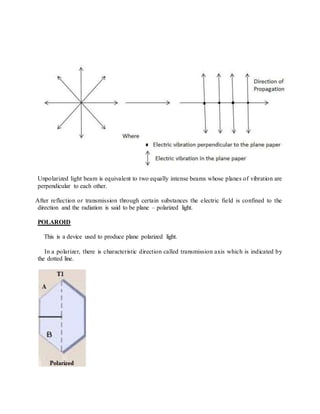
- The commonly used pictorial representation of an unpolarized light wave is as shown below
Unpolarized light beam is equivalent to two equally intense beams whose planes of vibration are
perpendicular to each other.
After reflection or transmission through certain substances the electric field is confined to the
direction and the radiation is said to be plane – polarized light.
POLAROID
This is a device used to produce plane polarized light.
In a polarizer, there is characteristic direction called transmission axis which is indicated by
the dotted line.
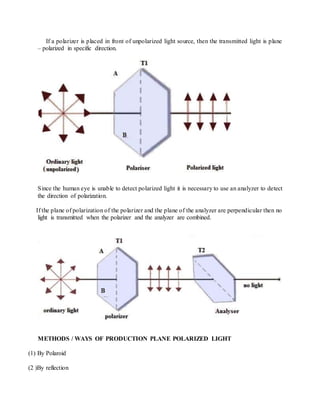
If a polarizer is placed in front of unpolarized light source, then the transmitted light is plane
– polarized in specific direction.
Since the human eye is unable to detect polarized light it is necessary to use an analyzer to detect
the direction of polarization.
If the plane of polarization of the polarizer and the plane of the analyzer are perpendicular then no
light is transmitted when the polarizer and the analyzer are combined.
METHODS / WAYS OF PRODUCTION PLANE POLARIZED LIGHT
(1) By Polaroid
(2 )By reflection
(3)By double refraction
(4)By using Nicol prism
POLARIZATION BY POLAROIDS
Polaroid is an artificial crystalline material which can be made in thin sheets.
It has the property of allowing light vibrations only of a particular polarization to pass through.
Uses of Polaroid
(i) They are used in sunglasses to reduce the intensity of light and to eliminate
glare.
(ii) They are used to control the intensity of light entering trains and aeroplanes.
(iii) They are used in wind shields of automobiles.
POLARIZATION BY REFLECTION
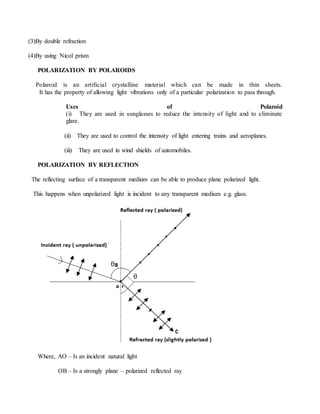
The reflecting surface of a transparent medium can be able to produce plane polarized light.
This happens when unpolarized light is incident to any transparent medium e.g. glass.
Where, AO – Is an incident natural light
OB – Is a strongly plane – polarized reflected ray
OC – Is a partially plane-polarized reflected ray.
BREWSTER’S ANGLE
- Polarization by reflection occurs at a certain special angle of incidence at which maximum
polarization occurs.
Example
- For a glass of refractive index 1.5, Brewster’s angle is 57 .
BREWSTER’S LAW
- The law states:
The extent of polarization of light reflected from a transparent surface is maximum when the
reflected ray is at right angles to the refracted ray.
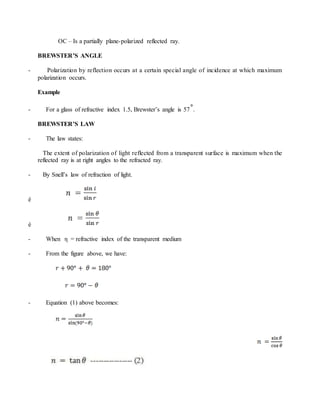
- By Snell’s law of refraction of light.
è
è
- When η = refractive index of the transparent medium
- From the figure above, we have:
- Equation (1) above becomes:
This equation leads to Brewster’s law
- The equation shows that the angle of incident for maximum polarization depends only on the
refractive index of the medium.
POLARIZATION BY DOUBLE REFRACTION
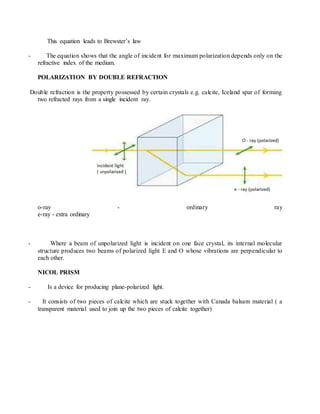
Double refraction is the property possessed by certain crystals e.g. calcite, Iceland spar of forming
two refracted rays from a single incident ray.
o-ray - ordinary ray
e-ray - extra ordinary
- Where a beam of unpolarized light is incident on one face crystal, its internal molecular
structure produces two beams of polarized light E and O whose vibrations are perpendicular to
each other.
NICOL PRISM
- Is a device for producing plane-polarized light.
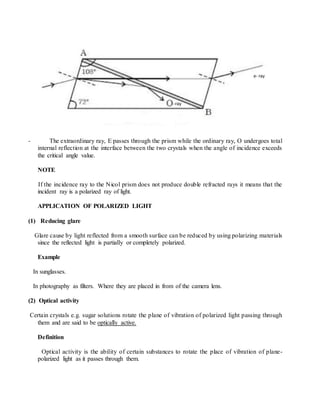
- It consists of two pieces of calcite which are stuck together with Canada balsam material ( a
transparent material used to join up the two pieces of calcite together)
- The extraordinary ray, E passes through the prism while the ordinary ray, O undergoes total
internal reflection at the interface between the two crystals when the angle of incidence exceeds
the critical angle value.
NOTE
If the incidence ray to the Nicol prism does not produce double refracted rays it means that the
incident ray is a polarized ray of light.
APPLICATION OF POLARIZED LIGHT
(1) Reducing glare
Glare cause by light reflected from a smooth surface can be reduced by using polarizing materials
since the reflected light is partially or completely polarized.
Example
In sunglasses.
In photography as filters. Where they are placed in from of the camera lens.
(2) Optical activity
Certain crystals e.g. sugar solutions rotate the plane of vibration of polarized light passing through
them and are said to be optically active.
Definition
Optical activity is the ability of certain substances to rotate the place of vibration of plane-
polarized light as it passes through them.
For a solution the angle of rotation depends on its concentration which can be measured by
the instrument known as Polarimeter.
(3) Stress analysis
When glass, Perspex, polythene and some other plastic materials are under stress (e.g. by
bending,or uneven heating) they become doubly refracting.
The effect is called photo elasticity and is used to analyze stresses in plastic models of various
structures.
Problem 71
A point P is situated at 20.1cm and 20.28cm from two coherent sources. Find the nature of
illumination at the point P if the wavelength of light is 6000 .
Problem 72
The path difference between the two identical waves arriving at a point is 85.5 . Is the point
bright or dark? If the path difference is 42.5 micrometer, calculate the wavelength of light.
Problem 73
In young’s experiment, the distance between the two slits is 0.8mm and the distance of the screen
from the slits is 80cm. If the fringe width is 0.6mm, find the wavelength of light.
Problem 74
In young’s experiment, interference bands were produced on a screen placed at 1.5m from two
slits 0.15mm part and illuminated by a light of wavelength 6500 .U. find
(i) Fringe width and
(ii) Change in fringe width, if the screen is move away from the slit by 50cm
Problem 75
Two parallel slits 1.2mm apart are illustrated with light of wavelength 5200 from a single slit.
A screen is placed at 1.0 m from the slits. Find the distance between the fifth dark band on one
side and the seventh bright band on the other side of the central bright band.
Problem 76
In a biprism experiment, the distance between the slit and the eyepiece is 80 cm and the
separation between the two virtual images of the slit is 0.25 mm. if the slit is illuminated by a
light of wavelength 6000 Å, find the distance of the second bright and from the central bright
band.
Problem 77
In a bi prism experiment, with the distance between the slit and the screen as 0.5m and the
separation between the two virtual images of the slit as 0.4 cm an interference pattern obtained
with a light of wavelength = 5500 Å. Find the distance between the 3rd and the 8th bands on
the same side of the central band.
Problem 78
In a biprism experiment, the distance of the 10th bright band from the center of the interference
pattern is 6 mm. Find the distance of the 15th bright band from the center.
Problem 79
The fringe separation in a biprism experiment is 3.2 10-4 m when red light of wavelength 6.4
10-7 m is used. By how much will this change if blue light of wavelength 4 1 m is used
with the same setting?
Problem 80
In a biprism experiment, the fringe width is 0.4mm, when the eyepiece is at a distance of 1m
from the slit. Find the change in the fringe width, if the eyepiece is moved through a distance of
25cm towards the biprism, without changing any other arrangement.
Problem 81
In a biprism experiment, the distance between the slit and the screen is 1.0m and the distance
between the images of the slit is 2.7mm. If the fringe width is 0.2mm, find the wavelength of
light used.
Problem 82
In a biprism experiment, the distance between the slit and the screen is 0.8m and the two virtual
sources formed by the biprism are 0.4mm apart. The wavelength of light used is 6000 . Find the
band width.
Problem 83
Calculate the distance between the second dark band and the fifth bright band on the same side
of the central bright band of an interference pattern produced by coherent sources separated by
1.2mm from each other. The screen is placed at one metre from the coherent sources and the
wavelength of light used is 6000 .
Problem 84
In a biprism experiment, the slit is illuminated by a light of wavelength 5000 . The distance
between the slit and the biprism is 20cm and the distance between the biprism and the eyepiece
is 80cm. If the distance between the two virtual source is 0.25cm, calculate the distance between
the fifth bright band on one side of the central bright band and the sixth dark band on the other
side.
Problem 85
In a biprism experiment, the distance between the two virtual images of the slit is 1.5mm and the
distance between the slit and the focal plane of the eyepiece is 1metre. Find the distance between
the second and the eighth dark fringe on the same side, if the wavelength of the light used is
5000 .
Problem 86
In biprism experiment, fringes were obtained with a monochromatic source of light. The
eyepiece was kept at a distance of 1.2m from the slit and fringe width was measured. When
another monochromatic source of light was used without disturbing slit and biprism, the same
fringe width was obtained when the eyepiece was at 0.8m from the slit. Find the ratio of
wavelength of light emitted by the two sources.
Problem 87
The distance between two consecutive dark bands in a bi prism experiment is 0.32mm when red
light of wavelength 6400 is used. By how much will this distance change if yellow light of
wavelength 5900 is used with the same setting?
Problem 88
Newton’s rings are observed with a plane convex lens in constant with a glass plate. The radius
of the first bright ring is 1mm. If the radius of the convex surface is 4metres, what is the
wavelength of light used.
Problem 89
The diameter of 10th dark ring in a Newton’s ring system viewed normally by reflected light of
= 5900Å is 0.5cm, calculate the thickness of the air film and radius of curvature of the lens.
Problem 90
Newton’s rings formed with sodium light between a flat glass plate and a convex lens are viewed
normally. What will be the order of the dark ring which will have double the diameter of that of
the 40th dark ring?
Problem 91
If the diameter of the two consecutive Newton’s rings in reflected light of wavelength 5890A.U.
are 2.00 and 2.20cm respectively, what is the radius of curvature of the lens surface in contact
with the plane glass surface?
Problem 92
Newton’s rings formed with sodium light ( cm) between a plane glass plate and
convex lens surface. The diameters of two successive dark rings are 2mm and 2.236mm. what is
the radius of curvature of the lens surface.
Problem 93
Newton’s rings are formed by placing lens on a glass surface. If the 10th bright ring of sodium
light by reflection( be 5mm in diameter. What is the radius curvature of the
lens.
Problem 94
In a Newton’s ring experiment, the plane convex lens and the glass plate are in optical contact
and the thickness of film at that point is zero. Find out the thickness of the air wedge at the fourth
bright ring for light of λ = 500Å
Problem 95
In a young’s double-slit experiment, sodium light of wavelength 0.59 1 m was used to
illuminate a double slit with separation 0.36mm. If the fringes are observed at a distance of 30cm
from the double slits, calculate the fringe separation.
Problem 96
In an experiment using young’s slit, fringes were found to occupy 3.0mm when viewed at a
distance of 36mm from the double slits. If the wavelength of the light used is 0.59 , calculate
the separation of the double slits.
Problem 97
When red monochromatic light of wavelength 0.70 m is used in a Young’s double-slit
arrangement, fringes with separation 0.60mm are observed. The slit separation is 0.40mm. Find
the fringe spacing if (independently)
(a ) Yellow light of wavelength 0.60 is used ;
(b) The slit separation becomes 0.30mm;
(c)The slit separation is 0.30mm and the slits fringe distance is doubled.
Problem 98
Interference fringe are formed in an air wedge using monochromatic light of wavelength 0.60
1 m. The fringes are formed parallel to the line contact, and a dark fringe is observed
along the line of contact. Calculate the thickness of the air wedge at position where:
(a) The twentieth dark fringe and
( b) The thirtieth bring fringe from the line of contact are observed.
Problem 99
When interference fringes are formed using an air wedge, it is found that the twentieth bright
fringe is formed at an air thickness of 6.8 . Calculate
(a)The wavelength of the light used Problem 100
( b) The diameter of the wire
Problem 101
Interference fringes of separation 0.40mm are with yellow of wavelength 0.60 . Calculate the
fringe spacing if the blue light of wave length 0.45 is used.
Problem 102
Interference fringes of spacing 1.0mm are obtained using the light of wavelength incident on
an air wedge of angle . The angle of the wedge is now double and the light replaced by one of
the wavelength 1.5 . Calculate the new fringe separation.
Problem 103
A loudspeaker emits a note which gives a beat frequency of 4Hz when sounded with a standard
turning fork of frequency 280Hz. The beat frequency decreases when the fork is loaded by
adding a small piece of plastic to its prongs. Calculate the frequency of the note emitted by the
loudspeaker.
Problem 104
A note from a loudspeaker gives a beat frequency of 10Hz when sounded with a turning fork of
frequency 440Hz. Calculate;
( a) The beat period.
b)Two possible values for the frequency of the note emitted by the loudspeaker
Problem 105
A vibrating sonometer wire emits a note which gives a beat frequency of 6.0Hz when sounded
in unison with a standard tuning fork of frequency 256 Hz. When the fork is loaded the beat
frequency increases. What is the frequency of the note emitted by the sonometer?
Problem 106
A beam of microwaves of wavelength 3.1cm is directed normally through a double slit in a metal
screen and interference effect are detected in a plane parallel to the slit and at a distance of 40cm
from them. It is found that the distance between the centers of the first maximum in the
interference pattern is 70cm. Calculate an approximate value for the slit separation.
Problem 107
What is the wavelength of light which gives a first order maximum at an angle of 22 when
incident normally on a grating with 600 lines mm-1.
Problem 108
Light of wavelength 600nm is incident normally on a diffraction grating of width 20.0mm on
which 10.0 1 lines have been ruled. Calculate the angular positions of the various orders.
Problem 109
A source emits special lines of wavelength 589nm and 615nm. This light is incident normally on
a diffraction grating having 600 lines per nm. Calculate the angular separation between the first-
order diffracted waves. Find the maximum order for each of the wavelengths
Problem 110
When a certain grating is illuminated normally by monochromatic light of wavelength 600 the
first-order maximum is observed at an angle of 21.1 . If the same grating is now illuminated
with light with wavelength from 500nm to 700nm, Find the angular spread of the first-order
spectrum.
Problem 111
When monochromatic light of wavelength 5.0 1 m is incident normally on a plane
diffraction lines are formed at angle of 30 . What is the number of lines per millimeter of the
grating?
Problem 112
A spectral line of known wavelength (5.792 1 m) emitted from the mercury vapour lamp
is used to determine the spacing between the lines ruled on a plane diffraction grating. When the
light is incident normally in the grating, the third-order spectrum, measured using a spectrometer,
occurs at an angle of 60 19' to normal. Calculate the grating spacing.
Problem 113
Light from a cadmium discharge lamp can be used to determine the spacing of the lines on a
plane diffraction grating. This is done by measuring the angle between the diffracted beams
either side of the normal in the first order spectrum for light incident normally on the grating.
( a) If the measured value of is 46 43' and the red line used in the cadmium spectrum is of
wavelength 644nm, calculate the number lines per metre on the grating.
( b) Make a suitable calculation to the whether the second order spectrum of this line will be visible.
Problem 114
A light source emits two distinct wavelengths, one of which is 450nm. When light from the
source is incident normally on a diffraction grating, it is observed that the fourth order image
formed by the same angle of diffraction as the third order image for the other wavelength. If the
angle of diffraction for each image is 46 , calculate;
( a)The second wavelength emitted by the source,
(b)The number of lines per meter of the grating
Problem 115
A horizontal string is stretched between two point points a distance 0.80m apart. The tension in
the string is 90N and its mass is 4.5g. Calculate;
(a)The speed of transverse waves along the string and
(b)The wavelength and frequencies of the three lowest frequency modes of vibration of the string.
Problem 116
The fundamental frequency of vibration of a stretched wire is 120Hz. Calculate the new
fundamental frequency if
( a)The tension in the wire is doubled, the length remaining constant
(b)The length of the wire is doubled the tension remaining constant
(c)The tension is doubled and the length of the wire is doubled.
(d)The wavelength of waves with frequency 120Hz.
(e)The length of wire which when fixed at its end, gives a fundamental frequency of 120Hz.
Problem 117
The fundamental frequency of vibration of a stretched wire is 150Hz. Calculate the new
fundamental frequency if;
(a )The tension in the wire is tripled, the length remaining constant.
(b )The length of wire is halved, the tension remaining constant.
(c)The tension is tripled and the length of wire is halved.
Problem 118
A wire having a diameter of 0.80mm is fixed in a sonometer and has a fundamental frequency of
256Hz alongside it's wire is made of the same material but of diameter 0.60mm. Both wires are
stretched over the same bridges on the sonometer but the thinner wire is subjected to only half
the tension of the thicker wire. Calculate the fundamental frequency of vibration of the thinner
wire.
Problem 119
A closed organ pipe is of length of 0.60 m. Calculate the wavelengths and frequencies of the tree
lowest frequency modes of vibration. Take the speed of sound to be 345 m and neglect any
end correction of the pipe.
Problem 120
Two open organ pipes are sounding together and produce a beat frequency of 12.0Hz. If the
longer pipe has length of 0.400 m. Calculate the length of the pipe. Take the speed of sound as
340 m and ignore end corrections.
Problem 121
A piece of glass tubing is closed at one end by covering it with a sheet of metal. The fundamental
frequency is found to be 280 Hz. If the metal sheet is now removed, calculate;
(a)What length the tube is
(b)The wavelength and frequencies of the fundamental and the first overtone 280 Hz. Ignore end
corrections.
Problem 122
A tall vertical cylinder is filled with water and a tuning fork of frequency 512 Hz is held over its
open end. The water is slowly run out and the first resonance of the air column is heard when the
water level is 15.6 cm below the open end. Calculate;
a) The end correction of the tube.
b) The position of the water level when the second resonance is heard.
Problem 129
An open tube of length 30.0 cm has an end correction of 0.60 cm. calculate its fundamental
frequency.
Problem 130
Two open pipes of length 0.700 m and 0.750 m are sounded together and vibrate in their
fundamental frequencies. Find the beat frequency, assuming that end corrections can be ignored.
Problem 131
Two identical closed pipes of length 0.322 m are each vibrating with their fundamental
frequency. If one pipe is held at 00C and the other at 17oC, calculate the beat frequency which is
observed. Take the speed of sound at 0oC to be 331 m-1 and ignore end corrections.
Problem 132
A closed pipe is of length 0.300 m. calculate:
a) Its fundamental frequency at 0oC, given that the speed of sound at 0oC is 331 m s-1,
b) The temperature, in oC, at which it will be in unison with a tuning fork of frequency 288 Hz.
Problem 133
Two open pipes of length 0.500 m and 0.550 m are sounded together and vibrate in their
fundamental frequencies at 7 oC. Calculate:
a) The beat frequency, given that the speed or sound at 7 oC is 335 ms-1
If the temperature of the longer pipe is now allowed to change whilst the shorter pipe stays at
7 oC, calculate.
b) The value of the temperature of the air in the longer pipe at which the two pipes will be in
unison.
Problem 134
Stationery waves are set up in the space between a microwave transmitter and plane reflector.
Successive minima are spaced 15mm apart. What is the frequency of the microwave oscillator?
Take the speed electromagnetic waves as 3.0 x 10⁸ m s-1.
Problem 135
A system of stationary waves in which the nodes are 2m apart are produced from progressive
waves of frequency 200 Hz. Calculate the speed of the progressive waves.
Problem 136
A stretched wire of length 0.7 m vibrates in its fundamental mode with a frequency of 320 Hz.
Calculate the velocity of waves along the wire. Why does such a vibration not continue
indefinitely?
Problem 137
A wire of mass per unit length 5.0 gm-1 is stretched between two points 30 cm apart. The tension
in the wire is 70 N. calculate the frequency of the sound emitted by the wire when it oscillates in
its fundamental mode.
Problem 138
a) A string of unstretched length 2.0 m and mass 0.15 kg has a force constant of 25 Nm-1.for the
experiment, the string is stretched to a total length of 3.0 m. calculate the velocity of propagation
of transverse waves along the string.
b) The same string in (a) above is clamped between two rigid supports 3.0 m apart, and set in
vibration. Calculate the wavelengths and frequencies of the five lowest frequency modes of
vibration which can be excited on the string. When the vibrating string is held lightly at the
centre, in which of these modes does the string continue to vibrate? Explain your reasoning.
Problem 139
A vertical steel wire is kept in tension by a piece of iron attached to one end. The wire is set in
transverse vibration and emits a note of frequency 200 Hz. The iron is now completely immersed
in water and the frequency of the note changes to 187 Hz. If the density of the water is 1000 kg
m-3 calculate the density of the iron.
Problem 140
A resonance tube is held vertically in water and can be raised or lowered. A tuning fork of
frequency 384 Hz is struck and held above open end of the tube on a day when the speed of
sound in air is 344 ms-1. The shortest tube length at which resonance occurs is 21.6 cm and the
corresponding length when the tube is filled with carbon dioxide is 16.7 cm. calculate:
a) The end correction for the tube,
b) The speed of sound in carbon dioxide.
Problem 141
A turning fork is sounded at the open end of a tube, containing air, which is closed at the other
end. Two successive positions of resonance are obtained when the length 49.0 cm and 82.0 cm.
calculate:
a) The wavelength of the sound waves in the tube,
b) The end correction of the tube.
Problem 142
If the speed of sound in air is 340 m s-1 at a given temperature, calculate the length of an open
pipe having a fundamental frequency of 192 Hz. If this pipe were sounded together with another
open pipe of length 0.850 m at the same temperature, calculate the beat frequency. Ignore any
end corrections.
Problem 143
An open ended pipe, of length 0.50 m, is sounded at 20oC together with a tuning fork of slightly
lower frequency. Five beats per second are heard. Calculate the change in temperature required
to bring the pipe and fork back into unison. Neglect end corrections and assume that changes in
temperature affect only the speed of sound in air, which is 340 ms-1 at 20oC.
Problem 144
A source of sound, when stationary, generates waves of frequency 500 Hz. The speed of sound is
340 ms-1. Find from first principles the wavelength of the waves detected by the observer and the
frequency observed when:
a) The source is stationary and the observer moves towards it with speed 20.0 ms-1,
b) The source moves with away from stationary observer with speed 30.0 ms-1.
c) The sources moves with speed 30.0 ms-1 in a direction away from, the observed and the
observer moves with speed 20.0 ms-1
Problem 145
A train sounding its whistle (frequency 580 Hz) is traveling at 40.0ms-1 a long straight section of
track, and passes an observer standing closed to the track. Calculate the maximum change in
frequency which the observer will hear. Take the speed of sound in air as 340 ms-1.
Problem 146
A motorist approaches a road junction at a constant speed of 15 m s-1. A policeman standing at
the junction blows on a whistle with frequency 680Hz.
a) Find from first principles the frequency observed by the motorist. The motorist now reduces
his speed at a rate of 5.0 m s-1.
b) Calculate the frequency he observers at subsequent 1 intervals until he stops.
Problem 147
A train sounding its whistle moves at a constant speed of 20 ms-1 a long straight section of track.
The train passes under a low bridge on which stands an observer. If the observer records a
maximum frequency of 638Hz. Calculate:
a) The frequency of the whistle,
b) The minimum frequency the observer hears.
Problem 148
A source of sound of frequency 400 Hz moves at steady speed of 15 ms-1 towards an observer. If
the observer moves a steady speed of 25 ms-1 towards the source, calculate the frequency he
observes.
Problem 149
A loudspeaker which emits a note of frequency 250 Hz is attached to a wire and whirled in a
vertical circle of radius 1.00 m at a steady rate of 20.0 revolutions per minute. Calculate:
a) The speed of rotation of the loudspeaker in m s-1.
b) The maximum and minimum frequency detected by a stationary observer.
Problem 150
A train sounding its whistle travels at constant speed on a long straight section of track. An
observer standing closed to the track records a range of frequencies between 551 Hz and 658 Hz.
Calculate:
(a) The speed of the train.
(b) The frequency of its whistle.
Problem 151
A hooter of frequency 360 Hz is sounded on a train approaching a tunnel in a cliff-face at 25 ms-
1, normal to the cliff. Calculate the observed frequency of the echo from the cliff-face, as heard
by the train driver. Assume that the speed of sound in air is 330 ms-1.
Problem 152
A car travel at a constant speed of 30 ms-1 towards a tunnel and sounds its horn, which has a
frequency of 200 Hz.the sound is reflected from the tunnel entrance. Calculate the frequency of
the echo observed by;
(a) The driver of the car
(b) A stationary observer standing close to the road
(c) The driver of the car travelling at 20 ms-1 which is following the first car.
Problem 153
A train emerges from a tunnel at a speed of 20 ms-1 and sound its whistle, which has a frequency
of 450Hz, Calculate the frequency of the echo from the tunnel entrance as observed by the train
driver,
Problem 154
A source of sound which is stationary with respect to air emits a note of frequency 340 Hz. An
observer receding at uniform speed, from the source hears an apparent frequency of 300 Hz
observer is moving, if the speed of sound in air is 340 ms-1.
Problem 155
(a) Show from first principles that the frequency f of sound in still air, heard by a stationary
observer as a source of sound of frequency approaches the observer with a velocity , is
given by
Where C is the velocity of sound in still air,
(c) When =1.0 103 Hz and c = 300 ms-1, what is the percentage change in the frequency heard by
the stationary observer when the source velocity changes from 30 ms-1 to 35 ms-1?
Problem 156
A model aircraft with an engine producing a note of constant frequency of value 400Hz flies at
constant speed in a horizontal circle of radius 12m and completes one revolution in 3.0s. An
observer, situated in the plane of the circle and 30m from its centre, monitors the frequency of
the sound from the engine.
(a) Explain why the observed frequency shows periodic variations
(b) Derive a relation for the minimum observed frequency in terms of f, the true frequency of the
engine, V, the speed of the aircraft and C, the speed of sound in air. Write down the
corresponding relation for the maximum observed frequency.
(c) Taking to C be 340 ms-1, calculate the maximum and minimum observed frequencies.
Determine the time interval between the occurrence of a maximum frequency and the next
minimum frequency.
Problem 157
A ship travelling at 3 ms-1 towards a cliff in still air and is sounding its siren at 1 KHz. Find from
first principles the frequency of the echo as measured by an observer on the ship. Give sufficient
detail for reasoning to be followed. The speed of sound in air is 330 ms-1.
Problem 158
A railway engine traveling at constant speed emits a whistle of constant frequency. When the
engine passes a stationary observer closed to the track, the frequency of the sound heard by the
observer changes from 600 Hz whilst approaching to 500 Hz whilst receding. Assuming the
speed of sound is 340 ms-1; calculate the speed of the engine.
Calculate the frequencies heard if the same engine passes an observer who is travelling at 2 ms-1
in the same direction as the engine and close to the track.

WAVE MOTION-2

  • 1.
    WAVE MOTION-2 DERIVATION OFSNELL’S LAW ON THE BASIS OF HUYGEN’S PRINCIPLE -Consider a plane wave front AA' which is incident on a transparent medium MM' The position of a new wave front after time t may be found by applying Huygen’s principle with points on AA' as centers. Those wavelets originating near the upper end of AA' travel with a speed medium and those wavelets originating near the lower end of AA' travel with a speed medium. Hence, after time = t: è Distance travelled in the medium = è Distance travelled in the medium = RELATIONSHIP BETWEEN i and r
  • 2.
    Where i =angle of incidence r = angle of reflection From ∆AOQ Sin i = -------------------- (1) From ∆AOR Sin r = --------------- (2) Dividing
  • 3.
    For a givenpair of media, this ratio is constant which expresses Snell’s law. From V = - Equation (3) becomes 1η2 v - Where Wavelength in the medium = wavelength in the medium 1η2 = refractive index of the second medium with respect to the first.
  • 4.
    Definition -The refractive index(η) of material is the ratio of the sine of the angle of incidence to the sine of the angle of refraction. Problem 36 Monochromatic light of a wavelength 800nm enters a glass plate of refractive index 1.5 Calculate; (i) The speed of light in glass (ii) The frequency of the light (iii) The wavelength of light in glass Given that C = 3 1 and 1nm = 1 1 m INTERFERENCE OF LIGHT WAVES Interference is a situation in which two or more waves overlap in space. In a region where two or more light waves cross, superposition occurs giving reinforcement (addition) of the waves at some points and cancellation (subtraction) at others. The resulting effect is called an interference pattern or system of fringes Definition Interference pattern/system of fringes is a set of light bands (fringes) and dark bands (fringes) formed on a screen when interference of light waves occurs. INTERFERENCE PATTERN
  • 5.
    ------------- B ------------- D -------------B ------------- D ------------- B ------------- D ------------- B - Where B = Bright band (fringe) D = Dark band (fringe) In order to bring about the interference of light waves the first task is to produce two coherence sources of light. Coherent source of light are sources producing light of the same wavelength, frequency and amplitude. - The sources have constant phase difference - Two independent sources of light cannot be coherent. - It is because the emission of light from any source is from a very larger number of atoms and the emission from each atom is random. - Therefore, there is no stable phase relationship between radiations from two independent sources. - HOW TO PRODUCE COHERENT SOURCES OF LIGHT - -Coherent sources of light are obtained by splitting up the light from a single source (primary source) into two parts (secondary source). METHODS OF PRODUCING INTERFERENCE PATTERN - Interference pattern can be produced by either of the following methods
  • 6.
    (1) Young’s doubleslit (2) Lloyd’s mirror (3) Fresnel’s biprism (4) Newton’s rings (5) Wedge fringes In this experiment monochromatic light is passed through a slit “s” and the light emerging from this slit is used to illuminate two adjacent slits By allowing light from these two slits to fall on the screen, a series of alternate bright and dark bands / fringes are formed on the screen. The bright bands/ fringes represent constructive interference while the dark bands / fringes represent destructive interference. CONSTRUCTIVE INTERFERENCE Constructive interference occurs when the interfering wave are in phase. Waves are said to be in phase if their maximum and minimum values occur at the same instant. Example
  • 7.
    separated waves resultantdisplacement -When constructive interference occur the two interfering waves combine together to give a wave of larger amplitude and hence bright fringe is formed. DESTRUCTIVE INTERFERENCE Destructive interference occurs when the two interfering waves are out of phase. Waves are said to be out of phase if the maximum of one wave and minimum the other wave are formed at the same instant. Example
  • 8.
    When destructive interferenceoccurs the two interfering waves cancel each other to produce nothing and hence a dark fringe is formed. THEORY OF YOUNG’S DOUBLE SLIT EXPERIMENT Consider the following below Let A and B be two close slits separated by a distance, a Let O be central bright fringe Suppose the bright fringe to be formed at point P a distance from O. CONCEPT If the two coherent monochromatic light sources are A and B then a bright fringe can be seen at P only if the path difference (BP – AP) is a whole number of wavelength. = Where n = 0, 1, 2, 3, ……………….. (2) If the difference is an odd number of half wavelength then darkness is obtained at the point considered. I.e. BP – AP =
  • 9.
    here n =0, 1, 2, 3, ……………………… In the figure above, for a bright fringe to be seen at P, we have: Path difference = BP – AP = - But, AP = NP è Path difference = BP – NP = v BN = ------------ (1) - Let be angular displacement of the bright fright from central bright fringe. - Consider ∆ABN and ∆PMO è m(B N) = m(PMO) = - From ∆BAN Sin - Where and AB = a Sin = Since is very small angle sin ≈ (in radian) v ------------- (2) - From ∆PMO è - Where D = Distance from the slits to the screen - Since is a very small angle tan (in radian)
  • 10.
    ------------------- (3) è equation(2) = equation (3) --------------------- (4) - Where n = 0, 1, 2, 3, ………………. - Equation (4) above gives the displacement of bright fringe from central bright fringe at O. NOTE. - Central bright fringe, n= 0 - First bright fringe, n = 1 - Second bright fringe, n = 2 e.t.c - Similarly, the displacement from O for a dark fringe is given by: -------------------- (5) - First dark fringe, n = 0 - Second dark fringe, n = 1 - Third dark fringe, n = 2 e.t.c DISTANCE BETWEEN TWO CONSECUTIVE BRIGHT / DARK FRINGES (FRINGE WIDTH) Let be displacement of bright fringe from O.
  • 11.
    - For thenext bright fringe ---------------- (2) - The distance between two consecutive bright fringes ( ) is given by: - The same formula applies for the separation between two consecutive dark fringes. All fringes are of the same width. SOME POINTS ABOUT YOUNG’S INTERFERENCE FRINGES (1) If the source slit “S” is put very close to the double slits the fringe separation does not change but the fringe intensity will increases. (2) If the double slits and are very close so that their separation distance approaches zero, then the fringe separation increases (3) If one of the double slits is covered up, then no fringes can be seen on the screen. (4) If the source slits S is made wider, then the fringes on the screen disappears.
  • 12.
    (5) If whitelight is used instead of monochromatic light source then the central fringe at O is white but the other bright fringe on either sides of the central fringe are colored with violet near “O” and red far away from “O”. ANGULAR WIDTH OF A FRINGE If P is the position of the first bright fringe then OP = fringe width and = angular width of a fringe Since is very small, therefore tan (in radian) ------------------- (1) From the expression of fringe width -------------- (2) Problem 37
  • 13.
    Two slits areat a distance of 0.2mm apart and the screen is at a distance of 1m. The third bright fringe is found to be displaced 7.5mm from the central fringe. Find the wavelength of the light used. Problem 38 A yellow light from a sodium vapour lamp of wavelength 5893 is directed upon two narrow slits of 0.1cm apart. Find the position on the screen 100cm away from the slits. Problem 39 In Young’s experiment, the distance of the screen from the two slits is 1.0m. When light of wavelength 6000 is allowed to fall on the slits the width of the fringes obtained on a screen is 2.0mm. Determine: (i) The distance between the two slits and (ii) The width of the fringes if the wavelength of the incident light is 4800 . Problem 40 In double slit experiment, light has a frequency of 6 1 . The distance between the centres of adjacent bright fringes is 0.75mm. What is the distance between the slits if the screen is 1.5m away? Given that the speed of light in free space 3 1 . Problem 41 In a Young’s double slit experiment, two narrow slits 0.8mm apart are illuminated by the same source of yellow light ( ). How far apart are the adjacent bright bands in the interference pattern observed on a screen 2m away? Problem 42 In young’s double slit experiment the angular width of a fringe formed on a distant screen is 0.1 . The wavelength of light used is 6000 . What is the spacing between the slits? Problem 43 A beam of light consisting of two wavelength 6500 and 5200 is used to obtain interference fringes in a Young’s double slit experiment.
  • 14.
    (i) Find thedistance of the third bright fringe on the screen from the central maximum to the wavelength 6500 . (ii) What is the least distance from the central maximum where the bright fringes due to both the wavelengths coincide? The distance between the slits is 2mm and the distance between the plane of the slits and the screen is 120cm. Problem 45 A Young’s double slit arrangement produces interference fringe for sodium light ( ) that are 0.20 apart. What is the angular fringe separation if the entire arrangement is immersed in water? Given that refractive index of water = 4/3 Problem 46 In Young’s double slit experiment the distance between the slits is 1mm and the distance of the screen from the slits is 1m. If light of wavelength 6000 is used, then find the distance between the second dark fringe and the forth bright fringe. FRINGE SHIFT -When a thin transparent plate of thickness (t) and refractive index ( is introduced in the path of one of the interfering waves ( say in the path P.) then the effective path in air is increased by ( )t due to the introduction of the plate.
  • 15.
    - Effective pathdifference in air = = - But - Effective path difference in air = - For a bright fringe, path difference = è è v --------------- (1)
  • 16.
    - For thenext bright fringe, we have:- ----------------- (2) - The fringe width is given by : v ------------------ (3) - From equation (1) - In the absence of the plate t = 0 è - Let ∆X be the fringe shift due to introduction of the plate. - ∆X =
  • 17.
    - From equation(5) v ------------------------------- (6) - Substitute equation (6) in equation (5) Thus, with the introduction of the transparent plate in the path of one of the slits, the entire fringe pattern is displaced through a distance given by either equation (5) or equation (7) towards the side on which the plates is placed. Problem 47 In the figure below are two coherent light sources in a Young’s two slit experiment separated by a distance 0.5mm and O is a point equidistant from at a distance 0.8m from the slits. When a thin parallel sided piece of glass (G) of thickness 3.6 1 m is placed near as shown, the central fringe system moves from O to point P. Calculate OP. (the wavelength of light used = 6.0 1 m).
  • 18.
    CONDITIONS NECESSARY FORSUSTAINED INTERFERENCE OF LIGHT WAVES - Sustained interference is an interference pattern in which the positions of maxima and minima remain fixed. - In order for light wave to produce an interference pattern which can be observed on a screen the following condition must be satisfied. (1)The light should be monochromatic. If this is not so, fringe of different color will overlap. (2)The two sources producing interference must be coherent. (3)The two interfering waves must have the same plane of polarization. (4)To observe interference fringe clearly. It necessary that the fringe width is sufficiently large. This is possible if: i) The two coherent sources are parallel and close to each other
  • 19.
    ii) The distancebetween slits and screen is reasonably large. A slit S1 illuminated by monochromatic light and placed closed to a plane mirror MN Interference occurs between direct light from the slit and light reflected from the mirror MN The reflected ray MA appear to be coming from a virtual image S2 of S1 S1 and S2 act as two coherent sources of, the expression giving the fringe spacing is the same as for the double slit Except that dark fringe will be obtained at N instead of a bright fringe Bi prism This is a glass prism with an obtuse angle that functions as two acute angle prisms placed.
  • 20.
    A double imageof a single object is always formed by means of this prism The device was used by Fresnel to produce two coherent beams for interference experiment Monochromatic light from a narrow slit S falls on a bi prism as shown in the figure above. Two virtual images S1 and S2 of S are formed by refraction at each half of the bi prism and these acts as coherent source which are close together. An interference pattern, similar to that given by the double slit but brighter, is obtained in the shaded region where the two refracted beans overlap. The theory and the expression for the fringes spacing are the same as for young’s method NEWTON’S RINGS
  • 21.
    This is aninterference effect discovered by Newton’s Interference fringes are formed by placing a slightly Plano-convex lens on a flat glass plate H A glass plate G reflects the light that comes from the monochromatic light source towards the lens L downwards Both reflected rays are going to be analyzed by the traveling microscope M and at the point of contact of the lens a dark spot is seen surrounded by a series of alternate bright and dark rings. These are called Newton’s rings.
  • 22.
    Definition Newton’s ring isa circular interference fringes formed between a lens and a glass plate with which the lens is contact. Concept Consider the air film PA t Some of the incident light is reflected at P towards the microscope M Some of the light passes to point A where it is reflected by glass plate H towards the microscope M. For nth dark ring Path difference = 2t = nλ When n 0, 1, 2, 3, Central dark spot, n 0 At constant pressure, i.e. At constant pressure the mean free path of a gas molecule λ ∝ T
  • 23.
    At constant pressurethe mean free path of a gas molecule is directly proportional to its absolute temperature T. λ = KT Where K constant of proportionality If λ1 and λ2 are mean free path of a gas molecule at temperature T1 and T2 respectively: And λ1 = KT1 λ2 = KT2 2. Pressure P of the gas From equation (3) At constant temperature the mean free path of a gas molecule is inversely proportional to pressure. Pλ = K Where K constant of proportionality Generally, we may write P1λ1= λ2P2
  • 24.
    MEASUREMENT OF WAVELENGTH BY NEWTON’S RINGS EXPERIMENT è The effect can be used to determine the wavelength of a light source if the radius of curvature R, of the lower surface of the lens is known:- - Where = Radius of the ring t = PA = air film R = Radius of curvature of the lens è Diameter. D = 2R Applying the theorem of intersecting chords t (2R –t ) =
  • 25.
    Assuming the lensto have large radius of curvature R then t is very small and hence is very very small 2tR = 2t = = pass difference - For a bright ring: Path difference = 2t = ( v - Where n = 0, 1, 2, 3,………… - First bright ring, n = 0 Second bright ring, n = 1 etc. For a dark ring: Path difference = 2t = - Where n = 0, 1, 2, 3, ……….. - Central dark spot, n = 0
  • 26.
    - First darkring, n = 1 - Second dark ring, n = 2 etc. Problem 48 A set of Newton’s ring produced by monochromatic light is viewed through a traveling microscope. The diameter of the and (n + 5 dark rings are found to be 0.143cm and 0.287cm respectively. The radius of the curvature of Plano convex lens used is 64.5cm. Determine the wavelength of the light used. Problem 49 Calculate the radius of curvature of a Plano convex lens used to produce Newton’s rings with a flat glass plate if the diameter of the tenth dark ring is 4.48mm, viewed by normally reflected light of wavelength 5.0 1 m. What is the diameter of the twentieth bright ring? WEDGE FRINGES This is another form of interference produced by a thin wedge shaped film of air, the thickness of which gradually increases from zero along its length. HOW A WEDGE IS FORMED The wedge can be formed from two microscope slides clamped at one end and separated by a thin piece of paper at the other end so that the wedge angle is very small.
  • 27.
    Monochromatic light froman extended source is partially reflected vertically downwards by the glass plate G. When the microscope is focused on the wedge, bright and dark equally spaced fringes are seen parallel to the edge of contact of the wedge. Some of the light falling on the wedge is reflected upwards from the bottom surface of the top slide and the rest which is transmitted through the wedge is reflected upwards from the top surface of the bottom slide. Let “ ” be thickness of the air wedge at P. If a dark fringe is formed at P then: Path difference between the rays at P = 2l =
  • 28.
    - Where n= 0, 1, 2, 3, ………………… - First bright fringe, n = 0 - Second bright fringe, n = 1 DETERMINATION OF ANGLE OF THE WEDGE In the figure above, let be the angle between the slides/plates (=wedge angle). For a dark fringe at P we have: è If is in radians then we have: è ---------------------- (3) - For the (n + K dark fringe at Q, we have:
  • 29.
    è here =Distance moved by the microscope = wavelength of the light used. Special case If K = 1, then fringe width. Problem 50 An air wedge is formed between two glass plates which are in contact at one end and separated by a piece of thin metal foil at the other end. Calculate the thickness of the foil if 30 dark fringes are observed between the ends when light of wavelength 6 1 m incident normally on the wedge. Problem 51 A wedge air film is formed by placing aluminum foil between the two glass slides at a distance of 75mm from the line of constant of the slides. When the air wedge is illuminated normally by a light of wavelength 5.6 1 m interference fringe are produce parallel to the line of contact which have a separation of 1.2mm. Calculate the angle of the wedge and the thickness of the foil. Problem 52 A narrow wedge of air is enclosed between two glass plates. When the wedge is illuminated by a beam of monochromatic light of wavelength 6.4 1 m parallel fringes are produced which are 0.3mm apart. Find the angle of the wedge. Problem 53 A wedge shaped film of air is formed between two parallel sided glass plates by means of a straight piece of wire. The two plates are in contact along one edge of the film and the wire is
  • 30.
    parallel to thiswedge. In such experiment, using light of wavelength 589nm, the distance between the 7th and 169th dark fringes was 26.3mm and the distance between the junction of the glass plates and the wire was 35.6mm. Calculate the angle of the wedge and the diameter of the wire. Problem 54 An air wedge is formed between two flat glass plates of length 45mm by using a spacer at one end. Wedge fringes spaced 0.29mm apart are observed by reflection when light of wavelength 430nm is directed normally at the wedge. Calculate the angle of the wedge and the thickness of the spacer. APPLICATION OF INTERFERENCE (1 (1) QUALITY TESTING OF OPTICAL SURFACES Fringes of equal thickness are useful for testing the quality of optical components. Example In making of optical flats the plate under test is made to form an air wedge with a standard plane glass surface. Any uneven part of the surface which require more grinding will show up irregularities. The grinding of a lens surface may be checked if it is placed on an optical flat and Newton’s rings observed in monochromatic light. (2) MAKING NON-REFLECTING GLASS / BLOOMING LENSES In optical instruments containing lenses or prisms light is lost by reflection at each refracting surface which results in reduced brightness of the final image. The amount of light reflected at the surface can be appreciably reduced by coating it with a film of transparent material example magnesium fluoride. The process is called Blooming. Blooming is the process of depositing a transparent film of a substance such as magnesium fluoride on a lens to reduce (or eliminate) the reflection of the light at the surface. è The film is about one-quarter of a wavelength thick and has a lower refractive index than the lens.
  • 31.
    Light reflected fromthe top (ray 1) and from the bottom (ray 2) surfaces of the film interfere destructively. Condition Destructive interference occurs when: Path difference = This is because the phase change which occur by reflection is 180 which is equivalent to v - Where = thickness of the film When light passes from one medium to another its speed and wavelength change but frequency (f) remain unchanged.
  • 32.
    If are thespeeds of light in air and in the film respectively then: - Let n be refraction index of the material of the film. è è - Substitute equation (2) in equation (1) v Problem 56 Expensive cameras have non-reflecting coated lens. Normally the lens surface is covered with a thin transparent film of fluoride of refractive index 1.43. suppose that no light of wave length 6000 is reflected when the incidence is normally. Calculate the thickness of the film. COLOUR IN THIN FILMS OF OIL / SOAP BUBBLE When a drop of oil spreads on water a thin film of oil is formed on its surface. In broad day light, the film appears to be made up of beautiful rainbow colors. The formation of these colors in a thin film is due to interference phenomenon.
  • 33.
    The interference phenomenonis the effect which happens when light wave gate reflected from the two opposite surfaces of a thin film. When the path difference gives constructive interference for light of wavelength, the corresponding color is seen in the film. The path difference varies with the thickness of the film and the angle of viewing both of which affect the color produced at any one part. The colours seen in soup bubbles are also produced in this way. DIFFRACTION OF LIGHT WAVES Diffraction of light is the phenomenon of spreading or bending of light waves as they pass through a narrow opening (aperture) or round the edge of a barrier.
  • 34.
    The diffracted wavessubsequently interfere with each other producing regions of reinforcement and weakening - Behind the obstacles / apertures at which diffraction occurs, a diffraction pattern of dark and bright fringes is formed. - Diffraction is regarded as being due to the superposition of secondary wavelets from coherent sources on the unrestricted part of a wave front that has been obstructed by an obstacle aperture. DIFFRACTION EFFECTS - Diffraction of light is quite pronounced when the width of the opening is comparable with the wavelength of the light. - This can be illustrated below
  • 35.
    (i) (ii) - In figure(i) and (ii) above the apertures are of the same size but the wave length of the incident waves are different.
  • 36.
    - The wavesare diffracted more when the wavelength is longer (iii) (iv) In figure (iii) and (iv) the two waves have the same wavelength but the sizes of the apertures are different. The diffraction is more in case of narrow slit.
  • 37.
    TYPES OF DIFFRACTION Diffractionof light is of two types (i) Fraunhofer diffraction (ii) Fresnel diffraction FRAUNHOFER DIFFRACTION This is the type of diffraction which takes place at a narrow slit when parallel rays of light (plane wave front) are incident on it. Both the light source and the receiving screen should be at infinite distance from the narrow slit. Here a lens is used to obtain the diffraction pattern on a screen placed at a distance equals focal length ( ) of the lens. FRENSEL DIFFRACTION This is a type of diffraction which takes place at a narrow slit when non-parallel rays of light are incident on it. In this type of diffraction either the light source or the receiving screen or both are at finite distances from the narrow slit.
  • 38.
    DIFFRACTION OF LIGHTAT A SINGLE SLIT If a plane wave front is incident on a slit AB, then there will be the formation of a bright band on a screen at the centre followed by dark and bright bands of decreasing intensity on either sides of the central bright band. A graph of fringe brightness against position is as shown in the figure above. - Consider a plane wave front of monochromatic light of wavelength to be incident on a slit AB
  • 39.
    - By Huygen’sprinciple, every point on the portion AB of the wavefront acts as a source of secondary wavelets spreading out in all directions. - Those secondary wavelets which go straight across the slits arrive on the screen at point O in the same phase and hence the intensity at point O is maximum. - Consider the 1st dark band (1st minimum) to be formed at any angle to the direction of the incident beam. - 1st dark band (1st minimum) is obtained on the screen at P where: Path difference, From triangle ABN Sin But , BN = Sin
  • 40.
    For 1st darkband (1st minimum) - Therefore, the general condition for a minimum for a single slit diffraction is Where n = 1, 2, 3, …………. The sign indicate that there are two nth order minima, one on each side of the original direction beam. The variation of intensity with angle of direction for a single slit diffraction pattern is a shown below.
  • 41.
    EXPRESSION OF WIDTHOF CENTRAL MAXIMUM - The width of the central maximum is the distance between the first minimum on the either side of O as shown in the figure above. - Thus, the width of the central maximum is - The 1st minimum occurs at
  • 42.
    Sin - If issmall then sin in radian ----------------- (1) - From the figure above: Tan --------------------- (2) è equation (1) = equation (2) v --------------------- (3) - Now P = 2K ------------ (4) Problem 57 Monochromatic light of wavelength 6.0 1 m is incident at a single slit of width 5.0 1 m. How many orders of diffraction minimum are visible? Problem 58 A parallel beam of light of wavelength 650nm is directed normally at a single slit of width 0,14mm in a darkened room. A screen is placed 1.50m from the single slit. (a) Sketch the graph to show how the intensity of light falling on the screen varies with position across the screen. (b) Calculate the width of the central fringe.
  • 43.
    DIFFERENCE BETWEEN INTERFERENCEAND DIFFRACTION FRINGES INTERFERENCE DIFFRACTION (1)Interference fringe are obtained due to the superposition of light coming from two different wave fronts originating from two coherent source (1)Diffraction fringe are obtained due to the superposition of light coming from different parts of the same wave front. (2)The width of interference fringe is generally the same. (2)The width of diffraction fringes is not the same. (3)The intensity of all bright fringes is the same. (3)The intensity of all bright fringes is not the same. It is not the same. It is maximum for central fringes and decreases sharply for first, second etc. bright fringes. PLANE TRANSMISSION DIFFRACTION GRATING - -This is a device consisting of a large number of equidistant closely spaced parallel lines of equal width rule on glass. - -The ruled widths are opaque to light while the space between any two successive lines is transparent and act as parallel slits.
  • 44.
    Application Diffraction gratings areused for producing spectra and for measuring wavelengths accurately. THEORY Suppose plane waves of monochromatic light of wave length fall on a transmission grating in which the slit separation (called grating spacing) is d. Let N be number of lines per meter of the grating (= Grating Constant)
  • 45.
    - Consider waveletscoming from corresponding point A and B on two successive slits and travelling at an angle to the direction of the incident beam. è Path difference, BC = d v Where “n” is an integer giving the order of the spectrum. Here reinforcement of the diffracted wavelets occurs in the direction and a maximum (bright band) will be obtained. The angular distribution of diffracted beams is as shown below:
  • 46.
    NOTE The actual numberof orders possible for a given grating will depend on the width of the grating spaced and the wavelength of the light used. Since cannot be greater than (90 diffraction), then the maximum number of orders possible for any given wavelength cannot be greater than the whole number value of n given by “n” is maximum when sin = 1 è Maximum number of orders possible Problem 59 Monochromatic light of wavelength 600nm is incident normally on an optical transmission grating of spacing 2.00 Calculate: (a) The angular position of the maxima (b) The number of diffracted beams which can be observed (c) The maximum order possible
  • 47.
    Problem 60 The limitsof the visible spectrum are approximately 400nm to 700nm. Find the angular spread of the first -order visible spectrum produced by a plane grating having 6000 lines per centimeter when light is incident normally on the grating. Problem 61 A grating has 500 lines per millimeter and is illuminated normally with monochromatic light of wavelength 5.89 1 m. (a) How many diffraction maxima may be observed? (b) Calculate the angular separation. Problem 62 What is the angular width of the first order spectrum produced by a diffraction grating of 5000 per cm when a parallel beam of while light is incident normally on it? Problem 63 A monochromatic light of wavelength 2 1 falls normally on a grating which has 4 1 lines per cm. (a) What is largest order of spectrum that can be visible? (b) Find the angular separation between the third and fourth order image. Problem 64 A diffraction grating with grating of 2 1 m is used to examine the light from the glaring gas. It is found that the first order of violet light emerges at an angle of 11.8 and the first order of red light emerges at angle of 15.8 . Calculate: (a) The wavelength of the two lights. (b)The angle at which nth order of red light will coincide with the (n+1 order of violet light. Problem 65
  • 48.
    A diffraction gratinghas 500 lines per mm when used with monochromatic light of m at normal incidence. At what angles will bright diffraction images be observed? Problem 66 A slit 0.1mm wide is illuminated with a monochromatic light of wavelength 5000 . How wide is the central maximum on a screen 1m from the slits? Problem 67 A single narrow slits is illuminated with red light of wavelength 6328 . A screen placed 1.60m from the slits shows a typical single –slit diffraction pattern. The separation between the first two minima is 4.0mm. what is the width of the slits? Problem 68 Light of wavelength 7500 passes through a slit of 1.0 1 mm wide. How wide is the central maximum (i) In degrees and (ii) In cm on a screen 20cm away? POLARIZATION OF LIGHT WAVES Light is an electromagnetic wave whose electric and magnetic vibrations are perpendicular to each other and to the direction of propagation. Polarization of light is the process of confining the vibrations of the electric vector of light waves to one direction. - In unpolarized light the electric field vibrates in all directions perpendicular to the direction of a wave . - The commonly used pictorial representation of an unpolarized light wave is as shown below
  • 49.
    Unpolarized light beamis equivalent to two equally intense beams whose planes of vibration are perpendicular to each other. After reflection or transmission through certain substances the electric field is confined to the direction and the radiation is said to be plane – polarized light. POLAROID This is a device used to produce plane polarized light. In a polarizer, there is characteristic direction called transmission axis which is indicated by the dotted line.
  • 50.
    If a polarizeris placed in front of unpolarized light source, then the transmitted light is plane – polarized in specific direction. Since the human eye is unable to detect polarized light it is necessary to use an analyzer to detect the direction of polarization. If the plane of polarization of the polarizer and the plane of the analyzer are perpendicular then no light is transmitted when the polarizer and the analyzer are combined. METHODS / WAYS OF PRODUCTION PLANE POLARIZED LIGHT (1) By Polaroid (2 )By reflection
  • 51.
    (3)By double refraction (4)Byusing Nicol prism POLARIZATION BY POLAROIDS Polaroid is an artificial crystalline material which can be made in thin sheets. It has the property of allowing light vibrations only of a particular polarization to pass through. Uses of Polaroid (i) They are used in sunglasses to reduce the intensity of light and to eliminate glare. (ii) They are used to control the intensity of light entering trains and aeroplanes. (iii) They are used in wind shields of automobiles. POLARIZATION BY REFLECTION The reflecting surface of a transparent medium can be able to produce plane polarized light. This happens when unpolarized light is incident to any transparent medium e.g. glass. Where, AO – Is an incident natural light OB – Is a strongly plane – polarized reflected ray
  • 52.
    OC – Isa partially plane-polarized reflected ray. BREWSTER’S ANGLE - Polarization by reflection occurs at a certain special angle of incidence at which maximum polarization occurs. Example - For a glass of refractive index 1.5, Brewster’s angle is 57 . BREWSTER’S LAW - The law states: The extent of polarization of light reflected from a transparent surface is maximum when the reflected ray is at right angles to the refracted ray. - By Snell’s law of refraction of light. è è - When η = refractive index of the transparent medium - From the figure above, we have: - Equation (1) above becomes:
  • 53.
    This equation leadsto Brewster’s law - The equation shows that the angle of incident for maximum polarization depends only on the refractive index of the medium. POLARIZATION BY DOUBLE REFRACTION Double refraction is the property possessed by certain crystals e.g. calcite, Iceland spar of forming two refracted rays from a single incident ray. o-ray - ordinary ray e-ray - extra ordinary - Where a beam of unpolarized light is incident on one face crystal, its internal molecular structure produces two beams of polarized light E and O whose vibrations are perpendicular to each other. NICOL PRISM - Is a device for producing plane-polarized light. - It consists of two pieces of calcite which are stuck together with Canada balsam material ( a transparent material used to join up the two pieces of calcite together)
  • 54.
    - The extraordinaryray, E passes through the prism while the ordinary ray, O undergoes total internal reflection at the interface between the two crystals when the angle of incidence exceeds the critical angle value. NOTE If the incidence ray to the Nicol prism does not produce double refracted rays it means that the incident ray is a polarized ray of light. APPLICATION OF POLARIZED LIGHT (1) Reducing glare Glare cause by light reflected from a smooth surface can be reduced by using polarizing materials since the reflected light is partially or completely polarized. Example In sunglasses. In photography as filters. Where they are placed in from of the camera lens. (2) Optical activity Certain crystals e.g. sugar solutions rotate the plane of vibration of polarized light passing through them and are said to be optically active. Definition Optical activity is the ability of certain substances to rotate the place of vibration of plane- polarized light as it passes through them.
  • 55.
    For a solutionthe angle of rotation depends on its concentration which can be measured by the instrument known as Polarimeter. (3) Stress analysis When glass, Perspex, polythene and some other plastic materials are under stress (e.g. by bending,or uneven heating) they become doubly refracting. The effect is called photo elasticity and is used to analyze stresses in plastic models of various structures. Problem 71 A point P is situated at 20.1cm and 20.28cm from two coherent sources. Find the nature of illumination at the point P if the wavelength of light is 6000 . Problem 72 The path difference between the two identical waves arriving at a point is 85.5 . Is the point bright or dark? If the path difference is 42.5 micrometer, calculate the wavelength of light. Problem 73 In young’s experiment, the distance between the two slits is 0.8mm and the distance of the screen from the slits is 80cm. If the fringe width is 0.6mm, find the wavelength of light. Problem 74 In young’s experiment, interference bands were produced on a screen placed at 1.5m from two slits 0.15mm part and illuminated by a light of wavelength 6500 .U. find (i) Fringe width and (ii) Change in fringe width, if the screen is move away from the slit by 50cm Problem 75 Two parallel slits 1.2mm apart are illustrated with light of wavelength 5200 from a single slit. A screen is placed at 1.0 m from the slits. Find the distance between the fifth dark band on one side and the seventh bright band on the other side of the central bright band. Problem 76
  • 56.
    In a biprismexperiment, the distance between the slit and the eyepiece is 80 cm and the separation between the two virtual images of the slit is 0.25 mm. if the slit is illuminated by a light of wavelength 6000 Å, find the distance of the second bright and from the central bright band. Problem 77 In a bi prism experiment, with the distance between the slit and the screen as 0.5m and the separation between the two virtual images of the slit as 0.4 cm an interference pattern obtained with a light of wavelength = 5500 Å. Find the distance between the 3rd and the 8th bands on the same side of the central band. Problem 78 In a biprism experiment, the distance of the 10th bright band from the center of the interference pattern is 6 mm. Find the distance of the 15th bright band from the center. Problem 79 The fringe separation in a biprism experiment is 3.2 10-4 m when red light of wavelength 6.4 10-7 m is used. By how much will this change if blue light of wavelength 4 1 m is used with the same setting? Problem 80 In a biprism experiment, the fringe width is 0.4mm, when the eyepiece is at a distance of 1m from the slit. Find the change in the fringe width, if the eyepiece is moved through a distance of 25cm towards the biprism, without changing any other arrangement. Problem 81 In a biprism experiment, the distance between the slit and the screen is 1.0m and the distance between the images of the slit is 2.7mm. If the fringe width is 0.2mm, find the wavelength of light used. Problem 82 In a biprism experiment, the distance between the slit and the screen is 0.8m and the two virtual sources formed by the biprism are 0.4mm apart. The wavelength of light used is 6000 . Find the band width. Problem 83 Calculate the distance between the second dark band and the fifth bright band on the same side of the central bright band of an interference pattern produced by coherent sources separated by
  • 57.
    1.2mm from eachother. The screen is placed at one metre from the coherent sources and the wavelength of light used is 6000 . Problem 84 In a biprism experiment, the slit is illuminated by a light of wavelength 5000 . The distance between the slit and the biprism is 20cm and the distance between the biprism and the eyepiece is 80cm. If the distance between the two virtual source is 0.25cm, calculate the distance between the fifth bright band on one side of the central bright band and the sixth dark band on the other side. Problem 85 In a biprism experiment, the distance between the two virtual images of the slit is 1.5mm and the distance between the slit and the focal plane of the eyepiece is 1metre. Find the distance between the second and the eighth dark fringe on the same side, if the wavelength of the light used is 5000 . Problem 86 In biprism experiment, fringes were obtained with a monochromatic source of light. The eyepiece was kept at a distance of 1.2m from the slit and fringe width was measured. When another monochromatic source of light was used without disturbing slit and biprism, the same fringe width was obtained when the eyepiece was at 0.8m from the slit. Find the ratio of wavelength of light emitted by the two sources. Problem 87 The distance between two consecutive dark bands in a bi prism experiment is 0.32mm when red light of wavelength 6400 is used. By how much will this distance change if yellow light of wavelength 5900 is used with the same setting? Problem 88 Newton’s rings are observed with a plane convex lens in constant with a glass plate. The radius of the first bright ring is 1mm. If the radius of the convex surface is 4metres, what is the wavelength of light used. Problem 89 The diameter of 10th dark ring in a Newton’s ring system viewed normally by reflected light of = 5900Å is 0.5cm, calculate the thickness of the air film and radius of curvature of the lens.
  • 58.
    Problem 90 Newton’s ringsformed with sodium light between a flat glass plate and a convex lens are viewed normally. What will be the order of the dark ring which will have double the diameter of that of the 40th dark ring? Problem 91 If the diameter of the two consecutive Newton’s rings in reflected light of wavelength 5890A.U. are 2.00 and 2.20cm respectively, what is the radius of curvature of the lens surface in contact with the plane glass surface? Problem 92 Newton’s rings formed with sodium light ( cm) between a plane glass plate and convex lens surface. The diameters of two successive dark rings are 2mm and 2.236mm. what is the radius of curvature of the lens surface. Problem 93 Newton’s rings are formed by placing lens on a glass surface. If the 10th bright ring of sodium light by reflection( be 5mm in diameter. What is the radius curvature of the lens. Problem 94 In a Newton’s ring experiment, the plane convex lens and the glass plate are in optical contact and the thickness of film at that point is zero. Find out the thickness of the air wedge at the fourth bright ring for light of λ = 500Å Problem 95 In a young’s double-slit experiment, sodium light of wavelength 0.59 1 m was used to illuminate a double slit with separation 0.36mm. If the fringes are observed at a distance of 30cm from the double slits, calculate the fringe separation. Problem 96 In an experiment using young’s slit, fringes were found to occupy 3.0mm when viewed at a distance of 36mm from the double slits. If the wavelength of the light used is 0.59 , calculate the separation of the double slits. Problem 97
  • 59.
    When red monochromaticlight of wavelength 0.70 m is used in a Young’s double-slit arrangement, fringes with separation 0.60mm are observed. The slit separation is 0.40mm. Find the fringe spacing if (independently) (a ) Yellow light of wavelength 0.60 is used ; (b) The slit separation becomes 0.30mm; (c)The slit separation is 0.30mm and the slits fringe distance is doubled. Problem 98 Interference fringe are formed in an air wedge using monochromatic light of wavelength 0.60 1 m. The fringes are formed parallel to the line contact, and a dark fringe is observed along the line of contact. Calculate the thickness of the air wedge at position where: (a) The twentieth dark fringe and ( b) The thirtieth bring fringe from the line of contact are observed. Problem 99 When interference fringes are formed using an air wedge, it is found that the twentieth bright fringe is formed at an air thickness of 6.8 . Calculate (a)The wavelength of the light used Problem 100 ( b) The diameter of the wire Problem 101 Interference fringes of separation 0.40mm are with yellow of wavelength 0.60 . Calculate the fringe spacing if the blue light of wave length 0.45 is used. Problem 102 Interference fringes of spacing 1.0mm are obtained using the light of wavelength incident on an air wedge of angle . The angle of the wedge is now double and the light replaced by one of the wavelength 1.5 . Calculate the new fringe separation. Problem 103
  • 60.
    A loudspeaker emitsa note which gives a beat frequency of 4Hz when sounded with a standard turning fork of frequency 280Hz. The beat frequency decreases when the fork is loaded by adding a small piece of plastic to its prongs. Calculate the frequency of the note emitted by the loudspeaker. Problem 104 A note from a loudspeaker gives a beat frequency of 10Hz when sounded with a turning fork of frequency 440Hz. Calculate; ( a) The beat period. b)Two possible values for the frequency of the note emitted by the loudspeaker Problem 105 A vibrating sonometer wire emits a note which gives a beat frequency of 6.0Hz when sounded in unison with a standard tuning fork of frequency 256 Hz. When the fork is loaded the beat frequency increases. What is the frequency of the note emitted by the sonometer? Problem 106 A beam of microwaves of wavelength 3.1cm is directed normally through a double slit in a metal screen and interference effect are detected in a plane parallel to the slit and at a distance of 40cm from them. It is found that the distance between the centers of the first maximum in the interference pattern is 70cm. Calculate an approximate value for the slit separation. Problem 107 What is the wavelength of light which gives a first order maximum at an angle of 22 when incident normally on a grating with 600 lines mm-1. Problem 108 Light of wavelength 600nm is incident normally on a diffraction grating of width 20.0mm on which 10.0 1 lines have been ruled. Calculate the angular positions of the various orders. Problem 109 A source emits special lines of wavelength 589nm and 615nm. This light is incident normally on a diffraction grating having 600 lines per nm. Calculate the angular separation between the first- order diffracted waves. Find the maximum order for each of the wavelengths Problem 110
  • 61.
    When a certaingrating is illuminated normally by monochromatic light of wavelength 600 the first-order maximum is observed at an angle of 21.1 . If the same grating is now illuminated with light with wavelength from 500nm to 700nm, Find the angular spread of the first-order spectrum. Problem 111 When monochromatic light of wavelength 5.0 1 m is incident normally on a plane diffraction lines are formed at angle of 30 . What is the number of lines per millimeter of the grating? Problem 112 A spectral line of known wavelength (5.792 1 m) emitted from the mercury vapour lamp is used to determine the spacing between the lines ruled on a plane diffraction grating. When the light is incident normally in the grating, the third-order spectrum, measured using a spectrometer, occurs at an angle of 60 19' to normal. Calculate the grating spacing. Problem 113 Light from a cadmium discharge lamp can be used to determine the spacing of the lines on a plane diffraction grating. This is done by measuring the angle between the diffracted beams either side of the normal in the first order spectrum for light incident normally on the grating. ( a) If the measured value of is 46 43' and the red line used in the cadmium spectrum is of wavelength 644nm, calculate the number lines per metre on the grating. ( b) Make a suitable calculation to the whether the second order spectrum of this line will be visible. Problem 114 A light source emits two distinct wavelengths, one of which is 450nm. When light from the source is incident normally on a diffraction grating, it is observed that the fourth order image formed by the same angle of diffraction as the third order image for the other wavelength. If the angle of diffraction for each image is 46 , calculate; ( a)The second wavelength emitted by the source, (b)The number of lines per meter of the grating Problem 115
  • 62.
    A horizontal stringis stretched between two point points a distance 0.80m apart. The tension in the string is 90N and its mass is 4.5g. Calculate; (a)The speed of transverse waves along the string and (b)The wavelength and frequencies of the three lowest frequency modes of vibration of the string. Problem 116 The fundamental frequency of vibration of a stretched wire is 120Hz. Calculate the new fundamental frequency if ( a)The tension in the wire is doubled, the length remaining constant (b)The length of the wire is doubled the tension remaining constant (c)The tension is doubled and the length of the wire is doubled. (d)The wavelength of waves with frequency 120Hz. (e)The length of wire which when fixed at its end, gives a fundamental frequency of 120Hz. Problem 117 The fundamental frequency of vibration of a stretched wire is 150Hz. Calculate the new fundamental frequency if; (a )The tension in the wire is tripled, the length remaining constant. (b )The length of wire is halved, the tension remaining constant. (c)The tension is tripled and the length of wire is halved. Problem 118 A wire having a diameter of 0.80mm is fixed in a sonometer and has a fundamental frequency of 256Hz alongside it's wire is made of the same material but of diameter 0.60mm. Both wires are stretched over the same bridges on the sonometer but the thinner wire is subjected to only half the tension of the thicker wire. Calculate the fundamental frequency of vibration of the thinner wire. Problem 119 A closed organ pipe is of length of 0.60 m. Calculate the wavelengths and frequencies of the tree lowest frequency modes of vibration. Take the speed of sound to be 345 m and neglect any end correction of the pipe.
  • 63.
    Problem 120 Two openorgan pipes are sounding together and produce a beat frequency of 12.0Hz. If the longer pipe has length of 0.400 m. Calculate the length of the pipe. Take the speed of sound as 340 m and ignore end corrections. Problem 121 A piece of glass tubing is closed at one end by covering it with a sheet of metal. The fundamental frequency is found to be 280 Hz. If the metal sheet is now removed, calculate; (a)What length the tube is (b)The wavelength and frequencies of the fundamental and the first overtone 280 Hz. Ignore end corrections. Problem 122 A tall vertical cylinder is filled with water and a tuning fork of frequency 512 Hz is held over its open end. The water is slowly run out and the first resonance of the air column is heard when the water level is 15.6 cm below the open end. Calculate; a) The end correction of the tube. b) The position of the water level when the second resonance is heard. Problem 129 An open tube of length 30.0 cm has an end correction of 0.60 cm. calculate its fundamental frequency. Problem 130 Two open pipes of length 0.700 m and 0.750 m are sounded together and vibrate in their fundamental frequencies. Find the beat frequency, assuming that end corrections can be ignored. Problem 131 Two identical closed pipes of length 0.322 m are each vibrating with their fundamental frequency. If one pipe is held at 00C and the other at 17oC, calculate the beat frequency which is observed. Take the speed of sound at 0oC to be 331 m-1 and ignore end corrections. Problem 132 A closed pipe is of length 0.300 m. calculate:
  • 64.
    a) Its fundamentalfrequency at 0oC, given that the speed of sound at 0oC is 331 m s-1, b) The temperature, in oC, at which it will be in unison with a tuning fork of frequency 288 Hz. Problem 133 Two open pipes of length 0.500 m and 0.550 m are sounded together and vibrate in their fundamental frequencies at 7 oC. Calculate: a) The beat frequency, given that the speed or sound at 7 oC is 335 ms-1 If the temperature of the longer pipe is now allowed to change whilst the shorter pipe stays at 7 oC, calculate. b) The value of the temperature of the air in the longer pipe at which the two pipes will be in unison. Problem 134 Stationery waves are set up in the space between a microwave transmitter and plane reflector. Successive minima are spaced 15mm apart. What is the frequency of the microwave oscillator? Take the speed electromagnetic waves as 3.0 x 10⁸ m s-1. Problem 135 A system of stationary waves in which the nodes are 2m apart are produced from progressive waves of frequency 200 Hz. Calculate the speed of the progressive waves. Problem 136 A stretched wire of length 0.7 m vibrates in its fundamental mode with a frequency of 320 Hz. Calculate the velocity of waves along the wire. Why does such a vibration not continue indefinitely? Problem 137 A wire of mass per unit length 5.0 gm-1 is stretched between two points 30 cm apart. The tension in the wire is 70 N. calculate the frequency of the sound emitted by the wire when it oscillates in its fundamental mode. Problem 138 a) A string of unstretched length 2.0 m and mass 0.15 kg has a force constant of 25 Nm-1.for the experiment, the string is stretched to a total length of 3.0 m. calculate the velocity of propagation of transverse waves along the string.
  • 65.
    b) The samestring in (a) above is clamped between two rigid supports 3.0 m apart, and set in vibration. Calculate the wavelengths and frequencies of the five lowest frequency modes of vibration which can be excited on the string. When the vibrating string is held lightly at the centre, in which of these modes does the string continue to vibrate? Explain your reasoning. Problem 139 A vertical steel wire is kept in tension by a piece of iron attached to one end. The wire is set in transverse vibration and emits a note of frequency 200 Hz. The iron is now completely immersed in water and the frequency of the note changes to 187 Hz. If the density of the water is 1000 kg m-3 calculate the density of the iron. Problem 140 A resonance tube is held vertically in water and can be raised or lowered. A tuning fork of frequency 384 Hz is struck and held above open end of the tube on a day when the speed of sound in air is 344 ms-1. The shortest tube length at which resonance occurs is 21.6 cm and the corresponding length when the tube is filled with carbon dioxide is 16.7 cm. calculate: a) The end correction for the tube, b) The speed of sound in carbon dioxide. Problem 141 A turning fork is sounded at the open end of a tube, containing air, which is closed at the other end. Two successive positions of resonance are obtained when the length 49.0 cm and 82.0 cm. calculate: a) The wavelength of the sound waves in the tube, b) The end correction of the tube. Problem 142 If the speed of sound in air is 340 m s-1 at a given temperature, calculate the length of an open pipe having a fundamental frequency of 192 Hz. If this pipe were sounded together with another open pipe of length 0.850 m at the same temperature, calculate the beat frequency. Ignore any end corrections. Problem 143 An open ended pipe, of length 0.50 m, is sounded at 20oC together with a tuning fork of slightly lower frequency. Five beats per second are heard. Calculate the change in temperature required to bring the pipe and fork back into unison. Neglect end corrections and assume that changes in temperature affect only the speed of sound in air, which is 340 ms-1 at 20oC.
  • 66.
    Problem 144 A sourceof sound, when stationary, generates waves of frequency 500 Hz. The speed of sound is 340 ms-1. Find from first principles the wavelength of the waves detected by the observer and the frequency observed when: a) The source is stationary and the observer moves towards it with speed 20.0 ms-1, b) The source moves with away from stationary observer with speed 30.0 ms-1. c) The sources moves with speed 30.0 ms-1 in a direction away from, the observed and the observer moves with speed 20.0 ms-1 Problem 145 A train sounding its whistle (frequency 580 Hz) is traveling at 40.0ms-1 a long straight section of track, and passes an observer standing closed to the track. Calculate the maximum change in frequency which the observer will hear. Take the speed of sound in air as 340 ms-1. Problem 146 A motorist approaches a road junction at a constant speed of 15 m s-1. A policeman standing at the junction blows on a whistle with frequency 680Hz. a) Find from first principles the frequency observed by the motorist. The motorist now reduces his speed at a rate of 5.0 m s-1. b) Calculate the frequency he observers at subsequent 1 intervals until he stops. Problem 147 A train sounding its whistle moves at a constant speed of 20 ms-1 a long straight section of track. The train passes under a low bridge on which stands an observer. If the observer records a maximum frequency of 638Hz. Calculate: a) The frequency of the whistle, b) The minimum frequency the observer hears. Problem 148 A source of sound of frequency 400 Hz moves at steady speed of 15 ms-1 towards an observer. If the observer moves a steady speed of 25 ms-1 towards the source, calculate the frequency he observes. Problem 149
  • 67.
    A loudspeaker whichemits a note of frequency 250 Hz is attached to a wire and whirled in a vertical circle of radius 1.00 m at a steady rate of 20.0 revolutions per minute. Calculate: a) The speed of rotation of the loudspeaker in m s-1. b) The maximum and minimum frequency detected by a stationary observer. Problem 150 A train sounding its whistle travels at constant speed on a long straight section of track. An observer standing closed to the track records a range of frequencies between 551 Hz and 658 Hz. Calculate: (a) The speed of the train. (b) The frequency of its whistle. Problem 151 A hooter of frequency 360 Hz is sounded on a train approaching a tunnel in a cliff-face at 25 ms- 1, normal to the cliff. Calculate the observed frequency of the echo from the cliff-face, as heard by the train driver. Assume that the speed of sound in air is 330 ms-1. Problem 152 A car travel at a constant speed of 30 ms-1 towards a tunnel and sounds its horn, which has a frequency of 200 Hz.the sound is reflected from the tunnel entrance. Calculate the frequency of the echo observed by; (a) The driver of the car (b) A stationary observer standing close to the road (c) The driver of the car travelling at 20 ms-1 which is following the first car. Problem 153 A train emerges from a tunnel at a speed of 20 ms-1 and sound its whistle, which has a frequency of 450Hz, Calculate the frequency of the echo from the tunnel entrance as observed by the train driver, Problem 154 A source of sound which is stationary with respect to air emits a note of frequency 340 Hz. An observer receding at uniform speed, from the source hears an apparent frequency of 300 Hz observer is moving, if the speed of sound in air is 340 ms-1.
  • 68.
    Problem 155 (a) Showfrom first principles that the frequency f of sound in still air, heard by a stationary observer as a source of sound of frequency approaches the observer with a velocity , is given by Where C is the velocity of sound in still air, (c) When =1.0 103 Hz and c = 300 ms-1, what is the percentage change in the frequency heard by the stationary observer when the source velocity changes from 30 ms-1 to 35 ms-1? Problem 156 A model aircraft with an engine producing a note of constant frequency of value 400Hz flies at constant speed in a horizontal circle of radius 12m and completes one revolution in 3.0s. An observer, situated in the plane of the circle and 30m from its centre, monitors the frequency of the sound from the engine. (a) Explain why the observed frequency shows periodic variations (b) Derive a relation for the minimum observed frequency in terms of f, the true frequency of the engine, V, the speed of the aircraft and C, the speed of sound in air. Write down the corresponding relation for the maximum observed frequency. (c) Taking to C be 340 ms-1, calculate the maximum and minimum observed frequencies. Determine the time interval between the occurrence of a maximum frequency and the next minimum frequency. Problem 157 A ship travelling at 3 ms-1 towards a cliff in still air and is sounding its siren at 1 KHz. Find from first principles the frequency of the echo as measured by an observer on the ship. Give sufficient detail for reasoning to be followed. The speed of sound in air is 330 ms-1. Problem 158 A railway engine traveling at constant speed emits a whistle of constant frequency. When the engine passes a stationary observer closed to the track, the frequency of the sound heard by the observer changes from 600 Hz whilst approaching to 500 Hz whilst receding. Assuming the speed of sound is 340 ms-1; calculate the speed of the engine.
  • 69.
    Calculate the frequenciesheard if the same engine passes an observer who is travelling at 2 ms-1 in the same direction as the engine and close to the track.