DR. BIJAY KR.YADAV
Holly vision technical campus
Shankhamul, Kathmandu
Viral infection
 Human Herpes virus.
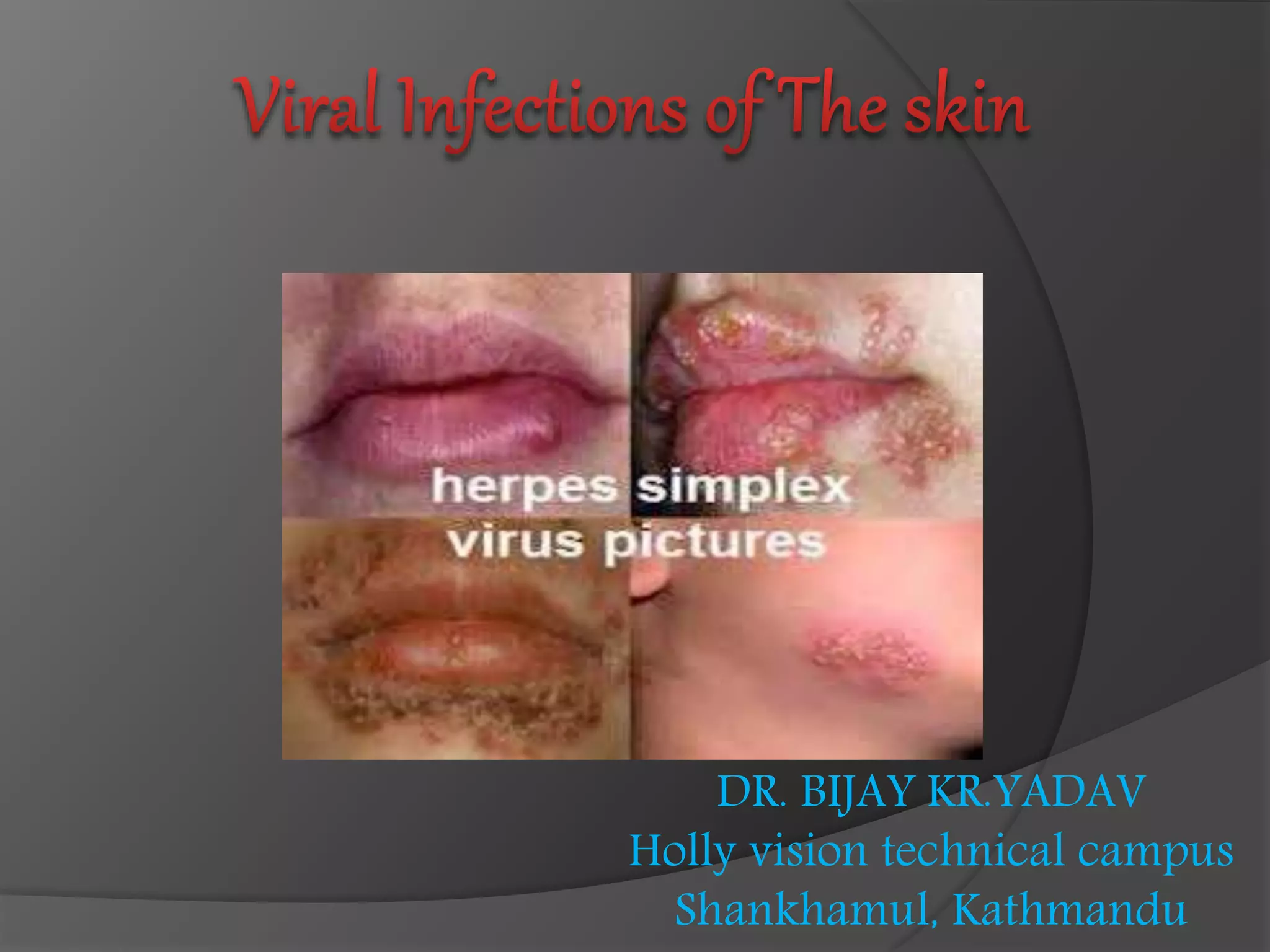
 HHV1 Herpes Simplex.(orofacial)
 HHV2 Herpes simplex(genital)
 HHV3 Chicken pox.
Herpes Zoster.
 Human Papilloma virus.
 Warts
 Pox virus.
 Molluscum Contagiosum.
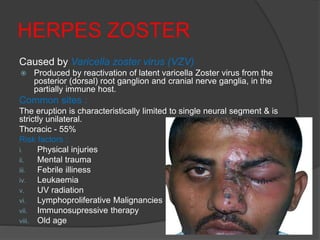
HERPES ZOSTER
Caused by Varicella zoster virus (VZV)
 Produced by reactivation of latent varicella Zoster virus from the
posterior (dorsal) root ganglion and cranial nerve ganglia, in the
partially immune host.
Common sites :
The eruption is characteristically limited to single neural segment & is
strictly unilateral.
Thoracic - 55%
Risk factors :
i. Physical injuries
ii. Mental trauma
iii. Febrile illiness
iv. Leukaemia
v. UV radiation
vi. Lymphoproliferative Malignancies
vii. Immunosupressive therapy
viii. Old age
Clinical feaatures
 Incubation period: 7-12 days
 Severe continuous pain or paresthesia in the distribution of the
nerve root
 Skin becomes erythematous ( redness of the skin or mucous
membranes, caused by hyperemia of superficial capillaries)
 Eruption of several group of vesicles on erythematous &
edematous base.
 Early vesicles contain a clear serum but after few days,the content
become purulent & dry to produce crusts after rupturing ( within 7-
10 days)
 Other vesicles dry up without rupturing, some may become
hemorrhagic or necrotic & may ulcerate.
After 3-4 days
After 3-5 days
Treatment :
Herpes zoster is a self limiting condition
1. Uncomplicated cases
 Drying compresses
 Analgesics to relieve pain
2. Localized Hepes zoster
 Acyclovir 800 mg orally five times a day for 7 days
 Cold compresses ( using 1 in 20 burrows solution)
 Topical application of 5% acyclovir
 Ibuprofen 400 mg TDS
Disseminated and complicated cases refer to the
higher centre
Warts
 It is benign epidermal proliferation, caused by human
papilloma virus (HPV)
 it is also knows as Verrucae
 The infection is limited to the epidermis
 It is common in children most commonly occur between
12-16 years but also in adult with immune deficiency may
daevelop extensive warts
 The appearance of warts can diffeer based on the type of
warts & where it is located on the body
Common Warts( Verruca vulgaris )
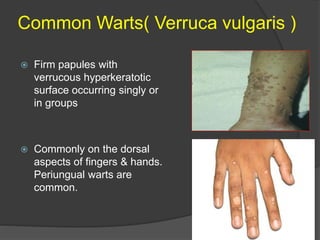
 Firm papules with
verrucous hyperkeratotic
surface occurring singly or
in groups
 Commonly on the dorsal
aspects of fingers & hands.
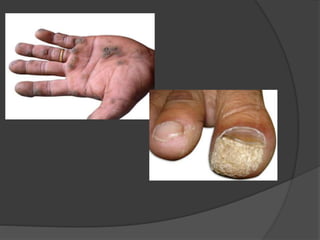
Periungual warts are
common.
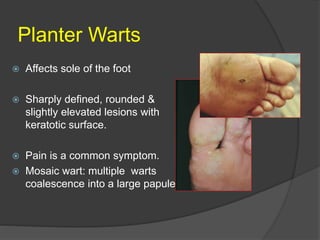
Planter Warts
 Affects sole of the foot
 Sharply defined, rounded &
slightly elevated lesions with
keratotic surface.
 Pain is a common symptom.
 Mosaic wart: multiple warts
coalescence into a large papule
Plane warts
 slightly elevated, flat,
smooth papules.
 Linear arrangement in
scratch marks may be
present “Koebner
phenomenon”.
Treatment
1. Home care is effective in making the wart or warts go away.
Warts disappear 60-70 % of the time.
2. Tape therapy :
 Use several layers of water proof adhesive tape over the
warts region.
 Do not remove the tape & open the area to the air for 12
hours.
 Reapply tape for another 6-7 days
 The tape works best in the region around the fingernail
 The tape works bcoz the air tight, moist environment under
the tape doesn’t allow the virus to grow & reproduce.
3. Salicyclic acid therapy : it is available by different trade
name.
 It comes either as a liquid to paint on the warts or as a
plaster to be cut out & placed on the wart tissue
 The area with the warts should be soaked in warm
water for 5-10 mins.
 The warts should be pared down with razor. A simple
razor worls fine for this, then throw it away
 Apply the salicyclic acid preparation to the wat tissue
 Do not apply it to the other skin bcoz of salicyclic acid
potential to injure normal tissue ( follow directions on the
package for how to apply )
4. Cryosurgery : Liquid nitrogen or cryotherapy.
5. Laser therapy
6. Shave removal
Molluscum Contagiosum
 It is a self-limited epidermal contagious skin
disease.
 Caused by pox virus infection.
 Transmission is by direct contact.
 Epidemiology:
• Children (a common childhood disease)
• and sexually active adults (20-29 years).
• Males > females.
Clinical Picture
• IP: 2 wks – 6 ms.
• Sites: face, hands, trunk & axillae.
• Lesions are shiny, white or pink and hemispherical,
grow slowly upto 0.5 cm in diameter.
• Affection of genital area, lower abdomen or upper
thighs occur after sexual transmission.
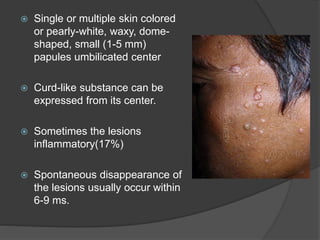
 Single or multiple skin colored
or pearly-white, waxy, dome-
shaped, small (1-5 mm)
papules umbilicated center
 Curd-like substance can be
expressed from its center.
 Sometimes the lesions
inflammatory(17%)
 Spontaneous disappearance of
the lesions usually occur within
6-9 ms.
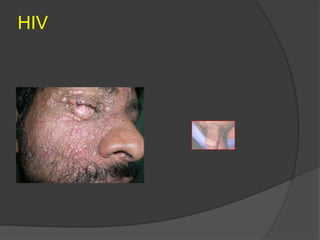
HIV
Treatment
 Spontaneous disappearance may occur.
 Physical destruction:
 Laser.
 Cryosurgery.
 Electrocautery.
 Curettage.
 Chemical destruction:
 Salicylic acid 20%, TCA, Phenol.
 Topical antiviral: Imidquimod5%, Cidovir 1-3%
6. Viral infections

6. Viral infections

  • 1.
    DR. BIJAY KR.YADAV Hollyvision technical campus Shankhamul, Kathmandu
  • 2.
    Viral infection  HumanHerpes virus.  HHV1 Herpes Simplex.(orofacial)  HHV2 Herpes simplex(genital)  HHV3 Chicken pox. Herpes Zoster.  Human Papilloma virus.  Warts  Pox virus.  Molluscum Contagiosum.
  • 3.
    HERPES ZOSTER Caused byVaricella zoster virus (VZV)  Produced by reactivation of latent varicella Zoster virus from the posterior (dorsal) root ganglion and cranial nerve ganglia, in the partially immune host. Common sites : The eruption is characteristically limited to single neural segment & is strictly unilateral. Thoracic - 55% Risk factors : i. Physical injuries ii. Mental trauma iii. Febrile illiness iv. Leukaemia v. UV radiation vi. Lymphoproliferative Malignancies vii. Immunosupressive therapy viii. Old age
  • 4.
    Clinical feaatures  Incubationperiod: 7-12 days  Severe continuous pain or paresthesia in the distribution of the nerve root  Skin becomes erythematous ( redness of the skin or mucous membranes, caused by hyperemia of superficial capillaries)  Eruption of several group of vesicles on erythematous & edematous base.  Early vesicles contain a clear serum but after few days,the content become purulent & dry to produce crusts after rupturing ( within 7- 10 days)  Other vesicles dry up without rupturing, some may become hemorrhagic or necrotic & may ulcerate. After 3-4 days After 3-5 days
  • 5.
    Treatment : Herpes zosteris a self limiting condition 1. Uncomplicated cases  Drying compresses  Analgesics to relieve pain 2. Localized Hepes zoster  Acyclovir 800 mg orally five times a day for 7 days  Cold compresses ( using 1 in 20 burrows solution)  Topical application of 5% acyclovir  Ibuprofen 400 mg TDS Disseminated and complicated cases refer to the higher centre
  • 6.
    Warts  It isbenign epidermal proliferation, caused by human papilloma virus (HPV)  it is also knows as Verrucae  The infection is limited to the epidermis  It is common in children most commonly occur between 12-16 years but also in adult with immune deficiency may daevelop extensive warts  The appearance of warts can diffeer based on the type of warts & where it is located on the body
  • 7.
    Common Warts( Verrucavulgaris )  Firm papules with verrucous hyperkeratotic surface occurring singly or in groups  Commonly on the dorsal aspects of fingers & hands. Periungual warts are common.
  • 9.
    Planter Warts  Affectssole of the foot  Sharply defined, rounded & slightly elevated lesions with keratotic surface.  Pain is a common symptom.  Mosaic wart: multiple warts coalescence into a large papule
  • 10.
    Plane warts  slightlyelevated, flat, smooth papules.  Linear arrangement in scratch marks may be present “Koebner phenomenon”.
  • 11.
    Treatment 1. Home careis effective in making the wart or warts go away. Warts disappear 60-70 % of the time. 2. Tape therapy :  Use several layers of water proof adhesive tape over the warts region.  Do not remove the tape & open the area to the air for 12 hours.  Reapply tape for another 6-7 days  The tape works best in the region around the fingernail  The tape works bcoz the air tight, moist environment under the tape doesn’t allow the virus to grow & reproduce.
  • 12.
    3. Salicyclic acidtherapy : it is available by different trade name.  It comes either as a liquid to paint on the warts or as a plaster to be cut out & placed on the wart tissue  The area with the warts should be soaked in warm water for 5-10 mins.  The warts should be pared down with razor. A simple razor worls fine for this, then throw it away  Apply the salicyclic acid preparation to the wat tissue  Do not apply it to the other skin bcoz of salicyclic acid potential to injure normal tissue ( follow directions on the package for how to apply ) 4. Cryosurgery : Liquid nitrogen or cryotherapy. 5. Laser therapy 6. Shave removal
  • 13.
    Molluscum Contagiosum  Itis a self-limited epidermal contagious skin disease.  Caused by pox virus infection.  Transmission is by direct contact.  Epidemiology: • Children (a common childhood disease) • and sexually active adults (20-29 years). • Males > females.
  • 14.
    Clinical Picture • IP:2 wks – 6 ms. • Sites: face, hands, trunk & axillae. • Lesions are shiny, white or pink and hemispherical, grow slowly upto 0.5 cm in diameter. • Affection of genital area, lower abdomen or upper thighs occur after sexual transmission.
  • 15.
     Single ormultiple skin colored or pearly-white, waxy, dome- shaped, small (1-5 mm) papules umbilicated center  Curd-like substance can be expressed from its center.  Sometimes the lesions inflammatory(17%)  Spontaneous disappearance of the lesions usually occur within 6-9 ms.
  • 16.
  • 17.
    Treatment  Spontaneous disappearancemay occur.  Physical destruction:  Laser.  Cryosurgery.  Electrocautery.  Curettage.  Chemical destruction:  Salicylic acid 20%, TCA, Phenol.  Topical antiviral: Imidquimod5%, Cidovir 1-3%