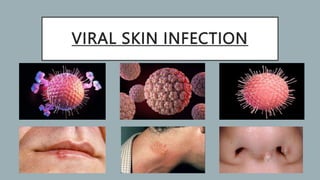
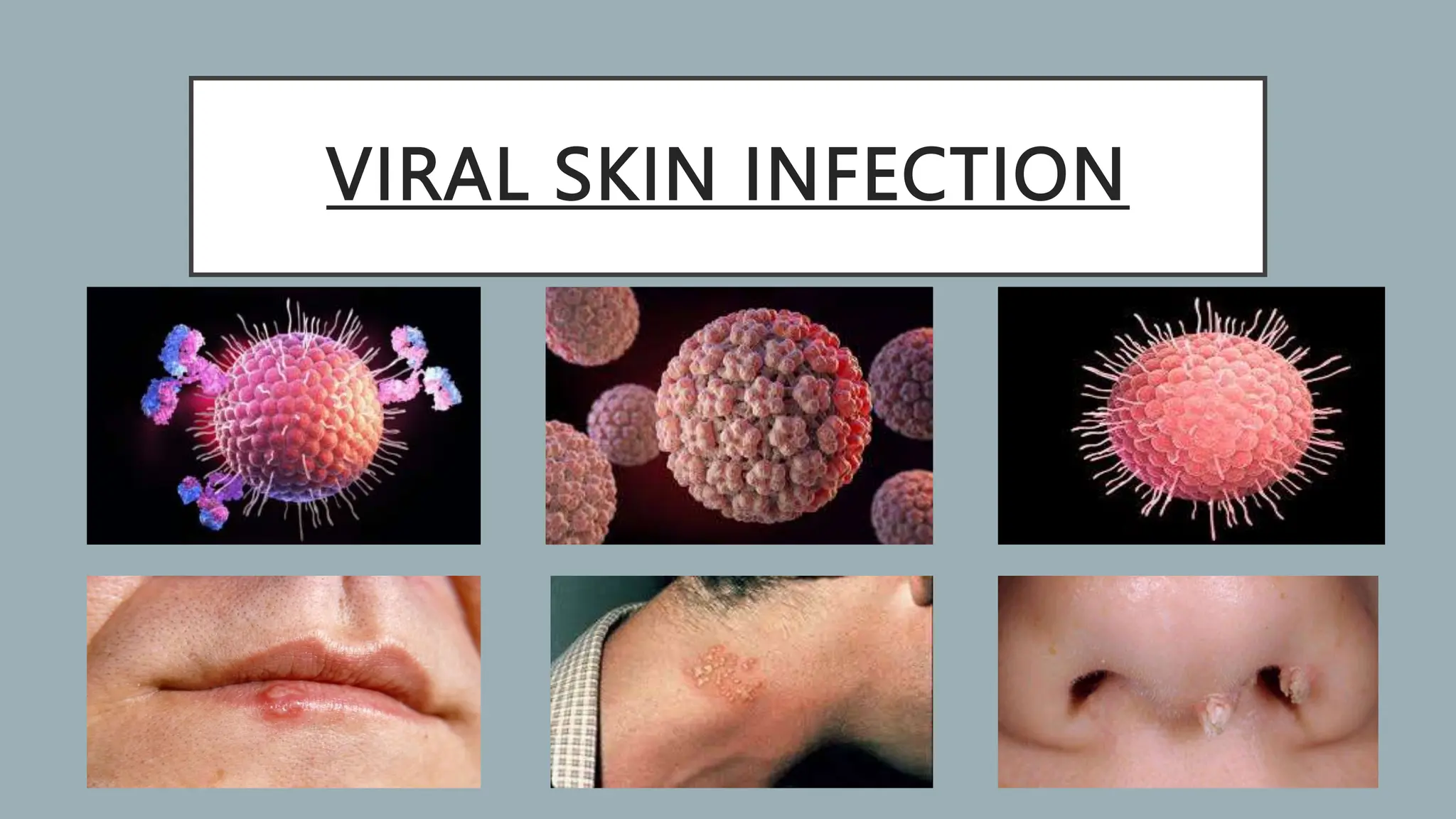
VIRAL SKIN INFECTION
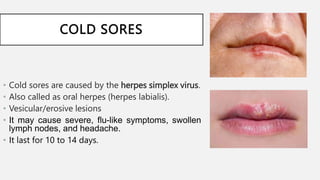
COLD SORES
• Cold sores are caused by the herpes simplex virus.
• Also called as oral herpes (herpes labialis).
• Vesicular/erosive lesions
• It may cause severe, flu-like symptoms, swollen
lymph nodes, and headache..
• It last for 10 to 14 days.
Pathophysiology
• HSV remains within the host for life, remaining
latent in the sensory nerve ganglia, leading to
recurrent reactivation.
• It last for short time around 5 days.
• Prodrome symptoms consist of itching,
tingling, and tenderness.
Other manifestation
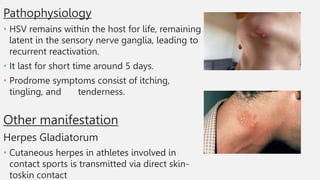
Herpes Gladiatorum
• Cutaneous herpes in athletes involved in
contact sports is transmitted via direct skin-
toskin contact
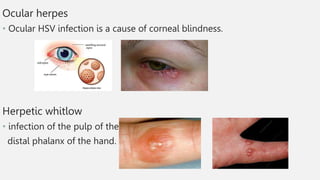
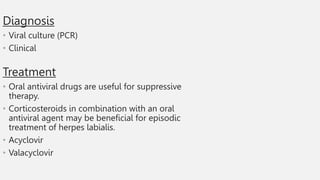
Ocular herpes
• Ocular HSV infection is a cause of corneal blindness.
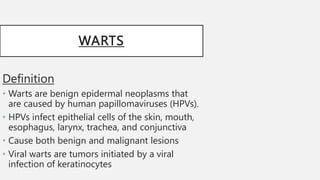
Herpetic whitlow
• infection of the pulp of the
distal phalanx of the hand.
Diagnosis
• Viral culture (PCR)
• Clinical
Treatment
• Oral antiviral drugs are useful for suppressive
therapy.
• Corticosteroids in combination with an oral
antiviral agent may be beneficial for episodic
treatment of herpes labialis.
• Acyclovir
• Valacyclovir
WARTS
Definition
• Warts are benign epidermal neoplasms that
are caused by human papillomaviruses (HPVs).
• HPVs infect epithelial cells of the skin, mouth,
esophagus, larynx, trachea, and conjunctiva
• Cause both benign and malignant lesions
• Viral warts are tumors initiated by a viral
infection of keratinocytes
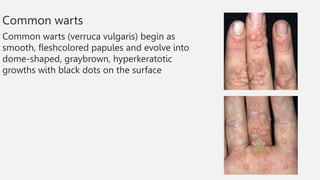
Common warts
Common warts (verruca vulgaris) begin as
smooth, fleshcolored papules and evolve into
dome-shaped, graybrown, hyperkeratotic
growths with black dots on the surface
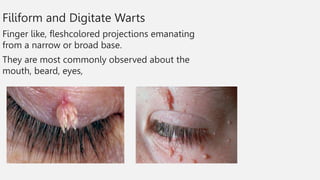
Filiform and Digitate Warts
Finger like, fleshcolored projections emanating
from a narrow or broad base.
They are most commonly observed about the
mouth, beard, eyes,
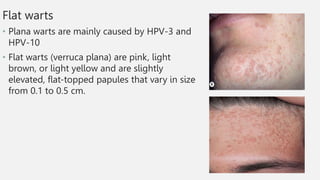
Flat warts
• Plana warts are mainly caused by HPV-3 and
HPV-10
• Flat warts (verruca plana) are pink, light
brown, or light yellow and are slightly
elevated, flat-topped papules that vary in size
from 0.1 to 0.5 cm.
Treatment
• Cryotherapy is effective for common warts
and is reasonable first-line therapy
• Keratolytic Therapy (40% Salicylic Acid
Plasters)
• Apple Cider Vinegar
• 5-Fluorouracil (5-FU).
• Imiquimod
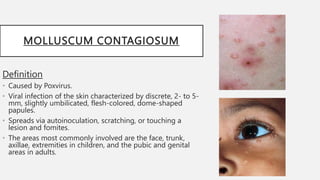
MOLLUSCUM CONTAGIOSUM
Definition
• Caused by Poxvirus.
• Viral infection of the skin characterized by discrete, 2- to 5-
mm, slightly umbilicated, flesh-colored, dome-shaped
papules.
• Spreads via autoinoculation, scratching, or touching a
lesion and fomites.
• The areas most commonly involved are the face, trunk,
axillae, extremities in children, and the pubic and genital
areas in adults.
Treatment
• Cryosurgery
• Cantharidin, a chemovesicant extract from the
blist
• Imiquimod
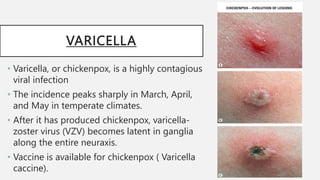
VARICELLA
• Varicella, or chickenpox, is a highly contagious
viral infection
• The incidence peaks sharply in March, April,
and May in temperate climates.
• After it has produced chickenpox, varicella-
zoster virus (VZV) becomes latent in ganglia
along the entire neuraxis.
• Vaccine is available for chickenpox ( Varicella
caccine).
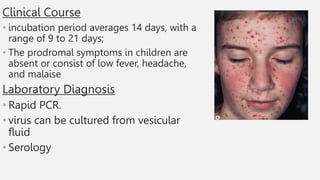
Clinical Course
• incubation period averages 14 days, with a
range of 9 to 21 days;
• The prodromal symptoms in children are
absent or consist of low fever, headache,
and malaise
Laboratory Diagnosis
• Rapid PCR.
• virus can be cultured from vesicular
fluid
• Serology
Treatment
• Acyclovir
Prevention
• Varicella vaccine is made with live, attenuated
varicella virus

Presentation (3).pptx

  • 1.
  • 2.
    COLD SORES • Coldsores are caused by the herpes simplex virus. • Also called as oral herpes (herpes labialis). • Vesicular/erosive lesions • It may cause severe, flu-like symptoms, swollen lymph nodes, and headache.. • It last for 10 to 14 days.
  • 3.
    Pathophysiology • HSV remainswithin the host for life, remaining latent in the sensory nerve ganglia, leading to recurrent reactivation. • It last for short time around 5 days. • Prodrome symptoms consist of itching, tingling, and tenderness. Other manifestation Herpes Gladiatorum • Cutaneous herpes in athletes involved in contact sports is transmitted via direct skin- toskin contact
  • 4.
    Ocular herpes • OcularHSV infection is a cause of corneal blindness. Herpetic whitlow • infection of the pulp of the distal phalanx of the hand.
  • 5.
    Diagnosis • Viral culture(PCR) • Clinical Treatment • Oral antiviral drugs are useful for suppressive therapy. • Corticosteroids in combination with an oral antiviral agent may be beneficial for episodic treatment of herpes labialis. • Acyclovir • Valacyclovir
  • 6.
    WARTS Definition • Warts arebenign epidermal neoplasms that are caused by human papillomaviruses (HPVs). • HPVs infect epithelial cells of the skin, mouth, esophagus, larynx, trachea, and conjunctiva • Cause both benign and malignant lesions • Viral warts are tumors initiated by a viral infection of keratinocytes
  • 7.
    Common warts Common warts(verruca vulgaris) begin as smooth, fleshcolored papules and evolve into dome-shaped, graybrown, hyperkeratotic growths with black dots on the surface
  • 8.
    Filiform and DigitateWarts Finger like, fleshcolored projections emanating from a narrow or broad base. They are most commonly observed about the mouth, beard, eyes,
  • 9.
    Flat warts • Planawarts are mainly caused by HPV-3 and HPV-10 • Flat warts (verruca plana) are pink, light brown, or light yellow and are slightly elevated, flat-topped papules that vary in size from 0.1 to 0.5 cm.
  • 10.
    Treatment • Cryotherapy iseffective for common warts and is reasonable first-line therapy • Keratolytic Therapy (40% Salicylic Acid Plasters) • Apple Cider Vinegar • 5-Fluorouracil (5-FU). • Imiquimod
  • 11.
    MOLLUSCUM CONTAGIOSUM Definition • Causedby Poxvirus. • Viral infection of the skin characterized by discrete, 2- to 5- mm, slightly umbilicated, flesh-colored, dome-shaped papules. • Spreads via autoinoculation, scratching, or touching a lesion and fomites. • The areas most commonly involved are the face, trunk, axillae, extremities in children, and the pubic and genital areas in adults.
  • 12.
    Treatment • Cryosurgery • Cantharidin,a chemovesicant extract from the blist • Imiquimod
  • 13.
    VARICELLA • Varicella, orchickenpox, is a highly contagious viral infection • The incidence peaks sharply in March, April, and May in temperate climates. • After it has produced chickenpox, varicella- zoster virus (VZV) becomes latent in ganglia along the entire neuraxis. • Vaccine is available for chickenpox ( Varicella caccine).
  • 14.
    Clinical Course • incubationperiod averages 14 days, with a range of 9 to 21 days; • The prodromal symptoms in children are absent or consist of low fever, headache, and malaise Laboratory Diagnosis • Rapid PCR. • virus can be cultured from vesicular fluid • Serology
  • 15.
    Treatment • Acyclovir Prevention • Varicellavaccine is made with live, attenuated varicella virus