Jitendra Tomar, Amity School of Business, AUUP Page 1
My Sincere Thanks to Marcia Robinson & Dr. Ravi Kalakota
Demystifying e-Procurement:
Buy-Side, Sell-Side, Net Markets, and Trading
Exchanges
Introduction
More than 5-10% revenues spent on non-production goods annually
– Office equipment, supplies, software, computers
– Top 2000 U.S. corporations = $500 billion annually
Purchase detail for negotiating better supplier contracts not available
– Most POs worth less than $500
– Large percentage of that is off contract, outside preferred channels
B2B transactions comprise significant market
– Several trillion dollars
– Big Three automakers do $500 billion/yr worth transactions related to buying and
selling car components
– Non-discretionary spending, required for business
– Both buyers and seller see importance of an efficient marketplace, to streamline
processes and reduce costs
Procurement not just support function; a valuable weapon
– Lower procurement costs, reduce order-cycle times and ensure smooth delivery of
materials
B2B strategies now a top mgmt focus
– Not so much a technological revolution as a business revolution enabled by
technology
– Driven by CEO or CFO, reflecting management’s awareness of key challenges facing
corporate procurement functions
• Reducing order-processing cost and cycle times
• Providing enterprise-wide access to corporate procurement capabilities
• Empowering desktop requisitioning through employee self-service
• Achieving procurement s/w integration with back office systems
• Elevating procurement function to strategic importance within organization
– Dollar-for-dollar bottomline impact of e-procurement is startling
B2B strategies now a top mgmt focus
– Driven by CEO or CFO, reflecting management’s awareness of key challenges facing
corporate procurement functions
• Reducing order-processing cost and cycle times
• Providing enterprise-wide access to corporate procurement capabilities
• Empowering desktop requisitioning through employee self-service
• Achieving procurement s/w integration with back office systems
• Elevating procurement function to strategic importance within organization
– Dollar-for-dollar bottomline impact of e-procurement is startling
Jitendra Tomar, Amity School of Business, AUUP
My Sincere Thanks to Marcia Robinson & Dr. Ravi Kalakota
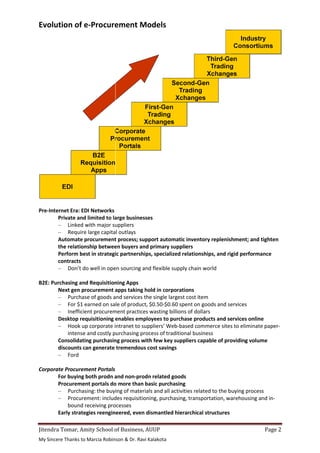
Evolution of e-Procurement Models
Pre-Internet Era: EDI Networks
Private and limited to large businesses
– Linked with major suppliers
– Require large capital outlays
Automate procurement process; support automatic inventory
the relationship between buyers and primary suppliers
Perform best in strategic partnerships, specialized relationships, and rigid performance
contracts
– Don’t do well in open sourcing and flexible supply chain world
B2E: Purchasing and Requisitioning Apps
Next gen procurement apps taking hold in corporations
– Purchase of goods and services the single largest cost item
– For $1 earned on sale of product, $0.50
– Inefficient procurement practices
Desktop requisitioning enables employees to purchase products and services online
– Hook up corporate intranet to suppliers’ Web
intense and costly purchasing process of traditional business
Consolidating purchasing process with few key suppliers capable of providing volume
discounts can generate tremendous cost savings
– Ford
Corporate Procurement Portals
For buying both prodn and non
Procurement portals do more than basic
– Purchasing: the buying of materials and all activities related to the buying process
– Procurement: includes requisitioning, purchasing, transportation, warehousing and in
bound receiving processes
Early strategies reengineered, even dismantled h
School of Business, AUUP
My Sincere Thanks to Marcia Robinson & Dr. Ravi Kalakota
Procurement Models
Private and limited to large businesses
Linked with major suppliers
Require large capital outlays
Automate procurement process; support automatic inventory replenishment; and tighten
the relationship between buyers and primary suppliers
Perform best in strategic partnerships, specialized relationships, and rigid performance
Don’t do well in open sourcing and flexible supply chain world
ing and Requisitioning Apps
Next gen procurement apps taking hold in corporations
Purchase of goods and services the single largest cost item
For $1 earned on sale of product, $0.50-$0.60 spent on goods and services
Inefficient procurement practices wasting billions of dollars
Desktop requisitioning enables employees to purchase products and services online
Hook up corporate intranet to suppliers’ Web-based commerce sites to eliminate paper
intense and costly purchasing process of traditional business
Consolidating purchasing process with few key suppliers capable of providing volume
discounts can generate tremendous cost savings
For buying both prodn and non-prodn related goods
Procurement portals do more than basic purchasing
Purchasing: the buying of materials and all activities related to the buying process
Procurement: includes requisitioning, purchasing, transportation, warehousing and in
bound receiving processes
Early strategies reengineered, even dismantled hierarchical structures
Page 2
replenishment; and tighten
Perform best in strategic partnerships, specialized relationships, and rigid performance
$0.60 spent on goods and services
Desktop requisitioning enables employees to purchase products and services online
based commerce sites to eliminate paper-
Consolidating purchasing process with few key suppliers capable of providing volume
Purchasing: the buying of materials and all activities related to the buying process
Procurement: includes requisitioning, purchasing, transportation, warehousing and in-
Jitendra Tomar, Amity School of Business, AUUP Page 3
My Sincere Thanks to Marcia Robinson & Dr. Ravi Kalakota
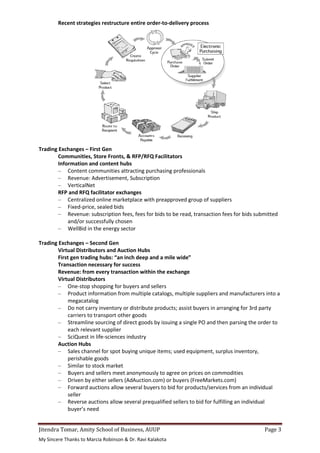
Recent strategies restructure entire order-to-delivery process
Trading Exchanges – First Gen
Communities, Store Fronts, & RFP/RFQ Facilitators
Information and content hubs
– Content communities attracting purchasing professionals
– Revenue: Advertisement, Subscription
– VerticalNet
RFP and RFQ facilitator exchanges
– Centralized online marketplace with preapproved group of suppliers
– Fixed-price, sealed bids
– Revenue: subscription fees, fees for bids to be read, transaction fees for bids submitted
and/or successfully chosen
– WellBid in the energy sector
Trading Exchanges – Second Gen
Virtual Distributors and Auction Hubs
First gen trading hubs: “an inch deep and a mile wide”
Transaction necessary for success
Revenue: from every transaction within the exchange
Virtual Distributors
– One-stop shopping for buyers and sellers
– Product information from multiple catalogs, multiple suppliers and manufacturers into a
megacatalog
– Do not carry inventory or distribute products; assist buyers in arranging for 3rd party
carriers to transport other goods
– Streamline sourcing of direct goods by issuing a single PO and then parsing the order to
each relevant supplier
– SciQuest in life-sciences industry
Auction Hubs
– Sales channel for spot buying unique items; used equipment, surplus inventory,
perishable goods
– Similar to stock market
– Buyers and sellers meet anonymously to agree on prices on commodities
– Driven by either sellers (AdAuction.com) or buyers (FreeMarkets.com)
– Forward auctions allow several buyers to bid for products/services from an individual
seller
– Reverse auctions allow several prequalified sellers to bid for fulfilling an individual
buyer’s need
Jitendra Tomar, Amity School of Business, AUUP Page 4
My Sincere Thanks to Marcia Robinson & Dr. Ravi Kalakota
Trading Exchanges – Third Gen
Collaboration hubs
Provide more than transaction functionality, help with end-to-end mgmt of supply chains
Create common platform for all participants in an industry supply chain
– Share information; conduct business transactions; collaborate on strategic and
operational planning
Provide value-added services
– Increase site “stickiness”; generate multiple revenue streams; increase competitive
barriers to entry
– Bidcom is a single online workplace for large contractors to collaborate with architects,
store blueprints, expedite permit process and purchase building materials
– Integrated commerce technology
– Automate transaction processing, incorporate static pricing and/or dynamic
pricing
– Brokering services
– Logistic and financial services
– Service and support
– Customer service support, returns processing, and warranty coverage
Industry Consortiums: Joint-Venture Procurement Hubs
Larger firms responding to competitive threat posed by new startups
– Forming either buyers or suppliers consortium
– Traditional industry leaders have two advantages over startups: instant commercial
activity and liquidity
Buyer consortium
– Groups of large companies combining buying power to drive down prices
– Covisint
Supplier consortium
– Forming in industries with few high concentration market players
– Difference compared to buyer consortium: sponsors get to promote and differentiate
suppliers’ products
– Not new: Sabre
Major issues: governance, technology and antitrust
Evolution of Procurement Processes
Reengineering procurement process key to deployment of e-procurement solution
E-procurement models all attempting to solve similar business process problems
– Fragmentation of channels
– Managing by exception rather than by transaction
– Controlling maverick buying by automating requisitioning process
– Integration of end-to-end process
Jitendra Tomar, Amity School of Business, AUUP
My Sincere Thanks to Marcia Robinson & Dr. Ravi Kalakota
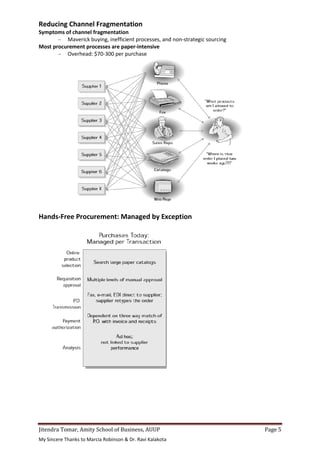
Reducing Channel Fragmentation
Symptoms of channel fragmentation
– Maverick buying, inefficient processes, and non
Most procurement processes are paper
– Overhead: $70-300 per purchase
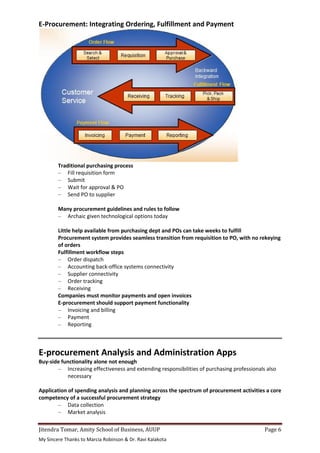
Hands-Free Procurement: Managed by Exception
School of Business, AUUP
My Sincere Thanks to Marcia Robinson & Dr. Ravi Kalakota
Fragmentation
Symptoms of channel fragmentation
Maverick buying, inefficient processes, and non-strategic sourcing
Most procurement processes are paper-intensive
300 per purchase
Free Procurement: Managed by Exception
Page 5
Jitendra Tomar, Amity School of Business, AUUP Page 6
My Sincere Thanks to Marcia Robinson & Dr. Ravi Kalakota
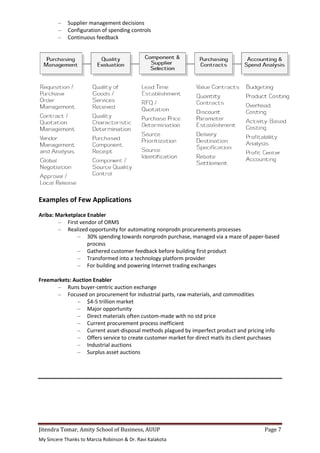
E-Procurement: Integrating Ordering, Fulfillment and Payment
Traditional purchasing process
– Fill requisition form
– Submit
– Wait for approval & PO
– Send PO to supplier
Many procurement guidelines and rules to follow
– Archaic given technological options today
Little help available from purchasing dept and POs can take weeks to fulfill
Procurement system provides seamless transition from requisition to PO, with no rekeying
of orders
Fulfillment workflow steps
– Order dispatch
– Accounting back-office systems connectivity
– Supplier connectivity
– Order tracking
– Receiving
Companies must monitor payments and open invoices
E-procurement should support payment functionality
– Invoicing and billing
– Payment
– Reporting
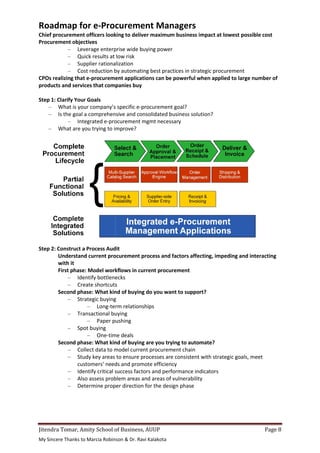
E-procurement Analysis and Administration Apps
Buy-side functionality alone not enough
– Increasing effectiveness and extending responsibilities of purchasing professionals also
necessary
Application of spending analysis and planning across the spectrum of procurement activities a core
competency of a successful procurement strategy
– Data collection
– Market analysis
Jitendra Tomar, Amity School of Business, AUUP Page 7
My Sincere Thanks to Marcia Robinson & Dr. Ravi Kalakota
– Supplier management decisions
– Configuration of spending controls
– Continuous feedback
Examples of Few Applications
Ariba: Marketplace Enabler
– First vendor of ORMS
– Realized opportunity for automating nonprodn procurements processes
– 30% spending towards nonprodn purchase, managed via a maze of paper-based
process
– Gathered customer feedback before building first product
– Transformed into a technology platform provider
– For building and powering Internet trading exchanges
Freemarkets: Auction Enabler
– Runs buyer-centric auction exchange
– Focused on procurement for industrial parts, raw materials, and commodities
– $4-5 trillion market
– Major opportunity
– Direct materials often custom-made with no std price
– Current procurement process inefficient
– Current asset-disposal methods plagued by imperfect product and pricing info
– Offers service to create customer market for direct matls its client purchases
– Industrial auctions
– Surplus asset auctions
Jitendra Tomar, Amity School of Business, AUUP
My Sincere Thanks to Marcia Robinson & Dr. Ravi Kalakota
Roadmap for e-Procurement Managers
Chief procurement officers looking to deliver maximum business impact at lowest possible cost
Procurement objectives
– Leverage enterprise wide buying power
– Quick results at low risk
– Supplier rationalization
– Cost reduction by autom
CPOs realizing that e-procurement applications can be powerful when applied to large number of
products and services that companies buy
Step 1: Clarify Your Goals
– What is your company’s specific e
– Is the goal a comprehensive and consolidated business solution?
– Integrated e-procurement mgmt necessary
– What are you trying to improve?
Step 2: Construct a Process Audit
Understand current procurement process and factors affecting, impeding and
with it
First phase: Model workflows in current procurement
– Identify bottlenecks
– Create shortcuts
Second phase: What kind of buying do you want to support?
– Strategic buying
– Long-term relationships
– Transactional buying
– Paper pushing
– Spot buying
– One-time deals
Second phase: What kind of buying are you trying to automate?
– Collect data to model current procurement chain
– Study key areas to ensure processes are consistent with strategic goals, meet
customers’ needs and promote efficiency
– Identify critical success factors and performance indicators
– Also assess problem areas and areas of vulnerability
– Determine proper direction for the design phase
School of Business, AUUP
My Sincere Thanks to Marcia Robinson & Dr. Ravi Kalakota
Procurement Managers
Chief procurement officers looking to deliver maximum business impact at lowest possible cost
Leverage enterprise wide buying power
Quick results at low risk
Supplier rationalization
Cost reduction by automating best practices in strategic procurement
procurement applications can be powerful when applied to large number of
products and services that companies buy
What is your company’s specific e-procurement goal?
Is the goal a comprehensive and consolidated business solution?
procurement mgmt necessary
What are you trying to improve?
Step 2: Construct a Process Audit
Understand current procurement process and factors affecting, impeding and
First phase: Model workflows in current procurement
Identify bottlenecks
Create shortcuts
Second phase: What kind of buying do you want to support?
Strategic buying
term relationships
Transactional buying
Paper pushing
time deals
Second phase: What kind of buying are you trying to automate?
Collect data to model current procurement chain
Study key areas to ensure processes are consistent with strategic goals, meet
customers’ needs and promote efficiency
ical success factors and performance indicators
Also assess problem areas and areas of vulnerability
Determine proper direction for the design phase
Page 8
Chief procurement officers looking to deliver maximum business impact at lowest possible cost
ating best practices in strategic procurement
procurement applications can be powerful when applied to large number of
Understand current procurement process and factors affecting, impeding and interacting
Study key areas to ensure processes are consistent with strategic goals, meet
Jitendra Tomar, Amity School of Business, AUUP Page 9
My Sincere Thanks to Marcia Robinson & Dr. Ravi Kalakota
Step 3: Create a Business Case for e-Procurement
Return on assets business case forces you to systematically analyze your business
Analysis forces to understand context
– Without understanding environment cannot fix it
– Can articulate hidden assumptions
Widely used technique in creating business case
– ROA = (Revenues-Expenses)/Assets
– Increase revenues, decrease expenses, keep asset base as small as possible
Increasing profitability by generating revenue requires substantial investment but through
e-procurement requires only a limited addl investment
Decreasing expenses can be accomplished by identifying inefficiencies in the procurement
chain
– Inventory carrying costs
– Reducing captive capital makes quick profits
– Cost improvements not just cutbacks; enhancements through better coordination
and communication; “premium freight” can be avoided for instance
Improving asset utilization can be accomplished by reducing working capital
– Eliminating warehouses to maximize stock availability and to minimize inventory
holdings
– Eliminating excess inventory to reduce leakage or hidden inventory
Step 4: Developing Supplier Integration Matrix
Without supplier commitment, e-procurement difficult
– But with ever-increasing velocity of change, few organizations want to commit to long
term relationships
Needed: Supplier Integration Matrix (SIM)
– Helps determine the best type of relationships to have with individual vendors
– An organization applying only one relationship structure to all vendors shortchanging
itself
SIM classifies suppliers into
– Strategic collaborative, long term, ex. MRO suppliers
– Strategic cooperative, ex. computer suppliers
– Nonstrategic limited, short term, ex. temp agency services
– Nonstrategic commodity, short term, ex. office and book suppliers
SIM should be reviewed periodically
Step 5: Select an e-Procurement App
Wade through vendor hype
– Will it support my procurement process?
– Does it leverage my other application investments?
– Will it work seamlessly with other apps?
– Is it extendable?
Step 6: Remember Integration is Everything
Doomed to fail strategy
– Gathering requirements, then disappearing for 6 months, then launching the portal
Ideal goal
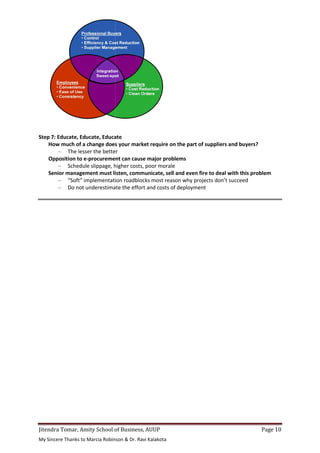
– Continuously iterate towards the target – the integration sweet spot
– Focus on all areas of ORM
Iterate development and deployment
– Do not take exclusive buy-side or sell-side viewpoint
Integration with back office systems a significant issue
Jitendra Tomar, Amity School of Business, AUUP
My Sincere Thanks to Marcia Robinson & Dr. Ravi Kalakota
Step 7: Educate, Educate, Educate
How much of a change does your market require on the part of suppliers and buyers?
– The lesser the better
Opposition to e-procurement can
– Schedule slippage, higher costs, poor morale
Senior management must listen, communicate, sell and even fire to deal with this problem
– “Soft” implementation roadblocks most reason why projects don’t succeed
– Do not underestimate the effo
School of Business, AUUP
My Sincere Thanks to Marcia Robinson & Dr. Ravi Kalakota
Step 7: Educate, Educate, Educate
How much of a change does your market require on the part of suppliers and buyers?
The lesser the better
procurement can cause major problems
Schedule slippage, higher costs, poor morale
Senior management must listen, communicate, sell and even fire to deal with this problem
“Soft” implementation roadblocks most reason why projects don’t succeed
Do not underestimate the effort and costs of deployment
Page 10
How much of a change does your market require on the part of suppliers and buyers?
Senior management must listen, communicate, sell and even fire to deal with this problem
“Soft” implementation roadblocks most reason why projects don’t succeed

Module 5 e procurement

  • 1.
    Jitendra Tomar, AmitySchool of Business, AUUP Page 1 My Sincere Thanks to Marcia Robinson & Dr. Ravi Kalakota Demystifying e-Procurement: Buy-Side, Sell-Side, Net Markets, and Trading Exchanges Introduction More than 5-10% revenues spent on non-production goods annually – Office equipment, supplies, software, computers – Top 2000 U.S. corporations = $500 billion annually Purchase detail for negotiating better supplier contracts not available – Most POs worth less than $500 – Large percentage of that is off contract, outside preferred channels B2B transactions comprise significant market – Several trillion dollars – Big Three automakers do $500 billion/yr worth transactions related to buying and selling car components – Non-discretionary spending, required for business – Both buyers and seller see importance of an efficient marketplace, to streamline processes and reduce costs Procurement not just support function; a valuable weapon – Lower procurement costs, reduce order-cycle times and ensure smooth delivery of materials B2B strategies now a top mgmt focus – Not so much a technological revolution as a business revolution enabled by technology – Driven by CEO or CFO, reflecting management’s awareness of key challenges facing corporate procurement functions • Reducing order-processing cost and cycle times • Providing enterprise-wide access to corporate procurement capabilities • Empowering desktop requisitioning through employee self-service • Achieving procurement s/w integration with back office systems • Elevating procurement function to strategic importance within organization – Dollar-for-dollar bottomline impact of e-procurement is startling B2B strategies now a top mgmt focus – Driven by CEO or CFO, reflecting management’s awareness of key challenges facing corporate procurement functions • Reducing order-processing cost and cycle times • Providing enterprise-wide access to corporate procurement capabilities • Empowering desktop requisitioning through employee self-service • Achieving procurement s/w integration with back office systems • Elevating procurement function to strategic importance within organization – Dollar-for-dollar bottomline impact of e-procurement is startling
  • 2.
    Jitendra Tomar, AmitySchool of Business, AUUP My Sincere Thanks to Marcia Robinson & Dr. Ravi Kalakota Evolution of e-Procurement Models Pre-Internet Era: EDI Networks Private and limited to large businesses – Linked with major suppliers – Require large capital outlays Automate procurement process; support automatic inventory the relationship between buyers and primary suppliers Perform best in strategic partnerships, specialized relationships, and rigid performance contracts – Don’t do well in open sourcing and flexible supply chain world B2E: Purchasing and Requisitioning Apps Next gen procurement apps taking hold in corporations – Purchase of goods and services the single largest cost item – For $1 earned on sale of product, $0.50 – Inefficient procurement practices Desktop requisitioning enables employees to purchase products and services online – Hook up corporate intranet to suppliers’ Web intense and costly purchasing process of traditional business Consolidating purchasing process with few key suppliers capable of providing volume discounts can generate tremendous cost savings – Ford Corporate Procurement Portals For buying both prodn and non Procurement portals do more than basic – Purchasing: the buying of materials and all activities related to the buying process – Procurement: includes requisitioning, purchasing, transportation, warehousing and in bound receiving processes Early strategies reengineered, even dismantled h School of Business, AUUP My Sincere Thanks to Marcia Robinson & Dr. Ravi Kalakota Procurement Models Private and limited to large businesses Linked with major suppliers Require large capital outlays Automate procurement process; support automatic inventory replenishment; and tighten the relationship between buyers and primary suppliers Perform best in strategic partnerships, specialized relationships, and rigid performance Don’t do well in open sourcing and flexible supply chain world ing and Requisitioning Apps Next gen procurement apps taking hold in corporations Purchase of goods and services the single largest cost item For $1 earned on sale of product, $0.50-$0.60 spent on goods and services Inefficient procurement practices wasting billions of dollars Desktop requisitioning enables employees to purchase products and services online Hook up corporate intranet to suppliers’ Web-based commerce sites to eliminate paper intense and costly purchasing process of traditional business Consolidating purchasing process with few key suppliers capable of providing volume discounts can generate tremendous cost savings For buying both prodn and non-prodn related goods Procurement portals do more than basic purchasing Purchasing: the buying of materials and all activities related to the buying process Procurement: includes requisitioning, purchasing, transportation, warehousing and in bound receiving processes Early strategies reengineered, even dismantled hierarchical structures Page 2 replenishment; and tighten Perform best in strategic partnerships, specialized relationships, and rigid performance $0.60 spent on goods and services Desktop requisitioning enables employees to purchase products and services online based commerce sites to eliminate paper- Consolidating purchasing process with few key suppliers capable of providing volume Purchasing: the buying of materials and all activities related to the buying process Procurement: includes requisitioning, purchasing, transportation, warehousing and in-
  • 3.
    Jitendra Tomar, AmitySchool of Business, AUUP Page 3 My Sincere Thanks to Marcia Robinson & Dr. Ravi Kalakota Recent strategies restructure entire order-to-delivery process Trading Exchanges – First Gen Communities, Store Fronts, & RFP/RFQ Facilitators Information and content hubs – Content communities attracting purchasing professionals – Revenue: Advertisement, Subscription – VerticalNet RFP and RFQ facilitator exchanges – Centralized online marketplace with preapproved group of suppliers – Fixed-price, sealed bids – Revenue: subscription fees, fees for bids to be read, transaction fees for bids submitted and/or successfully chosen – WellBid in the energy sector Trading Exchanges – Second Gen Virtual Distributors and Auction Hubs First gen trading hubs: “an inch deep and a mile wide” Transaction necessary for success Revenue: from every transaction within the exchange Virtual Distributors – One-stop shopping for buyers and sellers – Product information from multiple catalogs, multiple suppliers and manufacturers into a megacatalog – Do not carry inventory or distribute products; assist buyers in arranging for 3rd party carriers to transport other goods – Streamline sourcing of direct goods by issuing a single PO and then parsing the order to each relevant supplier – SciQuest in life-sciences industry Auction Hubs – Sales channel for spot buying unique items; used equipment, surplus inventory, perishable goods – Similar to stock market – Buyers and sellers meet anonymously to agree on prices on commodities – Driven by either sellers (AdAuction.com) or buyers (FreeMarkets.com) – Forward auctions allow several buyers to bid for products/services from an individual seller – Reverse auctions allow several prequalified sellers to bid for fulfilling an individual buyer’s need
  • 4.
    Jitendra Tomar, AmitySchool of Business, AUUP Page 4 My Sincere Thanks to Marcia Robinson & Dr. Ravi Kalakota Trading Exchanges – Third Gen Collaboration hubs Provide more than transaction functionality, help with end-to-end mgmt of supply chains Create common platform for all participants in an industry supply chain – Share information; conduct business transactions; collaborate on strategic and operational planning Provide value-added services – Increase site “stickiness”; generate multiple revenue streams; increase competitive barriers to entry – Bidcom is a single online workplace for large contractors to collaborate with architects, store blueprints, expedite permit process and purchase building materials – Integrated commerce technology – Automate transaction processing, incorporate static pricing and/or dynamic pricing – Brokering services – Logistic and financial services – Service and support – Customer service support, returns processing, and warranty coverage Industry Consortiums: Joint-Venture Procurement Hubs Larger firms responding to competitive threat posed by new startups – Forming either buyers or suppliers consortium – Traditional industry leaders have two advantages over startups: instant commercial activity and liquidity Buyer consortium – Groups of large companies combining buying power to drive down prices – Covisint Supplier consortium – Forming in industries with few high concentration market players – Difference compared to buyer consortium: sponsors get to promote and differentiate suppliers’ products – Not new: Sabre Major issues: governance, technology and antitrust Evolution of Procurement Processes Reengineering procurement process key to deployment of e-procurement solution E-procurement models all attempting to solve similar business process problems – Fragmentation of channels – Managing by exception rather than by transaction – Controlling maverick buying by automating requisitioning process – Integration of end-to-end process
  • 5.
    Jitendra Tomar, AmitySchool of Business, AUUP My Sincere Thanks to Marcia Robinson & Dr. Ravi Kalakota Reducing Channel Fragmentation Symptoms of channel fragmentation – Maverick buying, inefficient processes, and non Most procurement processes are paper – Overhead: $70-300 per purchase Hands-Free Procurement: Managed by Exception School of Business, AUUP My Sincere Thanks to Marcia Robinson & Dr. Ravi Kalakota Fragmentation Symptoms of channel fragmentation Maverick buying, inefficient processes, and non-strategic sourcing Most procurement processes are paper-intensive 300 per purchase Free Procurement: Managed by Exception Page 5
  • 6.
    Jitendra Tomar, AmitySchool of Business, AUUP Page 6 My Sincere Thanks to Marcia Robinson & Dr. Ravi Kalakota E-Procurement: Integrating Ordering, Fulfillment and Payment Traditional purchasing process – Fill requisition form – Submit – Wait for approval & PO – Send PO to supplier Many procurement guidelines and rules to follow – Archaic given technological options today Little help available from purchasing dept and POs can take weeks to fulfill Procurement system provides seamless transition from requisition to PO, with no rekeying of orders Fulfillment workflow steps – Order dispatch – Accounting back-office systems connectivity – Supplier connectivity – Order tracking – Receiving Companies must monitor payments and open invoices E-procurement should support payment functionality – Invoicing and billing – Payment – Reporting E-procurement Analysis and Administration Apps Buy-side functionality alone not enough – Increasing effectiveness and extending responsibilities of purchasing professionals also necessary Application of spending analysis and planning across the spectrum of procurement activities a core competency of a successful procurement strategy – Data collection – Market analysis
  • 7.
    Jitendra Tomar, AmitySchool of Business, AUUP Page 7 My Sincere Thanks to Marcia Robinson & Dr. Ravi Kalakota – Supplier management decisions – Configuration of spending controls – Continuous feedback Examples of Few Applications Ariba: Marketplace Enabler – First vendor of ORMS – Realized opportunity for automating nonprodn procurements processes – 30% spending towards nonprodn purchase, managed via a maze of paper-based process – Gathered customer feedback before building first product – Transformed into a technology platform provider – For building and powering Internet trading exchanges Freemarkets: Auction Enabler – Runs buyer-centric auction exchange – Focused on procurement for industrial parts, raw materials, and commodities – $4-5 trillion market – Major opportunity – Direct materials often custom-made with no std price – Current procurement process inefficient – Current asset-disposal methods plagued by imperfect product and pricing info – Offers service to create customer market for direct matls its client purchases – Industrial auctions – Surplus asset auctions
  • 8.
    Jitendra Tomar, AmitySchool of Business, AUUP My Sincere Thanks to Marcia Robinson & Dr. Ravi Kalakota Roadmap for e-Procurement Managers Chief procurement officers looking to deliver maximum business impact at lowest possible cost Procurement objectives – Leverage enterprise wide buying power – Quick results at low risk – Supplier rationalization – Cost reduction by autom CPOs realizing that e-procurement applications can be powerful when applied to large number of products and services that companies buy Step 1: Clarify Your Goals – What is your company’s specific e – Is the goal a comprehensive and consolidated business solution? – Integrated e-procurement mgmt necessary – What are you trying to improve? Step 2: Construct a Process Audit Understand current procurement process and factors affecting, impeding and with it First phase: Model workflows in current procurement – Identify bottlenecks – Create shortcuts Second phase: What kind of buying do you want to support? – Strategic buying – Long-term relationships – Transactional buying – Paper pushing – Spot buying – One-time deals Second phase: What kind of buying are you trying to automate? – Collect data to model current procurement chain – Study key areas to ensure processes are consistent with strategic goals, meet customers’ needs and promote efficiency – Identify critical success factors and performance indicators – Also assess problem areas and areas of vulnerability – Determine proper direction for the design phase School of Business, AUUP My Sincere Thanks to Marcia Robinson & Dr. Ravi Kalakota Procurement Managers Chief procurement officers looking to deliver maximum business impact at lowest possible cost Leverage enterprise wide buying power Quick results at low risk Supplier rationalization Cost reduction by automating best practices in strategic procurement procurement applications can be powerful when applied to large number of products and services that companies buy What is your company’s specific e-procurement goal? Is the goal a comprehensive and consolidated business solution? procurement mgmt necessary What are you trying to improve? Step 2: Construct a Process Audit Understand current procurement process and factors affecting, impeding and First phase: Model workflows in current procurement Identify bottlenecks Create shortcuts Second phase: What kind of buying do you want to support? Strategic buying term relationships Transactional buying Paper pushing time deals Second phase: What kind of buying are you trying to automate? Collect data to model current procurement chain Study key areas to ensure processes are consistent with strategic goals, meet customers’ needs and promote efficiency ical success factors and performance indicators Also assess problem areas and areas of vulnerability Determine proper direction for the design phase Page 8 Chief procurement officers looking to deliver maximum business impact at lowest possible cost ating best practices in strategic procurement procurement applications can be powerful when applied to large number of Understand current procurement process and factors affecting, impeding and interacting Study key areas to ensure processes are consistent with strategic goals, meet
  • 9.
    Jitendra Tomar, AmitySchool of Business, AUUP Page 9 My Sincere Thanks to Marcia Robinson & Dr. Ravi Kalakota Step 3: Create a Business Case for e-Procurement Return on assets business case forces you to systematically analyze your business Analysis forces to understand context – Without understanding environment cannot fix it – Can articulate hidden assumptions Widely used technique in creating business case – ROA = (Revenues-Expenses)/Assets – Increase revenues, decrease expenses, keep asset base as small as possible Increasing profitability by generating revenue requires substantial investment but through e-procurement requires only a limited addl investment Decreasing expenses can be accomplished by identifying inefficiencies in the procurement chain – Inventory carrying costs – Reducing captive capital makes quick profits – Cost improvements not just cutbacks; enhancements through better coordination and communication; “premium freight” can be avoided for instance Improving asset utilization can be accomplished by reducing working capital – Eliminating warehouses to maximize stock availability and to minimize inventory holdings – Eliminating excess inventory to reduce leakage or hidden inventory Step 4: Developing Supplier Integration Matrix Without supplier commitment, e-procurement difficult – But with ever-increasing velocity of change, few organizations want to commit to long term relationships Needed: Supplier Integration Matrix (SIM) – Helps determine the best type of relationships to have with individual vendors – An organization applying only one relationship structure to all vendors shortchanging itself SIM classifies suppliers into – Strategic collaborative, long term, ex. MRO suppliers – Strategic cooperative, ex. computer suppliers – Nonstrategic limited, short term, ex. temp agency services – Nonstrategic commodity, short term, ex. office and book suppliers SIM should be reviewed periodically Step 5: Select an e-Procurement App Wade through vendor hype – Will it support my procurement process? – Does it leverage my other application investments? – Will it work seamlessly with other apps? – Is it extendable? Step 6: Remember Integration is Everything Doomed to fail strategy – Gathering requirements, then disappearing for 6 months, then launching the portal Ideal goal – Continuously iterate towards the target – the integration sweet spot – Focus on all areas of ORM Iterate development and deployment – Do not take exclusive buy-side or sell-side viewpoint Integration with back office systems a significant issue
  • 10.
    Jitendra Tomar, AmitySchool of Business, AUUP My Sincere Thanks to Marcia Robinson & Dr. Ravi Kalakota Step 7: Educate, Educate, Educate How much of a change does your market require on the part of suppliers and buyers? – The lesser the better Opposition to e-procurement can – Schedule slippage, higher costs, poor morale Senior management must listen, communicate, sell and even fire to deal with this problem – “Soft” implementation roadblocks most reason why projects don’t succeed – Do not underestimate the effo School of Business, AUUP My Sincere Thanks to Marcia Robinson & Dr. Ravi Kalakota Step 7: Educate, Educate, Educate How much of a change does your market require on the part of suppliers and buyers? The lesser the better procurement can cause major problems Schedule slippage, higher costs, poor morale Senior management must listen, communicate, sell and even fire to deal with this problem “Soft” implementation roadblocks most reason why projects don’t succeed Do not underestimate the effort and costs of deployment Page 10 How much of a change does your market require on the part of suppliers and buyers? Senior management must listen, communicate, sell and even fire to deal with this problem “Soft” implementation roadblocks most reason why projects don’t succeed