
Presentation on
Capability Maturity Model
BY:-
AYUSH SHARMA
&
HIMANSHU KUMAR
(BCA 4TH SEM)
Outline
 INTRODUCTION TO CMM.
 WHAT ARE THE LEVELS OF CMM?
 DETAILS ABOUT CMM.
 PROBLEMS WITH CMM
INTRODUCTION TO CMM :-
 CMM : Capability Maturity Model
 CMM was developed by software engineering institute in
1986.
 Framework that describes the key elements of an
effective software process.
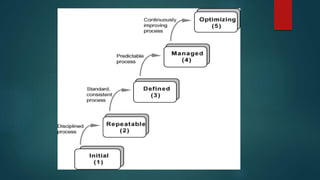
What are the levels of CMM?
 Initial
 Repeatable
 Defined
 Managed
 Optimising
Level 1:- Initial
Team tackles projects in different ways each time.
Can have strong successes, but may not repeat.
Success comes from smart people doing the right things.
Hard to recover from good people leaving
Most S/W development organizations are Level 1.
Level 2 :- Repeatable
 Realistic project commitments based on results
observed on previous projects.
 Software project standards are defined and faithfully
followed
 Processes may differ between projects.
 earlier successes can be repeated
Level 3 :- Defined
 The software process for both management and engineering
activities is documented, standardized, and integrated into a
standard software process for the organization.
 All projects use an approved, tailored version of the organization’s
standard software process for developing an maintaining software.
Level 4 :- Managed
 Detailed measures of the software process and product
quality are collected.
 Narrowing the variation in process performance to fall within
acceptable quantitative bounds
 When known limits are exceeded, corrective action can be
taken.
 Quantifiable and predictable
Level 5:- Optimising
 Continuous process improvement is enabled by quantitative
feedback from the process and from piloting innovative ideas
and technologies.
 Goal is to prevent the occurrence of defects.
 Data on process effectiveness used for cost benefit analysis of
new technologies and proposed process changes
 It is a goal, not a method.
 Being used just as stamp of approval.
 Doesn’t say anything about software.
 Doesn’t help in a crisis.
PROBLEMS WITH CMM :-
THANK YOU…

CMM

  • 1.
    Presentation on Capability MaturityModel BY:- AYUSH SHARMA & HIMANSHU KUMAR (BCA 4TH SEM)
  • 2.
    Outline  INTRODUCTION TOCMM.  WHAT ARE THE LEVELS OF CMM?  DETAILS ABOUT CMM.  PROBLEMS WITH CMM
  • 3.
    INTRODUCTION TO CMM:-  CMM : Capability Maturity Model  CMM was developed by software engineering institute in 1986.  Framework that describes the key elements of an effective software process.
  • 4.
    What are thelevels of CMM?  Initial  Repeatable  Defined  Managed  Optimising
  • 6.
    Level 1:- Initial Teamtackles projects in different ways each time. Can have strong successes, but may not repeat. Success comes from smart people doing the right things. Hard to recover from good people leaving Most S/W development organizations are Level 1.
  • 7.
    Level 2 :-Repeatable  Realistic project commitments based on results observed on previous projects.  Software project standards are defined and faithfully followed  Processes may differ between projects.  earlier successes can be repeated
  • 8.
    Level 3 :-Defined  The software process for both management and engineering activities is documented, standardized, and integrated into a standard software process for the organization.  All projects use an approved, tailored version of the organization’s standard software process for developing an maintaining software.
  • 9.
    Level 4 :-Managed  Detailed measures of the software process and product quality are collected.  Narrowing the variation in process performance to fall within acceptable quantitative bounds  When known limits are exceeded, corrective action can be taken.  Quantifiable and predictable
  • 10.
    Level 5:- Optimising Continuous process improvement is enabled by quantitative feedback from the process and from piloting innovative ideas and technologies.  Goal is to prevent the occurrence of defects.  Data on process effectiveness used for cost benefit analysis of new technologies and proposed process changes
  • 11.
     It isa goal, not a method.  Being used just as stamp of approval.  Doesn’t say anything about software.  Doesn’t help in a crisis. PROBLEMS WITH CMM :-
  • 12.