1 ÂĐThe McGraw-Hill Companies,
Software Project
Management
4th Edition
Software product
quality
Chapter 12
(part one)
2 ÂĐThe McGraw-Hill Companies,
The importance of
software quality
â€Ē Increasing criticality of software
â€Ē The intangibility of software
â€Ē Project control concerns:
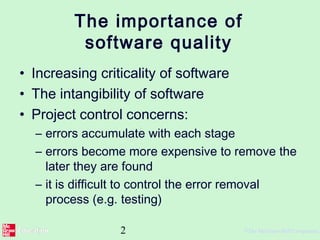
– errors accumulate with each stage
– errors become more expensive to remove the
later they are found
– it is difficult to control the error removal
process (e.g. testing)
3 ÂĐThe McGraw-Hill Companies,
ISO standards: development
life cycles
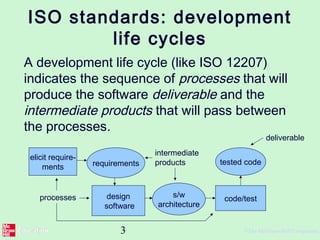
A development life cycle (like ISO 12207)
indicates the sequence of processes that will
produce the software deliverable and the
intermediate products that will pass between
the processes.
elicit require-
ments requirements
design
software
s/w
architecture
code/test
tested code
processes
intermediate
products
deliverable
4 ÂĐThe McGraw-Hill Companies,
ISO standards
ISO 9126 Software product quality
Attributes of software product quality
– External qualities i.e apparent to the user of
the deliverable
– Internal qualities i.e. apparent to the
developers of the deliverables and the
intermediate products
ISO 14598 Procedures to carry out the
assessment of the product qualities
defined in ISO 9126
5 ÂĐThe McGraw-Hill Companies,
ISO standards
ISO 15504 (formerly SPICE)
Assessment of the quality of the processes
in the defined life cycle that produce
intermediate and deliverable software
products.
6 ÂĐThe McGraw-Hill Companies,
ISO 9126 software product
quality
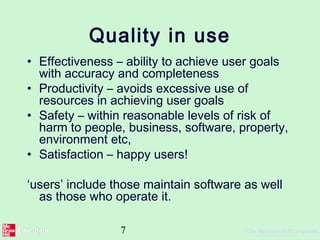
process
quality
Process
Process measures
(ISO 15504)
internal
quality
attributes
external
quality
attributes
quality
in use
attributes
influences
depends on
influences
depends on
influences
Software products Effect of software
product
Internal
measures
External
measures
Quality in
use
measures
Context
of use
7 ÂĐThe McGraw-Hill Companies,
Quality in use
â€Ē Effectiveness – ability to achieve user goals
with accuracy and completeness
â€Ē Productivity – avoids excessive use of
resources in achieving user goals
â€Ē Safety – within reasonable levels of risk of
harm to people, business, software, property,
environment etc,
â€Ē Satisfaction – happy users!
‘users’ include those maintain software as well
as those who operate it.
8 ÂĐThe McGraw-Hill Companies,
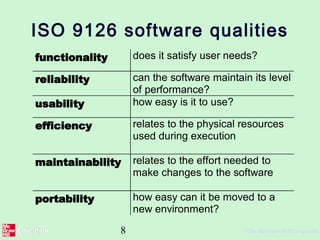
ISO 9126 software qualities
functionality does it satisfy user needs?
reliability can the software maintain its level
of performance?
usability how easy is it to use?
efficiency relates to the physical resources
used during execution
maintainability relates to the effort needed to
make changes to the software
portability how easy can it be moved to a
new environment?
9 ÂĐThe McGraw-Hill Companies,
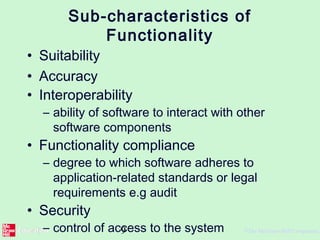
Sub-characteristics of
Functionality
â€Ē Suitability
â€Ē Accuracy
â€Ē Interoperability
– ability of software to interact with other
software components
â€Ē Functionality compliance
– degree to which software adheres to
application-related standards or legal
requirements e.g audit
â€Ē Security
– control of access to the system
10 ÂĐThe McGraw-Hill Companies,
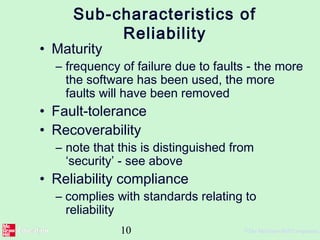
Sub-characteristics of
Reliability
â€Ē Maturity
– frequency of failure due to faults - the more
the software has been used, the more
faults will have been removed
â€Ē Fault-tolerance
â€Ē Recoverability
– note that this is distinguished from
‘security’ - see above
â€Ē Reliability compliance
– complies with standards relating to
reliability
11 ÂĐThe McGraw-Hill Companies,
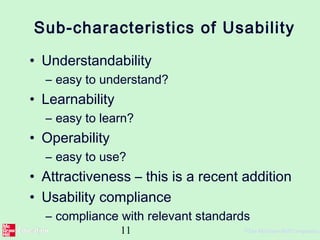
Sub-characteristics of Usability
â€Ē Understandability
– easy to understand?
â€Ē Learnability
– easy to learn?
â€Ē Operability
– easy to use?
â€Ē Attractiveness – this is a recent addition
â€Ē Usability compliance
– compliance with relevant standards
12 ÂĐThe McGraw-Hill Companies,
Sub-characteristics of
Efficiency
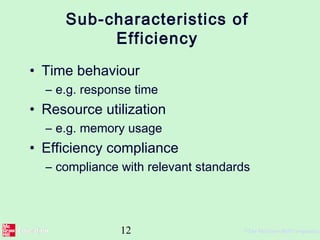
â€Ē Time behaviour
– e.g. response time
â€Ē Resource utilization
– e.g. memory usage
â€Ē Efficiency compliance
– compliance with relevant standards
13 ÂĐThe McGraw-Hill Companies,
Sub-characteristics of
Maintainability
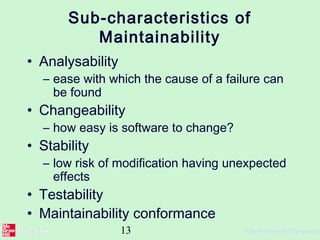
â€Ē Analysability
– ease with which the cause of a failure can
be found
â€Ē Changeability
– how easy is software to change?
â€Ē Stability
– low risk of modification having unexpected
effects
â€Ē Testability
â€Ē Maintainability conformance
14 ÂĐThe McGraw-Hill Companies,
Sub-characteristics of
portability
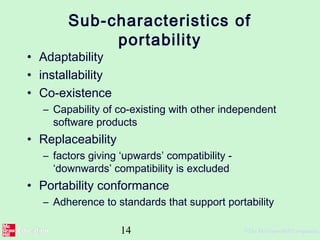
â€Ē Adaptability
â€Ē installability
â€Ē Co-existence
– Capability of co-existing with other independent
software products
â€Ē Replaceability
– factors giving ‘upwards’ compatibility -
‘downwards’ compatibility is excluded
â€Ē Portability conformance
– Adherence to standards that support portability
15 ÂĐThe McGraw-Hill Companies,
Using ISO 9126 quality
standards
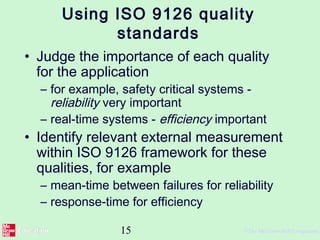
â€Ē Judge the importance of each quality
for the application
– for example, safety critical systems -
reliability very important
– real-time systems - efficiency important
â€Ē Identify relevant external measurement
within ISO 9126 framework for these
qualities, for example
– mean-time between failures for reliability
– response-time for efficiency
16 ÂĐThe McGraw-Hill Companies,
Using ISO 9126 quality
standards
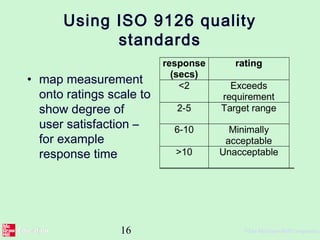
â€Ē map measurement
onto ratings scale to
show degree of
user satisfaction –
for example
response time
response
(secs)
rating
<2 Exceeds
requirement
2-5 Target range
6-10 Minimally
acceptable
>10 Unacceptable
17 ÂĐThe McGraw-Hill Companies,
Using ISO 9126 quality
standards
â€Ē Identify the relevant internal
measurements and the intermediate
products in which they would appear
e.g. at software design stage the
estimated execution time for a
transaction could be calculated
18 ÂĐThe McGraw-Hill Companies,
Specifying software evaluation
â€Ē may apply to:
– final products
– intermediate products (predictive metrics)
â€Ē may be:
– relative or binary (does it/ does it not
exist?) – latter may need expert judgment
or use of checklists
– direct or indirect
19 ÂĐThe McGraw-Hill Companies,
How do we achieve product
quality?
â€Ē the problem: quality attributes tend to
retrospectively measurable
â€Ē need to be able to examine processes
by which product is created beforehand
â€Ē the production process is a network of
sub-processes
â€Ē output from one process forms the input
to the next
â€Ē errors can enter the process at any
stage
20 ÂĐThe McGraw-Hill Companies,
Correction of errors
â€Ē Errors are more expensive to correct at
later stages
– need to rework more stages
– later stages are more detailed and less
able to absorb change
â€Ē Barry Boehm
– Error typically 10 times more expensive to
correct at coding stage than at
requirements stage
– 100 times more expensive at maintenance
stage
21 ÂĐThe McGraw-Hill Companies,
For each activity, define:
â€Ē Entry requirements
– these have to be in place before an activity
can be started
– example: ‘a comprehensive set of test data
and expected results be prepared and
independently reviewed against the system
requirement before program testing can
commence’
22 ÂĐThe McGraw-Hill Companies,
For each activity, define
â€Ē Implementation requirements
– these define how the process is to be
conducted
– example ‘whenever an error is found and
corrected, all test runs must be completed,
including those previously successfully
passed’
23 ÂĐThe McGraw-Hill Companies,
For each activity, define
â€Ē Exit requirements
– an activity will not be completed until these
requirements have been met
– example: ‘the testing phase is finished only
when all tests have been run in succession
with no outstanding errors’
24 ÂĐThe McGraw-Hill Companies,
Inspections - general principles
â€Ē when a piece of work is completed,
copies are distributed to co-workers
â€Ē time is spent individually going through
the work noting defects
â€Ē a meeting is held where the work is
then discussed
â€Ē a list of defects requiring re-work is
produced
25 ÂĐThe McGraw-Hill Companies,
Inspections - advantages of
approach
â€Ē an effective way of removing superficial
errors from a piece of software
â€Ē motivates the software developer to
produce better structured and self-
descriptive code
â€Ē spreads good programming practice
â€Ē enhances team-spirit
â€Ē the main problem maintaining the
commitment of participants

Software product quality

  • 1.
    1 ÂĐThe McGraw-HillCompanies, Software Project Management 4th Edition Software product quality Chapter 12 (part one)
  • 2.
    2 ÂĐThe McGraw-HillCompanies, The importance of software quality â€Ē Increasing criticality of software â€Ē The intangibility of software â€Ē Project control concerns: – errors accumulate with each stage – errors become more expensive to remove the later they are found – it is difficult to control the error removal process (e.g. testing)
  • 3.
    3 ÂĐThe McGraw-HillCompanies, ISO standards: development life cycles A development life cycle (like ISO 12207) indicates the sequence of processes that will produce the software deliverable and the intermediate products that will pass between the processes. elicit require- ments requirements design software s/w architecture code/test tested code processes intermediate products deliverable
  • 4.
    4 ÂĐThe McGraw-HillCompanies, ISO standards ISO 9126 Software product quality Attributes of software product quality – External qualities i.e apparent to the user of the deliverable – Internal qualities i.e. apparent to the developers of the deliverables and the intermediate products ISO 14598 Procedures to carry out the assessment of the product qualities defined in ISO 9126
  • 5.
    5 ÂĐThe McGraw-HillCompanies, ISO standards ISO 15504 (formerly SPICE) Assessment of the quality of the processes in the defined life cycle that produce intermediate and deliverable software products.
  • 6.
    6 ÂĐThe McGraw-HillCompanies, ISO 9126 software product quality process quality Process Process measures (ISO 15504) internal quality attributes external quality attributes quality in use attributes influences depends on influences depends on influences Software products Effect of software product Internal measures External measures Quality in use measures Context of use
  • 7.
    7 ÂĐThe McGraw-HillCompanies, Quality in use â€Ē Effectiveness – ability to achieve user goals with accuracy and completeness â€Ē Productivity – avoids excessive use of resources in achieving user goals â€Ē Safety – within reasonable levels of risk of harm to people, business, software, property, environment etc, â€Ē Satisfaction – happy users! ‘users’ include those maintain software as well as those who operate it.
  • 8.
    8 ÂĐThe McGraw-HillCompanies, ISO 9126 software qualities functionality does it satisfy user needs? reliability can the software maintain its level of performance? usability how easy is it to use? efficiency relates to the physical resources used during execution maintainability relates to the effort needed to make changes to the software portability how easy can it be moved to a new environment?
  • 9.
    9 ÂĐThe McGraw-HillCompanies, Sub-characteristics of Functionality â€Ē Suitability â€Ē Accuracy â€Ē Interoperability – ability of software to interact with other software components â€Ē Functionality compliance – degree to which software adheres to application-related standards or legal requirements e.g audit â€Ē Security – control of access to the system
  • 10.
    10 ÂĐThe McGraw-HillCompanies, Sub-characteristics of Reliability â€Ē Maturity – frequency of failure due to faults - the more the software has been used, the more faults will have been removed â€Ē Fault-tolerance â€Ē Recoverability – note that this is distinguished from ‘security’ - see above â€Ē Reliability compliance – complies with standards relating to reliability
  • 11.
    11 ÂĐThe McGraw-HillCompanies, Sub-characteristics of Usability â€Ē Understandability – easy to understand? â€Ē Learnability – easy to learn? â€Ē Operability – easy to use? â€Ē Attractiveness – this is a recent addition â€Ē Usability compliance – compliance with relevant standards
  • 12.
    12 ÂĐThe McGraw-HillCompanies, Sub-characteristics of Efficiency â€Ē Time behaviour – e.g. response time â€Ē Resource utilization – e.g. memory usage â€Ē Efficiency compliance – compliance with relevant standards
  • 13.
    13 ÂĐThe McGraw-HillCompanies, Sub-characteristics of Maintainability â€Ē Analysability – ease with which the cause of a failure can be found â€Ē Changeability – how easy is software to change? â€Ē Stability – low risk of modification having unexpected effects â€Ē Testability â€Ē Maintainability conformance
  • 14.
    14 ÂĐThe McGraw-HillCompanies, Sub-characteristics of portability â€Ē Adaptability â€Ē installability â€Ē Co-existence – Capability of co-existing with other independent software products â€Ē Replaceability – factors giving ‘upwards’ compatibility - ‘downwards’ compatibility is excluded â€Ē Portability conformance – Adherence to standards that support portability
  • 15.
    15 ÂĐThe McGraw-HillCompanies, Using ISO 9126 quality standards â€Ē Judge the importance of each quality for the application – for example, safety critical systems - reliability very important – real-time systems - efficiency important â€Ē Identify relevant external measurement within ISO 9126 framework for these qualities, for example – mean-time between failures for reliability – response-time for efficiency
  • 16.
    16 ÂĐThe McGraw-HillCompanies, Using ISO 9126 quality standards â€Ē map measurement onto ratings scale to show degree of user satisfaction – for example response time response (secs) rating <2 Exceeds requirement 2-5 Target range 6-10 Minimally acceptable >10 Unacceptable
  • 17.
    17 ÂĐThe McGraw-HillCompanies, Using ISO 9126 quality standards â€Ē Identify the relevant internal measurements and the intermediate products in which they would appear e.g. at software design stage the estimated execution time for a transaction could be calculated
  • 18.
    18 ÂĐThe McGraw-HillCompanies, Specifying software evaluation â€Ē may apply to: – final products – intermediate products (predictive metrics) â€Ē may be: – relative or binary (does it/ does it not exist?) – latter may need expert judgment or use of checklists – direct or indirect
  • 19.
    19 ÂĐThe McGraw-HillCompanies, How do we achieve product quality? â€Ē the problem: quality attributes tend to retrospectively measurable â€Ē need to be able to examine processes by which product is created beforehand â€Ē the production process is a network of sub-processes â€Ē output from one process forms the input to the next â€Ē errors can enter the process at any stage
  • 20.
    20 ÂĐThe McGraw-HillCompanies, Correction of errors â€Ē Errors are more expensive to correct at later stages – need to rework more stages – later stages are more detailed and less able to absorb change â€Ē Barry Boehm – Error typically 10 times more expensive to correct at coding stage than at requirements stage – 100 times more expensive at maintenance stage
  • 21.
    21 ÂĐThe McGraw-HillCompanies, For each activity, define: â€Ē Entry requirements – these have to be in place before an activity can be started – example: ‘a comprehensive set of test data and expected results be prepared and independently reviewed against the system requirement before program testing can commence’
  • 22.
    22 ÂĐThe McGraw-HillCompanies, For each activity, define â€Ē Implementation requirements – these define how the process is to be conducted – example ‘whenever an error is found and corrected, all test runs must be completed, including those previously successfully passed’
  • 23.
    23 ÂĐThe McGraw-HillCompanies, For each activity, define â€Ē Exit requirements – an activity will not be completed until these requirements have been met – example: ‘the testing phase is finished only when all tests have been run in succession with no outstanding errors’
  • 24.
    24 ÂĐThe McGraw-HillCompanies, Inspections - general principles â€Ē when a piece of work is completed, copies are distributed to co-workers â€Ē time is spent individually going through the work noting defects â€Ē a meeting is held where the work is then discussed â€Ē a list of defects requiring re-work is produced
  • 25.
    25 ÂĐThe McGraw-HillCompanies, Inspections - advantages of approach â€Ē an effective way of removing superficial errors from a piece of software â€Ē motivates the software developer to produce better structured and self- descriptive code â€Ē spreads good programming practice â€Ē enhances team-spirit â€Ē the main problem maintaining the commitment of participants

Editor's Notes

  • #2 This talk provides an overview of the basic steps needed to produce a project plan. The framework provided should allow students to identify where some of the particular issues discussed in other chapters are applied to the planning process. As the focus is on project planning, techniques to do with project control are not explicitly described. However, in practice, one element of project planning will be to decide what project control procedures need to be in place.
  • #3 Increasing criticality of software – e.g .software is increasingly being used in systems that can threaten or support human life and well-being The intangibility of software – it is difficult for observers to judge the quality of software development, especially during its early stages Project control concerns: The products of one sub-process in the development process are the inputs to subsequent sub-processes, thus errors accumulate with each stage e.g. at the design stage, the specification errors are incorporated into the design, and at the coding stage specification and design errors are incorporated into the software errors become more expensive to remove the later they are found it is difficult to control the error removal process (e.g. testing)
  • #4 The deliverables are the products that are handed over to the client at the end of the project, typically the executable code. Intermediate products are things that are produced during the project, but which are not (usually) handed to the client at the end. Typically they are things that are produced by one sub-process (e.g. a requirements document created by the requirements elicitation and analysis processes) and used by others (e.g. a design process which produces a design that fulfils the requirements). These sub-processes will fit into the overall framework of a development cycle. Some software quality models focus on evaluating the quality of software products, others on the processes by which the products are created.
  • #5 ISO 9126 focuses on the definition of software quality, while ISO 14598 focuses on the way that the quality, once defined, is assessed. The ISO 9000 series of standards establishes requirements for quality management systems for the creation/supply of all types of goods and services while the ones mentioned here relate specifically to software.
  • #6 CMMI (the capability maturity model – integrated), which was created by the Software Engineering Institute (SEI) at Carnegie Mellon University (CMU), Pittsburgh is another example of a process evaluation model that we look at in the 12.2 lecture on process quality.
  • #7 Internal quality attributes are the things that developers would be aware of during the project. They could be qualities in the intermediate products that are created. External quality attributes are the qualities of the final products that are delivered to the users. Thus users would be very aware of these. A key task is mapping these two types of quality. Acceptable quality in software depends on the use to which the software is put. For example, a higher standard of reliability would be expected of a software component that was very heavily used and the continued functioning of which was essential to the organization, than of a rarely used software tool for which there were many alternatives.
  • #9 These are the six top-level qualities identified in ISO9126. Note that ‘functionality’ is listed as a quality. Sometimes ‘functional’ requirements are distinguished from ‘non-functional’ (i.e. quality) requirements.
  • #10 In the case of interoperability, a good example is the ability to copy and paste content between different Microsoft products such as Excel and Word.
  • #11 Maturity – in general you would expect software that has been in operation for a relatively long time and to have had many users to be more reliable than brand-new software which only has a few users. In the first case, one would hope that most of the bugs had been found by the users and had been fixed by the devevlopers.
  • #12 Note that there may need to be a trade-off between ‘learnability’ and ‘operability’ – an analogy would be in learning shorthand writing: it takes a long time to do, but once you have done it you can write very quickly indeed. ‘Attractiveness’ is a new addition – it is important where the use of software is optional – if users don’t like the software then they won’t use it.
  • #14 Testability can be particularly important with embedded software, such as that used to control aircraft. Software that simulates the actions of the aircraft in terms of inputs to the control system etc would need to be built.
  • #15 Replaceability - A new version of a software product should be able to deal correctly with all the inputs that the previous versions could deal with. However there could be new features that need new inputs that the old system would not be able to deal with.
  • #20 There is a bridge here between the focus on the quality of products as discussed in this lecture and the quality of processes discussed in the lecture 12.2 on process qualiyt.
  • #21 The additional time needed to change products later is partly because more products in the project life cycle have to change e.g. the specifiication, design and code, rather than just the specification. Also the later products of the project tend to be more detailed and therefore more complicatioed.
  • #22 We are moving into process quality now. However, the entry requirements could well relate to the quality of the products of other processes tha this process will need to use.
  • #24 The exit requirements, however, could well relate to characteristics of the products created by the process in question.
  • #25 Inspections are a simple but very effective methods of removing errors from documents. Software code could be seen as just another type of document in this context.