S.NO.

SPECIFIC
OBJECTIVE

CONTENT MATTER

TEACHING LEARNING
ACTIVITIES
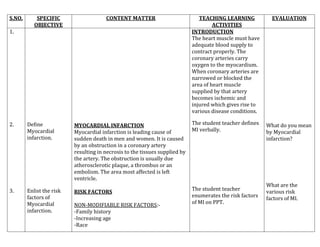
INTRODUCTION
The heart muscle must have
adequate blood supply to
contract properly. The
coronary arteries carry
oxygen to the myocardium.
When coronary arteries are
narrowed or blocked the
area of heart muscle
supplied by that artery
becomes ischemic and
injured which gives rise to
various disease conditions.

EVALUATION

MYOCARDIAL INFARCTION
Myocardial infarction is leading cause of
sudden death in men and women. It is caused
by an obstruction in a coronary artery
resulting in necrosis to the tissues supplied by
the artery. The obstruction is usually due
atherosclerotic plaque, a thrombus or an
embolism. The area most affected is left
ventricle.

The student teacher defines
MI verbally.

What do you mean
by Myocardial
infarction?

1.

2.

3.

Define
Myocardial
infarction.

Enlist the risk
factors of
Myocardial
infarction.

RISK FACTORS
NON-MODIFIABLE RISK FACTORS:-Family history
-Increasing age
-Race

The student teacher
enumerates the risk factors
of MI on PPT.

What are the
various risk
factors of MI.
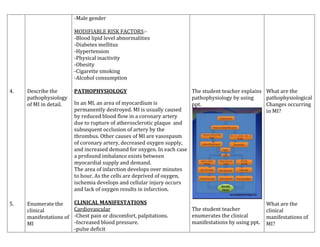
-Male gender
MODIFIABLE RISK FACTORS:-Blood lipid level abnormalities
-Diabetes mellitus
-Hypertension
-Physical inactivity
-Obesity
-Cigarette smoking
-Alcohol consumption
4.

5.

Describe the
pathophysiology
of MI in detail.

PATHOPHYSIOLOGY

Enumerate the
clinical
manifestations of
MI

CLINICAL MANIFESTATIONS
Cardiovascular
-Chest pain or discomfort, palpitations.
-Increased blood pressure.
-pulse deficit

In an MI, an area of myocardium is
permanently destroyed. MI is usually caused
by reduced blood flow in a coronary artery
due to rupture of atherosclerotic plaque and
subsequent occlusion of artery by the
thrombus. Other causes of MI are vasospasm
of coronary artery, decreased oxygen supply,
and increased demand for oxygen. In each case
a profound imbalance exists between
myocardial supply and demand.
The area of infarction develops over minutes
to hour. As the cells are deprived of oxygen,
ischemia develops and cellular injury occurs
and lack of oxygen results in infarction.

The student teacher explains What are the
pathophysiology by using
pathophysiological
ppt.
Changes occurring
in MI?

The student teacher
enumerates the clinical
manifestations by using ppt.

What are the
clinical
manifestations of
MI?
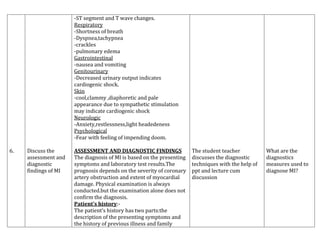
-ST segment and T wave changes.
Respiratory
-Shortness of breath
-Dyspnea,tachypnea
-crackles
-pulmonary edema
Gastrointestinal
-nausea and vomiting
Genitourinary
-Decreased urinary output indicates
cardiogenic shock.
Skin
-cool,clammy ,diaphoretic and pale
appearance due to sympathetic stimulation
may indicate cardiogenic shock
Neurologic
-Anxiety,restlessness,light headedeness
Psychological
-Fear with feeling of impending doom.
6.

Discuss the
assessment and
diagnostic
findings of MI

ASSESSMENT AND DIAGNOSTIC FINDINGS
The diagnosis of MI is based on the presenting
symptoms and laboratory test results.The
prognosis depends on the severity of coronary
artery obstruction and extent of myocardial
damage. Physical examination is always
conducted.but the examination alone does not
confirm the diagnosis.
Patient’s history:The patient’s history has two parts:the
description of the presenting symptoms and
the history of previous illness and family

The student teacher
discusses the diagnostic
techniques with the help of
ppt and lecture cum
discussion

What are the
diagnostics
measures used to
diagnose MI?
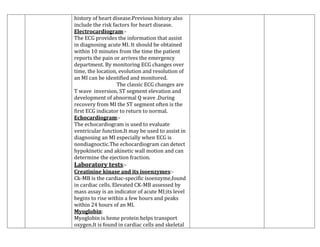
history of heart disease.Previous history also
include the risk factors for heart disease.
Electrocardiogram:The ECG provides the information that assist
in diagnosing acute MI. It should be obtained
within 10 minutes from the time the patient
reports the pain or arrives the emergency
department. By monitoring ECG changes over
time, the location, evolution and resolution of
an MI can be identified and monitored.
The classic ECG changes are
T wave inversion, ST segment elevation and
development of abnormal Q wave .During
recovery from MI the ST segment often is the
first ECG indicator to return to normal.
Echocardiogram:The echocardiogram is used to evaluate
ventricular function.It may be used to assist in
diagnosing an MI especially when ECG is
nondiagnoctic.The echocardiogram can detect
hypokinetic and akinetic wall motion and can
determine the ejection fraction.
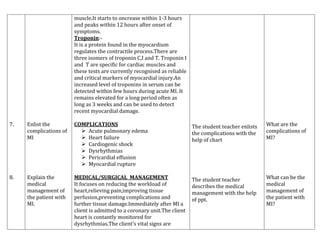
Laboratory tests:Creatinine kinase and its isoenzymes:Ck-MB is the cardiac-specific isoenzyme,found
in cardiac cells. Elevated CK-MB assessed by
mass assay is an indicator of acute MI;its level
begins to rise within a few hours and peaks
within 24 hours of an MI.
Myoglobin:
Myoglobin is heme protein helps transport
oxygen.It is found in cardiac cells and skeletal
muscle.It starts to oncrease within 1-3 hours
and peaks within 12 hours after onset of
symptoms.
Troponin:It is a protein found in the myocardium
regulates the contractile process.There are
three isomers of troponin C,I and T. Troponin I
and T are specific for cardiac muscles and
these tests are currently recognised as reliable
and critical markers of myocardial injury.An
increased level of troponins in serum can be
detected within few hours during acute MI. It
remains elevated for a long period often as
long as 3 weeks and can be used to detect
recent myocardial damage.
7.

Enlist the
complications of
MI

COMPLICATIONS
 Acute pulmonary edema
 Heart failure
 Cardiogenic shock
 Dysrhythmias
 Pericardial effusion
 Myocardial rupture

The student teacher enlists
the complications with the
help of chart

What are the
complications of
MI?

8.

Explain the
medical
management of
the patient with
MI.

MEDICAL/SURGICAL MANAGEMENT
It focuses on reducing the workload of
heart,relieving pain,improving tissue
perfusion,preventing complications and
further tissue damage.Immediately after MI a
client is admitted to a coronary unit.The client
heart is contantly monitored for
dysrhythmias.The client’s vital signs are

The student teacher
describes the medical
management with the help
of ppt.

What can be the
medical
management of
the patient with
MI?
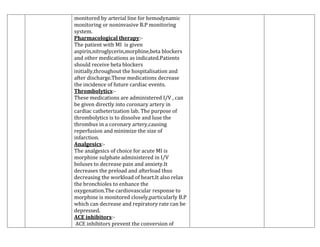
monitored by arterial line for hemodynamic
monitoring or noninvasive B.P monitoring
system.
Pharmacological therapy:The patient with MI is given
aspirin,nitroglycerin,morphine,beta blockers
and other medications as indicated.Patients
should receive beta blockers
initially,throughout the hospitalisation and
after discharge.These medications decrease
the incidence of future cardiac events.
Thrombolytics:These medications are administered I/V , can
be given directly into coronary artery in
cardiac catheterization lab. The purpose of
thrombolytics is to dissolve and luse the
thrombus in a coronary artery,causing
reperfusion and minimize the size of
infarction.
Analgesics:The analgesics of choice for acute MI is
morphine sulphate administered in I/V
boluses to decrease pain and anxiety.It
decreases the preload and afterload thus
decreasing the workload of heart.It also relax
the bronchioles to enhance the
oxygenation.The cardiovascular response to
morphine is monitored closely,particularly B.P
which can decrease and repiratory rate can be
depressed.
ACE inhibitors:ACE inhibitors prevent the conversion of
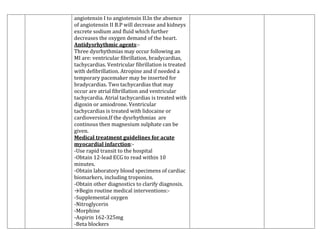
angiotensin I to angiotensin II.In the absence
of angiotensin II B.P will decrease and kidneys
excrete sodium and fluid which further
decreases the oxygen demand of the heart.
Antidysrhythmic agents:Three dysrhythmias may occur following an
MI are: ventricular fibrillation, bradycardias,
tachycardias. Ventricular fibrillation is treated
with defibrillation. Atropine and if needed a
temporary pacemaker may be inserted for
bradycardias. Two tachycardias that may
occur are atrial fibrillation and ventricular
tachycardia. Atrial tachycardias is treated with
digoxin or amiodrone. Ventricular
tachycardias is treated with lidocaine or
cardioversion.If the dysrhythmias are
continous then magnesium sulphate can be
given.
Medical treatment guidelines for acute
myocardial infarction:-Use rapid transit to the hospital
-Obtain 12-lead ECG to read within 10
minutes.
-Obtain laboratory blood specimens of cardiac
biomarkers, including troponins.
-Obtain other diagnostics to clarify diagnosis.
→Begin routine medical interventions:-Supplemental oxygen
-Nitroglycerin
-Morphine
-Aspirin 162-325mg
-Beta blockers
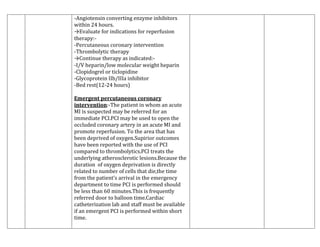
-Angiotensin converting enzyme inhibitors
within 24 hours.
→Evaluate for indications for reperfusion
therapy:-Percutaneous coronary intervention
-Thrombolytic therapy
→Continue therapy as indicated:-I/V heparin/low molecular weight heparin
-Clopidogrel or ticlopidine
-Glycoprotein IIb/IIIa inhibitor
-Bed rest(12-24 hours)
Emergent percutaneous coronary
intervention:-The patient in whom an acute
MI is suspected may be referred for an
immediate PCI.PCI may be used to open the
occluded coronary artery in an acute MI and
promote reperfusion. To the area that has
been deprived of oxygen.Supirior outcomes
have been reported with the use of PCI
compared to thrombolytics.PCI treats the
underlying atherosclerotic lesions.Because the
duration of oxygen deprivation is directly
related to number of cells that die,the time
from the patient’s arrival in the emergency
department to time PCI is performed should
be less than 60 minutes.This is frequently
referred door to balloon time.Cardiac
catheterization lab and staff must be available
if an emergent PCI is performed within short
time.
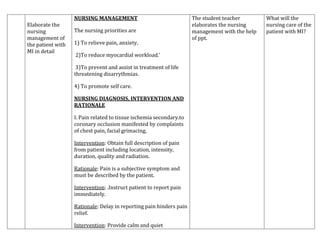
NURSING MANAGEMENT
Elaborate the
nursing
management of
the patient with
MI in detail

The nursing priorities are
1) To relieve pain, anxiety.
2)To reduce myocardial workload.'
3)To prevent and assist in treatment of life
threatening disarrythmias.
4) To promote self care.
NURSING DIAGNOSIS, INTERVENTION AND
RATIONALE
I. Pain related to tissue ischemia secondary.to
coronary occlusion manifested by complaints
of chest pain, facial grimacing.
Intervention: Obtain full description of pain
from patient including location, intensity,
duration, quality and radiation.
Rationale: Pain is a subjective symptom and
must be described by the patient.
Intervention: .Instruct patient to report pain
immediately.
Rationale: Delay in reporting pain hinders pain
relief.
Intervention: Provide calm and quiet

The student teacher
elaborates the nursing
management with the help
of ppt.

What will the
nursing care of the
patient with MI?
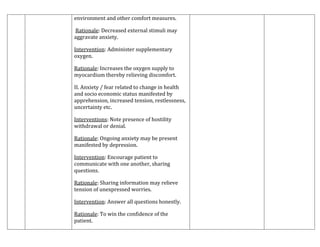
environment and other comfort measures.
Rationale: Decreased external stimuli may
aggravate anxiety.
Intervention: Administer supplementary
oxygen.
Rationale: Increases the oxygen supply to
myocardium thereby relieving discomfort.
II. Anxiety / fear related to change in health
and socio economic status manifested by
apprehension, increased tension, restlessness,
uncertainty etc.
Interventions: Note presence of hostility
withdrawal or denial.
Rationale: Ongoing anxiety may be present
manifested by depression.
Intervention: Encourage patient to
communicate with one another, sharing
questions.
Rationale: Sharing information may relieve
tension of unexpressed worries.
Intervention: Answer all questions honestly.
Rationale: To win the confidence of the
patient.
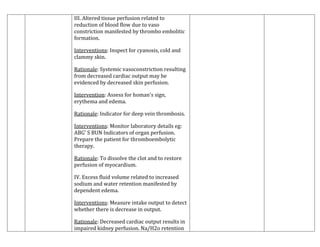
III. Altered tissue perfusion related to
reduction of blood flow due to vaso
constriction manifested by thrombo embolitic
formation.
Interventions: Inspect for cyanosis, cold and
clammy skin.
Rationale: Systemic vasoconstriction resulting
from decreased cardiac output may be
evidenced by decreased skin perfusion.
Intervention: Assess for homan's sign,
erythema and edema.
Rationale: Indicator for deep vein thrombosis.
Interventions: Monitor laboratory details eg:
ABG' S BUN Indicators of organ perfusion.
Prepare the patient for thromboembolytic
therapy.
Rationale: To dissolve the clot and to restore
perfusion of myocardium.
IV. Excess fluid volume related to increased
sodium and water retention manifested by
dependent edema.
Interventions: Measure intake output to detect
whether there is decrease in output.
Rationale: Decreased cardiac output results in
impaired kidney perfusion. Na/H2o retention
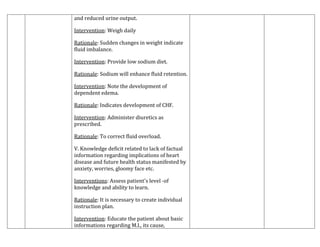
and reduced urine output.
Intervention: Weigh daily
Rationale: Sudden changes in weight indicate
fluid imbalance.
Intervention: Provide low sodium diet.
Rationale: Sodium will enhance fluid retention.
Intervention: Note the development of
dependent edema.
Rationale: Indicates development of CHF.
Intervention: Administer diuretics as
prescribed.
Rationale: To correct fluid overload.
V. Knowledge deficit related to lack of factual
information regarding implications of heart
disease and future health status manifested by
anxiety, worries, gloomy face etc.
Interventions: Assess patient's level -of
knowledge and ability to learn.
Rationale: It is necessary to create individual
instruction plan.
Intervention: Educate the patient about basic
informations regarding M.I., its cause,
prevention and management.
Rationale: Patient will gain adequate
knowledge about his disease and will try to
avoid a second attack.
Intervention: Emphasize on the importance of
avoiding the risk factors of M.I.
Rationale: Modifiable risk factors can be
prevented if we take adequate precautions.
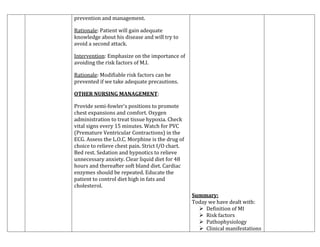
OTHER NURSING MANAGEMENT:
Provide semi-fowler's positions to promote
chest expansions and comfort. Oxygen
administration to treat tissue hypoxia. Check
vital signs every 15 minutes. Watch for PVC
(Premature Ventricular Contractions) in the
ECG. Assess the L.O.C. Morphine is the drug of
choice to relieve chest pain. Strict I/O chart.
Bed rest. Sedation and hypnotics to relieve
unnecessary anxiety. Clear liquid diet for 48
hours and thereafter soft bland diet. Cardiac
enzymes should be repeated. Educate the
patient to control diet high in fats and
cholesterol.
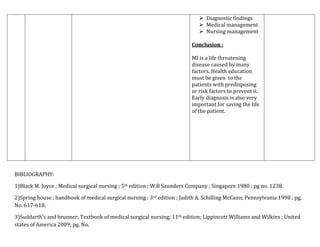
Summary:
Today we have dealt with:
 Definition of MI
 Risk factors
 Pathophysiology
 Clinical manifestations
 Diagnostic findings
 Medical management
 Nursing management
Conclusion :
MI is a life threatening
disease caused by many
factors. Health education
must be given to the
patients with predisposing
or risk factors to prevent it.
Early diagnosis is also very
important for saving the life
of the patient.

BIBLIOGRAPHY:
1)Black M. Joyce ; Medical surgical nursing ; 5th edition ; W.B Saunders Company ; Singapore 1980 ; pg no. 1238.
2)Spring house ; handbook of medical surgical nursing ; 3rd edition ; Judith A. Schilling McCann; Pennsylvania 1998 ; pg.
No. 617-618.
3)Suddarth’s and brunner; Textbook of medical surgical nursing; 11th edition; Lippincott Williams and Wilkins ; United
states of America 2009; pg. No.
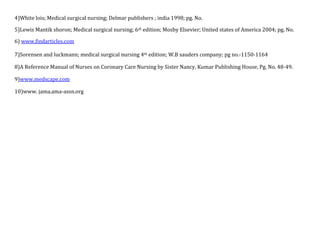
4)White lois; Medical surgical nursing; Delmar publishers ; india 1998; pg. No.
5)Lewis Mantik shoron; Medical surgical nursing; 6th edition; Mosby Elsevier; United states of America 2004; pg. No.
6) www.findarticles.com
7)Sorensen and luckmann; medical surgical nursing 4th edition; W.B sauders company; pg no.-1150-1164
8)A Reference Manual of Nurses on Coronary Care Nursing by Sister Nancy, Kumar Publishing House, Pg. No. 48-49.
9)www.medscape.com
10)www. jama.ama-assn.org

lesson plan on Myocardial infarction

  • 1.
    S.NO. SPECIFIC OBJECTIVE CONTENT MATTER TEACHING LEARNING ACTIVITIES INTRODUCTION Theheart muscle must have adequate blood supply to contract properly. The coronary arteries carry oxygen to the myocardium. When coronary arteries are narrowed or blocked the area of heart muscle supplied by that artery becomes ischemic and injured which gives rise to various disease conditions. EVALUATION MYOCARDIAL INFARCTION Myocardial infarction is leading cause of sudden death in men and women. It is caused by an obstruction in a coronary artery resulting in necrosis to the tissues supplied by the artery. The obstruction is usually due atherosclerotic plaque, a thrombus or an embolism. The area most affected is left ventricle. The student teacher defines MI verbally. What do you mean by Myocardial infarction? 1. 2. 3. Define Myocardial infarction. Enlist the risk factors of Myocardial infarction. RISK FACTORS NON-MODIFIABLE RISK FACTORS:-Family history -Increasing age -Race The student teacher enumerates the risk factors of MI on PPT. What are the various risk factors of MI.
  • 2.
    -Male gender MODIFIABLE RISKFACTORS:-Blood lipid level abnormalities -Diabetes mellitus -Hypertension -Physical inactivity -Obesity -Cigarette smoking -Alcohol consumption 4. 5. Describe the pathophysiology of MI in detail. PATHOPHYSIOLOGY Enumerate the clinical manifestations of MI CLINICAL MANIFESTATIONS Cardiovascular -Chest pain or discomfort, palpitations. -Increased blood pressure. -pulse deficit In an MI, an area of myocardium is permanently destroyed. MI is usually caused by reduced blood flow in a coronary artery due to rupture of atherosclerotic plaque and subsequent occlusion of artery by the thrombus. Other causes of MI are vasospasm of coronary artery, decreased oxygen supply, and increased demand for oxygen. In each case a profound imbalance exists between myocardial supply and demand. The area of infarction develops over minutes to hour. As the cells are deprived of oxygen, ischemia develops and cellular injury occurs and lack of oxygen results in infarction. The student teacher explains What are the pathophysiology by using pathophysiological ppt. Changes occurring in MI? The student teacher enumerates the clinical manifestations by using ppt. What are the clinical manifestations of MI?
  • 3.
    -ST segment andT wave changes. Respiratory -Shortness of breath -Dyspnea,tachypnea -crackles -pulmonary edema Gastrointestinal -nausea and vomiting Genitourinary -Decreased urinary output indicates cardiogenic shock. Skin -cool,clammy ,diaphoretic and pale appearance due to sympathetic stimulation may indicate cardiogenic shock Neurologic -Anxiety,restlessness,light headedeness Psychological -Fear with feeling of impending doom. 6. Discuss the assessment and diagnostic findings of MI ASSESSMENT AND DIAGNOSTIC FINDINGS The diagnosis of MI is based on the presenting symptoms and laboratory test results.The prognosis depends on the severity of coronary artery obstruction and extent of myocardial damage. Physical examination is always conducted.but the examination alone does not confirm the diagnosis. Patient’s history:The patient’s history has two parts:the description of the presenting symptoms and the history of previous illness and family The student teacher discusses the diagnostic techniques with the help of ppt and lecture cum discussion What are the diagnostics measures used to diagnose MI?
  • 4.
    history of heartdisease.Previous history also include the risk factors for heart disease. Electrocardiogram:The ECG provides the information that assist in diagnosing acute MI. It should be obtained within 10 minutes from the time the patient reports the pain or arrives the emergency department. By monitoring ECG changes over time, the location, evolution and resolution of an MI can be identified and monitored. The classic ECG changes are T wave inversion, ST segment elevation and development of abnormal Q wave .During recovery from MI the ST segment often is the first ECG indicator to return to normal. Echocardiogram:The echocardiogram is used to evaluate ventricular function.It may be used to assist in diagnosing an MI especially when ECG is nondiagnoctic.The echocardiogram can detect hypokinetic and akinetic wall motion and can determine the ejection fraction. Laboratory tests:Creatinine kinase and its isoenzymes:Ck-MB is the cardiac-specific isoenzyme,found in cardiac cells. Elevated CK-MB assessed by mass assay is an indicator of acute MI;its level begins to rise within a few hours and peaks within 24 hours of an MI. Myoglobin: Myoglobin is heme protein helps transport oxygen.It is found in cardiac cells and skeletal
  • 5.
    muscle.It starts tooncrease within 1-3 hours and peaks within 12 hours after onset of symptoms. Troponin:It is a protein found in the myocardium regulates the contractile process.There are three isomers of troponin C,I and T. Troponin I and T are specific for cardiac muscles and these tests are currently recognised as reliable and critical markers of myocardial injury.An increased level of troponins in serum can be detected within few hours during acute MI. It remains elevated for a long period often as long as 3 weeks and can be used to detect recent myocardial damage. 7. Enlist the complications of MI COMPLICATIONS  Acute pulmonary edema  Heart failure  Cardiogenic shock  Dysrhythmias  Pericardial effusion  Myocardial rupture The student teacher enlists the complications with the help of chart What are the complications of MI? 8. Explain the medical management of the patient with MI. MEDICAL/SURGICAL MANAGEMENT It focuses on reducing the workload of heart,relieving pain,improving tissue perfusion,preventing complications and further tissue damage.Immediately after MI a client is admitted to a coronary unit.The client heart is contantly monitored for dysrhythmias.The client’s vital signs are The student teacher describes the medical management with the help of ppt. What can be the medical management of the patient with MI?
  • 6.
    monitored by arterialline for hemodynamic monitoring or noninvasive B.P monitoring system. Pharmacological therapy:The patient with MI is given aspirin,nitroglycerin,morphine,beta blockers and other medications as indicated.Patients should receive beta blockers initially,throughout the hospitalisation and after discharge.These medications decrease the incidence of future cardiac events. Thrombolytics:These medications are administered I/V , can be given directly into coronary artery in cardiac catheterization lab. The purpose of thrombolytics is to dissolve and luse the thrombus in a coronary artery,causing reperfusion and minimize the size of infarction. Analgesics:The analgesics of choice for acute MI is morphine sulphate administered in I/V boluses to decrease pain and anxiety.It decreases the preload and afterload thus decreasing the workload of heart.It also relax the bronchioles to enhance the oxygenation.The cardiovascular response to morphine is monitored closely,particularly B.P which can decrease and repiratory rate can be depressed. ACE inhibitors:ACE inhibitors prevent the conversion of
  • 7.
    angiotensin I toangiotensin II.In the absence of angiotensin II B.P will decrease and kidneys excrete sodium and fluid which further decreases the oxygen demand of the heart. Antidysrhythmic agents:Three dysrhythmias may occur following an MI are: ventricular fibrillation, bradycardias, tachycardias. Ventricular fibrillation is treated with defibrillation. Atropine and if needed a temporary pacemaker may be inserted for bradycardias. Two tachycardias that may occur are atrial fibrillation and ventricular tachycardia. Atrial tachycardias is treated with digoxin or amiodrone. Ventricular tachycardias is treated with lidocaine or cardioversion.If the dysrhythmias are continous then magnesium sulphate can be given. Medical treatment guidelines for acute myocardial infarction:-Use rapid transit to the hospital -Obtain 12-lead ECG to read within 10 minutes. -Obtain laboratory blood specimens of cardiac biomarkers, including troponins. -Obtain other diagnostics to clarify diagnosis. →Begin routine medical interventions:-Supplemental oxygen -Nitroglycerin -Morphine -Aspirin 162-325mg -Beta blockers
  • 8.
    -Angiotensin converting enzymeinhibitors within 24 hours. →Evaluate for indications for reperfusion therapy:-Percutaneous coronary intervention -Thrombolytic therapy →Continue therapy as indicated:-I/V heparin/low molecular weight heparin -Clopidogrel or ticlopidine -Glycoprotein IIb/IIIa inhibitor -Bed rest(12-24 hours) Emergent percutaneous coronary intervention:-The patient in whom an acute MI is suspected may be referred for an immediate PCI.PCI may be used to open the occluded coronary artery in an acute MI and promote reperfusion. To the area that has been deprived of oxygen.Supirior outcomes have been reported with the use of PCI compared to thrombolytics.PCI treats the underlying atherosclerotic lesions.Because the duration of oxygen deprivation is directly related to number of cells that die,the time from the patient’s arrival in the emergency department to time PCI is performed should be less than 60 minutes.This is frequently referred door to balloon time.Cardiac catheterization lab and staff must be available if an emergent PCI is performed within short time.
  • 9.
    NURSING MANAGEMENT Elaborate the nursing managementof the patient with MI in detail The nursing priorities are 1) To relieve pain, anxiety. 2)To reduce myocardial workload.' 3)To prevent and assist in treatment of life threatening disarrythmias. 4) To promote self care. NURSING DIAGNOSIS, INTERVENTION AND RATIONALE I. Pain related to tissue ischemia secondary.to coronary occlusion manifested by complaints of chest pain, facial grimacing. Intervention: Obtain full description of pain from patient including location, intensity, duration, quality and radiation. Rationale: Pain is a subjective symptom and must be described by the patient. Intervention: .Instruct patient to report pain immediately. Rationale: Delay in reporting pain hinders pain relief. Intervention: Provide calm and quiet The student teacher elaborates the nursing management with the help of ppt. What will the nursing care of the patient with MI?
  • 10.
    environment and othercomfort measures. Rationale: Decreased external stimuli may aggravate anxiety. Intervention: Administer supplementary oxygen. Rationale: Increases the oxygen supply to myocardium thereby relieving discomfort. II. Anxiety / fear related to change in health and socio economic status manifested by apprehension, increased tension, restlessness, uncertainty etc. Interventions: Note presence of hostility withdrawal or denial. Rationale: Ongoing anxiety may be present manifested by depression. Intervention: Encourage patient to communicate with one another, sharing questions. Rationale: Sharing information may relieve tension of unexpressed worries. Intervention: Answer all questions honestly. Rationale: To win the confidence of the patient.
  • 11.
    III. Altered tissueperfusion related to reduction of blood flow due to vaso constriction manifested by thrombo embolitic formation. Interventions: Inspect for cyanosis, cold and clammy skin. Rationale: Systemic vasoconstriction resulting from decreased cardiac output may be evidenced by decreased skin perfusion. Intervention: Assess for homan's sign, erythema and edema. Rationale: Indicator for deep vein thrombosis. Interventions: Monitor laboratory details eg: ABG' S BUN Indicators of organ perfusion. Prepare the patient for thromboembolytic therapy. Rationale: To dissolve the clot and to restore perfusion of myocardium. IV. Excess fluid volume related to increased sodium and water retention manifested by dependent edema. Interventions: Measure intake output to detect whether there is decrease in output. Rationale: Decreased cardiac output results in impaired kidney perfusion. Na/H2o retention
  • 12.
    and reduced urineoutput. Intervention: Weigh daily Rationale: Sudden changes in weight indicate fluid imbalance. Intervention: Provide low sodium diet. Rationale: Sodium will enhance fluid retention. Intervention: Note the development of dependent edema. Rationale: Indicates development of CHF. Intervention: Administer diuretics as prescribed. Rationale: To correct fluid overload. V. Knowledge deficit related to lack of factual information regarding implications of heart disease and future health status manifested by anxiety, worries, gloomy face etc. Interventions: Assess patient's level -of knowledge and ability to learn. Rationale: It is necessary to create individual instruction plan. Intervention: Educate the patient about basic informations regarding M.I., its cause,
  • 13.
    prevention and management. Rationale:Patient will gain adequate knowledge about his disease and will try to avoid a second attack. Intervention: Emphasize on the importance of avoiding the risk factors of M.I. Rationale: Modifiable risk factors can be prevented if we take adequate precautions. OTHER NURSING MANAGEMENT: Provide semi-fowler's positions to promote chest expansions and comfort. Oxygen administration to treat tissue hypoxia. Check vital signs every 15 minutes. Watch for PVC (Premature Ventricular Contractions) in the ECG. Assess the L.O.C. Morphine is the drug of choice to relieve chest pain. Strict I/O chart. Bed rest. Sedation and hypnotics to relieve unnecessary anxiety. Clear liquid diet for 48 hours and thereafter soft bland diet. Cardiac enzymes should be repeated. Educate the patient to control diet high in fats and cholesterol. Summary: Today we have dealt with:  Definition of MI  Risk factors  Pathophysiology  Clinical manifestations
  • 14.
     Diagnostic findings Medical management  Nursing management Conclusion : MI is a life threatening disease caused by many factors. Health education must be given to the patients with predisposing or risk factors to prevent it. Early diagnosis is also very important for saving the life of the patient. BIBLIOGRAPHY: 1)Black M. Joyce ; Medical surgical nursing ; 5th edition ; W.B Saunders Company ; Singapore 1980 ; pg no. 1238. 2)Spring house ; handbook of medical surgical nursing ; 3rd edition ; Judith A. Schilling McCann; Pennsylvania 1998 ; pg. No. 617-618. 3)Suddarth’s and brunner; Textbook of medical surgical nursing; 11th edition; Lippincott Williams and Wilkins ; United states of America 2009; pg. No.
  • 15.
    4)White lois; Medicalsurgical nursing; Delmar publishers ; india 1998; pg. No. 5)Lewis Mantik shoron; Medical surgical nursing; 6th edition; Mosby Elsevier; United states of America 2004; pg. No. 6) www.findarticles.com 7)Sorensen and luckmann; medical surgical nursing 4th edition; W.B sauders company; pg no.-1150-1164 8)A Reference Manual of Nurses on Coronary Care Nursing by Sister Nancy, Kumar Publishing House, Pg. No. 48-49. 9)www.medscape.com 10)www. jama.ama-assn.org