ASHOKA
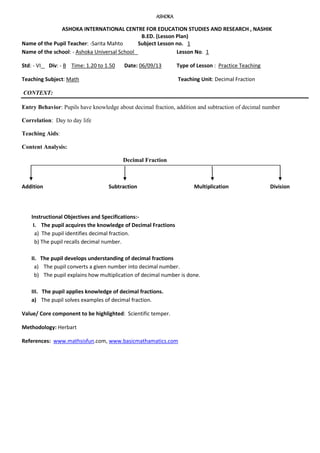
ASHOKA INTERNATIONAL CENTRE FOR EDUCATION STUDIES AND RESEARCH , NASHIK
B.ED. (Lesson Plan)
Name of the Pupil Teacher: -Sarita Mahto Subject Lesson no. 1
Name of the school: - Ashoka Universal School Lesson No. 1
Std: - VI Div: - B Time: 1.20 to 1.50 Date: 06/09/13 Type of Lesson : Practice Teaching
Teaching Subject: Math Teaching Unit: Decimal Fraction
CONTEXT:
Entry Behavior: Pupils have knowledge about decimal fraction, addition and subtraction of decimal number
Correlation: Day to day life
Teaching Aids:
Content Analysis:
Decimal Fraction
Addition Subtraction Multiplication Division
Instructional Objectives and Specifications:-
I. The pupil acquires the knowledge of Decimal Fractions
a) The pupil identifies decimal fraction.
b) The pupil recalls decimal number.
II. The pupil develops understanding of decimal fractions
a) The pupil converts a given number into decimal number.
b) The pupil explains how multiplication of decimal number is done.
III. The pupil applies knowledge of decimal fractions.
a) The pupil solves examples of decimal fraction.
Value/ Core component to be highlighted: Scientific temper.
Methodology: Herbart
References: www.mathsisfun.com, www.basicmathamatics.com
Experience:
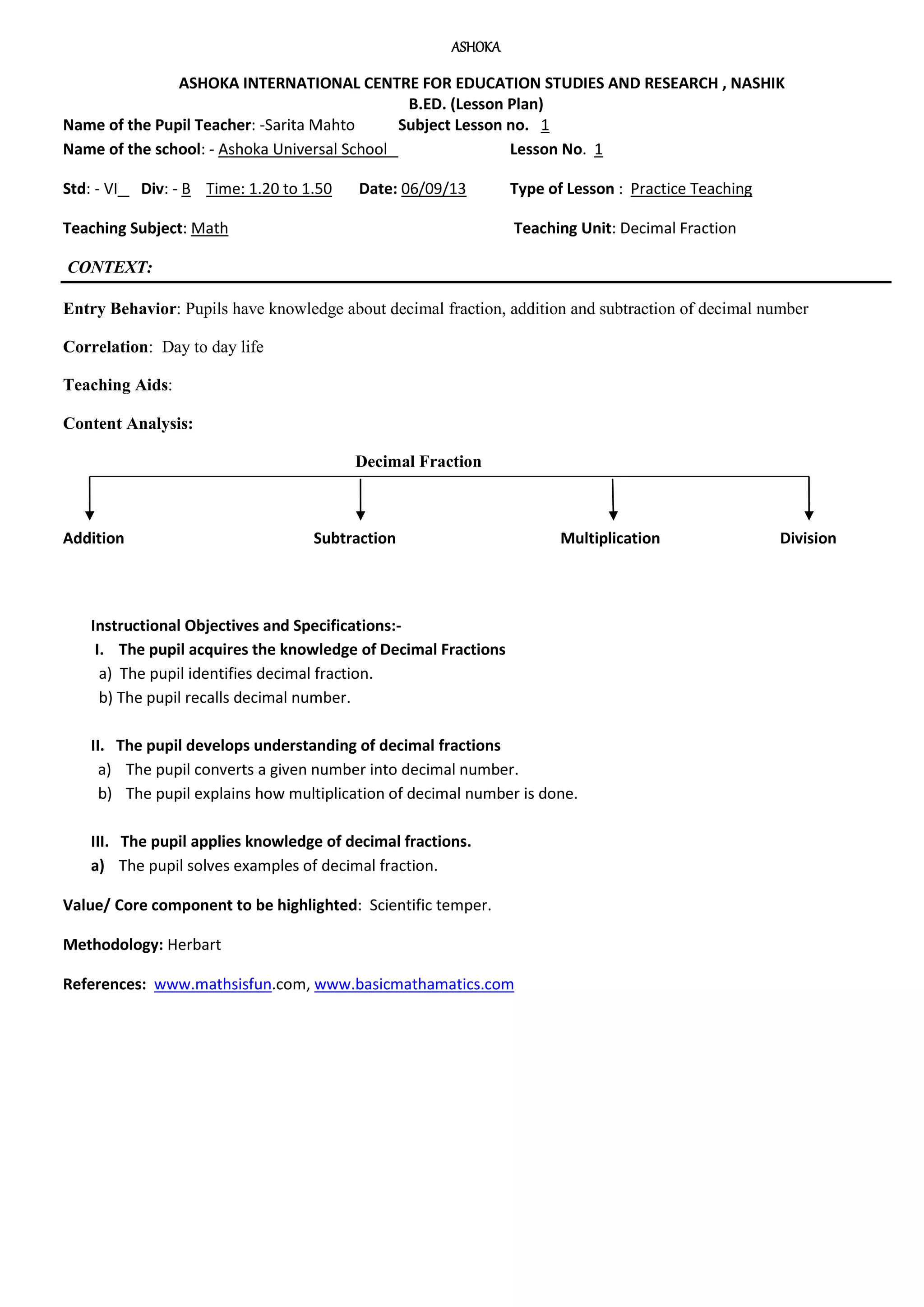
Teaching points / Content Teacher Activities & Procedure Support system / CB work
Set Induction
(on the basis of General Knowledge)
Linking Statement
Statement of Aim/ Topic & Scope
Good morning Students
Teacher ask students to solve two
examples put on C.B
In this example on C.B what care
should we take while adding sub
numbers.
So now addition and subtraction of
decimal number you know.
Today we will learn how to multiply
decimal numbers in the unit Decimal
Fraction.
1) 2.7 +35.82 +140.052
2) 14.8 -7.23+9.631
Presentation
 Multiplication of a decimal
number by a single digit
number.
 Model example 1
532.43 X 7
 Model example 2
4.09 X 5.6
Drill work
Teacher writes the title on C.B.
Teacher solves two examples of
multiplication of decimal numbers.
Teacher solves the example with the
help of student.
Teacher asks students to solve two
examples in their notebook.
Teacher supervises their work
Teacher later ask one student to
come forward to the C.B and solve
the example.
Decimal Fraction
1) 532.43 X 7
532.43
X 7
3727.01
2) 4.09 X 5.6
4.09
X 5.6
22.904
1) 5.62 X 2.3
2) 222.21 X 3
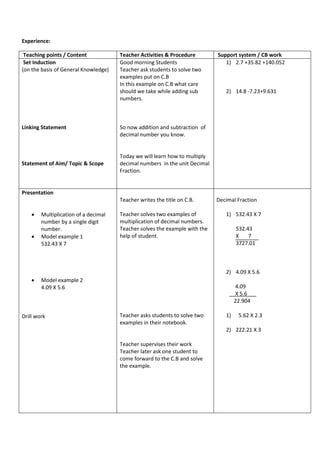
Application Teacher gives another example to the
student ( multiplication of a decimal
number by 10 ,100).
What do you notice about the
answers of multiplication of one
number by 10 or 100.
Can we derive any conclusion or rule
with respect to multiplication of
decimal number by 10 or 100.
1) 43.8725 X 10
= 438.725
2) 43.8725 X 100
= 4387.25
Summarization
Recapitulation / Evaluation
(Through Drill work )
Reflection
India’s Common Cultural Heritage
Action
Assignment
So today we have studied about
Decimal Fractions – multiplication.
Today we have seen that if we
multiply a number by 10 or 100 etc
values increases that many times and
without actual multiplication we can
merely write the answer by shifting
the decimal point .
Q. The concept 0 in 10 or 100 was
discovered by whom?
Q. Mention some other discovery by
India which enriched man kind?
Q. So when we talk about Indian
common cultural heritage what
feeling come into your mind ?
Q. How will you preserve this
heritage ?
Teacher ask student to solve this
Exercise 15
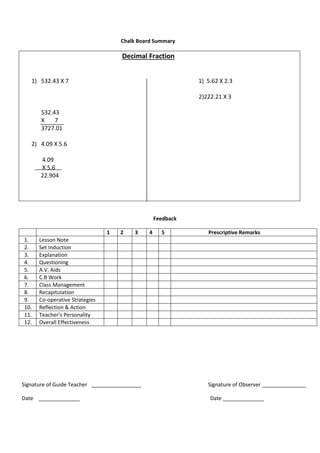
Chalk Board Summary
Decimal Fraction
1) 532.43 X 7 1) 5.62 X 2.3
2)222.21 X 3
532.43
X 7
3727.01
2) 4.09 X 5.6
4.09
X 5.6
22.904
Feedback
1 2 3 4 5 Prescriptive Remarks
1. Lesson Note
2. Set Induction
3. Explanation
4. Questioning
5. A.V. Aids
6. C.B Work
7. Class Management
8. Recapitulation
9. Co-operative Strategies
10. Reflection & Action
11. Teacher’s Personality
12. Overall Effectiveness
Signature of Guide Teacher _________________ Signature of Observer _______________
Date ______________ Date ______________
6 Maths Lesson Plan.docx

6 Maths Lesson Plan.docx

  • 1.
    ASHOKA ASHOKA INTERNATIONAL CENTREFOR EDUCATION STUDIES AND RESEARCH , NASHIK B.ED. (Lesson Plan) Name of the Pupil Teacher: -Sarita Mahto Subject Lesson no. 1 Name of the school: - Ashoka Universal School Lesson No. 1 Std: - VI Div: - B Time: 1.20 to 1.50 Date: 06/09/13 Type of Lesson : Practice Teaching Teaching Subject: Math Teaching Unit: Decimal Fraction CONTEXT: Entry Behavior: Pupils have knowledge about decimal fraction, addition and subtraction of decimal number Correlation: Day to day life Teaching Aids: Content Analysis: Decimal Fraction Addition Subtraction Multiplication Division Instructional Objectives and Specifications:- I. The pupil acquires the knowledge of Decimal Fractions a) The pupil identifies decimal fraction. b) The pupil recalls decimal number. II. The pupil develops understanding of decimal fractions a) The pupil converts a given number into decimal number. b) The pupil explains how multiplication of decimal number is done. III. The pupil applies knowledge of decimal fractions. a) The pupil solves examples of decimal fraction. Value/ Core component to be highlighted: Scientific temper. Methodology: Herbart References: www.mathsisfun.com, www.basicmathamatics.com
  • 2.
    Experience: Teaching points /Content Teacher Activities & Procedure Support system / CB work Set Induction (on the basis of General Knowledge) Linking Statement Statement of Aim/ Topic & Scope Good morning Students Teacher ask students to solve two examples put on C.B In this example on C.B what care should we take while adding sub numbers. So now addition and subtraction of decimal number you know. Today we will learn how to multiply decimal numbers in the unit Decimal Fraction. 1) 2.7 +35.82 +140.052 2) 14.8 -7.23+9.631 Presentation  Multiplication of a decimal number by a single digit number.  Model example 1 532.43 X 7  Model example 2 4.09 X 5.6 Drill work Teacher writes the title on C.B. Teacher solves two examples of multiplication of decimal numbers. Teacher solves the example with the help of student. Teacher asks students to solve two examples in their notebook. Teacher supervises their work Teacher later ask one student to come forward to the C.B and solve the example. Decimal Fraction 1) 532.43 X 7 532.43 X 7 3727.01 2) 4.09 X 5.6 4.09 X 5.6 22.904 1) 5.62 X 2.3 2) 222.21 X 3
  • 3.
    Application Teacher givesanother example to the student ( multiplication of a decimal number by 10 ,100). What do you notice about the answers of multiplication of one number by 10 or 100. Can we derive any conclusion or rule with respect to multiplication of decimal number by 10 or 100. 1) 43.8725 X 10 = 438.725 2) 43.8725 X 100 = 4387.25 Summarization Recapitulation / Evaluation (Through Drill work ) Reflection India’s Common Cultural Heritage Action Assignment So today we have studied about Decimal Fractions – multiplication. Today we have seen that if we multiply a number by 10 or 100 etc values increases that many times and without actual multiplication we can merely write the answer by shifting the decimal point . Q. The concept 0 in 10 or 100 was discovered by whom? Q. Mention some other discovery by India which enriched man kind? Q. So when we talk about Indian common cultural heritage what feeling come into your mind ? Q. How will you preserve this heritage ? Teacher ask student to solve this Exercise 15
  • 4.
    Chalk Board Summary DecimalFraction 1) 532.43 X 7 1) 5.62 X 2.3 2)222.21 X 3 532.43 X 7 3727.01 2) 4.09 X 5.6 4.09 X 5.6 22.904 Feedback 1 2 3 4 5 Prescriptive Remarks 1. Lesson Note 2. Set Induction 3. Explanation 4. Questioning 5. A.V. Aids 6. C.B Work 7. Class Management 8. Recapitulation 9. Co-operative Strategies 10. Reflection & Action 11. Teacher’s Personality 12. Overall Effectiveness Signature of Guide Teacher _________________ Signature of Observer _______________ Date ______________ Date ______________