Bonding in solids
By
S.Priyanka
E.M.G.Yadava Women’s College
Madurai 14
Bonding:
❖ A solid is composed of billion of atoms packed closely together
❖ The attraction between atoms, ions or molecules which hold the
atoms together
❖ They are classified as primary bonds and secondary bonds
according to the strength and directionality.
Primary Bonds:
❖ The types of primary bonding are
❖ Ionic bonding
❖ Covalent bonding
❖ Metallic bonding
Ionic Bonding:
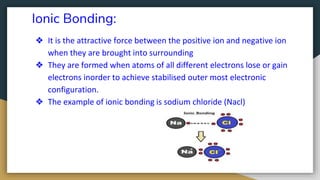
❖ It is the attractive force between the positive ion and negative ion
when they are brought into surrounding
❖ They are formed when atoms of all different electrons lose or gain
electrons inorder to achieve stabilised outer most electronic
configuration.
❖ The example of ionic bonding is sodium chloride (Nacl)
Covalent Bonding:
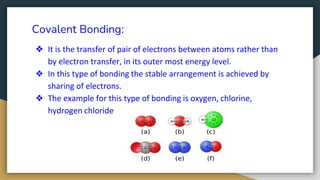
❖ It is the transfer of pair of electrons between atoms rather than
by electron transfer, in its outer most energy level.
❖ In this type of bonding the stable arrangement is achieved by
sharing of electrons.
❖ The example for this type of bonding is oxygen, chlorine,
hydrogen chloride
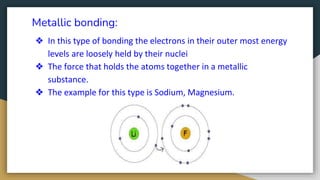
Metallic bonding:
❖ In this type of bonding the electrons in their outer most energy
levels are loosely held by their nuclei
❖ The force that holds the atoms together in a metallic
substance.
❖ The example for this type is Sodium, Magnesium.
Secondary Bonding:
The types of Secondary bonding are
❖ Hydrogen Bonding
❖ VanderWaal Bonding
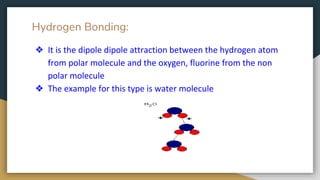
Hydrogen Bonding:
❖ It is the dipole dipole attraction between the hydrogen atom
from polar molecule and the oxygen, fluorine from the non
polar molecule
❖ The example for this type is water molecule
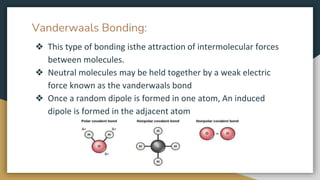
Vanderwaals Bonding:
❖ This type of bonding isthe attraction of intermolecular forces
between molecules.
❖ Neutral molecules may be held together by a weak electric
force known as the vanderwaals bond
❖ Once a random dipole is formed in one atom, An induced
dipole is formed in the adjacent atom
THANK YOU

Bonding in solids

  • 1.
  • 2.
    Bonding: ❖ A solidis composed of billion of atoms packed closely together ❖ The attraction between atoms, ions or molecules which hold the atoms together ❖ They are classified as primary bonds and secondary bonds according to the strength and directionality.
  • 3.
    Primary Bonds: ❖ Thetypes of primary bonding are ❖ Ionic bonding ❖ Covalent bonding ❖ Metallic bonding
  • 4.
    Ionic Bonding: ❖ Itis the attractive force between the positive ion and negative ion when they are brought into surrounding ❖ They are formed when atoms of all different electrons lose or gain electrons inorder to achieve stabilised outer most electronic configuration. ❖ The example of ionic bonding is sodium chloride (Nacl)
  • 5.
    Covalent Bonding: ❖ Itis the transfer of pair of electrons between atoms rather than by electron transfer, in its outer most energy level. ❖ In this type of bonding the stable arrangement is achieved by sharing of electrons. ❖ The example for this type of bonding is oxygen, chlorine, hydrogen chloride
  • 6.
    Metallic bonding: ❖ Inthis type of bonding the electrons in their outer most energy levels are loosely held by their nuclei ❖ The force that holds the atoms together in a metallic substance. ❖ The example for this type is Sodium, Magnesium.
  • 7.
    Secondary Bonding: The typesof Secondary bonding are ❖ Hydrogen Bonding ❖ VanderWaal Bonding
  • 8.
    Hydrogen Bonding: ❖ Itis the dipole dipole attraction between the hydrogen atom from polar molecule and the oxygen, fluorine from the non polar molecule ❖ The example for this type is water molecule
  • 9.
    Vanderwaals Bonding: ❖ Thistype of bonding isthe attraction of intermolecular forces between molecules. ❖ Neutral molecules may be held together by a weak electric force known as the vanderwaals bond ❖ Once a random dipole is formed in one atom, An induced dipole is formed in the adjacent atom
  • 10.