Open Scenarios
                                                                    In Higher Education


                Open/Closed / Antti T. Nissinen / CC BY


Open Educational Resources (OER)                                             Paul Stacey
Open Textbooks                                                               2-Apr-2013
Open Access
MOOC’s
                  Except where otherwise noted these Open Scenarios in Higher Education materials
                   are licensed under a Creative Commons Attribution 3.0 Unported License (CC-BY)
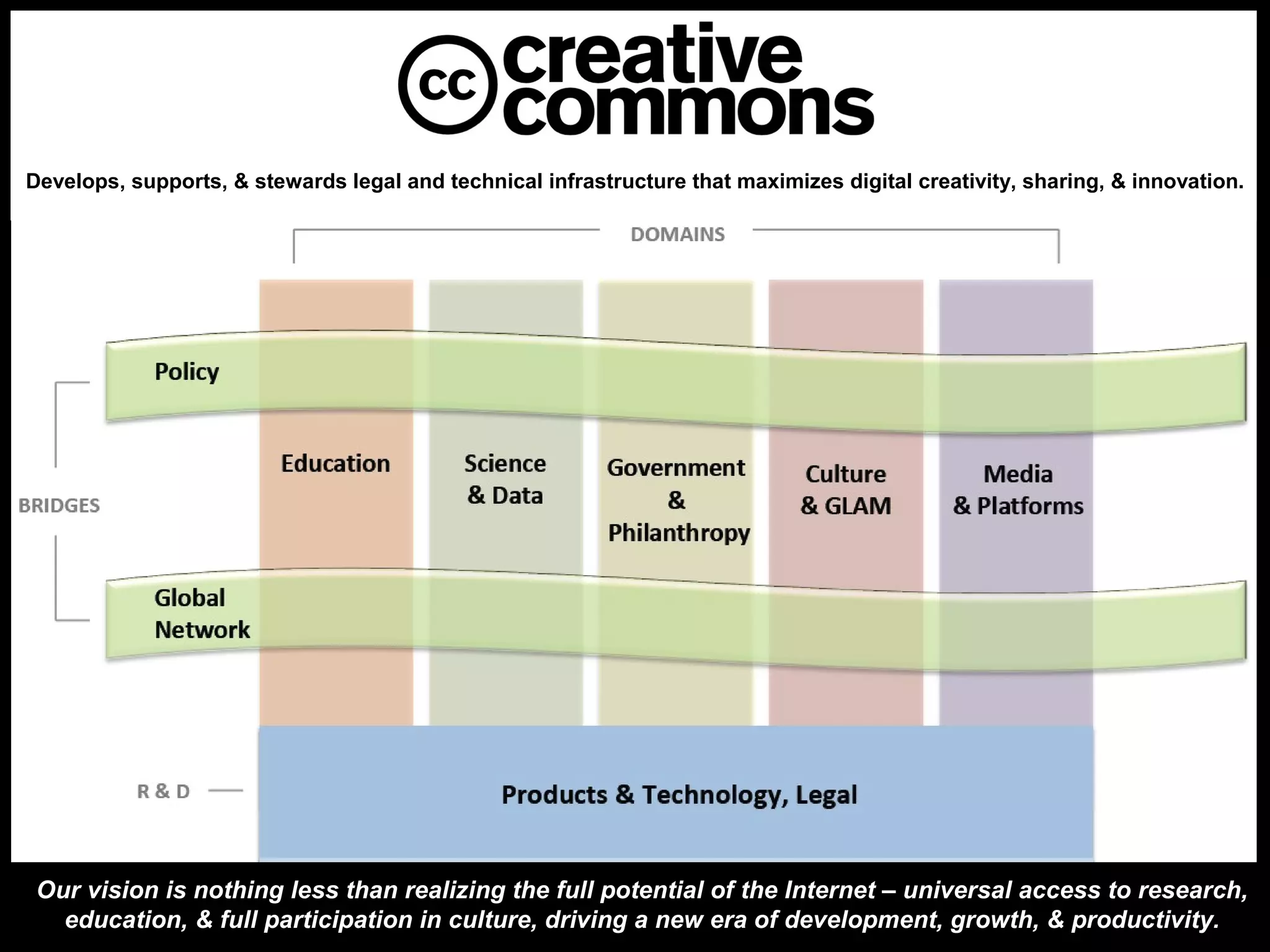
Develops, supports, & stewards legal and technical infrastructure that maximizes digital creativity, sharing, & innovation.


 Our vision is nothing less than realizing the full potential of the Internet – universal access to research,
   education, & full participation in culture, driving a new era of development, growth, & productivity.
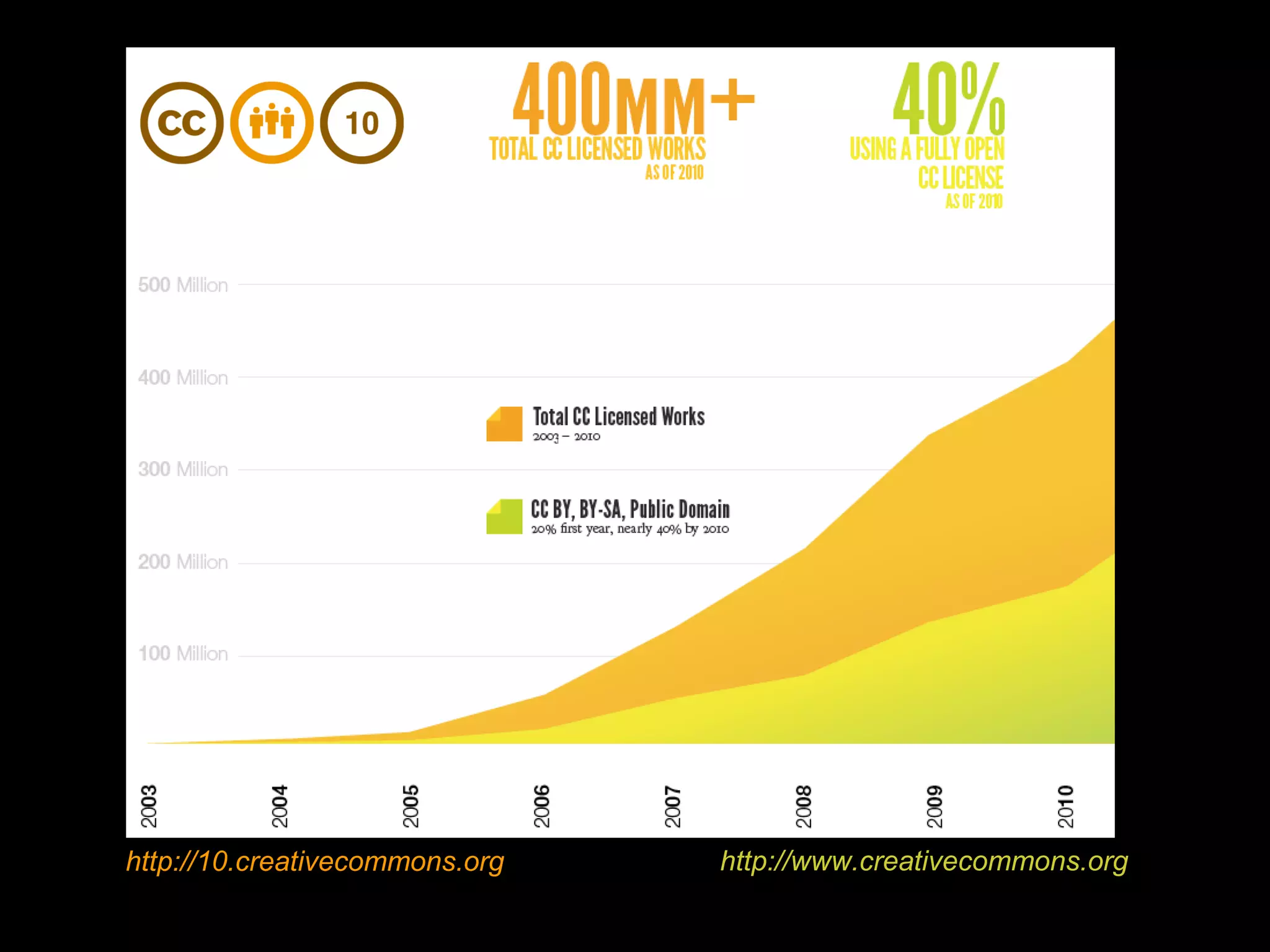
http://10.creativecommons.org   http://www.creativecommons.org
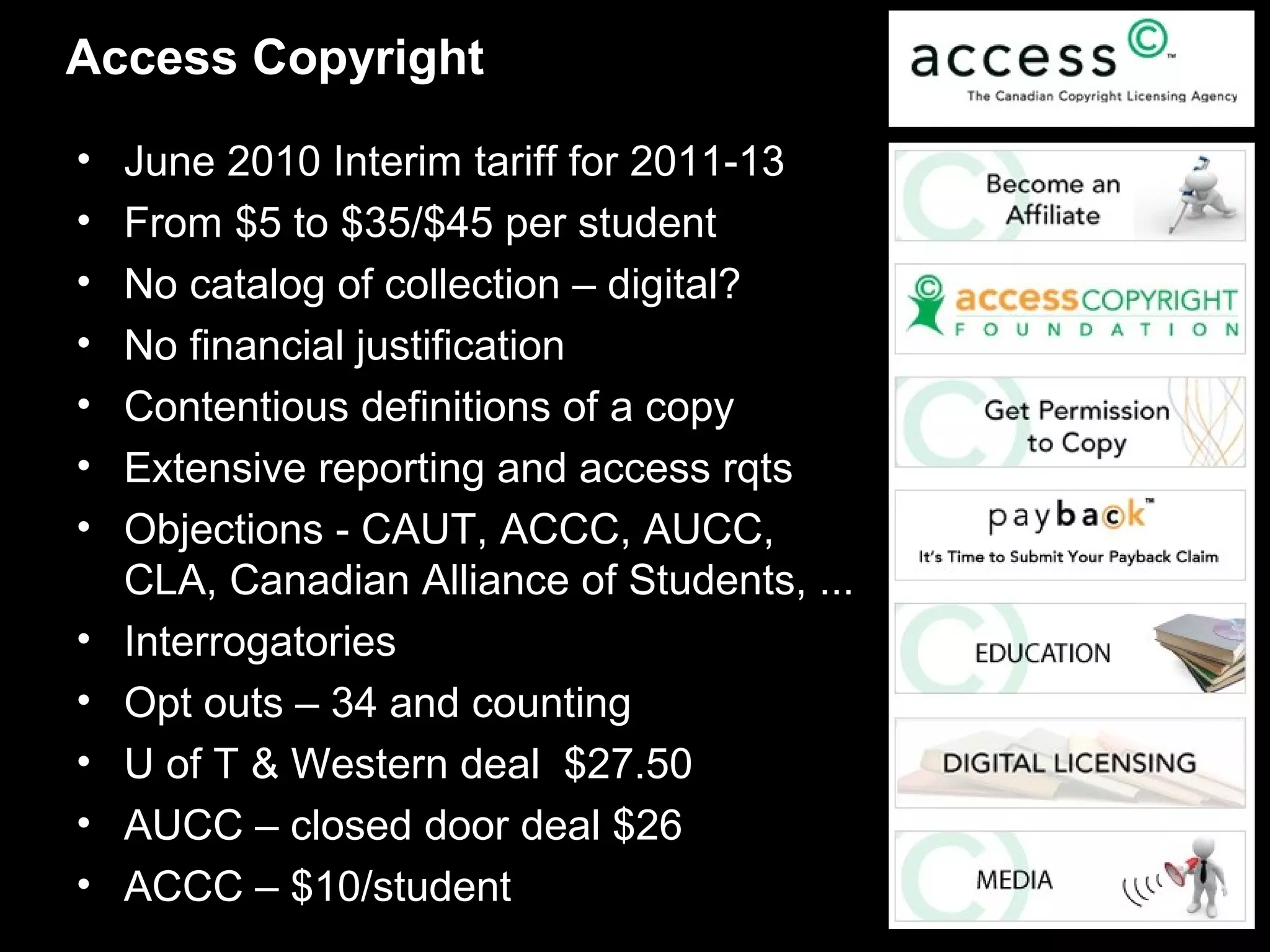
Access Copyright

•   June 2010 Interim tariff for 2011-13
•   From $5 to $35/$45 per student
•   No catalog of collection – digital?
•   No financial justification
•   Contentious definitions of a copy
•   Extensive reporting and access rqts
•   Objections - CAUT, ACCC, AUCC,
    CLA, Canadian Alliance of Students, ...
•   Interrogatories
•   Opt outs – 34 and counting
•   U of T & Western deal $27.50
•   AUCC – closed door deal $26
•   ACCC – $10/student
Copyright

•   Copyright Modernization Act – Bill C-32 now C-11
•   Supreme Court - 6 criteria for evaluating fair dealing
•   Expansion of fair dealing to education, parody & satire
•   Remix provision – non-commercial mashups
•   Technical protection measures – digital lock rules
•   Supreme Court of Canada rulings on fair dealing and
    copyright summer 2012


         Bill C-32 & C-11
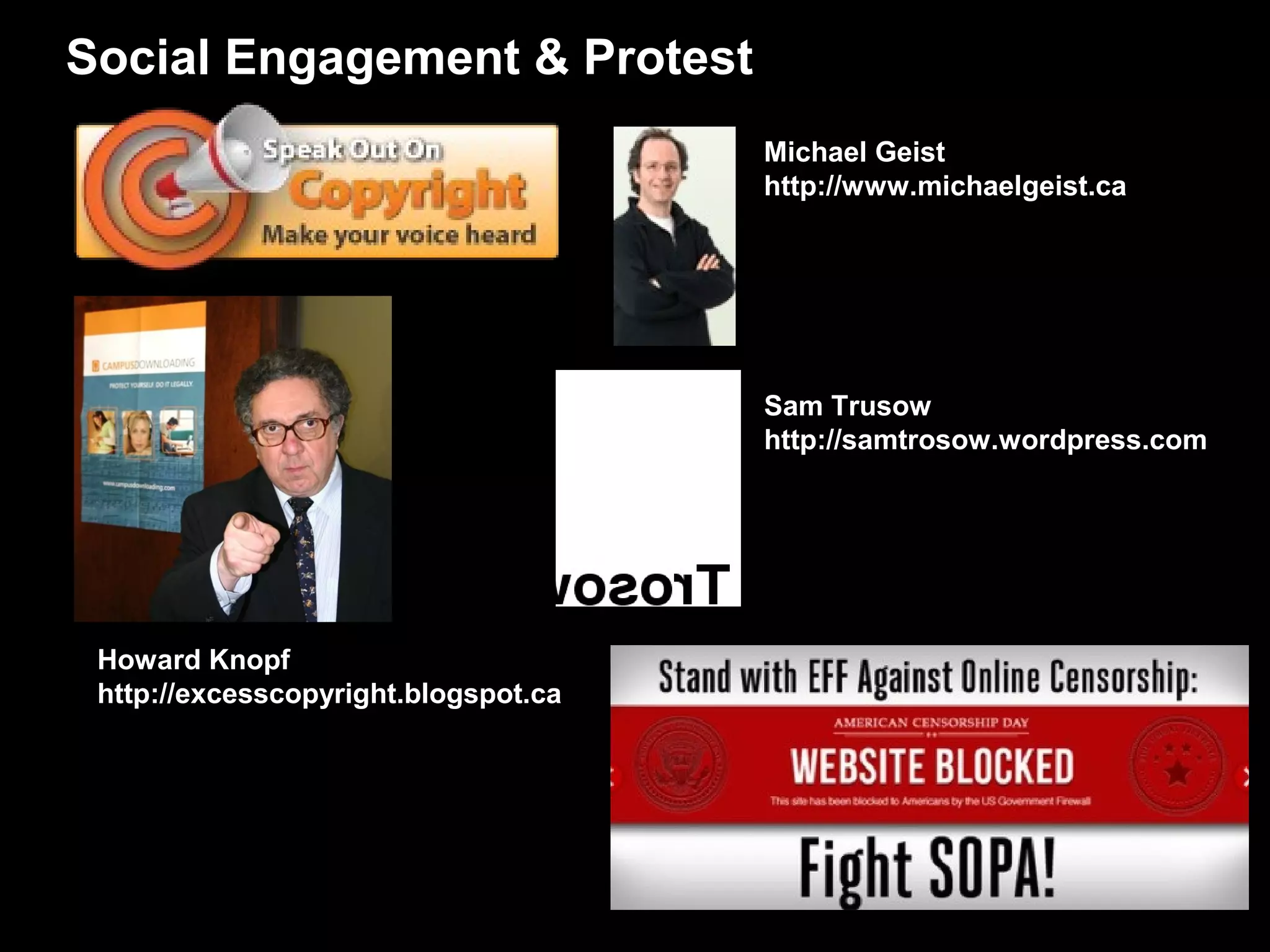
Social Engagement & Protest
                                      Michael Geist
                                      http://www.michaelgeist.ca


                                      Sam Trusow
                                      http://samtrosow.wordpress.com


 Howard Knopf
 http://excesscopyright.blogspot.ca
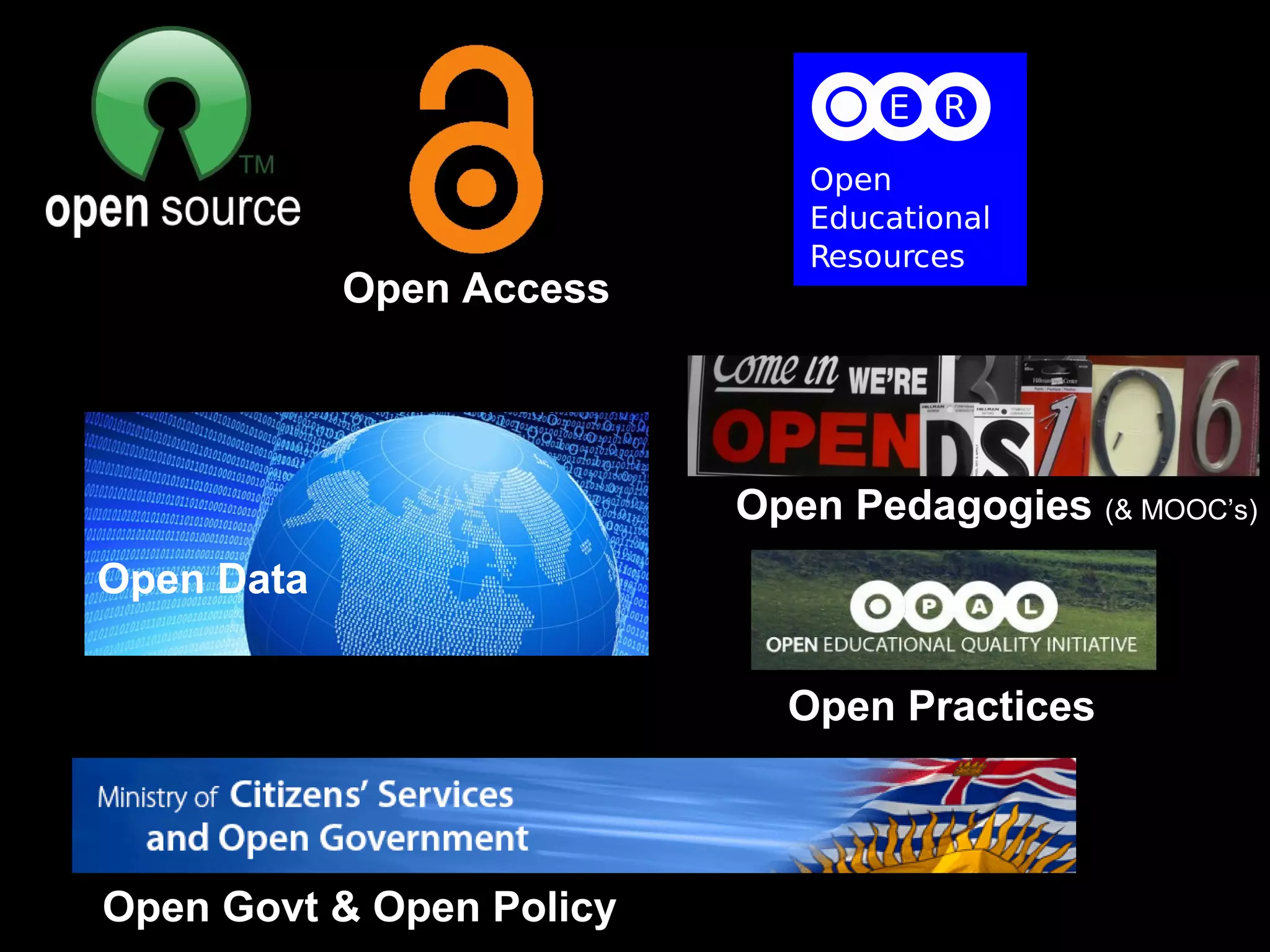
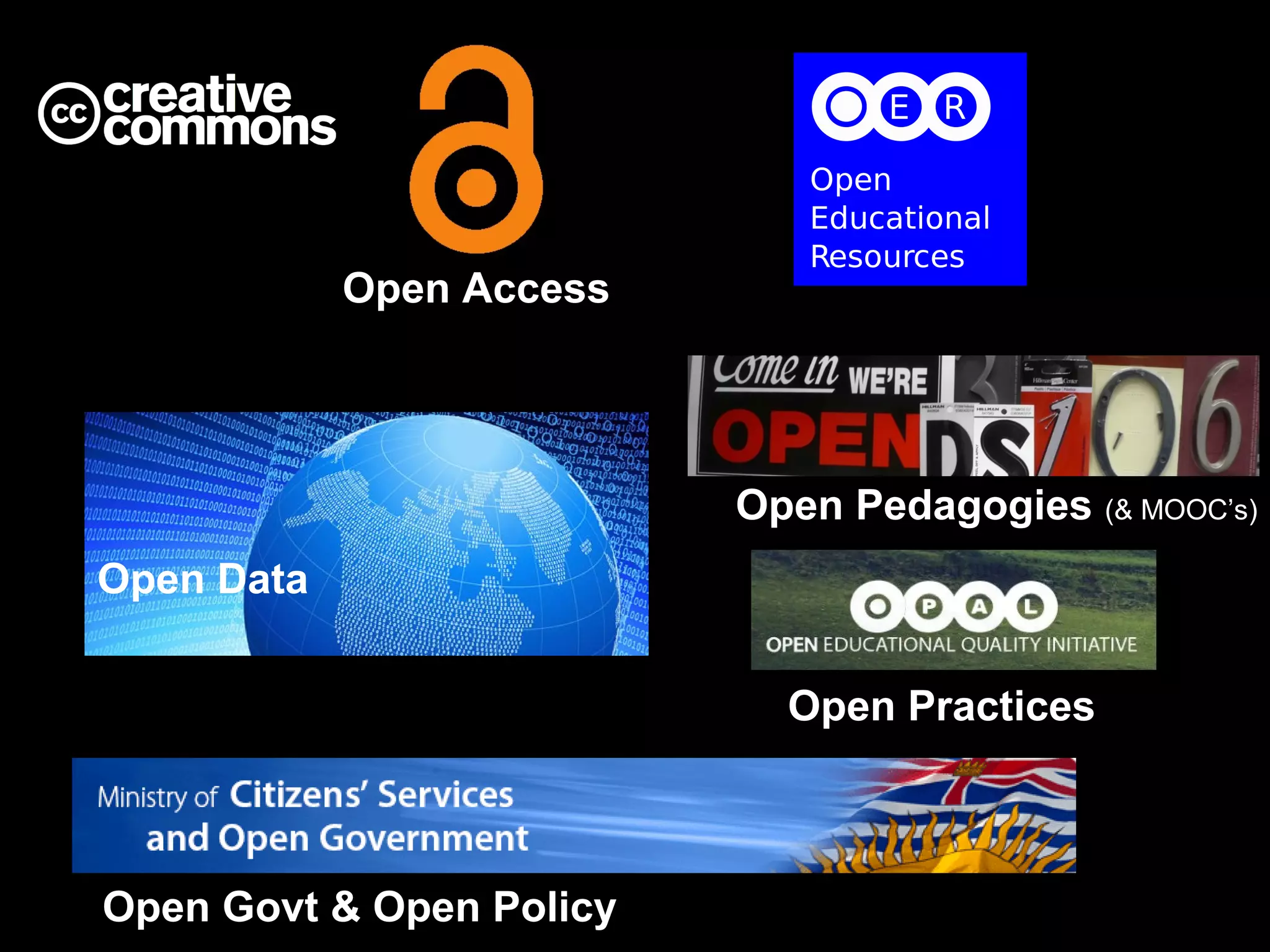
Open Access


                          Open Pedagogies (& MOOC’s)
Open Data


                            Open Practices


Open Govt & Open Policy
Common Attributes of Open
• Free – public funding results in a public good
• Access & use is explicitly expressed upfront – not
  dependent on access copyright, payment of fees,
  proprietary owner permission
• Easily & quickly adapted
• Customization & enhancements don't require large
  investments
• Errors, improvements, & feature requests are openly
  shared & managed
• Development, distribution & use is
  community/consortia based
• Sustainability relies on sharing - resources,
  development, hosting & support
• Users are developers
Open Data
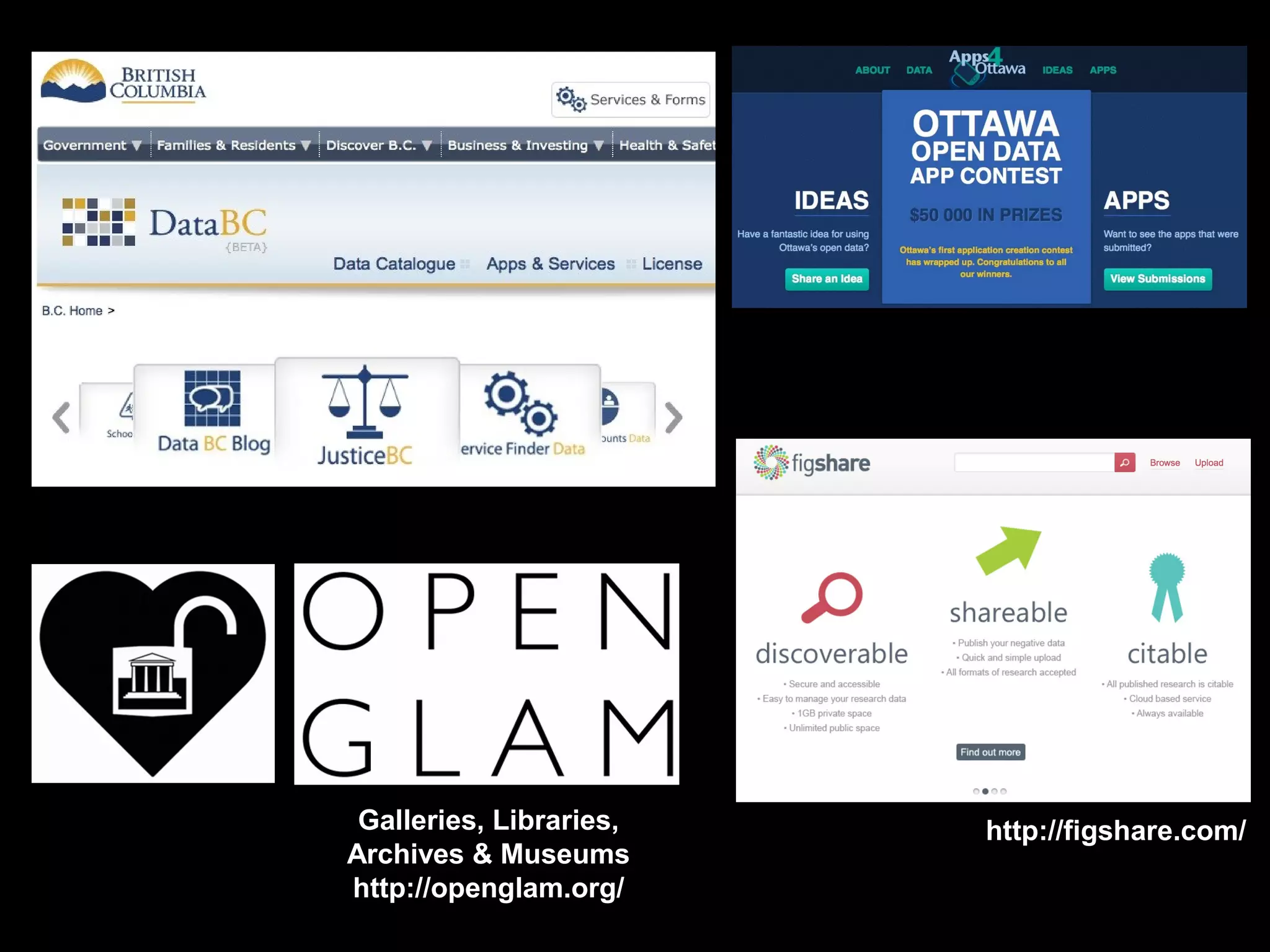
Galleries, Libraries,   http://figshare.com/
Archives & Museums
http://openglam.org/
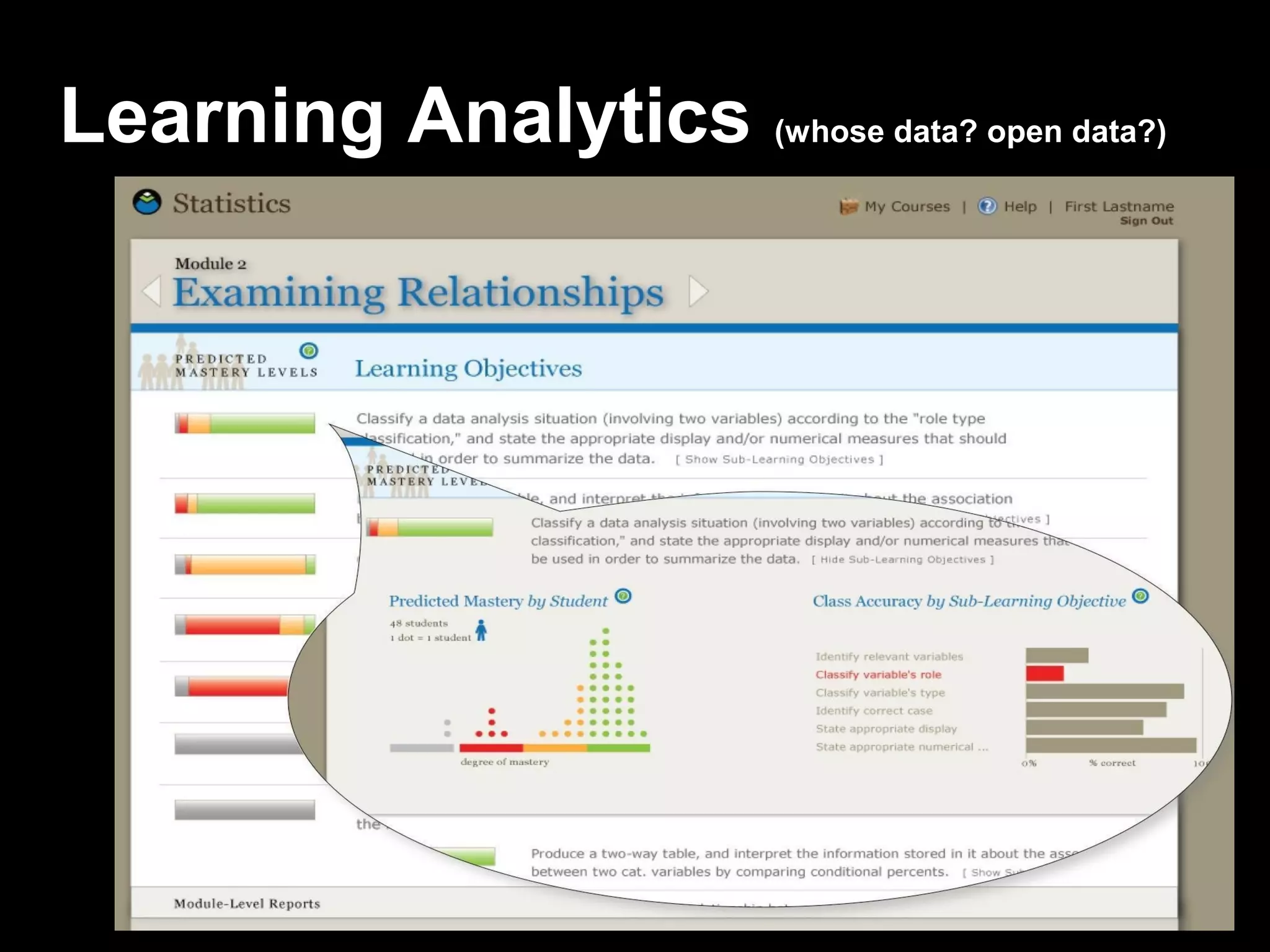
Learning Analytics (whose data? open data?)
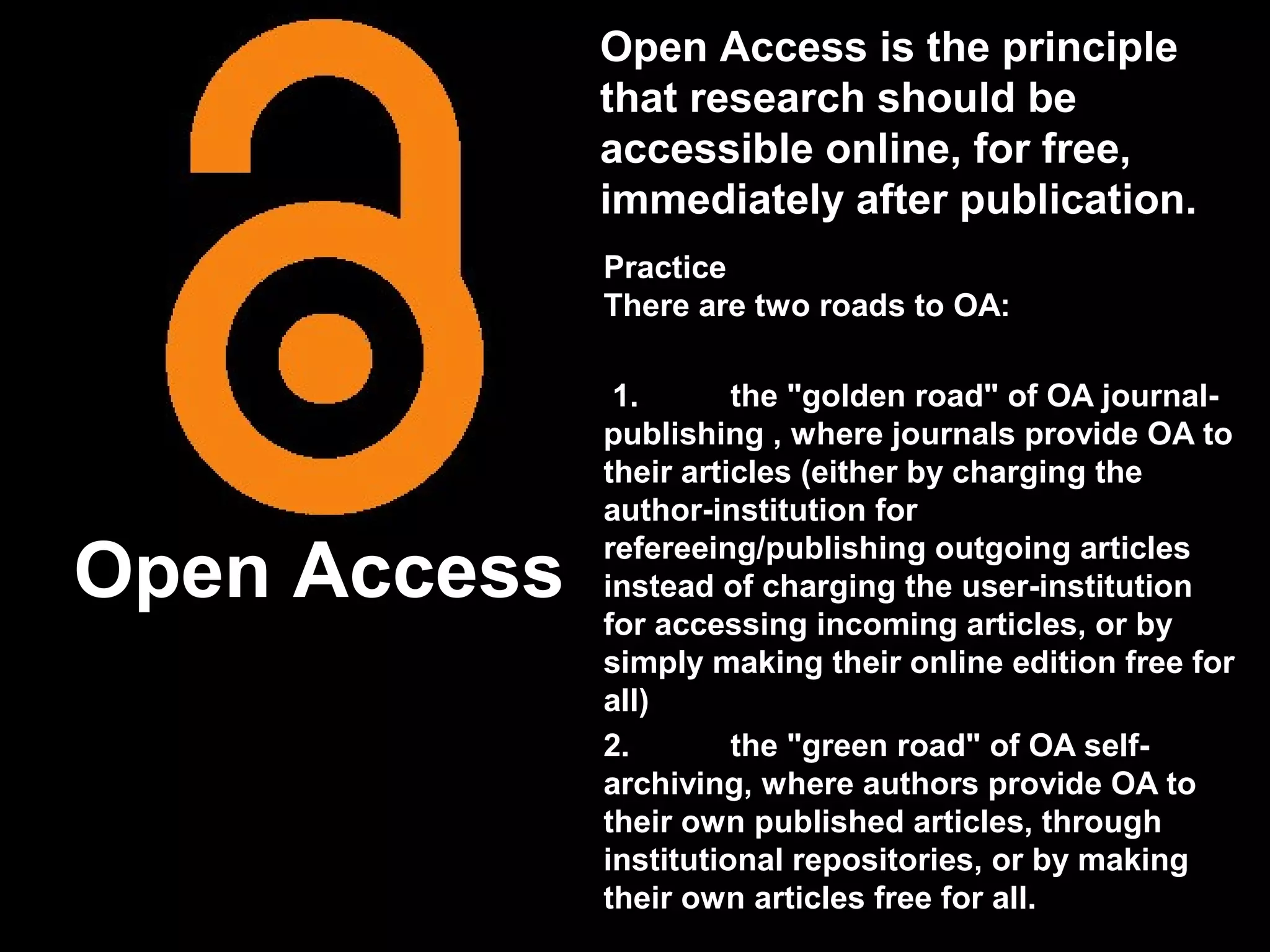
Open Access is the principle
              that research should be
              accessible online, for free,
              immediately after publication.
              Practice
              There are two roads to OA:

               1.       the "golden road" of OA journal-
              publishing , where journals provide OA to
              their articles (either by charging the
              author-institution for

Open Access   refereeing/publishing outgoing articles
              instead of charging the user-institution
              for accessing incoming articles, or by
              simply making their online edition free for
              all)
              2.        the "green road" of OA self-
              archiving, where authors provide OA to
              their own published articles, through
              institutional repositories, or by making
              their own articles free for all.
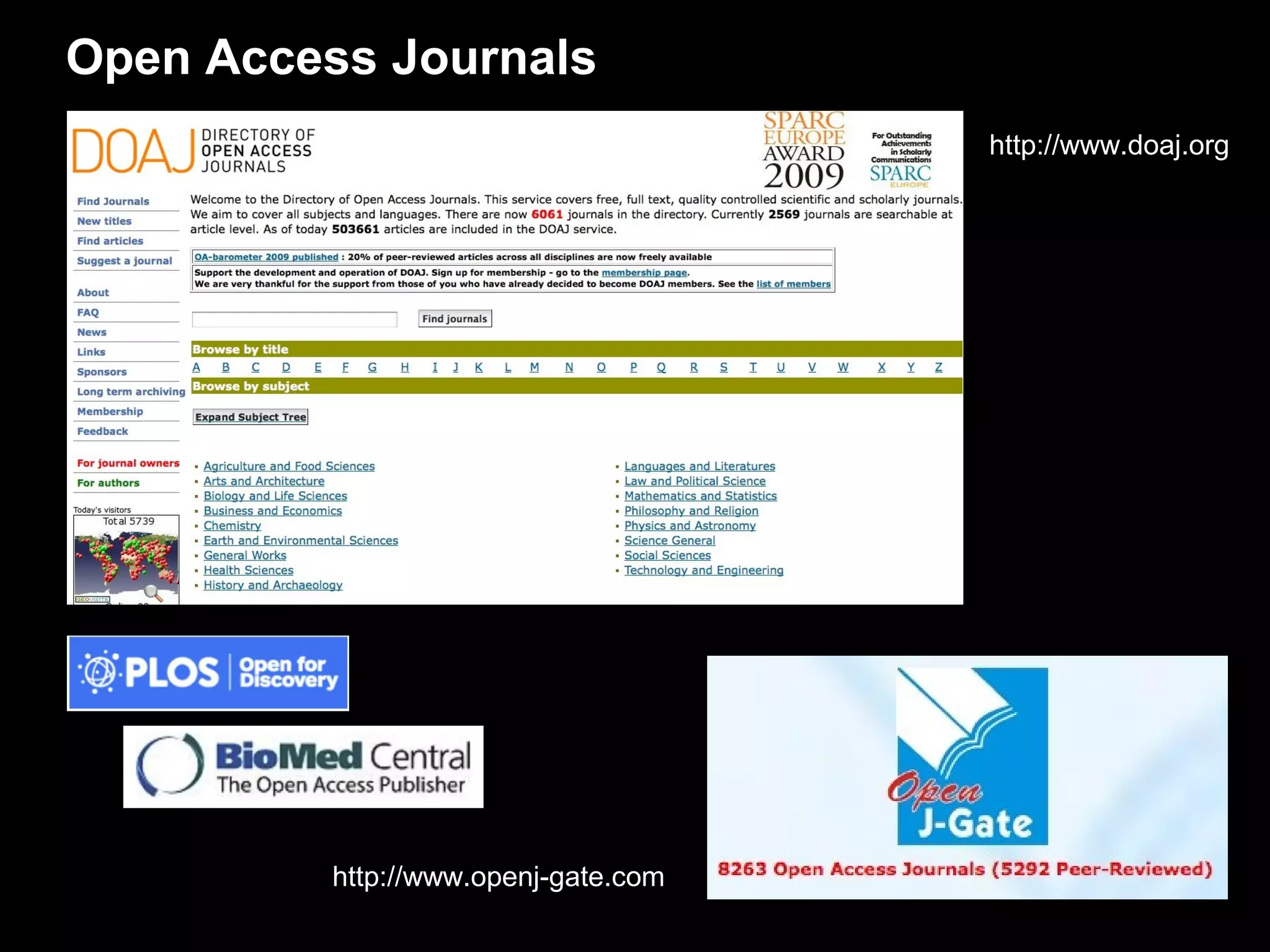
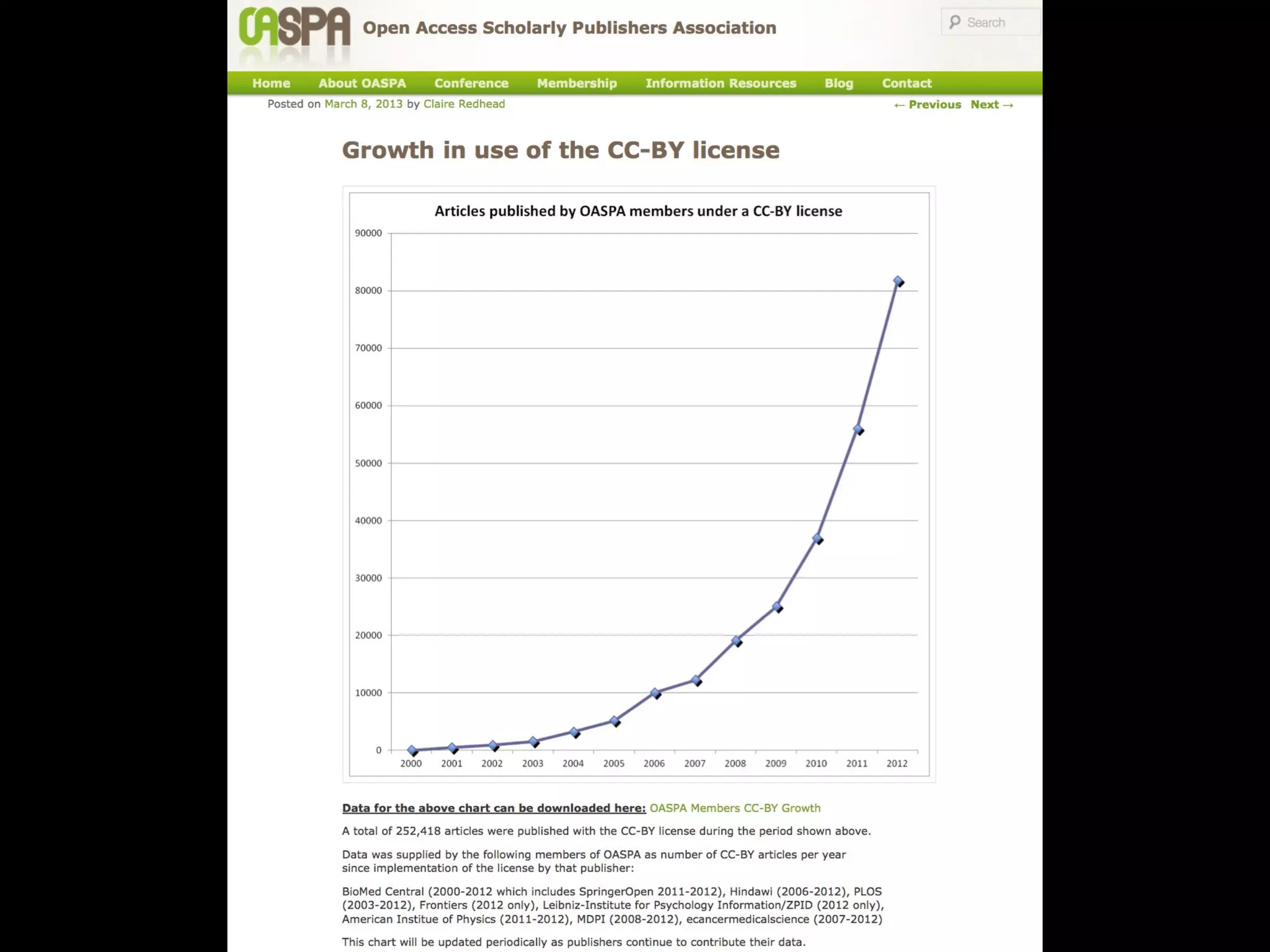
Open Access Journals
                                      http://www.doaj.org


          http://www.openj-gate.com
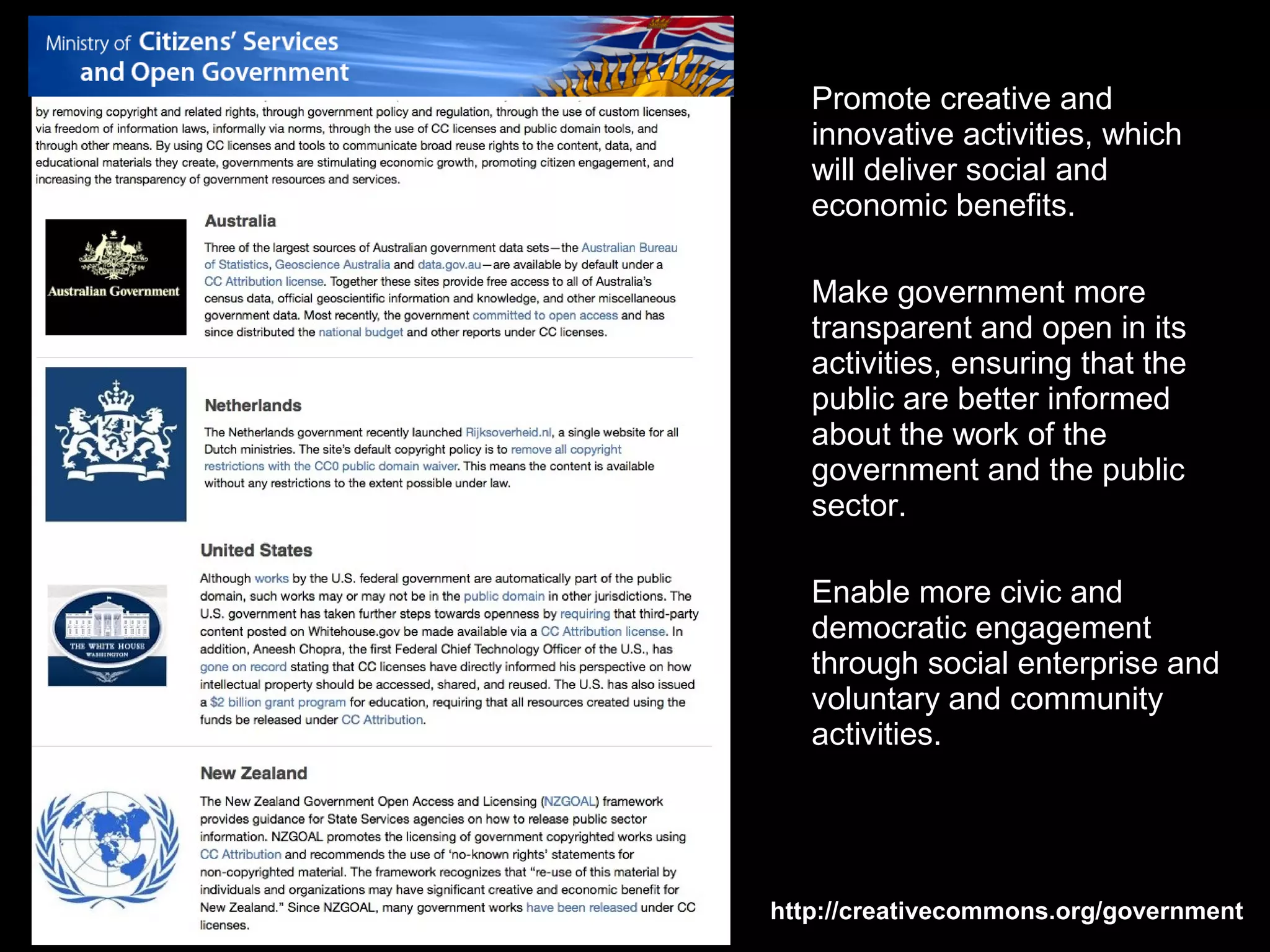
Open Government
                     Promote creative and
                     innovative activities, which
                     will deliver social and
                     economic benefits.

                     Make government more
                     transparent and open in its
                     activities, ensuring that the
                     public are better informed
                     about the work of the
                     government and the public
                     sector.

                     Enable more civic and
                     democratic engagement
                     through social enterprise and
                     voluntary and community
                     activities.


                  http://creativecommons.org/government
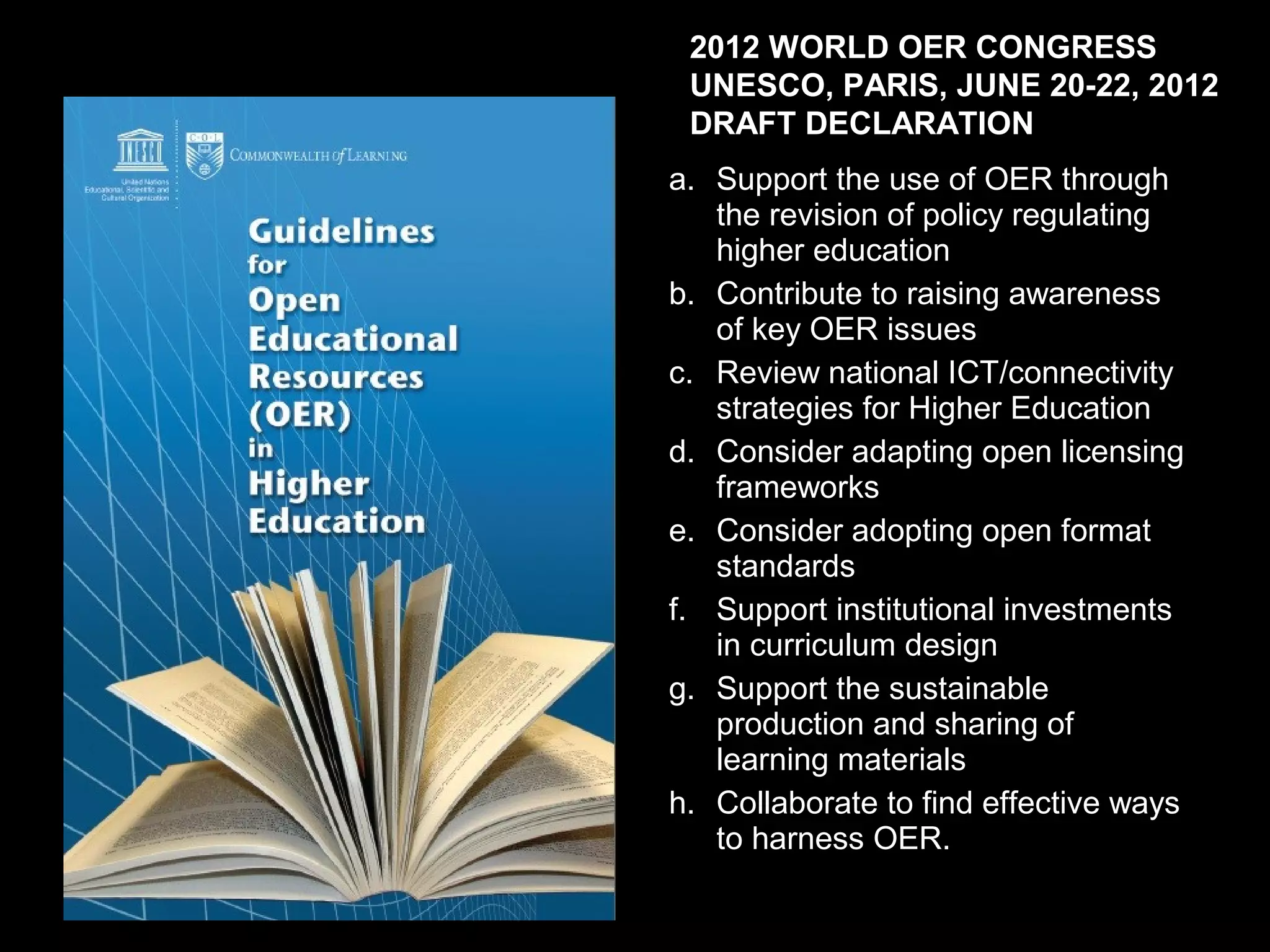
2012 WORLD OER CONGRESS
 UNESCO, PARIS, JUNE 20-22, 2012
 DRAFT DECLARATION
a. Support the use of OER through
   the revision of policy regulating
   higher education
b. Contribute to raising awareness
   of key OER issues
c. Review national ICT/connectivity
   strategies for Higher Education
d. Consider adapting open licensing
   frameworks
e. Consider adopting open format
   standards
f. Support institutional investments
   in curriculum design
g. Support the sustainable
   production and sharing of
   learning materials
h. Collaborate to find effective ways
   to harness OER.
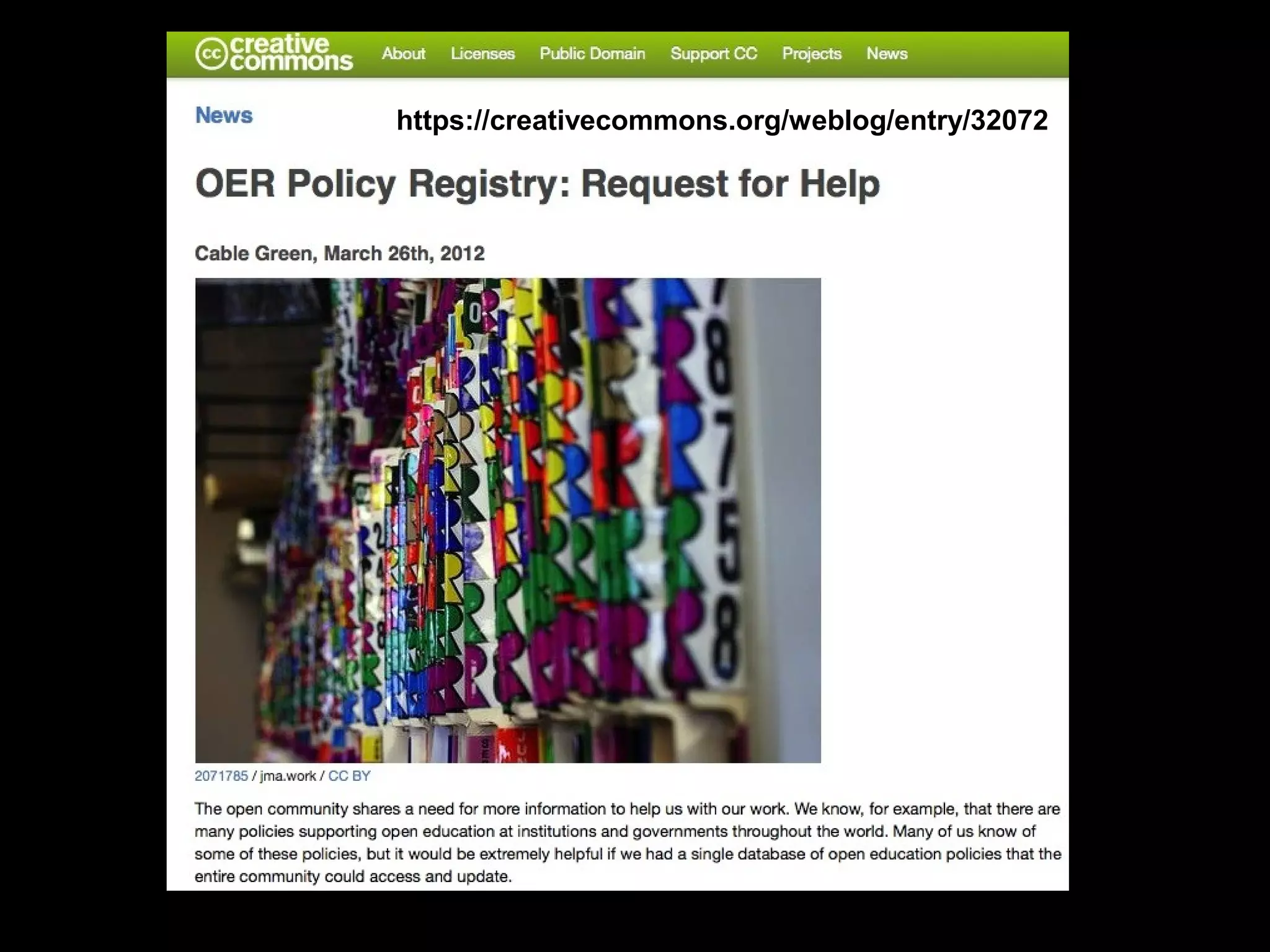
https://creativecommons.org/weblog/entry/32072
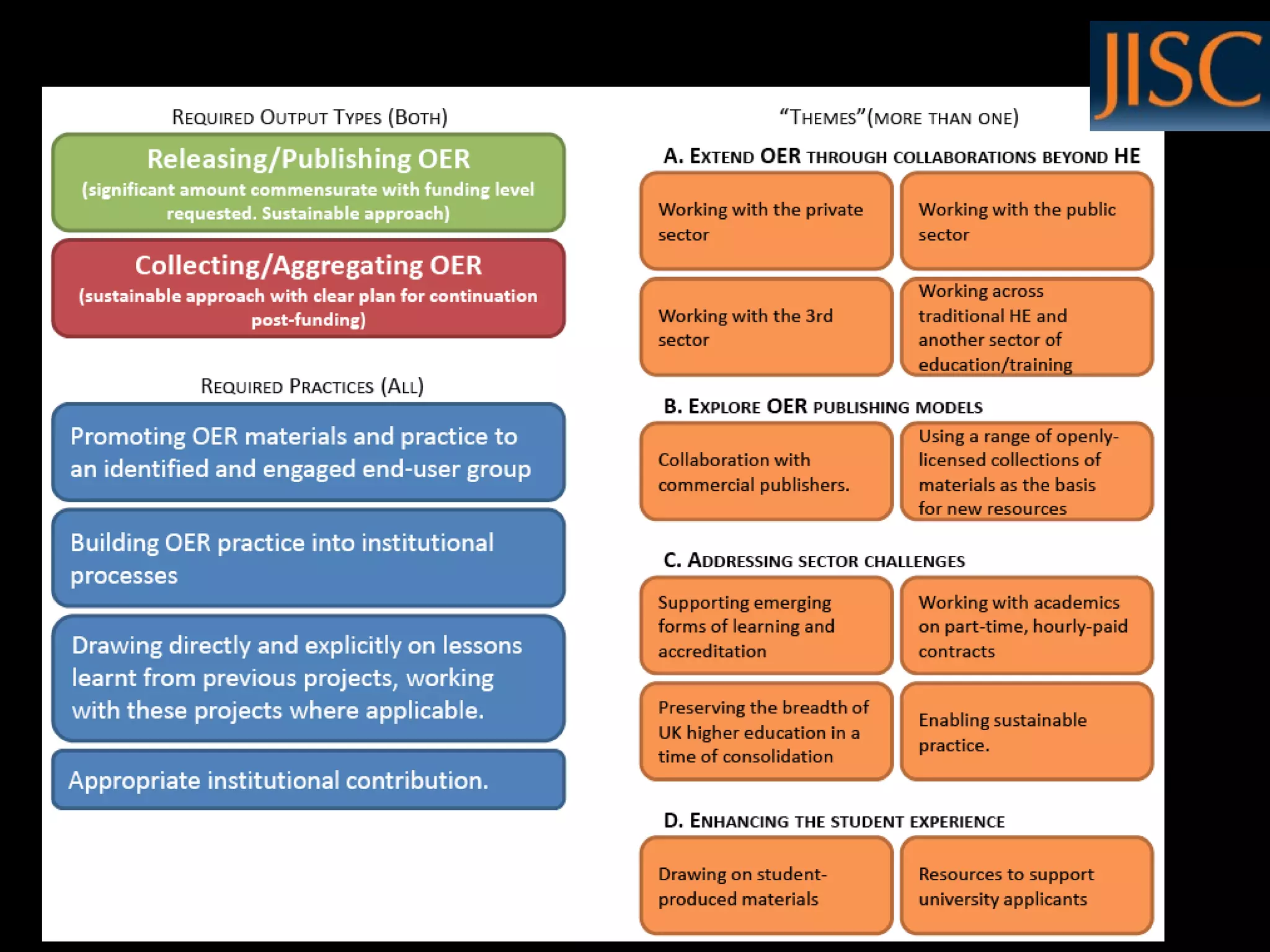
Open Practices
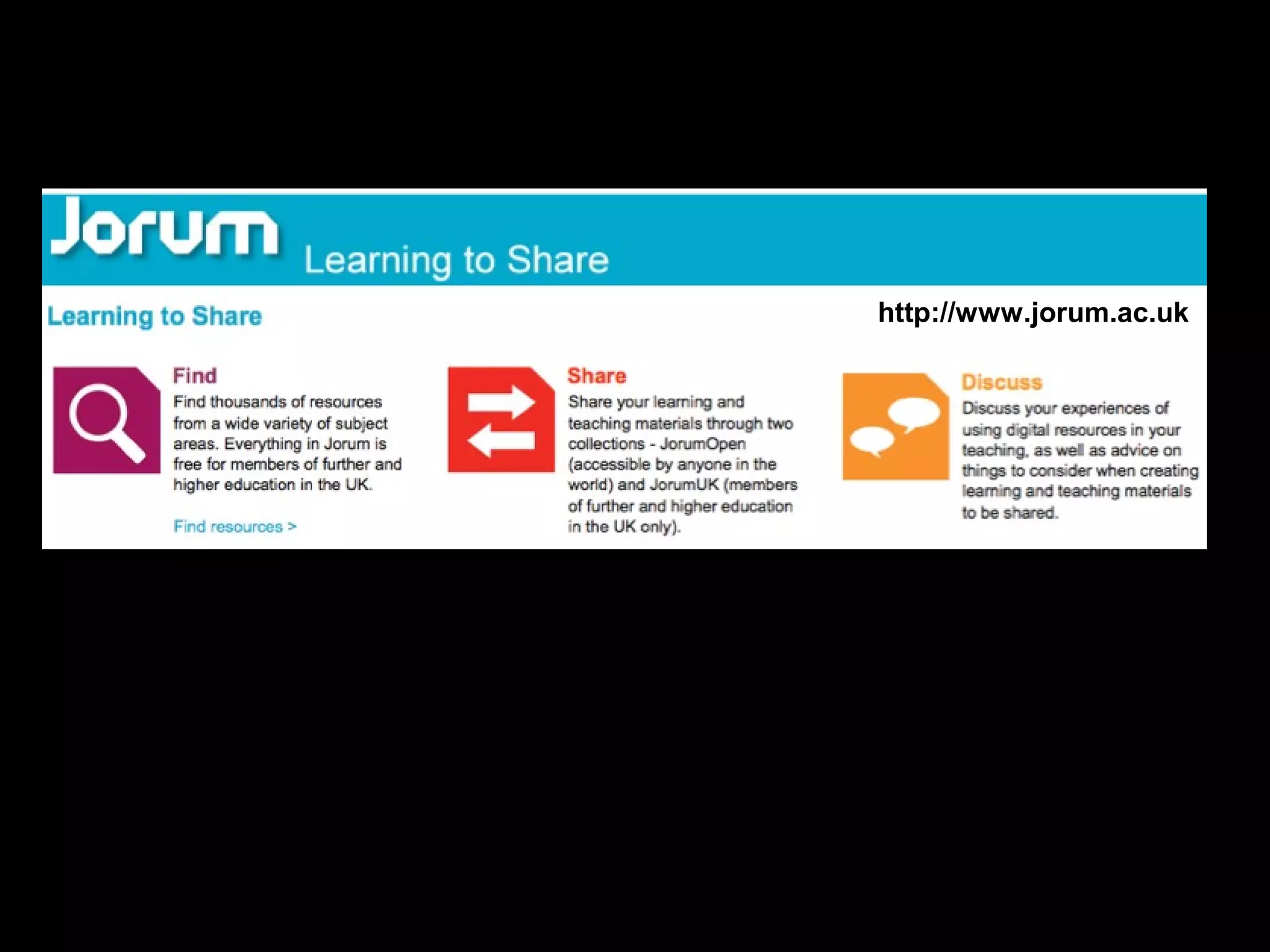
http://www.jorum.ac.uk
OER are teaching, learning, and research resources
that reside in the public domain or have been
released under an open license that permits their
free use and re-purposing by others.

Open educational resources include full courses and
supplemental resources such as textbooks, images,
videos, animations, simulations, assessments, …

Core Concept

OER are learning materials freely available under
a license that allows you to:

•Reuse
•Revise
•Remix
•Redistribute
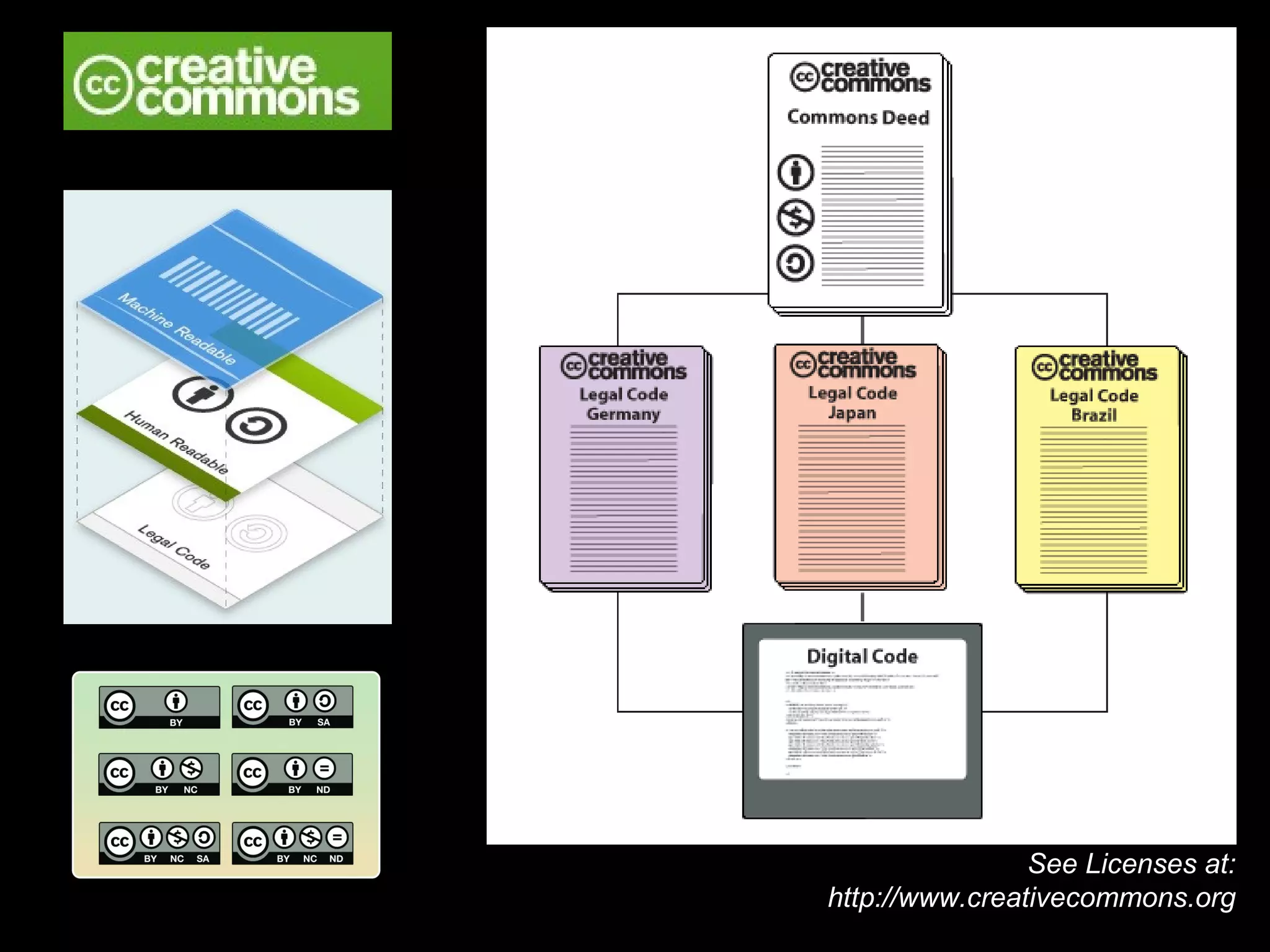
See Licenses at:
http://www.creativecommons.org
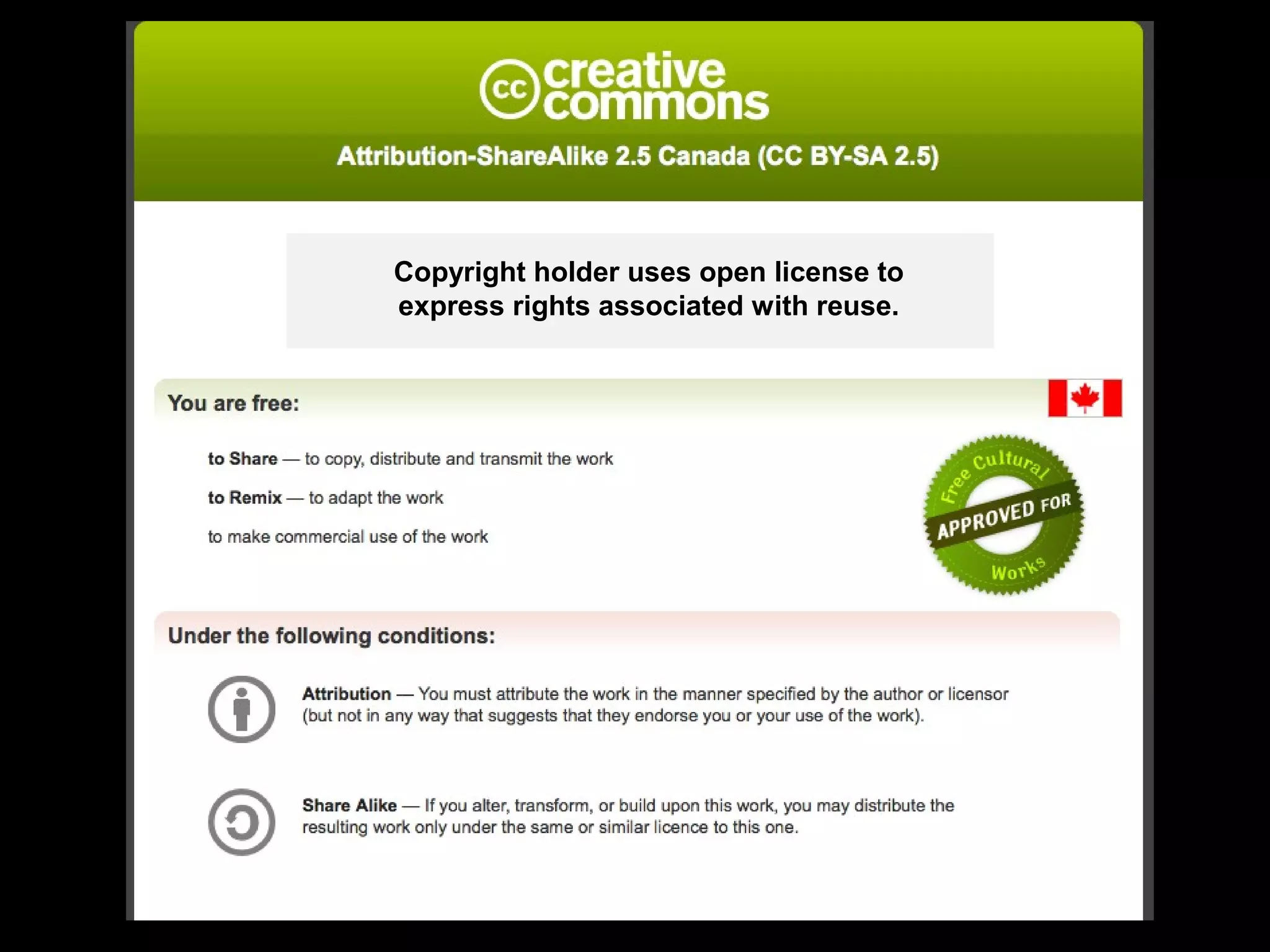
Copyright holder uses open license to
express rights associated with reuse.
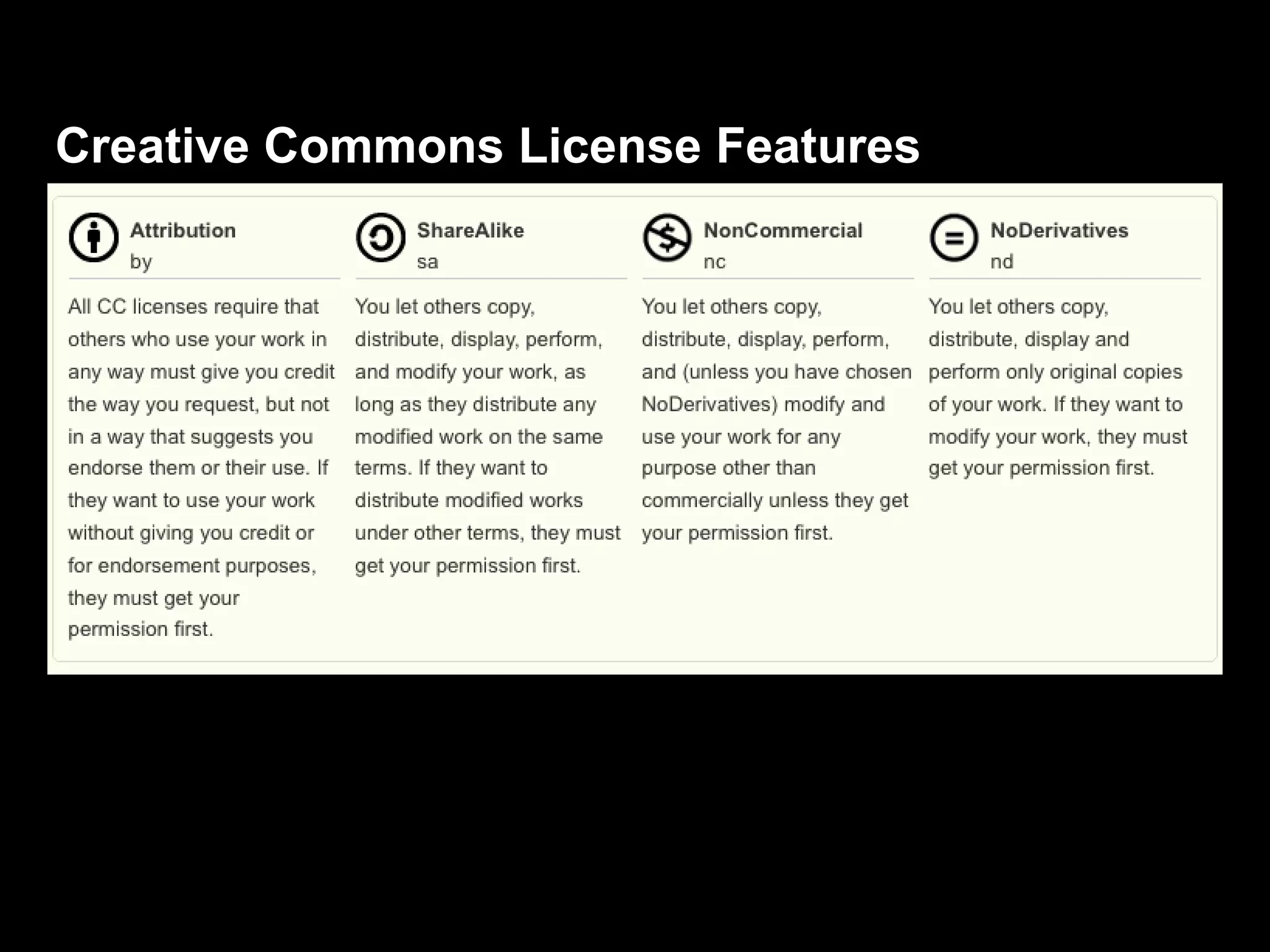
Creative Commons License Features
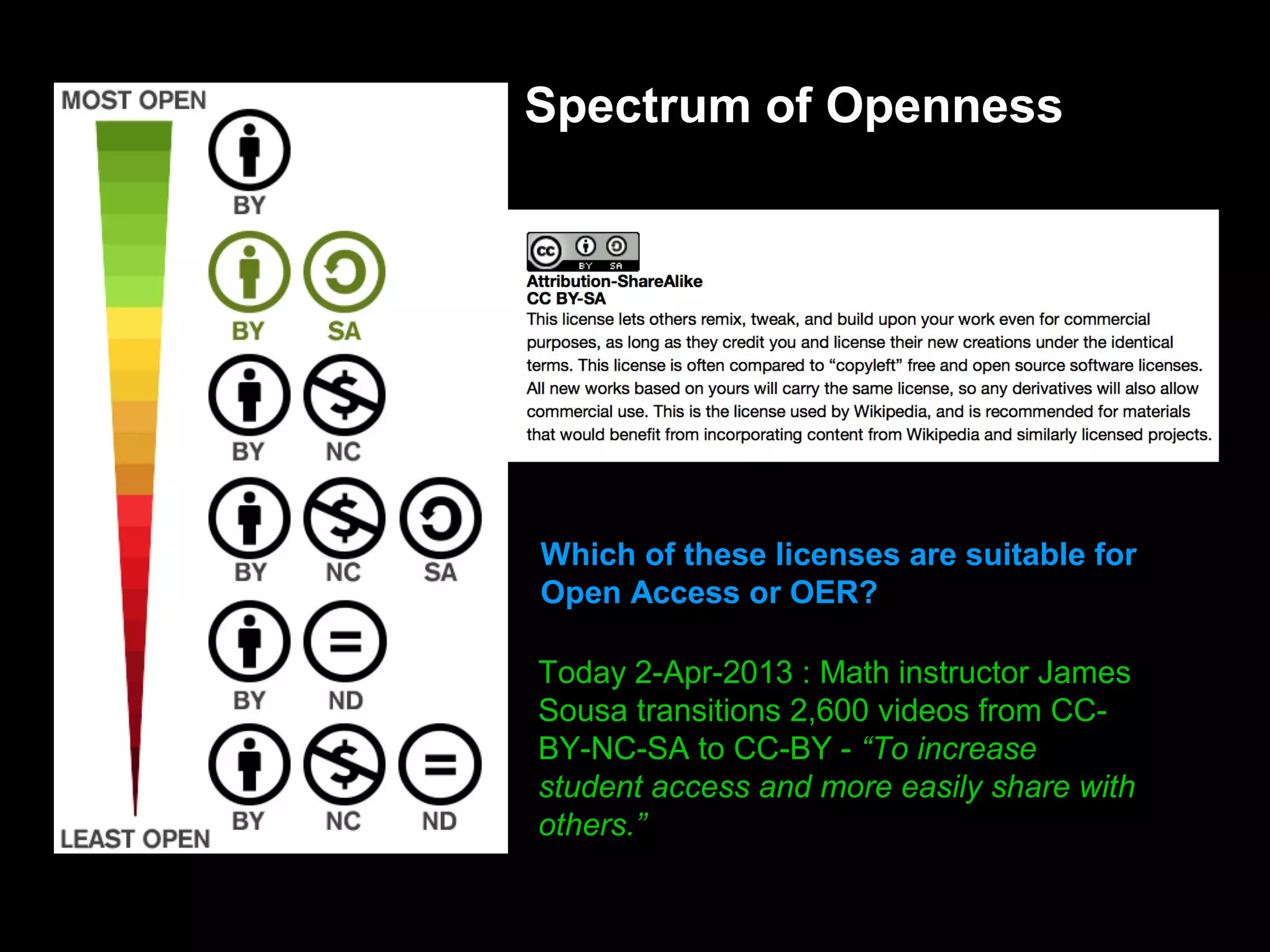
Spectrum of Openness


Which of these licenses are suitable for
Open Access or OER?

Today 2-Apr-2013 : Math instructor James
Sousa transitions 2,600 videos from CC-
BY-NC-SA to CC-BY - “To increase
student access and more easily share with
others.”
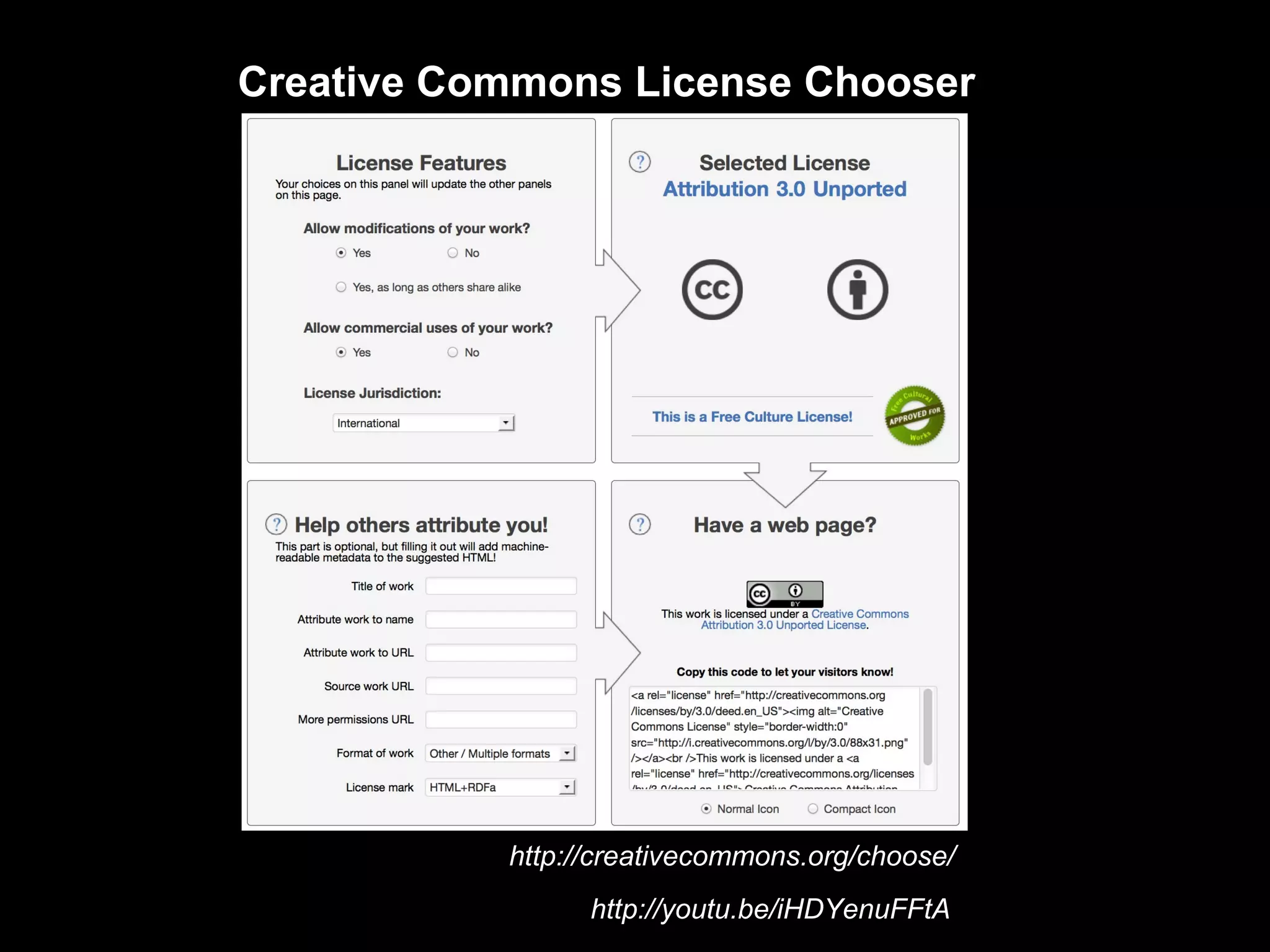
Creative Commons License Chooser


           http://creativecommons.org/choose/
                 http://youtu.be/iHDYenuFFtA
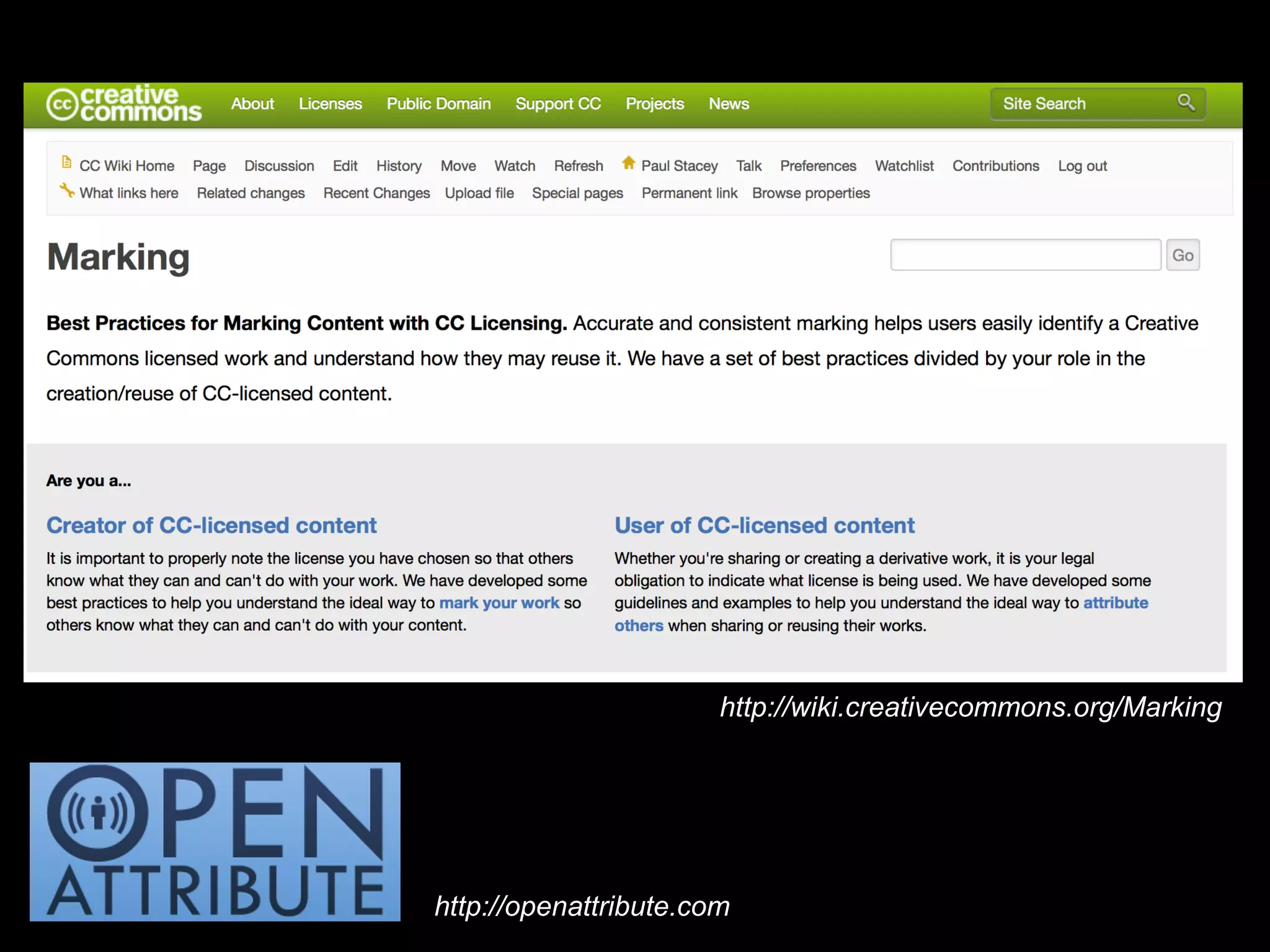
http://wiki.creativecommons.org/Marking


http://openattribute.com
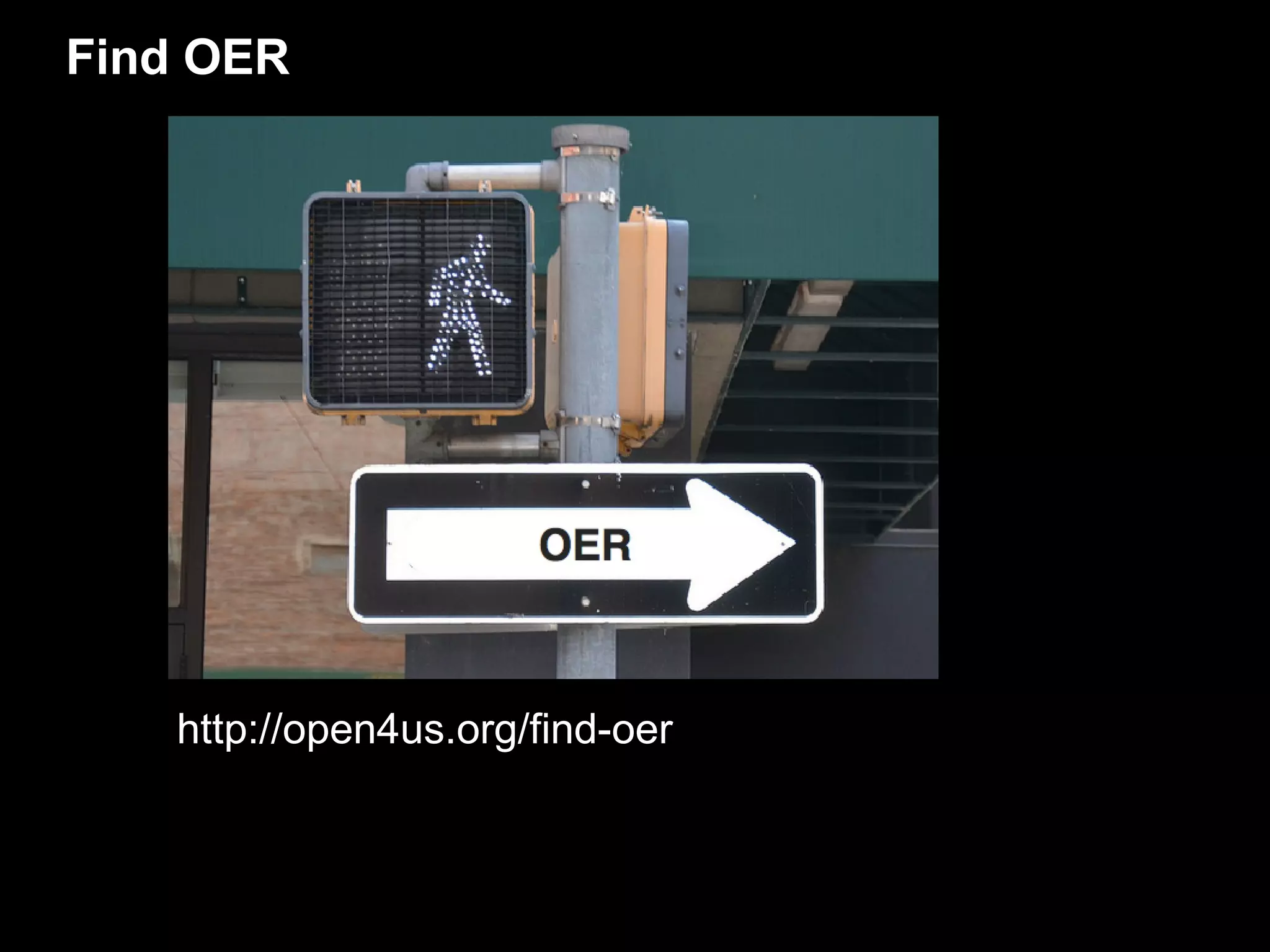
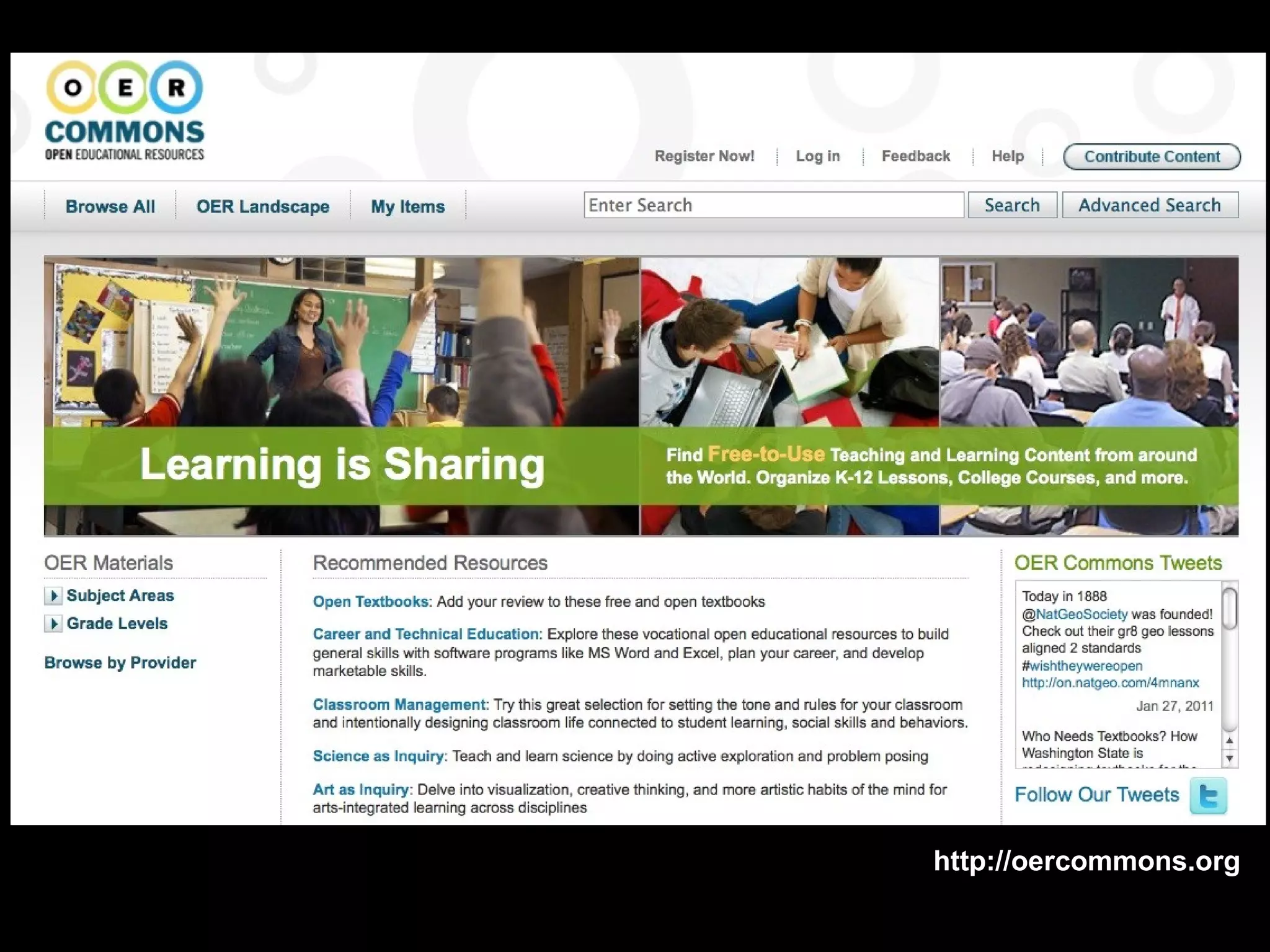
Find OER


   http://open4us.org/find-oer
http://oercommons.org
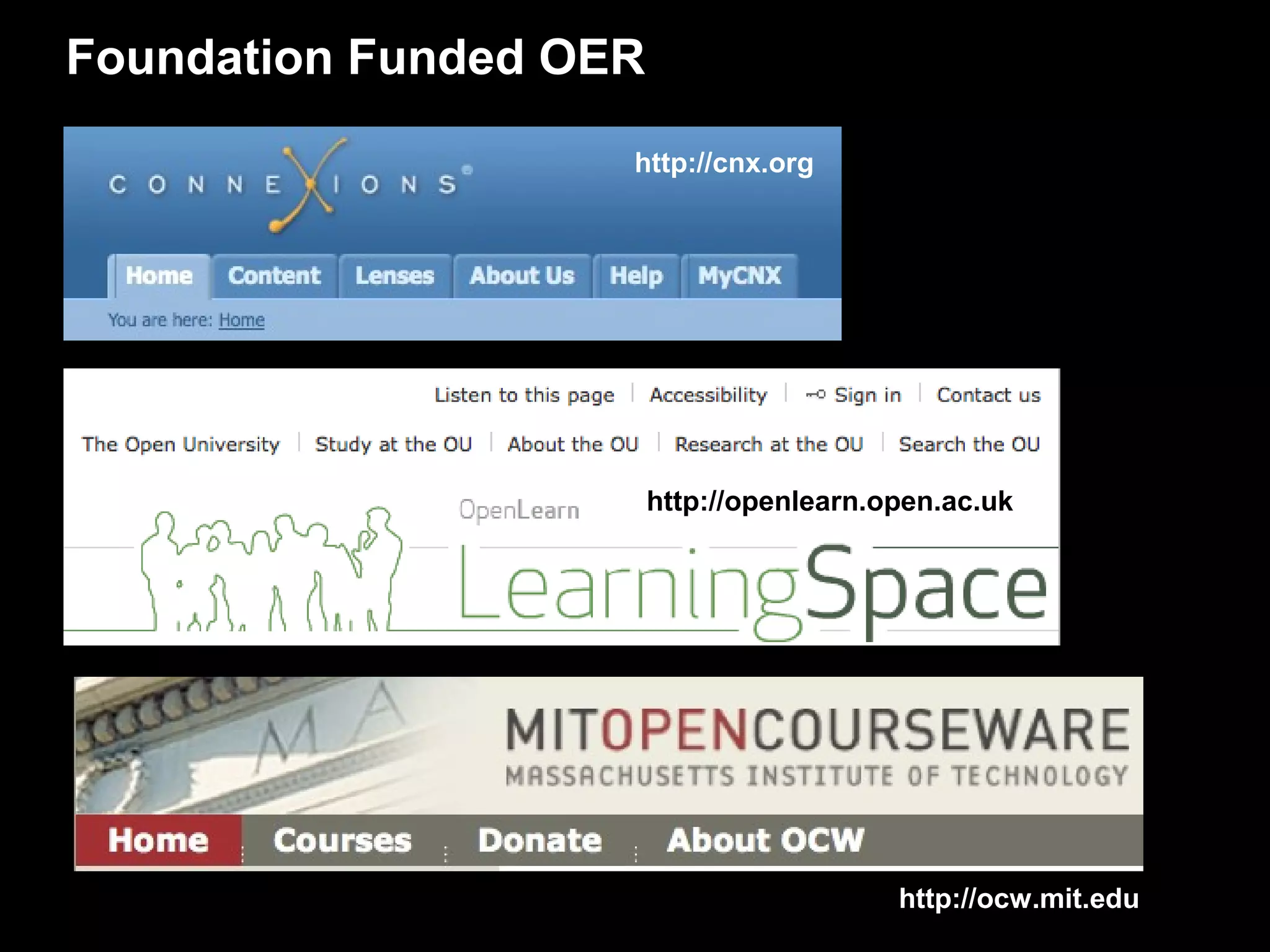
Foundation Funded OER
                    http://cnx.org


                        http://openlearn.open.ac.uk


                                          http://ocw.mit.edu
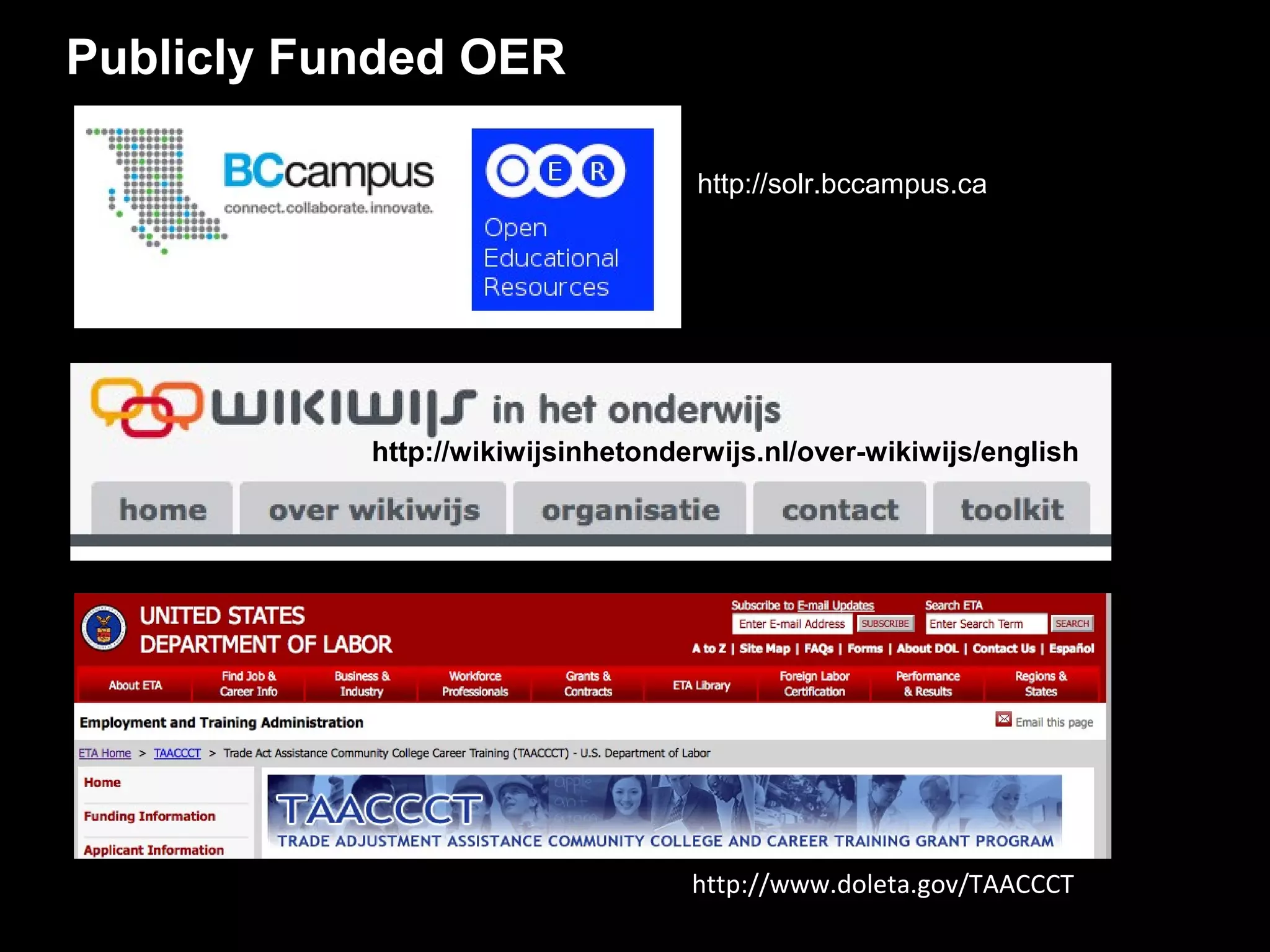
Publicly Funded OER

                                   http://solr.bccampus.ca


           http://wikiwijsinhetonderwijs.nl/over-wikiwijs/english


                                   http://www.doleta.gov/TAACCCT
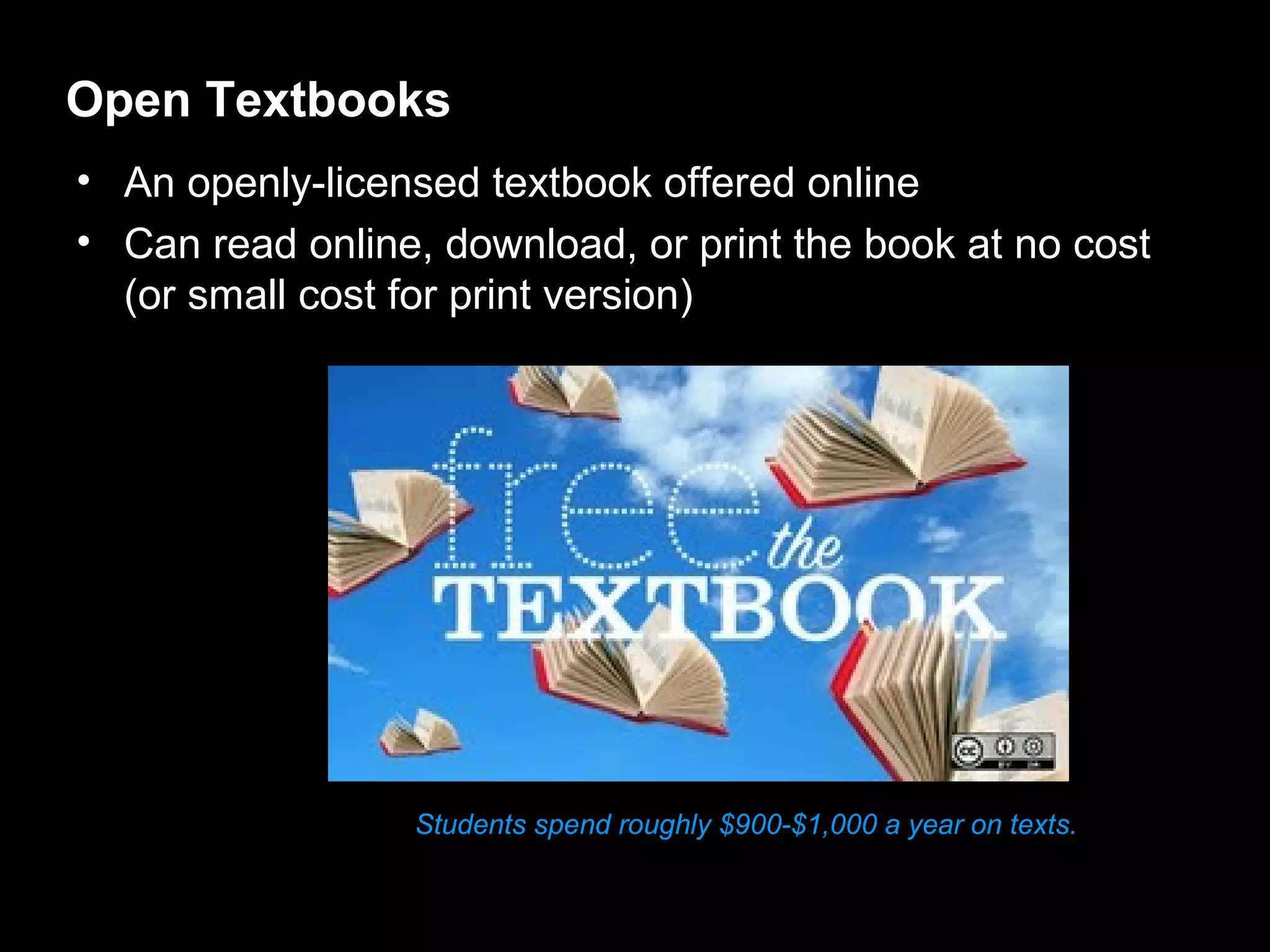
Open Textbooks
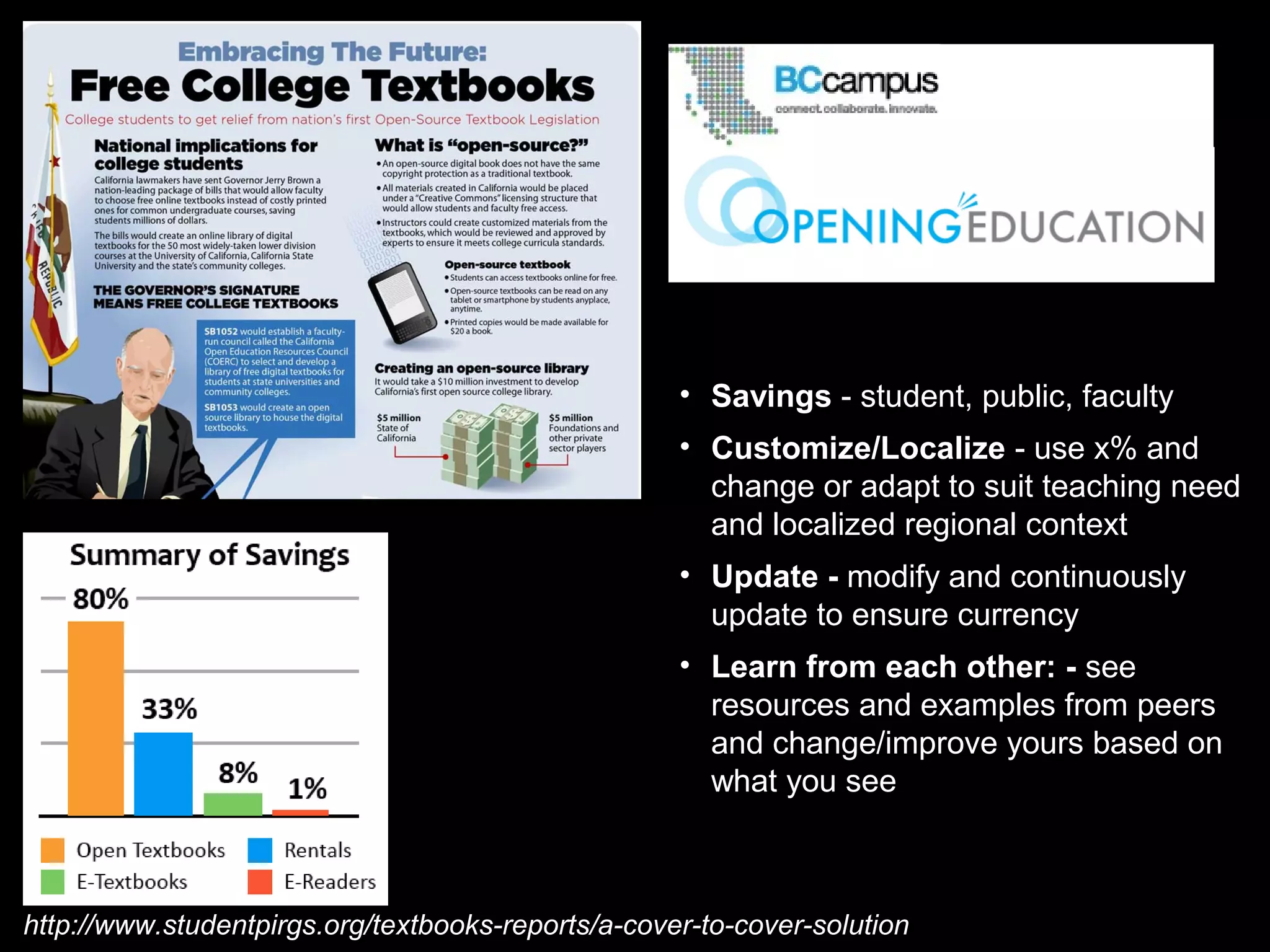
• An openly-licensed textbook offered online
• Can read online, download, or print the book at no cost
  (or small cost for print version)


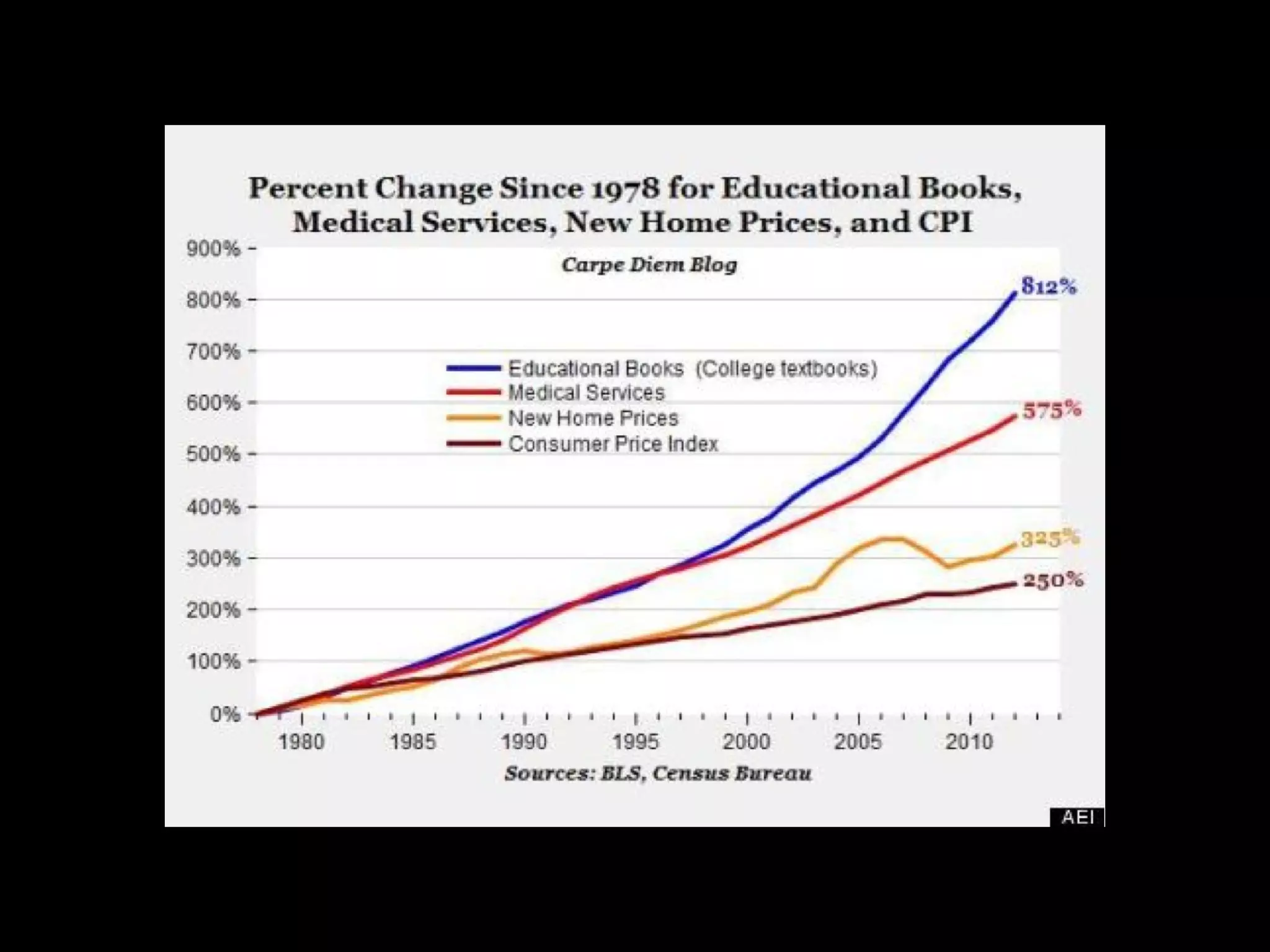
                 Students spend roughly $900-$1,000 a year on texts.
• Savings - student, public, faculty
                                                    • Customize/Localize - use x% and
                                                      change or adapt to suit teaching need
                                                      and localized regional context
                                                    • Update - modify and continuously
                                                      update to ensure currency
                                                    • Learn from each other: - see
                                                      resources and examples from peers
                                                      and change/improve yours based on
                                                      what you see


http://www.studentpirgs.org/textbooks-reports/a-cover-to-cover-solution
What does an Open Textbook Look Like?


  http://openstaxcollege.org/books


   http://www.saylor.org/category/o
            pen-textbook-challenge/


        http://projects.siyavula.com/
Open Pedagogies
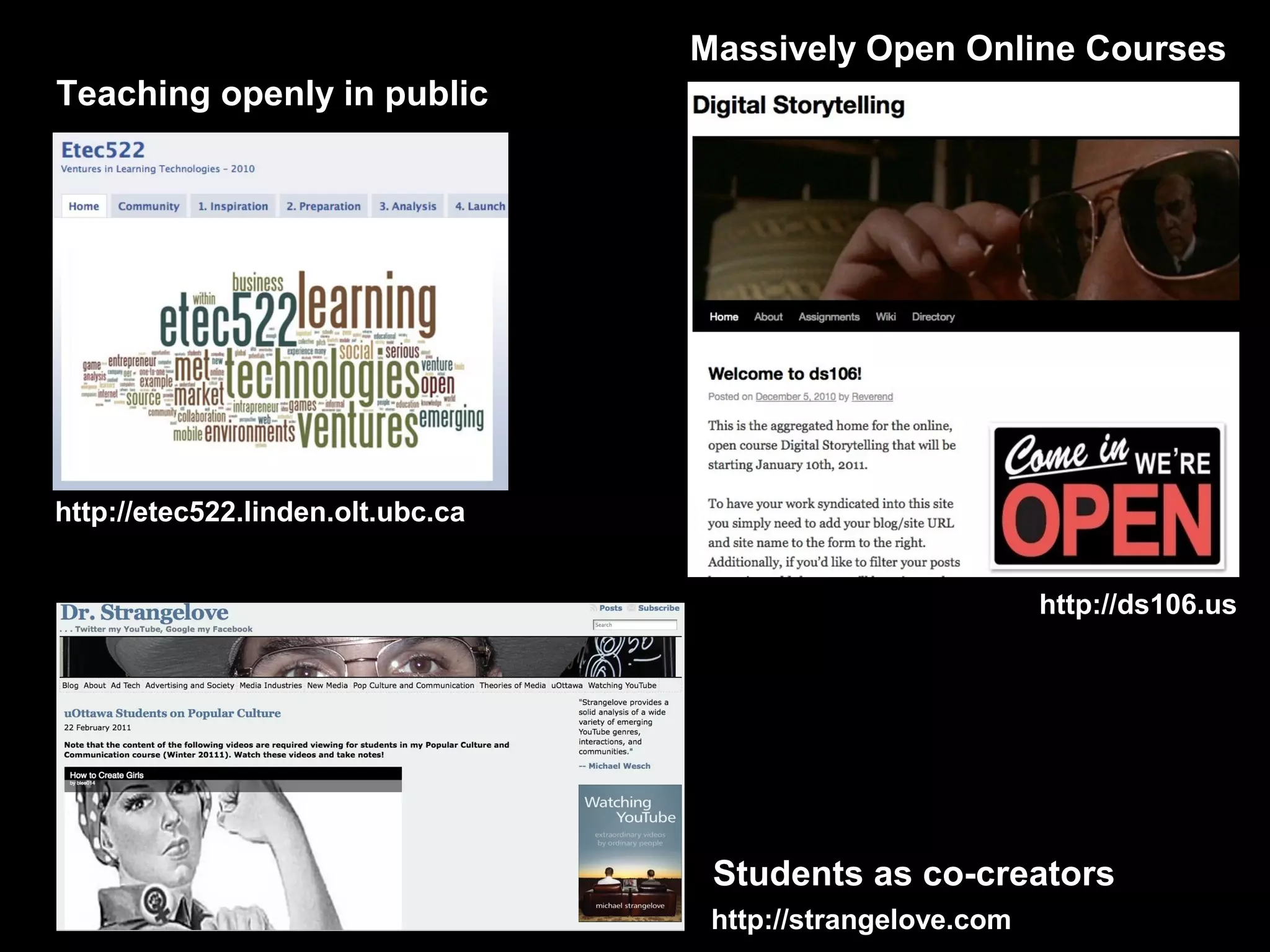
Massively Open Online Courses
Teaching openly in public


http://etec522.linden.olt.ubc.ca


                                                             http://ds106.us


                                    Students as co-creators
                                    http://strangelove.com
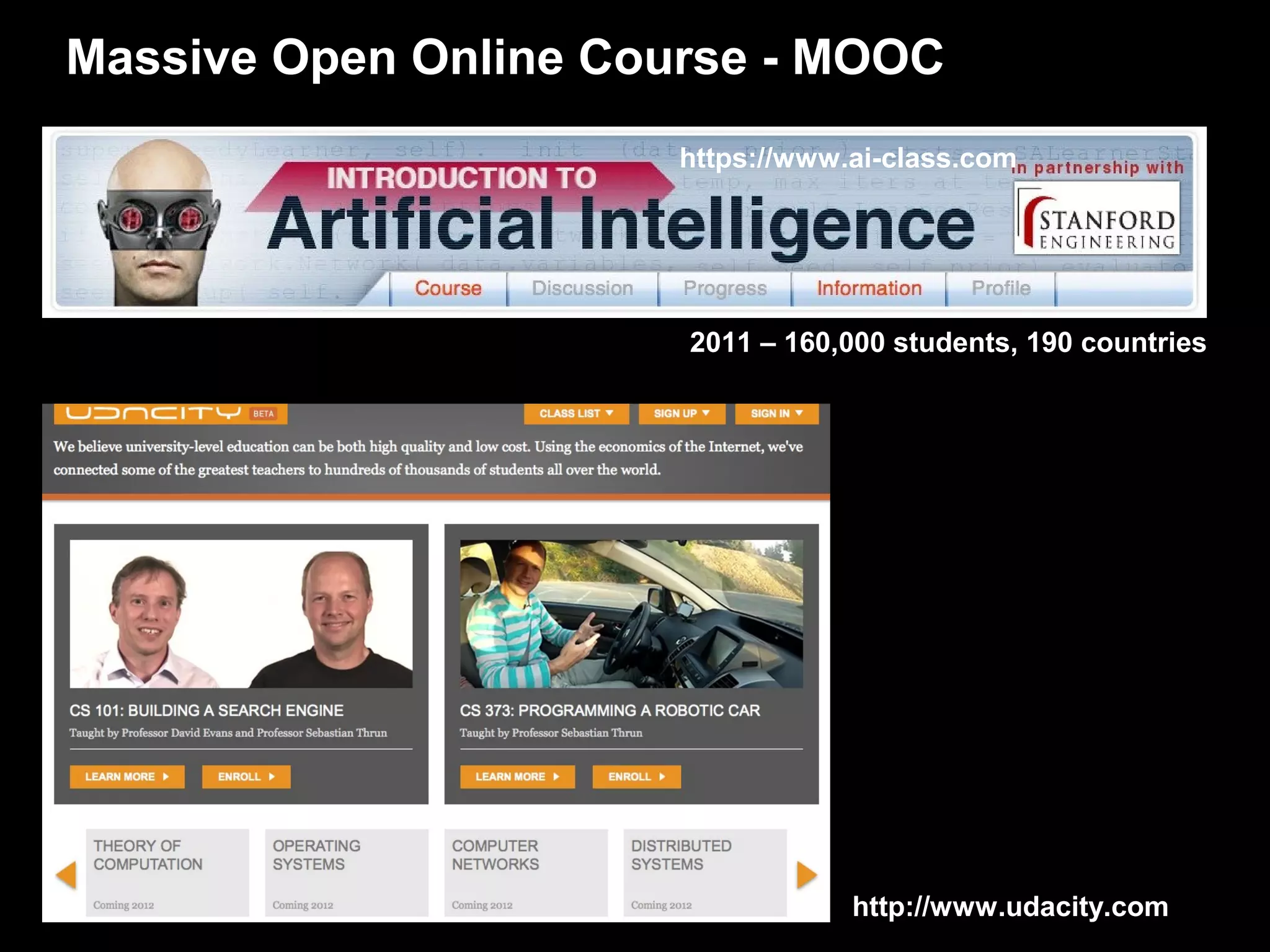
Massive Open Online Course - MOOC
                       https://www.ai-class.com


                       2011 – 160,000 students, 190 countries


                                   http://www.udacity.com
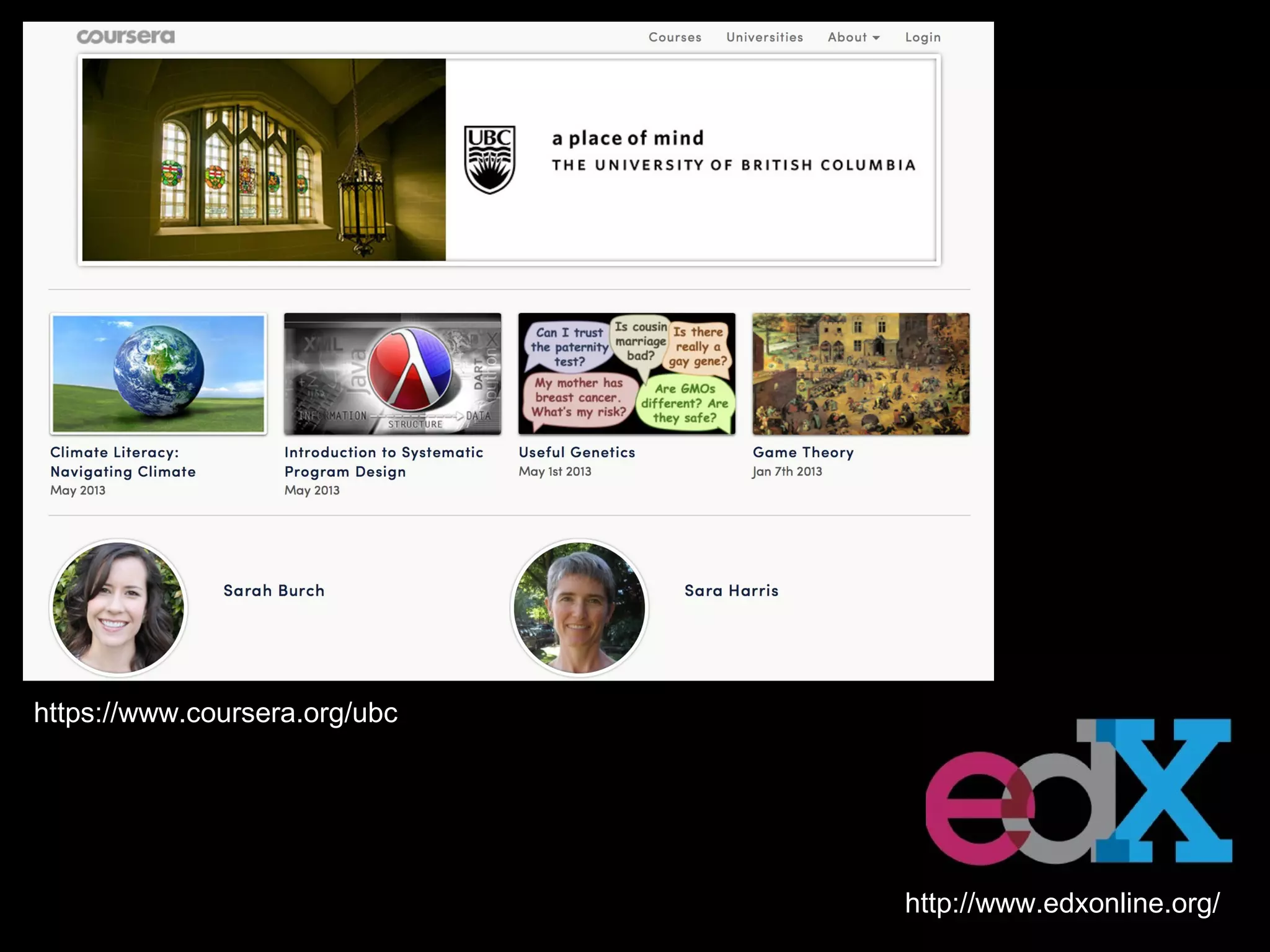
https://www.coursera.org/ubc


                               http://www.edxonline.org/
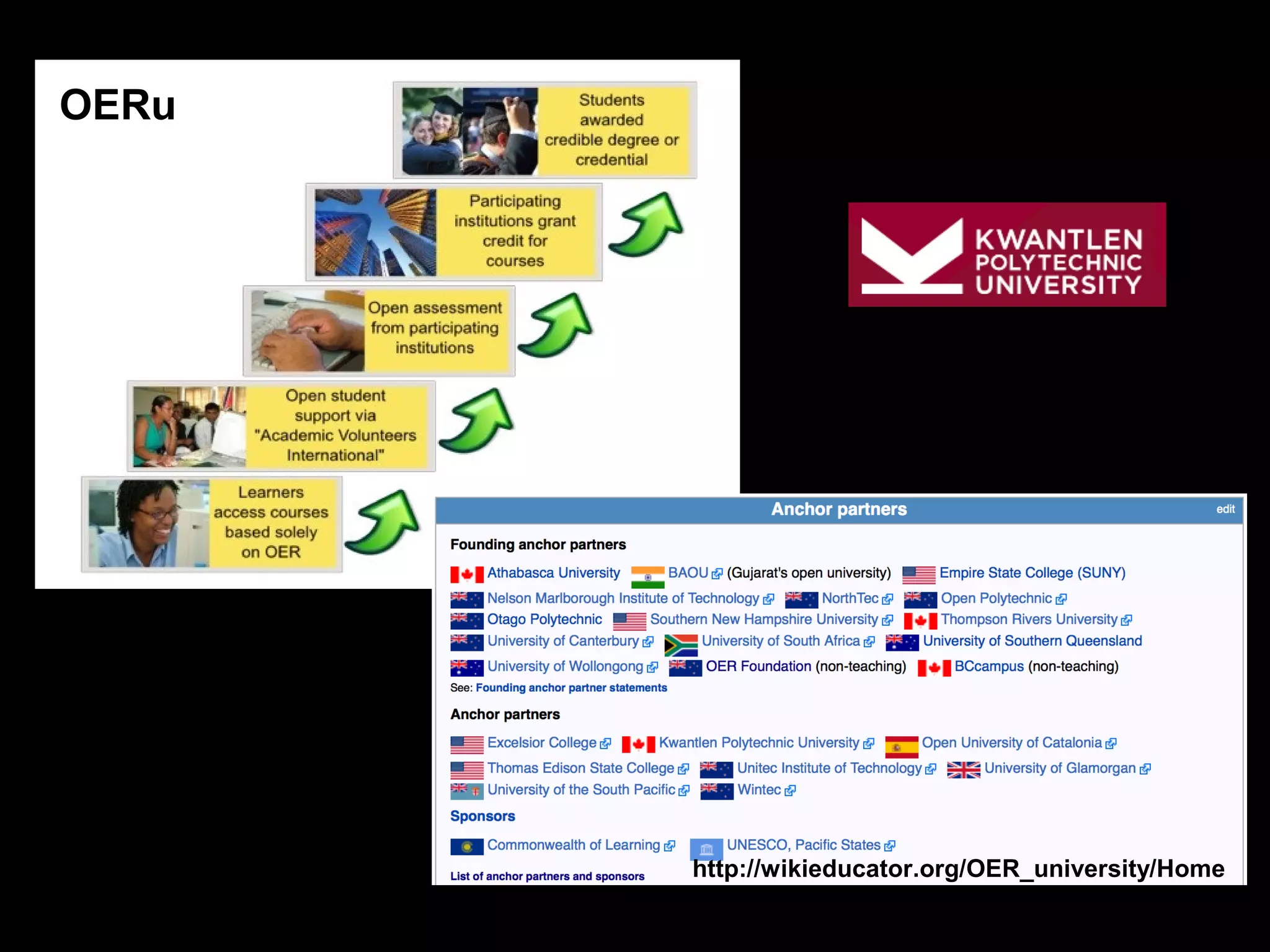
OERu


       http://wikieducator.org/OER_university/Home
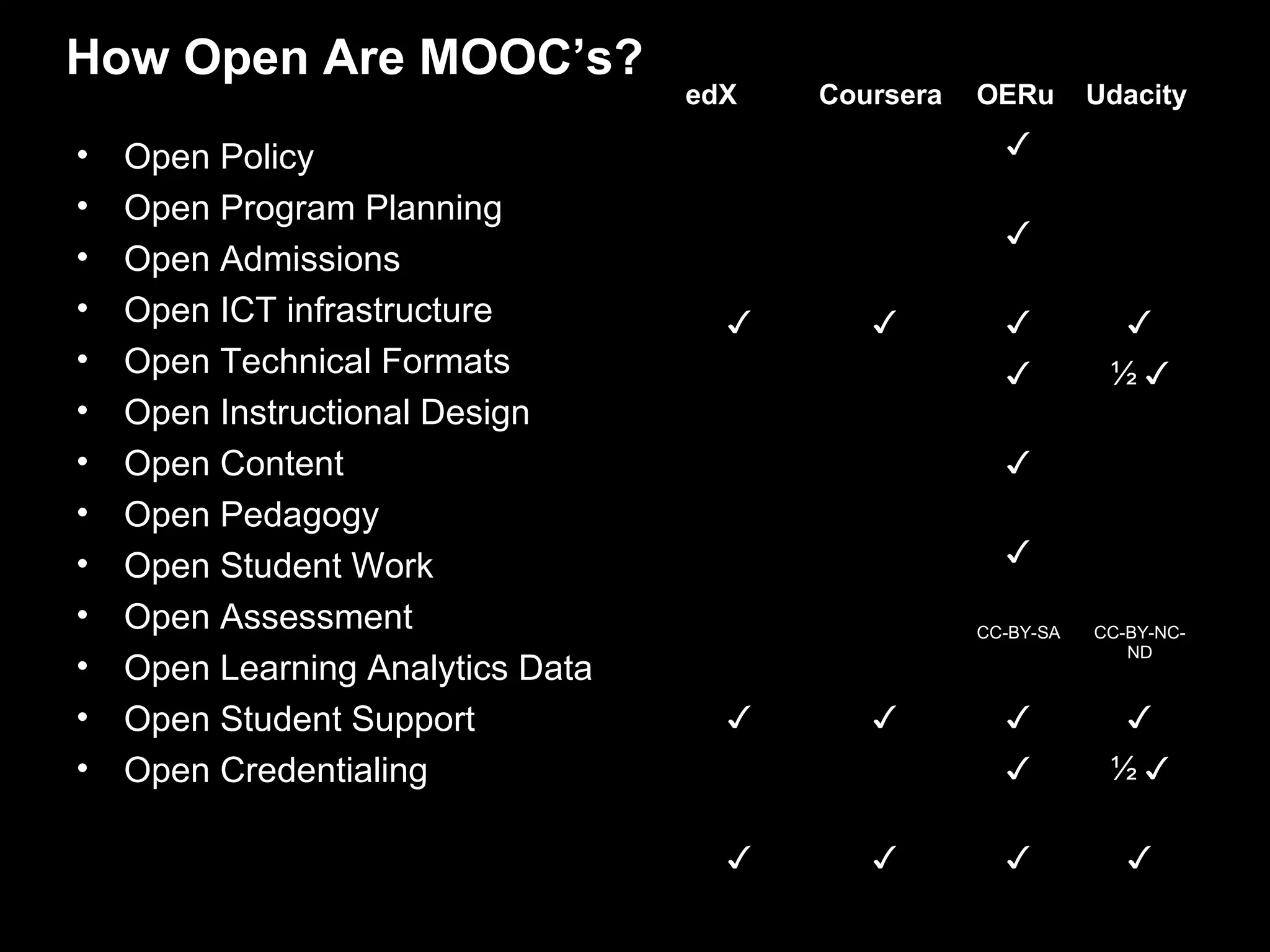
How Open Are MOOC’s?
                                   edX   Coursera   OERu       Udacity

•   Open Policy                                       ✓
•   Open Program Planning
                                                      ✓
•   Open Admissions
•   Open ICT infrastructure          ✓      ✓         ✓           ✓
•   Open Technical Formats                            ✓         ½✓
•   Open Instructional Design
•   Open Content                                      ✓
•   Open Pedagogy
•   Open Student Work                                 ✓

•   Open Assessment                                 CC-BY-SA   CC-BY-NC-
                                                                  ND
•   Open Learning Analytics Data
•   Open Student Support             ✓      ✓         ✓           ✓
•   Open Credentialing                                ✓         ½✓

                                     ✓      ✓         ✓           ✓
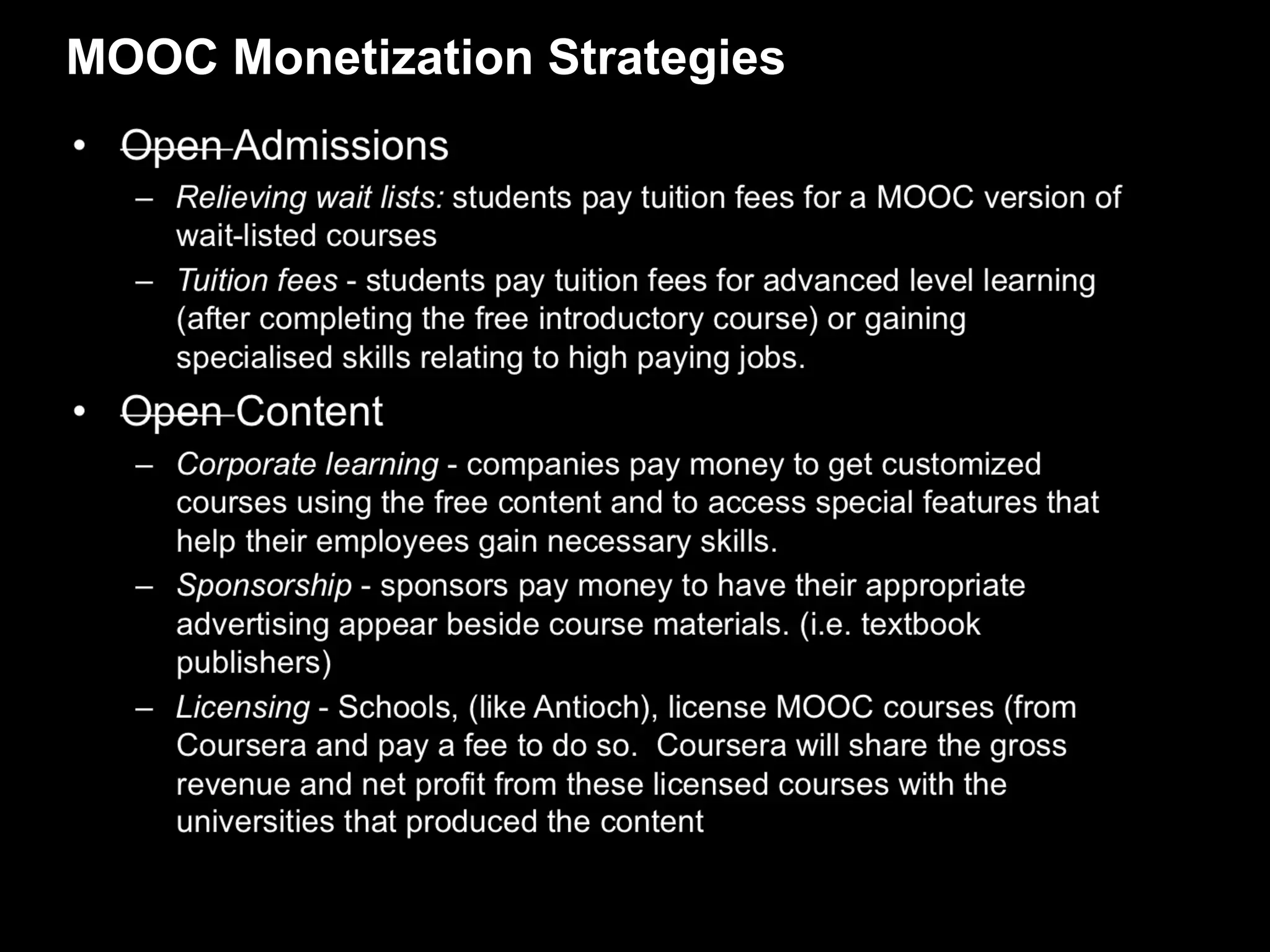
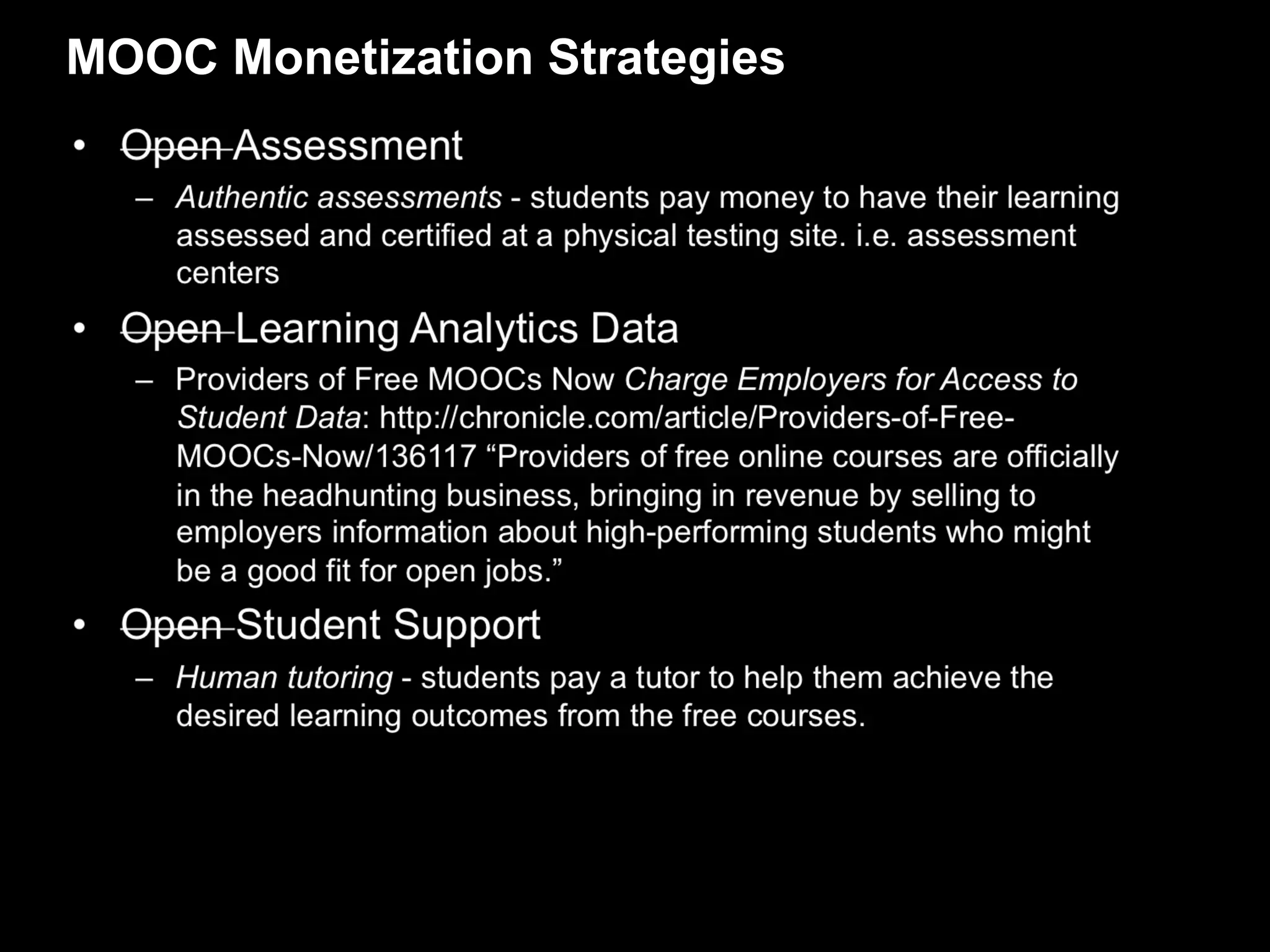
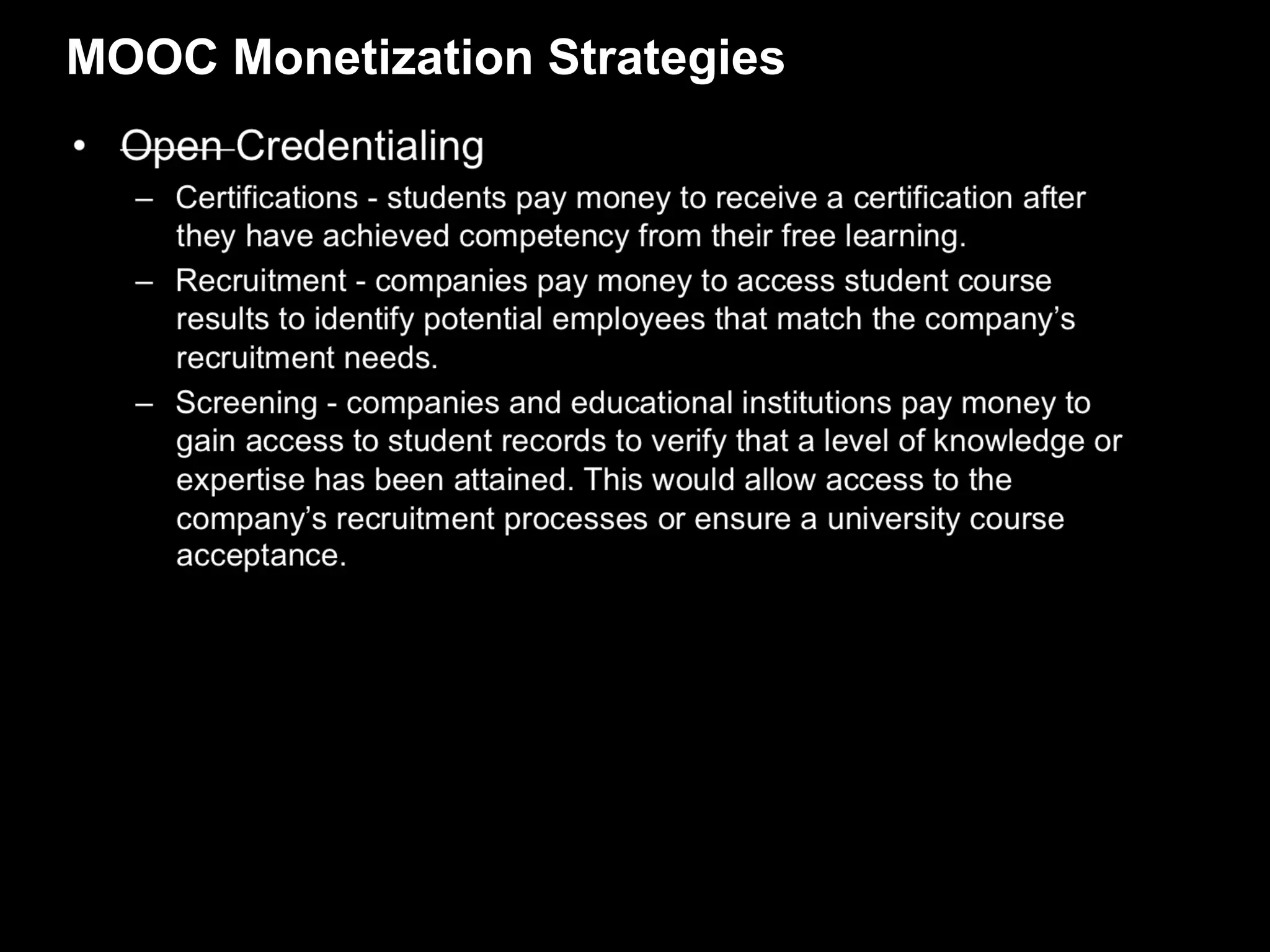
MOOC Monetization Strategies
Open Access


                          Open Pedagogies (& MOOC’s)
Open Data


                            Open Practices


Open Govt & Open Policy
Paul Stacey                                      Q&A
Creative Commons
web site: http://creativecommons.org
e-mail: pstacey@creativecommons.org
blog: http://edtechfrontier.com
presentation slides: http://www.slideshare.net/Paul_Stacey

Open Scenarios in Higher Education

  • 1.
    Open Scenarios In Higher Education Open/Closed / Antti T. Nissinen / CC BY Open Educational Resources (OER) Paul Stacey Open Textbooks 2-Apr-2013 Open Access MOOC’s Except where otherwise noted these Open Scenarios in Higher Education materials are licensed under a Creative Commons Attribution 3.0 Unported License (CC-BY)
  • 2.
    Develops, supports, &stewards legal and technical infrastructure that maximizes digital creativity, sharing, & innovation. Our vision is nothing less than realizing the full potential of the Internet – universal access to research, education, & full participation in culture, driving a new era of development, growth, & productivity.
  • 3.
    http://10.creativecommons.org http://www.creativecommons.org
  • 4.
    Access Copyright • June 2010 Interim tariff for 2011-13 • From $5 to $35/$45 per student • No catalog of collection – digital? • No financial justification • Contentious definitions of a copy • Extensive reporting and access rqts • Objections - CAUT, ACCC, AUCC, CLA, Canadian Alliance of Students, ... • Interrogatories • Opt outs – 34 and counting • U of T & Western deal $27.50 • AUCC – closed door deal $26 • ACCC – $10/student
  • 5.
    Copyright • Copyright Modernization Act – Bill C-32 now C-11 • Supreme Court - 6 criteria for evaluating fair dealing • Expansion of fair dealing to education, parody & satire • Remix provision – non-commercial mashups • Technical protection measures – digital lock rules • Supreme Court of Canada rulings on fair dealing and copyright summer 2012 Bill C-32 & C-11
  • 6.
    Social Engagement &Protest Michael Geist http://www.michaelgeist.ca Sam Trusow http://samtrosow.wordpress.com Howard Knopf http://excesscopyright.blogspot.ca
  • 8.
    Open Access Open Pedagogies (& MOOC’s) Open Data Open Practices Open Govt & Open Policy
  • 9.
    Common Attributes ofOpen • Free – public funding results in a public good • Access & use is explicitly expressed upfront – not dependent on access copyright, payment of fees, proprietary owner permission • Easily & quickly adapted • Customization & enhancements don't require large investments • Errors, improvements, & feature requests are openly shared & managed • Development, distribution & use is community/consortia based • Sustainability relies on sharing - resources, development, hosting & support • Users are developers
  • 11.
  • 12.
    Galleries, Libraries, http://figshare.com/ Archives & Museums http://openglam.org/
  • 13.
    Learning Analytics (whosedata? open data?)
  • 14.
    Open Access isthe principle that research should be accessible online, for free, immediately after publication. Practice There are two roads to OA: 1. the "golden road" of OA journal- publishing , where journals provide OA to their articles (either by charging the author-institution for Open Access refereeing/publishing outgoing articles instead of charging the user-institution for accessing incoming articles, or by simply making their online edition free for all) 2. the "green road" of OA self- archiving, where authors provide OA to their own published articles, through institutional repositories, or by making their own articles free for all.
  • 15.
    Open Access Journals http://www.doaj.org http://www.openj-gate.com
  • 18.
    Open Government Promote creative and innovative activities, which will deliver social and economic benefits. Make government more transparent and open in its activities, ensuring that the public are better informed about the work of the government and the public sector. Enable more civic and democratic engagement through social enterprise and voluntary and community activities. http://creativecommons.org/government
  • 19.
    2012 WORLD OERCONGRESS UNESCO, PARIS, JUNE 20-22, 2012 DRAFT DECLARATION a. Support the use of OER through the revision of policy regulating higher education b. Contribute to raising awareness of key OER issues c. Review national ICT/connectivity strategies for Higher Education d. Consider adapting open licensing frameworks e. Consider adopting open format standards f. Support institutional investments in curriculum design g. Support the sustainable production and sharing of learning materials h. Collaborate to find effective ways to harness OER.
  • 20.
  • 21.
  • 23.
  • 25.
    OER are teaching,learning, and research resources that reside in the public domain or have been released under an open license that permits their free use and re-purposing by others. Open educational resources include full courses and supplemental resources such as textbooks, images, videos, animations, simulations, assessments, … Core Concept OER are learning materials freely available under a license that allows you to: •Reuse •Revise •Remix •Redistribute
  • 26.
  • 27.
    Copyright holder usesopen license to express rights associated with reuse.
  • 28.
  • 29.
    Spectrum of Openness Whichof these licenses are suitable for Open Access or OER? Today 2-Apr-2013 : Math instructor James Sousa transitions 2,600 videos from CC- BY-NC-SA to CC-BY - “To increase student access and more easily share with others.”
  • 30.
    Creative Commons LicenseChooser http://creativecommons.org/choose/ http://youtu.be/iHDYenuFFtA
  • 31.
  • 32.
    Find OER http://open4us.org/find-oer
  • 33.
  • 34.
    Foundation Funded OER http://cnx.org http://openlearn.open.ac.uk http://ocw.mit.edu
  • 35.
    Publicly Funded OER http://solr.bccampus.ca http://wikiwijsinhetonderwijs.nl/over-wikiwijs/english http://www.doleta.gov/TAACCCT
  • 36.
    Open Textbooks • Anopenly-licensed textbook offered online • Can read online, download, or print the book at no cost (or small cost for print version) Students spend roughly $900-$1,000 a year on texts.
  • 38.
    • Savings -student, public, faculty • Customize/Localize - use x% and change or adapt to suit teaching need and localized regional context • Update - modify and continuously update to ensure currency • Learn from each other: - see resources and examples from peers and change/improve yours based on what you see http://www.studentpirgs.org/textbooks-reports/a-cover-to-cover-solution
  • 39.
    What does anOpen Textbook Look Like? http://openstaxcollege.org/books http://www.saylor.org/category/o pen-textbook-challenge/ http://projects.siyavula.com/
  • 40.
  • 41.
    Massively Open OnlineCourses Teaching openly in public http://etec522.linden.olt.ubc.ca http://ds106.us Students as co-creators http://strangelove.com
  • 42.
    Massive Open OnlineCourse - MOOC https://www.ai-class.com 2011 – 160,000 students, 190 countries http://www.udacity.com
  • 43.
    https://www.coursera.org/ubc http://www.edxonline.org/
  • 44.
    OERu http://wikieducator.org/OER_university/Home
  • 45.
    How Open AreMOOC’s? edX Coursera OERu Udacity • Open Policy ✓ • Open Program Planning ✓ • Open Admissions • Open ICT infrastructure ✓ ✓ ✓ ✓ • Open Technical Formats ✓ ½✓ • Open Instructional Design • Open Content ✓ • Open Pedagogy • Open Student Work ✓ • Open Assessment CC-BY-SA CC-BY-NC- ND • Open Learning Analytics Data • Open Student Support ✓ ✓ ✓ ✓ • Open Credentialing ✓ ½✓ ✓ ✓ ✓ ✓
  • 46.
  • 47.
  • 48.
  • 49.
    Open Access Open Pedagogies (& MOOC’s) Open Data Open Practices Open Govt & Open Policy
  • 50.
    Paul Stacey Q&A Creative Commons web site: http://creativecommons.org e-mail: pstacey@creativecommons.org blog: http://edtechfrontier.com presentation slides: http://www.slideshare.net/Paul_Stacey