OII 2013
Eric T. Meyer
Oxford Internet Institute, www.oii.ox.ac.uk @etmeyer
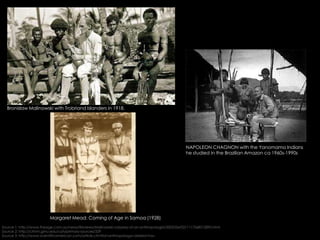
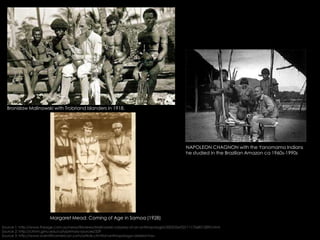
Bronislaw Malinowski with Trobriand Islanders in 1918.
Margaret Mead: Coming of Age in Samoa (1928)
NAPOLEON CHAGNON with the Yanomamo Indians
he studied in the Brazilian Amazon ca 1960s-1990s
Source 1: http://www.theage.com.au/news/Reviews/Malinowski-odyssey-of-an-anthropologist/2005/06/02/1117568312895.html
Source 2: http://chnm.gmu.edu/cyh/primary-sources/329
Source 3: http://www.scientificamerican.com/article.cfm?id=anthropologys-darkest-hou
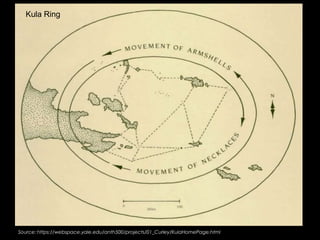
Kula Ring
Source: https://webspace.yale.edu/anth500/projects/01_Curley/KulaHomePage.html
Fieldwork boundaries
• As part of my doctoral studies, I conducted ethnographic
research last year at a university campus in Kathmandu,
Nepal. In the course of my fieldwork it turned out that the
majority of my research participants were very actively using
Facebook (usually relying on their mobile phones to access
the internet). I hadn't anticipated that this source of
information would play such a big role for my project and
hence want to see whether and how I could use the
information for my analysis. (Andrea Koelbel)
Questions from past students
Fieldwork boundaries
• A central question/issue I have, surrounds
how to study a viral "moment" or event in
social media space and, thus, how to best
conduct online ethnographic research
retroactively. (Starr Thibido)
• How does one combine online ethnography
with more traditional historical research
methods? Any particularly successful
examples? (Bo Ærenlund Sørensen)
Questions from past students
Fieldwork boundaries
• I am interested in capturing the frames the
actors use to represent the technology, as well
as their viewpoints, which I’d define as the
combination of a specific perspective on the
issue with the social position of the actor. How
would I capture this online ethnography? (Nils
Markusson)
Questions from past students
Understanding the field
• Is the problems with overcoming cultural
difference (and understanding a foreign
culture) different when working with online
rather than offline ethnography? (Bo
Ærenlund Sørensen)
Questions from past students
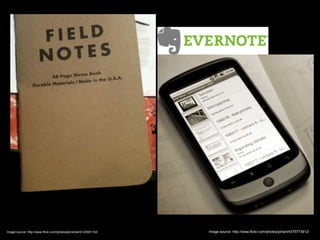
Image source: http://www.flickr.com/photos/jemshed/4123591152/ Image source: http://www.flickr.com/photos/johanl/4375773612/
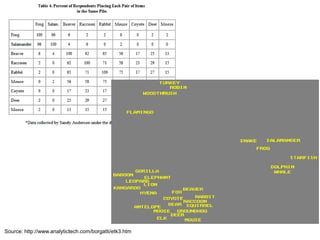
Source: http://www.analytictech.com/borgatti/etk3.htm
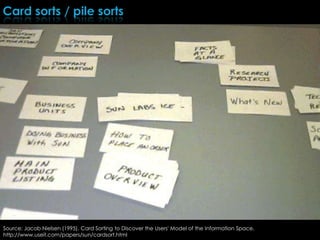
Source: Jacob Nielsen (1995). Card Sorting to Discover the Users' Model of the Information Space.
http://www.useit.com/papers/sun/cardsort.html
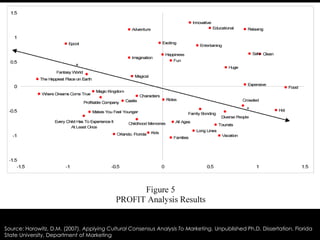
Source: Horowitz, D.M. (2007). Applying Cultural Consensus Analysis To Marketing. Unpublished Ph.D. Dissertation, Florida
State University, Department of Marketing
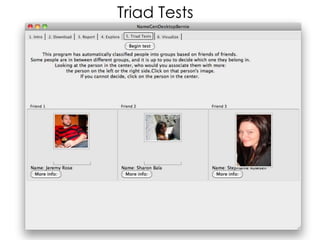
Triad Tests
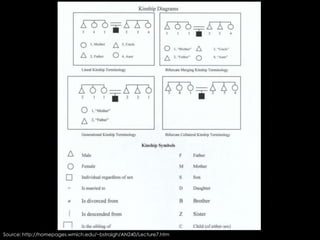
Source: http://homepages.wmich.edu/~bstraigh/AN240/Lecture7.htm
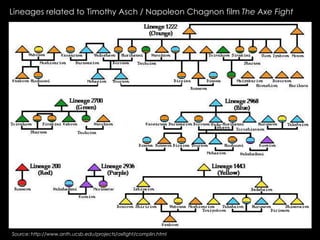
Source: http://www.anth.ucsb.edu/projects/axfight/complin.html
Lineages related to Timothy Asch / Napoleon Chagnon film The Axe Fight
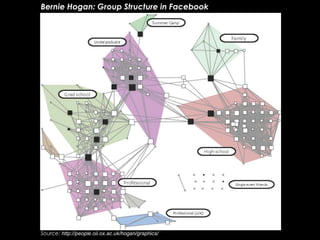
Source: http://people.oii.ox.ac.uk/hogan/graphics/
Bernie Hogan: Group Structure in Facebook
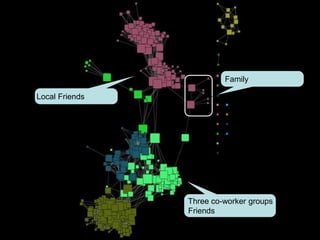
Family
Local Friends
Three co-worker groups
Friends
Method choices
• From where I sit it looks like some people
make node-and-spoke diagrams (or the
equivalent) and some cluster primary quotes
from participants. I’m interested in methods
that bring these approaches together in an
attempt to communicate what is happening
out there (David White)
Questions from past students
Dealing with data
• Secondly, I'm sure this is an issue most people face
when working in a 'black hole' medium, but I also still
wonder how to make sense of a specific topic when it
is (by nature) immersed in a world of endless big data.
As I hone in on certain themes and aspects of KONY
2012, how do I weigh and assess the risks of leaving
out other aspects of the movement? In other words,
what is the best way to set parameters of the research
to avoid 'information overload' without having a
negative impact on the quality/holistic portrait being
created (e.g. which, if any, participants/consumers of
the movement to follow, etc.)? (Starr Thibido)
Questions from past students
Tools and recording
• How do I record the information I get (print
screens?, shall I use any specific programme such
as Nvivo?) (Dominique Jolivet)
• I'd particularly like practical help eg. how to
record and reference online sources. Eg. is it
acceptable to take screenshots of relevant
sources as a record (particularly as eg. personal
websites often change), and what conventions
are best for referencing. (Kitty Wheater)
Questions from past students
 Lurking? (Hine)
 Hyperlink analysis (Webometric Analyst)
 Blog data: coding and deep reading
 Textual analysis
 Coding texts, notes, images, etc (NVivo, ATLAS.ti, MaxQDA, CAT,
Dedoose, others)
 Social networks (NodeXL, NameGen)
 Web archives (HTTrack)
 Twitter (TAGS)
 Email archives
 Photo voice / Photo-elicitation interviews
 Quant data (traces of activity like log files?)
 Crowd-sourcing
 Reflexivity – blogging your research (Wordpress / Livejournal)
 Dropbox to store and backup files
 Photobucket / Flickr
 MindMaps (Compendium, Vue)
 Fraps (capture game video)
 Greenshot or SnagIt or other programs to capture screen
(including scrolling windows)
 Evernote / OneNote / Zotero
 Freeforums
 Recording
 Livescribe pen
 Zoom and Olympus recorders
 iPhone
 Cameras / iPhones with GPS tagging on
Bronislaw Malinowski with Trobriand Islanders in 1918.
Margaret Mead: Coming of Age in Samoa (1928)
NAPOLEON CHAGNON with the Yanomamo Indians
he studied in the Brazilian Amazon ca 1960s-1990s
Source 1: http://www.theage.com.au/news/Reviews/Malinowski-odyssey-of-an-anthropologist/2005/06/02/1117568312895.html
Source 2: http://chnm.gmu.edu/cyh/primary-sources/329
Source 3: http://www.scientificamerican.com/article.cfm?id=anthropologys-darkest-hou
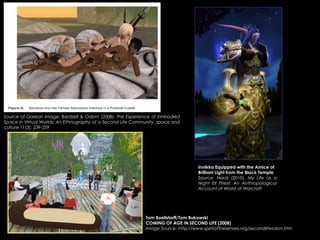
Innikka Equipped with the Amice of
Brilliant Light from the Black Temple
Source: Nardi (2010). My Life as a
Night Elf Priest: An Anthropological
Account of World of Warcraft
Source of Gorean image: Bardzell & Odom (2008). The Experience of Embodied
Space in Virtual Worlds: An Ethnography of a Second Life Community. space and
culture 11(3): 239-259
Tom Boellstorff/Tom Bukowski
COMING OF AGE IN SECOND LIFE (2008)
Image Source: http://www.spiritofthesenses.org/secondlifesalon.htm
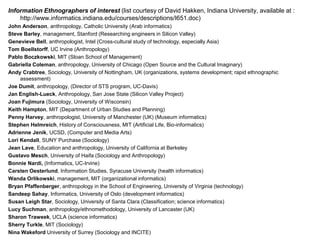
Information Ethnographers of interest (list courtesy of David Hakken, Indiana University, available at :
http://www.informatics.indiana.edu/courses/descriptions/I651.doc)
John Anderson, anthropology, Catholic University (Arab informatics)
Steve Barley, management, Stanford (Researching engineers in Silicon Valley)
Genevieve Bell, anthropologist, Intel (Cross-cultural study of technology, especially Asia)
Tom Boellstorff, UC Irvine (Anthropology)
Pablo Boczkowski, MIT (Sloan School of Management)
Gabriella Coleman, anthropology, University of Chicago (Open Source and the Cultural Imaginary)
Andy Crabtree, Sociology, University of Nottingham, UK (organizations, systems development; rapid ethnographic
assessment)
Joe Dumit, anthropology, (Director of STS program, UC-Davis)
Jan English-Lueck, Anthropology, San Jose State (Silicon Valley Project)
Joan Fujimura (Sociology, University of Wisconsin)
Keith Hampton, MIT (Department of Urban Studies and Planning)
Penny Harvey, anthropologist, University of Manchester (UK) (Museum informatics)
Stephen Helmreich, History of Consciousness, MIT (Artificial Life, Bio-informatics)
Adrienne Jenik, UCSD, (Computer and Media Arts)
Lori Kendall, SUNY Purchase (Sociology)
Jean Lave, Education and anthropology, University of California at Berkeley
Gustavo Mesch, University of Haifa (Sociology and Anthropology)
Bonnie Nardi, (Informatics, UC-Irvine)
Carsten Oesterlund, Information Studies, Syracuse University (health informatics)
Wanda Orlikowski, management, MIT (organizational informatics)
Bryan Pfaffenberger, anthropology in the School of Engineering, University of Virginia (technology)
Sandeep Sahay, Informatics, University of Oslo (development informatics)
Susan Leigh Star, Sociology, University of Santa Clara (Classification; science informatics)
Lucy Suchman, anthropology/ethnomethodology, University of Lancaster (UK)
Sharon Traweek, UCLA (science informatics)
Sherry Turkle, MIT (Sociology)
Nina Wakeford University of Surrey (Sociology and INCITE)
Ethics
• I worry about ethical issues: How to use
information found online & how to participate on
the online community (do you mention that you
are a researcher?) (Dominique Jolivet)
• How can one approach the ethics of online
ethnography? Should one inform people who are
being cited of the purposes of the research? Is it
ethical to directly quote from the web from
people who are not aware that their words are
being used for other purposes? Olivia
Sheringham
Questions from past students
Ethics
• Consideration of ethics of using eg. posts on
publicly-assessed messaging boards would
also be helpful. I would also add, discussion of
the ethics of 'participation' online as well as
'observation' - eg. construction of blogs in the
field, contributing to websites of organisations
that may form the object of study, etc. (Kitty
Wheater)
Questions from past students
Ethics
• I'm most interested in discussing the ethics of
conducting online ethnographic research,
particularly in relation to piracy and illegal activities.
My research will involve the close analysis of the
communities around BitTorrent trackers, so I'd also
like to discuss how to get informants in these
situations to trust researchers enough to provide
truthful answers. (Blake Durham)
Questions from past students
Authenticity and trust
• How valid is the information? People can say
anything on the internet – how can
researchers know that what they are reading
is a true representation of reality? Can you
really ‘trust’ online sources? What can you do
to make sure it is as reliable as possible?
(Olivia Sheringham)
Questions from past students
Eric T. Meyer
eric.meyer@oii.ox.ac.uk
http://www.oii.ox.ac.uk/people/?id=120
• In groups of two plan how you would go about doing a
virtual ethnography for one of the communities you
selected earlier.
• Think about:
– constructing the study
– gathering and managing the data
– the methods you would use
– analysing the data
– issues when analysing the data
– ethical considerations
Practical exercise: planning a
virtual ethnography

Meyer dig ethno_2013sdp

  • 1.
    OII 2013 Eric T.Meyer Oxford Internet Institute, www.oii.ox.ac.uk @etmeyer
  • 2.
    Bronislaw Malinowski withTrobriand Islanders in 1918. Margaret Mead: Coming of Age in Samoa (1928) NAPOLEON CHAGNON with the Yanomamo Indians he studied in the Brazilian Amazon ca 1960s-1990s Source 1: http://www.theage.com.au/news/Reviews/Malinowski-odyssey-of-an-anthropologist/2005/06/02/1117568312895.html Source 2: http://chnm.gmu.edu/cyh/primary-sources/329 Source 3: http://www.scientificamerican.com/article.cfm?id=anthropologys-darkest-hou
  • 4.
  • 6.
    Fieldwork boundaries • Aspart of my doctoral studies, I conducted ethnographic research last year at a university campus in Kathmandu, Nepal. In the course of my fieldwork it turned out that the majority of my research participants were very actively using Facebook (usually relying on their mobile phones to access the internet). I hadn't anticipated that this source of information would play such a big role for my project and hence want to see whether and how I could use the information for my analysis. (Andrea Koelbel) Questions from past students
  • 7.
    Fieldwork boundaries • Acentral question/issue I have, surrounds how to study a viral "moment" or event in social media space and, thus, how to best conduct online ethnographic research retroactively. (Starr Thibido) • How does one combine online ethnography with more traditional historical research methods? Any particularly successful examples? (Bo Ærenlund Sørensen) Questions from past students
  • 8.
    Fieldwork boundaries • Iam interested in capturing the frames the actors use to represent the technology, as well as their viewpoints, which I’d define as the combination of a specific perspective on the issue with the social position of the actor. How would I capture this online ethnography? (Nils Markusson) Questions from past students
  • 9.
    Understanding the field •Is the problems with overcoming cultural difference (and understanding a foreign culture) different when working with online rather than offline ethnography? (Bo Ærenlund Sørensen) Questions from past students
  • 11.
    Image source: http://www.flickr.com/photos/jemshed/4123591152/Image source: http://www.flickr.com/photos/johanl/4375773612/
  • 12.
  • 13.
    Source: Jacob Nielsen(1995). Card Sorting to Discover the Users' Model of the Information Space. http://www.useit.com/papers/sun/cardsort.html
  • 14.
    Source: Horowitz, D.M.(2007). Applying Cultural Consensus Analysis To Marketing. Unpublished Ph.D. Dissertation, Florida State University, Department of Marketing
  • 15.
  • 16.
  • 17.
    Source: http://www.anth.ucsb.edu/projects/axfight/complin.html Lineages relatedto Timothy Asch / Napoleon Chagnon film The Axe Fight
  • 18.
  • 19.
  • 20.
    Method choices • Fromwhere I sit it looks like some people make node-and-spoke diagrams (or the equivalent) and some cluster primary quotes from participants. I’m interested in methods that bring these approaches together in an attempt to communicate what is happening out there (David White) Questions from past students
  • 21.
    Dealing with data •Secondly, I'm sure this is an issue most people face when working in a 'black hole' medium, but I also still wonder how to make sense of a specific topic when it is (by nature) immersed in a world of endless big data. As I hone in on certain themes and aspects of KONY 2012, how do I weigh and assess the risks of leaving out other aspects of the movement? In other words, what is the best way to set parameters of the research to avoid 'information overload' without having a negative impact on the quality/holistic portrait being created (e.g. which, if any, participants/consumers of the movement to follow, etc.)? (Starr Thibido) Questions from past students
  • 22.
    Tools and recording •How do I record the information I get (print screens?, shall I use any specific programme such as Nvivo?) (Dominique Jolivet) • I'd particularly like practical help eg. how to record and reference online sources. Eg. is it acceptable to take screenshots of relevant sources as a record (particularly as eg. personal websites often change), and what conventions are best for referencing. (Kitty Wheater) Questions from past students

  • 23.
     Lurking? (Hine) Hyperlink analysis (Webometric Analyst)  Blog data: coding and deep reading  Textual analysis  Coding texts, notes, images, etc (NVivo, ATLAS.ti, MaxQDA, CAT, Dedoose, others)  Social networks (NodeXL, NameGen)  Web archives (HTTrack)  Twitter (TAGS)  Email archives  Photo voice / Photo-elicitation interviews  Quant data (traces of activity like log files?)  Crowd-sourcing  Reflexivity – blogging your research (Wordpress / Livejournal)
  • 24.
     Dropbox tostore and backup files  Photobucket / Flickr  MindMaps (Compendium, Vue)  Fraps (capture game video)  Greenshot or SnagIt or other programs to capture screen (including scrolling windows)  Evernote / OneNote / Zotero  Freeforums  Recording  Livescribe pen  Zoom and Olympus recorders  iPhone  Cameras / iPhones with GPS tagging on
  • 26.
    Bronislaw Malinowski withTrobriand Islanders in 1918. Margaret Mead: Coming of Age in Samoa (1928) NAPOLEON CHAGNON with the Yanomamo Indians he studied in the Brazilian Amazon ca 1960s-1990s Source 1: http://www.theage.com.au/news/Reviews/Malinowski-odyssey-of-an-anthropologist/2005/06/02/1117568312895.html Source 2: http://chnm.gmu.edu/cyh/primary-sources/329 Source 3: http://www.scientificamerican.com/article.cfm?id=anthropologys-darkest-hou
  • 27.
    Innikka Equipped withthe Amice of Brilliant Light from the Black Temple Source: Nardi (2010). My Life as a Night Elf Priest: An Anthropological Account of World of Warcraft Source of Gorean image: Bardzell & Odom (2008). The Experience of Embodied Space in Virtual Worlds: An Ethnography of a Second Life Community. space and culture 11(3): 239-259 Tom Boellstorff/Tom Bukowski COMING OF AGE IN SECOND LIFE (2008) Image Source: http://www.spiritofthesenses.org/secondlifesalon.htm
  • 29.
    Information Ethnographers ofinterest (list courtesy of David Hakken, Indiana University, available at : http://www.informatics.indiana.edu/courses/descriptions/I651.doc) John Anderson, anthropology, Catholic University (Arab informatics) Steve Barley, management, Stanford (Researching engineers in Silicon Valley) Genevieve Bell, anthropologist, Intel (Cross-cultural study of technology, especially Asia) Tom Boellstorff, UC Irvine (Anthropology) Pablo Boczkowski, MIT (Sloan School of Management) Gabriella Coleman, anthropology, University of Chicago (Open Source and the Cultural Imaginary) Andy Crabtree, Sociology, University of Nottingham, UK (organizations, systems development; rapid ethnographic assessment) Joe Dumit, anthropology, (Director of STS program, UC-Davis) Jan English-Lueck, Anthropology, San Jose State (Silicon Valley Project) Joan Fujimura (Sociology, University of Wisconsin) Keith Hampton, MIT (Department of Urban Studies and Planning) Penny Harvey, anthropologist, University of Manchester (UK) (Museum informatics) Stephen Helmreich, History of Consciousness, MIT (Artificial Life, Bio-informatics) Adrienne Jenik, UCSD, (Computer and Media Arts) Lori Kendall, SUNY Purchase (Sociology) Jean Lave, Education and anthropology, University of California at Berkeley Gustavo Mesch, University of Haifa (Sociology and Anthropology) Bonnie Nardi, (Informatics, UC-Irvine) Carsten Oesterlund, Information Studies, Syracuse University (health informatics) Wanda Orlikowski, management, MIT (organizational informatics) Bryan Pfaffenberger, anthropology in the School of Engineering, University of Virginia (technology) Sandeep Sahay, Informatics, University of Oslo (development informatics) Susan Leigh Star, Sociology, University of Santa Clara (Classification; science informatics) Lucy Suchman, anthropology/ethnomethodology, University of Lancaster (UK) Sharon Traweek, UCLA (science informatics) Sherry Turkle, MIT (Sociology) Nina Wakeford University of Surrey (Sociology and INCITE)
  • 31.
    Ethics • I worryabout ethical issues: How to use information found online & how to participate on the online community (do you mention that you are a researcher?) (Dominique Jolivet) • How can one approach the ethics of online ethnography? Should one inform people who are being cited of the purposes of the research? Is it ethical to directly quote from the web from people who are not aware that their words are being used for other purposes? Olivia Sheringham Questions from past students
  • 32.
    Ethics • Consideration ofethics of using eg. posts on publicly-assessed messaging boards would also be helpful. I would also add, discussion of the ethics of 'participation' online as well as 'observation' - eg. construction of blogs in the field, contributing to websites of organisations that may form the object of study, etc. (Kitty Wheater) Questions from past students
  • 33.
    Ethics • I'm mostinterested in discussing the ethics of conducting online ethnographic research, particularly in relation to piracy and illegal activities. My research will involve the close analysis of the communities around BitTorrent trackers, so I'd also like to discuss how to get informants in these situations to trust researchers enough to provide truthful answers. (Blake Durham) Questions from past students
  • 34.
    Authenticity and trust •How valid is the information? People can say anything on the internet – how can researchers know that what they are reading is a true representation of reality? Can you really ‘trust’ online sources? What can you do to make sure it is as reliable as possible? (Olivia Sheringham) Questions from past students
  • 35.
  • 36.
    • In groupsof two plan how you would go about doing a virtual ethnography for one of the communities you selected earlier. • Think about: – constructing the study – gathering and managing the data – the methods you would use – analysing the data – issues when analysing the data – ethical considerations Practical exercise: planning a virtual ethnography