Open Access Introduction
• Rafia Mirza
• Digital Humanities Librarian
• Clarke Iakovakis
• Data & eScience Librarian

• Kristine Witkowski
• Electronic Thesis and Dissertation Specialist
3/5/2014

1
Outline

•
•
•
•
•
•
•

University Presses
Traditional (or Conventional) Publishing
Serials & Monographs issues
Gold and Green OA
Institutional Repositories
OA and the Humanities
MLA & OA

Image via Open access Week
http://www.openaccessweek.org/p
age/englishhigh-resolution-1

3/5/2014

2
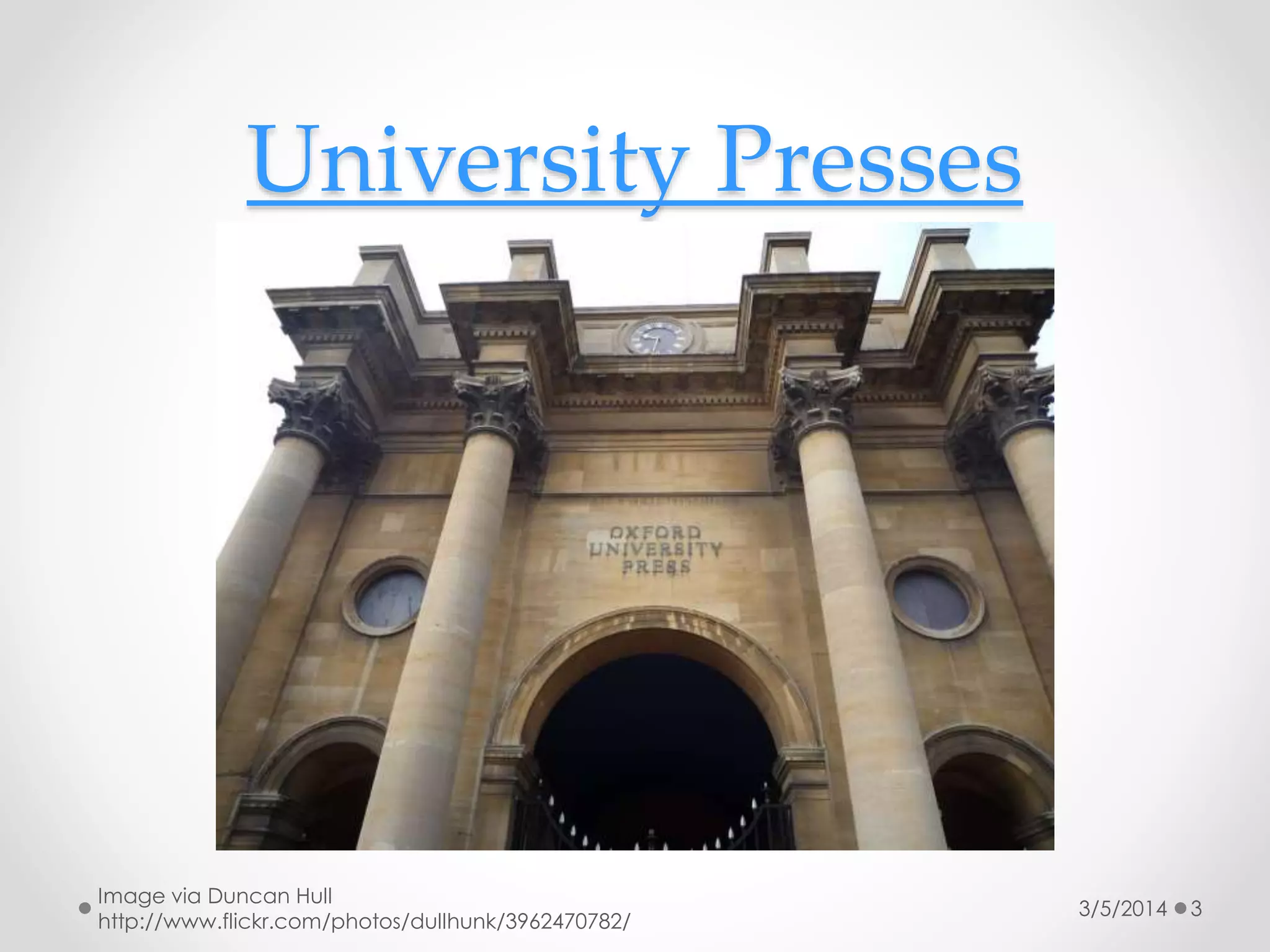
University Presses

Image via Duncan Hull
http://www.flickr.com/photos/dullhunk/3962470782/

3/5/2014

3
What is traditional or
conventional publishing?
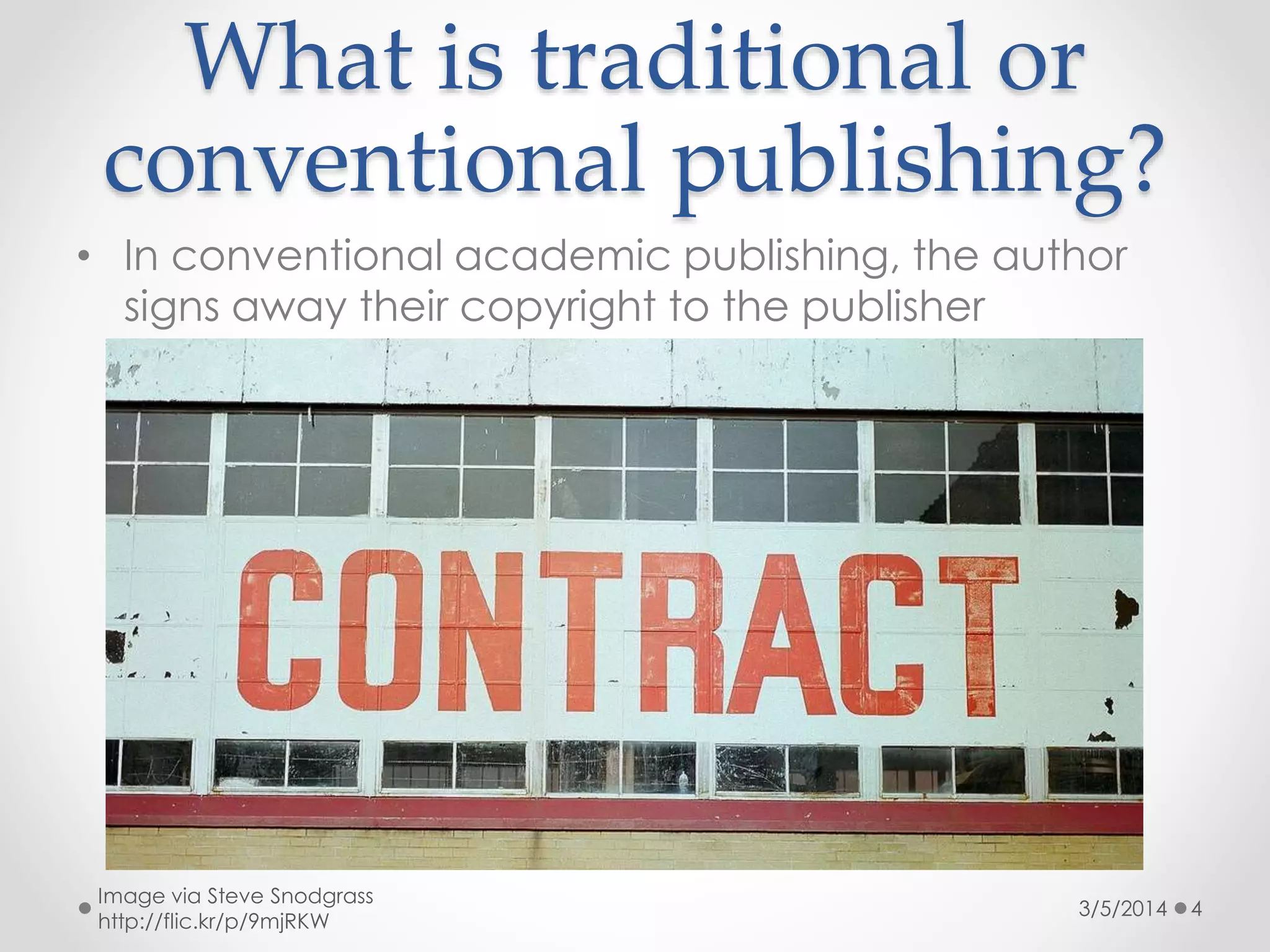
• In conventional academic publishing, the author
signs away their copyright to the publisher

Image via Steve Snodgrass
http://flic.kr/p/9mjRKW

3/5/2014

4
What is traditional or
conventional publishing?
• When you sign away your copyright, you need to
get permission from the publisher
o to put your article on reserve,
o to publish derivative works
o to post it on academic sites like academia.edu

Image via Mike Seyfang
http://flic.kr/p/5AXf6j

3/5/2014

5
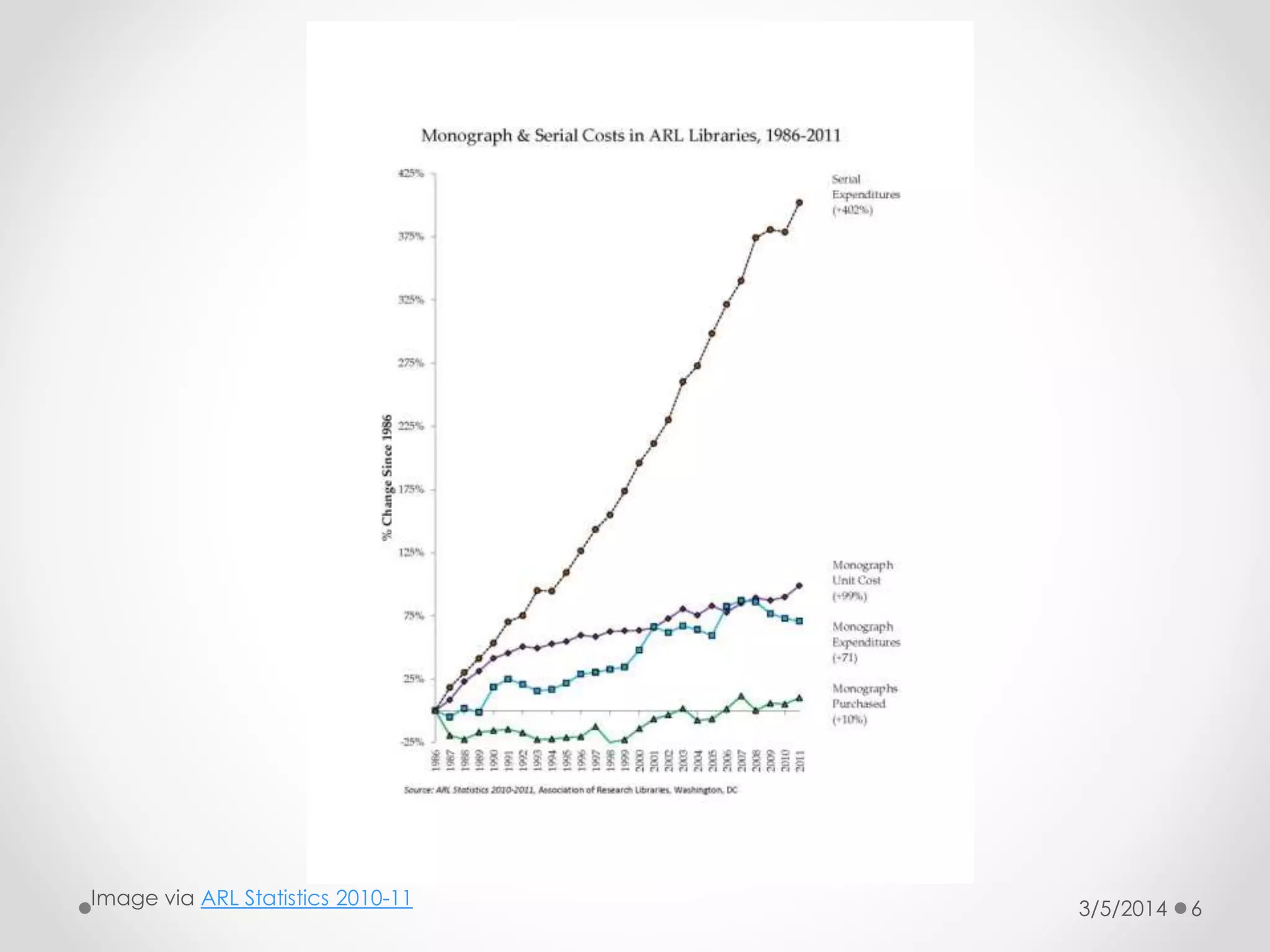
Image via ARL Statistics 2010-11

3/5/2014

6
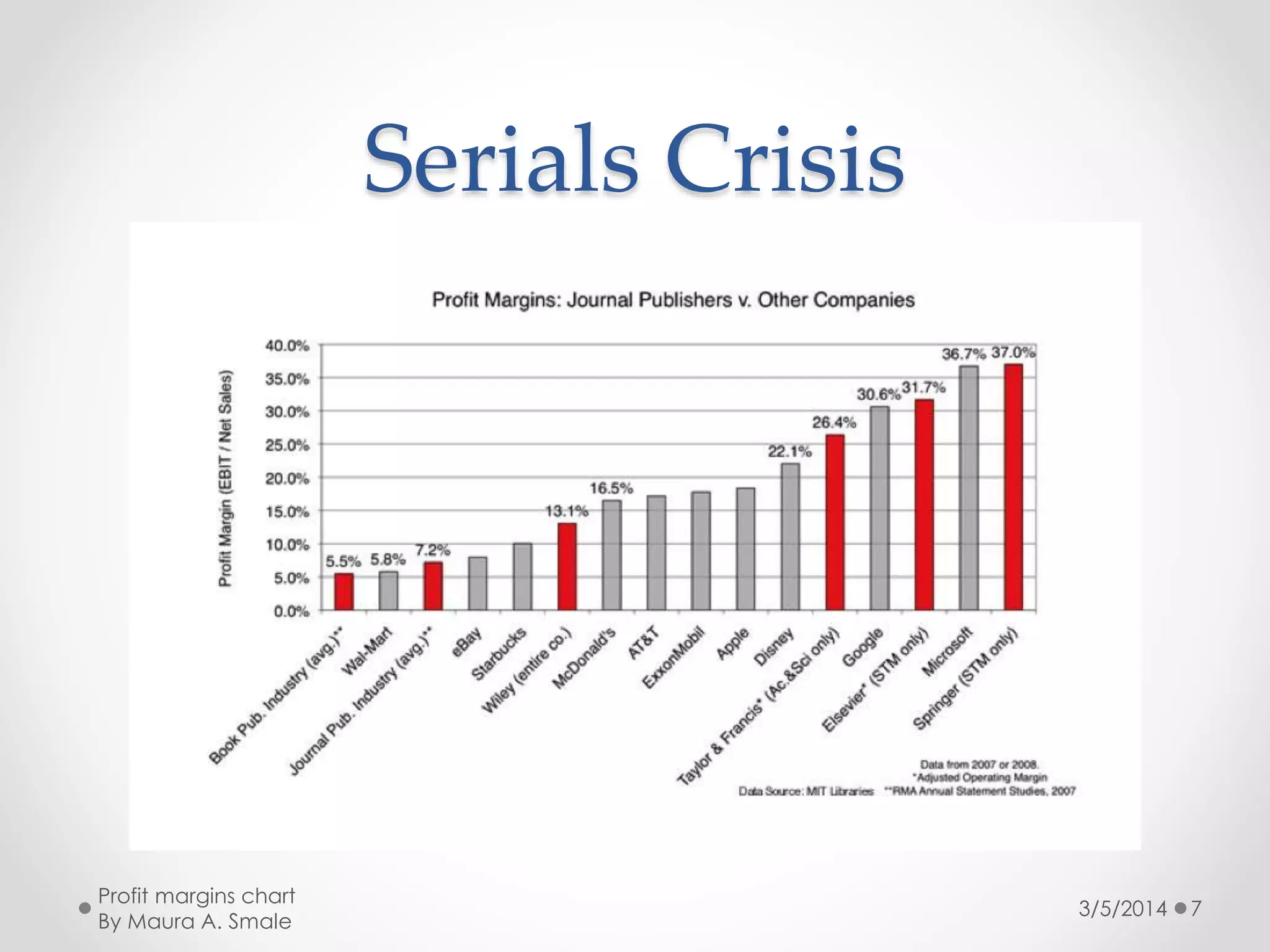
Serials Crisis

Profit margins chart
By Maura A. Smale

3/5/2014

7
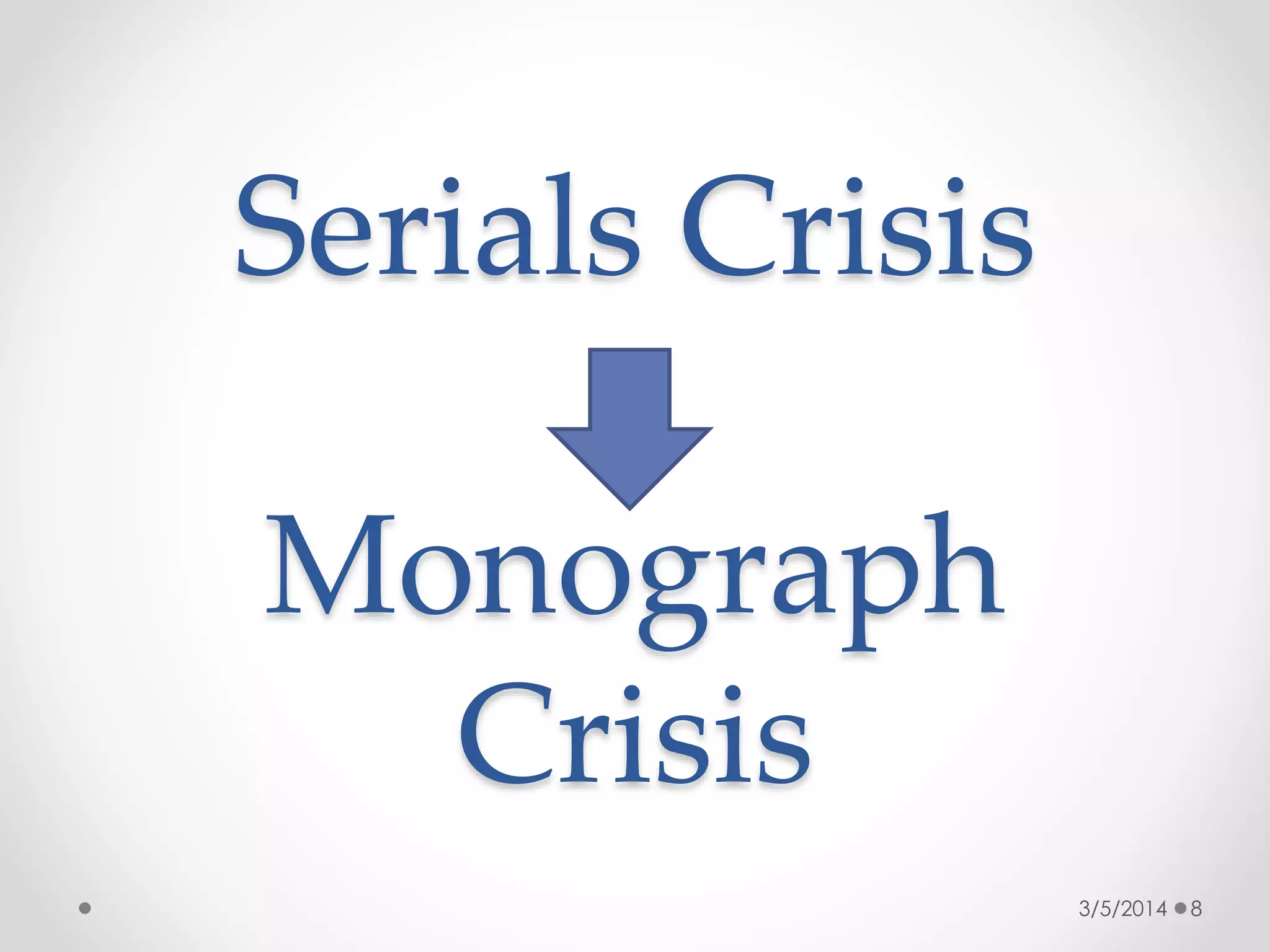
Serials Crisis
Monograph
Crisis
3/5/2014

8
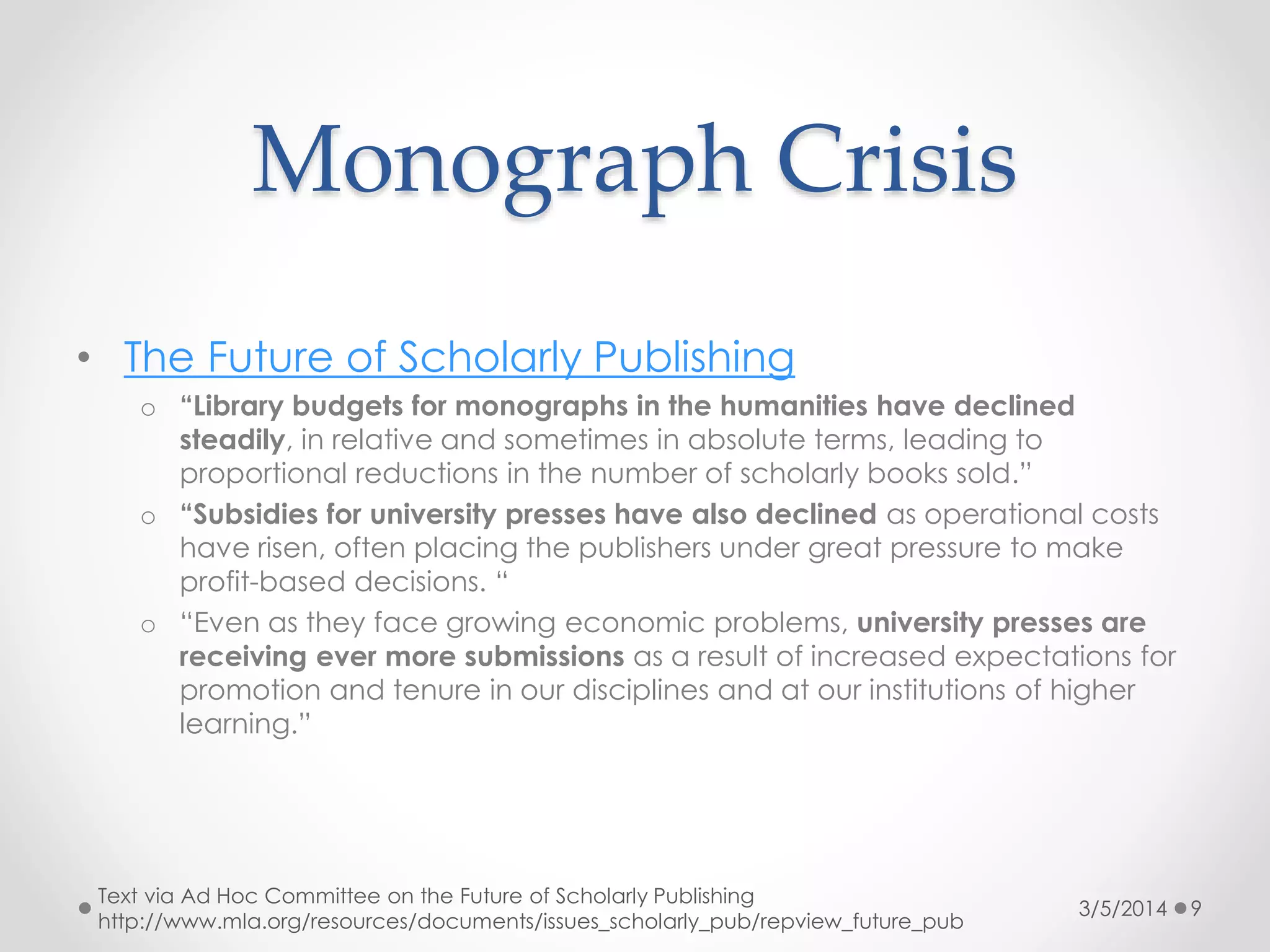
Monograph Crisis
• The Future of Scholarly Publishing
o “Library budgets for monographs in the humanities have declined
steadily, in relative and sometimes in absolute terms, leading to
proportional reductions in the number of scholarly books sold.”
o “Subsidies for university presses have also declined as operational costs
have risen, often placing the publishers under great pressure to make
profit-based decisions. “
o “Even as they face growing economic problems, university presses are
receiving ever more submissions as a result of increased expectations for
promotion and tenure in our disciplines and at our institutions of higher
learning.”

Text via Ad Hoc Committee on the Future of Scholarly Publishing
http://www.mla.org/resources/documents/issues_scholarly_pub/repview_future_pub

3/5/2014

9
What is OA?
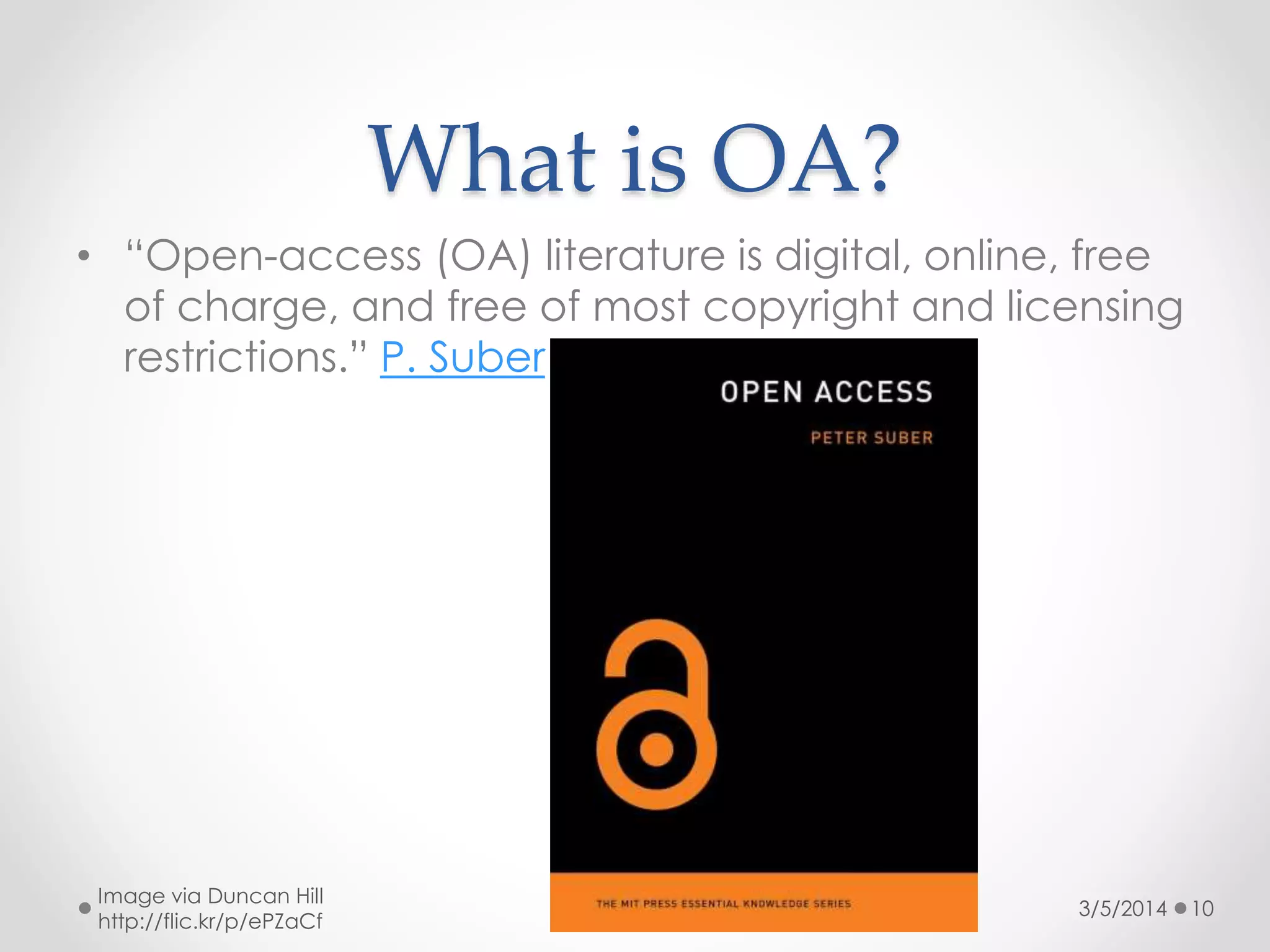
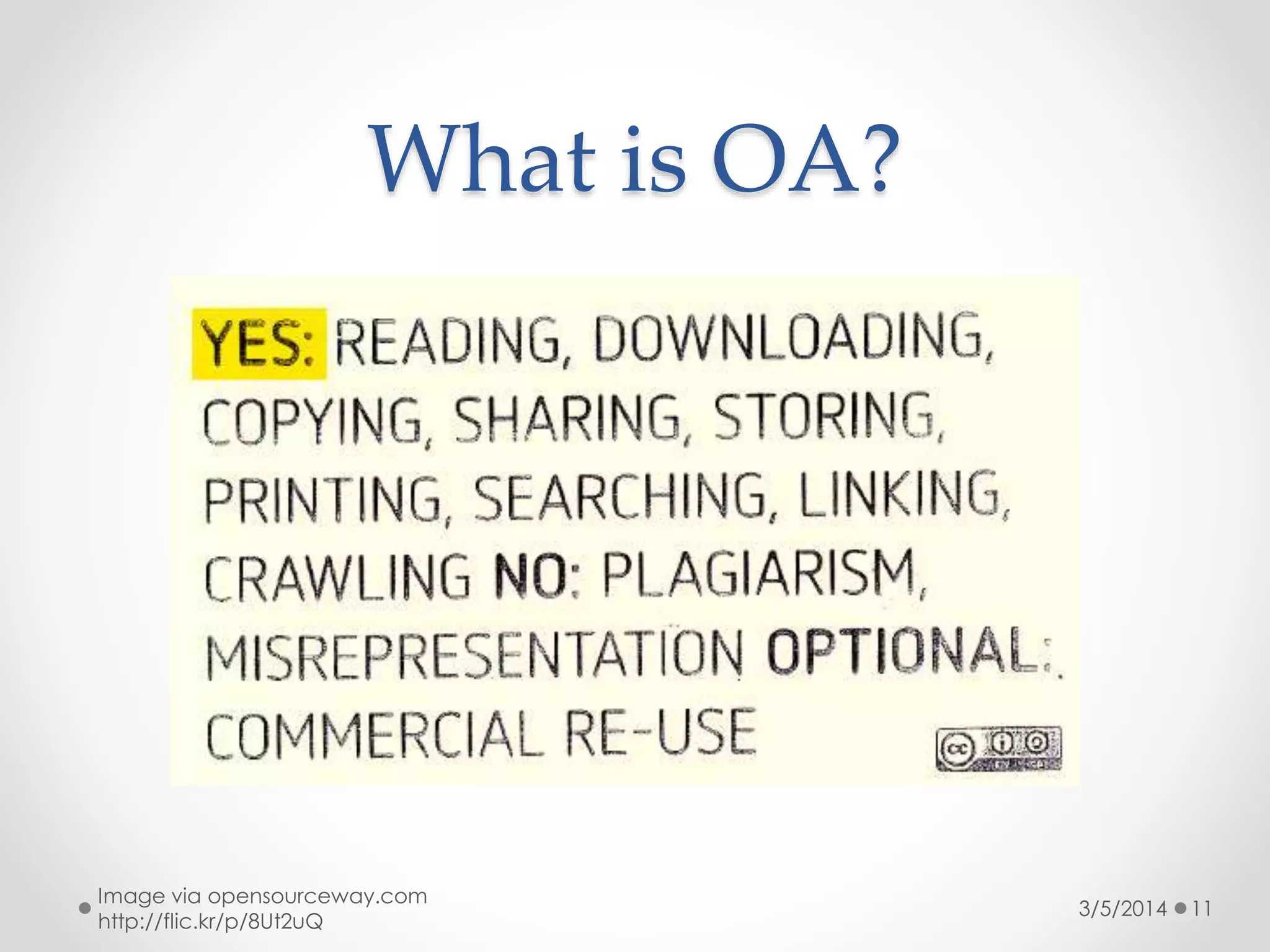
• “Open-access (OA) literature is digital, online, free
of charge, and free of most copyright and licensing
restrictions.” P. Suber

Image via Duncan Hill
http://flic.kr/p/ePZaCf

3/5/2014

10
What is OA?

Image via opensourceway.com
http://flic.kr/p/8Ut2uQ

3/5/2014

11
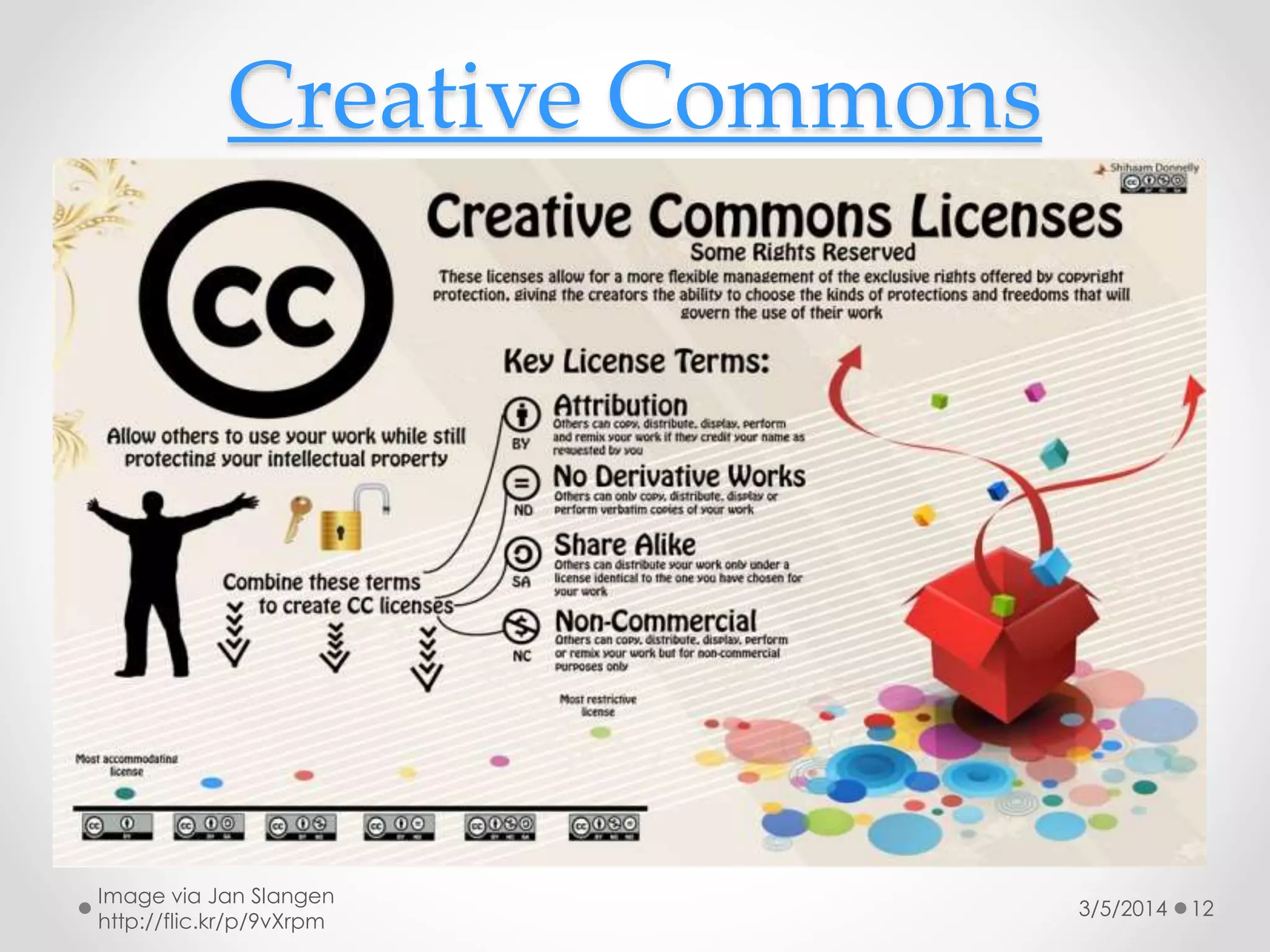
Creative Commons

Image via Jan Slangen
http://flic.kr/p/9vXrpm

3/5/2014

12
Gold
• Gold OA
o is delivered by journals
o is Publisher OA

Image via Open Access Week
http://www.openaccessweek.org/p
age/englishhigh-resolution-1

3/5/2014

13
Green
• “There are other models that societies can and
should explore, including the “green” road
provided by institutional repositories and other kinds
of scholarly archives.”
o Openness, value, and scholarly societies: The Modern Language
Association model by Kathleen Fitzpatrick

Green OA image via Mitchell N Charity
http://www.clarifyscience.info/part/About

3/5/2014

14
Research Commons(IR)
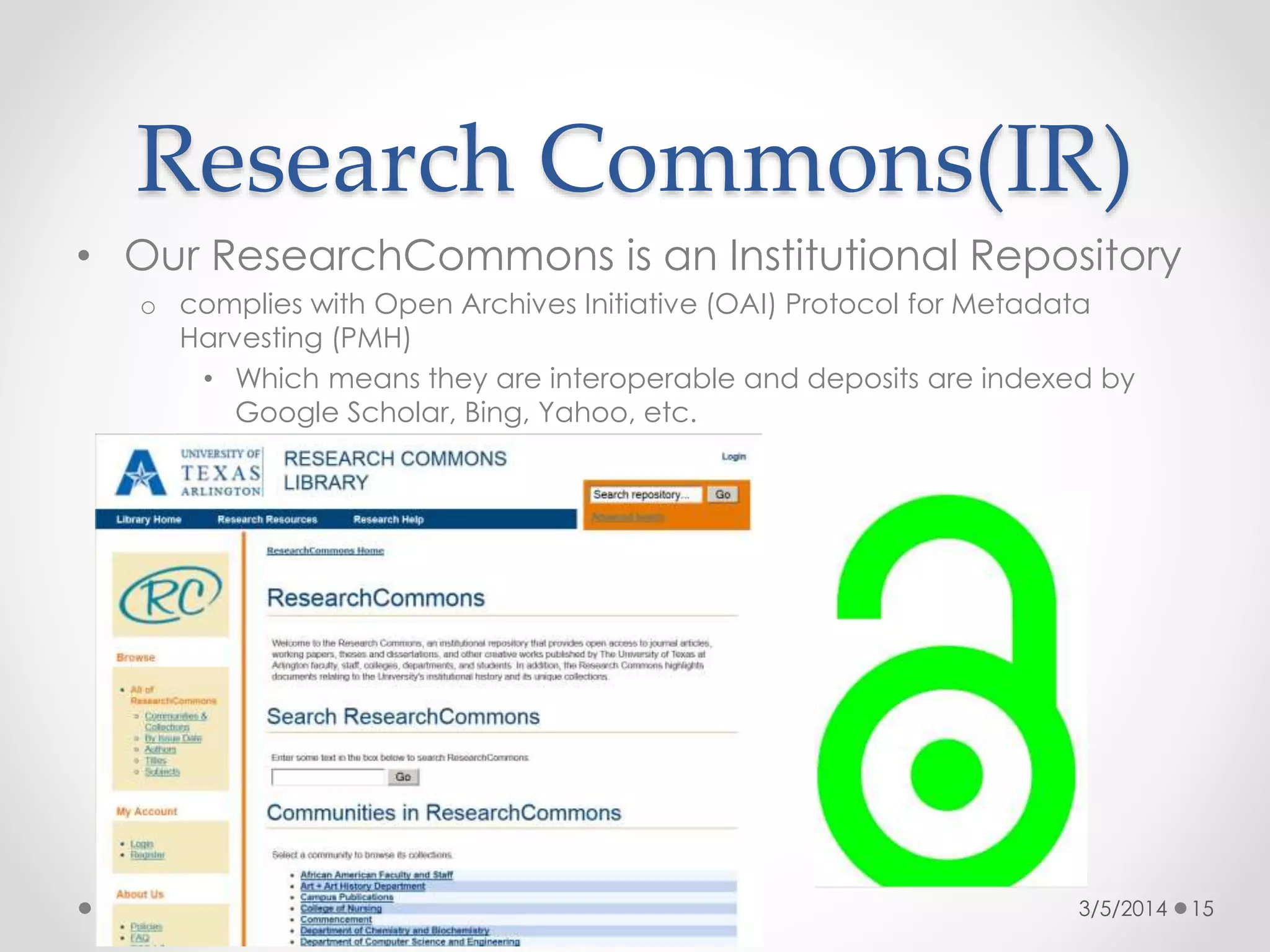
• Our ResearchCommons is an Institutional Repository
o complies with Open Archives Initiative (OAI) Protocol for Metadata
Harvesting (PMH)
• Which means they are interoperable and deposits are indexed by
Google Scholar, Bing, Yahoo, etc.

3/5/2014

15
OA and the Humanities
• Do Open Access Theses & Dissertations Diminish
Publishing Opportunities in the Social Sciences &
Humanities? (College & Research Libraries, PDF,
p.376)
• MLA Office of Scholarly Communication
• [MLA] The Future of Scholarly Publishing, From the
Ad Hoc Committee on the Future of Scholarly
Publishing

Footer Text

3/5/2014

16
OA and MLA
• MLA Journals Adopt New Open-Access-Friendly
Author Agreements
o 6/5/2012, PMLA, Profession, and the ADE and ADFL bulletins.

• Scholarly Communication @ MLA
• Beyond the PDF: Experiments in Open-Access
Scholar

Footer Text

3/5/2014

17
OA Journal: ABO
• ABO: Interactive Journal for Women in the Arts,
1640-1830 (ISSN 2157-7129) is an open access,
interactive, scholarly journal, launched in 2011 by
the Aphra Behn Society.
• MLA Roundtable Presentation on Open Access:
Editing Online Scholarly Journals

Footer Text

3/5/2014

18
Suggested Readings
• Open Access By Peter Suber
• The Future of Scholarly Publishing From the Ad Hoc
Committee on the Future of Scholarly Publishing
• MLA Resources on Publishing and Scholarship
• Planned Obsolescence: Publishing, Technology,
and the Future of the Academy by Kathleen
Fitzpatrick, Director of Scholarly Communication at
the Modern Language Association

Footer Text

3/5/2014

19
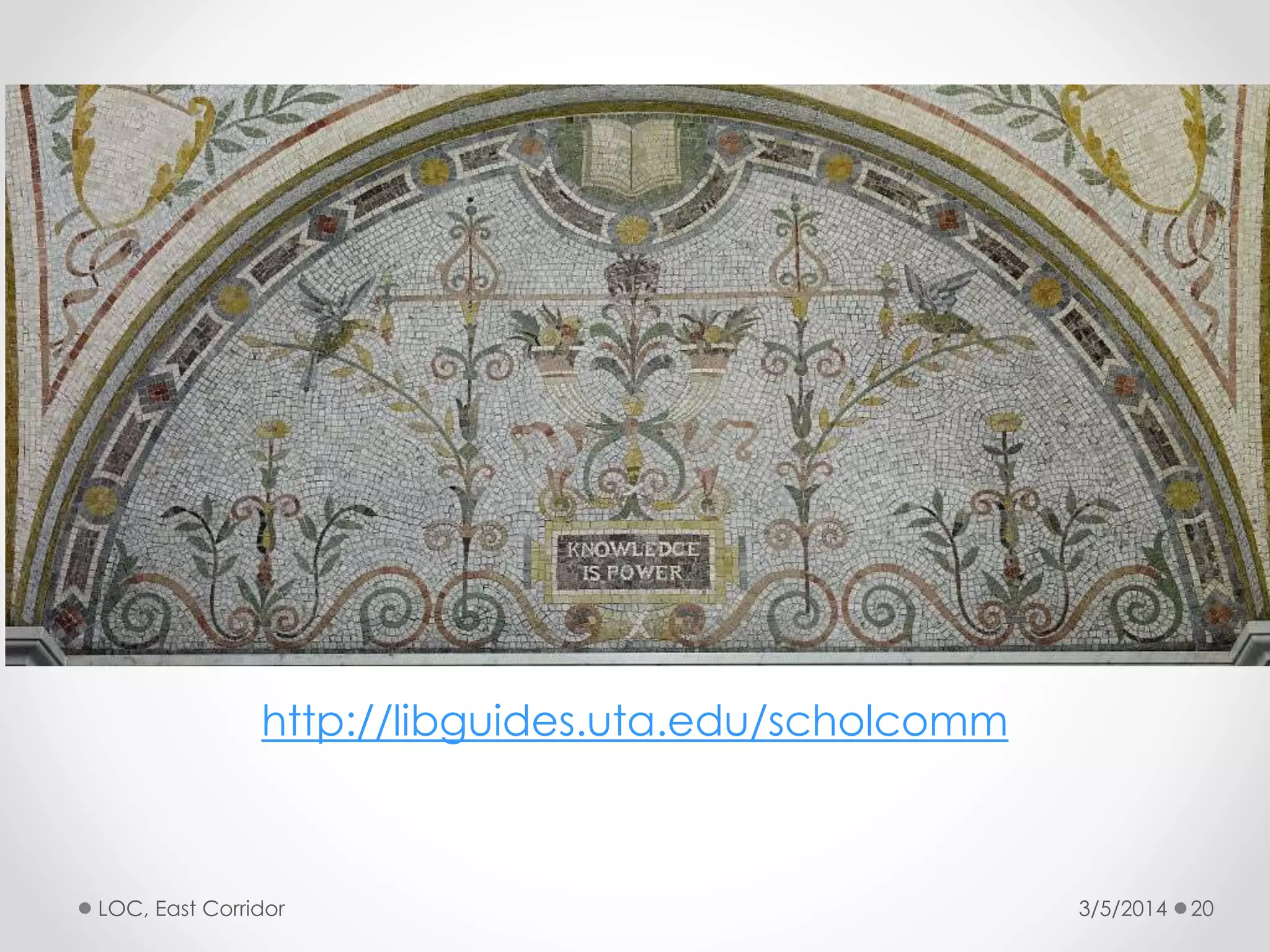
http://libguides.uta.edu/scholcomm

LOC, East Corridor

3/5/2014

20
Presenters
• Rafia Mirza
• Digital Humanities Librarian
• rafia@uta.edu
• Clarke Iakovakis
• Data & eScience Librarian
• clarke@uta.edu
• Kristine Witkowski
• Electronic Thesis and Dissertation Specialist
• kwitkowski@uta.edu
This work is licensed under a
Creative Commons Attribution-NonCommercial 3.0 Unported License.

3/5/2014

21

Introduction to Open Access

  • 1.
    Open Access Introduction •Rafia Mirza • Digital Humanities Librarian • Clarke Iakovakis • Data & eScience Librarian • Kristine Witkowski • Electronic Thesis and Dissertation Specialist 3/5/2014 1
  • 2.
    Outline • • • • • • • University Presses Traditional (orConventional) Publishing Serials & Monographs issues Gold and Green OA Institutional Repositories OA and the Humanities MLA & OA Image via Open access Week http://www.openaccessweek.org/p age/englishhigh-resolution-1 3/5/2014 2
  • 3.
    University Presses Image viaDuncan Hull http://www.flickr.com/photos/dullhunk/3962470782/ 3/5/2014 3
  • 4.
    What is traditionalor conventional publishing? • In conventional academic publishing, the author signs away their copyright to the publisher Image via Steve Snodgrass http://flic.kr/p/9mjRKW 3/5/2014 4
  • 5.
    What is traditionalor conventional publishing? • When you sign away your copyright, you need to get permission from the publisher o to put your article on reserve, o to publish derivative works o to post it on academic sites like academia.edu Image via Mike Seyfang http://flic.kr/p/5AXf6j 3/5/2014 5
  • 6.
    Image via ARLStatistics 2010-11 3/5/2014 6
  • 7.
    Serials Crisis Profit marginschart By Maura A. Smale 3/5/2014 7
  • 8.
  • 9.
    Monograph Crisis • TheFuture of Scholarly Publishing o “Library budgets for monographs in the humanities have declined steadily, in relative and sometimes in absolute terms, leading to proportional reductions in the number of scholarly books sold.” o “Subsidies for university presses have also declined as operational costs have risen, often placing the publishers under great pressure to make profit-based decisions. “ o “Even as they face growing economic problems, university presses are receiving ever more submissions as a result of increased expectations for promotion and tenure in our disciplines and at our institutions of higher learning.” Text via Ad Hoc Committee on the Future of Scholarly Publishing http://www.mla.org/resources/documents/issues_scholarly_pub/repview_future_pub 3/5/2014 9
  • 10.
    What is OA? •“Open-access (OA) literature is digital, online, free of charge, and free of most copyright and licensing restrictions.” P. Suber Image via Duncan Hill http://flic.kr/p/ePZaCf 3/5/2014 10
  • 11.
    What is OA? Imagevia opensourceway.com http://flic.kr/p/8Ut2uQ 3/5/2014 11
  • 12.
    Creative Commons Image viaJan Slangen http://flic.kr/p/9vXrpm 3/5/2014 12
  • 13.
    Gold • Gold OA ois delivered by journals o is Publisher OA Image via Open Access Week http://www.openaccessweek.org/p age/englishhigh-resolution-1 3/5/2014 13
  • 14.
    Green • “There areother models that societies can and should explore, including the “green” road provided by institutional repositories and other kinds of scholarly archives.” o Openness, value, and scholarly societies: The Modern Language Association model by Kathleen Fitzpatrick Green OA image via Mitchell N Charity http://www.clarifyscience.info/part/About 3/5/2014 14
  • 15.
    Research Commons(IR) • OurResearchCommons is an Institutional Repository o complies with Open Archives Initiative (OAI) Protocol for Metadata Harvesting (PMH) • Which means they are interoperable and deposits are indexed by Google Scholar, Bing, Yahoo, etc. 3/5/2014 15
  • 16.
    OA and theHumanities • Do Open Access Theses & Dissertations Diminish Publishing Opportunities in the Social Sciences & Humanities? (College & Research Libraries, PDF, p.376) • MLA Office of Scholarly Communication • [MLA] The Future of Scholarly Publishing, From the Ad Hoc Committee on the Future of Scholarly Publishing Footer Text 3/5/2014 16
  • 17.
    OA and MLA •MLA Journals Adopt New Open-Access-Friendly Author Agreements o 6/5/2012, PMLA, Profession, and the ADE and ADFL bulletins. • Scholarly Communication @ MLA • Beyond the PDF: Experiments in Open-Access Scholar Footer Text 3/5/2014 17
  • 18.
    OA Journal: ABO •ABO: Interactive Journal for Women in the Arts, 1640-1830 (ISSN 2157-7129) is an open access, interactive, scholarly journal, launched in 2011 by the Aphra Behn Society. • MLA Roundtable Presentation on Open Access: Editing Online Scholarly Journals Footer Text 3/5/2014 18
  • 19.
    Suggested Readings • OpenAccess By Peter Suber • The Future of Scholarly Publishing From the Ad Hoc Committee on the Future of Scholarly Publishing • MLA Resources on Publishing and Scholarship • Planned Obsolescence: Publishing, Technology, and the Future of the Academy by Kathleen Fitzpatrick, Director of Scholarly Communication at the Modern Language Association Footer Text 3/5/2014 19
  • 20.
  • 21.
    Presenters • Rafia Mirza •Digital Humanities Librarian • rafia@uta.edu • Clarke Iakovakis • Data & eScience Librarian • clarke@uta.edu • Kristine Witkowski • Electronic Thesis and Dissertation Specialist • kwitkowski@uta.edu This work is licensed under a Creative Commons Attribution-NonCommercial 3.0 Unported License. 3/5/2014 21