openness and change
in learning technologies
Amber Thomas, Academic Technology Team
A mash-up For Warwick’s Computer Sciences Educational Technology Group
my background
JISC Information Strategies
National Grid for Learning
Ferl (Information and Learning Technologies for FE)
West Midlands Share project at University of Worcester
JISC: Open Access Repositories, Rapid Innovation,
Jorum, Open Educational Resources
Now heading up Academic Technology Team:
eLearning support, moodle, digital humanities, Russ!
openness in universities
(Eduwiki Conference 5th
Sep 2012)
Amber Thomas
CC BY
openness: the sunlight effect
“Freedom of information legislation comprises laws
that guarantee access to data held by the state”
http://en.wikipedia.org/wiki/Sunshine_laws
opening up access to information, data and
processes floods sunlight into areas that were
previously hidden from public view, and in doing
so it also nurtures growth
dimensions
of openness
Tim Berners Lee et al
http://5stardata.info/
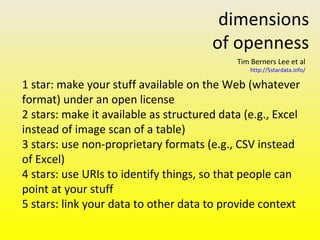
1 star: make your stuff available on the Web (whatever
format) under an open license
2 stars: make it available as structured data (e.g., Excel
instead of image scan of a table)
3 stars: use non-proprietary formats (e.g., CSV instead
of Excel)
4 stars: use URIs to identify things, so that people can
point at your stuff
5 stars: link your data to other data to provide context
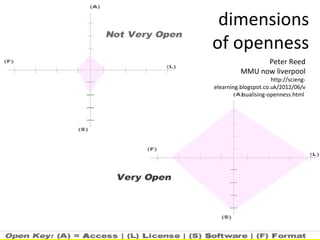
dimensions
of openness
Peter Reed
MMU now liverpool
http://scieng-
elearning.blogspot.co.uk/2012/06/v
isualising-openness.html
dimensions
of openness
Amber Thomas, JISC
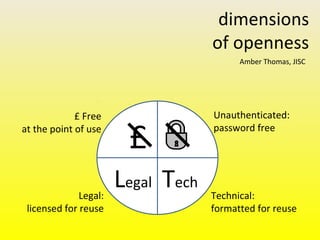
£ Free
at the point of use
Unauthenticated:
password free
Legal:
licensed for reuse
Technical:
formatted for reuse
£
Legal Tech
forms of openness in universities
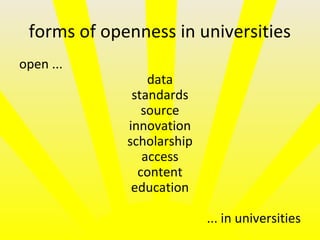
open ...
data
standards
source
innovation
scholarship
access
content
education
... in universities
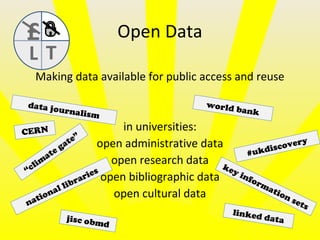
Open Data
Making data available for public access and reuse
in universities:
open administrative data
open research data
open bibliographic data
open cultural data
£
L T
“clim
ate gate”
key information setsnational libraries
world bank
#ukdiscovery
jisc obmd
data journalism
linked data
CERN
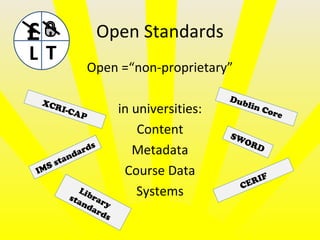
Open Standards
Open =“non-proprietary”
in universities:
Content
Metadata
Course Data
Systems
£
L T
IMS standards
Dublin Core
XCRI-CAP
CERIF
Library
standards
SWORD
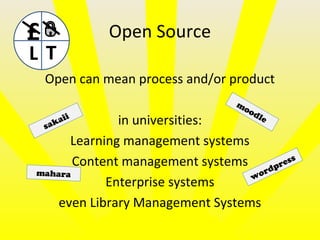
Open Source
Open can mean process and/or product
in universities:
Learning management systems
Content management systems
Enterprise systems
even Library Management Systems
£
L T
sakaii
mahara wordpress
moodle
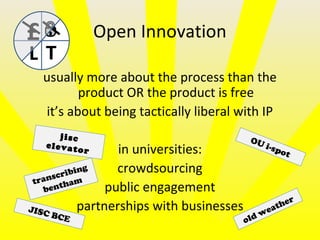
Open Innovation
usually more about the process than the
product OR the product is free
it’s about being tactically liberal with IP
in universities:
crowdsourcing
public engagement
partnerships with businesses
£
L T
jisc
elevator
OU i-spot
old weather
JISC BCE
transcribing
bentham
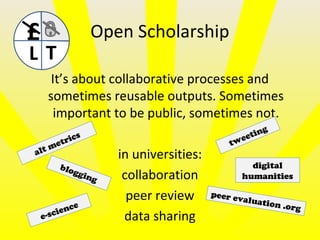
Open Scholarship
It’s about collaborative processes and
sometimes reusable outputs. Sometimes
important to be public, sometimes not.
in universities:
collaboration
peer review
data sharing
£
L T
peer evaluation .org
alt metrics
blogging
tweeting
e-science
digital
humanities
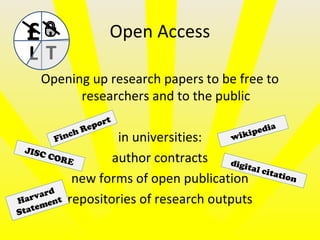
Open Access
Opening up research papers to be free to
researchers and to the public
in universities:
author contracts
new forms of open publication
repositories of research outputs
£
L T
JISC CORE
wikipedia
Finch Report
digital citation
Harvard
Statement
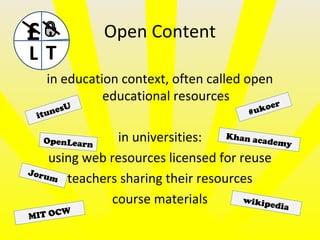
Open Content
in education context, often called open
educational resources
in universities:
using web resources licensed for reuse
teachers sharing their resources
course materials
£
L T
wikipedia
itunesU
MIT OCW
Jorum
OpenLearn
Khan academy
#ukoer
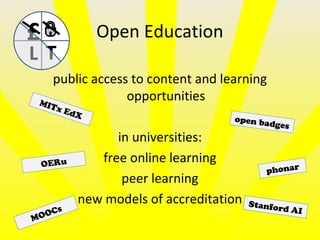
Open Education
public access to content and learning
opportunities
in universities:
free online learning
peer learning
new models of accreditation
£
L T
phonar
MITx EdX
MOOCs
open badges
Stanford AI
OERu
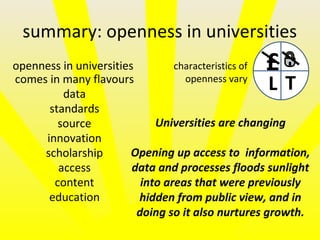
summary: openness in universities
openness in universities
comes in many flavours
data
standards
source
innovation
scholarship
access
content
education
£
L T
Universities are changing
Opening up access to information,
data and processes floods sunlight
into areas that were previously
hidden from public view, and in
doing so it also nurtures growth.
characteristics of
openness vary
Amber Thomas, JISC. (ALT-C September 2012)
When ideals meet reality:
lessons from open source, open
standards and open access
curves and cycles: hype, change, learn
cynical
jaded
purist
evangelistic
curious
pragmatic
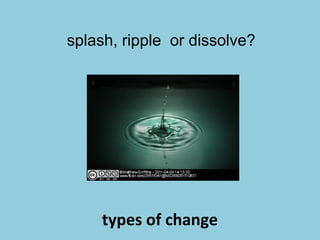
types of change
splash, ripple or dissolve?
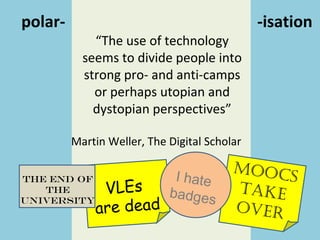
polar- -isation
VLEs
are dead
MOOCs
take
Over
The End of
the
university
I hate
badges
“The use of technology
seems to divide people into
strong pro- and anti-camps
or perhaps utopian and
dystopian perspectives”
Martin Weller, The Digital Scholar
dialectics
of open and free
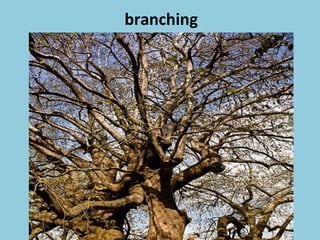
branching
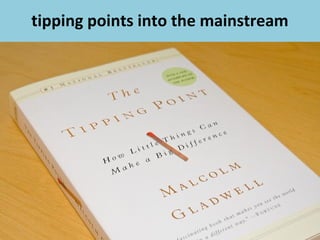
tipping points into the mainstream
pace
key messages
• We are all unique in our encounters with new
things.
• Polarisation often masks the real questions.
• There is often a dialectic around open and free.
• Often it’s not just one model that comes to
dominate. Sometimes when mainstreaming
happens we don’t recognise it.
• Change can take a lot longer than we hope. But
then sometimes it hits us fast!
Picture Credits
58
7
642
3
1
1 http://www.flickr.com/photos/28481088@N00/176177164/ (c) tanahaku CC BY
2 http://www.flickr.com/photos/petereed/2667835909/ (c) Peter Reed CC BY NC
3 http://www.flickr.com/photos/travel_aficionado/2396819536/ (c) Travel Afficionado CC BY NC
4 http://www.flickr.com/photos/carbonnyc/991004550/ (c) Carbon NCY CC BY
5 http://www.flickr.com/photos/tinou/341591917/ (c) Tinu Bao CC BY
6 http://www.flickr.com/photos/eliaslar/4557937822/ (c) Elias Lar CC BY NC ND
7 http://www.flickr.com/photos/jgarber/822382161/ (c) Jgarber BY NC SA
8 http://www.flickr.com/photos/redteam/2491179043/ (c) Redteam CC BY NC ND
openness and change
in learning technologies
Amber Thomas, Academic Technology Team
A mash-up For Warwick’s Computer Sciences Educational Technology Group

Openness and change

  • 1.
    openness and change inlearning technologies Amber Thomas, Academic Technology Team A mash-up For Warwick’s Computer Sciences Educational Technology Group
  • 2.
    my background JISC InformationStrategies National Grid for Learning Ferl (Information and Learning Technologies for FE) West Midlands Share project at University of Worcester JISC: Open Access Repositories, Rapid Innovation, Jorum, Open Educational Resources Now heading up Academic Technology Team: eLearning support, moodle, digital humanities, Russ!
  • 3.
    openness in universities (EduwikiConference 5th Sep 2012) Amber Thomas CC BY
  • 4.
    openness: the sunlighteffect “Freedom of information legislation comprises laws that guarantee access to data held by the state” http://en.wikipedia.org/wiki/Sunshine_laws opening up access to information, data and processes floods sunlight into areas that were previously hidden from public view, and in doing so it also nurtures growth
  • 5.
    dimensions of openness Tim BernersLee et al http://5stardata.info/ 1 star: make your stuff available on the Web (whatever format) under an open license 2 stars: make it available as structured data (e.g., Excel instead of image scan of a table) 3 stars: use non-proprietary formats (e.g., CSV instead of Excel) 4 stars: use URIs to identify things, so that people can point at your stuff 5 stars: link your data to other data to provide context
  • 6.
    dimensions of openness Peter Reed MMUnow liverpool http://scieng- elearning.blogspot.co.uk/2012/06/v isualising-openness.html
  • 7.
    dimensions of openness Amber Thomas,JISC £ Free at the point of use Unauthenticated: password free Legal: licensed for reuse Technical: formatted for reuse £ Legal Tech
  • 8.
    forms of opennessin universities open ... data standards source innovation scholarship access content education ... in universities
  • 9.
    Open Data Making dataavailable for public access and reuse in universities: open administrative data open research data open bibliographic data open cultural data £ L T “clim ate gate” key information setsnational libraries world bank #ukdiscovery jisc obmd data journalism linked data CERN
  • 10.
    Open Standards Open =“non-proprietary” inuniversities: Content Metadata Course Data Systems £ L T IMS standards Dublin Core XCRI-CAP CERIF Library standards SWORD
  • 11.
    Open Source Open canmean process and/or product in universities: Learning management systems Content management systems Enterprise systems even Library Management Systems £ L T sakaii mahara wordpress moodle
  • 12.
    Open Innovation usually moreabout the process than the product OR the product is free it’s about being tactically liberal with IP in universities: crowdsourcing public engagement partnerships with businesses £ L T jisc elevator OU i-spot old weather JISC BCE transcribing bentham
  • 13.
    Open Scholarship It’s aboutcollaborative processes and sometimes reusable outputs. Sometimes important to be public, sometimes not. in universities: collaboration peer review data sharing £ L T peer evaluation .org alt metrics blogging tweeting e-science digital humanities
  • 14.
    Open Access Opening upresearch papers to be free to researchers and to the public in universities: author contracts new forms of open publication repositories of research outputs £ L T JISC CORE wikipedia Finch Report digital citation Harvard Statement
  • 15.
    Open Content in educationcontext, often called open educational resources in universities: using web resources licensed for reuse teachers sharing their resources course materials £ L T wikipedia itunesU MIT OCW Jorum OpenLearn Khan academy #ukoer
  • 16.
    Open Education public accessto content and learning opportunities in universities: free online learning peer learning new models of accreditation £ L T phonar MITx EdX MOOCs open badges Stanford AI OERu
  • 17.
    summary: openness inuniversities openness in universities comes in many flavours data standards source innovation scholarship access content education £ L T Universities are changing Opening up access to information, data and processes floods sunlight into areas that were previously hidden from public view, and in doing so it also nurtures growth. characteristics of openness vary
  • 18.
    Amber Thomas, JISC.(ALT-C September 2012) When ideals meet reality: lessons from open source, open standards and open access
  • 19.
    curves and cycles:hype, change, learn cynical jaded purist evangelistic curious pragmatic
  • 20.
    types of change splash,ripple or dissolve?
  • 21.
    polar- -isation VLEs are dead MOOCs take Over TheEnd of the university I hate badges “The use of technology seems to divide people into strong pro- and anti-camps or perhaps utopian and dystopian perspectives” Martin Weller, The Digital Scholar
  • 22.
  • 23.
  • 24.
    tipping points intothe mainstream
  • 25.
  • 26.
    key messages • Weare all unique in our encounters with new things. • Polarisation often masks the real questions. • There is often a dialectic around open and free. • Often it’s not just one model that comes to dominate. Sometimes when mainstreaming happens we don’t recognise it. • Change can take a lot longer than we hope. But then sometimes it hits us fast!
  • 27.
    Picture Credits 58 7 642 3 1 1 http://www.flickr.com/photos/28481088@N00/176177164/(c) tanahaku CC BY 2 http://www.flickr.com/photos/petereed/2667835909/ (c) Peter Reed CC BY NC 3 http://www.flickr.com/photos/travel_aficionado/2396819536/ (c) Travel Afficionado CC BY NC 4 http://www.flickr.com/photos/carbonnyc/991004550/ (c) Carbon NCY CC BY 5 http://www.flickr.com/photos/tinou/341591917/ (c) Tinu Bao CC BY 6 http://www.flickr.com/photos/eliaslar/4557937822/ (c) Elias Lar CC BY NC ND 7 http://www.flickr.com/photos/jgarber/822382161/ (c) Jgarber BY NC SA 8 http://www.flickr.com/photos/redteam/2491179043/ (c) Redteam CC BY NC ND
  • 28.
    openness and change inlearning technologies Amber Thomas, Academic Technology Team A mash-up For Warwick’s Computer Sciences Educational Technology Group

Editor's Notes

  • #20 The first thing to say is that we are all different in our encounters with new approaches Whether they are new technologies like badges or new delivery models like MOOCs. We are each on our own learning curves and changed curves, and we meet new ideas and solutions at different points in the hype cycle. That is a lot of variation. So when we meet new ideas, we can respond very differently. My first message is that every response is a real response because responses are individual and they are about perceptions.
  • #22 It’s to easy to characterise people as pro- or anti- something It’s too easy to present things as a debate for or against But polarisation often masks the real questions, because we don’t hear them properly http://www.bloomsburyacademic.com/view/DigitalScholar_9781849666275/chapter-ba-9781849666275-chapter-013.xml
  • #23 There is usually a dialectic around open and free free as in freedom, free as in beer http://www.wired.com/wired/archive/14.09/posts.html?pg=6 Open as in door or open as in heart Some courses are open as in door. You can walk in, you can listen for free. Others are open as in heart. You become part of a community, you are accepted and nurtured. http://followersoftheapocalyp.se/open-as-in-door-or-open-as-in-heart-mooc/ I always add: open as in markets? Some would characterise the Finch Report on open access as being pulled towards the more conservative forces Conservative forces aren’t necessarily “right wing” – they might be to protect the NHS rather than marketise the health system. Closer to home they might be to protect the public education system against competitive private provision How do you feel about Pearson entering the HE market? How do you feel about Free Schools?
  • #24 To follow on from free as in beer ... A great example of branching is the trajectory of the open source movement Big debates over gratis vs libre Introduction of the Free AND Libre Open Source Software term – FLOSS By enabling the practices of open source to branch off, to allow the community to branch off Towards profit-making business models in some areas, free culture models in others. This is sometimes called a diffusion of innovation Interesting how github supports the whole spectrum This has also been the approach of the UK OER Programme. We have been quite pluralistic about OER, to let people find their own ways. We have certainly had tensions between the marketing/recruitment aspect and the open practice perspective. What’s important to note is that often it’s not just one model that comes to dominate.
  • #25 We don’t always understand what brings about mainstreaming. We very rarely control it. Consider a story from open standards: the rise and fall of RSS aggregation. Is it netvibes or pageflakes that made the difference? Or google-reader? At what point did twitter and facebook start to dominate the aggregation game and overtake RSS? OER programme gave freedom for each project to choose their platform. They didn’t chose a standard they chose a platform. It’s often when open standards are baked in to platforms that we see take-up without conscious decision making. I’m not sure we always notice: sometimes when mainstreaming happens we don’t recognise it When did e-learning become part of the fabric of education?
  • #26 Finally, change can take a lot longer than we hope The 10 years since the Berlin Declaration on Open Access can feel like geological time. Perhaps we need some time-lapse photography approach to recognising the impact of changes we started back then. So many more people understand OA now. So many more people care. Wikipedia started in 2001. Is that fast or slow? Were there points when they thought about giving up? change takes longer than you think