Elizabeth Brown Scholarly Communications and Library Grants Officer Binghamton University Libraries Monday, February 9, 2009 Library Brown Bag
Topics What is a Scholarly Communications Officer? What is happening now in Scholarly Communications? Publishing: Open Access, SCOAP3 Copyright and sharing material: Creative Commons Digital Repositories Campus Outreach and Education What will happen in the future?
Scholarly Communications Officer Coordinates scholarly communications and intellectual property activities for the Libraries.  Leads a scholarly communications program.  Educates the university community about intellectual property issues and impact on scholarly inquiry and instruction.  Monitor and report to the Libraries’ staff and administration on current developments in scholarly communications, open access, institutional repositories, intellectual property, and related legislative initiatives.    Collaborate with and inform library faculty, research faculty, graduate students, University administrators, and the library and information science community of changes in scholarly communication and how each group can contribute to new and evolving methods for distribution of research results.  Communicate with appropriate university offices and administration regarding intellectual property and copyright matters. Communicate university policies and decisions to library staff and others.   Represent the Libraries in the development of university policy on copyright, the public domain, user privacy, and other scholarly communications issues.  Develop educational opportunities for sharing information regarding scholarly communications, intellectual property, open access, institutional repositories, and legislative actions that might affect these issues.   Organize and develop programming, as appropriate, to educate and inform the University community on scholarly communication and intellectual property topics.  Develop and maintain the Libraries’ Scholarly Communication website and publications.   Participate and guide development of the Libraries’ Institutional Repository.
What I really do Read a lot of reports and articles Interpret what I’ve read and seen Send (a lot of) emails to library staff Talk to campus faculty and administrators about what I do and what I read Make sure these new ideas are infused into library policies
Why do I (we) need to do this? Publishing models are changing. Copyright law and perceptions of ownership  are changing as everyone can access, modify and share information online. Many university faculty members don’t realize how changes may affect their research and publishing. The Libraries’ policies and collections planning may need adjustment, refinement, or review.
Publishing: User-Generated Content Shared, contributed sources of information Amazon.com  book reviews Wikipedia Discussion boards Mobile Photos & Videos:  flickr ,  Slideshare ,  FaceBook Self Publishing Lulu.com ,  iUniverse Blogs
Publishing – Open Access Open Access - new models to publish journal articles and books http://www.slideshare.net/ebrown/open-access-overview-libraries-allstaff-meeting-102208-presentation SCOAP 3  (Sponsoring Consortium for Open Access Publishing in Particle Physics) http://www.scoap3.org/ High-Energy Particle (HEP) Physics pays its own publishing costs Universities, labs, and funding agencies producing the literature pay into the SCOAP 3  consortium SCOAP 3  pays publishers  - all articles made Open Access. Journal subscription costs will cease.
Laws and Legislative Actions Dec 2007 European Research Council (ERC)  Guidelines for Open Access Jan 2008 US National Institutes of Health (NIH)  Public Access Policy NOT-OD-08-033 Feb 2008 Harvard Faculty of Arts and Sciences  Open Access Mandate Sept 2008 US Fair Copyright in Research Works Act HR 6845 Jan 2009 US National Science Foundation (NSF)  Advisory Committee on Cyberinfrastructure  (ACCI) recommends Open Access  for data,  publications and software Feb 2009 Fair Copyright in Research Works Act reintroduced  HR 801
Publishing – Copyright Copyright – ownership of materials Affects ILL, Course Reserves, Digitization, Preservation Google Books Settlement (2008) http://wo.ala.org/gbs/ http://books.google.com/booksrightsholders/ IMLS grant: Copyright Review Management System (U of Michigan) (Sept 2008) Determine copyright status of books published in the United States from 1923 to 1963 Create a point of collaboration for other institutions  Add more material to the public domain Assistance with copyright status of materials Copyright slider:  http://librarycopyright.net/digitalslider/ Section 108 spinner:  http://librarycopyright.net/108spinner/
Publishing – Creative Commons http://creativecommons.org/ Attribution  You let others copy, distribute, display, and perform your copyrighted work — and derivative works based upon it — but only if they give credit the way you request. Share Alike  You allow others to distribute derivative works only under a license identical to the license that governs your work.
Publishing – Creative Commons Noncommercial   You let others copy, distribute, display, and perform your work — and derivative works based upon it — but for noncommercial purposes only. No Derivative Works   You let others copy, distribute, display, and perform only verbatim copies of your work, not derivative works based upon it.
CC License Types Attribution Lets others distribute, remix, tweak, and build upon your work, even commercially, as long as they credit you for the original creation. Attribution Share Alike Lets others remix, tweak, and build upon your work even for commercial reasons, as long as they credit you and license their new creations under the identical terms. This license is often compared to open source software licenses. Attribution No Derivatives Allows for redistribution, commercial and non-commercial, as long as it is passed along unchanged and in whole, with credit to you. Attribution Non-Commercial Lets others remix, tweak, and build upon your work non-commercially, and although their new works must also acknowledge you and be non-commercial, they don’t have to license their derivative works on the same terms. Attribution Non-Commercial Share Alike Lets others remix, tweak, and build upon your work non-commercially, as long as they credit you and license their new creations under the identical terms. Others can download and redistribute your work just like the by-nc-nd license, but they can also translate, make remixes, and produce new stories based on your work. All new work based on yours will carry the same license, so any derivatives will also be non-commercial in nature. Attribution Non-Commercial No Derivatives Allows others to download your works and share them with others as long as they mention you and link back to you, but they can’t change them in any way or use them commercially. (most restrictive)
CC - Library Website  Adopted 2008 by Library Faculty Attribution-Noncommercial-Share Alike v 3.0
Digital Repositories Subject Repositories (Preprint Archives) Mostly Scholarly Articles Contain manuscripts of completed, unpublished articles Assume items are peer reviewed after submission Institutional Repositories = Digital Repositories Scholarly Articles: Journals, Books Other creative output: audio, video, data, paper reports Archival office and non-scholarly output: Newsletters, Reports, Office Files
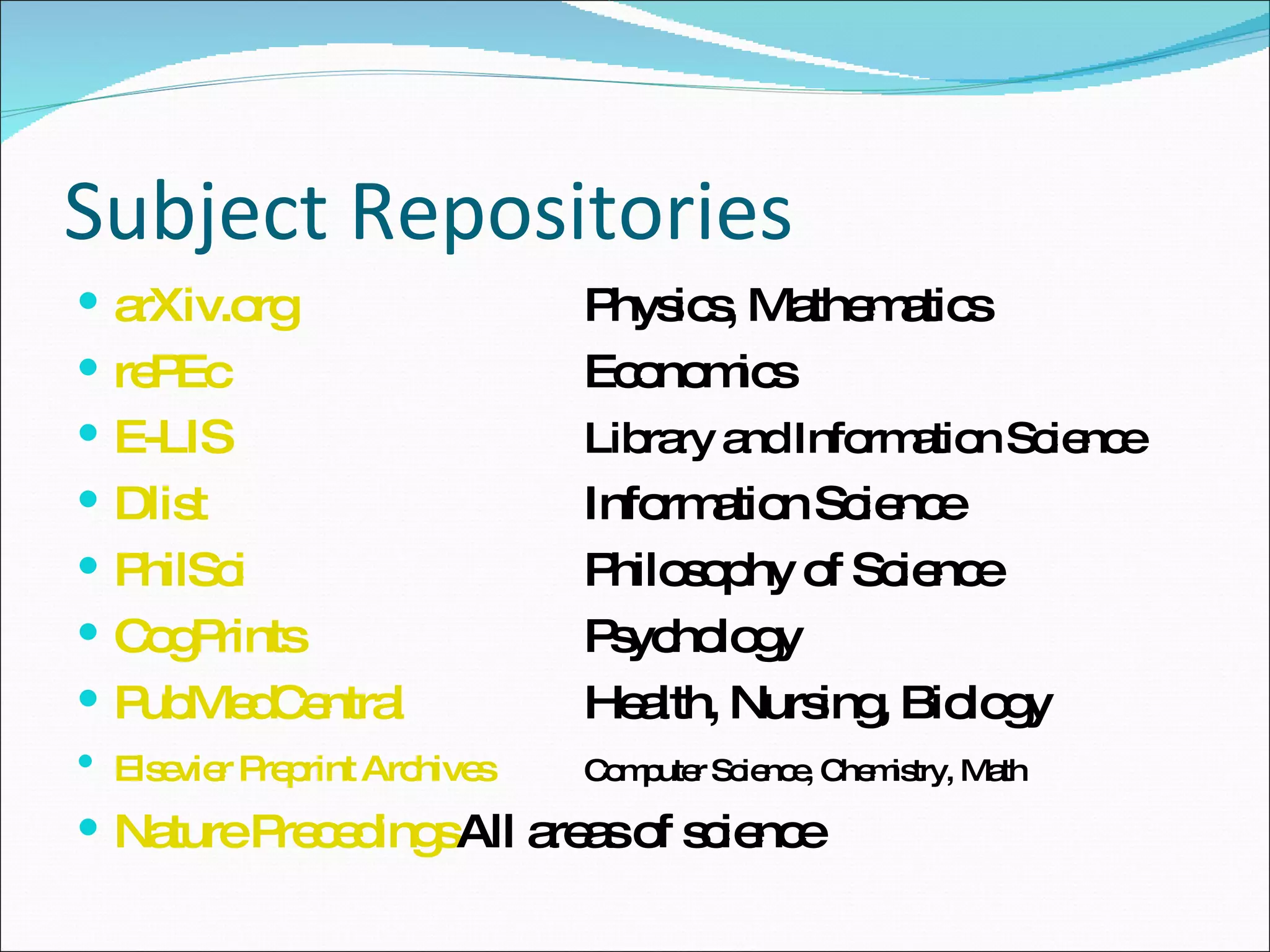
Subject Repositories arXiv.org Physics, Mathematics rePEc Economics E-LIS Library and Information Science Dlist Information Science PhilSci Philosophy of Science CogPrints Psychology PubMedCentral Health, Nursing, Biology Elsevier Preprint Archives Computer Science, Chemistry, Math Nature Precedings All areas of science
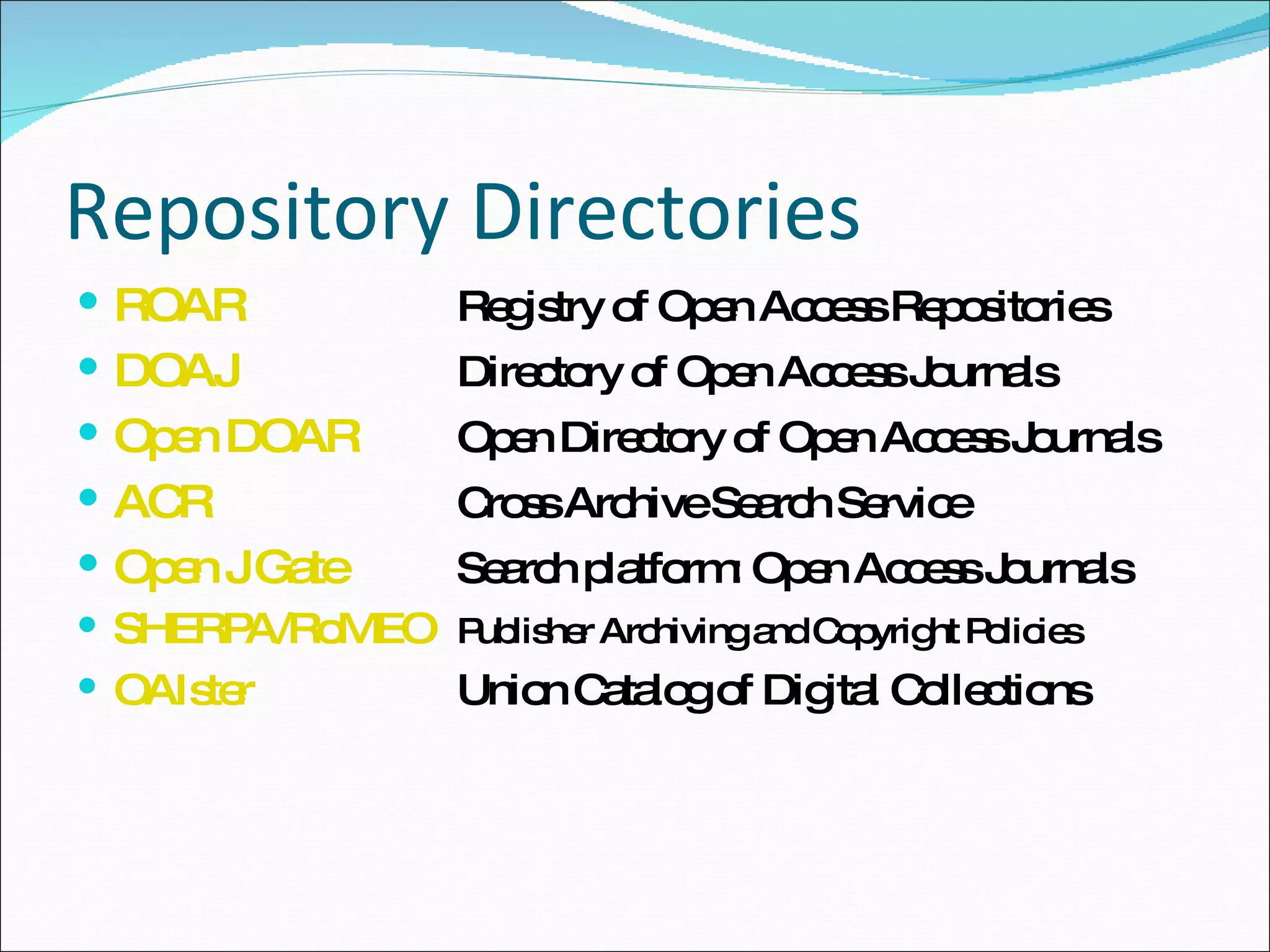
Repository Directories ROAR Registry of Open Access Repositories DOAJ   Directory of Open Access Journals Open DOAR Open Directory of Open Access Journals ACR	 Cross Archive Search Service Open J Gate Search platform: Open Access Journals SHERPA/RoMEO Publisher Archiving and Copyright Policies OAIster Union Catalog of Digital Collections
Campus Outreach and Education Web sites and handouts http://library.lib.binghamton.edu/webdocs/NIHPublicAccesspolicy.html Presentations: library staff, campus faculty and staff http://www.slideshare.net/ebrown Programming: 2009 Provost’s Symposium New Approaches to Scholarly Communications and Publishing April 15-16, 2009 2009 Open Access Week : October 19-23, 2009
What’s on the horizon? My Predictions Economy:  Tighter budgets will push models faster Publishing: Further growth in Open Access publishing User-Generated content Self Publishing Print on Demand for books Publishing: Additional/Expanded Author deposit mandate policies: NSF, NEH Use of Author Addenda for publishing articles Use of alternative citation metrics to measure prestige and value of research Publishing: Creative Commons use will expand. Growth of  Semantic Web  (Web 3.0)
What’s on the horizon? Binghamton University Libraries  Develop policies and priorities to create a digital repository for university students, faculty, and staff. Determine materials to include in a repository. Assist faculty with managing their research output and complying with reporting requirements from funding agencies. Assist faculty with negotiating publication rights for materials.
Thank you Link to presentation: Slideshare http://www.slideshare.net/ebrown/scholarly-communications-brown-bag-2-9-09-a

Scholarly Communications Brown Bag 2 9 09 A Amended

  • 1.
    Elizabeth Brown ScholarlyCommunications and Library Grants Officer Binghamton University Libraries Monday, February 9, 2009 Library Brown Bag
  • 2.
    Topics What isa Scholarly Communications Officer? What is happening now in Scholarly Communications? Publishing: Open Access, SCOAP3 Copyright and sharing material: Creative Commons Digital Repositories Campus Outreach and Education What will happen in the future?
  • 3.
    Scholarly Communications OfficerCoordinates scholarly communications and intellectual property activities for the Libraries. Leads a scholarly communications program. Educates the university community about intellectual property issues and impact on scholarly inquiry and instruction. Monitor and report to the Libraries’ staff and administration on current developments in scholarly communications, open access, institutional repositories, intellectual property, and related legislative initiatives.   Collaborate with and inform library faculty, research faculty, graduate students, University administrators, and the library and information science community of changes in scholarly communication and how each group can contribute to new and evolving methods for distribution of research results.  Communicate with appropriate university offices and administration regarding intellectual property and copyright matters. Communicate university policies and decisions to library staff and others.   Represent the Libraries in the development of university policy on copyright, the public domain, user privacy, and other scholarly communications issues.  Develop educational opportunities for sharing information regarding scholarly communications, intellectual property, open access, institutional repositories, and legislative actions that might affect these issues.   Organize and develop programming, as appropriate, to educate and inform the University community on scholarly communication and intellectual property topics.  Develop and maintain the Libraries’ Scholarly Communication website and publications.   Participate and guide development of the Libraries’ Institutional Repository.
  • 4.
    What I reallydo Read a lot of reports and articles Interpret what I’ve read and seen Send (a lot of) emails to library staff Talk to campus faculty and administrators about what I do and what I read Make sure these new ideas are infused into library policies
  • 5.
    Why do I(we) need to do this? Publishing models are changing. Copyright law and perceptions of ownership are changing as everyone can access, modify and share information online. Many university faculty members don’t realize how changes may affect their research and publishing. The Libraries’ policies and collections planning may need adjustment, refinement, or review.
  • 6.
    Publishing: User-Generated ContentShared, contributed sources of information Amazon.com book reviews Wikipedia Discussion boards Mobile Photos & Videos: flickr , Slideshare , FaceBook Self Publishing Lulu.com , iUniverse Blogs
  • 7.
    Publishing – OpenAccess Open Access - new models to publish journal articles and books http://www.slideshare.net/ebrown/open-access-overview-libraries-allstaff-meeting-102208-presentation SCOAP 3 (Sponsoring Consortium for Open Access Publishing in Particle Physics) http://www.scoap3.org/ High-Energy Particle (HEP) Physics pays its own publishing costs Universities, labs, and funding agencies producing the literature pay into the SCOAP 3 consortium SCOAP 3 pays publishers - all articles made Open Access. Journal subscription costs will cease.
  • 8.
    Laws and LegislativeActions Dec 2007 European Research Council (ERC) Guidelines for Open Access Jan 2008 US National Institutes of Health (NIH) Public Access Policy NOT-OD-08-033 Feb 2008 Harvard Faculty of Arts and Sciences Open Access Mandate Sept 2008 US Fair Copyright in Research Works Act HR 6845 Jan 2009 US National Science Foundation (NSF) Advisory Committee on Cyberinfrastructure (ACCI) recommends Open Access for data, publications and software Feb 2009 Fair Copyright in Research Works Act reintroduced HR 801
  • 9.
    Publishing – CopyrightCopyright – ownership of materials Affects ILL, Course Reserves, Digitization, Preservation Google Books Settlement (2008) http://wo.ala.org/gbs/ http://books.google.com/booksrightsholders/ IMLS grant: Copyright Review Management System (U of Michigan) (Sept 2008) Determine copyright status of books published in the United States from 1923 to 1963 Create a point of collaboration for other institutions Add more material to the public domain Assistance with copyright status of materials Copyright slider: http://librarycopyright.net/digitalslider/ Section 108 spinner: http://librarycopyright.net/108spinner/
  • 10.
    Publishing – CreativeCommons http://creativecommons.org/ Attribution You let others copy, distribute, display, and perform your copyrighted work — and derivative works based upon it — but only if they give credit the way you request. Share Alike You allow others to distribute derivative works only under a license identical to the license that governs your work.
  • 11.
    Publishing – CreativeCommons Noncommercial You let others copy, distribute, display, and perform your work — and derivative works based upon it — but for noncommercial purposes only. No Derivative Works You let others copy, distribute, display, and perform only verbatim copies of your work, not derivative works based upon it.
  • 12.
    CC License TypesAttribution Lets others distribute, remix, tweak, and build upon your work, even commercially, as long as they credit you for the original creation. Attribution Share Alike Lets others remix, tweak, and build upon your work even for commercial reasons, as long as they credit you and license their new creations under the identical terms. This license is often compared to open source software licenses. Attribution No Derivatives Allows for redistribution, commercial and non-commercial, as long as it is passed along unchanged and in whole, with credit to you. Attribution Non-Commercial Lets others remix, tweak, and build upon your work non-commercially, and although their new works must also acknowledge you and be non-commercial, they don’t have to license their derivative works on the same terms. Attribution Non-Commercial Share Alike Lets others remix, tweak, and build upon your work non-commercially, as long as they credit you and license their new creations under the identical terms. Others can download and redistribute your work just like the by-nc-nd license, but they can also translate, make remixes, and produce new stories based on your work. All new work based on yours will carry the same license, so any derivatives will also be non-commercial in nature. Attribution Non-Commercial No Derivatives Allows others to download your works and share them with others as long as they mention you and link back to you, but they can’t change them in any way or use them commercially. (most restrictive)
  • 13.
    CC - LibraryWebsite Adopted 2008 by Library Faculty Attribution-Noncommercial-Share Alike v 3.0
  • 14.
    Digital Repositories SubjectRepositories (Preprint Archives) Mostly Scholarly Articles Contain manuscripts of completed, unpublished articles Assume items are peer reviewed after submission Institutional Repositories = Digital Repositories Scholarly Articles: Journals, Books Other creative output: audio, video, data, paper reports Archival office and non-scholarly output: Newsletters, Reports, Office Files
  • 15.
    Subject Repositories arXiv.orgPhysics, Mathematics rePEc Economics E-LIS Library and Information Science Dlist Information Science PhilSci Philosophy of Science CogPrints Psychology PubMedCentral Health, Nursing, Biology Elsevier Preprint Archives Computer Science, Chemistry, Math Nature Precedings All areas of science
  • 16.
    Repository Directories ROARRegistry of Open Access Repositories DOAJ Directory of Open Access Journals Open DOAR Open Directory of Open Access Journals ACR Cross Archive Search Service Open J Gate Search platform: Open Access Journals SHERPA/RoMEO Publisher Archiving and Copyright Policies OAIster Union Catalog of Digital Collections
  • 17.
    Campus Outreach andEducation Web sites and handouts http://library.lib.binghamton.edu/webdocs/NIHPublicAccesspolicy.html Presentations: library staff, campus faculty and staff http://www.slideshare.net/ebrown Programming: 2009 Provost’s Symposium New Approaches to Scholarly Communications and Publishing April 15-16, 2009 2009 Open Access Week : October 19-23, 2009
  • 18.
    What’s on thehorizon? My Predictions Economy: Tighter budgets will push models faster Publishing: Further growth in Open Access publishing User-Generated content Self Publishing Print on Demand for books Publishing: Additional/Expanded Author deposit mandate policies: NSF, NEH Use of Author Addenda for publishing articles Use of alternative citation metrics to measure prestige and value of research Publishing: Creative Commons use will expand. Growth of Semantic Web (Web 3.0)
  • 19.
    What’s on thehorizon? Binghamton University Libraries Develop policies and priorities to create a digital repository for university students, faculty, and staff. Determine materials to include in a repository. Assist faculty with managing their research output and complying with reporting requirements from funding agencies. Assist faculty with negotiating publication rights for materials.
  • 20.
    Thank you Linkto presentation: Slideshare http://www.slideshare.net/ebrown/scholarly-communications-brown-bag-2-9-09-a