Retrieval of biomass burning aerosols  with combination of  near-UV radiance and near -IR polarimetry I.Sano, S.Mukai, M. Nakata  (Kinki University, Japan),   B. Holben  (NASA/GSFC, USA)   and N. Kikuchi  (NIES, Japan)
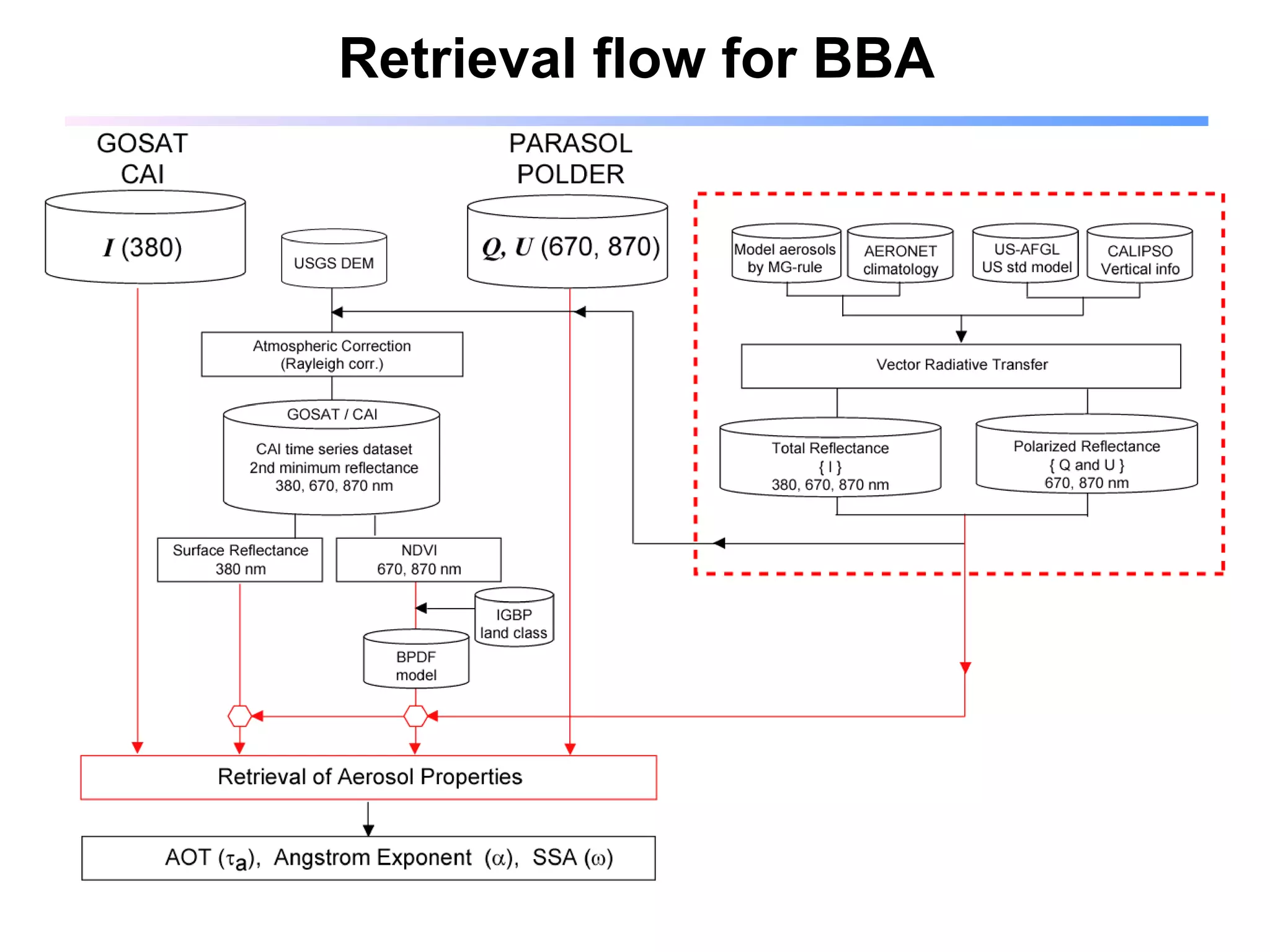
Objective Carbonaceous aerosol plays an important role not only in climate but also in aerosol study. It is difficult of modeling the biomass burning aerosols because their properties are widely varied. This work intends to develop an algorithm for retrieval of  the  biomass burning aerosols (BBA)  based on combined use of near-UV radiance by GOSAT/CAI   & near-IR polarization by PARASOL/POLDER .
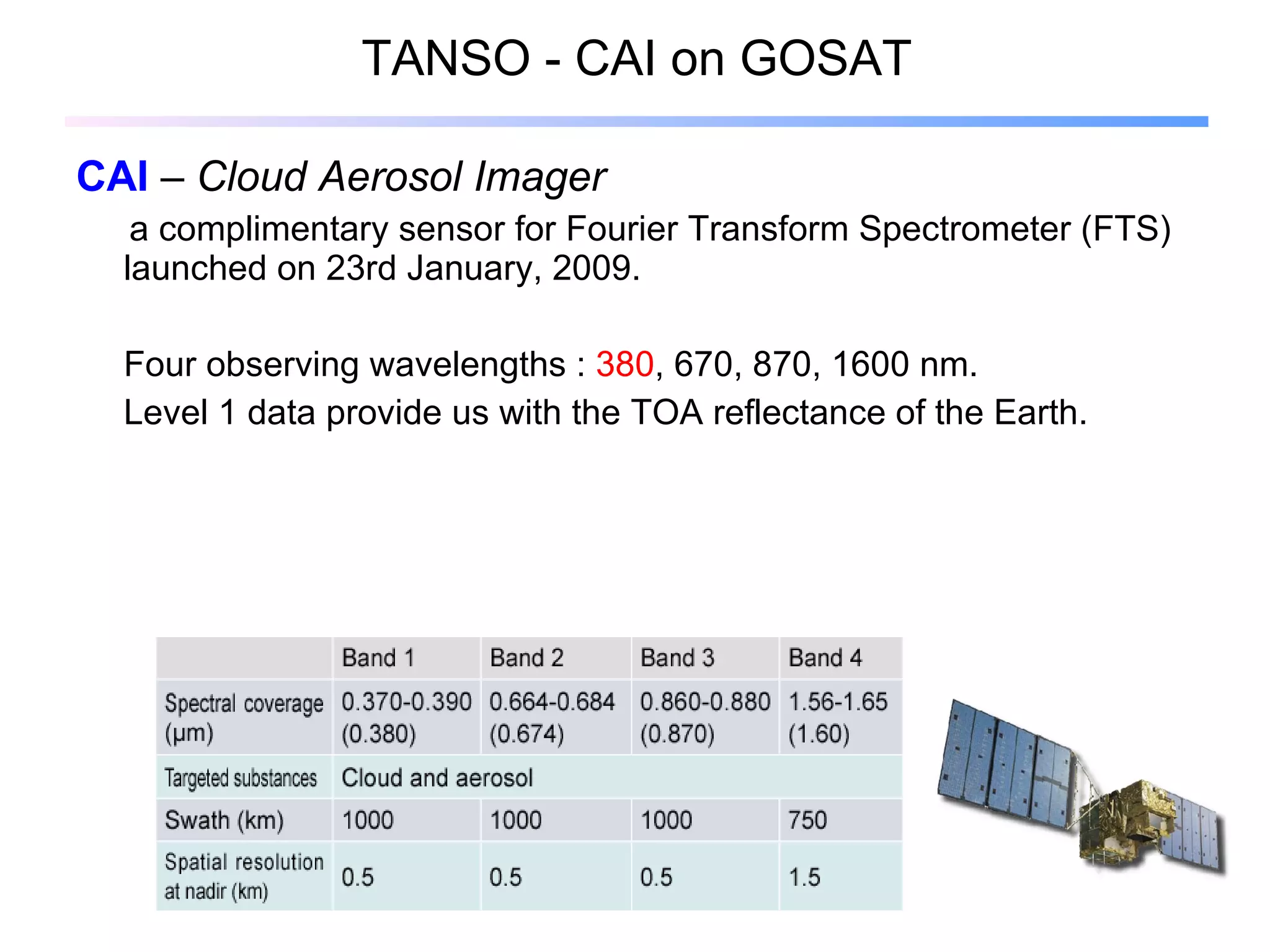
TANSO - CAI on GOSAT CAI  –  Cloud Aerosol Imager  a complimentary sensor for Fourier Transform Spectrometer (FTS) launched on 23rd January, 2009. Four observing wavelengths :  380 , 670, 870, 1600 n m. Level 1 data provide us with the TOA reflectance of the Earth.
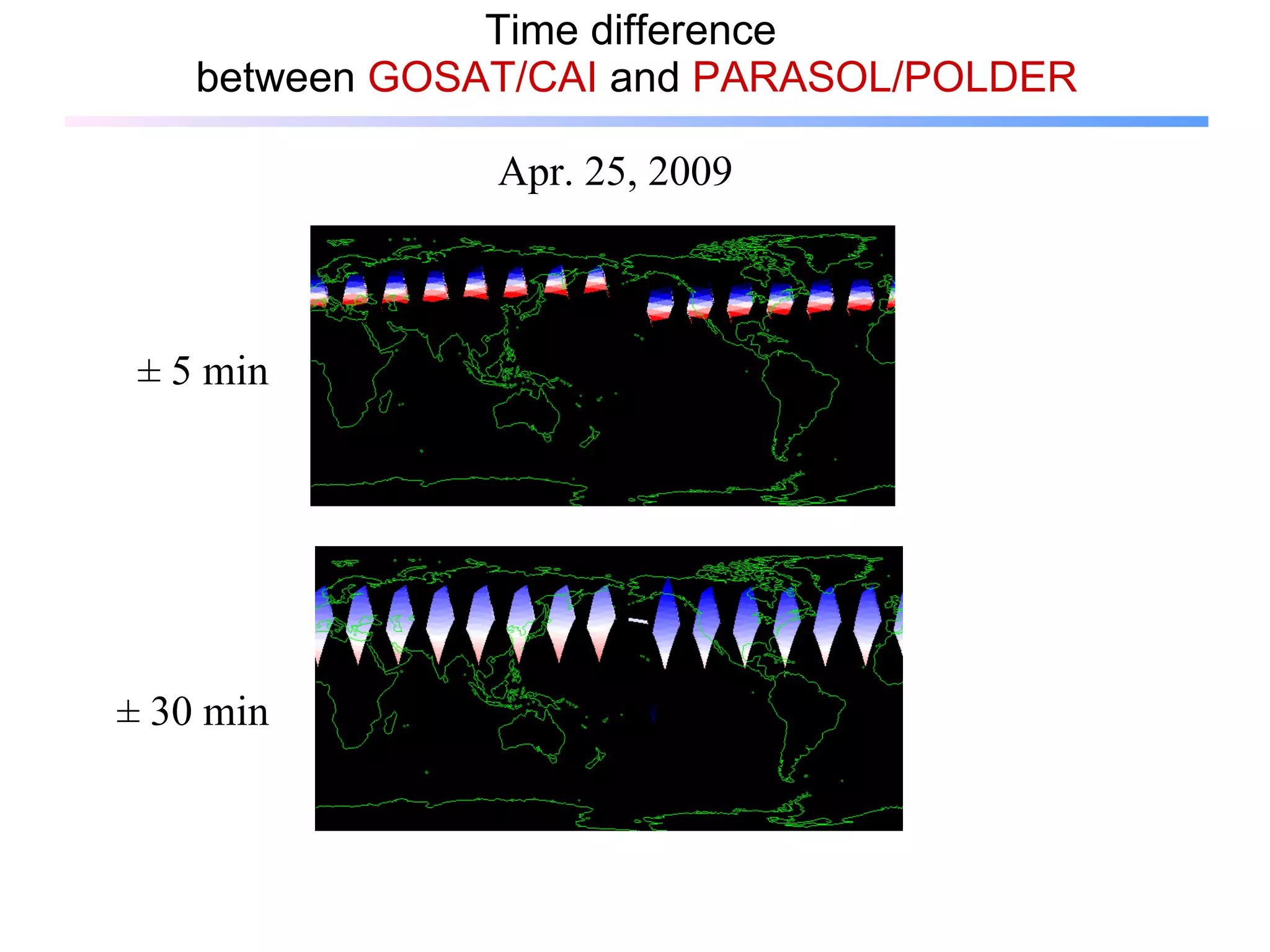
Time difference  between  GOSAT/CAI  and  PARASOL/POLDER ± 5 min ± 30 min Apr. 25, 2009
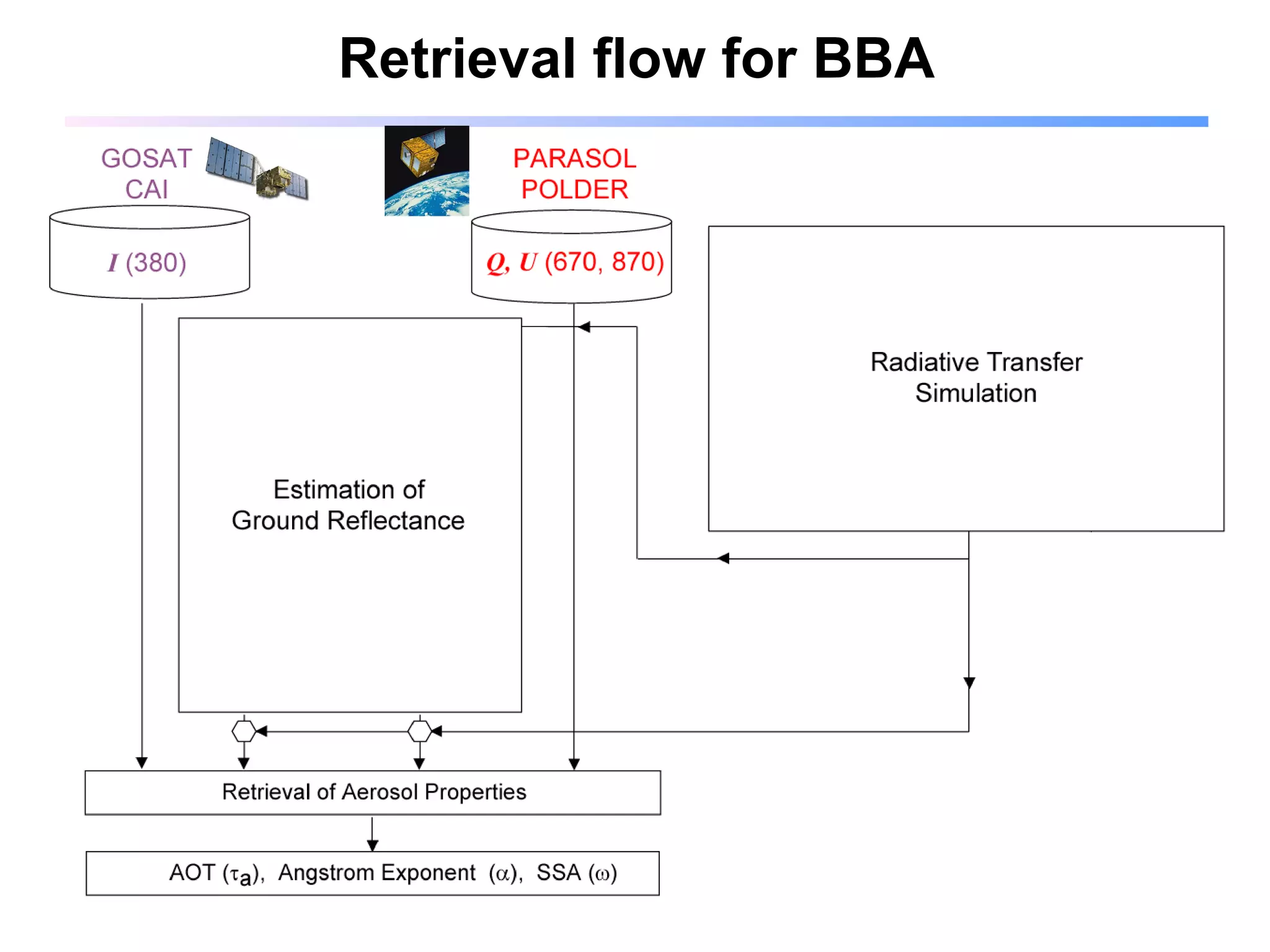
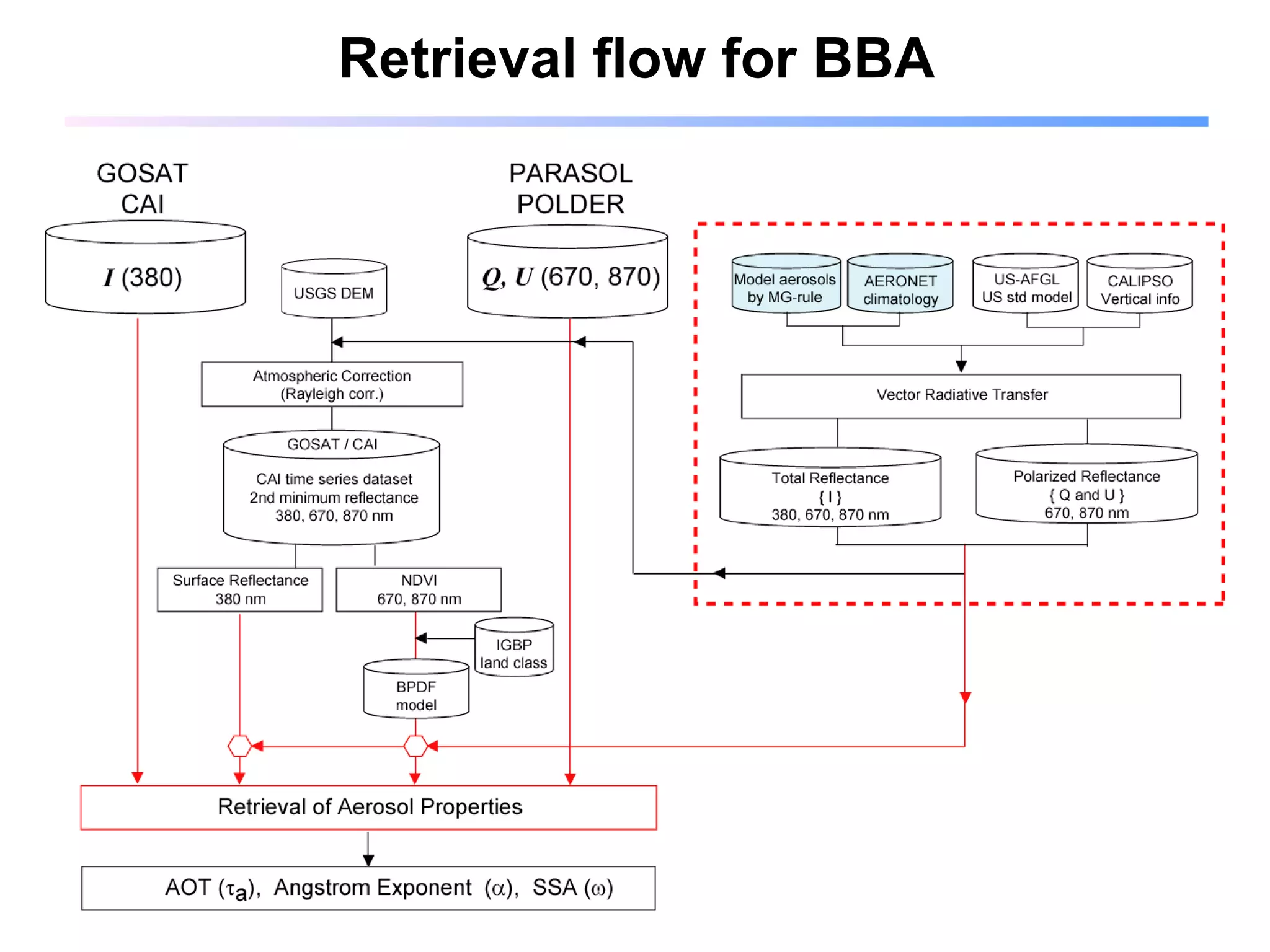
Retrieval flow for BBA
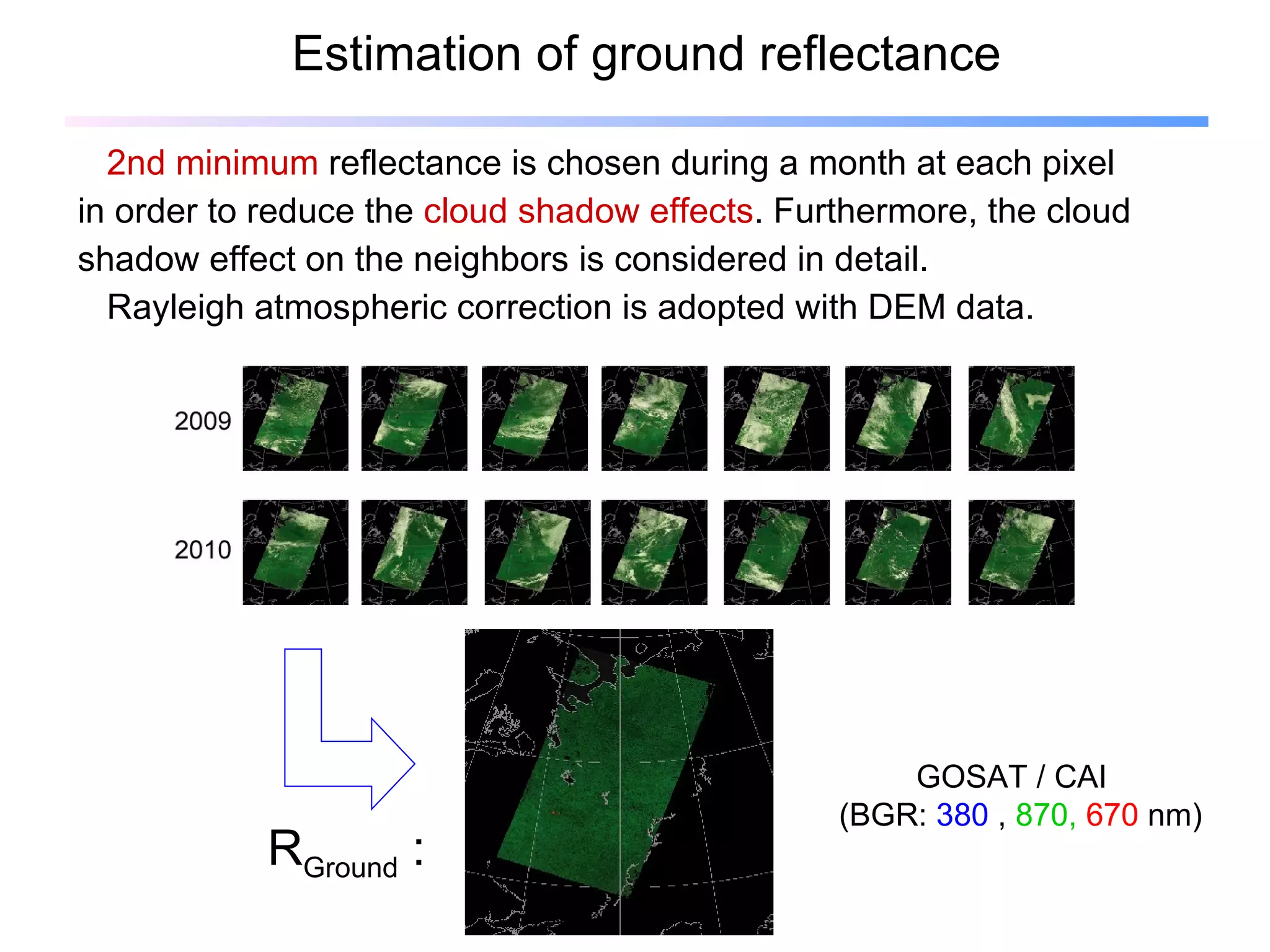
Estimation of ground reflectance 2nd minimum  reflectance is chosen during a month at each pixel in order to reduce the  cloud shadow effects . Furthermore, the cloud  shadow effect on the neighbors is considered in detail.  Rayleigh atmospheric correction is adopted with DEM data. R Ground  : GOSAT / CAI  (BGR:  380  ,  870,  670   nm)
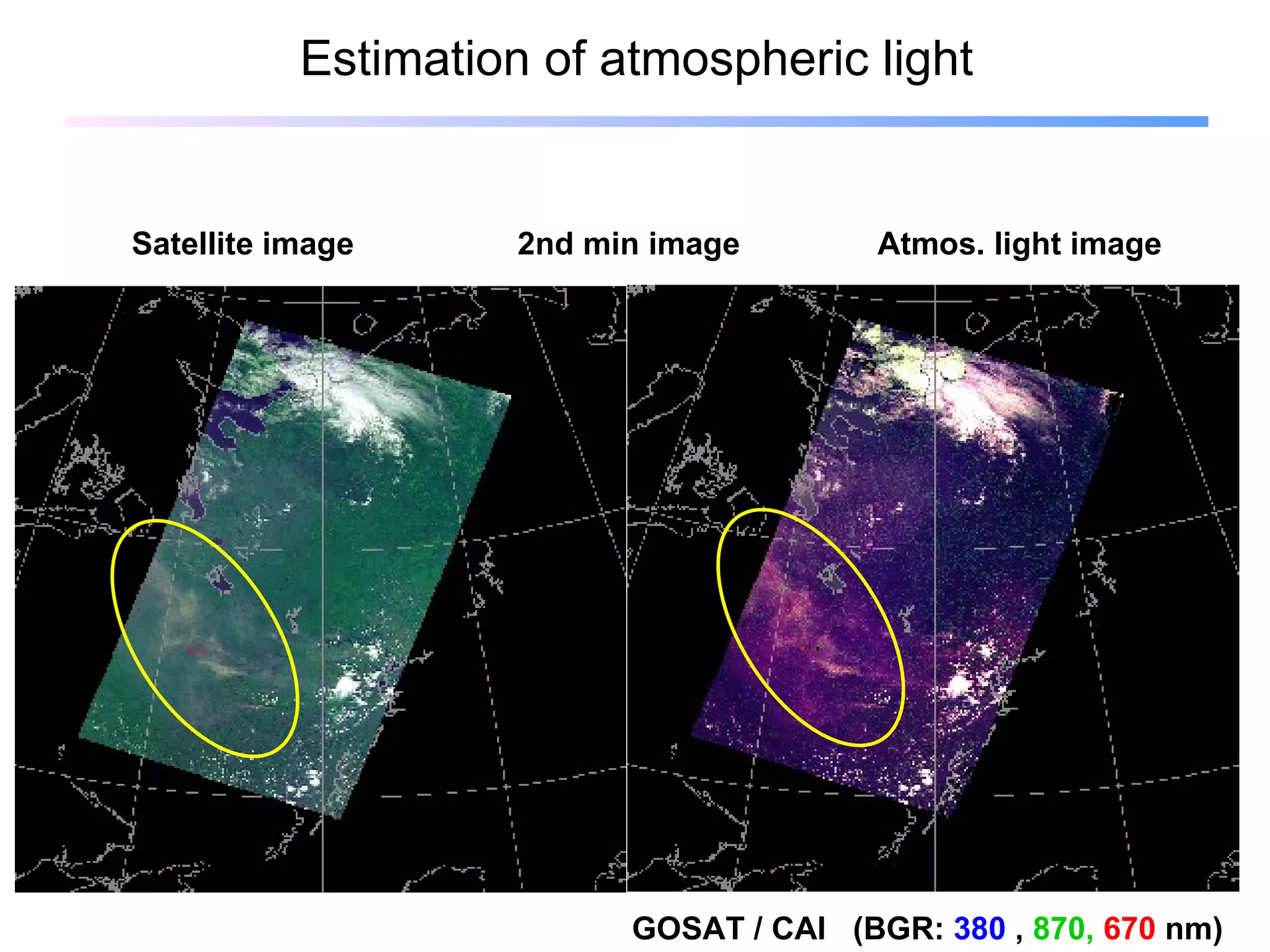
Estimation of atmospheric light GOSAT / CAI  (BGR:  380  ,  870,  670   nm)  Satellite image 2nd min image Atmos. light image
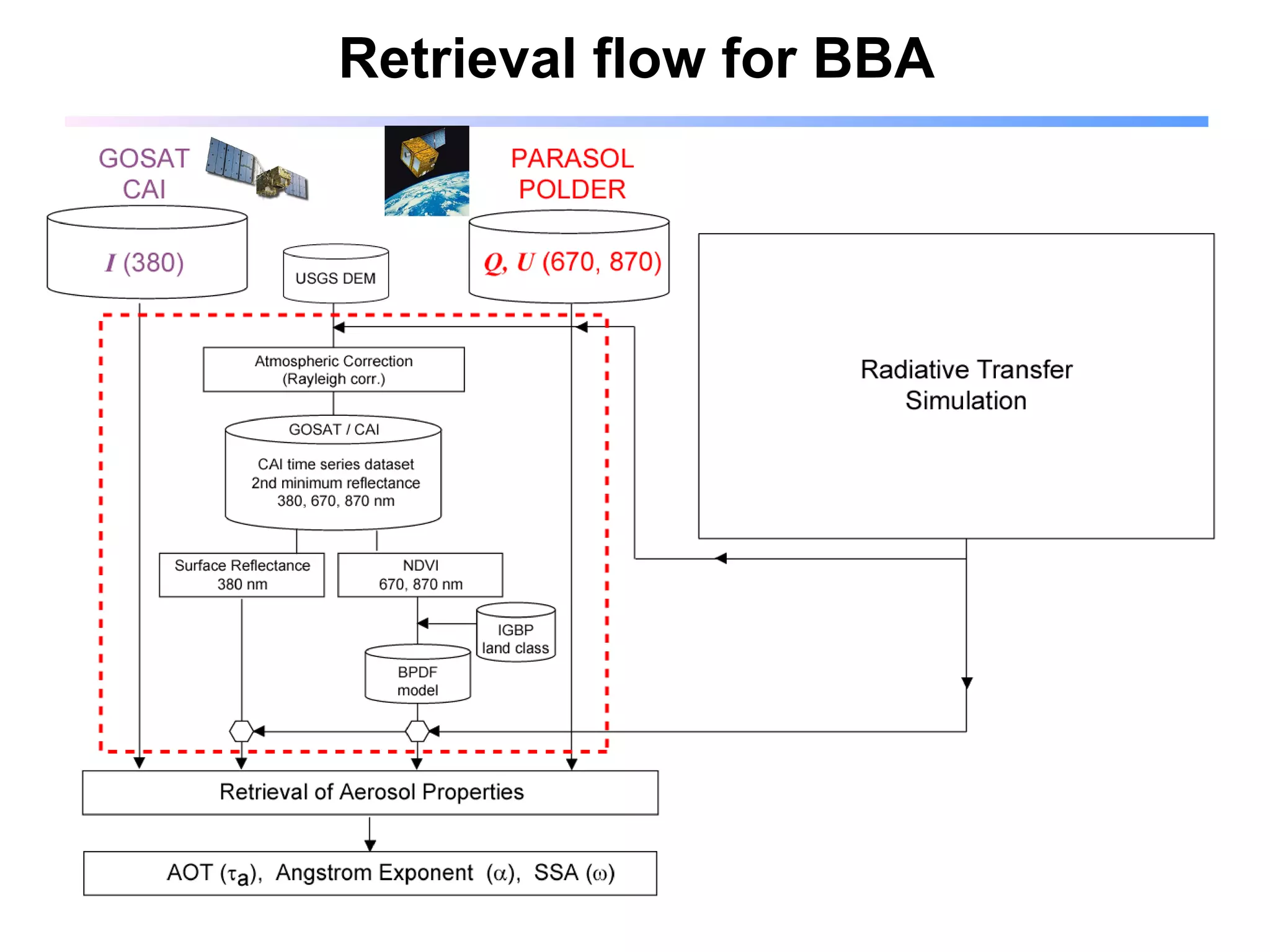
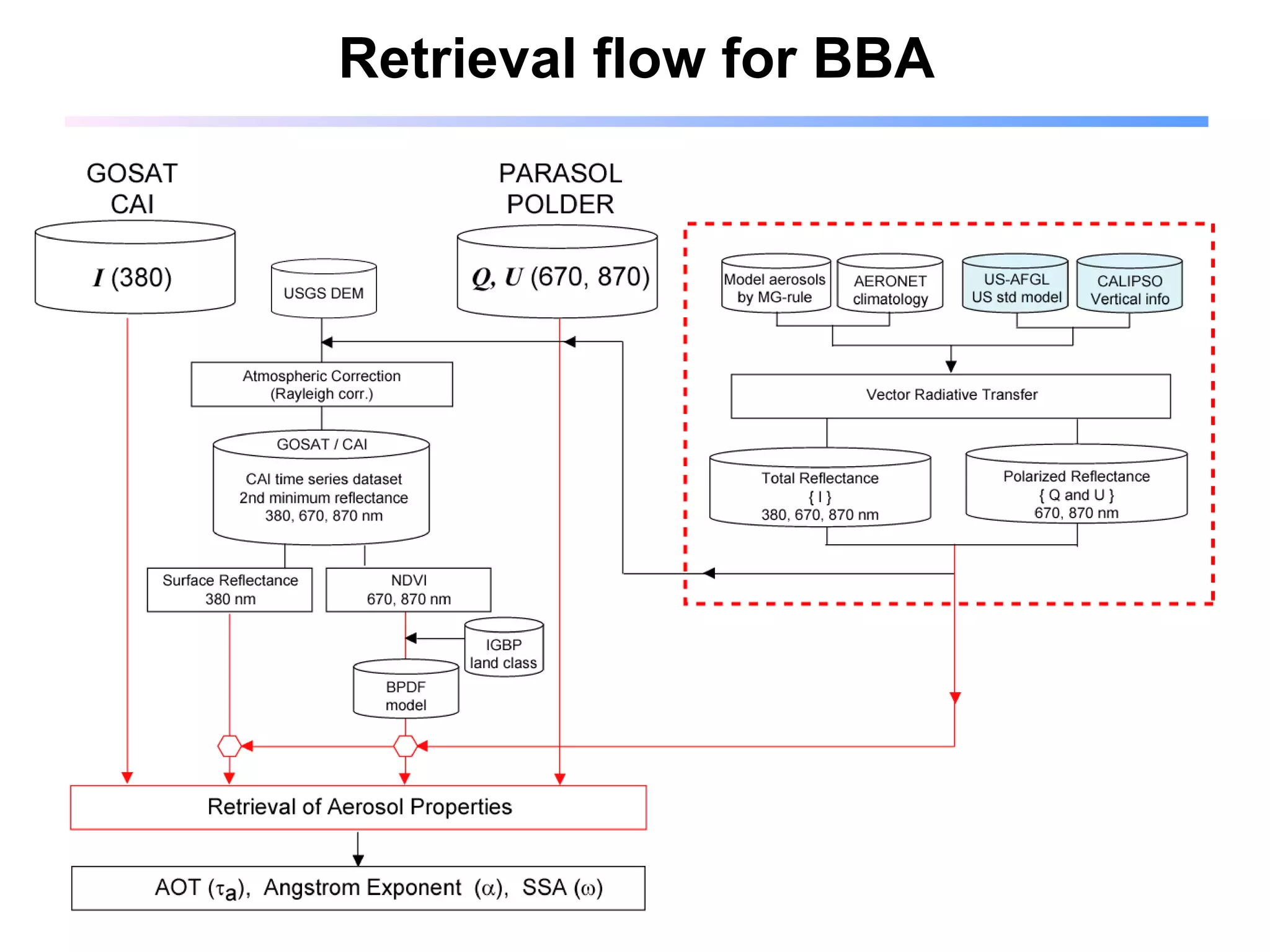
Retrieval flow for BBA
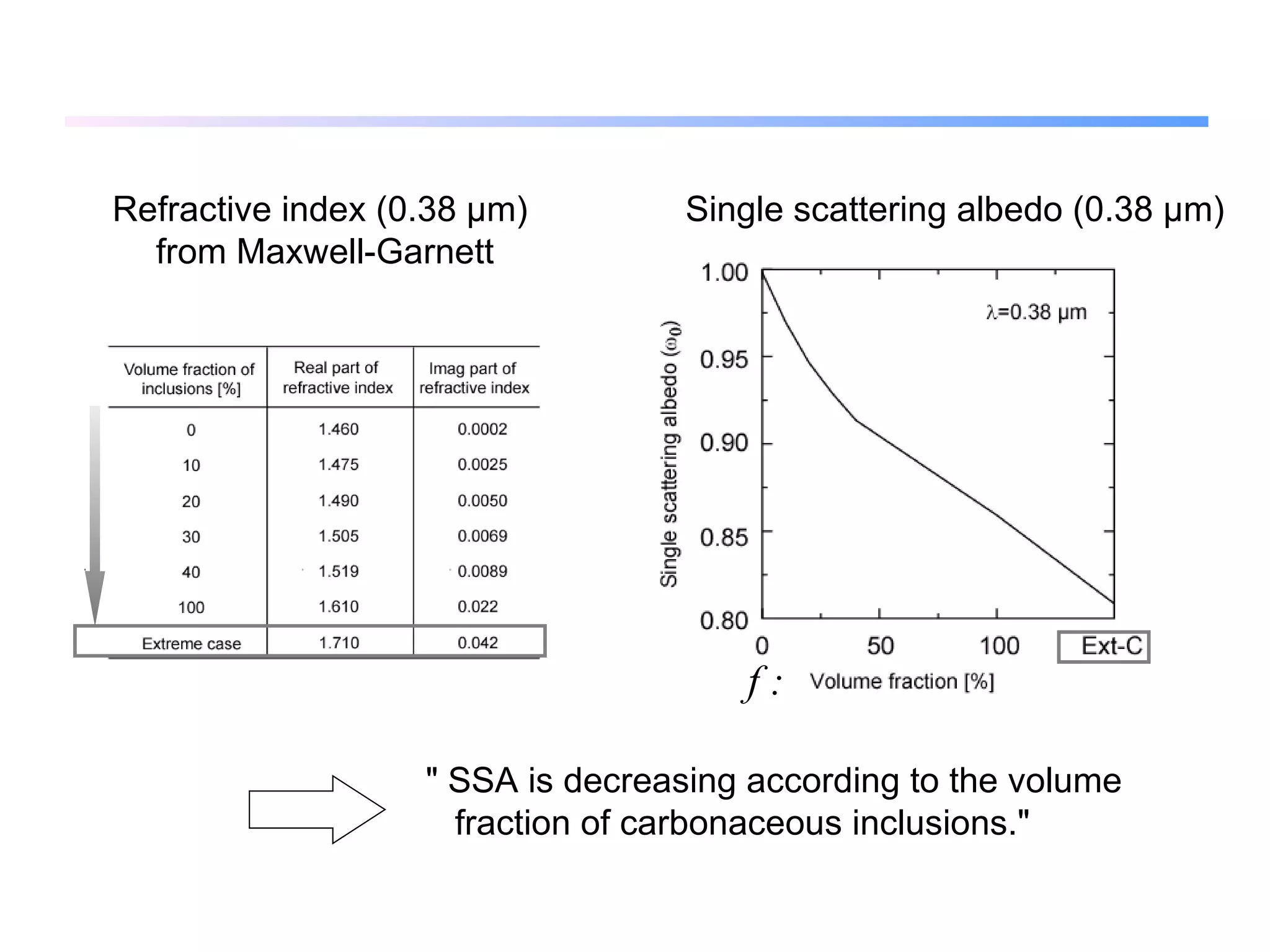
Aerosol model : carbonaceous aerosols Heterogeneous particles  should be considered  for  carbonaceous  aerosols. Heterogeneous particles is approximately interpreted by using  the refractive index calculated by  Maxwell-Garnett mixing rule . ex) Matrix :  m =1.46 - 0.0002 i  Inclusions:  m =1.61 - 0.022 i measurements value for carbon Matrix Inclusions f   [%]  :   volume fraction  of inclusions  against matrix
Refractive index (0.38 µm) from Maxwell-Garnett Single scattering albedo (0.38 µm) f : " SSA is decreasing according to the volume  fraction of carbonaceous inclusions."
Retrieval flow for BBA
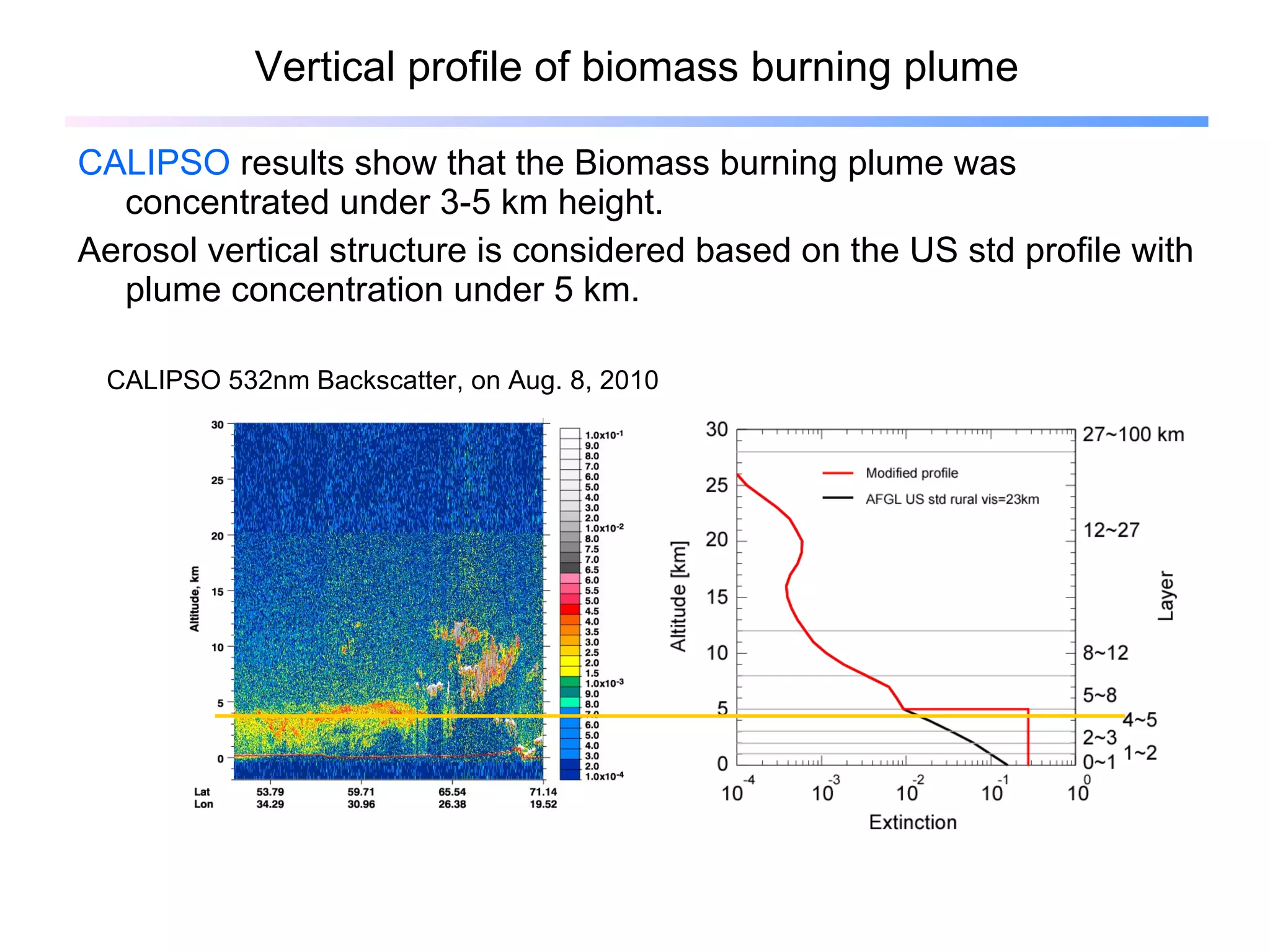
Vertical profile of biomass burning plume CALIPSO  results show that the Biomass burning plume was concentrated under 3-5 km height. Aerosol vertical structure is considered based on the US std profile with plume concentration under 5 km. CALIPSO 532nm Backscatter, on Aug. 8, 2010
Retrieval flow for BBA
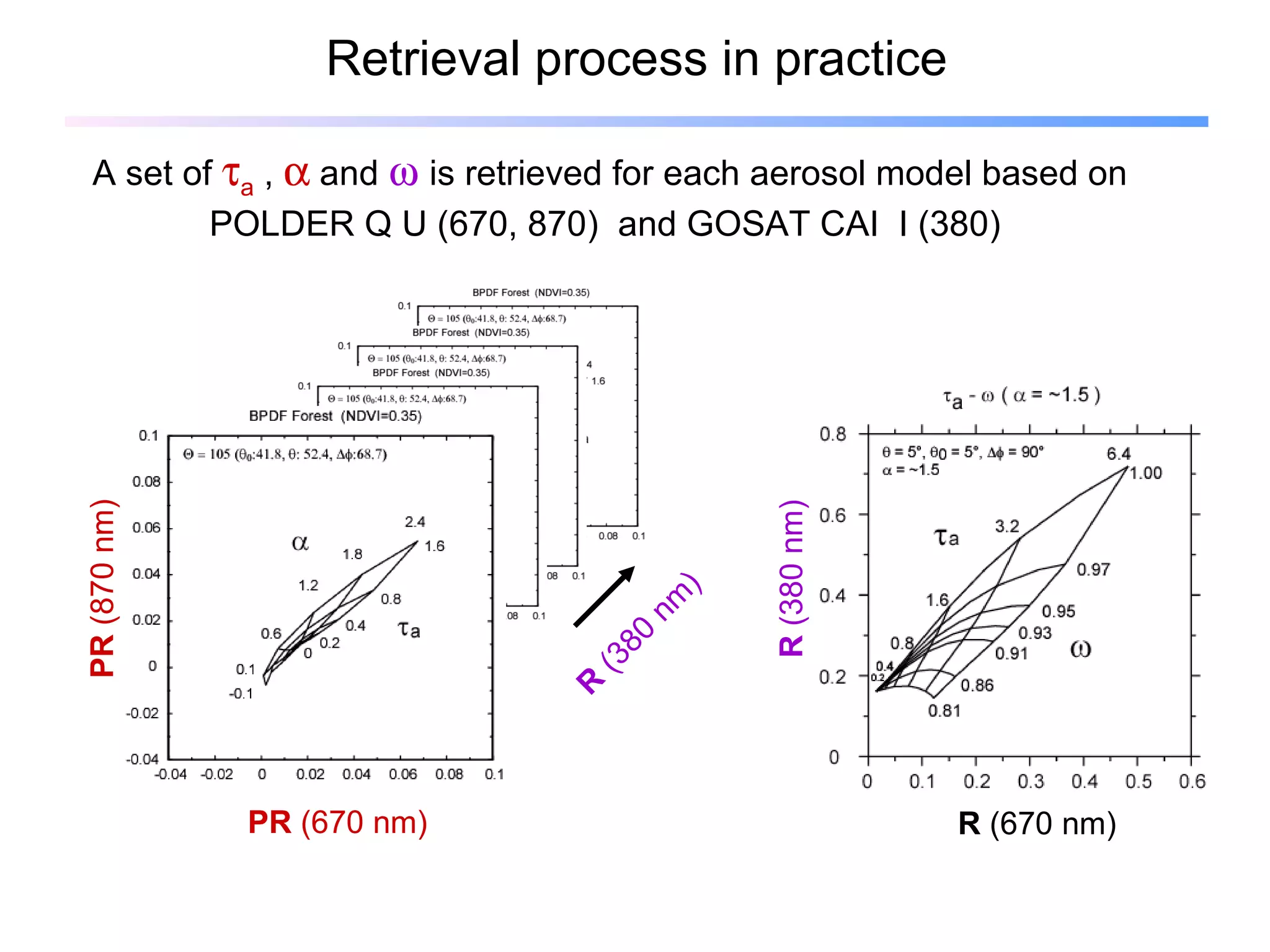
Retrieval process in practice A set of   a  ,    and     is retrieved for each aerosol model based on POLDER Q U (670, 870)  and GOSAT CAI  I (380) R  (380 nm) PR  (670 nm ) PR  (870 nm ) R  (670 nm ) R  (380 nm )
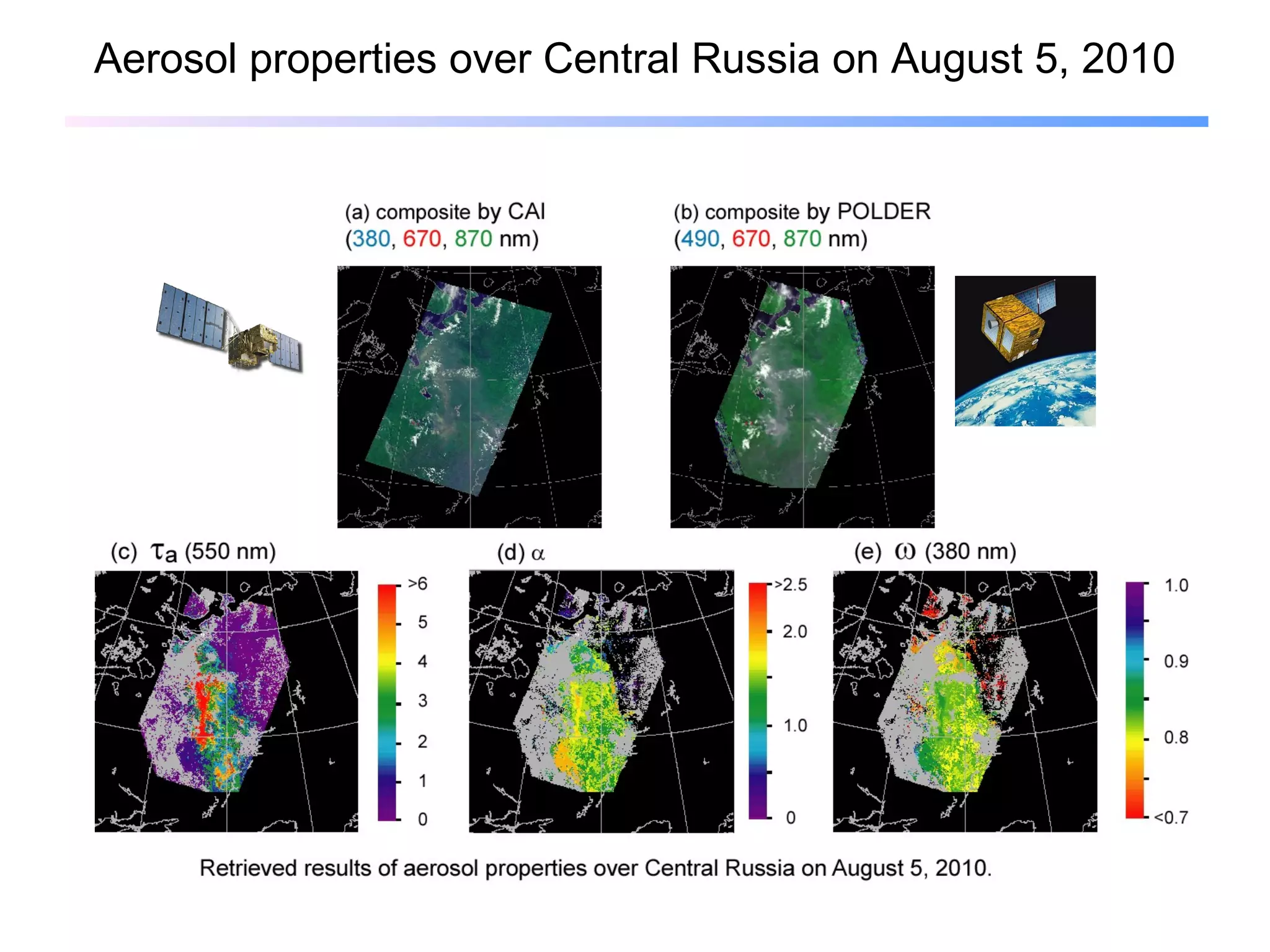
Aerosol properties over Central Russia on August 5, 2010
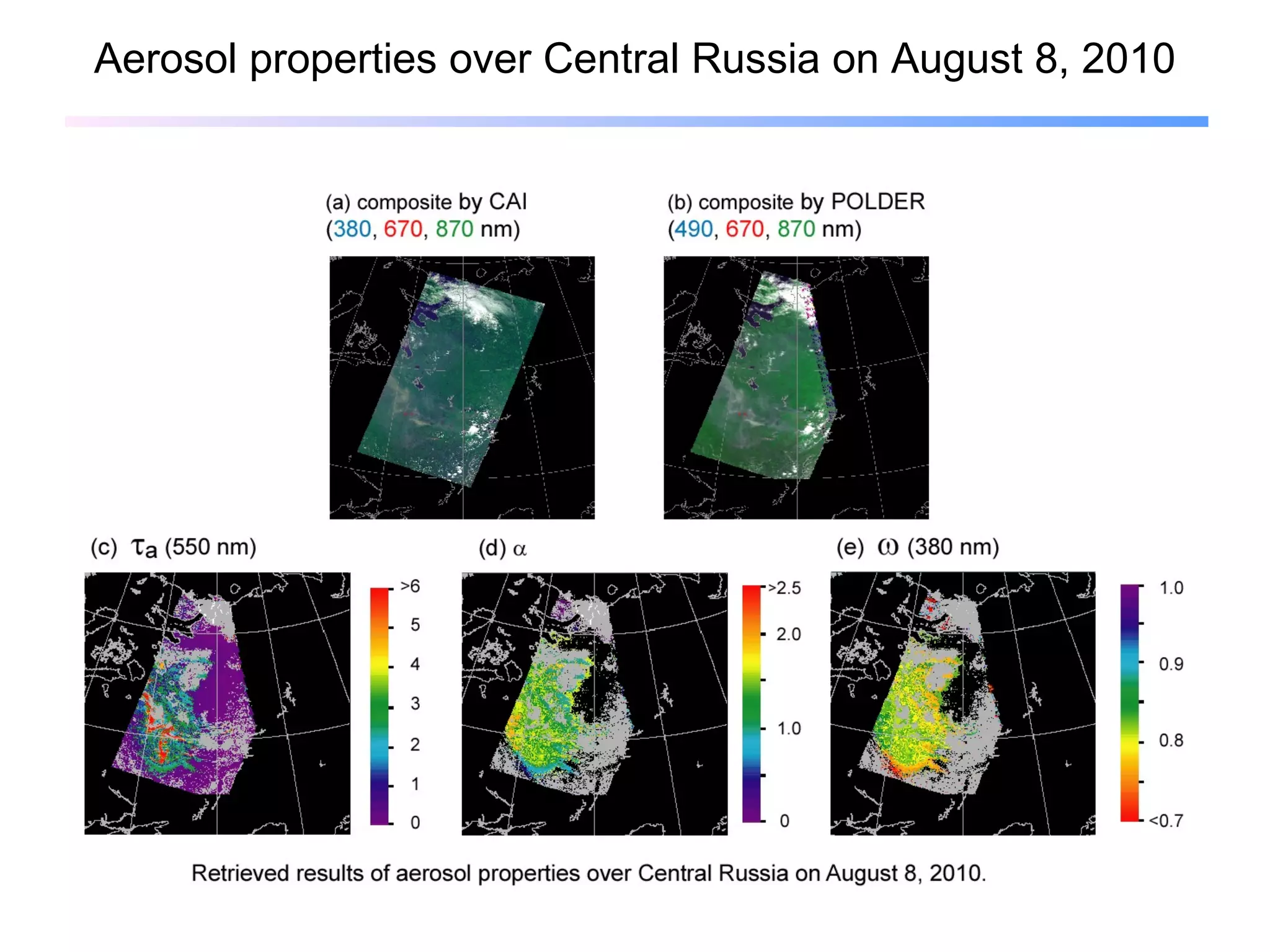
Aerosol properties over Central Russia on August 8, 2010
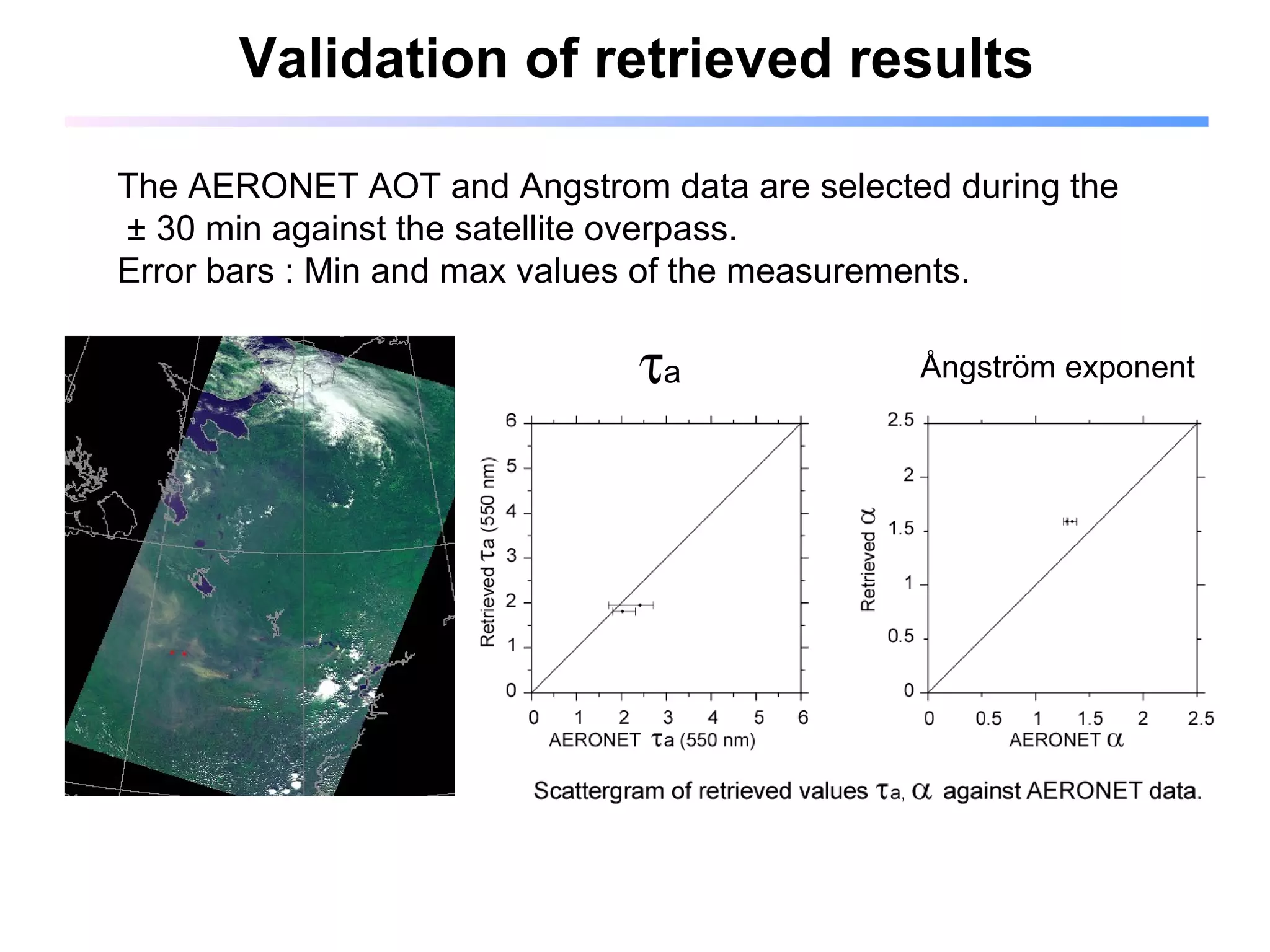
Validation of retrieved results  a Å ngstr ö m exponent The AERONET AOT and Angstrom data are selected during the ± 30 min against the satellite overpass. Error bars : Min and max values of the measurements.
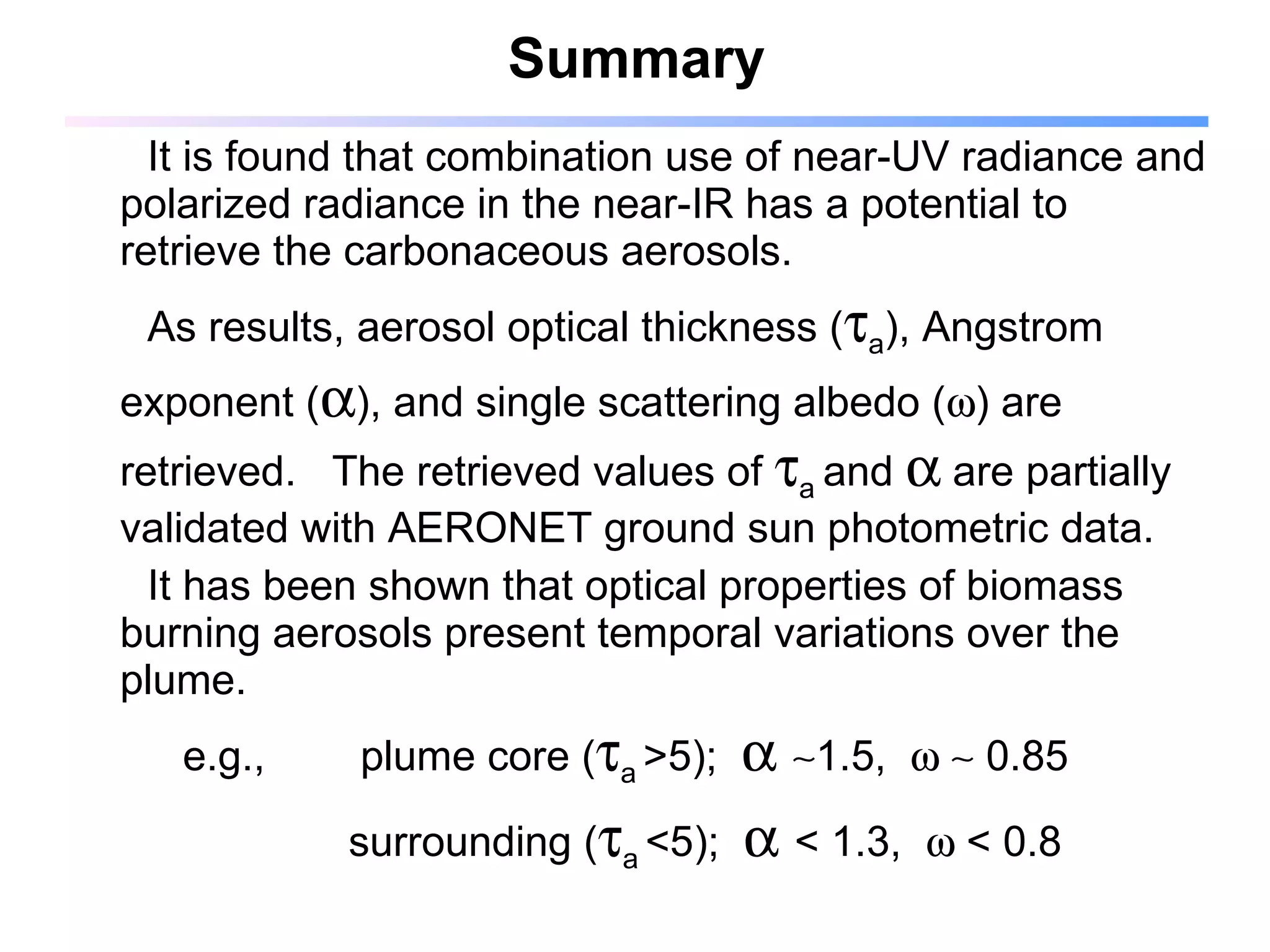
Summary It is found that combination use of near-UV radiance and polarized radiance in the near-IR has a potential to retrieve the carbonaceous aerosols.  As results, aerosol optical thickness (  a ), Angstrom exponent (  ), and single scattering albedo (  ) are retrieved.  The retrieved values of   a  and    are partially validated with AERONET ground sun photometric data. It has been shown that optical properties of biomass burning aerosols present temporal variations over the plume.  e.g.,  plume core (  a   >5);      1.5,       0.85 surrounding (  a   <5);     < 1.3,    < 0.8
Acknowledgement The authors thank to NIES GOSAT team,  CNES PARASOL team,  Dr. Natalia Chubarova, and NASA AERONET team for operations of their instrument and data distributions. This work was supported by the Greenhouse Gases Observing Satellite (GOSAT) Science Project of the National Institute of Environmental Studies (NIES), Tsukuba, Japan, and GCOM-C1 SGLI project by JAXA.
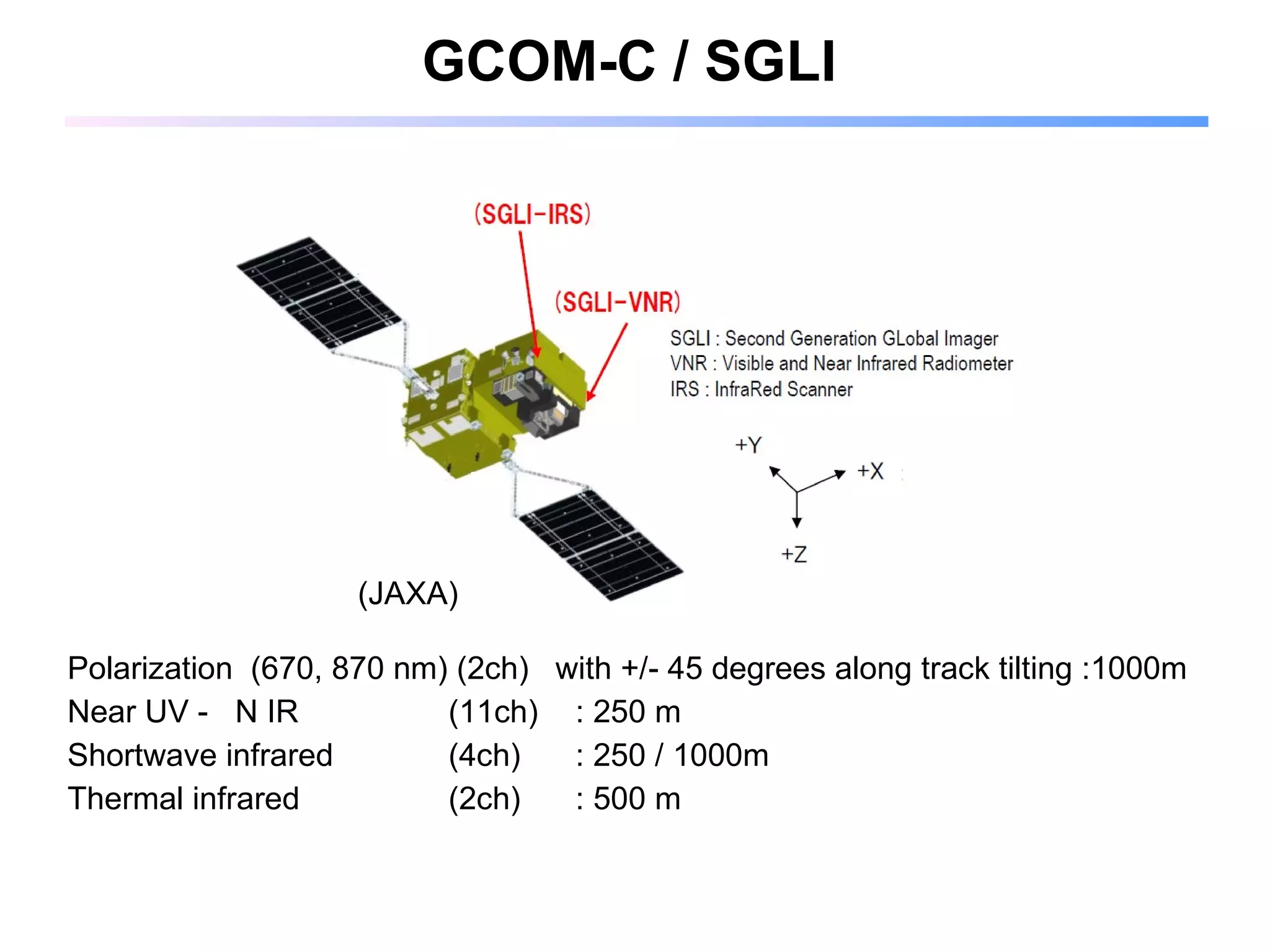
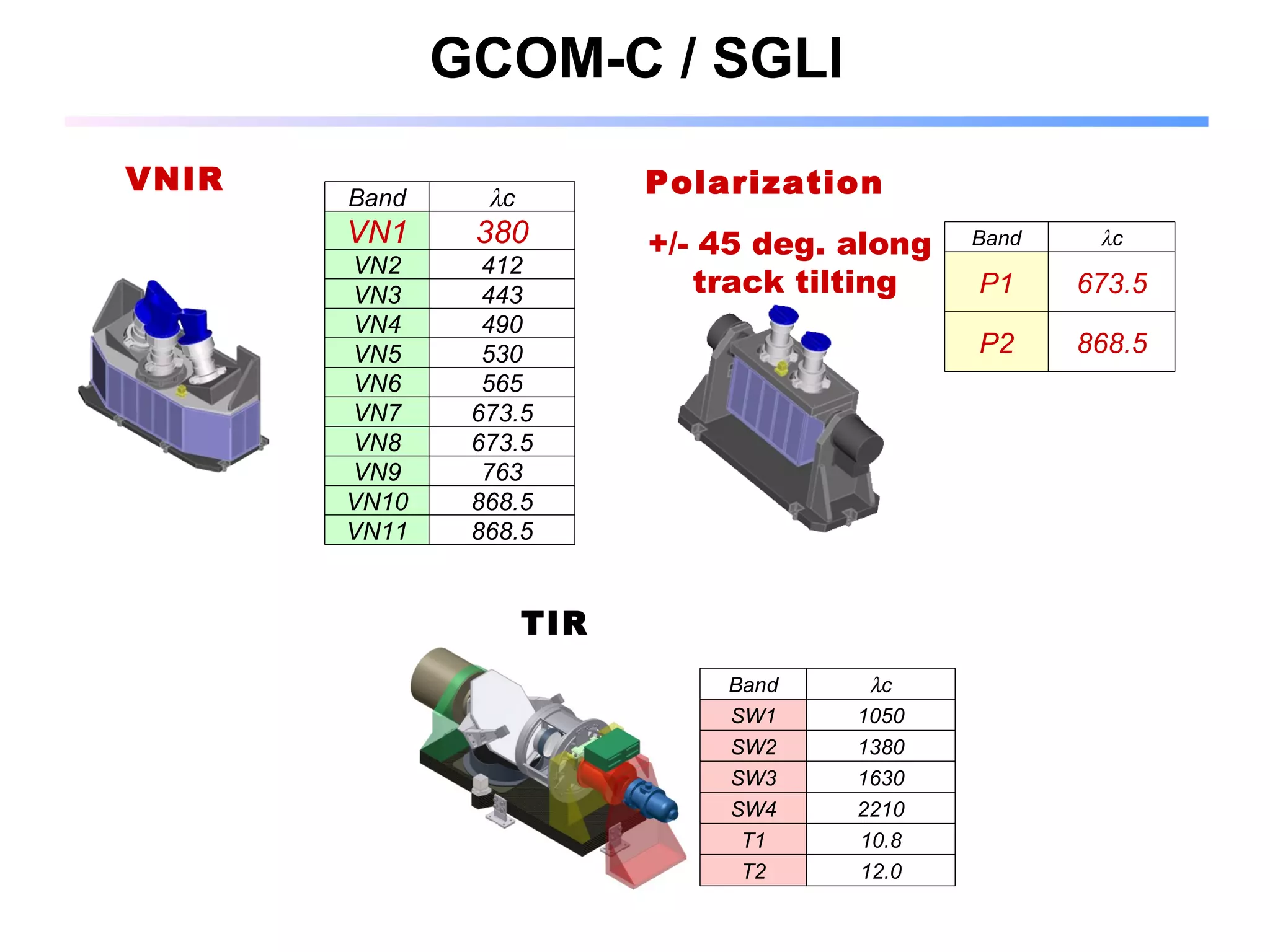
GCOM-C / SGLI   Polarization  (670, 870 n m) (2ch)  with +/- 45 degrees along track tilting :1000m Near UV -  N IR (11ch) : 250 m  Shortwave infrared (4ch)  : 250 / 1000m  Thermal infrared  (2ch) : 500 m (JAXA)
GCOM-C / SGLI VNIR Polarization TIR +/- 45 deg. along  track tilting Band  c SW1 1050 SW2 1380 SW3 1630 SW4 2210 T1 10.8 T2 12.0 Band  c VN1 380 VN2 412 VN3 443 VN4 490 VN5 530 VN6 565 VN7 673.5 VN8 673.5 VN9 763 VN10 868.5 VN11 868.5 Band  c P1 673.5 P2 868.5

Sano_IGARSS2011.ppt

  • 1.
    Retrieval of biomassburning aerosols with combination of near-UV radiance and near -IR polarimetry I.Sano, S.Mukai, M. Nakata (Kinki University, Japan), B. Holben (NASA/GSFC, USA) and N. Kikuchi (NIES, Japan)
  • 2.
    Objective Carbonaceous aerosolplays an important role not only in climate but also in aerosol study. It is difficult of modeling the biomass burning aerosols because their properties are widely varied. This work intends to develop an algorithm for retrieval of the biomass burning aerosols (BBA) based on combined use of near-UV radiance by GOSAT/CAI & near-IR polarization by PARASOL/POLDER .
  • 3.
    TANSO - CAIon GOSAT CAI – Cloud Aerosol Imager a complimentary sensor for Fourier Transform Spectrometer (FTS) launched on 23rd January, 2009. Four observing wavelengths : 380 , 670, 870, 1600 n m. Level 1 data provide us with the TOA reflectance of the Earth.
  • 4.
    Time difference between GOSAT/CAI and PARASOL/POLDER ± 5 min ± 30 min Apr. 25, 2009
  • 5.
  • 6.
  • 7.
    Estimation of groundreflectance 2nd minimum reflectance is chosen during a month at each pixel in order to reduce the cloud shadow effects . Furthermore, the cloud shadow effect on the neighbors is considered in detail. Rayleigh atmospheric correction is adopted with DEM data. R Ground : GOSAT / CAI (BGR: 380 , 870, 670 nm)
  • 8.
    Estimation of atmosphericlight GOSAT / CAI (BGR: 380 , 870, 670 nm) Satellite image 2nd min image Atmos. light image
  • 9.
  • 10.
    Aerosol model :carbonaceous aerosols Heterogeneous particles should be considered for carbonaceous aerosols. Heterogeneous particles is approximately interpreted by using the refractive index calculated by Maxwell-Garnett mixing rule . ex) Matrix : m =1.46 - 0.0002 i Inclusions: m =1.61 - 0.022 i measurements value for carbon Matrix Inclusions f [%] : volume fraction of inclusions against matrix
  • 11.
    Refractive index (0.38µm) from Maxwell-Garnett Single scattering albedo (0.38 µm) f : &quot; SSA is decreasing according to the volume fraction of carbonaceous inclusions.&quot;
  • 12.
  • 13.
    Vertical profile ofbiomass burning plume CALIPSO results show that the Biomass burning plume was concentrated under 3-5 km height. Aerosol vertical structure is considered based on the US std profile with plume concentration under 5 km. CALIPSO 532nm Backscatter, on Aug. 8, 2010
  • 14.
  • 15.
    Retrieval process inpractice A set of  a ,  and  is retrieved for each aerosol model based on POLDER Q U (670, 870) and GOSAT CAI I (380) R (380 nm) PR (670 nm ) PR (870 nm ) R (670 nm ) R (380 nm )
  • 16.
    Aerosol properties overCentral Russia on August 5, 2010
  • 17.
    Aerosol properties overCentral Russia on August 8, 2010
  • 18.
    Validation of retrievedresults  a Å ngstr ö m exponent The AERONET AOT and Angstrom data are selected during the ± 30 min against the satellite overpass. Error bars : Min and max values of the measurements.
  • 19.
    Summary It isfound that combination use of near-UV radiance and polarized radiance in the near-IR has a potential to retrieve the carbonaceous aerosols. As results, aerosol optical thickness (  a ), Angstrom exponent (  ), and single scattering albedo (  ) are retrieved. The retrieved values of  a and  are partially validated with AERONET ground sun photometric data. It has been shown that optical properties of biomass burning aerosols present temporal variations over the plume. e.g., plume core (  a >5);   1.5,   0.85 surrounding (  a <5);  < 1.3,  < 0.8
  • 20.
    Acknowledgement The authorsthank to NIES GOSAT team, CNES PARASOL team, Dr. Natalia Chubarova, and NASA AERONET team for operations of their instrument and data distributions. This work was supported by the Greenhouse Gases Observing Satellite (GOSAT) Science Project of the National Institute of Environmental Studies (NIES), Tsukuba, Japan, and GCOM-C1 SGLI project by JAXA.
  • 21.
    GCOM-C / SGLI Polarization (670, 870 n m) (2ch) with +/- 45 degrees along track tilting :1000m Near UV - N IR (11ch) : 250 m Shortwave infrared (4ch) : 250 / 1000m Thermal infrared (2ch) : 500 m (JAXA)
  • 22.
    GCOM-C / SGLIVNIR Polarization TIR +/- 45 deg. along track tilting Band  c SW1 1050 SW2 1380 SW3 1630 SW4 2210 T1 10.8 T2 12.0 Band  c VN1 380 VN2 412 VN3 443 VN4 490 VN5 530 VN6 565 VN7 673.5 VN8 673.5 VN9 763 VN10 868.5 VN11 868.5 Band  c P1 673.5 P2 868.5