5 PULMONARY INFECTIONS
DAVID SUTTON
DAVID SUTTON PICTURES
DR. Muhammad Bin Zulfiqar
PGR-FCPS III SIMS/SHL
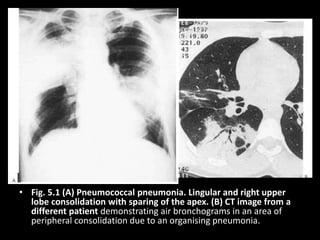
• Fig. 5.1 (A) Pneumococcal pneumonia. Lingular and right upper
lobe consolidation with sparing of the apex. (B) CT image from a
different patient demonstrating air bronchograms in an area of
peripheral consolidation due to an organising pneumonia.
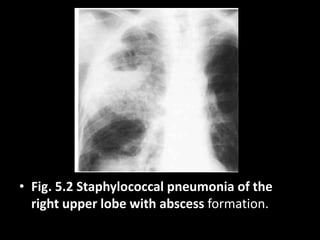
• Fig. 5.2 Staphylococcal pneumonia of the
right upper lobe with abscess formation.
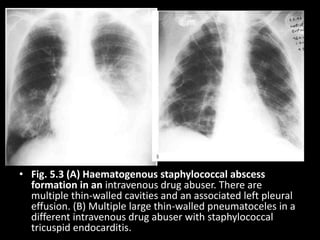
• Fig. 5.3 (A) Haematogenous staphylococcal abscess
formation in an intravenous drug abuser. There are
multiple thin-walled cavities and an associated left pleural
effusion. (B) Multiple large thin-walled pneumatoceles in a
different intravenous drug abuser with staphylococcal
tricuspid endocarditis.
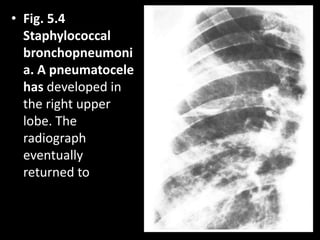
• Fig. 5.4
Staphylococcal
bronchopneumoni
a. A pneumatocele
has developed in
the right upper
lobe. The
radiograph
eventually
returned to
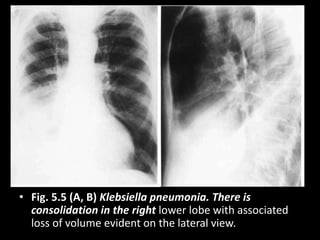
• Fig. 5.5 (A, B) Klebsiella pneumonia. There is
consolidation in the right lower lobe with associated
loss of volume evident on the lateral view.
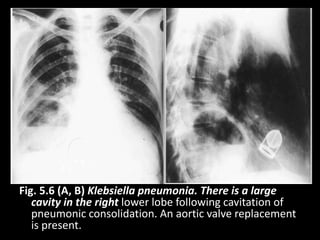
Fig. 5.6 (A, B) Klebsiella pneumonia. There is a large
cavity in the right lower lobe following cavitation of
pneumonic consolidation. An aortic valve replacement
is present.
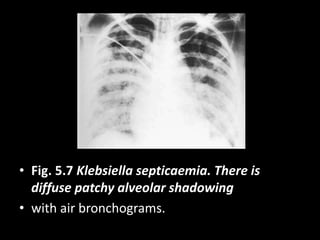
• Fig. 5.7 Klebsiella septicaemia. There is
diffuse patchy alveolar shadowing
• with air bronchograms.
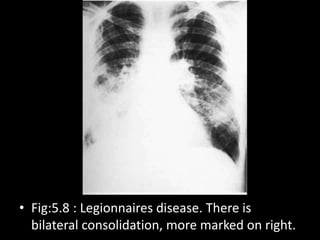
• Fig:5.8 : Legionnaires disease. There is
bilateral consolidation, more marked on right.
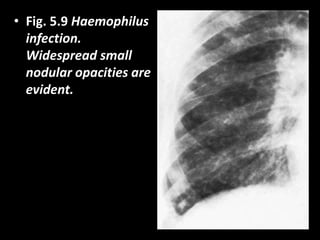
• Fig. 5.9 Haemophilus
infection.
Widespread small
nodular opacities are
evident.
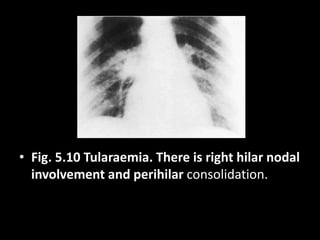
• Fig. 5.10 Tularaemia. There is right hilar nodal
involvement and perihilar consolidation.
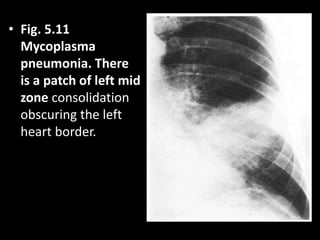
• Fig. 5.11
Mycoplasma
pneumonia. There
is a patch of left mid
zone consolidation
obscuring the left
heart border.
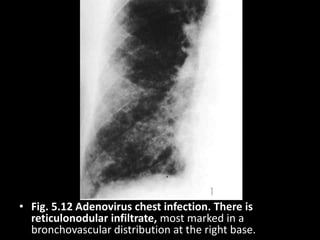
• Fig. 5.12 Adenovirus chest infection. There is
reticulonodular infiltrate, most marked in a
bronchovascular distribution at the right base.
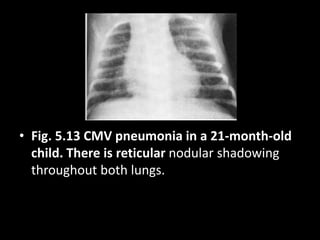
• Fig. 5.13 CMV pneumonia in a 21-month-old
child. There is reticular nodular shadowing
throughout both lungs.
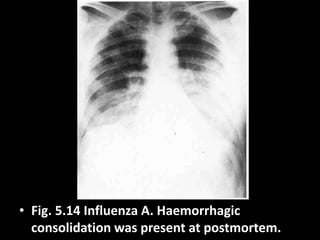
• Fig. 5.14 Influenza A. Haemorrhagic
consolidation was present at postmortem.
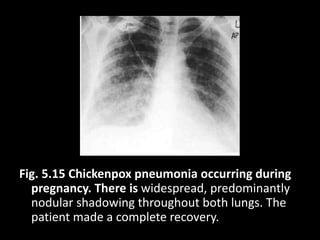
Fig. 5.15 Chickenpox pneumonia occurring during
pregnancy. There is widespread, predominantly
nodular shadowing throughout both lungs. The
patient made a complete recovery.
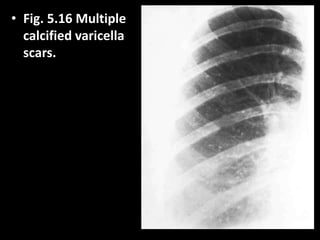
• Fig. 5.16 Multiple
calcified varicella
scars.
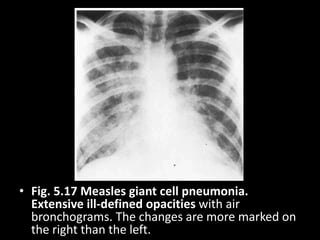
• Fig. 5.17 Measles giant cell pneumonia.
Extensive ill-defined opacities with air
bronchograms. The changes are more marked on
the right than the left.
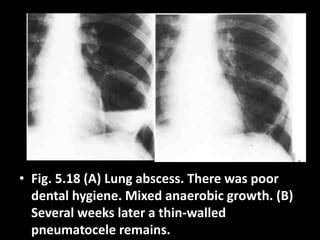
• Fig. 5.18 (A) Lung abscess. There was poor
dental hygiene. Mixed anaerobic growth. (B)
Several weeks later a thin-walled
pneumatocele remains.
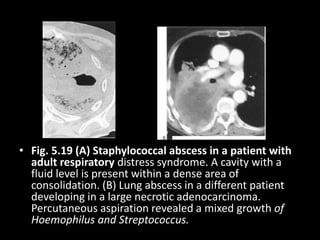
• Fig. 5.19 (A) Staphylococcal abscess in a patient with
adult respiratory distress syndrome. A cavity with a
fluid level is present within a dense area of
consolidation. (B) Lung abscess in a different patient
developing in a large necrotic adenocarcinoma.
Percutaneous aspiration revealed a mixed growth of
Hoemophilus and Streptococcus.
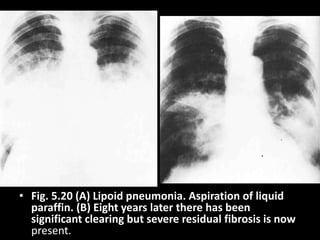
• Fig. 5.20 (A) Lipoid pneumonia. Aspiration of liquid
paraffin. (B) Eight years later there has been
significant clearing but severe residual fibrosis is now
present.
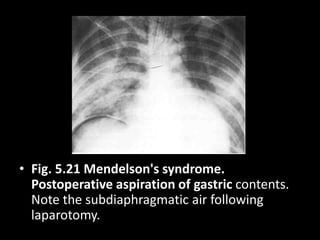
• Fig. 5.21 Mendelson's syndrome.
Postoperative aspiration of gastric contents.
Note the subdiaphragmatic air following
laparotomy.
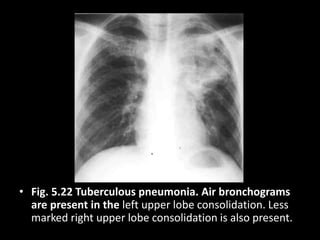
• Fig. 5.22 Tuberculous pneumonia. Air bronchograms
are present in the left upper lobe consolidation. Less
marked right upper lobe consolidation is also present.
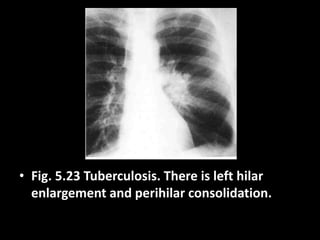
• Fig. 5.23 Tuberculosis. There is left hilar
enlargement and perihilar consolidation.
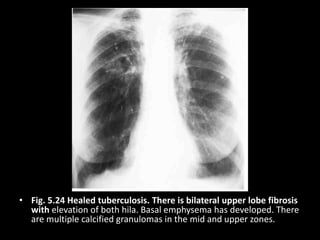
• Fig. 5.24 Healed tuberculosis. There is bilateral upper lobe fibrosis
with elevation of both hila. Basal emphysema has developed. There
are multiple calcified granulomas in the mid and upper zones.
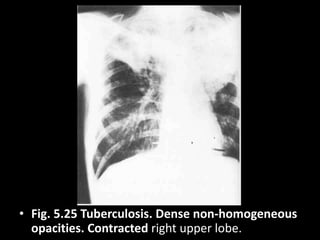
• Fig. 5.25 Tuberculosis. Dense non-homogeneous
opacities. Contracted right upper lobe.
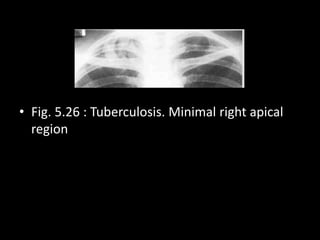
• Fig. 5.26 : Tuberculosis. Minimal right apical
region
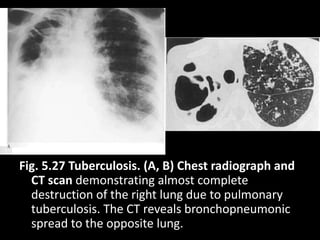
Fig. 5.27 Tuberculosis. (A, B) Chest radiograph and
CT scan demonstrating almost complete
destruction of the right lung due to pulmonary
tuberculosis. The CT reveals bronchopneumonic
spread to the opposite lung.
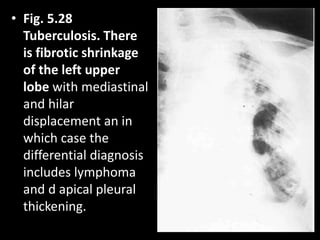
• Fig. 5.28
Tuberculosis. There
is fibrotic shrinkage
of the left upper
lobe with mediastinal
and hilar
displacement an in
which case the
differential diagnosis
includes lymphoma
and d apical pleural
thickening.
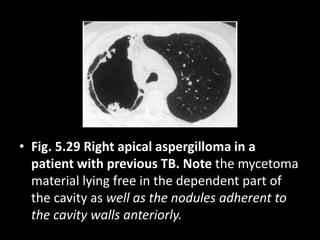
• Fig. 5.29 Right apical aspergilloma in a
patient with previous TB. Note the mycetoma
material lying free in the dependent part of
the cavity as well as the nodules adherent to
the cavity walls anteriorly.
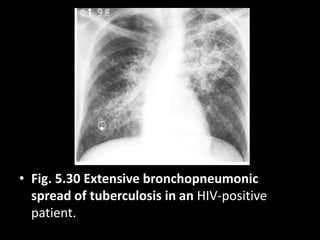
• Fig. 5.30 Extensive bronchopneumonic
spread of tuberculosis in an HIV-positive
patient.
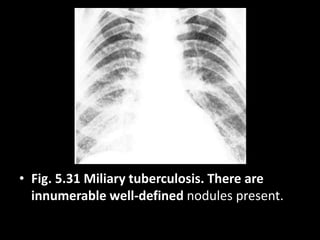
• Fig. 5.31 Miliary tuberculosis. There are
innumerable well-defined nodules present.
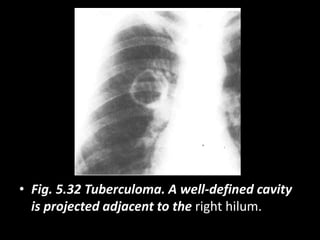
• Fig. 5.32 Tuberculoma. A well-defined cavity
is projected adjacent to the right hilum.
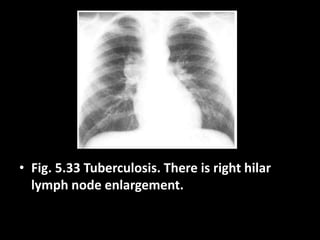
• Fig. 5.33 Tuberculosis. There is right hilar
lymph node enlargement.
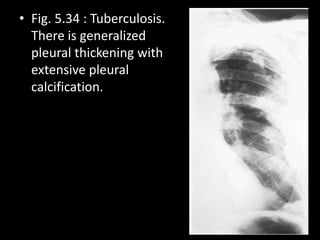
• Fig. 5.34 : Tuberculosis.
There is generalized
pleural thickening with
extensive pleural
calcification.
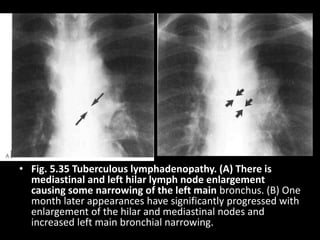
• Fig. 5.35 Tuberculous lymphadenopathy. (A) There is
mediastinal and left hilar lymph node enlargement
causing some narrowing of the left main bronchus. (B) One
month later appearances have significantly progressed with
enlargement of the hilar and mediastinal nodes and
increased left main bronchial narrowing.
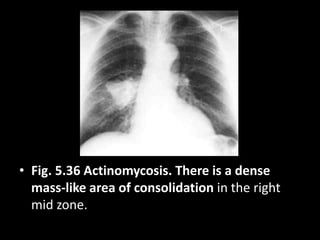
• Fig. 5.36 Actinomycosis. There is a dense
mass-like area of consolidation in the right
mid zone.
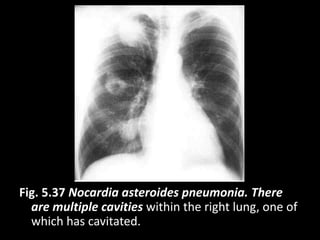
Fig. 5.37 Nocardia asteroides pneumonia. There
are multiple cavities within the right lung, one of
which has cavitated.
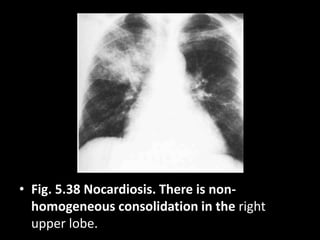
• Fig. 5.38 Nocardiosis. There is non-
homogeneous consolidation in the right
upper lobe.
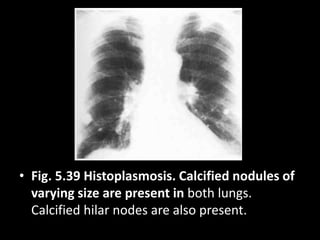
• Fig. 5.39 Histoplasmosis. Calcified nodules of
varying size are present in both lungs.
Calcified hilar nodes are also present.
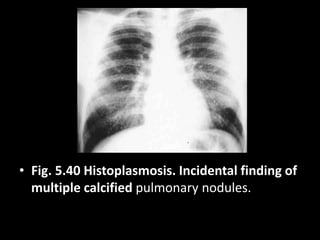
• Fig. 5.40 Histoplasmosis. Incidental finding of
multiple calcified pulmonary nodules.
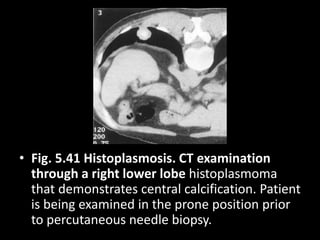
• Fig. 5.41 Histoplasmosis. CT examination
through a right lower lobe histoplasmoma
that demonstrates central calcification. Patient
is being examined in the prone position prior
to percutaneous needle biopsy.
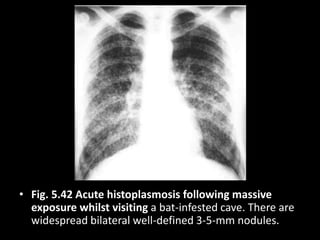
• Fig. 5.42 Acute histoplasmosis following massive
exposure whilst visiting a bat-infested cave. There are
widespread bilateral well-defined 3-5-mm nodules.
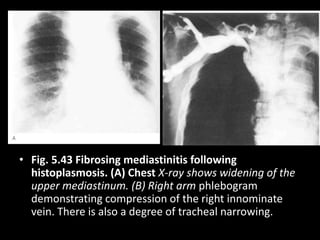
• Fig. 5.43 Fibrosing mediastinitis following
histoplasmosis. (A) Chest X-ray shows widening of the
upper mediastinum. (B) Right arm phlebogram
demonstrating compression of the right innominate
vein. There is also a degree of tracheal narrowing.
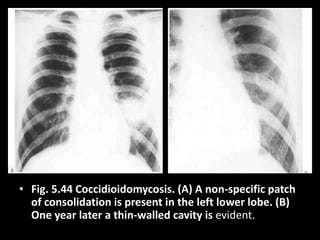
• Fig. 5.44 Coccidioidomycosis. (A) A non-specific patch
of consolidation is present in the left lower lobe. (B)
One year later a thin-walled cavity is evident.
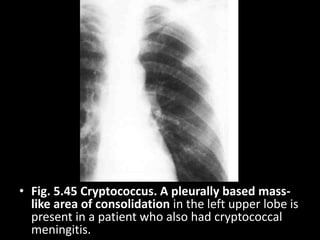
• Fig. 5.45 Cryptococcus. A pleurally based mass-
like area of consolidation in the left upper lobe is
present in a patient who also had cryptococcal
meningitis.
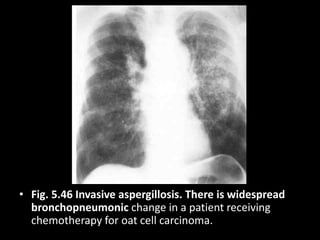
• Fig. 5.46 Invasive aspergillosis. There is widespread
bronchopneumonic change in a patient receiving
chemotherapy for oat cell carcinoma.
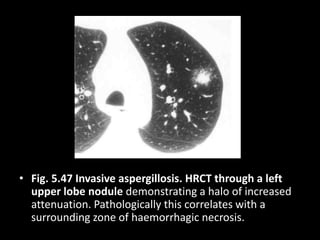
• Fig. 5.47 Invasive aspergillosis. HRCT through a left
upper lobe nodule demonstrating a halo of increased
attenuation. Pathologically this correlates with a
surrounding zone of haemorrhagic necrosis.
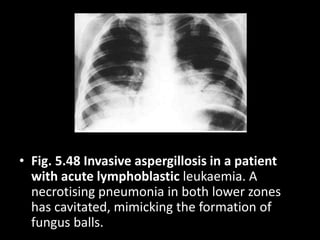
• Fig. 5.48 Invasive aspergillosis in a patient
with acute lymphoblastic leukaemia. A
necrotising pneumonia in both lower zones
has cavitated, mimicking the formation of
fungus balls.
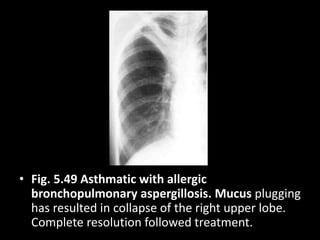
• Fig. 5.49 Asthmatic with allergic
bronchopulmonary aspergillosis. Mucus plugging
has resulted in collapse of the right upper lobe.
Complete resolution followed treatment.
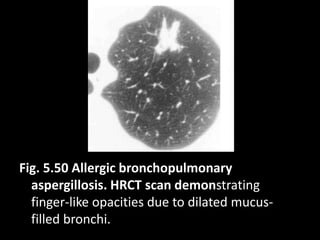
Fig. 5.50 Allergic bronchopulmonary
aspergillosis. HRCT scan demonstrating
finger-like opacities due to dilated mucus-
filled bronchi.
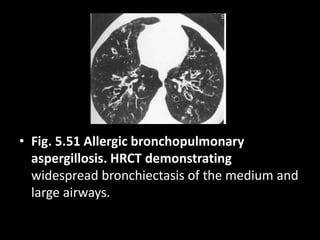
• Fig. 5.51 Allergic bronchopulmonary
aspergillosis. HRCT demonstrating
widespread bronchiectasis of the medium and
large airways.
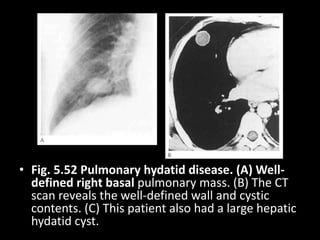
• Fig. 5.52 Pulmonary hydatid disease. (A) Well-
defined right basal pulmonary mass. (B) The CT
scan reveals the well-defined wall and cystic
contents. (C) This patient also had a large hepatic
hydatid cyst.
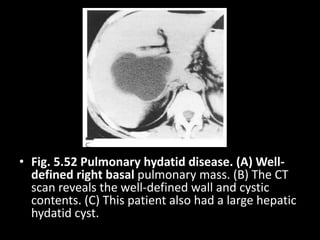
• Fig. 5.52 Pulmonary hydatid disease. (A) Well-
defined right basal pulmonary mass. (B) The CT
scan reveals the well-defined wall and cystic
contents. (C) This patient also had a large hepatic
hydatid cyst.
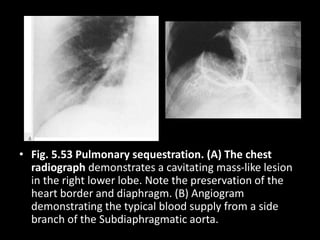
• Fig. 5.53 Pulmonary sequestration. (A) The chest
radiograph demonstrates a cavitating mass-like lesion
in the right lower lobe. Note the preservation of the
heart border and diaphragm. (B) Angiogram
demonstrating the typical blood supply from a side
branch of the Subdiaphragmatic aorta.
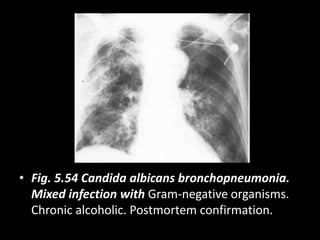
• Fig. 5.54 Candida albicans bronchopneumonia.
Mixed infection with Gram-negative organisms.
Chronic alcoholic. Postmortem confirmation.
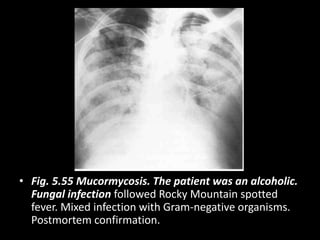
• Fig. 5.55 Mucormycosis. The patient was an alcoholic.
Fungal infection followed Rocky Mountain spotted
fever. Mixed infection with Gram-negative organisms.
Postmortem confirmation.
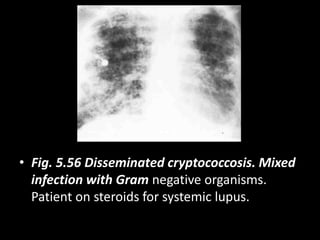
• Fig. 5.56 Disseminated cryptococcosis. Mixed
infection with Gram negative organisms.
Patient on steroids for systemic lupus.
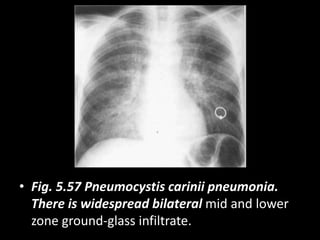
• Fig. 5.57 Pneumocystis carinii pneumonia.
There is widespread bilateral mid and lower
zone ground-glass infiltrate.
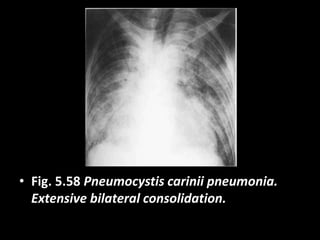
• Fig. 5.58 Pneumocystis carinii pneumonia.
Extensive bilateral consolidation.
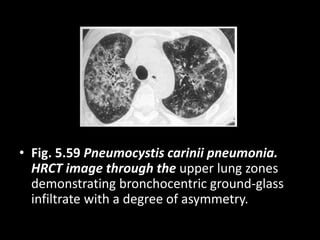
• Fig. 5.59 Pneumocystis carinii pneumonia.
HRCT image through the upper lung zones
demonstrating bronchocentric ground-glass
infiltrate with a degree of asymmetry.
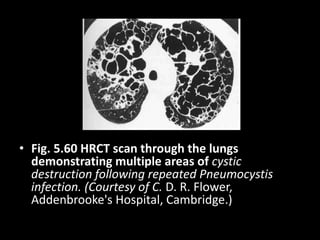
• Fig. 5.60 HRCT scan through the lungs
demonstrating multiple areas of cystic
destruction following repeated Pneumocystis
infection. (Courtesy of C. D. R. Flower,
Addenbrooke's Hospital, Cambridge.)
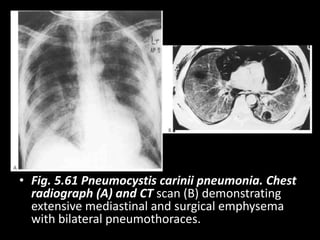
• Fig. 5.61 Pneumocystis carinii pneumonia. Chest
radiograph (A) and CT scan (B) demonstrating
extensive mediastinal and surgical emphysema
with bilateral pneumothoraces.
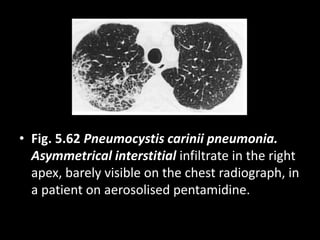
• Fig. 5.62 Pneumocystis carinii pneumonia.
Asymmetrical interstitial infiltrate in the right
apex, barely visible on the chest radiograph, in
a patient on aerosolised pentamidine.
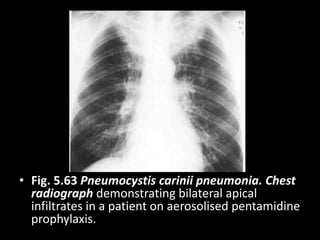
• Fig. 5.63 Pneumocystis carinii pneumonia. Chest
radiograph demonstrating bilateral apical
infiltrates in a patient on aerosolised pentamidine
prophylaxis.
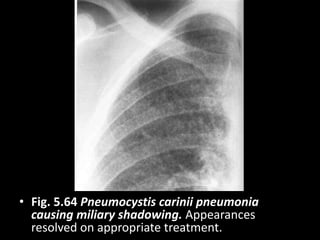
• Fig. 5.64 Pneumocystis carinii pneumonia
causing miliary shadowing. Appearances
resolved on appropriate treatment.
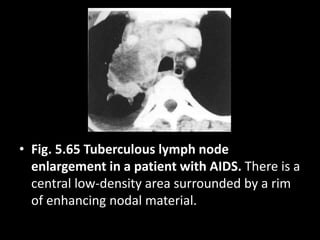
• Fig. 5.65 Tuberculous lymph node
enlargement in a patient with AIDS. There is a
central low-density area surrounded by a rim
of enhancing nodal material.
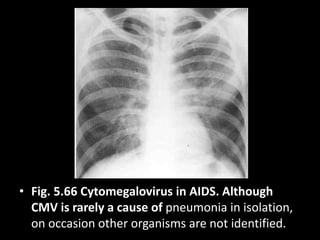
• Fig. 5.66 Cytomegalovirus in AIDS. Although
CMV is rarely a cause of pneumonia in isolation,
on occasion other organisms are not identified.
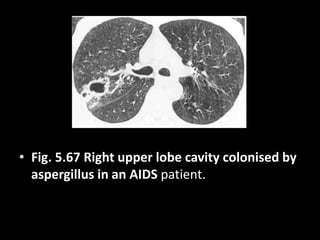
• Fig. 5.67 Right upper lobe cavity colonised by
aspergillus in an AIDS patient.
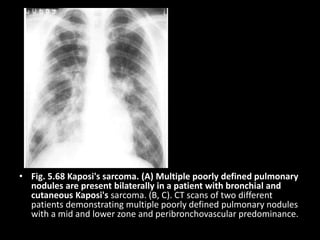
• Fig. 5.68 Kaposi's sarcoma. (A) Multiple poorly defined pulmonary
nodules are present bilaterally in a patient with bronchial and
cutaneous Kaposi's sarcoma. (B, C). CT scans of two different
patients demonstrating multiple poorly defined pulmonary nodules
with a mid and lower zone and peribronchovascular predominance.
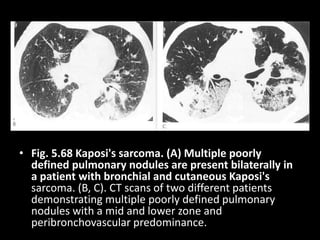
• Fig. 5.68 Kaposi's sarcoma. (A) Multiple poorly
defined pulmonary nodules are present bilaterally in
a patient with bronchial and cutaneous Kaposi's
sarcoma. (B, C). CT scans of two different patients
demonstrating multiple poorly defined pulmonary
nodules with a mid and lower zone and
peribronchovascular predominance.
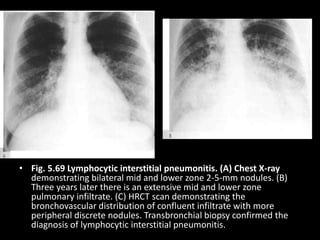
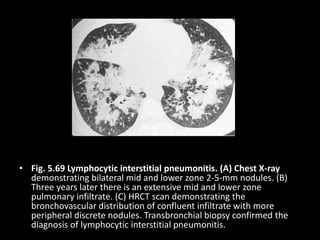
• Fig. 5.69 Lymphocytic interstitial pneumonitis. (A) Chest X-ray
demonstrating bilateral mid and lower zone 2-5-mm nodules. (B)
Three years later there is an extensive mid and lower zone
pulmonary infiltrate. (C) HRCT scan demonstrating the
bronchovascular distribution of confluent infiltrate with more
peripheral discrete nodules. Transbronchial biopsy confirmed the
diagnosis of lymphocytic interstitial pneumonitis.
• Fig. 5.69 Lymphocytic interstitial pneumonitis. (A) Chest X-ray
demonstrating bilateral mid and lower zone 2-5-mm nodules. (B)
Three years later there is an extensive mid and lower zone
pulmonary infiltrate. (C) HRCT scan demonstrating the
bronchovascular distribution of confluent infiltrate with more
peripheral discrete nodules. Transbronchial biopsy confirmed the
diagnosis of lymphocytic interstitial pneumonitis.
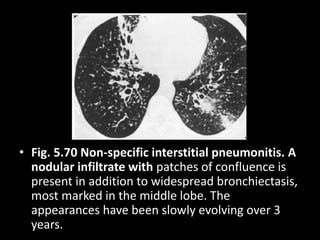
• Fig. 5.70 Non-specific interstitial pneumonitis. A
nodular infiltrate with patches of confluence is
present in addition to widespread bronchiectasis,
most marked in the middle lobe. The
appearances have been slowly evolving over 3
years.
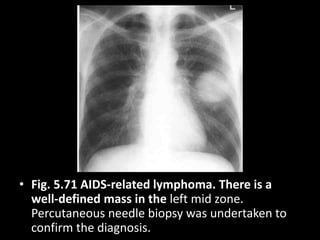
• Fig. 5.71 AIDS-related lymphoma. There is a
well-defined mass in the left mid zone.
Percutaneous needle biopsy was undertaken to
confirm the diagnosis.
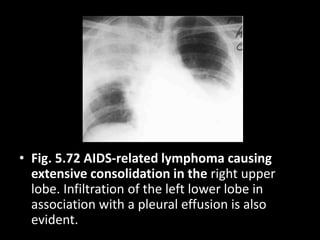
• Fig. 5.72 AIDS-related lymphoma causing
extensive consolidation in the right upper
lobe. Infiltration of the left lower lobe in
association with a pleural effusion is also
evident.
5 pulmonary infections

5 pulmonary infections

  • 1.
  • 2.
    DAVID SUTTON PICTURES DR.Muhammad Bin Zulfiqar PGR-FCPS III SIMS/SHL
  • 3.
    • Fig. 5.1(A) Pneumococcal pneumonia. Lingular and right upper lobe consolidation with sparing of the apex. (B) CT image from a different patient demonstrating air bronchograms in an area of peripheral consolidation due to an organising pneumonia.
  • 4.
    • Fig. 5.2Staphylococcal pneumonia of the right upper lobe with abscess formation.
  • 5.
    • Fig. 5.3(A) Haematogenous staphylococcal abscess formation in an intravenous drug abuser. There are multiple thin-walled cavities and an associated left pleural effusion. (B) Multiple large thin-walled pneumatoceles in a different intravenous drug abuser with staphylococcal tricuspid endocarditis.
  • 6.
    • Fig. 5.4 Staphylococcal bronchopneumoni a.A pneumatocele has developed in the right upper lobe. The radiograph eventually returned to
  • 7.
    • Fig. 5.5(A, B) Klebsiella pneumonia. There is consolidation in the right lower lobe with associated loss of volume evident on the lateral view.
  • 8.
    Fig. 5.6 (A,B) Klebsiella pneumonia. There is a large cavity in the right lower lobe following cavitation of pneumonic consolidation. An aortic valve replacement is present.
  • 9.
    • Fig. 5.7Klebsiella septicaemia. There is diffuse patchy alveolar shadowing • with air bronchograms.
  • 10.
    • Fig:5.8 :Legionnaires disease. There is bilateral consolidation, more marked on right.
  • 11.
    • Fig. 5.9Haemophilus infection. Widespread small nodular opacities are evident.
  • 12.
    • Fig. 5.10Tularaemia. There is right hilar nodal involvement and perihilar consolidation.
  • 13.
    • Fig. 5.11 Mycoplasma pneumonia.There is a patch of left mid zone consolidation obscuring the left heart border.
  • 14.
    • Fig. 5.12Adenovirus chest infection. There is reticulonodular infiltrate, most marked in a bronchovascular distribution at the right base.
  • 15.
    • Fig. 5.13CMV pneumonia in a 21-month-old child. There is reticular nodular shadowing throughout both lungs.
  • 16.
    • Fig. 5.14Influenza A. Haemorrhagic consolidation was present at postmortem.
  • 17.
    Fig. 5.15 Chickenpoxpneumonia occurring during pregnancy. There is widespread, predominantly nodular shadowing throughout both lungs. The patient made a complete recovery.
  • 18.
    • Fig. 5.16Multiple calcified varicella scars.
  • 19.
    • Fig. 5.17Measles giant cell pneumonia. Extensive ill-defined opacities with air bronchograms. The changes are more marked on the right than the left.
  • 20.
    • Fig. 5.18(A) Lung abscess. There was poor dental hygiene. Mixed anaerobic growth. (B) Several weeks later a thin-walled pneumatocele remains.
  • 21.
    • Fig. 5.19(A) Staphylococcal abscess in a patient with adult respiratory distress syndrome. A cavity with a fluid level is present within a dense area of consolidation. (B) Lung abscess in a different patient developing in a large necrotic adenocarcinoma. Percutaneous aspiration revealed a mixed growth of Hoemophilus and Streptococcus.
  • 22.
    • Fig. 5.20(A) Lipoid pneumonia. Aspiration of liquid paraffin. (B) Eight years later there has been significant clearing but severe residual fibrosis is now present.
  • 23.
    • Fig. 5.21Mendelson's syndrome. Postoperative aspiration of gastric contents. Note the subdiaphragmatic air following laparotomy.
  • 24.
    • Fig. 5.22Tuberculous pneumonia. Air bronchograms are present in the left upper lobe consolidation. Less marked right upper lobe consolidation is also present.
  • 25.
    • Fig. 5.23Tuberculosis. There is left hilar enlargement and perihilar consolidation.
  • 26.
    • Fig. 5.24Healed tuberculosis. There is bilateral upper lobe fibrosis with elevation of both hila. Basal emphysema has developed. There are multiple calcified granulomas in the mid and upper zones.
  • 27.
    • Fig. 5.25Tuberculosis. Dense non-homogeneous opacities. Contracted right upper lobe.
  • 28.
    • Fig. 5.26: Tuberculosis. Minimal right apical region
  • 29.
    Fig. 5.27 Tuberculosis.(A, B) Chest radiograph and CT scan demonstrating almost complete destruction of the right lung due to pulmonary tuberculosis. The CT reveals bronchopneumonic spread to the opposite lung.
  • 30.
    • Fig. 5.28 Tuberculosis.There is fibrotic shrinkage of the left upper lobe with mediastinal and hilar displacement an in which case the differential diagnosis includes lymphoma and d apical pleural thickening.
  • 31.
    • Fig. 5.29Right apical aspergilloma in a patient with previous TB. Note the mycetoma material lying free in the dependent part of the cavity as well as the nodules adherent to the cavity walls anteriorly.
  • 32.
    • Fig. 5.30Extensive bronchopneumonic spread of tuberculosis in an HIV-positive patient.
  • 33.
    • Fig. 5.31Miliary tuberculosis. There are innumerable well-defined nodules present.
  • 34.
    • Fig. 5.32Tuberculoma. A well-defined cavity is projected adjacent to the right hilum.
  • 35.
    • Fig. 5.33Tuberculosis. There is right hilar lymph node enlargement.
  • 36.
    • Fig. 5.34: Tuberculosis. There is generalized pleural thickening with extensive pleural calcification.
  • 37.
    • Fig. 5.35Tuberculous lymphadenopathy. (A) There is mediastinal and left hilar lymph node enlargement causing some narrowing of the left main bronchus. (B) One month later appearances have significantly progressed with enlargement of the hilar and mediastinal nodes and increased left main bronchial narrowing.
  • 38.
    • Fig. 5.36Actinomycosis. There is a dense mass-like area of consolidation in the right mid zone.
  • 39.
    Fig. 5.37 Nocardiaasteroides pneumonia. There are multiple cavities within the right lung, one of which has cavitated.
  • 40.
    • Fig. 5.38Nocardiosis. There is non- homogeneous consolidation in the right upper lobe.
  • 41.
    • Fig. 5.39Histoplasmosis. Calcified nodules of varying size are present in both lungs. Calcified hilar nodes are also present.
  • 42.
    • Fig. 5.40Histoplasmosis. Incidental finding of multiple calcified pulmonary nodules.
  • 43.
    • Fig. 5.41Histoplasmosis. CT examination through a right lower lobe histoplasmoma that demonstrates central calcification. Patient is being examined in the prone position prior to percutaneous needle biopsy.
  • 44.
    • Fig. 5.42Acute histoplasmosis following massive exposure whilst visiting a bat-infested cave. There are widespread bilateral well-defined 3-5-mm nodules.
  • 45.
    • Fig. 5.43Fibrosing mediastinitis following histoplasmosis. (A) Chest X-ray shows widening of the upper mediastinum. (B) Right arm phlebogram demonstrating compression of the right innominate vein. There is also a degree of tracheal narrowing.
  • 46.
    • Fig. 5.44Coccidioidomycosis. (A) A non-specific patch of consolidation is present in the left lower lobe. (B) One year later a thin-walled cavity is evident.
  • 47.
    • Fig. 5.45Cryptococcus. A pleurally based mass- like area of consolidation in the left upper lobe is present in a patient who also had cryptococcal meningitis.
  • 48.
    • Fig. 5.46Invasive aspergillosis. There is widespread bronchopneumonic change in a patient receiving chemotherapy for oat cell carcinoma.
  • 49.
    • Fig. 5.47Invasive aspergillosis. HRCT through a left upper lobe nodule demonstrating a halo of increased attenuation. Pathologically this correlates with a surrounding zone of haemorrhagic necrosis.
  • 50.
    • Fig. 5.48Invasive aspergillosis in a patient with acute lymphoblastic leukaemia. A necrotising pneumonia in both lower zones has cavitated, mimicking the formation of fungus balls.
  • 51.
    • Fig. 5.49Asthmatic with allergic bronchopulmonary aspergillosis. Mucus plugging has resulted in collapse of the right upper lobe. Complete resolution followed treatment.
  • 52.
    Fig. 5.50 Allergicbronchopulmonary aspergillosis. HRCT scan demonstrating finger-like opacities due to dilated mucus- filled bronchi.
  • 53.
    • Fig. 5.51Allergic bronchopulmonary aspergillosis. HRCT demonstrating widespread bronchiectasis of the medium and large airways.
  • 54.
    • Fig. 5.52Pulmonary hydatid disease. (A) Well- defined right basal pulmonary mass. (B) The CT scan reveals the well-defined wall and cystic contents. (C) This patient also had a large hepatic hydatid cyst.
  • 55.
    • Fig. 5.52Pulmonary hydatid disease. (A) Well- defined right basal pulmonary mass. (B) The CT scan reveals the well-defined wall and cystic contents. (C) This patient also had a large hepatic hydatid cyst.
  • 56.
    • Fig. 5.53Pulmonary sequestration. (A) The chest radiograph demonstrates a cavitating mass-like lesion in the right lower lobe. Note the preservation of the heart border and diaphragm. (B) Angiogram demonstrating the typical blood supply from a side branch of the Subdiaphragmatic aorta.
  • 57.
    • Fig. 5.54Candida albicans bronchopneumonia. Mixed infection with Gram-negative organisms. Chronic alcoholic. Postmortem confirmation.
  • 58.
    • Fig. 5.55Mucormycosis. The patient was an alcoholic. Fungal infection followed Rocky Mountain spotted fever. Mixed infection with Gram-negative organisms. Postmortem confirmation.
  • 59.
    • Fig. 5.56Disseminated cryptococcosis. Mixed infection with Gram negative organisms. Patient on steroids for systemic lupus.
  • 60.
    • Fig. 5.57Pneumocystis carinii pneumonia. There is widespread bilateral mid and lower zone ground-glass infiltrate.
  • 61.
    • Fig. 5.58Pneumocystis carinii pneumonia. Extensive bilateral consolidation.
  • 62.
    • Fig. 5.59Pneumocystis carinii pneumonia. HRCT image through the upper lung zones demonstrating bronchocentric ground-glass infiltrate with a degree of asymmetry.
  • 63.
    • Fig. 5.60HRCT scan through the lungs demonstrating multiple areas of cystic destruction following repeated Pneumocystis infection. (Courtesy of C. D. R. Flower, Addenbrooke's Hospital, Cambridge.)
  • 64.
    • Fig. 5.61Pneumocystis carinii pneumonia. Chest radiograph (A) and CT scan (B) demonstrating extensive mediastinal and surgical emphysema with bilateral pneumothoraces.
  • 65.
    • Fig. 5.62Pneumocystis carinii pneumonia. Asymmetrical interstitial infiltrate in the right apex, barely visible on the chest radiograph, in a patient on aerosolised pentamidine.
  • 66.
    • Fig. 5.63Pneumocystis carinii pneumonia. Chest radiograph demonstrating bilateral apical infiltrates in a patient on aerosolised pentamidine prophylaxis.
  • 67.
    • Fig. 5.64Pneumocystis carinii pneumonia causing miliary shadowing. Appearances resolved on appropriate treatment.
  • 68.
    • Fig. 5.65Tuberculous lymph node enlargement in a patient with AIDS. There is a central low-density area surrounded by a rim of enhancing nodal material.
  • 69.
    • Fig. 5.66Cytomegalovirus in AIDS. Although CMV is rarely a cause of pneumonia in isolation, on occasion other organisms are not identified.
  • 70.
    • Fig. 5.67Right upper lobe cavity colonised by aspergillus in an AIDS patient.
  • 71.
    • Fig. 5.68Kaposi's sarcoma. (A) Multiple poorly defined pulmonary nodules are present bilaterally in a patient with bronchial and cutaneous Kaposi's sarcoma. (B, C). CT scans of two different patients demonstrating multiple poorly defined pulmonary nodules with a mid and lower zone and peribronchovascular predominance.
  • 72.
    • Fig. 5.68Kaposi's sarcoma. (A) Multiple poorly defined pulmonary nodules are present bilaterally in a patient with bronchial and cutaneous Kaposi's sarcoma. (B, C). CT scans of two different patients demonstrating multiple poorly defined pulmonary nodules with a mid and lower zone and peribronchovascular predominance.
  • 73.
    • Fig. 5.69Lymphocytic interstitial pneumonitis. (A) Chest X-ray demonstrating bilateral mid and lower zone 2-5-mm nodules. (B) Three years later there is an extensive mid and lower zone pulmonary infiltrate. (C) HRCT scan demonstrating the bronchovascular distribution of confluent infiltrate with more peripheral discrete nodules. Transbronchial biopsy confirmed the diagnosis of lymphocytic interstitial pneumonitis.
  • 74.
    • Fig. 5.69Lymphocytic interstitial pneumonitis. (A) Chest X-ray demonstrating bilateral mid and lower zone 2-5-mm nodules. (B) Three years later there is an extensive mid and lower zone pulmonary infiltrate. (C) HRCT scan demonstrating the bronchovascular distribution of confluent infiltrate with more peripheral discrete nodules. Transbronchial biopsy confirmed the diagnosis of lymphocytic interstitial pneumonitis.
  • 75.
    • Fig. 5.70Non-specific interstitial pneumonitis. A nodular infiltrate with patches of confluence is present in addition to widespread bronchiectasis, most marked in the middle lobe. The appearances have been slowly evolving over 3 years.
  • 76.
    • Fig. 5.71AIDS-related lymphoma. There is a well-defined mass in the left mid zone. Percutaneous needle biopsy was undertaken to confirm the diagnosis.
  • 77.
    • Fig. 5.72AIDS-related lymphoma causing extensive consolidation in the right upper lobe. Infiltration of the left lower lobe in association with a pleural effusion is also evident.