41DAVID SUTTON
DAVID SUTTON PICTURES
DR. Muhammad Bin Zulfiqar
PGR-FCPS III SIMS/SHL
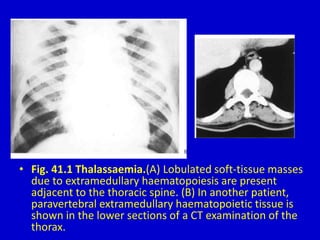
• Fig. 41.1 Thalassaemia.(A) Lobulated soft-tissue masses
due to extramedullary haematopoiesis are present
adjacent to the thoracic spine. (B) In another patient,
paravertebral extramedullary haematopoietic tissue is
shown in the lower sections of a CT examination of the
thorax.
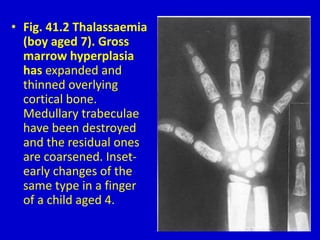
• Fig. 41.2 Thalassaemia
(boy aged 7). Gross
marrow hyperplasia
has expanded and
thinned overlying
cortical bone.
Medullary trabeculae
have been destroyed
and the residual ones
are coarsened. Inset-
early changes of the
same type in a finger
of a child aged 4.
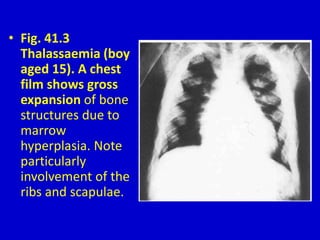
• Fig. 41.3
Thalassaemia (boy
aged 15). A chest
film shows gross
expansion of bone
structures due to
marrow
hyperplasia. Note
particularly
involvement of the
ribs and scapulae.
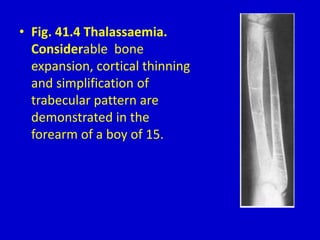
• Fig. 41.4 Thalassaemia.
Considerable bone
expansion, cortical thinning
and simplification of
trabecular pattern are
demonstrated in the
forearm of a boy of 15.
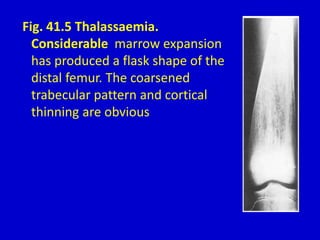
Fig. 41.5 Thalassaemia.
Considerable marrow expansion
has produced a flask shape of the
distal femur. The coarsened
trabecular pattern and cortical
thinning are obvious
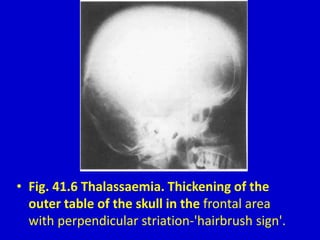
• Fig. 41.6 Thalassaemia. Thickening of the
outer table of the skull in the frontal area
with perpendicular striation-'hairbrush sign'.
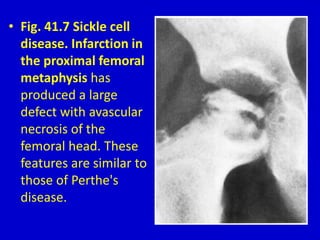
• Fig. 41.7 Sickle cell
disease. Infarction in
the proximal femoral
metaphysis has
produced a large
defect with avascular
necrosis of the
femoral head. These
features are similar to
those of Perthe's
disease.
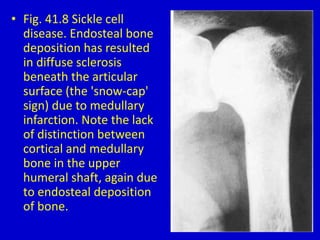
• Fig. 41.8 Sickle cell
disease. Endosteal bone
deposition has resulted
in diffuse sclerosis
beneath the articular
surface (the 'snow-cap'
sign) due to medullary
infarction. Note the lack
of distinction between
cortical and medullary
bone in the upper
humeral shaft, again due
to endosteal deposition
of bone.
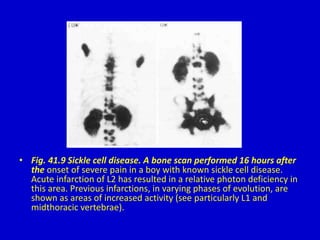
• Fig. 41.9 Sickle cell disease. A bone scan performed 16 hours after
the onset of severe pain in a boy with known sickle cell disease.
Acute infarction of L2 has resulted in a relative photon deficiency in
this area. Previous infarctions, in varying phases of evolution, are
shown as areas of increased activity (see particularly L1 and
midthoracic vertebrae).
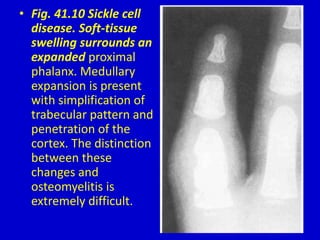
• Fig. 41.10 Sickle cell
disease. Soft-tissue
swelling surrounds an
expanded proximal
phalanx. Medullary
expansion is present
with simplification of
trabecular pattern and
penetration of the
cortex. The distinction
between these
changes and
osteomyelitis is
extremely difficult.
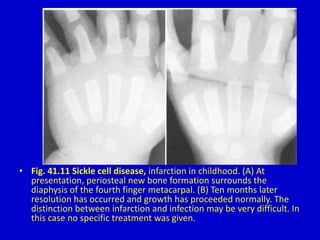
• Fig. 41.11 Sickle cell disease, infarction in childhood. (A) At
presentation, periosteal new bone formation surrounds the
diaphysis of the fourth finger metacarpal. (B) Ten months later
resolution has occurred and growth has proceeded normally. The
distinction between infarction and infection may be very difficult. In
this case no specific treatment was given.
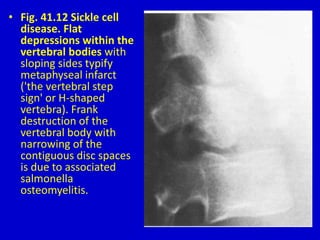
• Fig. 41.12 Sickle cell
disease. Flat
depressions within the
vertebral bodies with
sloping sides typify
metaphyseal infarct
('the vertebral step
sign' or H-shaped
vertebra). Frank
destruction of the
vertebral body with
narrowing of the
contiguous disc spaces
is due to associated
salmonella
osteomyelitis.
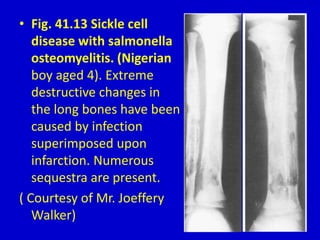
• Fig. 41.13 Sickle cell
disease with salmonella
osteomyelitis. (Nigerian
boy aged 4). Extreme
destructive changes in
the long bones have been
caused by infection
superimposed upon
infarction. Numerous
sequestra are present.
( Courtesy of Mr. Joeffery
Walker)
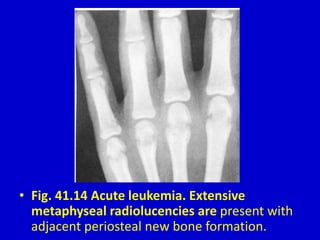
• Fig. 41.14 Acute leukemia. Extensive
metaphyseal radiolucencies are present with
adjacent periosteal new bone formation.
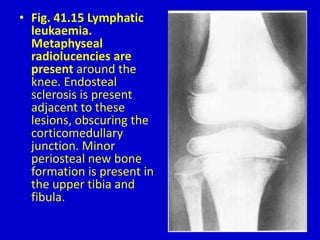
• Fig. 41.15 Lymphatic
leukaemia.
Metaphyseal
radiolucencies are
present around the
knee. Endosteal
sclerosis is present
adjacent to these
lesions, obscuring the
corticomedullary
junction. Minor
periosteal new bone
formation is present in
the upper tibia and
fibula.
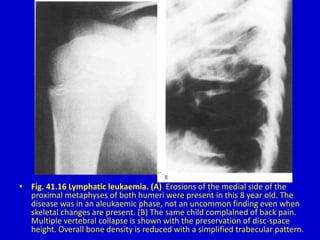
• Fig. 41.16 Lymphatic leukaemia. (A) Erosions of the medial side of the
proximal metaphyses of both humeri were present in this 8 year old. The
disease was in an aleukaemic phase, not an uncommon finding even when
skeletal changes are present. (B) The same child complained of back pain.
Multiple vertebral collapse is shown with the preservation of disc-space
height. Overall bone density is reduced with a simplified trabecular pattern.
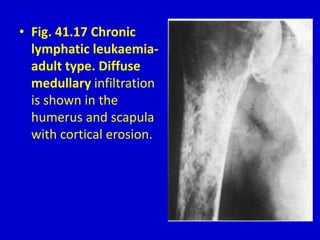
• Fig. 41.17 Chronic
lymphatic leukaemia-
adult type. Diffuse
medullary infiltration
is shown in the
humerus and scapula
with cortical erosion.
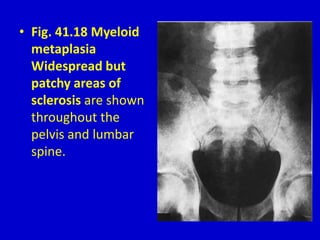
• Fig. 41.18 Myeloid
metaplasia
Widespread but
patchy areas of
sclerosis are shown
throughout the
pelvis and lumbar
spine.
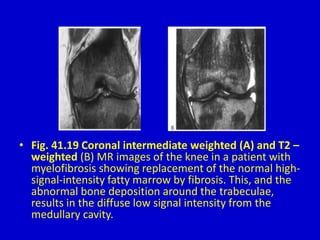
• Fig. 41.19 Coronal intermediate weighted (A) and T2 –
weighted (B) MR images of the knee in a patient with
myelofibrosis showing replacement of the normal high-
signal-intensity fatty marrow by fibrosis. This, and the
abnormal bone deposition around the trabeculae,
results in the diffuse low signal intensity from the
medullary cavity.
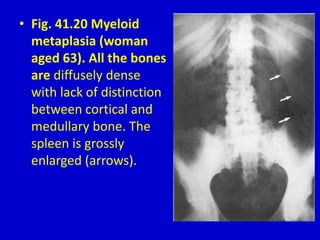
• Fig. 41.20 Myeloid
metaplasia (woman
aged 63). All the bones
are diffusely dense
with lack of distinction
between cortical and
medullary bone. The
spleen is grossly
enlarged (arrows).
• Fig. 41.21 Hodgkin's
disease. An
expanding,
destructive lesion
involves the body of
the sternum, with
anterior and posterior
soft-tissue masses.
Bizarre changes in this
bone should always
arouse suspicion of a
lymphoma.
• Fig. 41.22 Hodgkin's disease. (A) The common pattern of
endosteal sclerosis and patchy bone destruction is shown in the
vertebral body of T9 in an adult man. Similar changes are also
present at TI 1 . These features are virtually diagnostic. (B) In
another patient, an intravenous enhanced CT section of the
abdomen demonstrates a densely sclerotic lumbar vertebral body
associated with a large paravertebral soft-tissue mass. Sagittal (C)
and coronal (D) T,- weighted images show low signal intensity
within the upper lumbar vertebral body due to diffuse sclerosis
and the extent of the soft-tissue mass. This extends into the
central spinal canal and circumferentially around the thecal sac.
• Fig. 41.22 Hodgkin's disease. (A) The common pattern of endosteal sclerosis and patchy bone
destruction is shown in the vertebral body of T9 in an adult man. Similar changes are also present
at TI 1 . These features are virtually diagnostic. (B) In another patient, an intravenous enhanced CT
section of the abdomen demonstrates a densely sclerotic lumbar vertebral body associated with a
large paravertebral soft-tissue mass. Sagittal (C) and coronal (D) T,- weighted images show low
signal intensity within the upper lumbar vertebral body due to diffuse sclerosis and the extent of
the soft-tissue mass. This extends into the central spinal canal and circumferentially around the
thecal sac.
• Fig. 41.23 Hodgkin
Disease. A) Diffuse
sclerosis is present in
the bodies of L2 and
L3 in a young woman
at presentation with
the disease. (B) Two
years later, following
treatment, the
appearances have
reverted to normal.
(Lymphographic
contrast medium is
present in para-aortic
nodes.)
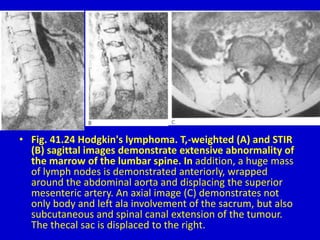
• Fig. 41.24 Hodgkin's lymphoma. T,-weighted (A) and STIR
(B) sagittal images demonstrate extensive abnormality of
the marrow of the lumbar spine. In addition, a huge mass
of lymph nodes is demonstrated anteriorly, wrapped
around the abdominal aorta and displacing the superior
mesenteric artery. An axial image (C) demonstrates not
only body and left ala involvement of the sacrum, but also
subcutaneous and spinal canal extension of the tumour.
The thecal sac is displaced to the right.
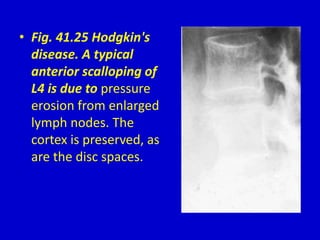
• Fig. 41.25 Hodgkin's
disease. A typical
anterior scalloping of
L4 is due to pressure
erosion from enlarged
lymph nodes. The
cortex is preserved, as
are the disc spaces.
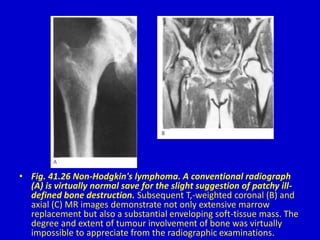
• Fig. 41.26 Non-Hodgkin's lymphoma. A conventional radiograph
(A) is virtually normal save for the slight suggestion of patchy ill-
defined bone destruction. Subsequent T,-weighted coronal (B) and
axial (C) MR images demonstrate not only extensive marrow
replacement but also a substantial enveloping soft-tissue mass. The
degree and extent of tumour involvement of bone was virtually
impossible to appreciate from the radiographic examinations.
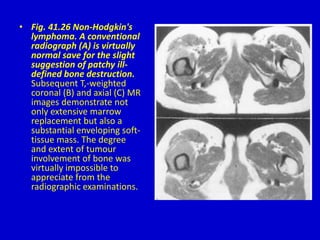
• Fig. 41.26 Non-Hodgkin's
lymphoma. A conventional
radiograph (A) is virtually
normal save for the slight
suggestion of patchy ill-
defined bone destruction.
Subsequent T,-weighted
coronal (B) and axial (C) MR
images demonstrate not
only extensive marrow
replacement but also a
substantial enveloping soft-
tissue mass. The degree
and extent of tumour
involvement of bone was
virtually impossible to
appreciate from the
radiographic examinations.
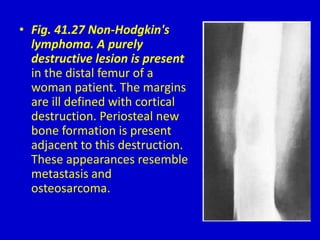
• Fig. 41.27 Non-Hodgkin's
lymphoma. A purely
destructive lesion is present
in the distal femur of a
woman patient. The margins
are ill defined with cortical
destruction. Periosteal new
bone formation is present
adjacent to this destruction.
These appearances resemble
metastasis and
osteosarcoma.
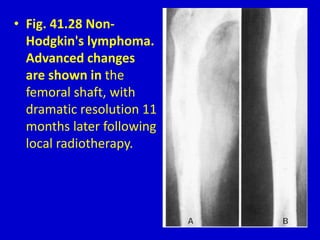
• Fig. 41.28 Non-
Hodgkin's lymphoma.
Advanced changes
are shown in the
femoral shaft, with
dramatic resolution 11
months later following
local radiotherapy.
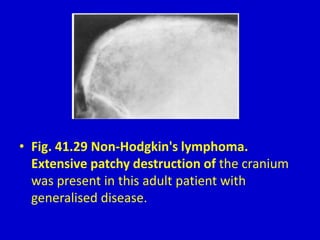
• Fig. 41.29 Non-Hodgkin's lymphoma.
Extensive patchy destruction of the cranium
was present in this adult patient with
generalised disease.
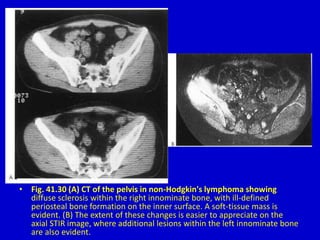
• Fig. 41.30 (A) CT of the pelvis in non-Hodgkin's lymphoma showing
diffuse sclerosis within the right innominate bone, with ill-defined
periosteal bone formation on the inner surface. A soft-tissue mass is
evident. (B) The extent of these changes is easier to appreciate on the
axial STIR image, where additional lesions within the left innominate bone
are also evident.
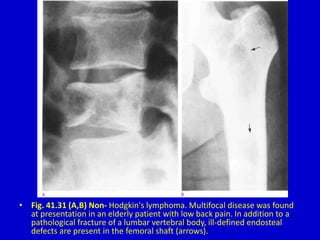
• Fig. 41.31 (A,B) Non- Hodgkin's lymphoma. Multifocal disease was found
at presentation in an elderly patient with low back pain. In addition to a
pathological fracture of a lumbar vertebral body, ill-defined endosteal
defects are present in the femoral shaft (arrows).
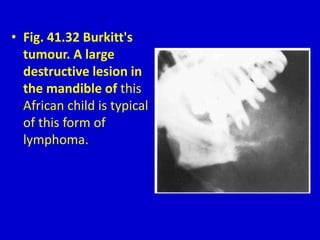
• Fig. 41.32 Burkitt's
tumour. A large
destructive lesion in
the mandible of this
African child is typical
of this form of
lymphoma.
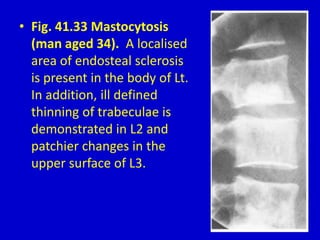
• Fig. 41.33 Mastocytosis
(man aged 34). A localised
area of endosteal sclerosis
is present in the body of Lt.
In addition, ill defined
thinning of trabeculae is
demonstrated in L2 and
patchier changes in the
upper surface of L3.
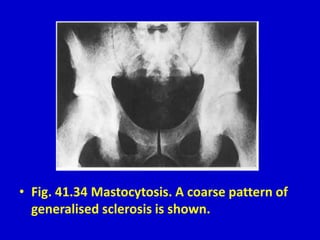
• Fig. 41.34 Mastocytosis. A coarse pattern of
generalised sclerosis is shown.
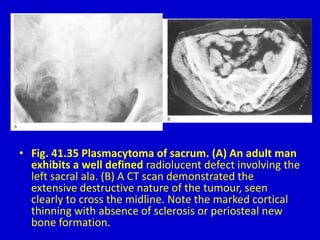
• Fig. 41.35 Plasmacytoma of sacrum. (A) An adult man
exhibits a well defined radiolucent defect involving the
left sacral ala. (B) A CT scan demonstrated the
extensive destructive nature of the tumour, seen
clearly to cross the midline. Note the marked cortical
thinning with absence of sclerosis or periosteal new
bone formation.
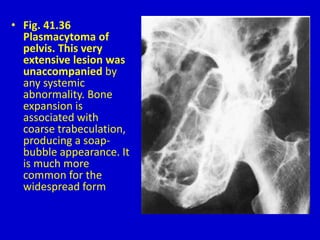
• Fig. 41.36
Plasmacytoma of
pelvis. This very
extensive lesion was
unaccompanied by
any systemic
abnormality. Bone
expansion is
associated with
coarse trabeculation,
producing a soap-
bubble appearance. It
is much more
common for the
widespread form
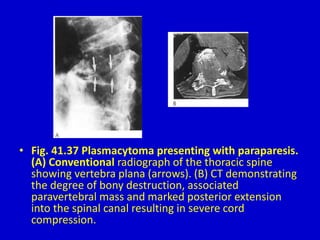
• Fig. 41.37 Plasmacytoma presenting with paraparesis.
(A) Conventional radiograph of the thoracic spine
showing vertebra plana (arrows). (B) CT demonstrating
the degree of bony destruction, associated
paravertebral mass and marked posterior extension
into the spinal canal resulting in severe cord
compression.
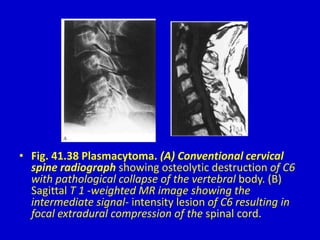
• Fig. 41.38 Plasmacytoma. (A) Conventional cervical
spine radiograph showing osteolytic destruction of C6
with pathological collapse of the vertebral body. (B)
Sagittal T 1 -weighted MR image showing the
intermediate signal- intensity lesion of C6 resulting in
focal extradural compression of the spinal cord.
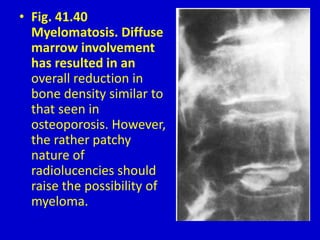
• Fig. 41.40
Myelomatosis. Diffuse
marrow involvement
has resulted in an
overall reduction in
bone density similar to
that seen in
osteoporosis. However,
the rather patchy
nature of
radiolucencies should
raise the possibility of
myeloma.
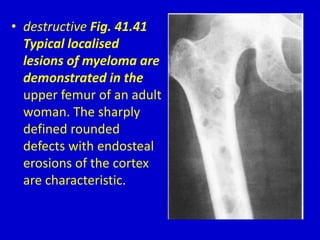
• destructive Fig. 41.41
Typical localised
lesions of myeloma are
demonstrated in the
upper femur of an adult
woman. The sharply
defined rounded
defects with endosteal
erosions of the cortex
are characteristic.
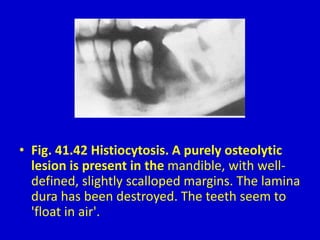
• Fig. 41.42 Histiocytosis. A purely osteolytic
lesion is present in the mandible, with well-
defined, slightly scalloped margins. The lamina
dura has been destroyed. The teeth seem to
'float in air'.
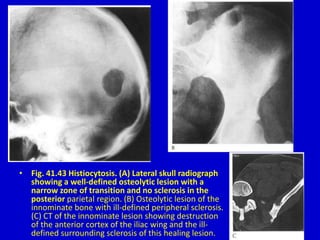
• Fig. 41.43 Histiocytosis. (A) Lateral skull radiograph
showing a well-defined osteolytic lesion with a
narrow zone of transition and no sclerosis in the
posterior parietal region. (B) Osteolytic lesion of the
innominate bone with ill-defined peripheral sclerosis.
(C) CT of the innominate lesion showing destruction
of the anterior cortex of the iliac wing and the ill-
defined surrounding sclerosis of this healing lesion.
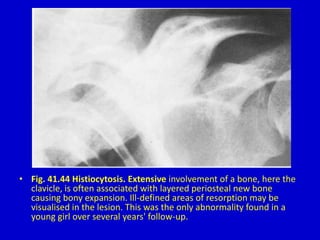
• Fig. 41.44 Histiocytosis. Extensive involvement of a bone, here the
clavicle, is often associated with layered periosteal new bone
causing bony expansion. Ill-defined areas of resorption may be
visualised in the lesion. This was the only abnormality found in a
young girl over several years' follow-up.
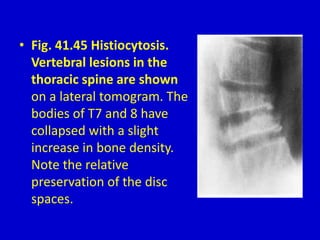
• Fig. 41.45 Histiocytosis.
Vertebral lesions in the
thoracic spine are shown
on a lateral tomogram. The
bodies of T7 and 8 have
collapsed with a slight
increase in bone density.
Note the relative
preservation of the disc
spaces.
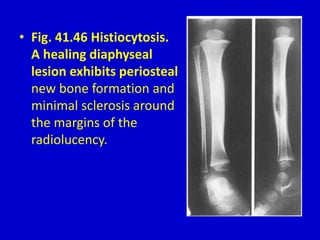
• Fig. 41.46 Histiocytosis.
A healing diaphyseal
lesion exhibits periosteal
new bone formation and
minimal sclerosis around
the margins of the
radiolucency.
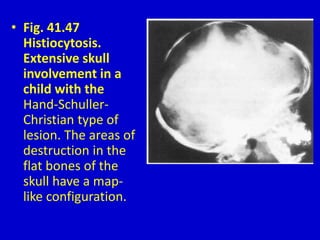
• Fig. 41.47
Histiocytosis.
Extensive skull
involvement in a
child with the
Hand-Schuller-
Christian type of
lesion. The areas of
destruction in the
flat bones of the
skull have a map-
like configuration.
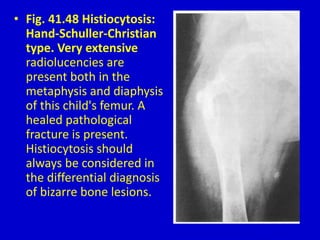
• Fig. 41.48 Histiocytosis:
Hand-Schuller-Christian
type. Very extensive
radiolucencies are
present both in the
metaphysis and diaphysis
of this child's femur. A
healed pathological
fracture is present.
Histiocytosis should
always be considered in
the differential diagnosis
of bizarre bone lesions.
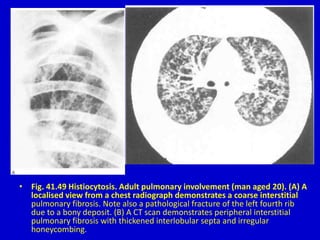
• Fig. 41.49 Histiocytosis. Adult pulmonary involvement (man aged 20). (A) A
localised view from a chest radiograph demonstrates a coarse interstitial
pulmonary fibrosis. Note also a pathological fracture of the left fourth rib
due to a bony deposit. (B) A CT scan demonstrates peripheral interstitial
pulmonary fibrosis with thickened interlobular septa and irregular
honeycombing.
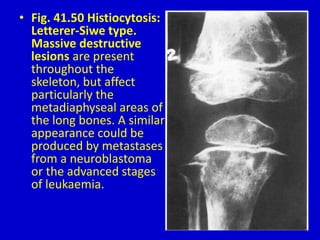
• Fig. 41.50 Histiocytosis:
Letterer-Siwe type.
Massive destructive
lesions are present
throughout the
skeleton, but affect
particularly the
metadiaphyseal areas of
the long bones. A similar
appearance could be
produced by metastases
from a neuroblastoma
or the advanced stages
of leukaemia.
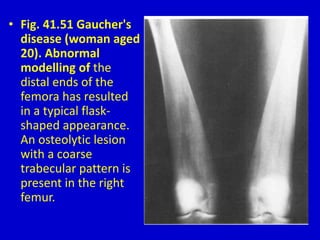
• Fig. 41.51 Gaucher's
disease (woman aged
20). Abnormal
modelling of the
distal ends of the
femora has resulted
in a typical flask-
shaped appearance.
An osteolytic lesion
with a coarse
trabecular pattern is
present in the right
femur.
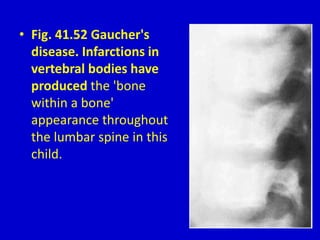
• Fig. 41.52 Gaucher's
disease. Infarctions in
vertebral bodies have
produced the 'bone
within a bone'
appearance throughout
the lumbar spine in this
child.
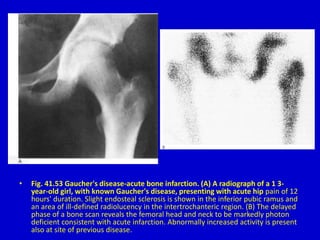
• Fig. 41.53 Gaucher's disease-acute bone infarction. (A) A radiograph of a 1 3-
year-old girl, with known Gaucher's disease, presenting with acute hip pain of 12
hours' duration. Slight endosteal sclerosis is shown in the inferior pubic ramus and
an area of ill-defined radiolucency in the intertrochanteric region. (B) The delayed
phase of a bone scan reveals the femoral head and neck to be markedly photon
deficient consistent with acute infarction. Abnormally increased activity is present
also at site of previous disease.
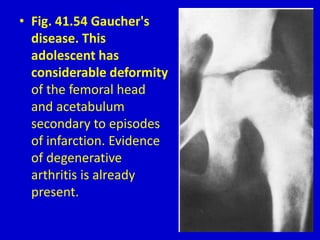
• Fig. 41.54 Gaucher's
disease. This
adolescent has
considerable deformity
of the femoral head
and acetabulum
secondary to episodes
of infarction. Evidence
of degenerative
arthritis is already
present.
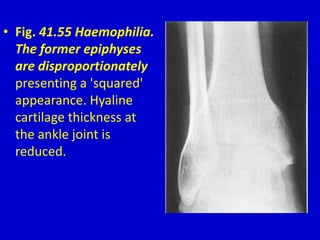
• Fig. 41.55 Haemophilia.
The former epiphyses
are disproportionately
presenting a 'squared'
appearance. Hyaline
cartilage thickness at
the ankle joint is
reduced.
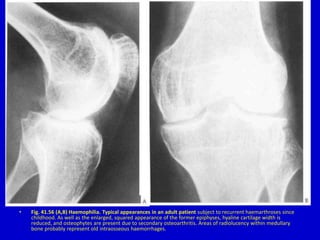
• Fig. 41.56 (A,B) Haemophilia. Typical appearances in an adult patient subject to recurrent haemarthroses since
childhood. As well as the enlarged, squared appearance of the former epiphyses, hyaline cartilage width is
reduced, and osteophytes are present due to secondary osteoarthritis. Areas of radiolucency within medullary
bone probably represent old intraosseous haemorrhages.
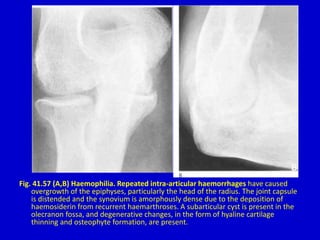
Fig. 41.57 (A,B) Haemophilia. Repeated intra-articular haemorrhages have caused
overgrowth of the epiphyses, particularly the head of the radius. The joint capsule
is distended and the synovium is amorphously dense due to the deposition of
haemosiderin from recurrent haemarthroses. A subarticular cyst is present in the
olecranon fossa, and degenerative changes, in the form of hyaline cartilage
thinning and osteophyte formation, are present.
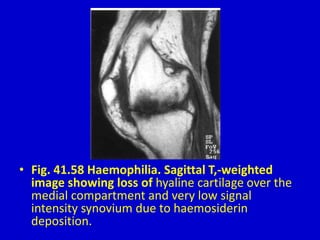
• Fig. 41.58 Haemophilia. Sagittal T,-weighted
image showing loss of hyaline cartilage over the
medial compartment and very low signal
intensity synovium due to haemosiderin
deposition.
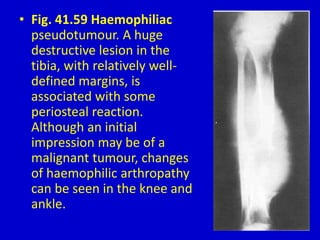
• Fig. 41.59 Haemophiliac
pseudotumour. A huge
destructive lesion in the
tibia, with relatively well-
defined margins, is
associated with some
periosteal reaction.
Although an initial
impression may be of a
malignant tumour, changes
of haemophilic arthropathy
can be seen in the knee and
ankle.
41 DAVID SUTTON PICTURES DISORDERS OF LYMPHORETICULAR SYSTEM AND HEMATOPOITIC DISORDERS

41 DAVID SUTTON PICTURES DISORDERS OF LYMPHORETICULAR SYSTEM AND HEMATOPOITIC DISORDERS

  • 1.
  • 2.
    DAVID SUTTON PICTURES DR.Muhammad Bin Zulfiqar PGR-FCPS III SIMS/SHL
  • 3.
    • Fig. 41.1Thalassaemia.(A) Lobulated soft-tissue masses due to extramedullary haematopoiesis are present adjacent to the thoracic spine. (B) In another patient, paravertebral extramedullary haematopoietic tissue is shown in the lower sections of a CT examination of the thorax.
  • 4.
    • Fig. 41.2Thalassaemia (boy aged 7). Gross marrow hyperplasia has expanded and thinned overlying cortical bone. Medullary trabeculae have been destroyed and the residual ones are coarsened. Inset- early changes of the same type in a finger of a child aged 4.
  • 5.
    • Fig. 41.3 Thalassaemia(boy aged 15). A chest film shows gross expansion of bone structures due to marrow hyperplasia. Note particularly involvement of the ribs and scapulae.
  • 6.
    • Fig. 41.4Thalassaemia. Considerable bone expansion, cortical thinning and simplification of trabecular pattern are demonstrated in the forearm of a boy of 15.
  • 7.
    Fig. 41.5 Thalassaemia. Considerablemarrow expansion has produced a flask shape of the distal femur. The coarsened trabecular pattern and cortical thinning are obvious
  • 8.
    • Fig. 41.6Thalassaemia. Thickening of the outer table of the skull in the frontal area with perpendicular striation-'hairbrush sign'.
  • 9.
    • Fig. 41.7Sickle cell disease. Infarction in the proximal femoral metaphysis has produced a large defect with avascular necrosis of the femoral head. These features are similar to those of Perthe's disease.
  • 10.
    • Fig. 41.8Sickle cell disease. Endosteal bone deposition has resulted in diffuse sclerosis beneath the articular surface (the 'snow-cap' sign) due to medullary infarction. Note the lack of distinction between cortical and medullary bone in the upper humeral shaft, again due to endosteal deposition of bone.
  • 11.
    • Fig. 41.9Sickle cell disease. A bone scan performed 16 hours after the onset of severe pain in a boy with known sickle cell disease. Acute infarction of L2 has resulted in a relative photon deficiency in this area. Previous infarctions, in varying phases of evolution, are shown as areas of increased activity (see particularly L1 and midthoracic vertebrae).
  • 12.
    • Fig. 41.10Sickle cell disease. Soft-tissue swelling surrounds an expanded proximal phalanx. Medullary expansion is present with simplification of trabecular pattern and penetration of the cortex. The distinction between these changes and osteomyelitis is extremely difficult.
  • 13.
    • Fig. 41.11Sickle cell disease, infarction in childhood. (A) At presentation, periosteal new bone formation surrounds the diaphysis of the fourth finger metacarpal. (B) Ten months later resolution has occurred and growth has proceeded normally. The distinction between infarction and infection may be very difficult. In this case no specific treatment was given.
  • 14.
    • Fig. 41.12Sickle cell disease. Flat depressions within the vertebral bodies with sloping sides typify metaphyseal infarct ('the vertebral step sign' or H-shaped vertebra). Frank destruction of the vertebral body with narrowing of the contiguous disc spaces is due to associated salmonella osteomyelitis.
  • 15.
    • Fig. 41.13Sickle cell disease with salmonella osteomyelitis. (Nigerian boy aged 4). Extreme destructive changes in the long bones have been caused by infection superimposed upon infarction. Numerous sequestra are present. ( Courtesy of Mr. Joeffery Walker)
  • 16.
    • Fig. 41.14Acute leukemia. Extensive metaphyseal radiolucencies are present with adjacent periosteal new bone formation.
  • 17.
    • Fig. 41.15Lymphatic leukaemia. Metaphyseal radiolucencies are present around the knee. Endosteal sclerosis is present adjacent to these lesions, obscuring the corticomedullary junction. Minor periosteal new bone formation is present in the upper tibia and fibula.
  • 18.
    • Fig. 41.16Lymphatic leukaemia. (A) Erosions of the medial side of the proximal metaphyses of both humeri were present in this 8 year old. The disease was in an aleukaemic phase, not an uncommon finding even when skeletal changes are present. (B) The same child complained of back pain. Multiple vertebral collapse is shown with the preservation of disc-space height. Overall bone density is reduced with a simplified trabecular pattern.
  • 19.
    • Fig. 41.17Chronic lymphatic leukaemia- adult type. Diffuse medullary infiltration is shown in the humerus and scapula with cortical erosion.
  • 20.
    • Fig. 41.18Myeloid metaplasia Widespread but patchy areas of sclerosis are shown throughout the pelvis and lumbar spine.
  • 21.
    • Fig. 41.19Coronal intermediate weighted (A) and T2 – weighted (B) MR images of the knee in a patient with myelofibrosis showing replacement of the normal high- signal-intensity fatty marrow by fibrosis. This, and the abnormal bone deposition around the trabeculae, results in the diffuse low signal intensity from the medullary cavity.
  • 22.
    • Fig. 41.20Myeloid metaplasia (woman aged 63). All the bones are diffusely dense with lack of distinction between cortical and medullary bone. The spleen is grossly enlarged (arrows).
  • 23.
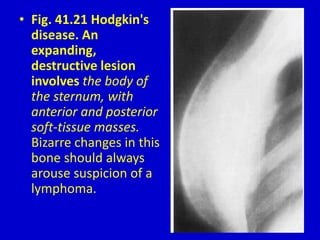
    • Fig. 41.21Hodgkin's disease. An expanding, destructive lesion involves the body of the sternum, with anterior and posterior soft-tissue masses. Bizarre changes in this bone should always arouse suspicion of a lymphoma.
  • 24.
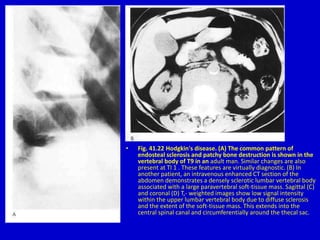
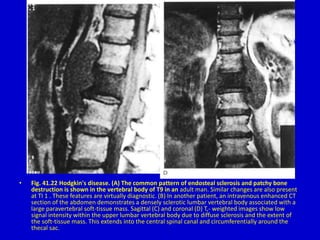
    • Fig. 41.22Hodgkin's disease. (A) The common pattern of endosteal sclerosis and patchy bone destruction is shown in the vertebral body of T9 in an adult man. Similar changes are also present at TI 1 . These features are virtually diagnostic. (B) In another patient, an intravenous enhanced CT section of the abdomen demonstrates a densely sclerotic lumbar vertebral body associated with a large paravertebral soft-tissue mass. Sagittal (C) and coronal (D) T,- weighted images show low signal intensity within the upper lumbar vertebral body due to diffuse sclerosis and the extent of the soft-tissue mass. This extends into the central spinal canal and circumferentially around the thecal sac.
  • 25.
    • Fig. 41.22Hodgkin's disease. (A) The common pattern of endosteal sclerosis and patchy bone destruction is shown in the vertebral body of T9 in an adult man. Similar changes are also present at TI 1 . These features are virtually diagnostic. (B) In another patient, an intravenous enhanced CT section of the abdomen demonstrates a densely sclerotic lumbar vertebral body associated with a large paravertebral soft-tissue mass. Sagittal (C) and coronal (D) T,- weighted images show low signal intensity within the upper lumbar vertebral body due to diffuse sclerosis and the extent of the soft-tissue mass. This extends into the central spinal canal and circumferentially around the thecal sac.
  • 26.
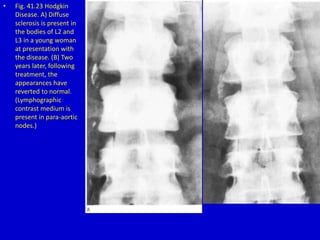
    • Fig. 41.23Hodgkin Disease. A) Diffuse sclerosis is present in the bodies of L2 and L3 in a young woman at presentation with the disease. (B) Two years later, following treatment, the appearances have reverted to normal. (Lymphographic contrast medium is present in para-aortic nodes.)
  • 27.
    • Fig. 41.24Hodgkin's lymphoma. T,-weighted (A) and STIR (B) sagittal images demonstrate extensive abnormality of the marrow of the lumbar spine. In addition, a huge mass of lymph nodes is demonstrated anteriorly, wrapped around the abdominal aorta and displacing the superior mesenteric artery. An axial image (C) demonstrates not only body and left ala involvement of the sacrum, but also subcutaneous and spinal canal extension of the tumour. The thecal sac is displaced to the right.
  • 28.
    • Fig. 41.25Hodgkin's disease. A typical anterior scalloping of L4 is due to pressure erosion from enlarged lymph nodes. The cortex is preserved, as are the disc spaces.
  • 29.
    • Fig. 41.26Non-Hodgkin's lymphoma. A conventional radiograph (A) is virtually normal save for the slight suggestion of patchy ill- defined bone destruction. Subsequent T,-weighted coronal (B) and axial (C) MR images demonstrate not only extensive marrow replacement but also a substantial enveloping soft-tissue mass. The degree and extent of tumour involvement of bone was virtually impossible to appreciate from the radiographic examinations.
  • 30.
    • Fig. 41.26Non-Hodgkin's lymphoma. A conventional radiograph (A) is virtually normal save for the slight suggestion of patchy ill- defined bone destruction. Subsequent T,-weighted coronal (B) and axial (C) MR images demonstrate not only extensive marrow replacement but also a substantial enveloping soft- tissue mass. The degree and extent of tumour involvement of bone was virtually impossible to appreciate from the radiographic examinations.
  • 31.
    • Fig. 41.27Non-Hodgkin's lymphoma. A purely destructive lesion is present in the distal femur of a woman patient. The margins are ill defined with cortical destruction. Periosteal new bone formation is present adjacent to this destruction. These appearances resemble metastasis and osteosarcoma.
  • 32.
    • Fig. 41.28Non- Hodgkin's lymphoma. Advanced changes are shown in the femoral shaft, with dramatic resolution 11 months later following local radiotherapy.
  • 33.
    • Fig. 41.29Non-Hodgkin's lymphoma. Extensive patchy destruction of the cranium was present in this adult patient with generalised disease.
  • 34.
    • Fig. 41.30(A) CT of the pelvis in non-Hodgkin's lymphoma showing diffuse sclerosis within the right innominate bone, with ill-defined periosteal bone formation on the inner surface. A soft-tissue mass is evident. (B) The extent of these changes is easier to appreciate on the axial STIR image, where additional lesions within the left innominate bone are also evident.
  • 35.
    • Fig. 41.31(A,B) Non- Hodgkin's lymphoma. Multifocal disease was found at presentation in an elderly patient with low back pain. In addition to a pathological fracture of a lumbar vertebral body, ill-defined endosteal defects are present in the femoral shaft (arrows).
  • 36.
    • Fig. 41.32Burkitt's tumour. A large destructive lesion in the mandible of this African child is typical of this form of lymphoma.
  • 37.
    • Fig. 41.33Mastocytosis (man aged 34). A localised area of endosteal sclerosis is present in the body of Lt. In addition, ill defined thinning of trabeculae is demonstrated in L2 and patchier changes in the upper surface of L3.
  • 38.
    • Fig. 41.34Mastocytosis. A coarse pattern of generalised sclerosis is shown.
  • 39.
    • Fig. 41.35Plasmacytoma of sacrum. (A) An adult man exhibits a well defined radiolucent defect involving the left sacral ala. (B) A CT scan demonstrated the extensive destructive nature of the tumour, seen clearly to cross the midline. Note the marked cortical thinning with absence of sclerosis or periosteal new bone formation.
  • 40.
    • Fig. 41.36 Plasmacytomaof pelvis. This very extensive lesion was unaccompanied by any systemic abnormality. Bone expansion is associated with coarse trabeculation, producing a soap- bubble appearance. It is much more common for the widespread form
  • 41.
    • Fig. 41.37Plasmacytoma presenting with paraparesis. (A) Conventional radiograph of the thoracic spine showing vertebra plana (arrows). (B) CT demonstrating the degree of bony destruction, associated paravertebral mass and marked posterior extension into the spinal canal resulting in severe cord compression.
  • 42.
    • Fig. 41.38Plasmacytoma. (A) Conventional cervical spine radiograph showing osteolytic destruction of C6 with pathological collapse of the vertebral body. (B) Sagittal T 1 -weighted MR image showing the intermediate signal- intensity lesion of C6 resulting in focal extradural compression of the spinal cord.
  • 44.
    • Fig. 41.40 Myelomatosis.Diffuse marrow involvement has resulted in an overall reduction in bone density similar to that seen in osteoporosis. However, the rather patchy nature of radiolucencies should raise the possibility of myeloma.
  • 45.
    • destructive Fig.41.41 Typical localised lesions of myeloma are demonstrated in the upper femur of an adult woman. The sharply defined rounded defects with endosteal erosions of the cortex are characteristic.
  • 46.
    • Fig. 41.42Histiocytosis. A purely osteolytic lesion is present in the mandible, with well- defined, slightly scalloped margins. The lamina dura has been destroyed. The teeth seem to 'float in air'.
  • 47.
    • Fig. 41.43Histiocytosis. (A) Lateral skull radiograph showing a well-defined osteolytic lesion with a narrow zone of transition and no sclerosis in the posterior parietal region. (B) Osteolytic lesion of the innominate bone with ill-defined peripheral sclerosis. (C) CT of the innominate lesion showing destruction of the anterior cortex of the iliac wing and the ill- defined surrounding sclerosis of this healing lesion.
  • 48.
    • Fig. 41.44Histiocytosis. Extensive involvement of a bone, here the clavicle, is often associated with layered periosteal new bone causing bony expansion. Ill-defined areas of resorption may be visualised in the lesion. This was the only abnormality found in a young girl over several years' follow-up.
  • 49.
    • Fig. 41.45Histiocytosis. Vertebral lesions in the thoracic spine are shown on a lateral tomogram. The bodies of T7 and 8 have collapsed with a slight increase in bone density. Note the relative preservation of the disc spaces.
  • 50.
    • Fig. 41.46Histiocytosis. A healing diaphyseal lesion exhibits periosteal new bone formation and minimal sclerosis around the margins of the radiolucency.
  • 51.
    • Fig. 41.47 Histiocytosis. Extensiveskull involvement in a child with the Hand-Schuller- Christian type of lesion. The areas of destruction in the flat bones of the skull have a map- like configuration.
  • 52.
    • Fig. 41.48Histiocytosis: Hand-Schuller-Christian type. Very extensive radiolucencies are present both in the metaphysis and diaphysis of this child's femur. A healed pathological fracture is present. Histiocytosis should always be considered in the differential diagnosis of bizarre bone lesions.
  • 53.
    • Fig. 41.49Histiocytosis. Adult pulmonary involvement (man aged 20). (A) A localised view from a chest radiograph demonstrates a coarse interstitial pulmonary fibrosis. Note also a pathological fracture of the left fourth rib due to a bony deposit. (B) A CT scan demonstrates peripheral interstitial pulmonary fibrosis with thickened interlobular septa and irregular honeycombing.
  • 54.
    • Fig. 41.50Histiocytosis: Letterer-Siwe type. Massive destructive lesions are present throughout the skeleton, but affect particularly the metadiaphyseal areas of the long bones. A similar appearance could be produced by metastases from a neuroblastoma or the advanced stages of leukaemia.
  • 55.
    • Fig. 41.51Gaucher's disease (woman aged 20). Abnormal modelling of the distal ends of the femora has resulted in a typical flask- shaped appearance. An osteolytic lesion with a coarse trabecular pattern is present in the right femur.
  • 56.
    • Fig. 41.52Gaucher's disease. Infarctions in vertebral bodies have produced the 'bone within a bone' appearance throughout the lumbar spine in this child.
  • 57.
    • Fig. 41.53Gaucher's disease-acute bone infarction. (A) A radiograph of a 1 3- year-old girl, with known Gaucher's disease, presenting with acute hip pain of 12 hours' duration. Slight endosteal sclerosis is shown in the inferior pubic ramus and an area of ill-defined radiolucency in the intertrochanteric region. (B) The delayed phase of a bone scan reveals the femoral head and neck to be markedly photon deficient consistent with acute infarction. Abnormally increased activity is present also at site of previous disease.
  • 58.
    • Fig. 41.54Gaucher's disease. This adolescent has considerable deformity of the femoral head and acetabulum secondary to episodes of infarction. Evidence of degenerative arthritis is already present.
  • 59.
    • Fig. 41.55Haemophilia. The former epiphyses are disproportionately presenting a 'squared' appearance. Hyaline cartilage thickness at the ankle joint is reduced.
  • 60.
    • Fig. 41.56(A,B) Haemophilia. Typical appearances in an adult patient subject to recurrent haemarthroses since childhood. As well as the enlarged, squared appearance of the former epiphyses, hyaline cartilage width is reduced, and osteophytes are present due to secondary osteoarthritis. Areas of radiolucency within medullary bone probably represent old intraosseous haemorrhages.
  • 61.
    Fig. 41.57 (A,B)Haemophilia. Repeated intra-articular haemorrhages have caused overgrowth of the epiphyses, particularly the head of the radius. The joint capsule is distended and the synovium is amorphously dense due to the deposition of haemosiderin from recurrent haemarthroses. A subarticular cyst is present in the olecranon fossa, and degenerative changes, in the form of hyaline cartilage thinning and osteophyte formation, are present.
  • 62.
    • Fig. 41.58Haemophilia. Sagittal T,-weighted image showing loss of hyaline cartilage over the medial compartment and very low signal intensity synovium due to haemosiderin deposition.
  • 63.
    • Fig. 41.59Haemophiliac pseudotumour. A huge destructive lesion in the tibia, with relatively well- defined margins, is associated with some periosteal reaction. Although an initial impression may be of a malignant tumour, changes of haemophilic arthropathy can be seen in the knee and ankle.