

PROBABILITY Presented by:
Savi Arora
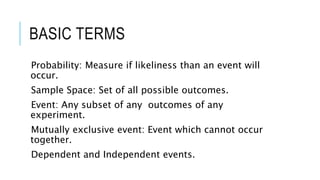
BASIC TERMS
Probability: Measure if likeliness than an event will
occur.
Sample Space: Set of all possible outcomes.
Event: Any subset of any outcomes of any
experiment.
Mutually exclusive event: Event which cannot occur
together.
Dependent and Independent events.
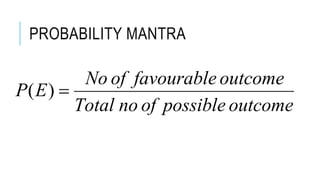
PROBABILITY MANTRA
outcomepossibleofnoTotal
outcomefavourableofNo
EP )(
TODAY WE WILL PLAY WITH
Coins
Dice
Cards
&
A bag full of colorful balls.
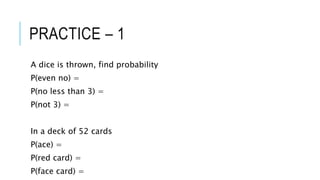
PRACTICE – 1
A dice is thrown, find probability
P(even no) =
P(no less than 3) =
P(not 3) =
In a deck of 52 cards
P(ace) =
P(red card) =
P(face card) =
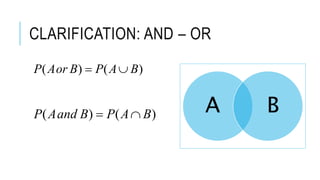
CLARIFICATION: AND – OR
)()( BAPBorAP 
)()( BAPBandAP  A B
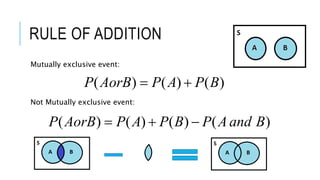
RULE OF ADDITION
Mutually exclusive event:
Not Mutually exclusive event:
)()()( BPAPAorBP 
)()()()( BandAPBPAPAorBP 
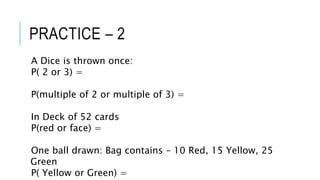
PRACTICE – 2
A Dice is thrown once:
P( 2 or 3) =
P(multiple of 2 or multiple of 3) =
In Deck of 52 cards
P(red or face) =
One ball drawn: Bag contains – 10 Red, 15 Yellow, 25
Green
P( Yellow or Green) =
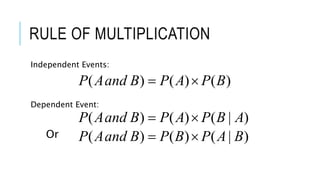
RULE OF MULTIPLICATION
Independent Events:
Dependent Event:
)()()( BPAPBandAP 
)|()()( ABPAPBandAP 
)|()()( BAPBPBandAP Or
PRACTICE – 3
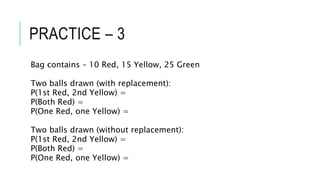
Bag contains – 10 Red, 15 Yellow, 25 Green
Two balls drawn (with replacement):
P(1st Red, 2nd Yellow) =
P(Both Red) =
P(One Red, one Yellow) =
Two balls drawn (without replacement):
P(1st Red, 2nd Yellow) =
P(Both Red) =
P(One Red, one Yellow) =
COIN
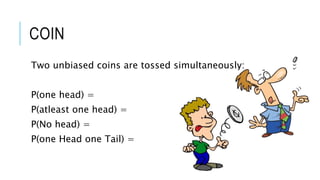
Two unbiased coins are tossed simultaneously:
P(one head) =
P(atleast one head) =
P(No head) =
P(one Head one Tail) =
COIN
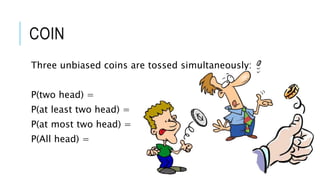
Three unbiased coins are tossed simultaneously:
P(two head) =
P(at least two head) =
P(at most two head) =
P(All head) =
COIN
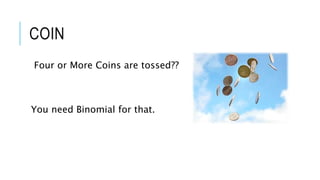
Four or More Coins are tossed??
You need Binomial for that.
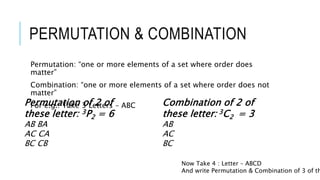
PERMUTATION & COMBINATION
Permutation: “one or more elements of a set where order does
matter”
Combination: “one or more elements of a set where order does not
matter”
For e.g.: Take 3 Letters – ABCPermutation of 2 of
these letter: 3P2 = 6
AB BA
AC CA
BC CB
Combination of 2 of
these letter: 3C2 = 3
AB
AC
BC
Now Take 4 : Letter – ABCD
And write Permutation & Combination of 3 of th
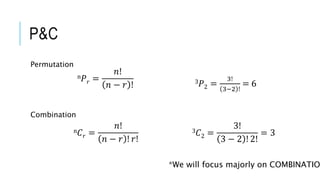
P&C
Permutation
Combination
3 𝐶2 =
3!
3 − 2 ! 2!
= 3n 𝐶 𝑟 =
𝑛!
𝑛 − 𝑟 ! 𝑟!
3 𝑃2 =
3!
3−2 !
= 6
n 𝑃 𝑟 =
𝑛!
𝑛 − 𝑟 !
*We will focus majorly on COMBINATIO
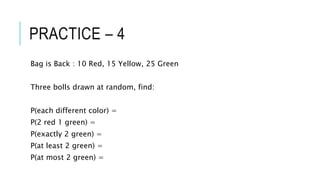
PRACTICE – 4
Bag is Back : 10 Red, 15 Yellow, 25 Green
Three bolls drawn at random, find:
P(each different color) =
P(2 red 1 green) =
P(exactly 2 green) =
P(at least 2 green) =
P(at most 2 green) =
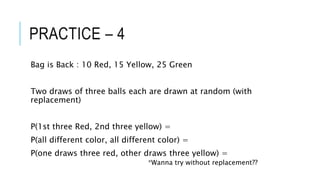
PRACTICE – 4
Bag is Back : 10 Red, 15 Yellow, 25 Green
Two draws of three balls each are drawn at random (with
replacement)
P(1st three Red, 2nd three yellow) =
P(all different color, all different color) =
P(one draws three red, other draws three yellow) =
*Wanna try without replacement??
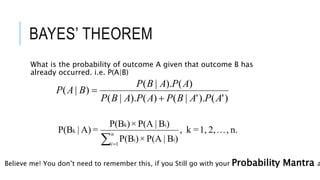
BAYES’ THEOREM
What is the probability of outcome A given that outcome B has
already occurred. i.e. P(A|B)
)'().'|()().|(
)().|(
)|(
APABPAPABP
APABP
BAP


n.,...2,1,=k,
)B|P(A×)P(B
)B|P(A×)P(B
=A)|P(B
1
ii
ik
k

n
i
Believe me! You don’t need to remember this, if you Still go with your Probability Mantra a
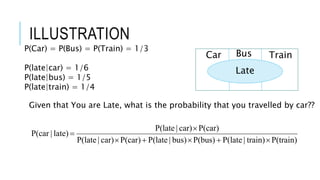
ILLUSTRATION
Late
BusCar Train
P(train)train)|P(lateP(bus)bus)|P(lateP(car)car)|P(late
P(car)car)|P(late
late)|P(car



P(Car) = P(Bus) = P(Train) = 1/3
P(late|car) = 1/6
P(late|bus) = 1/5
P(late|train) = 1/4
Given that You are Late, what is the probability that you travelled by car??
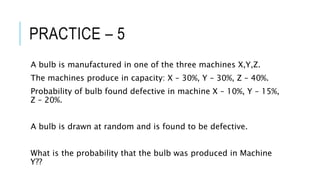
PRACTICE – 5
A bulb is manufactured in one of the three machines X,Y,Z.
The machines produce in capacity: X – 30%, Y – 30%, Z – 40%.
Probability of bulb found defective in machine X – 10%, Y – 15%,
Z – 20%.
A bulb is drawn at random and is found to be defective.
What is the probability that the bulb was produced in Machine
Y??
THANK YOU
Queries are welcomed.

Probability basics

  • 1.
  • 2.
    BASIC TERMS Probability: Measureif likeliness than an event will occur. Sample Space: Set of all possible outcomes. Event: Any subset of any outcomes of any experiment. Mutually exclusive event: Event which cannot occur together. Dependent and Independent events.
  • 3.
  • 4.
    TODAY WE WILLPLAY WITH Coins Dice Cards & A bag full of colorful balls.
  • 5.
    PRACTICE – 1 Adice is thrown, find probability P(even no) = P(no less than 3) = P(not 3) = In a deck of 52 cards P(ace) = P(red card) = P(face card) =
  • 6.
    CLARIFICATION: AND –OR )()( BAPBorAP  )()( BAPBandAP  A B
  • 7.
    RULE OF ADDITION Mutuallyexclusive event: Not Mutually exclusive event: )()()( BPAPAorBP  )()()()( BandAPBPAPAorBP 
  • 8.
    PRACTICE – 2 ADice is thrown once: P( 2 or 3) = P(multiple of 2 or multiple of 3) = In Deck of 52 cards P(red or face) = One ball drawn: Bag contains – 10 Red, 15 Yellow, 25 Green P( Yellow or Green) =
  • 9.
    RULE OF MULTIPLICATION IndependentEvents: Dependent Event: )()()( BPAPBandAP  )|()()( ABPAPBandAP  )|()()( BAPBPBandAP Or
  • 10.
    PRACTICE – 3 Bagcontains – 10 Red, 15 Yellow, 25 Green Two balls drawn (with replacement): P(1st Red, 2nd Yellow) = P(Both Red) = P(One Red, one Yellow) = Two balls drawn (without replacement): P(1st Red, 2nd Yellow) = P(Both Red) = P(One Red, one Yellow) =
  • 11.
    COIN Two unbiased coinsare tossed simultaneously: P(one head) = P(atleast one head) = P(No head) = P(one Head one Tail) =
  • 12.
    COIN Three unbiased coinsare tossed simultaneously: P(two head) = P(at least two head) = P(at most two head) = P(All head) =
  • 13.
    COIN Four or MoreCoins are tossed?? You need Binomial for that.
  • 14.
    PERMUTATION & COMBINATION Permutation:“one or more elements of a set where order does matter” Combination: “one or more elements of a set where order does not matter” For e.g.: Take 3 Letters – ABCPermutation of 2 of these letter: 3P2 = 6 AB BA AC CA BC CB Combination of 2 of these letter: 3C2 = 3 AB AC BC Now Take 4 : Letter – ABCD And write Permutation & Combination of 3 of th
  • 15.
    P&C Permutation Combination 3 𝐶2 = 3! 3− 2 ! 2! = 3n 𝐶 𝑟 = 𝑛! 𝑛 − 𝑟 ! 𝑟! 3 𝑃2 = 3! 3−2 ! = 6 n 𝑃 𝑟 = 𝑛! 𝑛 − 𝑟 ! *We will focus majorly on COMBINATIO
  • 16.
    PRACTICE – 4 Bagis Back : 10 Red, 15 Yellow, 25 Green Three bolls drawn at random, find: P(each different color) = P(2 red 1 green) = P(exactly 2 green) = P(at least 2 green) = P(at most 2 green) =
  • 17.
    PRACTICE – 4 Bagis Back : 10 Red, 15 Yellow, 25 Green Two draws of three balls each are drawn at random (with replacement) P(1st three Red, 2nd three yellow) = P(all different color, all different color) = P(one draws three red, other draws three yellow) = *Wanna try without replacement??
  • 18.
    BAYES’ THEOREM What isthe probability of outcome A given that outcome B has already occurred. i.e. P(A|B) )'().'|()().|( )().|( )|( APABPAPABP APABP BAP   n.,...2,1,=k, )B|P(A×)P(B )B|P(A×)P(B =A)|P(B 1 ii ik k  n i Believe me! You don’t need to remember this, if you Still go with your Probability Mantra a
  • 19.
    ILLUSTRATION Late BusCar Train P(train)train)|P(lateP(bus)bus)|P(lateP(car)car)|P(late P(car)car)|P(late late)|P(car    P(Car) =P(Bus) = P(Train) = 1/3 P(late|car) = 1/6 P(late|bus) = 1/5 P(late|train) = 1/4 Given that You are Late, what is the probability that you travelled by car??
  • 20.
    PRACTICE – 5 Abulb is manufactured in one of the three machines X,Y,Z. The machines produce in capacity: X – 30%, Y – 30%, Z – 40%. Probability of bulb found defective in machine X – 10%, Y – 15%, Z – 20%. A bulb is drawn at random and is found to be defective. What is the probability that the bulb was produced in Machine Y??
  • 21.