Clouds and Precipitation
By: Cullen Williamson
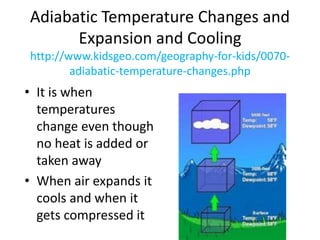
Adiabatic Temperature Changes and
Expansion and Cooling
http://www.kidsgeo.com/geography-for-kids/0070-
adiabatic-temperature-changes.php
• It is when
temperatures
change even though
no heat is added or
taken away
• When air expands it
cools and when it
gets compressed it
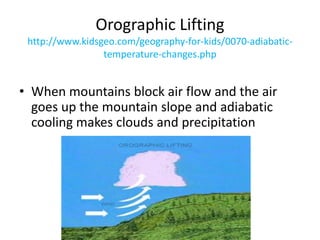
Orographic Lifting
http://www.kidsgeo.com/geography-for-kids/0070-adiabatic-
temperature-changes.php
• When mountains block air flow and the air
goes up the mountain slope and adiabatic
cooling makes clouds and precipitation
Frontal Wedging
http://www.geo.hunter.cuny.edu/~tbw/wc.notes/4.moisture.at
m.stability/frontal_wedging.htm
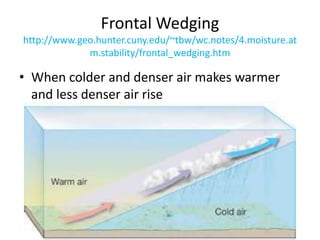
• When colder and denser air makes warmer
and less denser air rise
Convergence
http://santasusana.org/pakelly/ES9CP/ES9%20cl
ouds.htm
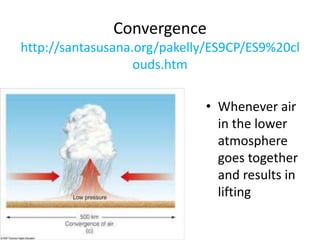
• Whenever air
in the lower
atmosphere
goes together
and results in
lifting
Localized Convective Lifting
http://rst.gsfc.nasa.gov/Sect14/Sect14_1c.html
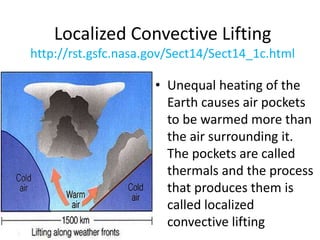
• Unequal heating of the
Earth causes air pockets
to be warmed more than
the air surrounding it.
The pockets are called
thermals and the process
that produces them is
called localized
convective lifting
Stability
http://ocw.usu.edu/Forest__Range__and_Wildlife_Scie
nces/Wildland_Fire_Management_and_Planning/Unit_
7__Atmospheric_Stability_and_Instability_1.html
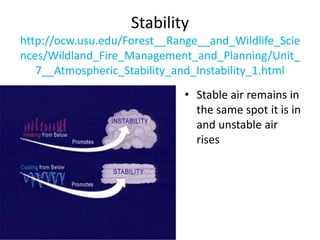
• Stable air remains in
the same spot it is in
and unstable air
rises
Condensation
http://keep3.sjfc.edu/students/kes00898/e-
port/condensation%20page%20for%20unit.html
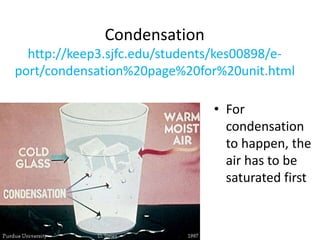
• For
condensation
to happen, the
air has to be
saturated first
Types of Clouds
http://www.media.pearson.com.au/schools/cw/a
u_sch_stacey_ksg_3/em/ch9.html
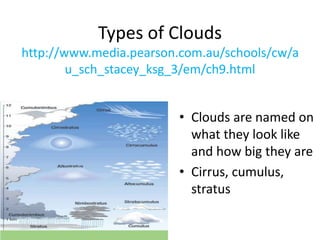
• Clouds are named on
what they look like
and how big they are
• Cirrus, cumulus,
stratus
High Clouds
http://www.media.pearson.com.au/school
s/cw/au_sch_stacey_ksg_3/em/ch9.html
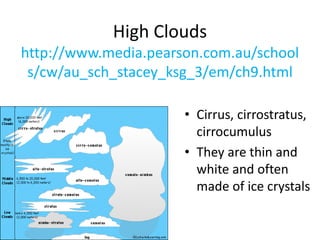
• Cirrus, cirrostratus,
cirrocumulus
• They are thin and
white and often
made of ice crystals
Middle Clouds
http://www.media.pearson.com.au/sc
hools/cw/au_sch_stacey_ksg_3/em/ch
9.html
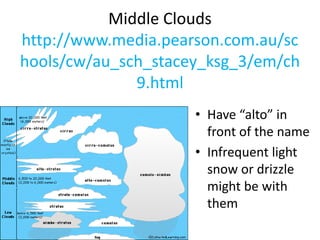
• Have “alto” in
front of the name
• Infrequent light
snow or drizzle
might be with
them
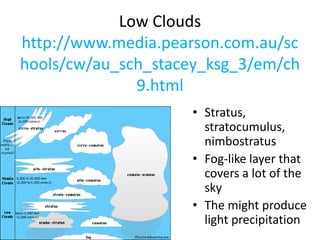
Low Clouds
http://www.media.pearson.com.au/sc
hools/cw/au_sch_stacey_ksg_3/em/ch
9.html
• Stratus,
stratocumulus,
nimbostratus
• Fog-like layer that
covers a lot of the
sky
• The might produce
light precipitation
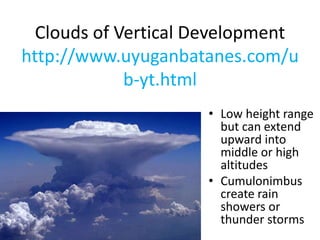
Clouds of Vertical Development
http://www.uyuganbatanes.com/u
b-yt.html
• Low height range
but can extend
upward into
middle or high
altitudes
• Cumulonimbus
create rain
showers or
thunder storms
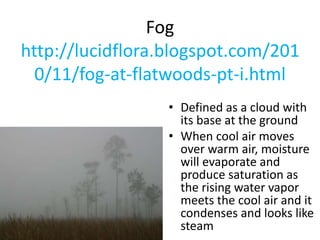
Fog
http://lucidflora.blogspot.com/201
0/11/fog-at-flatwoods-pt-i.html
• Defined as a cloud with
its base at the ground
• When cool air moves
over warm air, moisture
will evaporate and
produce saturation as
the rising water vapor
meets the cool air and it
condenses and looks like
steam
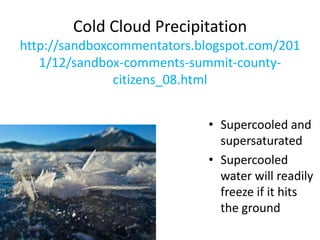
Cold Cloud Precipitation
http://sandboxcommentators.blogspot.com/201
1/12/sandbox-comments-summit-county-
citizens_08.html
• Supercooled and
supersaturated
• Supercooled
water will readily
freeze if it hits
the ground
Warm Cloud Precipitation
http://www.atmos.umd.edu/~meto200/3_
04_03_lecture_files/frame.htm
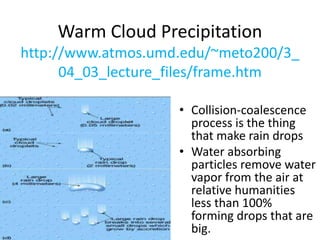
• Collision-coalescence
process is the thing
that make rain drops
• Water absorbing
particles remove water
vapor from the air at
relative humanities
less than 100%
forming drops that are
big.
Rain and Snow
http://www.dimensionsguide.com/dimensi
on-of-a-raindrop/
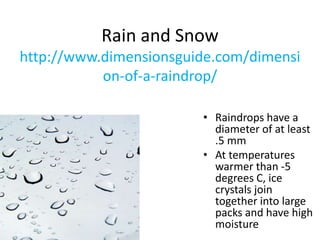
• Raindrops have a
diameter of at least
.5 mm
• At temperatures
warmer than -5
degrees C, ice
crystals join
together into large
packs and have high
moisture
Sleet, Glaze, and Hail
http://en.wikipedia.org/wiki/Hail
• Sleet is ice that is clear
or translucent
• Glaze is when rain
becomes supercooled
and turn to ice when
impacting the ground
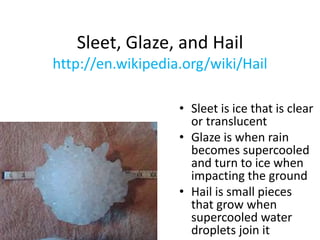
• Hail is small pieces
that grow when
supercooled water
droplets join it
THE END!!!!!!!!!Ms. Joseph is awesome!!!!!!

Clouds and precipitation