Clouds and Precipitation

      By Haley Evans
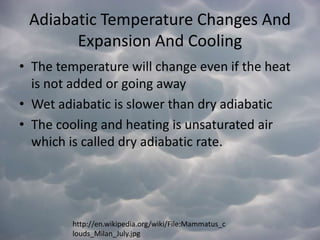
Adiabatic Temperature Changes And
       Expansion And Cooling
• The temperature will change even if the heat
  is not added or going away
• Wet adiabatic is slower than dry adiabatic
• The cooling and heating is unsaturated air
  which is called dry adiabatic rate.


         http://en.wikipedia.org/wiki/File:Mammatus_c
         louds_Milan_July.jpg
Orographic Lifting
• This is the first mechanisms that causes the air
  to rise
• The mountains will act as barriers for the air
  to flow
• The force will cause the air to go up.


         http://free-screensavers-
         backgrounds.com/category/bgs/clouds/
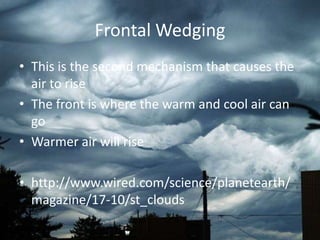
Frontal Wedging
• This is the second mechanism that causes the
  air to rise
• The front is where the warm and cool air can
  go
• Warmer air will rise

• http://www.wired.com/science/planetearth/
  magazine/17-10/st_clouds
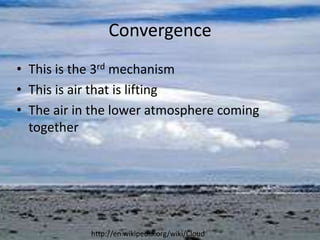
Convergence
• This is the 3rd mechanism
• This is air that is lifting
• The air in the lower atmosphere coming
  together


            http://en.wikipedia.org/wiki/Cloud
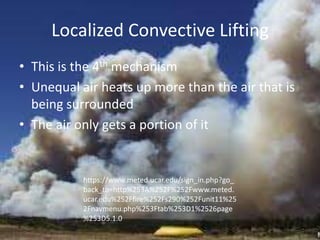
Localized Convective Lifting
• This is the 4th mechanism
• Unequal air heats up more than the air that is
  being surrounded
• The air only gets a portion of it


           https://www.meted.ucar.edu/sign_in.php?go_
           back_to=http%253A%252F%252Fwww.meted.
           ucar.edu%252Ffire%252Fs290%252Funit11%25
           2Fnavmenu.php%253Ftab%253D1%2526page
           %253D5.1.0
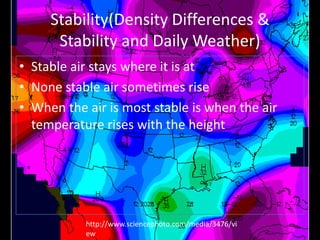
Stability(Density Differences &
      Stability and Daily Weather)
• Stable air stays where it is at
• None stable air sometimes rise
• When the air is most stable is when the air
  temperature rises with the height


           http://www.sciencephoto.com/media/3476/vi
           ew
Condensation
• When there is dew, clouds, or fog the air has
  to be saturated
• This happens in the air above the ground
• There must be a surface for water-vapor
  condensation


          http://www.sciencephoto.com/media/3476/vi
          ew
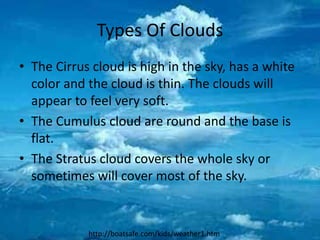
Types Of Clouds
• The Cirrus cloud is high in the sky, has a white
  color and the cloud is thin. The clouds will
  appear to feel very soft.
• The Cumulus cloud are round and the base is
  flat.
• The Stratus cloud covers the whole sky or
  sometimes will cover most of the sky.


            http://boatsafe.com/kids/weather1.htm
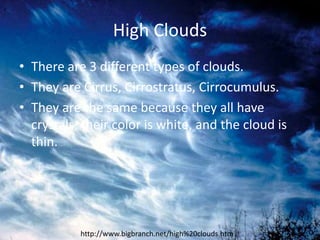
High Clouds
• There are 3 different types of clouds.
• They are Cirrus, Cirrostratus, Cirrocumulus.
• They are the same because they all have
  crystals, their color is white, and the cloud is
  thin.


           http://www.bigbranch.net/high%20clouds.htm
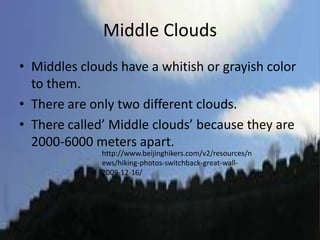
Middle Clouds
• Middles clouds have a whitish or grayish color
  to them.
• There are only two different clouds.
• There called’ Middle clouds’ because they are
  2000-6000 meters apart.
              http://www.beijinghikers.com/v2/resources/n
              ews/hiking-photos-switchback-great-wall-
              2009-12-16/
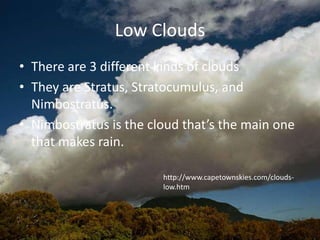
Low Clouds
• There are 3 different kinds of clouds
• They are Stratus, Stratocumulus, and
  Nimbostratus.
• Nimbostratus is the cloud that’s the main one
  that makes rain.

                        http://www.capetownskies.com/clouds-
                        low.htm
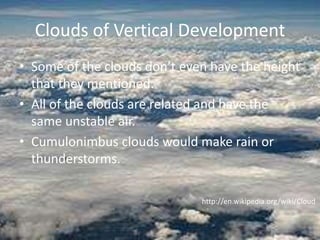
Clouds of Vertical Development
• Some of the clouds don’t even have the height
  that they mentioned.
• All of the clouds are related and have the
  same unstable air.
• Cumulonimbus clouds would make rain or
  thunderstorms.

                              http://en.wikipedia.org/wiki/Cloud
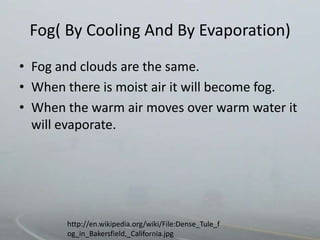
Fog( By Cooling And By Evaporation)
• Fog and clouds are the same.
• When there is moist air it will become fog.
• When the warm air moves over warm water it
  will evaporate.


       http://en.wikipedia.org/wiki/File:Dense_Tule_f
       og_in_Bakersfield,_California.jpg
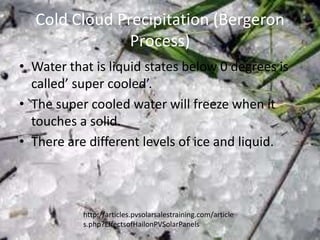
Cold Cloud Precipitation (Bergeron
               Process)
• Water that is liquid states below 0 degrees is
  called’ super cooled’.
• The super cooled water will freeze when it
  touches a solid.
• There are different levels of ice and liquid.


           http://articles.pvsolarsalestraining.com/article
           s.php?EffectsofHailonPVSolarPanels
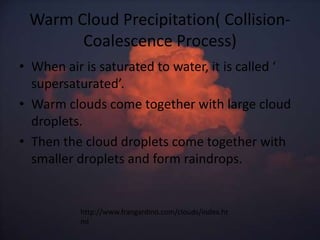
Warm Cloud Precipitation( Collision-
       Coalescence Process)
• When air is saturated to water, it is called ‘
  supersaturated’.
• Warm clouds come together with large cloud
  droplets.
• Then the cloud droplets come together with
  smaller droplets and form raindrops.


          http://www.frangardino.com/clouds/index.ht
          ml
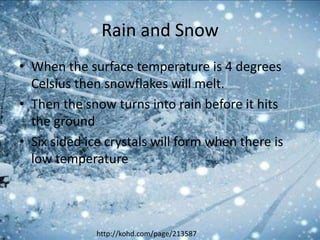
Rain and Snow
• When the surface temperature is 4 degrees
  Celsius then snowflakes will melt.
• Then the snow turns into rain before it hits
  the ground
• Six sided ice crystals will form when there is
  low temperature


              http://kohd.com/page/213587
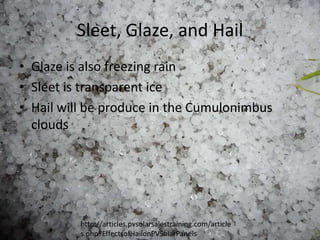
Sleet, Glaze, and Hail
• Glaze is also freezing rain
• Sleet is transparent ice
• Hail will be produce in the Cumulonimbus
  clouds


          http://articles.pvsolarsalestraining.com/article
          s.php?EffectsofHailonPVSolarPanels
The End!

2hevans

  • 1.
  • 2.
    Adiabatic Temperature ChangesAnd Expansion And Cooling • The temperature will change even if the heat is not added or going away • Wet adiabatic is slower than dry adiabatic • The cooling and heating is unsaturated air which is called dry adiabatic rate. http://en.wikipedia.org/wiki/File:Mammatus_c louds_Milan_July.jpg
  • 3.
    Orographic Lifting • Thisis the first mechanisms that causes the air to rise • The mountains will act as barriers for the air to flow • The force will cause the air to go up. http://free-screensavers- backgrounds.com/category/bgs/clouds/
  • 4.
    Frontal Wedging • Thisis the second mechanism that causes the air to rise • The front is where the warm and cool air can go • Warmer air will rise • http://www.wired.com/science/planetearth/ magazine/17-10/st_clouds
  • 5.
    Convergence • This isthe 3rd mechanism • This is air that is lifting • The air in the lower atmosphere coming together http://en.wikipedia.org/wiki/Cloud
  • 6.
    Localized Convective Lifting •This is the 4th mechanism • Unequal air heats up more than the air that is being surrounded • The air only gets a portion of it https://www.meted.ucar.edu/sign_in.php?go_ back_to=http%253A%252F%252Fwww.meted. ucar.edu%252Ffire%252Fs290%252Funit11%25 2Fnavmenu.php%253Ftab%253D1%2526page %253D5.1.0
  • 7.
    Stability(Density Differences & Stability and Daily Weather) • Stable air stays where it is at • None stable air sometimes rise • When the air is most stable is when the air temperature rises with the height http://www.sciencephoto.com/media/3476/vi ew
  • 8.
    Condensation • When thereis dew, clouds, or fog the air has to be saturated • This happens in the air above the ground • There must be a surface for water-vapor condensation http://www.sciencephoto.com/media/3476/vi ew
  • 9.
    Types Of Clouds •The Cirrus cloud is high in the sky, has a white color and the cloud is thin. The clouds will appear to feel very soft. • The Cumulus cloud are round and the base is flat. • The Stratus cloud covers the whole sky or sometimes will cover most of the sky. http://boatsafe.com/kids/weather1.htm
  • 10.
    High Clouds • Thereare 3 different types of clouds. • They are Cirrus, Cirrostratus, Cirrocumulus. • They are the same because they all have crystals, their color is white, and the cloud is thin. http://www.bigbranch.net/high%20clouds.htm
  • 11.
    Middle Clouds • Middlesclouds have a whitish or grayish color to them. • There are only two different clouds. • There called’ Middle clouds’ because they are 2000-6000 meters apart. http://www.beijinghikers.com/v2/resources/n ews/hiking-photos-switchback-great-wall- 2009-12-16/
  • 12.
    Low Clouds • Thereare 3 different kinds of clouds • They are Stratus, Stratocumulus, and Nimbostratus. • Nimbostratus is the cloud that’s the main one that makes rain. http://www.capetownskies.com/clouds- low.htm
  • 13.
    Clouds of VerticalDevelopment • Some of the clouds don’t even have the height that they mentioned. • All of the clouds are related and have the same unstable air. • Cumulonimbus clouds would make rain or thunderstorms. http://en.wikipedia.org/wiki/Cloud
  • 14.
    Fog( By CoolingAnd By Evaporation) • Fog and clouds are the same. • When there is moist air it will become fog. • When the warm air moves over warm water it will evaporate. http://en.wikipedia.org/wiki/File:Dense_Tule_f og_in_Bakersfield,_California.jpg
  • 15.
    Cold Cloud Precipitation(Bergeron Process) • Water that is liquid states below 0 degrees is called’ super cooled’. • The super cooled water will freeze when it touches a solid. • There are different levels of ice and liquid. http://articles.pvsolarsalestraining.com/article s.php?EffectsofHailonPVSolarPanels
  • 16.
    Warm Cloud Precipitation(Collision- Coalescence Process) • When air is saturated to water, it is called ‘ supersaturated’. • Warm clouds come together with large cloud droplets. • Then the cloud droplets come together with smaller droplets and form raindrops. http://www.frangardino.com/clouds/index.ht ml
  • 17.
    Rain and Snow •When the surface temperature is 4 degrees Celsius then snowflakes will melt. • Then the snow turns into rain before it hits the ground • Six sided ice crystals will form when there is low temperature http://kohd.com/page/213587
  • 18.
    Sleet, Glaze, andHail • Glaze is also freezing rain • Sleet is transparent ice • Hail will be produce in the Cumulonimbus clouds http://articles.pvsolarsalestraining.com/article s.php?EffectsofHailonPVSolarPanels
  • 19.