By Brendan McFadden
Adiabatic Temperature
changes, expansion, and
cooling.
 When air is compressed, the molecules
  move faster and the temperature
  increases. When it can expand, the
  temperature decreases.
 Every 1,000 meters from the surface the
  temperature goes down 10 c.
Orographic Lifting
 Mountains act as barriers to prevent air
  flow. That is why the leeward is cooler
  than the windward side.
 The moisture in the air decreases by the
  time it gets to the leeward side so it
  becomes dryer.
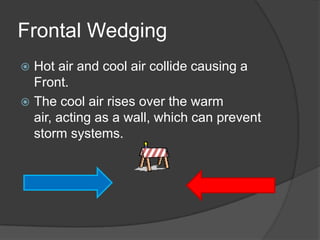
Frontal Wedging
 Hot air and cool air collide causing a
  Front.
 The cool air rises over the warm
  air, acting as a wall, which can prevent
  storm systems.
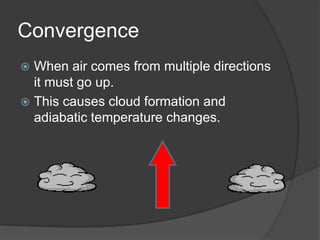
Convergence
 When air comes from multiple directions
  it must go up.
 This causes cloud formation and
  adiabatic temperature changes.
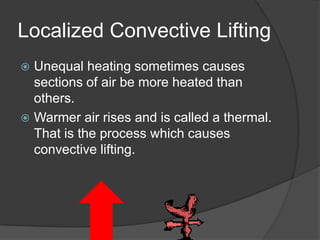
Localized Convective Lifting
 Unequal heating sometimes causes
  sections of air be more heated than
  others.
 Warmer air rises and is called a thermal.
  That is the process which causes
  convective lifting.
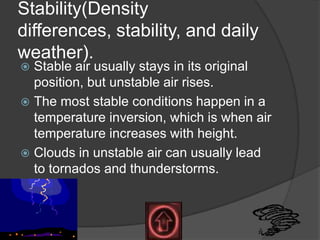
Stability(Density
differences, stability, and daily
weather).
 Stable air usually stays in its original
  position, but unstable air rises.
 The most stable conditions happen in a
  temperature inversion, which is when air
  temperature increases with height.
 Clouds in unstable air can usually lead
  to tornados and thunderstorms.
Condensation
 The air MUST be saturated before it can
  condense.
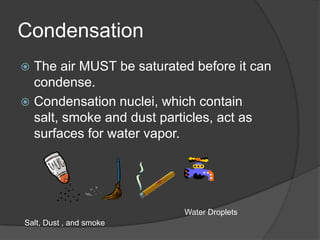
 Condensation nuclei, which contain
  salt, smoke and dust particles, act as
  surfaces for water vapor.


                          Water Droplets
Salt, Dust , and smoke
Types of clouds
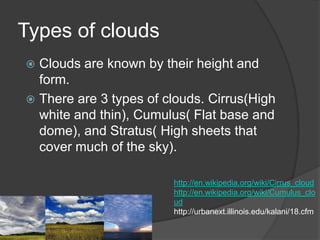
 Clouds are known by their height and
  form.
 There are 3 types of clouds. Cirrus(High
  white and thin), Cumulus( Flat base and
  dome), and Stratus( High sheets that
  cover much of the sky).

                        http://en.wikipedia.org/wiki/Cirrus_cloud
                        http://en.wikipedia.org/wiki/Cumulus_clo
                        ud
                        http://urbanext.illinois.edu/kalani/18.cfm
High clouds
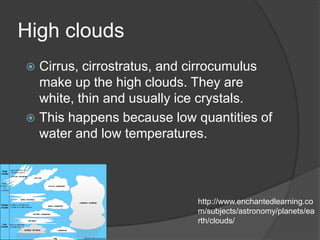
 Cirrus, cirrostratus, and cirrocumulus
  make up the high clouds. They are
  white, thin and usually ice crystals.
 This happens because low quantities of
  water and low temperatures.


                           http://www.enchantedlearning.co
                           m/subjects/astronomy/planets/ea
                           rth/clouds/
Middle clouds
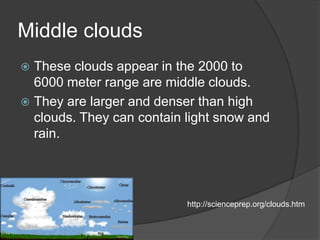
 These clouds appear in the 2000 to
  6000 meter range are middle clouds.
 They are larger and denser than high
  clouds. They can contain light snow and
  rain.


                           http://scienceprep.org/clouds.htm
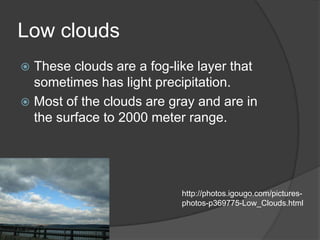
Low clouds
 These clouds are a fog-like layer that
  sometimes has light precipitation.
 Most of the clouds are gray and are in
  the surface to 2000 meter range.


                           http://photos.igougo.com/pictures-
                           photos-p369775-Low_Clouds.html
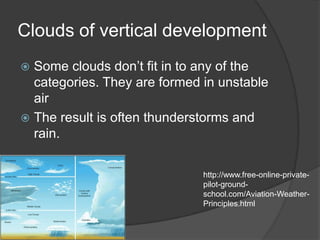
Clouds of vertical development
 Some clouds don’t fit in to any of the
  categories. They are formed in unstable
  air
 The result is often thunderstorms and
  rain.

                              http://www.free-online-private-
                              pilot-ground-
                              school.com/Aviation-Weather-
                              Principles.html
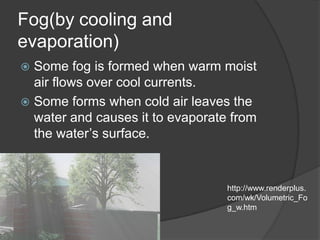
Fog(by cooling and
evaporation)
 Some fog is formed when warm moist
  air flows over cool currents.
 Some forms when cold air leaves the
  water and causes it to evaporate from
  the water’s surface.


                                  http://www.renderplus.
                                  com/wk/Volumetric_Fo
                                  g_w.htm
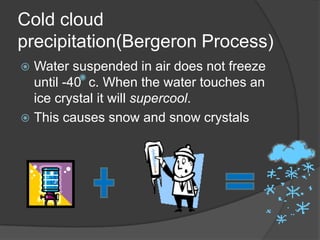
Cold cloud
precipitation(Bergeron Process)
 Water suspended in air does not freeze
  until -40 c. When the water touches an
  ice crystal it will supercool.
 This causes snow and snow crystals
Warm cloud Precipitation
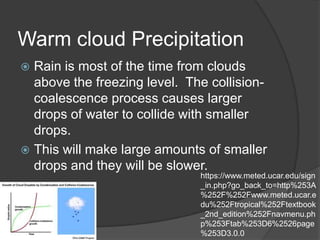
 Rain is most of the time from clouds
  above the freezing level. The collision-
  coalescence process causes larger
  drops of water to collide with smaller
  drops.
 This will make large amounts of smaller
  drops and they will be slower.
                              https://www.meted.ucar.edu/sign
                              _in.php?go_back_to=http%253A
                              %252F%252Fwww.meted.ucar.e
                              du%252Ftropical%252Ftextbook
                              _2nd_edition%252Fnavmenu.ph
                              p%253Ftab%253D6%2526page
                              %253D3.0.0
Rain and snow
 Rain is actually small drops of water that
  fall from clouds that of a diameter of at
  least .5 mm.
 Snow, which usually melts before it
  touches the ground, clumps up with ice
  crystals and make a heavy moisture
  content.
Sleet, Glaze, and Hail
 Sleet is small grains of translucent ice
  that fall from clouds. A layer of air near
  the ground must be subfreezing.
 Glaze is know as freezing rain and must
  be super cooled below 0 c. Hail begins
  as small ice pellets but can supercooled
  and increase in size.
                                 http://climate.met.psu
                                 .edu/features/Hail/PE
                                 MA_hail.php
The End

1bMcFadden

  • 1.
  • 2.
    Adiabatic Temperature changes, expansion,and cooling.  When air is compressed, the molecules move faster and the temperature increases. When it can expand, the temperature decreases.  Every 1,000 meters from the surface the temperature goes down 10 c.
  • 3.
    Orographic Lifting  Mountainsact as barriers to prevent air flow. That is why the leeward is cooler than the windward side.  The moisture in the air decreases by the time it gets to the leeward side so it becomes dryer.
  • 4.
    Frontal Wedging  Hotair and cool air collide causing a Front.  The cool air rises over the warm air, acting as a wall, which can prevent storm systems.
  • 5.
    Convergence  When aircomes from multiple directions it must go up.  This causes cloud formation and adiabatic temperature changes.
  • 6.
    Localized Convective Lifting Unequal heating sometimes causes sections of air be more heated than others.  Warmer air rises and is called a thermal. That is the process which causes convective lifting.
  • 7.
    Stability(Density differences, stability, anddaily weather).  Stable air usually stays in its original position, but unstable air rises.  The most stable conditions happen in a temperature inversion, which is when air temperature increases with height.  Clouds in unstable air can usually lead to tornados and thunderstorms.
  • 8.
    Condensation  The airMUST be saturated before it can condense.  Condensation nuclei, which contain salt, smoke and dust particles, act as surfaces for water vapor. Water Droplets Salt, Dust , and smoke
  • 9.
    Types of clouds Clouds are known by their height and form.  There are 3 types of clouds. Cirrus(High white and thin), Cumulus( Flat base and dome), and Stratus( High sheets that cover much of the sky). http://en.wikipedia.org/wiki/Cirrus_cloud http://en.wikipedia.org/wiki/Cumulus_clo ud http://urbanext.illinois.edu/kalani/18.cfm
  • 10.
    High clouds  Cirrus,cirrostratus, and cirrocumulus make up the high clouds. They are white, thin and usually ice crystals.  This happens because low quantities of water and low temperatures. http://www.enchantedlearning.co m/subjects/astronomy/planets/ea rth/clouds/
  • 11.
    Middle clouds  Theseclouds appear in the 2000 to 6000 meter range are middle clouds.  They are larger and denser than high clouds. They can contain light snow and rain. http://scienceprep.org/clouds.htm
  • 12.
    Low clouds  Theseclouds are a fog-like layer that sometimes has light precipitation.  Most of the clouds are gray and are in the surface to 2000 meter range. http://photos.igougo.com/pictures- photos-p369775-Low_Clouds.html
  • 13.
    Clouds of verticaldevelopment  Some clouds don’t fit in to any of the categories. They are formed in unstable air  The result is often thunderstorms and rain. http://www.free-online-private- pilot-ground- school.com/Aviation-Weather- Principles.html
  • 14.
    Fog(by cooling and evaporation) Some fog is formed when warm moist air flows over cool currents.  Some forms when cold air leaves the water and causes it to evaporate from the water’s surface. http://www.renderplus. com/wk/Volumetric_Fo g_w.htm
  • 15.
    Cold cloud precipitation(Bergeron Process) Water suspended in air does not freeze until -40 c. When the water touches an ice crystal it will supercool.  This causes snow and snow crystals
  • 16.
    Warm cloud Precipitation Rain is most of the time from clouds above the freezing level. The collision- coalescence process causes larger drops of water to collide with smaller drops.  This will make large amounts of smaller drops and they will be slower. https://www.meted.ucar.edu/sign _in.php?go_back_to=http%253A %252F%252Fwww.meted.ucar.e du%252Ftropical%252Ftextbook _2nd_edition%252Fnavmenu.ph p%253Ftab%253D6%2526page %253D3.0.0
  • 17.
    Rain and snow Rain is actually small drops of water that fall from clouds that of a diameter of at least .5 mm.  Snow, which usually melts before it touches the ground, clumps up with ice crystals and make a heavy moisture content.
  • 18.
    Sleet, Glaze, andHail  Sleet is small grains of translucent ice that fall from clouds. A layer of air near the ground must be subfreezing.  Glaze is know as freezing rain and must be super cooled below 0 c. Hail begins as small ice pellets but can supercooled and increase in size. http://climate.met.psu .edu/features/Hail/PE MA_hail.php
  • 19.