Physical Geography
Class 24
Types and Formation
Of Precipitation
© 2011 Pearson Education, Inc. 1
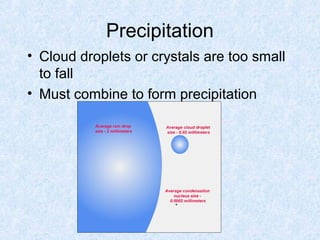
Precipitation
• Cloud droplets or crystals are too small
to fall
• Must combine to form precipitation
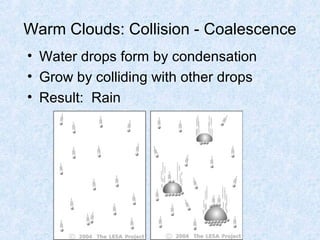
Warm Clouds: Collision - Coalescence
• Water drops form by condensation
• Grow by colliding with other drops
• Result: Rain
Cold Clouds: Bergeron process
• A mix of ice crystals and supercooled
water droplets (water droplets below
freezing but haven’t frozen yet)
• Deposition (sublimation) causes ice
crystals to grow
• Snowflakes grow big enough to fall from
cloud
© 2011 Pearson Education, Inc.
Cold Clouds
5
Figure 6-28
At which latitude would the Collision-
Coalescense process be most
common?
© 2011 Pearson Education, Inc. 6
73%
27%
0% 1. Polar
2. Mid-latitudes
3. Tropical
Types of Precipitation
• Snow (ice crystals)
• Rain and drizzle (liquid)
• Freezing rain or Glaze
• Sleet
• Hail
At which surface temperature would it be
hardest to predict type of precipitation?
© 2011 Pearson Education, Inc. 8
20%
50%
30%
0% 1. -10 to -6 degrees C
2. -2 to 2 degrees C
3. 6 to10 degrees C
4. 16 to 20 degrees C
Snow
© 2011 Pearson Education, Inc. 9
What can happen to ice crystals on
their way from a cloud to the ground?
© 2011 Pearson Education, Inc. 10
100%
0%
0%
0% 1. It can remain in its original frozen form
2. It can melt and become rain
3. It can melt and then refreeze
4. Any of the above can occur
What can happen to snow on its
way to Earth?
• Can melt and form raindrops
• Can stay snowflakes
• Can melt and then refreeze  sleet or
freezing rain
Sleet = frozen pellets
• Snow melts, then refreezes in air
Freezing Rain
• Melts on its way to Earth, freezes only
when it contacts a solid surface
Which is more hazardous?
© 2011 Pearson Education, Inc. 16
0%
100%
0% 1. Sleet
2. Freezing rain
3. Snow
Hail
• Forms in cumulonimbus clouds only
During which season is hail
most common?
© 2011 Pearson Education, Inc. 18
27%
9%
0%
18%
45% 1. Winter
2. Spring
3. Summer
4. Fall
5. Equally common in all four seasons
© 2011 Pearson Education, Inc.
Atmospheric Lifting
• Four types of atmospheric lifting
19
Figure 6-32
Orographic Precipitation
• Ask me to tell you about my Glacier
Park camping trip (or stop me from
repeating myself)
Hawaii – where do the winds
come from?
Winds travel from:
© 2011 Pearson Education, Inc. 22
82%
0%
9%
9% 1. Bottom right to upper left
2. Top left to bottom right
3. Bottom left to upper right
4. Top right to bottom left
GLOBAL DISTRIBUTION OF
PRECIPITATION
23
© 2011 Pearson Education, Inc.
Global Distribution of
Precipitation
• High precipitation regions, tropics
• Low precipitation regions, deserts and poles
24
Figure 6-34
© 2011 Pearson Education, Inc.
Global Distribution of Precipitation
25
Figure 6-35
© 2011 Pearson Education, Inc.
Acid Rain
• Definition of acid rain
• Sources of acid rain
• Principal acids—
sulfuric and nitric
• Number of hydrogen
ions—pH
26
Figure 6-38
© 2011 Pearson Education, Inc.
Distribution of acid rain in US
27
© 2011 Pearson Education, Inc. 28
© 2011 Pearson Education, Inc. 29
© 2011 Pearson Education, Inc. 30
THE END
31
© 2011 Pearson Education, Inc.
Summary
• Moisture can impact the landscape in a variety of
ways, including fog, haze, and precipitation
• The hydrologic cycle shows the balance between
water removed from the oceans and water returned
by precipitation
• Water has a number of unique properties
• Water vapor is the gas form of water
• Evaporation rates change as surrounding
atmospheric conditions change
• There are several measures of vapor content in the
atmosphere 32
© 2011 Pearson Education, Inc.
Summary
• There are several measures of vapor content in the
atmosphere, called humidity measurements
• Condensation is the process by which vapor is
converted to liquid
• Adiabatic processes explain changes in parcel
temperature without the addition or subtraction of
heat to the parcel
• Clouds are a visual identification of saturation
• Air has buoyancy associated with it that describes
its stability
33
© 2011 Pearson Education, Inc.
Summary
• Many processes are responsible for precipitation
• There are five primary types of precipitation
• Atmospheric lifting occurs through four primary
mechanisms
• The most highly variable rainfall worldwide occurs
over deserts
• Tropical regions are generally wet
• Acid rain affects the Northeast and results from
compounds released into the air by humans
34
© 2011 Pearson Education, Inc.
Global Distribution of Precipitation
35
Figure 6-37

Pg tp-class24-precipitation

  • 1.
    Physical Geography Class 24 Typesand Formation Of Precipitation © 2011 Pearson Education, Inc. 1
  • 2.
    Precipitation • Cloud dropletsor crystals are too small to fall • Must combine to form precipitation
  • 3.
    Warm Clouds: Collision- Coalescence • Water drops form by condensation • Grow by colliding with other drops • Result: Rain
  • 4.
    Cold Clouds: Bergeronprocess • A mix of ice crystals and supercooled water droplets (water droplets below freezing but haven’t frozen yet) • Deposition (sublimation) causes ice crystals to grow • Snowflakes grow big enough to fall from cloud
  • 5.
    © 2011 PearsonEducation, Inc. Cold Clouds 5 Figure 6-28
  • 6.
    At which latitudewould the Collision- Coalescense process be most common? © 2011 Pearson Education, Inc. 6 73% 27% 0% 1. Polar 2. Mid-latitudes 3. Tropical
  • 7.
    Types of Precipitation •Snow (ice crystals) • Rain and drizzle (liquid) • Freezing rain or Glaze • Sleet • Hail
  • 8.
    At which surfacetemperature would it be hardest to predict type of precipitation? © 2011 Pearson Education, Inc. 8 20% 50% 30% 0% 1. -10 to -6 degrees C 2. -2 to 2 degrees C 3. 6 to10 degrees C 4. 16 to 20 degrees C
  • 9.
    Snow © 2011 PearsonEducation, Inc. 9
  • 10.
    What can happento ice crystals on their way from a cloud to the ground? © 2011 Pearson Education, Inc. 10 100% 0% 0% 0% 1. It can remain in its original frozen form 2. It can melt and become rain 3. It can melt and then refreeze 4. Any of the above can occur
  • 11.
    What can happento snow on its way to Earth? • Can melt and form raindrops • Can stay snowflakes • Can melt and then refreeze  sleet or freezing rain
  • 12.
    Sleet = frozenpellets • Snow melts, then refreezes in air
  • 14.
    Freezing Rain • Meltson its way to Earth, freezes only when it contacts a solid surface
  • 16.
    Which is morehazardous? © 2011 Pearson Education, Inc. 16 0% 100% 0% 1. Sleet 2. Freezing rain 3. Snow
  • 17.
    Hail • Forms incumulonimbus clouds only
  • 18.
    During which seasonis hail most common? © 2011 Pearson Education, Inc. 18 27% 9% 0% 18% 45% 1. Winter 2. Spring 3. Summer 4. Fall 5. Equally common in all four seasons
  • 19.
    © 2011 PearsonEducation, Inc. Atmospheric Lifting • Four types of atmospheric lifting 19 Figure 6-32
  • 20.
    Orographic Precipitation • Askme to tell you about my Glacier Park camping trip (or stop me from repeating myself)
  • 21.
    Hawaii – wheredo the winds come from?
  • 22.
    Winds travel from: ©2011 Pearson Education, Inc. 22 82% 0% 9% 9% 1. Bottom right to upper left 2. Top left to bottom right 3. Bottom left to upper right 4. Top right to bottom left
  • 23.
  • 24.
    © 2011 PearsonEducation, Inc. Global Distribution of Precipitation • High precipitation regions, tropics • Low precipitation regions, deserts and poles 24 Figure 6-34
  • 25.
    © 2011 PearsonEducation, Inc. Global Distribution of Precipitation 25 Figure 6-35
  • 26.
    © 2011 PearsonEducation, Inc. Acid Rain • Definition of acid rain • Sources of acid rain • Principal acids— sulfuric and nitric • Number of hydrogen ions—pH 26 Figure 6-38
  • 27.
    © 2011 PearsonEducation, Inc. Distribution of acid rain in US 27
  • 28.
    © 2011 PearsonEducation, Inc. 28
  • 29.
    © 2011 PearsonEducation, Inc. 29
  • 30.
    © 2011 PearsonEducation, Inc. 30
  • 31.
  • 32.
    © 2011 PearsonEducation, Inc. Summary • Moisture can impact the landscape in a variety of ways, including fog, haze, and precipitation • The hydrologic cycle shows the balance between water removed from the oceans and water returned by precipitation • Water has a number of unique properties • Water vapor is the gas form of water • Evaporation rates change as surrounding atmospheric conditions change • There are several measures of vapor content in the atmosphere 32
  • 33.
    © 2011 PearsonEducation, Inc. Summary • There are several measures of vapor content in the atmosphere, called humidity measurements • Condensation is the process by which vapor is converted to liquid • Adiabatic processes explain changes in parcel temperature without the addition or subtraction of heat to the parcel • Clouds are a visual identification of saturation • Air has buoyancy associated with it that describes its stability 33
  • 34.
    © 2011 PearsonEducation, Inc. Summary • Many processes are responsible for precipitation • There are five primary types of precipitation • Atmospheric lifting occurs through four primary mechanisms • The most highly variable rainfall worldwide occurs over deserts • Tropical regions are generally wet • Acid rain affects the Northeast and results from compounds released into the air by humans 34
  • 35.
    © 2011 PearsonEducation, Inc. Global Distribution of Precipitation 35 Figure 6-37