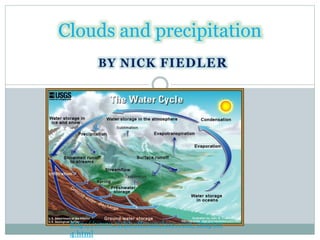
Clouds and precipitation
http://www.richhoffmanclass.com/chapter
4.html
Adiabatic Temperature Changes and Expansion
and Cooling
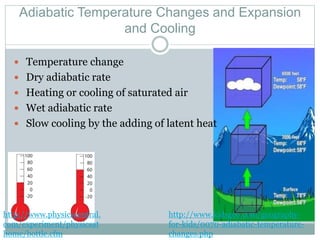
 Temperature change
 Dry adiabatic rate
 Heating or cooling of saturated air
 Wet adiabatic rate
 Slow cooling by the adding of latent heat
http://www.physicscentral.
com/experiment/physicsat
home/bottle.cfm
http://www.kidsgeo.com/geography-
for-kids/0070-adiabatic-temperature-
changes.php
Orographic Lifting
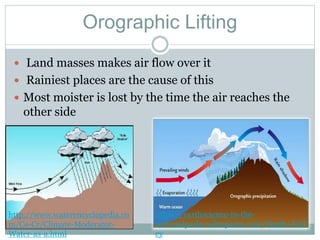
 Land masses makes air flow over it
 Rainiest places are the cause of this
 Most moister is lost by the time the air reaches the
other side
http://www.waterencyclopedia.co
m/Ce-Cr/Climate-Moderator-
Water-as-a.html
https://earthscience-in-the-
nationalparks.wikispaces.com/Death+Vall
ey
Convergence
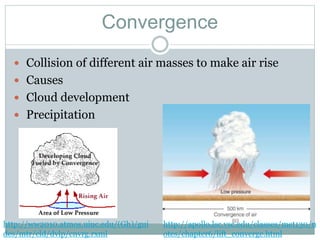
 Collision of different air masses to make air rise
 Causes
 Cloud development
 Precipitation
http://apollo.lsc.vsc.edu/classes/met130/n
otes/chapter6/lift_converge.html
http://ww2010.atmos.uiuc.edu/(Gh)/gui
des/mtr/cld/dvlp/cnvrg.rxml
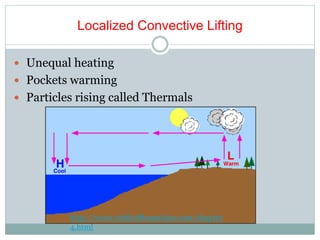
Localized Convective Lifting
 Unequal heating
 Pockets warming
 Particles rising called Thermals
http://www.richhoffmanclass.com/chapter
4.html
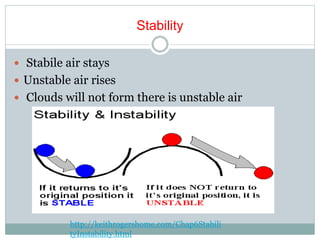
Stability
 Stabile air stays
 Unstable air rises
 Clouds will not form there is unstable air
http://keithrogershome.com/Chap6Stabili
tyInstability.html
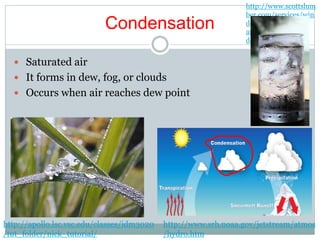
Condensation
 Saturated air
 It forms in dew, fog, or clouds
 Occurs when air reaches dew point
http://apollo.lsc.vsc.edu/classes/idm3020
/tut_folder/nick_tutorial/
http://www.scottslum
ber.com/services/win
dow-condensation-
are-my-windows-
defective/
http://www.srh.noaa.gov/jetstream/atmos
/hydro.htm
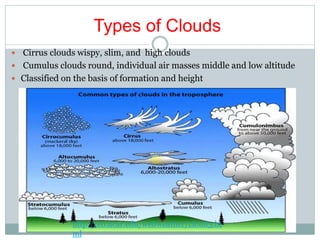
Types of Clouds
 Cirrus clouds wispy, slim, and high clouds
 Cumulus clouds round, individual air masses middle and low altitude
 Classified on the basis of formation and height
http://eo.ucar.edu/webweather/cloud3.ht
ml
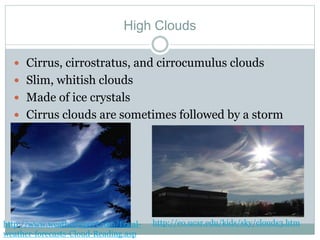
High Clouds
 Cirrus, cirrostratus, and cirrocumulus clouds
 Slim, whitish clouds
 Made of ice crystals
 Cirrus clouds are sometimes followed by a storm
http://www.weatherreport.com/Local-
weather-forecasts-Cloud-Reading.asp
http://eo.ucar.edu/kids/sky/clouds3.htm
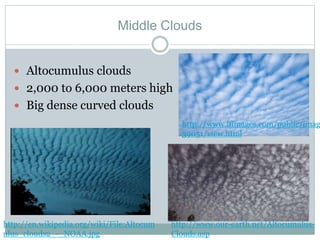
Middle Clouds
 Altocumulus clouds
 2,000 to 6,000 meters high
 Big dense curved clouds
http://en.wikipedia.org/wiki/File:Altocum
ulus_clouds2_-_NOAA.jpg
http://www.ifimages.com/public/imag
39051/view.html
http://www.our-earth.net/Altocumulus-
Clouds.asp
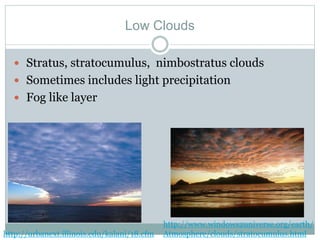
Low Clouds
 Stratus, stratocumulus, nimbostratus clouds
 Sometimes includes light precipitation
 Fog like layer
http://urbanext.illinois.edu/kalani/18.cfm
http://www.windows2universe.org/earth/
Atmosphere/clouds/stratocumulus.html
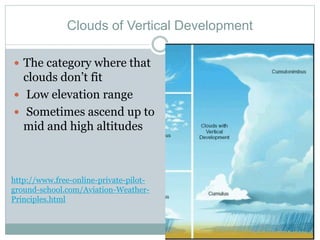
Clouds of Vertical Development
 The category where that
clouds don’t fit
 Low elevation range
 Sometimes ascend up to
mid and high altitudes
http://www.free-online-private-pilot-
ground-school.com/Aviation-Weather-
Principles.html
Fog
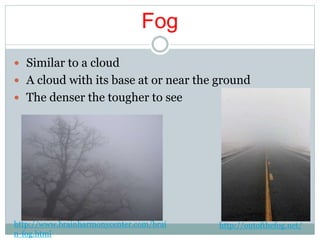
 Similar to a cloud
 A cloud with its base at or near the ground
 The denser the tougher to see
http://www.brainharmonycenter.com/brai
n-fog.html
http://outofthefog.net/
Cold Cloud Precipitation
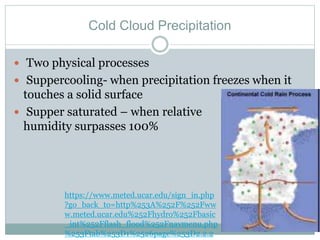
 Two physical processes
 Suppercooling- when precipitation freezes when it
touches a solid surface
 Supper saturated – when relative
humidity surpasses 100%
https://www.meted.ucar.edu/sign_in.php
?go_back_to=http%253A%252F%252Fww
w.meted.ucar.edu%252Fhydro%252Fbasic
_int%252Fflash_flood%252Fnavmenu.php
%253Ftab%253D1%2526page%253D2.2.2
Warm Cloud Precipitation
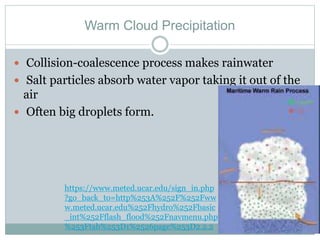
 Collision-coalescence process makes rainwater
 Salt particles absorb water vapor taking it out of the
air
 Often big droplets form.
https://www.meted.ucar.edu/sign_in.php
?go_back_to=http%253A%252F%252Fww
w.meted.ucar.edu%252Fhydro%252Fbasic
_int%252Fflash_flood%252Fnavmenu.php
%253Ftab%253D1%2526page%253D2.2.2
Rain and Snow
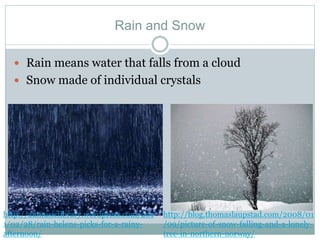
 Rain means water that falls from a cloud
 Snow made of individual crystals
http://aumusiclibrary.wordpress.com/201
1/02/28/rain-helens-picks-for-a-rainy-
afternoon/
http://blog.thomaslaupstad.com/2008/01
/09/picture-of-snow-falling-and-a-lonely-
tree-in-northern-norway/
Sleet, Glaze and Hail
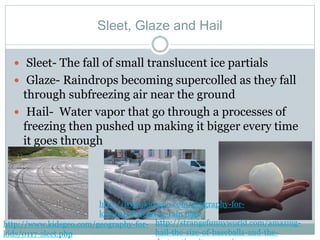
 Sleet- The fall of small translucent ice partials
 Glaze- Raindrops becoming supercolled as they fall
through subfreezing air near the ground
 Hail- Water vapor that go through a processes of
freezing then pushed up making it bigger every time
it goes through
http://www.kidsgeo.com/geography-for-
kids/0117-sleet.php
http://strangefunnyworld.com/amazing-
hail-the-size-of-baseballs-and-the-
http://www.kidsgeo.com/geography-for-
kids/0118-freezing-rain.php
Clouds and precipitation

Clouds and precipitation

  • 1.
  • 2.
    Adiabatic Temperature Changesand Expansion and Cooling  Temperature change  Dry adiabatic rate  Heating or cooling of saturated air  Wet adiabatic rate  Slow cooling by the adding of latent heat http://www.physicscentral. com/experiment/physicsat home/bottle.cfm http://www.kidsgeo.com/geography- for-kids/0070-adiabatic-temperature- changes.php
  • 3.
    Orographic Lifting  Landmasses makes air flow over it  Rainiest places are the cause of this  Most moister is lost by the time the air reaches the other side http://www.waterencyclopedia.co m/Ce-Cr/Climate-Moderator- Water-as-a.html https://earthscience-in-the- nationalparks.wikispaces.com/Death+Vall ey
  • 4.
    Convergence  Collision ofdifferent air masses to make air rise  Causes  Cloud development  Precipitation http://apollo.lsc.vsc.edu/classes/met130/n otes/chapter6/lift_converge.html http://ww2010.atmos.uiuc.edu/(Gh)/gui des/mtr/cld/dvlp/cnvrg.rxml
  • 5.
    Localized Convective Lifting Unequal heating  Pockets warming  Particles rising called Thermals http://www.richhoffmanclass.com/chapter 4.html
  • 6.
    Stability  Stabile airstays  Unstable air rises  Clouds will not form there is unstable air http://keithrogershome.com/Chap6Stabili tyInstability.html
  • 7.
    Condensation  Saturated air It forms in dew, fog, or clouds  Occurs when air reaches dew point http://apollo.lsc.vsc.edu/classes/idm3020 /tut_folder/nick_tutorial/ http://www.scottslum ber.com/services/win dow-condensation- are-my-windows- defective/ http://www.srh.noaa.gov/jetstream/atmos /hydro.htm
  • 8.
    Types of Clouds Cirrus clouds wispy, slim, and high clouds  Cumulus clouds round, individual air masses middle and low altitude  Classified on the basis of formation and height http://eo.ucar.edu/webweather/cloud3.ht ml
  • 9.
    High Clouds  Cirrus,cirrostratus, and cirrocumulus clouds  Slim, whitish clouds  Made of ice crystals  Cirrus clouds are sometimes followed by a storm http://www.weatherreport.com/Local- weather-forecasts-Cloud-Reading.asp http://eo.ucar.edu/kids/sky/clouds3.htm
  • 10.
    Middle Clouds  Altocumulusclouds  2,000 to 6,000 meters high  Big dense curved clouds http://en.wikipedia.org/wiki/File:Altocum ulus_clouds2_-_NOAA.jpg http://www.ifimages.com/public/imag 39051/view.html http://www.our-earth.net/Altocumulus- Clouds.asp
  • 11.
    Low Clouds  Stratus,stratocumulus, nimbostratus clouds  Sometimes includes light precipitation  Fog like layer http://urbanext.illinois.edu/kalani/18.cfm http://www.windows2universe.org/earth/ Atmosphere/clouds/stratocumulus.html
  • 12.
    Clouds of VerticalDevelopment  The category where that clouds don’t fit  Low elevation range  Sometimes ascend up to mid and high altitudes http://www.free-online-private-pilot- ground-school.com/Aviation-Weather- Principles.html
  • 13.
    Fog  Similar toa cloud  A cloud with its base at or near the ground  The denser the tougher to see http://www.brainharmonycenter.com/brai n-fog.html http://outofthefog.net/
  • 14.
    Cold Cloud Precipitation Two physical processes  Suppercooling- when precipitation freezes when it touches a solid surface  Supper saturated – when relative humidity surpasses 100% https://www.meted.ucar.edu/sign_in.php ?go_back_to=http%253A%252F%252Fww w.meted.ucar.edu%252Fhydro%252Fbasic _int%252Fflash_flood%252Fnavmenu.php %253Ftab%253D1%2526page%253D2.2.2
  • 15.
    Warm Cloud Precipitation Collision-coalescence process makes rainwater  Salt particles absorb water vapor taking it out of the air  Often big droplets form. https://www.meted.ucar.edu/sign_in.php ?go_back_to=http%253A%252F%252Fww w.meted.ucar.edu%252Fhydro%252Fbasic _int%252Fflash_flood%252Fnavmenu.php %253Ftab%253D1%2526page%253D2.2.2
  • 16.
    Rain and Snow Rain means water that falls from a cloud  Snow made of individual crystals http://aumusiclibrary.wordpress.com/201 1/02/28/rain-helens-picks-for-a-rainy- afternoon/ http://blog.thomaslaupstad.com/2008/01 /09/picture-of-snow-falling-and-a-lonely- tree-in-northern-norway/
  • 17.
    Sleet, Glaze andHail  Sleet- The fall of small translucent ice partials  Glaze- Raindrops becoming supercolled as they fall through subfreezing air near the ground  Hail- Water vapor that go through a processes of freezing then pushed up making it bigger every time it goes through http://www.kidsgeo.com/geography-for- kids/0117-sleet.php http://strangefunnyworld.com/amazing- hail-the-size-of-baseballs-and-the- http://www.kidsgeo.com/geography-for- kids/0118-freezing-rain.php