Seema Bansal
HISTORY
 50000 BC: used poisonous plants for hunting
 1500 BC: written evidence indicated opium, curare
and metals were used for hunting
 Mathieu Orifila: father of forensic toxicology,
published Traite des Poisons, in 1814.
 Jean Servais Stat: isolated nicotine from dead man’s
tissue
 James M. Marsh: test for presence of arsenic in tissues
in 1836
 Medical examiner’s office and toxicology laboratory
established in New York in 1918
TOXICOLOGY
 Science of poisons
 Toxicology is the study of the toxic or harmful effects
of chemicals on humans
 Involves the identification of the substances involved.
 Paracelsus is the Father of Toxicology. According to
him “All things are poison, nothing is without poison,
what matters is the dose”
Poison: Any substance which when administered in
living body through any route (Inhalation, Ingestion,
surface absorption, etc) will produce ill-health or
death by its action which is due to its physical,
chemical or physiological properties. Eg: sulphuric
acid, arsenic etc.
Drug (WHO 1996): Any substance or product that
is used or intended to be used to modify or explore
physiological systems or pathological states for the
benefit of the recipient.
Eg: parecetamol, salbutamol, insulin
FORENSIC SCIENCE
 Forensic: synonym for “legal”
or “related to courts”
 Answer questions of interest to
a legal system
 It is concerned with the
recognition, identification,
individualization, and
evaluation of physical
evidence.
Toxicology is defined as the study of the adverse
effects of chemicals on living organisms.
Forensic toxicology is defined as the application of
toxicology for the purposes of the law.
Postmortem forensic toxicology.
Human performance toxicology.
Forensic drug testing.
FORENSIC TOXICOLOGY
FORENSIC TOXICOLOGY
 Hybrid of analytical chemistry and fundamental
toxicological principles concerned with the
medicolegal aspects of the harmful effects of
chemicals on living system.
 Toxicological principles are:
 Study of alcohol, drugs and poisons, including their
chemical composition, preparations and
identification.
 Knowledge about the ADME of above substances
and the factors which determine drug safety and
effectiveness.
FORENSIC TOXICOLOGIST
 Members of medico legal team
 Specialized scientists
RESPONSIBILITIES:
 Collection of evidence
 Preservation of samples
 Investigation
 Oral / written reports
DEATH SCENE IN LAB
Medico legal investigation team
 The homicide investigator
 The medical examiner
 The forensic pathologist
 The forensic toxicologist
 Proper labeling
 Storage (for collection/ preservation)
COLLETION AND
PRESERVATION OF SPECIMENS
 Obtain
 Appropriate container
 Sealing
 Dated & signed
 Taken to laboratory
 Receiving by toxicologist(signed, date and time
recorded)
 Chain of possession must be intact, guaranteeing
complete chronological accountability
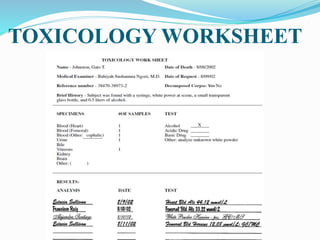
TOXICOLOGY WORKSHEET
TISSUES REQUIRED FOR
ANALYSIS
 BLOOD: 100 ml sample sufficient
Care taken to ensure freedom from
contamination
Heart blood preferred, peripheral blood accepted
 BRAIN: 50 g
Demonstration of alcohol and volatile poisons
KIDNEY: equivalent of one kidney
 Choice for most metals and sulphonamides
•LIVER: 100g sample
Site of biotransformation-higher levels found.
•LUNG: 100g
Useful in fatalities due to substance inhalation.
•BONE: 100g
Pesticide or metal suspected.
•HAIR AND NAILS:
chronic metal poisoning suspected.
•URINE:
 available urine collected, if empty, entire
bladder submitted.
Microsugar and acetone determination.
•BILE: removed intact
Important route of elimination for many
drugs(morphine, methadone)
•STOMACH CONTENTS:
tablets and capsules in overdose case
Volume of contents recorded
LABORATORY ANALYSIS
 Colorimetric screening tests
 Thermal desorption
 Thin layer chromatography
 Gas chromatography
 High performance liquid chromatography
 Enzyme immunoassay
 Atomic absorption spectroscopy
DRUG ANALYSIS
APPLICATIONS
Identify potential suspects by DNA matching.
Identify crime & catastrophe victims.
Establish Paternity & family relationship.
Identify endangered & protected species.
Detect bacteria & other organism that can pollute
environment.
In transplant programs.
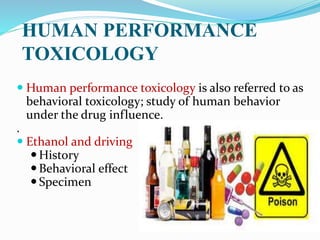
 Human performance toxicology is also referred to as
behavioral toxicology; study of human behavior
under the drug influence.
.
 Ethanol and driving
History
Behavioral effect
Specimen
HUMAN PERFORMANCE
TOXICOLOGY
ETHANOL TOXICOLOGY
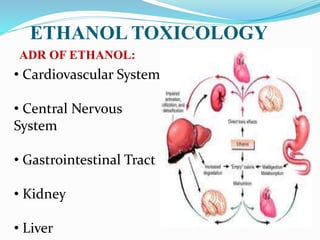
• Cardiovascular System
• Central Nervous
System
• Gastrointestinal Tract
• Kidney
• Liver
ADR OF ETHANOL:
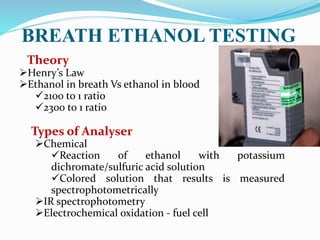
Henry’s Law
Ethanol in breath Vs ethanol in blood
2100 to 1 ratio
2300 to 1 ratio
Types of Analyser
Chemical
Reaction of ethanol with potassium
dichromate/sulfuric acid solution
Colored solution that results is measured
spectrophotometrically
IR spectrophotometry
Electrochemical oxidation - fuel cell
BREATH ETHANOL TESTING
Theory
BLOOD ETHANOL TESTING
Chemical
 Screening
 Quantitative
 Disadvantage -
aldehydes and
ketones will interfere
with the test
 Enzymatic
• Conversion of NAD to
NADH by ethanol (serum,
urine and whole blood)
 Measured
spectrophotometrically
at 340 nm
• Same reaction with a blue
dye (thiazoyl blue) (serum,
urine, fresh blood and
postmortem blood)
 Measured with a
fluorometer
Gas Chromatography
•Can measure ethanol in a wide
range of specimens
•Can distinguish ethanol from
other alcohols, aldehydes and
ketones
•Two common methods
•Head space
•Direct injection
ACETALDEHYDE
(1.414
min.)
EHTANOL
(1.787
min.)
2-PROPANOL
(2.804
min.)
MEK(ISTD)
(5.584
min.)
ACETONE
(2.462
min.)
0 6
BLOOD ETHANOL TESTING
 Blood alcohol concentration:
 10-50 mg/dl: Impairment detectable by special tests
 30-120 mg/dl: Beginning of sensory-motor
impairment
 90-250 mg/dl: Sensory-motor in coordination ;
impaired balance
 180-400 mg/dl: Increased muscular in coordination;
apathy; lethargy
 250-400 mg/dl: Impaired consciousness; sleep; stupor
 350-500 mg/dl: Complete unconsciousness; coma
 450 and greater mg/dl: Death from respiratory arrest
ETHANOL IMPAIRMENT
ASSESSMENT
Drug Recognition Evaluation - 12 Steps
Breath alcohol test
Interview of the arresting officer.
Preliminary examination of the suspect.
Examination of the eyes.
Divided attention psychophysical tests.
Vital signs examination.
Dark room examination.
Examination of muscle tone.
Examination for injection sites.
Suspect’s statements and other observations.
Opinion of the evaluator.
Toxicological examination.
FORENSIC DRUG TESTING
REFERENCES
 Wennig R. Forensic Toxicology. Encyclopedia of Life
Sciences
 Hodgson E. A Textbook of Modern Toxicology.2004(3):
403-406
 Katzung BG, Masters SB, Trevor AJ. Basic and Clinical
Pharmacology. (2012)12: 69-77
 Journal of forensic toxicology and pharmacology; 2013

FORENSIC TOX.pptx

  • 1.
  • 2.
    HISTORY  50000 BC:used poisonous plants for hunting  1500 BC: written evidence indicated opium, curare and metals were used for hunting  Mathieu Orifila: father of forensic toxicology, published Traite des Poisons, in 1814.  Jean Servais Stat: isolated nicotine from dead man’s tissue  James M. Marsh: test for presence of arsenic in tissues in 1836  Medical examiner’s office and toxicology laboratory established in New York in 1918
  • 3.
    TOXICOLOGY  Science ofpoisons  Toxicology is the study of the toxic or harmful effects of chemicals on humans  Involves the identification of the substances involved.  Paracelsus is the Father of Toxicology. According to him “All things are poison, nothing is without poison, what matters is the dose”
  • 4.
    Poison: Any substancewhich when administered in living body through any route (Inhalation, Ingestion, surface absorption, etc) will produce ill-health or death by its action which is due to its physical, chemical or physiological properties. Eg: sulphuric acid, arsenic etc. Drug (WHO 1996): Any substance or product that is used or intended to be used to modify or explore physiological systems or pathological states for the benefit of the recipient. Eg: parecetamol, salbutamol, insulin
  • 5.
    FORENSIC SCIENCE  Forensic:synonym for “legal” or “related to courts”  Answer questions of interest to a legal system  It is concerned with the recognition, identification, individualization, and evaluation of physical evidence.
  • 6.
    Toxicology is definedas the study of the adverse effects of chemicals on living organisms. Forensic toxicology is defined as the application of toxicology for the purposes of the law. Postmortem forensic toxicology. Human performance toxicology. Forensic drug testing. FORENSIC TOXICOLOGY
  • 7.
    FORENSIC TOXICOLOGY  Hybridof analytical chemistry and fundamental toxicological principles concerned with the medicolegal aspects of the harmful effects of chemicals on living system.  Toxicological principles are:  Study of alcohol, drugs and poisons, including their chemical composition, preparations and identification.  Knowledge about the ADME of above substances and the factors which determine drug safety and effectiveness.
  • 8.
    FORENSIC TOXICOLOGIST  Membersof medico legal team  Specialized scientists RESPONSIBILITIES:  Collection of evidence  Preservation of samples  Investigation  Oral / written reports
  • 9.
    DEATH SCENE INLAB Medico legal investigation team  The homicide investigator  The medical examiner  The forensic pathologist  The forensic toxicologist  Proper labeling  Storage (for collection/ preservation)
  • 10.
    COLLETION AND PRESERVATION OFSPECIMENS  Obtain  Appropriate container  Sealing  Dated & signed  Taken to laboratory  Receiving by toxicologist(signed, date and time recorded)  Chain of possession must be intact, guaranteeing complete chronological accountability
  • 11.
  • 12.
    TISSUES REQUIRED FOR ANALYSIS BLOOD: 100 ml sample sufficient Care taken to ensure freedom from contamination Heart blood preferred, peripheral blood accepted  BRAIN: 50 g Demonstration of alcohol and volatile poisons KIDNEY: equivalent of one kidney  Choice for most metals and sulphonamides
  • 13.
    •LIVER: 100g sample Siteof biotransformation-higher levels found. •LUNG: 100g Useful in fatalities due to substance inhalation. •BONE: 100g Pesticide or metal suspected. •HAIR AND NAILS: chronic metal poisoning suspected. •URINE:  available urine collected, if empty, entire bladder submitted. Microsugar and acetone determination.
  • 14.
    •BILE: removed intact Importantroute of elimination for many drugs(morphine, methadone) •STOMACH CONTENTS: tablets and capsules in overdose case Volume of contents recorded
  • 15.
    LABORATORY ANALYSIS  Colorimetricscreening tests  Thermal desorption  Thin layer chromatography  Gas chromatography  High performance liquid chromatography  Enzyme immunoassay  Atomic absorption spectroscopy
  • 16.
  • 17.
    APPLICATIONS Identify potential suspectsby DNA matching. Identify crime & catastrophe victims. Establish Paternity & family relationship. Identify endangered & protected species. Detect bacteria & other organism that can pollute environment. In transplant programs.
  • 18.
     Human performancetoxicology is also referred to as behavioral toxicology; study of human behavior under the drug influence. .  Ethanol and driving History Behavioral effect Specimen HUMAN PERFORMANCE TOXICOLOGY
  • 19.
    ETHANOL TOXICOLOGY • CardiovascularSystem • Central Nervous System • Gastrointestinal Tract • Kidney • Liver ADR OF ETHANOL:
  • 20.
    Henry’s Law Ethanol inbreath Vs ethanol in blood 2100 to 1 ratio 2300 to 1 ratio Types of Analyser Chemical Reaction of ethanol with potassium dichromate/sulfuric acid solution Colored solution that results is measured spectrophotometrically IR spectrophotometry Electrochemical oxidation - fuel cell BREATH ETHANOL TESTING Theory
  • 21.
    BLOOD ETHANOL TESTING Chemical Screening  Quantitative  Disadvantage - aldehydes and ketones will interfere with the test  Enzymatic • Conversion of NAD to NADH by ethanol (serum, urine and whole blood)  Measured spectrophotometrically at 340 nm • Same reaction with a blue dye (thiazoyl blue) (serum, urine, fresh blood and postmortem blood)  Measured with a fluorometer
  • 22.
    Gas Chromatography •Can measureethanol in a wide range of specimens •Can distinguish ethanol from other alcohols, aldehydes and ketones •Two common methods •Head space •Direct injection ACETALDEHYDE (1.414 min.) EHTANOL (1.787 min.) 2-PROPANOL (2.804 min.) MEK(ISTD) (5.584 min.) ACETONE (2.462 min.) 0 6 BLOOD ETHANOL TESTING
  • 23.
     Blood alcoholconcentration:  10-50 mg/dl: Impairment detectable by special tests  30-120 mg/dl: Beginning of sensory-motor impairment  90-250 mg/dl: Sensory-motor in coordination ; impaired balance  180-400 mg/dl: Increased muscular in coordination; apathy; lethargy  250-400 mg/dl: Impaired consciousness; sleep; stupor  350-500 mg/dl: Complete unconsciousness; coma  450 and greater mg/dl: Death from respiratory arrest ETHANOL IMPAIRMENT ASSESSMENT
  • 24.
    Drug Recognition Evaluation- 12 Steps Breath alcohol test Interview of the arresting officer. Preliminary examination of the suspect. Examination of the eyes. Divided attention psychophysical tests. Vital signs examination. Dark room examination. Examination of muscle tone. Examination for injection sites. Suspect’s statements and other observations. Opinion of the evaluator. Toxicological examination. FORENSIC DRUG TESTING
  • 25.
    REFERENCES  Wennig R.Forensic Toxicology. Encyclopedia of Life Sciences  Hodgson E. A Textbook of Modern Toxicology.2004(3): 403-406  Katzung BG, Masters SB, Trevor AJ. Basic and Clinical Pharmacology. (2012)12: 69-77  Journal of forensic toxicology and pharmacology; 2013

Editor's Notes

  • #4 It is concerned with how toxins act, when their harmful effects occur, and what the symptoms and treatments are for poisoning
  • #5 Environmental toxicology is concerned primarily with the harmful effects of chemicals that are encountered incidentally because they are in the atmosphere, in the food chain, or present in occupational or recreational environments.
  • #6 The word forensic comes from the Latin forēnsis, meaning "of or before the forum.“ [forensic" is effectively a synonym for "legal" or "related to courts".
  • #17 A given laboratory will follow an algorithm to handle the analysis. The Volatile Screen (VS) is frequently used for the detection of ethanol. A Drugs of Abuse Screen (DAS) is commonly used for amphetamines, cocaine, marijuana, and so on. When the cause of death is unclear, a General Drug Screen (GDS) is employed. Acidic/Neutral Screen (ANS) is primarily used to detect barbiturates, muscle relaxants, and so on. Basic Drug Screens (BDS) are more specific for the detection of drugs such as cocaine and antidepressants.