Chapter 11 Forensic Toxicology
Introduction Toxicologists -detecting and identifying: -drugs/poisons -body fluids -tissues -organs Major branch of forensic toxicology: -measurement of alcohol in the body
Toxicology of Alcohol Alcohol/ethyl alcohol (ETOH) -colorless liquid consumed as a beverage. -Depressant: effects the CNS/particularly the brain.
Alcohol Levels Blood:  -within minutes  -slowly increases in concentration -maximum alcohol level is reached in the blood -post-absorption period begins.  -alcohol concentration slowly decreases
Alcohol Levels -Factors: *consumption time *the alcohol content *amount consumed *food present in the stomach determine the rate at which alcohol is absorbed.
Alcohol Levels Elimination: -oxidation-liver -excretion-breath, urine, sweat  Extent of influence: Measuring -blood system -breath. Experimental evidence: -amount exhaled=blood conetration
Alcohol & Circulatory System Closed circulatory system: -heart/arteries/veins/capillaries. Stomach-small intestines-blood stream-liver Blood (w/ETOH)-heart-lungs. -carbon dioxide/alcohol leave the blood  -oxygen enters alveoli (air sacs). -carbon dioxide/alcohol exhaled.
Breath Testers Many types of breath testers  -infrared light absorption  -exposed to infrared light.  -degree of the interaction of the light/alcohol -gaining favor with police
Field Testing Field Sobriety tests: (FSTs) -walk and turn -one-leg stand  -alphabet  -horizontal gaze nystagmus (HGN) -handheld breathalyzers  -establish probable cause of impairment
Gas Chromatography Testing Gas chromatography: -most widely used approach -medically accepted conditions -qualified individual.  -nonalcoholic disinfectant -proper storage: -airtight container -anticoagulant/preservative  -refrigerate
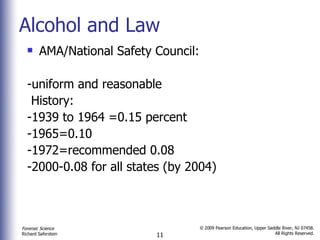
Alcohol and Law AMA/National Safety Council: -uniform and reasonable  History: -1939 to 1964 =0.15 percent  -1965=0.10 -1972=recommended 0.08 -2000-0.08 for all states (by 2004)
Alcohol and Law Implied Consent Law: -1973/ all states -DL stipulations -refusal to submit=loss of license -vary by state -Forced blood draw?
Role of the Toxicologist Drugs/poisons -body fluids -organs Supportive evidence  -symptoms -postmortem exam -scene evidence No one test for all  -general screening procedures -hope/1000’s to 1
Role of the Toxicologist Problem: -concentration levels -body=active chemistry laboratory -assess the toxicity
The Analytical Scheme Scheme: -detect  -isolate -specifically identify  Drug extraction: acidic or basic.  Screening/confirmation.
The Screening Step Screening test:  -quick insight -presence of a drug substance  -+ results (tentative) -confirmation test -thin-layer chromatography -gas chromatography -immunoassay.
The Confirmation Step Gas chromatography/mass spectrometry: -test of choice. -GC: separates the sample into its components -MS: unique “fingerprint” pattern -extracted/identified -opinion to effect on person’s physical state.
Detecting Drugs in Hair Drugs: -diffuse through the capillary walls -base of the hair -permanently in hair’s protein  -hair grows -historical marker -1cm/month=timeline  -problem:  -environmental exposure -sweat
Nondrug Poisons Heavy metals: Rarely encountered - arsenic -bismuth -antimony -mercury Carbon monoxide: -most common -spectrophotometric -measure carboxyhemoglobin to total hemoglobin -gas chromatography.
Significance of Findings Found and identified: -assesses influence -blood concentration levels  -observations by PO -motor skills/behavior
The Drug Recognition Expert (DRE) Program Drug Recognition Experts (DRE) -LAPD (1970’s) -clinical/psychological  -ID/Differentiate  -3-5 month training  -standardized methods (court)
The DRE Drug Influence Evaluation form cannot specify drug DRE data/forensic toxicologist Drug intoxication

Fs Ch 11

  • 1.
  • 2.
    Introduction Toxicologists -detectingand identifying: -drugs/poisons -body fluids -tissues -organs Major branch of forensic toxicology: -measurement of alcohol in the body
  • 3.
    Toxicology of AlcoholAlcohol/ethyl alcohol (ETOH) -colorless liquid consumed as a beverage. -Depressant: effects the CNS/particularly the brain.
  • 4.
    Alcohol Levels Blood: -within minutes -slowly increases in concentration -maximum alcohol level is reached in the blood -post-absorption period begins. -alcohol concentration slowly decreases
  • 5.
    Alcohol Levels -Factors:*consumption time *the alcohol content *amount consumed *food present in the stomach determine the rate at which alcohol is absorbed.
  • 6.
    Alcohol Levels Elimination:-oxidation-liver -excretion-breath, urine, sweat Extent of influence: Measuring -blood system -breath. Experimental evidence: -amount exhaled=blood conetration
  • 7.
    Alcohol & CirculatorySystem Closed circulatory system: -heart/arteries/veins/capillaries. Stomach-small intestines-blood stream-liver Blood (w/ETOH)-heart-lungs. -carbon dioxide/alcohol leave the blood -oxygen enters alveoli (air sacs). -carbon dioxide/alcohol exhaled.
  • 8.
    Breath Testers Manytypes of breath testers -infrared light absorption -exposed to infrared light. -degree of the interaction of the light/alcohol -gaining favor with police
  • 9.
    Field Testing FieldSobriety tests: (FSTs) -walk and turn -one-leg stand -alphabet -horizontal gaze nystagmus (HGN) -handheld breathalyzers -establish probable cause of impairment
  • 10.
    Gas Chromatography TestingGas chromatography: -most widely used approach -medically accepted conditions -qualified individual. -nonalcoholic disinfectant -proper storage: -airtight container -anticoagulant/preservative -refrigerate
  • 11.
    Alcohol and LawAMA/National Safety Council: -uniform and reasonable History: -1939 to 1964 =0.15 percent -1965=0.10 -1972=recommended 0.08 -2000-0.08 for all states (by 2004)
  • 12.
    Alcohol and LawImplied Consent Law: -1973/ all states -DL stipulations -refusal to submit=loss of license -vary by state -Forced blood draw?
  • 13.
    Role of theToxicologist Drugs/poisons -body fluids -organs Supportive evidence -symptoms -postmortem exam -scene evidence No one test for all -general screening procedures -hope/1000’s to 1
  • 14.
    Role of theToxicologist Problem: -concentration levels -body=active chemistry laboratory -assess the toxicity
  • 15.
    The Analytical SchemeScheme: -detect -isolate -specifically identify Drug extraction: acidic or basic. Screening/confirmation.
  • 16.
    The Screening StepScreening test: -quick insight -presence of a drug substance -+ results (tentative) -confirmation test -thin-layer chromatography -gas chromatography -immunoassay.
  • 17.
    The Confirmation StepGas chromatography/mass spectrometry: -test of choice. -GC: separates the sample into its components -MS: unique “fingerprint” pattern -extracted/identified -opinion to effect on person’s physical state.
  • 18.
    Detecting Drugs inHair Drugs: -diffuse through the capillary walls -base of the hair -permanently in hair’s protein -hair grows -historical marker -1cm/month=timeline -problem: -environmental exposure -sweat
  • 19.
    Nondrug Poisons Heavymetals: Rarely encountered - arsenic -bismuth -antimony -mercury Carbon monoxide: -most common -spectrophotometric -measure carboxyhemoglobin to total hemoglobin -gas chromatography.
  • 20.
    Significance of FindingsFound and identified: -assesses influence -blood concentration levels -observations by PO -motor skills/behavior
  • 21.
    The Drug RecognitionExpert (DRE) Program Drug Recognition Experts (DRE) -LAPD (1970’s) -clinical/psychological -ID/Differentiate -3-5 month training -standardized methods (court)
  • 22.
    The DRE DrugInfluence Evaluation form cannot specify drug DRE data/forensic toxicologist Drug intoxication

Editor's Notes

  • #3 Toxicologists are charged with the responsibility for detecting and identifying the presence of drugs and poisons in body fluids, tissues, and organs. Toxicologists not only work in crime laboratories and medical examiners’ offices, but may also reach into hospital laboratories and health facilities to identify a drug overdose or monitor the intake of drugs. A major branch of forensic toxicology deals with the measurement of alcohol in the body for matters that pertain to violations of criminal law.
  • #4 The analysis of alcohol exemplifies the primary objective of forensic toxicology—the detection and isolation of drugs in the body for the purpose of determining their influence on human behavior. Alcohol, or ethyl alcohol, is a colorless liquid normally diluted with water and consumed as a beverage. Like any depressant, alcohol principally effects the central nervous system, particularly the brain.
  • #5 Alcohol appears in the blood within minutes after it has been taken by mouth and slowly increases in concentration while it is being absorbed from the stomach and the small intestine into the bloodstream. When all the alcohol has been absorbed, a maximum alcohol level is reached in the blood; and the post-absorption period begins. Then the alcohol concentration slowly decreases until a zero level is again reached. Factors such as time taken to consume the drink, the alcohol content, the amount consumed, and food present in the stomach determine the rate at which alcohol is absorbed.
  • #6 Factors: *consumption time *the alcohol content *amount consumed *food present in the stomach determine the rate at which alcohol is absorbed.
  • #7 Elimination of alcohol throughout the body is accomplished through oxidation and excretion. Oxidation takes place almost entirely in the liver, while alcohol is excreted unchanged in the breath, urine, and perspiration. The extent to which an individual may be under the influence of alcohol is usually determined by either measuring the quantity of alcohol present in the blood system or by measuring the alcohol content in the breath. Experimental evidence has verified that the amount of alcohol exhaled in the breath is in direct proportion to the blood concentration.
  • #8 Humans have a closed circulatory system consisting of a heart, arteries, veins, and capillaries. Alcohol is absorbed from the stomach and small intestines into the blood stream. Alcohol is carried to the liver where the process of its destruction starts. Blood, carrying alcohol, moves to the heart and is pumped to the lungs. In the lungs, carbon dioxide and alcohol leave the blood and oxygen enters the blood in the air sacs known as alveoli. Then the carbon dioxide and alcohol are exhaled during breathing.
  • #9 Breath testers operate on the fact that at 34  C , the ratio of alcohol in the blood to alcohol in alveolar breath is approximately 2,100 to 1. Breath testers that operate on the principle of infrared light absorption are becoming increasingly popular within the law enforcement community. Many types of breath testers are designed to analyze a set volume of breath. The captured breath is exposed to infrared light. It’s the degree of the interaction of the light with alcohol in the captured breath sample that allows the instrument to measure a blood alcohol concentration in breath. Some breath testing devices also use fuel cells.
  • #10 Law enforcement officers typically use field sobriety tests to estimate a motorist’s degree of physical impairment by alcohol and whether or not an evidential test for alcohol is justified. The horizontal gaze nystagmus test, walk and turn, and the one-leg stand are all considered reliable and effective psychophysical tests. A portable, handheld, roadside breath tester may be used to determine a preliminary breath-alcohol content.
  • #11 Gas chromatography offers the toxicologist the most widely used approach for determining alcohol levels in blood. Blood must always be drawn under medically accepted conditions by a qualified individual. It is important that a nonalcoholic disinfectant be applied before the suspect’s skin is penetrated with a sterile needle or lancet. Once blood is removed from an individual, its preservation is best ensured when it is sealed in an airtight container after an anticoagulant and a preservative have been added and stored in a refrigerator.
  • #12 The American Medical Association and the National Safety Council have been able to exert considerable influence in convincing the states to establish uniform and reasonable blood-alcohol standards. Between 1939 and 1964 a person having a blood-alcohol level in excess of 0.15 percent w/v was to be considered under the influence, which was lowered to 0.10 percent by 1965. In 1972 the impairment level was recommended to be lowered again to 0.08 percent w/v. 2000: Congress passed a law mantaing all states to adopt 0.08 by 2004 or lose federal highway funds.
  • #13 Starting in 2003, states adopted the 0.08 percent per se level. To prevent a person’s refusal to take a test for alcohol consumption, the National Highway Traffic Safety Administration recommended an “implied consent” law. Adopted by all states by 1973, this law states that the operation of a motor vehicle on a public highway automatically carries with it the stipulation that a driver will submit for a test for alcohol intoxication if requested or be subject to loss of the license.
  • #14 Beyond the analysis of alcohol, the toxicologist is confronted with a maze of drugs and poisons. The toxicologist is originally presented with body fluids and/or organs and is normally requested to examine them for the presence of drugs and poisons. Without supportive evidence, such as the victim’s symptoms, a postmortem pathological examination, or an examination of the victim’s personal effects, the toxicologist is forced to use general screening procedures with the hope of narrowing thousands of possibilities to one.
  • #15 In addition, the toxicologist is not dealing with drugs at the concentration levels found in powders and pills, having been dissipated and distributed throughout the body. Furthermore, the body is an active chemistry laboratory as few substances enter and completely leave the body in the same chemical state. Last, when and if the toxicologist has surmounted all of these obstacles, he or she must be prepared to assess the toxicity of the drug or poison.
  • #16 The forensic toxicologist must devise an analytical scheme that will successfully detect, isolate, and specifically identify toxic drug substances. Once the drug has been extracted from appropriate biological fluids, tissues, and organs, the forensic toxicologist can proceed to identify the drug substance present. Drug extraction is generally based on a large number of drugs being either acidic or basic. The strategy used for identifying abused drugs entails a two-step approach: screening and confirmation.
  • #17 A screening test is normally employed to provide the analyst with quick insight into the likelihood that a specimen contains a drug substance. Positive results arising from a screening test are considered to be tentative at best and must be verified with a confirmation test. The most widely used screening tests are thin-layer chromatography, gas chromatography, and immunoassay.
  • #18 Gas chromatography/mass spectrometry is generally accepted as the confirmation test of choice. The GC separates the sample into its components, while the MS represents a unique “fingerprint” pattern that can be used for identification. Once the drug is extracted and identified, the toxicologist may be required to provide an opinion on the drug’s effect on an individual’s natural performance or physical state.
  • #19 Drugs present in blood diffuse through the capillary walls into the base of the hair and become permanently entrapped in the hair’s hardening protein structure. As the hair continues to grow, the drug’s location on the hair shaft becomes a historical marker for delineating drug intake. Given that the average human head hair grows at the rate of 1 centimeter per month, analyzing segments of hair for drug content may define the timeline for drug use. The chronology of drug intake may be distorted by drugs penetrating the hair’s surface as a result of environmental exposure, or drugs may enter the hair’s surface through sweat.
  • #20 Heavy metals such as arsenic, bismuth, antimony, mercury, and thallium are only occasionally encountered because severe environmental protection regulations restrict their availability to the general public. Carbon monoxide is one of the most common poisons encountered in a forensic laboratory. To measure the concentration of carbon monoxide in the blood spectrophotometric methods determine the amount of carboxyhemoglobin relative to oxyhemoglobin or total hemoglobin; or a volume of blood can be treated with a reagent to liberate the carbon monoxide, which is then measured by gas chromatography.
  • #21 Once a drug is found and identified, the toxicologist assesses its influence on the behavior of the individual. For many drugs, blood concentration levels are readily determined and can be used to estimate the pharmacological effects of the drug on the individual. Often, when dealing with a living person, the toxicologist has the added benefit of knowing what a police officer may have observed about an individual’s behavior and motor skills.
  • #22 During the 1970s, the Los Angeles Police Department developed clinical and psychophysical examinations that a trained police officer could use to identify and differentiate between types of drug impairment. This program has evolved into a national program to train police as drug recognition experts. Normally, a three- to five-month training program is required to certify an officer as a drug recognition expert (DRE). The DRE program incorporates standardized methods for examining suspects to determine whether they have taken one or more drugs.
  • #23 To ensure that each subject has been tested in a routine fashion, each DRE must complete a standard Drug Influence Evaluation form. The DRE program usually cannot determine which specific drug was ingested. Hence, it is the production of reliable data from both the DRE and the forensic toxicologist that is required to prove drug intoxication.