Bule Hora University
College of Health and Medical Sciences
Department Of Pharmacy
TOXICOLOGY
For 4th year Medical Laboratoy
Students
4/5/2022
Mutagens, Carcinogens and Teratogens 1
By:Aliyi G.(B.Pharm)
. Introduction to mutagenesis
. mutagens
3. Mutagenesis
2
4/5/2022
Mutagens, Carcinogens and Teratogens
Introduction to mutagenesis
3
Mutagenesis :-
 Genesis means to synthesize something.
 is a process by which the genetic information of
an organism is changed,
 resulting in a mutation.
 It may occur
 spontaneously in nature, or
 as a result of exposure to mutagens.
 It can also be achieved experimentally using
laboratory procedures.
4/5/2022
Mutagens, Carcinogens and Teratogens
Introduction to mutagenesis cont’d,…
4
Mutagenesis as a laboratory technique
 Mutagenesis in the laboratory is an important
technique where by DNA mutations are
deliberately
engineered to produce
 mutant genes,
 proteins or
 strains of organisms.
4/5/2022
Mutagens, Carcinogens and Teratogens
Introduction to mutagenesis
cont’d,…
5
 Types of Mutagenesis
I. Random mutagenesis
II. Site-directed mutagenesis
4/5/2022
Mutagens, Carcinogens and Teratogens
Introduction to mutagenesis
cont’d,…
6
I. Random mutagenesis
 When an organism is exposed to a physical or
chemical mutagen,
 mutations are induced randomly in all genes of the
organism.
 Hence, this process of generating mutations is
known as random mutagenesis.
 The desired mutant is selected from the
mutagenised
population.
4/5/2022
Mutagens, Carcinogens and Teratogens
Introduction to mutagenesis
cont’d,…
7
II. Site-directed mutagenesis
 Site-directed mutagenesis, also called site-
specific
mutagenesis or oligonucleotide-directed
mutagenesis,
 is a molecular biology technique
 in which a mutation is created at a defined site in a
DNA molecule.
 Oligonucleotide-directed mutagenesis
 is used to test the role of particular residues in the
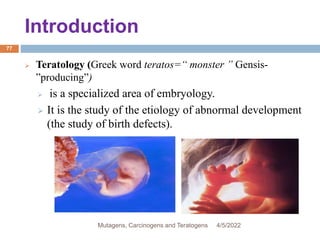
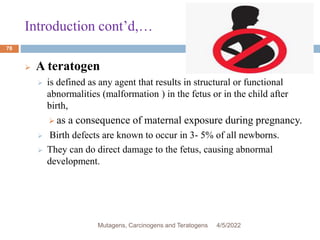
structure, catalytic activity, and ligand-binding
capacity of a protein. 4/5/2022
Mutagens, Carcinogens and Teratogens
Mutagen:
8
Definition
 “Mutagen is a physical, chemical or biological agent that
causes mutation by
 altering the genetic material which possibly results in the disease
condition.”
 Mutagens are the agents that damage genetic material, usually
DNA and
 results in genetic abnormalities.
Or
 Anything that causes mutations is known as mutagens.
4/5/2022
Mutagens, Carcinogens and Teratogens
Definition Cont’d,…
9
 In genetics, mutagen induced changes are
known as mutation.
 However, not all mutations emerge due to
mutagens, some mutations arise spontaneously
by
 error in replication, hydrolysis or recombination
errors.
4/5/2022
Mutagens, Carcinogens and Teratogens
Definition Cont’d,…
10
 The mutations are categorized under two broader categories;
 gene mutations and
 chromosomal mutations.
 Insertion, deletion, duplication, translocation, inversion are
some of the common types of gene mutations that occur
spontaneously in nature while
 trisomy, monosomy and numerical chromosomal
abnormalities are some of the chromosomal mutations.
4/5/2022
Mutagens, Carcinogens and Teratogens
Types of mutagens
11
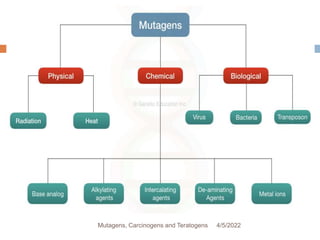
 Physical
 Radiation
 Heat
 Chemical
 Base analogs
 Alkylating agents
 intercalating agents
 Metal ions
 biological
 Viruses
 bacteria
 transposons
4/5/2022
Mutagens, Carcinogens and Teratogens
12
4/5/2022
Mutagens, Carcinogens and Teratogens
Physical agents
13
Radiation:
 Radiations are the first mutagenic agent reported in
1920.
 UV rays, X-rays, alpha rays, neutrons, and other ionizing
and non-ionizing radiations are mutagenic.
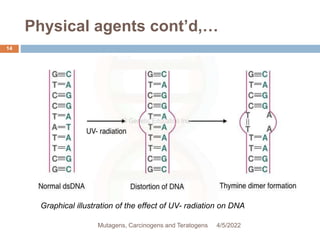
 Usually, radiation directly damages the DNA or
nucleotide structure.
 The radiation causes
 cross-linking of DNA or protein,
 chromosomal break,
 strand break or chromosomes loss,
 also, at the molecular level it prompts deletion of
bases or DNA strand breakages.
4/5/2022
Mutagens, Carcinogens and Teratogens
Physical agents cont’d,…
14
Graphical illustration of the effect of UV- radiation on DNA
4/5/2022
Mutagens, Carcinogens and Teratogens
Physical agents cont’d,…
15
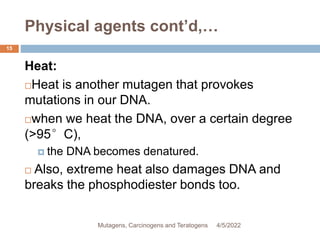
Heat:
Heat is another mutagen that provokes
mutations in our DNA.
when we heat the DNA, over a certain degree
(>95°C),
 the DNA becomes denatured.
 Also, extreme heat also damages DNA and
breaks the phosphodiester bonds too.
4/5/2022
Mutagens, Carcinogens and Teratogens
Chemical mutagens
16
 Chemicals are actually dangerous for the
entire world.
 The first mutagenic effect of the nitrogen
mustard was reported by charlotte Auerbach in
1942.
 the nitrogen mustard is a poisonous gas used
during the world war 1 and 2.
4/5/2022
Mutagens, Carcinogens and Teratogens
Chemical mutagens cont’d,…
17
Base analogs:
 The base analogs are chemicals similar to the
 bases of DNA- purine and pyrimidines or
 structurally resemble the DNA bases.
 Bromouracil and aminopurine are two common base analogs
incorporated into DNA- instead of normal bases,
 during the process of replication.
4/5/2022
Mutagens, Carcinogens and Teratogens
Chemical mutagens cont’d,…
18
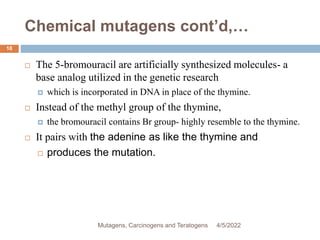
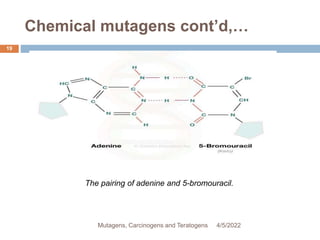
 The 5-bromouracil are artificially synthesized molecules- a
base analog utilized in the genetic research
 which is incorporated in DNA in place of the thymine.
 Instead of the methyl group of the thymine,
 the bromouracil contains Br group- highly resemble to the thymine.
 It pairs with the adenine as like the thymine and
 produces the mutation.
4/5/2022
Mutagens, Carcinogens and Teratogens
Chemical mutagens cont’d,…
19
The pairing of adenine and 5-bromouracil.
4/5/2022
Mutagens, Carcinogens and Teratogens
Chemical mutagens cont’d,…
20
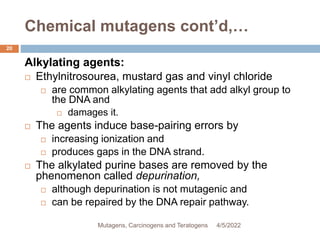
Alkylating agents:
 Ethylnitrosourea, mustard gas and vinyl chloride
 are common alkylating agents that add alkyl group to
the DNA and
 damages it.
 The agents induce base-pairing errors by
 increasing ionization and
 produces gaps in the DNA strand.
 The alkylated purine bases are removed by the
phenomenon called depurination,
 although depurination is not mutagenic and
 can be repaired by the DNA repair pathway.
4/5/2022
Mutagens, Carcinogens and Teratogens
Chemical mutagens cont’d,…
21
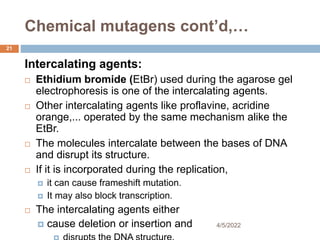
Intercalating agents:
 Ethidium bromide (EtBr) used during the agarose gel
electrophoresis is one of the intercalating agents.
 Other intercalating agents like proflavine, acridine
orange,... operated by the same mechanism alike the
EtBr.
 The molecules intercalate between the bases of DNA
and disrupt its structure.
 If it is incorporated during the replication,
 it can cause frameshift mutation.
 It may also block transcription.
 The intercalating agents either
 cause deletion or insertion and 4/5/2022
Chemical mutagens cont’d,…
22
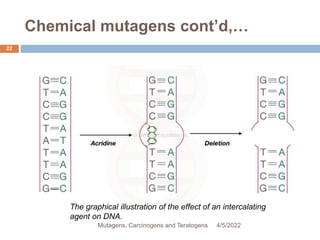
The graphical illustration of the effect of an intercalating
agent on DNA.
4/5/2022
Mutagens, Carcinogens and Teratogens
Chemical mutagens cont’d,…
23
Metal ions:
 Metal ions also dangerous to our DNA as it acts
in varieties of different ways.
 Nickel, chromium, cobalt, cadmium, arsenic,
chromium and iron are some of the common metal
ions cause mutations.
 The metal ions work by
 producing ROS (reactive oxygen species),
 hindering the DNA repair pathway,
 cause DNA hypermethylation or
 may directly damages the DNA.
4/5/2022
Mutagens, Carcinogens and Teratogens
Biological agents
24
Virus:
 HIV is causative agent of AIDS.
 Viruses are common mutagens that are well
known to us and creates lethal health issues.
 Viruses insert their DNA into our genome and
 disrupt the normal function of DNA or genes.
 Once it inserts DNA, the DNA is replicated,
transcribed and translate viral protein instead of
our own protein.
 Mature viral particle forms in a cell.
4/5/2022
Mutagens, Carcinogens and Teratogens
Biological agents cont’d,…
25
Bacteria:
 Some bacteria are also dangerous for our DNA-
 cause inflammation.
 It provokes DNA damage and
 DNA breakage.
4/5/2022
Mutagens, Carcinogens and Teratogens
Biological agents cont’d,…
26
Transposons:
 Less known biological mutagens are transposons.
 The transposons are non-coding DNA sequences,
 jumps from one place to another place in a genome
and
 influence the function of genes.
 Unlike the viral DNA, the transposons are our
own DNA believed to be originated from the
retroviruses.
4/5/2022
Mutagens, Carcinogens and Teratogens
Effect of mutagens
27
 The mutagens are genotoxic- harmful to our
DNA in many ways,
 some directly affect the DNA
 some indirectly.
 therefore, the exact effect of each mutagen is
still unknown to us.
4/5/2022
Mutagens, Carcinogens and Teratogens
Effect of mutagens cont’d,…
28
 At the chromosomal level, the mutagens can
alter the structure or number of chromosomes.
 As deletion, duplication, insertion, translocation,
monosomy and nondisjunction are some of the
chromosomal abnormalities produced by
mutagens.
4/5/2022
Mutagens, Carcinogens and Teratogens
Effect of mutagens cont’d,…
29
 At the molecular level, the mutagens create
different gene mutations results in
 loss of function,
 altered function or
 non-functional protein.
 It also alters the codon, deletes bases, alters
bases, breaks hydrogen bonds or
phosphodiester bonds and
 changes gene expression.
4/5/2022
Mutagens, Carcinogens and Teratogens
Effect of mutagens cont’d,…
30
 Some mutagens dysregulate cell proliferation
and cell death process and
 thus cause cancer, those are called carcinogens.
 Biological mutagens slower down the DNA
repair or DNA synthesis process.
4/5/2022
Mutagens, Carcinogens and Teratogens
Effect of mutagens cont’d,…
31
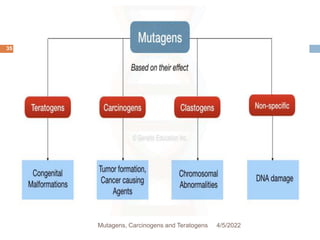
 Some of the common types of mutagens
based on their effect are enlisted here:
Teratogens:
 are the class of the mutagens
 which causes congenital malformations.
 X-rays, valproate and toxoplasma are common
physicals, chemical and biological teratogens,
respectively.
4/5/2022
Mutagens, Carcinogens and Teratogens
Effect of mutagens cont’d,…
32
Carcinogens:
 are the class of mutagens
 induces tumor formation and
 thus cause cancer.
 A wide variety of agents are categorized as
carcinogens.
 X-rays/ UV-rays, Aflatoxins and retroviruses are
common physicals, chemical and biological
carcinogens, respectively.
4/5/2022
Mutagens, Carcinogens and Teratogens
Effect of mutagens cont’d,…
33
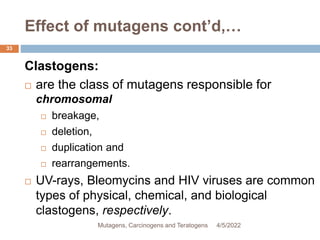
Clastogens:
 are the class of mutagens responsible for
chromosomal
 breakage,
 deletion,
 duplication and
 rearrangements.
 UV-rays, Bleomycins and HIV viruses are common
types of physical, chemical, and biological
clastogens, respectively.
4/5/2022
Mutagens, Carcinogens and Teratogens
Effect of mutagens cont’d,…
34
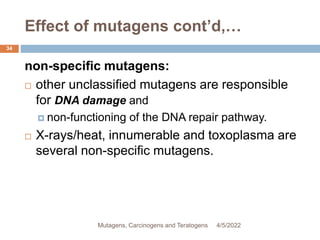
non-specific mutagens:
 other unclassified mutagens are responsible
for DNA damage and
 non-functioning of the DNA repair pathway.
 X-rays/heat, innumerable and toxoplasma are
several non-specific mutagens.
4/5/2022
Mutagens, Carcinogens and Teratogens
35
4/5/2022
Mutagens, Carcinogens and Teratogens
Mutagens are useful
36
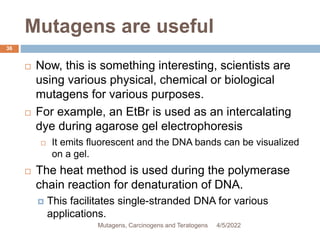
 Now, this is something interesting, scientists are
using various physical, chemical or biological
mutagens for various purposes.
 For example, an EtBr is used as an intercalating
dye during agarose gel electrophoresis
 It emits fluorescent and the DNA bands can be visualized
on a gel.
 The heat method is used during the polymerase
chain reaction for denaturation of DNA.
 This facilitates single-stranded DNA for various
applications.
4/5/2022
Mutagens, Carcinogens and Teratogens
Mutagens are useful…
37
 The UV-rays are utilized for decontamination or
sterilization processes in genetics as well as
microbiology.
 The UV-light destroys all the bacteria or viruses
present in a culture room.
 Carcinogens and teratogens are used in cancer
research.
 Transposons are used as a vehicle for transferring
a gene of interest at a particular location in a
genome.
 Thus it is used in gene therapy experiments.
4/5/2022
Mutagens, Carcinogens and Teratogens
 Cancer
 Carcinogenesis
 Carcinogen
CARCINOGENESIS
38
4/5/2022
Mutagens, Carcinogens and Teratogens
Cancer
39
 A group of disease characterized by
 uncontrolled multiplication and
 spread of abnormal forms of the body's own cells.
 A multi-causal, multistage group of diseases the
mechanisms of which are still only partially known.
4/5/2022
Mutagens, Carcinogens and Teratogens
Cancer cont’d,…
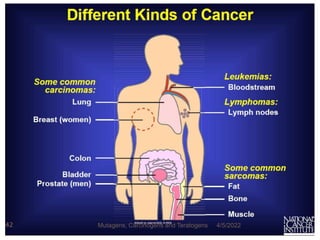
 Can originate almost anywhere in the body.
 Carcinomas
 The most common types of cancer
 Arise from the cells that cover external & internal body
surfaces.
 Lung, breast, and colon
 are the most frequent cancers of this type in the United
States.
 Sarcomas
 Arising from cells found in the supporting tissues of the body
 Bone, cartilage, fat, connective tissue, and muscle.
4/5/2022
40
Mutagens, Carcinogens and Teratogens
Cancer cont’d,…
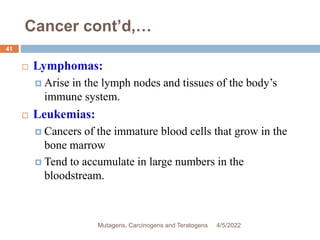
 Lymphomas:
 Arise in the lymph nodes and tissues of the body’s
immune system.
 Leukemias:
 Cancers of the immature blood cells that grow in the
bone marrow
 Tend to accumulate in large numbers in the
bloodstream.
4/5/2022
41
Mutagens, Carcinogens and Teratogens
4/5/2022
42 Mutagens, Carcinogens and Teratogens
Cancer cont’d,…
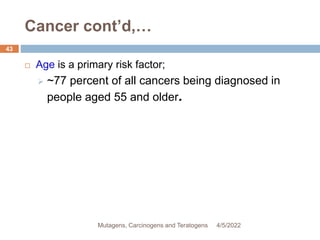
 Age is a primary risk factor;
 ~77 percent of all cancers being diagnosed in
people aged 55 and older.
4/5/2022
43
Mutagens, Carcinogens and Teratogens
Cancer cont’d,…
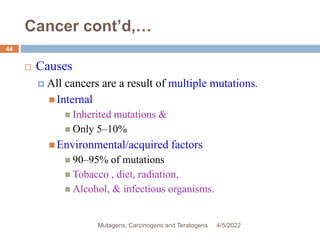
 Causes
 All cancers are a result of multiple mutations.
 Internal
 Inherited mutations &
 Only 5–10%
 Environmental/acquired factors
 90–95% of mutations
 Tobacco , diet, radiation,
 Alcohol, & infectious organisms.
4/5/2022
44
Mutagens, Carcinogens and Teratogens
Cancer cont’d,…
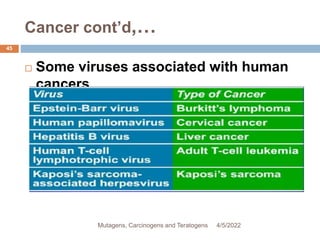
45
 Some viruses associated with human
cancers
4/5/2022
Mutagens, Carcinogens and Teratogens
Carcinogenesis
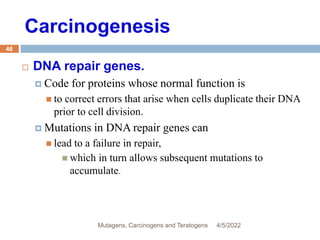
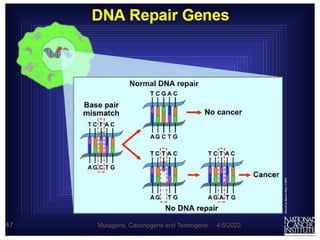
 DNA repair genes.
 Code for proteins whose normal function is
 to correct errors that arise when cells duplicate their DNA
prior to cell division.
 Mutations in DNA repair genes can
 lead to a failure in repair,
 which in turn allows subsequent mutations to
accumulate.
4/5/2022
46
Mutagens, Carcinogens and Teratogens
4/5/2022
47 Mutagens, Carcinogens and Teratogens
Cancer:
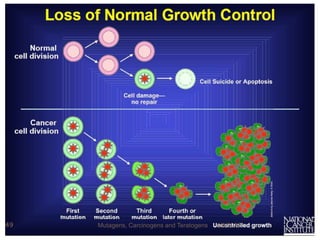
 the result of malfunctions within the regulation of the
cell cycle,
 such that injured or mutated cells
 which are normally killed are allowed to progress
through the cell cycle, accumulating mutations.
4/5/2022
48
Mutagens, Carcinogens and Teratogens
4/5/2022
49 Mutagens, Carcinogens and Teratogens
Stages of carcinogenesis
50
 Carcinogenesis is a complex multistage process, usually
involving
 More than one genetic change as well as
 Epigenetic factors which do not by themselves produce
cancer but
 increase the likelihood that the genetic mutation(s) will
eventually result in cancer.
4/5/2022
Mutagens, Carcinogens and Teratogens
Stages of carcinogenesis cont’d,…
51
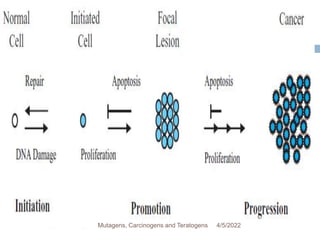
Initiation
 Phenomenon of gene alteration, which may result from the
interaction of ultimate carcinogens with DNA in the target cell.
 Initiating event involves cellular genome – MUTATIONS.
4/5/2022
Mutagens, Carcinogens and Teratogens
Stages of carcinogenesis
cont’d,…
52
 Results from DNA mutations
 Mutations may occur in oncogenes/proto-
oncogenes or
tumor suppressor genes.
 Initiated cells may remain ‘dormant’, and rarely
become
neoplastic cells without undergoing promotion and
progression.
 Irreversible
 Single treatment can induce mutation.
4/5/2022
Mutagens, Carcinogens and Teratogens
Stages of carcinogenesis
cont’d,…
53
Promotion
 A phenomenon of gene activation in which the latent altered
phenotype of the initiated cell becomes expressed through
selection and clonal expansion.
4/5/2022
Mutagens, Carcinogens and Teratogens
Stages of carcinogenesis
cont’d,…
54
 Results from clonal expansion of initiated cells

No direct DNA modification

Nongenotoxic; don’t induce cancer by themselves.

No direct mutation

Cell signaling and gene expression are altered,

leading to increased cell mitogensis and/or reduced apoptosis.

Leads to the formation of preneoplastic cells

Long duration and reversible, especially at earlier stage

Tumor promoters (not mutagenic) do not directly interact with
DNA ---altered expression of genes
4/5/2022
Mutagens, Carcinogens and Teratogens
Stages of carcinogenesis
cont’d,…
55
Progression
 The last irreversible stage of multistage carcinogenesis,
 which usually develops from the cells in the stage of promotion.
 Characterised by
 irreversibility,
 genetic instability,
 faster growth,
 invasion,
 metastization, and
 changes in the biochemical, metabolical and morphological
characteristics of cells – malignant phenotypes
4/5/2022
Mutagens, Carcinogens and Teratogens
Stages of carcinogenesis
cont’d,…
56
 Results from additional genomic structural alterations
 Leads to the formation of benign or malignant neoplasms
 Chemicals that impact on the progression stage are usually
genotoxic agents.
 Agents that only cause the transition of a cell from the stage
of promotion to that of progression are termed progressor
agents.
4/5/2022
Mutagens, Carcinogens and Teratogens
57
4/5/2022
Mutagens, Carcinogens and Teratogens
Carcinogen
58
Defn.
 is Substance that can cause cancer by inhalation,
ingestion or skin.
 Carcinogens either produce:
 New neoplastic growth in a tissue or organ or
 Increase the incidence and/or multiplicity of background
spontaneous neoplastic formation in the target tissue.
4/5/2022
Mutagens, Carcinogens and Teratogens
Carcinogen cont’d,…
59
 Carcinogens can be
 chemicals,
 physical agents (such as Uv light and gamma radiation),
and
 biological agents (such as viruses).
4/5/2022
Mutagens, Carcinogens and Teratogens
Carcinogen cont’d,…
60
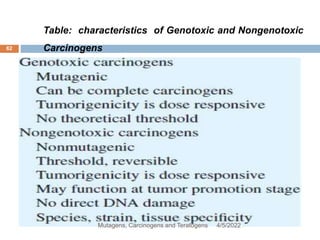
 Carcinogen - can be divided into two major categories:
 Based on whether or not they are mutagenic in in-vitro
mutagenicity assay.
A. DNA-damaging agents (genotoxic)
 Mutagenic in in-vitro assays
 Considered to produce permanent alterations in the
genetic material of the host in vivo
4/5/2022
Mutagens, Carcinogens and Teratogens
Carcinogen cont’d,…
61
B. Epigenetic agents (nongenotoxic)
 Not mutagenic in in-vitro assays
 Don’t alter the primary sequence of DNA but are
considered to alter the expression or repression of
certain genes and/or to produce perturbations in signal
transduction pathways that influence cellular events
related to proliferation, differentiation, or apoptosis.
4/5/2022
Mutagens, Carcinogens and Teratogens
62
Table: characteristics of Genotoxic and Nongenotoxic
Carcinogens
4/5/2022
Mutagens, Carcinogens and Teratogens
A.DNA-damaging agents (genotoxic)
63
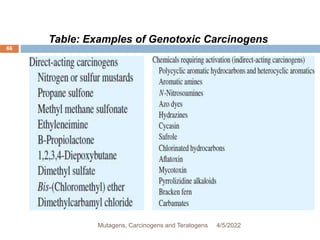
Direct acting carcinogens
 are intrinsically reactive compounds
 do not require metabolic activation
 Examples include
 N-methyl-N-nitrosourea and N-methyl-N-nitro-N-
nitrosoguanidine;
 the alkyl alkanesulfonates such as methyl methanesulfonate;
 the lactones such as beta propiolactone and the nitrogen
and sulfur mustards.
4/5/2022
Mutagens, Carcinogens and Teratogens
DNA-damaging agents (genotoxic)
cont’d,…
64
Indirect-acting carcinogens
 require metabolic activation by cellular enzymes
 to form the ultimate carcinogenic species.
o Examples include
o dimethylnitrosamine,
o benzo[a]pyrene,
o 7,12-dimethylbenz[a]anthracene,
o aflatoxin B1and
o 2-acetylaminofluorene
4/5/2022
Mutagens, Carcinogens and Teratogens
DNA-damaging agents (genotoxic)
cont’d,…
65
Radiation and oxidative DNA damage
 can occur directly or indirectly.
Inorganic agents
such as
 arsenic,
 chromium and
 nickel
4/5/2022
Mutagens, Carcinogens and Teratogens
66
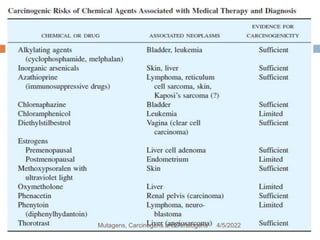
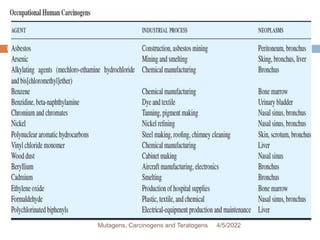
Table: Examples of Genotoxic Carcinogens
4/5/2022
Mutagens, Carcinogens and Teratogens
B. Epigenetic Agents
67
 Many epigenetic agents favor the proliferation of cells with an
altered genotype and
 allow the clonal expansion of these altered or “initiated” cells.
4/5/2022
Mutagens, Carcinogens and Teratogens
Epigenetic Agents cont’d,…
68
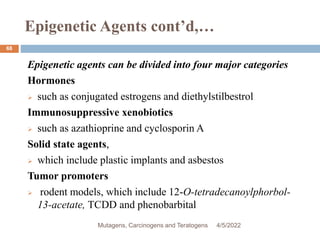
Epigenetic agents can be divided into four major categories
Hormones
 such as conjugated estrogens and diethylstilbestrol
Immunosuppressive xenobiotics
 such as azathioprine and cyclosporin A
Solid state agents,
 which include plastic implants and asbestos
Tumor promoters
 rodent models, which include 12-O-tetradecanoylphorbol-
13-acetate, TCDD and phenobarbital
4/5/2022
Mutagens, Carcinogens and Teratogens
69
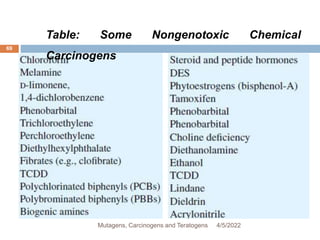
Table: Some Nongenotoxic Chemical
Carcinogens
4/5/2022
Mutagens, Carcinogens and Teratogens
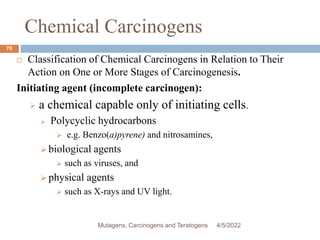
Chemical Carcinogens
70
 Classification of Chemical Carcinogens in Relation to Their
Action on One or More Stages of Carcinogenesis.
Initiating agent (incomplete carcinogen):
 a chemical capable only of initiating cells.
 Polycyclic hydrocarbons
 e.g. Benzo(a)pyrene) and nitrosamines,
 biological agents
 such as viruses, and
 physical agents
 such as X-rays and UV light.
4/5/2022
Mutagens, Carcinogens and Teratogens
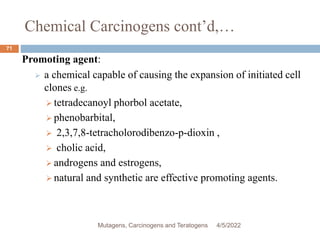
Chemical Carcinogens cont’d,…
71
Promoting agent:
 a chemical capable of causing the expansion of initiated cell
clones e.g.
 tetradecanoyl phorbol acetate,
 phenobarbital,
 2,3,7,8-tetracholorodibenzo-p-dioxin ,
 cholic acid,
 androgens and estrogens,
 natural and synthetic are effective promoting agents.
4/5/2022
Mutagens, Carcinogens and Teratogens
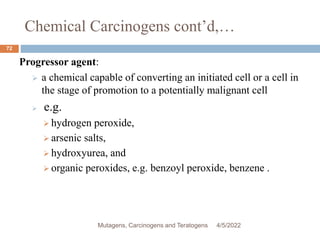
Chemical Carcinogens cont’d,…
72
Progressor agent:
 a chemical capable of converting an initiated cell or a cell in
the stage of promotion to a potentially malignant cell
 e.g.
 hydrogen peroxide,
 arsenic salts,
 hydroxyurea, and
 organic peroxides, e.g. benzoyl peroxide, benzene .
4/5/2022
Mutagens, Carcinogens and Teratogens
Chemical Carcinogens cont’d,…
73
Complete carcinogen:
 a chemical possessing the capability of inducing cancer
from normal cells,
usually possessing properties of initiating,
promoting, and progressor agents
e.g.
 aflatoxin,
 tobacco smoking,
 soluble nickel salts, can be genotoxic carcinogen.
4/5/2022
Mutagens, Carcinogens and Teratogens
74
4/5/2022
Mutagens, Carcinogens and Teratogens
75
4/5/2022
Mutagens, Carcinogens and Teratogens
Teratogenesis
Teratogen
TERATOGEN
76
4/5/2022
Mutagens, Carcinogens and Teratogens
Introduction
77
 Teratology (Greek word teratos=“ monster ” Gensis-
”producing”)
 is a specialized area of embryology.
 It is the study of the etiology of abnormal development
(the study of birth defects).
4/5/2022
Mutagens, Carcinogens and Teratogens
Introduction cont’d,…
78
 A teratogen
 is defined as any agent that results in structural or functional
abnormalities (malformation ) in the fetus or in the child after
birth,
 as a consequence of maternal exposure during pregnancy.
 Birth defects are known to occur in 3- 5% of all newborns.
 They can do direct damage to the fetus, causing abnormal
development.
4/5/2022
Mutagens, Carcinogens and Teratogens
Introduction cont’d,…
79
 Teratogens are substances that may produce
physical or functional defects in the human
embryo or fetus after the pregnant woman is
exposed to the substance.
 Alcohol and cocaine are examples of such
substances.
 Exposure to the teratogen affects the fetus or
embryo in a variety of ways, such as the
 duration of exposure,
 the amount of teratogenic substance, and
 the stage of development the embryo or fetus is in
during the exposure.
4/5/2022
Mutagens, Carcinogens and Teratogens
Introduction cont’d,…
80
 They affect the embryo or fetus in a number of
ways, causing
 physical malformations,
 problems in the behavioral or emotional
development of the child, and
 decreased intellectual quotient (IQ) in the child.
4/5/2022
Mutagens, Carcinogens and Teratogens
Introduction cont’d,…
81
 The agents responsible for the disruptions are called
teratogens.
 Mutagens and carcinogens also are the causes of abnormal
development but their mode of action differ.
 Teratogens are agents that affect the embryo at dose levels.
 They are harmless to adult organisms and
 do not permanently damage the genetic material.
 On the other hand,
 mutagens are agents that alter the genes, whereas
 carcinogens are agents that lead to excessive growth and loss of
differentiation, generally in adult tissue.
4/5/2022
Mutagens, Carcinogens and Teratogens
Causes of teratogenesis
82
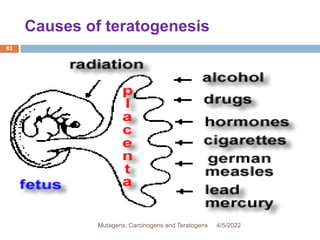
 Abnormalities caused by genetic events, e.g.
 mutation in genes,
 structural changes in chromosomes etc. are called
malformations.
 Abnormalities caused by environmental agents
are
called disruptions. May be either
 biological (e.g. viruses and parasites) or
 Non biological such as physical factors (e.g.
temperature,
radiation) and
 chemical factors (e.g. drug, chemicals
and nutritional imbalances). 4/5/2022
Mutagens, Carcinogens and Teratogens
Causes of teratogenesis
83
4/5/2022
Mutagens, Carcinogens and Teratogens
Causes of teratogenesis cont’d,…
84
Characteristics of environmental induced
teratogenesis
Stage sensitivity
 Susceptibility to teratogen varies from stage of gestation
 From fertilization to early post – implantation (pre-embryonic period)
o Days 0-17 post conception
o Prior to implantation and organ differentiation
o Not usually associated with teratogenesis
o Effect of teratogen is all (embryonic lethality) or none effect.
4/5/2022
Mutagens, Carcinogens and Teratogens
Causes of teratogenesis cont’d,…
85
 Embryonic period
o Days 18-60 post conception
o Implantation to time of organogenesis
o Period of major organ development
o Greater risk of malformation; morphological
defects .
4/5/2022
Mutagens, Carcinogens and Teratogens
Causes of teratogenesis cont’d,…
86
 The fetal period: Fetal → neonatal stage
o > 8 weeks post conception until term
o Fetal growth
o CNS and some organs continue to develop
o e.g. eyes, ears, teeth, external genitalia
o Abnormalities also occurs e.g. ethanol
o Functional disorders,
o growth retardation,
o carcinogenesis.
4/5/2022
Mutagens, Carcinogens and Teratogens
87
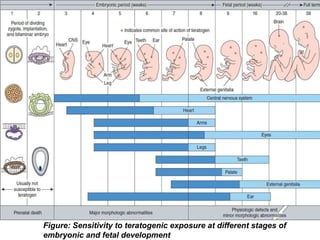
Figure: Sensitivity to teratogenic exposure at different stages of
embryonic and fetal development
Types Teratogens
88
 Teratogens are classified into four types:
1. physical agents,
2. metabolic conditions,
3. infection and
4. drugs and chemicals
4/5/2022
Mutagens, Carcinogens and Teratogens
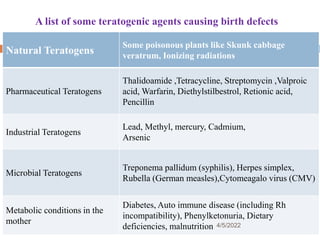
A list of some teratogenic agents causing birth defects
89
Natural Teratogens
Some poisonous plants like Skunk cabbage
veratrum, Ionizing radiations
Pharmaceutical Teratogens
Thalidoamide ,Tetracycline, Streptomycin ,Valproic
acid, Warfarin, Diethylstilbestrol, Retionic acid,
Pencillin
Industrial Teratogens
Lead, Methyl, mercury, Cadmium,
Arsenic
Microbial Teratogens
Treponema pallidum (syphilis), Herpes simplex,
Rubella (German measles),Cytomeagalo virus (CMV)
Metabolic conditions in the
mother
Diabetes, Auto immune disease (including Rh
incompatibility), Phenylketonuria, Dietary
deficiencies, malnutrition 4/5/2022
Microbial teratogens cont’d,…
90
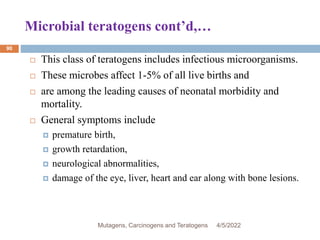
 This class of teratogens includes infectious microorganisms.
 These microbes affect 1-5% of all live births and
 are among the leading causes of neonatal morbidity and
mortality.
 General symptoms include
 premature birth,
 growth retardation,
 neurological abnormalities,
 damage of the eye, liver, heart and ear along with bone lesions.
4/5/2022
Mutagens, Carcinogens and Teratogens
Microbial teratogens cont’d,…
91
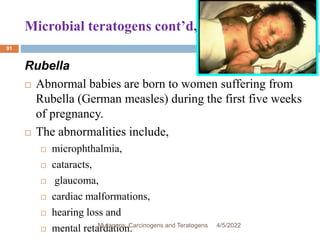
Rubella
 Abnormal babies are born to women suffering from
Rubella (German measles) during the first five weeks
of pregnancy.
 The abnormalities include,
 microphthalmia,
 cataracts,
 glaucoma,
 cardiac malformations,
 hearing loss and
 mental retardation. 4/5/2022
Mutagens, Carcinogens and Teratogens
Microbial teratogens cont’d,…
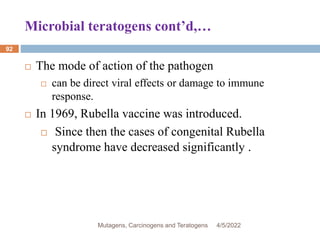
 The mode of action of the pathogen
 can be direct viral effects or damage to immune
response.
 In 1969, Rubella vaccine was introduced.
 Since then the cases of congenital Rubella
syndrome have decreased significantly .
4/5/2022
Mutagens, Carcinogens and Teratogens
92
Microbial teratogens cont’d,…
93
Cytomegalovirus (CMV) & Herpes
simplex
 Cytomegalovirus infection early in gestation is fatal
while infection of later embryos might lead to
 blindness ,
 deafness,
 cerebral palsy and
 mental retardation.
4/5/2022
Mutagens, Carcinogens and Teratogens
Microbial teratogens cont’d,…
 CMV damage including
 hepatitis,
 gestational prematurity,
 anemia.
 Mode of action of CMV is similar to that of rubella
virus,
 i.e. cell lysis and immune response.
4/5/2022
Mutagens, Carcinogens and Teratogens
94
Microbial teratogens cont’d,…
95
Toxoplasma
 Toxoplasma goondii is a protozoan parasite carried
by rabbits and cats.
 It can cross the placenta causing
 hydrocephaly,
 microphthalmia,
 brain lesions and
 multiple organ damage.
4/5/2022
Mutagens, Carcinogens and Teratogens
Microbial teratogens cont’d,…
 Fetal infection occurs approximately one in four
thousand pregnancies.
 The fetal damage caused by the teratogen is
maxmium if the mother is infected in third trimester
resulting in 60% of the infected new born.
4/5/2022
Mutagens, Carcinogens and Teratogens
96
Microbial teratogens cont’d,…
97
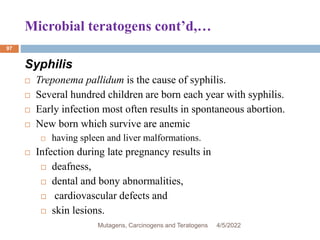
Syphilis
 Treponema pallidum is the cause of syphilis.
 Several hundred children are born each year with syphilis.
 Early infection most often results in spontaneous abortion.
 New born which survive are anemic
 having spleen and liver malformations.
 Infection during late pregnancy results in
 deafness,
 dental and bony abnormalities,
 cardiovascular defects and
 skin lesions.
4/5/2022
Mutagens, Carcinogens and Teratogens
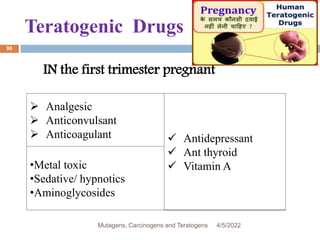
Teratogenic Drugs
98
 Analgesic
 Anticonvulsant
 Anticoagulant  Antidepressant
 Ant thyroid
 Vitamin A
•Metal toxic
•Sedative/ hypnotics
•Aminoglycosides
IN the first trimester pregnant
4/5/2022
Mutagens, Carcinogens and Teratogens
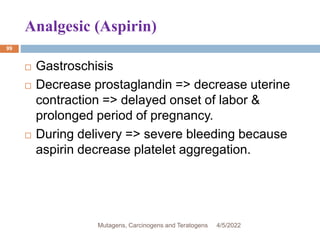
Analgesic (Aspirin)
99
 Gastroschisis
 Decrease prostaglandin => decrease uterine
contraction => delayed onset of labor &
prolonged period of pregnancy.
 During delivery => severe bleeding because
aspirin decrease platelet aggregation.
4/5/2022
Mutagens, Carcinogens and Teratogens
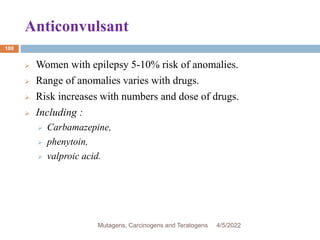
Anticonvulsant
100
 Women with epilepsy 5-10% risk of anomalies.
 Range of anomalies varies with drugs.
 Risk increases with numbers and dose of drugs.
 Including :
 Carbamazepine,
 phenytoin,
 valproic acid.
4/5/2022
Mutagens, Carcinogens and Teratogens
Anticonvulsant
101
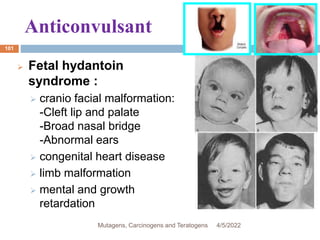
 Fetal hydantoin
syndrome :
 cranio facial malformation:
-Cleft lip and palate
-Broad nasal bridge
-Abnormal ears
 congenital heart disease
 limb malformation
 mental and growth
retardation
4/5/2022
Mutagens, Carcinogens and Teratogens
Anticoagulant
102
Warfarin and coumadin
 Fetal warfarin syndrome:
-Nasal hypoplasia (bones
appears small)
-Bone stippling
-Mental retardation
 Respiratory distress syndrome
 Fetal and maternal hemorrhage
4/5/2022
Mutagens, Carcinogens and Teratogens
Vitamin A (Retinoic Acid)
103
 Carnie-facial dismorphism
 Cleft palate (facial malformation)
 Thymic aplasia (missing of organ)
 Neural tube defect ( birth defect of brain)
4/5/2022
Mutagens, Carcinogens and Teratogens
Other Teratogenic drug
104
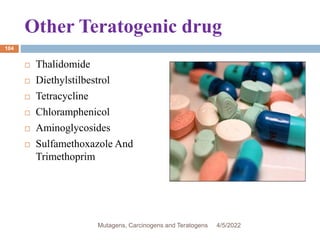
 Thalidomide
 Diethylstilbestrol
 Tetracycline
 Chloramphenicol
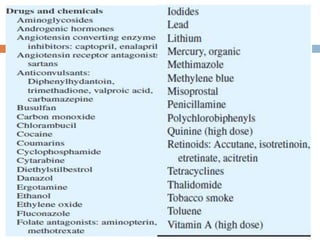
 Aminoglycosides
 Sulfamethoxazole And
Trimethoprim
4/5/2022
Mutagens, Carcinogens and Teratogens
Teratogenic drug cont’d,…
105
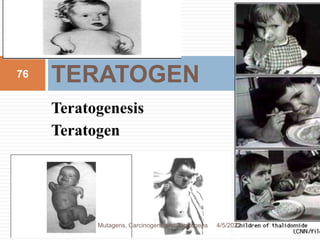
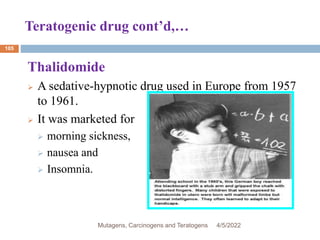
Thalidomide
 A sedative-hypnotic drug used in Europe from 1957
to 1961.
 It was marketed for
 morning sickness,
 nausea and
 Insomnia.
4/5/2022
Mutagens, Carcinogens and Teratogens
Teratogenic drug cont’d,…
106
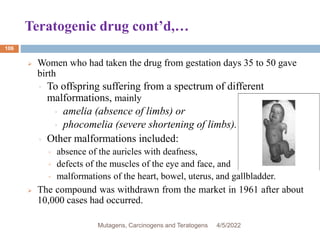
 Women who had taken the drug from gestation days 35 to 50 gave
birth
◦ To offspring suffering from a spectrum of different
malformations, mainly
◦ amelia (absence of limbs) or
◦ phocomelia (severe shortening of limbs).
◦ Other malformations included:
◦ absence of the auricles with deafness,
◦ defects of the muscles of the eye and face, and
◦ malformations of the heart, bowel, uterus, and gallbladder.
 The compound was withdrawn from the market in 1961 after about
10,000 cases had occurred.
4/5/2022
Mutagens, Carcinogens and Teratogens
Teratogenic drug cont’d,…
107
Diethylstilbestrol
 A synthetic non-steroidal estrogen widely used from the
1940s to the 1970s in the US
 to prevent threatened miscarriage by stimulating
synthesis of estrogen and progesterone in the placenta.
 In 1970’s female offspring to have vaginal adenocarcinoma
at age 15 – 22yrs.
 22-58% females developed uterine, cervical or tubal changes
=> infertility, miscarriage etc…
 Male offspring => undescended or small testes etc…
4/5/2022
Mutagens, Carcinogens and Teratogens
Teratogenic drug cont’d,…
108
Tetracycline
 Protein synthesis inhibitor
 Inhibit the binding of aminoacyl-tRNA to the
mRNA ribosomes complex
 by binding to the 30S ribosomal subunit in mRNA
translation complex .
 SIDE EFFECTS
 dental discoloration in children
 maternal hepatotoxicity (drug that cause injury to
liver) with large parenteral doses.
4/5/2022
Mutagens, Carcinogens and Teratogens
Teratogenic drug cont’d,…
109
Chloramphenicol
 Bacteriostatic drug that stop bacterial growth by inhibiting
protein synthesis
• Prevent protein chain elongation by inhibiting peptidyl
transferase activity of bacterial chromosome
• Intravenous chloramphenicol use has been associated with
Gray Baby syndrome.
 This occur in newborn infants
 because their liver enzymes not yet fully developed.
4/5/2022
Mutagens, Carcinogens and Teratogens
Teratogenic drug cont’d,…
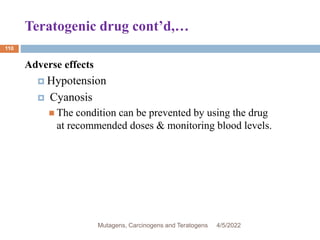
110
Adverse effects
 Hypotension
 Cyanosis
 The condition can be prevented by using the drug
at recommended doses & monitoring blood levels.
4/5/2022
Mutagens, Carcinogens and Teratogens
Teratogenic drug cont’d,…
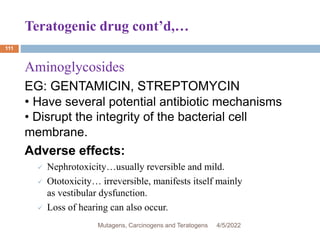
111
Aminoglycosides
EG: GENTAMICIN, STREPTOMYCIN
• Have several potential antibiotic mechanisms
• Disrupt the integrity of the bacterial cell
membrane.
Adverse effects:
 Nephrotoxicity…usually reversible and mild.
 Ototoxicity… irreversible, manifests itself mainly
as vestibular dysfunction.
 Loss of hearing can also occur.
4/5/2022
Mutagens, Carcinogens and Teratogens
Teratogenic drug cont’d,…
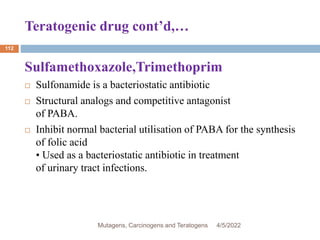
112
Sulfamethoxazole,Trimethoprim
 Sulfonamide is a bacteriostatic antibiotic
 Structural analogs and competitive antagonist
of PABA.
 Inhibit normal bacterial utilisation of PABA for the synthesis
of folic acid
• Used as a bacteriostatic antibiotic in treatment
of urinary tract infections.
4/5/2022
Mutagens, Carcinogens and Teratogens
Teratogenic drug cont’d,…
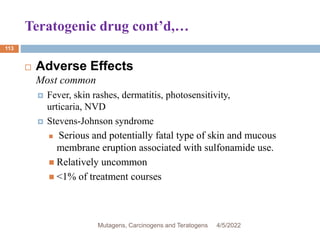
113
 Adverse Effects
Most common
 Fever, skin rashes, dermatitis, photosensitivity,
urticaria, NVD
 Stevens-Johnson syndrome
 Serious and potentially fatal type of skin and mucous
membrane eruption associated with sulfonamide use.
 Relatively uncommon
 <1% of treatment courses
4/5/2022
Mutagens, Carcinogens and Teratogens
continued
114
115
4/5/2022
Mutagens, Carcinogens and Teratogens

3. mutagen,carcino and teratogen

  • 1.
    Bule Hora University Collegeof Health and Medical Sciences Department Of Pharmacy TOXICOLOGY For 4th year Medical Laboratoy Students 4/5/2022 Mutagens, Carcinogens and Teratogens 1 By:Aliyi G.(B.Pharm)
  • 2.
    . Introduction tomutagenesis . mutagens 3. Mutagenesis 2 4/5/2022 Mutagens, Carcinogens and Teratogens
  • 3.
    Introduction to mutagenesis 3 Mutagenesis:-  Genesis means to synthesize something.  is a process by which the genetic information of an organism is changed,  resulting in a mutation.  It may occur  spontaneously in nature, or  as a result of exposure to mutagens.  It can also be achieved experimentally using laboratory procedures. 4/5/2022 Mutagens, Carcinogens and Teratogens
  • 4.
    Introduction to mutagenesiscont’d,… 4 Mutagenesis as a laboratory technique  Mutagenesis in the laboratory is an important technique where by DNA mutations are deliberately engineered to produce  mutant genes,  proteins or  strains of organisms. 4/5/2022 Mutagens, Carcinogens and Teratogens
  • 5.
    Introduction to mutagenesis cont’d,… 5 Types of Mutagenesis I. Random mutagenesis II. Site-directed mutagenesis 4/5/2022 Mutagens, Carcinogens and Teratogens
  • 6.
    Introduction to mutagenesis cont’d,… 6 I.Random mutagenesis  When an organism is exposed to a physical or chemical mutagen,  mutations are induced randomly in all genes of the organism.  Hence, this process of generating mutations is known as random mutagenesis.  The desired mutant is selected from the mutagenised population. 4/5/2022 Mutagens, Carcinogens and Teratogens
  • 7.
    Introduction to mutagenesis cont’d,… 7 II.Site-directed mutagenesis  Site-directed mutagenesis, also called site- specific mutagenesis or oligonucleotide-directed mutagenesis,  is a molecular biology technique  in which a mutation is created at a defined site in a DNA molecule.  Oligonucleotide-directed mutagenesis  is used to test the role of particular residues in the structure, catalytic activity, and ligand-binding capacity of a protein. 4/5/2022 Mutagens, Carcinogens and Teratogens
  • 8.
    Mutagen: 8 Definition  “Mutagen isa physical, chemical or biological agent that causes mutation by  altering the genetic material which possibly results in the disease condition.”  Mutagens are the agents that damage genetic material, usually DNA and  results in genetic abnormalities. Or  Anything that causes mutations is known as mutagens. 4/5/2022 Mutagens, Carcinogens and Teratogens
  • 9.
    Definition Cont’d,… 9  Ingenetics, mutagen induced changes are known as mutation.  However, not all mutations emerge due to mutagens, some mutations arise spontaneously by  error in replication, hydrolysis or recombination errors. 4/5/2022 Mutagens, Carcinogens and Teratogens
  • 10.
    Definition Cont’d,… 10  Themutations are categorized under two broader categories;  gene mutations and  chromosomal mutations.  Insertion, deletion, duplication, translocation, inversion are some of the common types of gene mutations that occur spontaneously in nature while  trisomy, monosomy and numerical chromosomal abnormalities are some of the chromosomal mutations. 4/5/2022 Mutagens, Carcinogens and Teratogens
  • 11.
    Types of mutagens 11 Physical  Radiation  Heat  Chemical  Base analogs  Alkylating agents  intercalating agents  Metal ions  biological  Viruses  bacteria  transposons 4/5/2022 Mutagens, Carcinogens and Teratogens
  • 12.
  • 13.
    Physical agents 13 Radiation:  Radiationsare the first mutagenic agent reported in 1920.  UV rays, X-rays, alpha rays, neutrons, and other ionizing and non-ionizing radiations are mutagenic.  Usually, radiation directly damages the DNA or nucleotide structure.  The radiation causes  cross-linking of DNA or protein,  chromosomal break,  strand break or chromosomes loss,  also, at the molecular level it prompts deletion of bases or DNA strand breakages. 4/5/2022 Mutagens, Carcinogens and Teratogens
  • 14.
    Physical agents cont’d,… 14 Graphicalillustration of the effect of UV- radiation on DNA 4/5/2022 Mutagens, Carcinogens and Teratogens
  • 15.
    Physical agents cont’d,… 15 Heat: Heatis another mutagen that provokes mutations in our DNA. when we heat the DNA, over a certain degree (>95°C),  the DNA becomes denatured.  Also, extreme heat also damages DNA and breaks the phosphodiester bonds too. 4/5/2022 Mutagens, Carcinogens and Teratogens
  • 16.
    Chemical mutagens 16  Chemicalsare actually dangerous for the entire world.  The first mutagenic effect of the nitrogen mustard was reported by charlotte Auerbach in 1942.  the nitrogen mustard is a poisonous gas used during the world war 1 and 2. 4/5/2022 Mutagens, Carcinogens and Teratogens
  • 17.
    Chemical mutagens cont’d,… 17 Baseanalogs:  The base analogs are chemicals similar to the  bases of DNA- purine and pyrimidines or  structurally resemble the DNA bases.  Bromouracil and aminopurine are two common base analogs incorporated into DNA- instead of normal bases,  during the process of replication. 4/5/2022 Mutagens, Carcinogens and Teratogens
  • 18.
    Chemical mutagens cont’d,… 18 The 5-bromouracil are artificially synthesized molecules- a base analog utilized in the genetic research  which is incorporated in DNA in place of the thymine.  Instead of the methyl group of the thymine,  the bromouracil contains Br group- highly resemble to the thymine.  It pairs with the adenine as like the thymine and  produces the mutation. 4/5/2022 Mutagens, Carcinogens and Teratogens
  • 19.
    Chemical mutagens cont’d,… 19 Thepairing of adenine and 5-bromouracil. 4/5/2022 Mutagens, Carcinogens and Teratogens
  • 20.
    Chemical mutagens cont’d,… 20 Alkylatingagents:  Ethylnitrosourea, mustard gas and vinyl chloride  are common alkylating agents that add alkyl group to the DNA and  damages it.  The agents induce base-pairing errors by  increasing ionization and  produces gaps in the DNA strand.  The alkylated purine bases are removed by the phenomenon called depurination,  although depurination is not mutagenic and  can be repaired by the DNA repair pathway. 4/5/2022 Mutagens, Carcinogens and Teratogens
  • 21.
    Chemical mutagens cont’d,… 21 Intercalatingagents:  Ethidium bromide (EtBr) used during the agarose gel electrophoresis is one of the intercalating agents.  Other intercalating agents like proflavine, acridine orange,... operated by the same mechanism alike the EtBr.  The molecules intercalate between the bases of DNA and disrupt its structure.  If it is incorporated during the replication,  it can cause frameshift mutation.  It may also block transcription.  The intercalating agents either  cause deletion or insertion and 4/5/2022
  • 22.
    Chemical mutagens cont’d,… 22 Thegraphical illustration of the effect of an intercalating agent on DNA. 4/5/2022 Mutagens, Carcinogens and Teratogens
  • 23.
    Chemical mutagens cont’d,… 23 Metalions:  Metal ions also dangerous to our DNA as it acts in varieties of different ways.  Nickel, chromium, cobalt, cadmium, arsenic, chromium and iron are some of the common metal ions cause mutations.  The metal ions work by  producing ROS (reactive oxygen species),  hindering the DNA repair pathway,  cause DNA hypermethylation or  may directly damages the DNA. 4/5/2022 Mutagens, Carcinogens and Teratogens
  • 24.
    Biological agents 24 Virus:  HIVis causative agent of AIDS.  Viruses are common mutagens that are well known to us and creates lethal health issues.  Viruses insert their DNA into our genome and  disrupt the normal function of DNA or genes.  Once it inserts DNA, the DNA is replicated, transcribed and translate viral protein instead of our own protein.  Mature viral particle forms in a cell. 4/5/2022 Mutagens, Carcinogens and Teratogens
  • 25.
    Biological agents cont’d,… 25 Bacteria: Some bacteria are also dangerous for our DNA-  cause inflammation.  It provokes DNA damage and  DNA breakage. 4/5/2022 Mutagens, Carcinogens and Teratogens
  • 26.
    Biological agents cont’d,… 26 Transposons: Less known biological mutagens are transposons.  The transposons are non-coding DNA sequences,  jumps from one place to another place in a genome and  influence the function of genes.  Unlike the viral DNA, the transposons are our own DNA believed to be originated from the retroviruses. 4/5/2022 Mutagens, Carcinogens and Teratogens
  • 27.
    Effect of mutagens 27 The mutagens are genotoxic- harmful to our DNA in many ways,  some directly affect the DNA  some indirectly.  therefore, the exact effect of each mutagen is still unknown to us. 4/5/2022 Mutagens, Carcinogens and Teratogens
  • 28.
    Effect of mutagenscont’d,… 28  At the chromosomal level, the mutagens can alter the structure or number of chromosomes.  As deletion, duplication, insertion, translocation, monosomy and nondisjunction are some of the chromosomal abnormalities produced by mutagens. 4/5/2022 Mutagens, Carcinogens and Teratogens
  • 29.
    Effect of mutagenscont’d,… 29  At the molecular level, the mutagens create different gene mutations results in  loss of function,  altered function or  non-functional protein.  It also alters the codon, deletes bases, alters bases, breaks hydrogen bonds or phosphodiester bonds and  changes gene expression. 4/5/2022 Mutagens, Carcinogens and Teratogens
  • 30.
    Effect of mutagenscont’d,… 30  Some mutagens dysregulate cell proliferation and cell death process and  thus cause cancer, those are called carcinogens.  Biological mutagens slower down the DNA repair or DNA synthesis process. 4/5/2022 Mutagens, Carcinogens and Teratogens
  • 31.
    Effect of mutagenscont’d,… 31  Some of the common types of mutagens based on their effect are enlisted here: Teratogens:  are the class of the mutagens  which causes congenital malformations.  X-rays, valproate and toxoplasma are common physicals, chemical and biological teratogens, respectively. 4/5/2022 Mutagens, Carcinogens and Teratogens
  • 32.
    Effect of mutagenscont’d,… 32 Carcinogens:  are the class of mutagens  induces tumor formation and  thus cause cancer.  A wide variety of agents are categorized as carcinogens.  X-rays/ UV-rays, Aflatoxins and retroviruses are common physicals, chemical and biological carcinogens, respectively. 4/5/2022 Mutagens, Carcinogens and Teratogens
  • 33.
    Effect of mutagenscont’d,… 33 Clastogens:  are the class of mutagens responsible for chromosomal  breakage,  deletion,  duplication and  rearrangements.  UV-rays, Bleomycins and HIV viruses are common types of physical, chemical, and biological clastogens, respectively. 4/5/2022 Mutagens, Carcinogens and Teratogens
  • 34.
    Effect of mutagenscont’d,… 34 non-specific mutagens:  other unclassified mutagens are responsible for DNA damage and  non-functioning of the DNA repair pathway.  X-rays/heat, innumerable and toxoplasma are several non-specific mutagens. 4/5/2022 Mutagens, Carcinogens and Teratogens
  • 35.
  • 36.
    Mutagens are useful 36 Now, this is something interesting, scientists are using various physical, chemical or biological mutagens for various purposes.  For example, an EtBr is used as an intercalating dye during agarose gel electrophoresis  It emits fluorescent and the DNA bands can be visualized on a gel.  The heat method is used during the polymerase chain reaction for denaturation of DNA.  This facilitates single-stranded DNA for various applications. 4/5/2022 Mutagens, Carcinogens and Teratogens
  • 37.
    Mutagens are useful… 37 The UV-rays are utilized for decontamination or sterilization processes in genetics as well as microbiology.  The UV-light destroys all the bacteria or viruses present in a culture room.  Carcinogens and teratogens are used in cancer research.  Transposons are used as a vehicle for transferring a gene of interest at a particular location in a genome.  Thus it is used in gene therapy experiments. 4/5/2022 Mutagens, Carcinogens and Teratogens
  • 38.
     Cancer  Carcinogenesis Carcinogen CARCINOGENESIS 38 4/5/2022 Mutagens, Carcinogens and Teratogens
  • 39.
    Cancer 39  A groupof disease characterized by  uncontrolled multiplication and  spread of abnormal forms of the body's own cells.  A multi-causal, multistage group of diseases the mechanisms of which are still only partially known. 4/5/2022 Mutagens, Carcinogens and Teratogens
  • 40.
    Cancer cont’d,…  Canoriginate almost anywhere in the body.  Carcinomas  The most common types of cancer  Arise from the cells that cover external & internal body surfaces.  Lung, breast, and colon  are the most frequent cancers of this type in the United States.  Sarcomas  Arising from cells found in the supporting tissues of the body  Bone, cartilage, fat, connective tissue, and muscle. 4/5/2022 40 Mutagens, Carcinogens and Teratogens
  • 41.
    Cancer cont’d,…  Lymphomas: Arise in the lymph nodes and tissues of the body’s immune system.  Leukemias:  Cancers of the immature blood cells that grow in the bone marrow  Tend to accumulate in large numbers in the bloodstream. 4/5/2022 41 Mutagens, Carcinogens and Teratogens
  • 42.
  • 43.
    Cancer cont’d,…  Ageis a primary risk factor;  ~77 percent of all cancers being diagnosed in people aged 55 and older. 4/5/2022 43 Mutagens, Carcinogens and Teratogens
  • 44.
    Cancer cont’d,…  Causes All cancers are a result of multiple mutations.  Internal  Inherited mutations &  Only 5–10%  Environmental/acquired factors  90–95% of mutations  Tobacco , diet, radiation,  Alcohol, & infectious organisms. 4/5/2022 44 Mutagens, Carcinogens and Teratogens
  • 45.
    Cancer cont’d,… 45  Someviruses associated with human cancers 4/5/2022 Mutagens, Carcinogens and Teratogens
  • 46.
    Carcinogenesis  DNA repairgenes.  Code for proteins whose normal function is  to correct errors that arise when cells duplicate their DNA prior to cell division.  Mutations in DNA repair genes can  lead to a failure in repair,  which in turn allows subsequent mutations to accumulate. 4/5/2022 46 Mutagens, Carcinogens and Teratogens
  • 47.
  • 48.
    Cancer:  the resultof malfunctions within the regulation of the cell cycle,  such that injured or mutated cells  which are normally killed are allowed to progress through the cell cycle, accumulating mutations. 4/5/2022 48 Mutagens, Carcinogens and Teratogens
  • 49.
  • 50.
    Stages of carcinogenesis 50 Carcinogenesis is a complex multistage process, usually involving  More than one genetic change as well as  Epigenetic factors which do not by themselves produce cancer but  increase the likelihood that the genetic mutation(s) will eventually result in cancer. 4/5/2022 Mutagens, Carcinogens and Teratogens
  • 51.
    Stages of carcinogenesiscont’d,… 51 Initiation  Phenomenon of gene alteration, which may result from the interaction of ultimate carcinogens with DNA in the target cell.  Initiating event involves cellular genome – MUTATIONS. 4/5/2022 Mutagens, Carcinogens and Teratogens
  • 52.
    Stages of carcinogenesis cont’d,… 52 Results from DNA mutations  Mutations may occur in oncogenes/proto- oncogenes or tumor suppressor genes.  Initiated cells may remain ‘dormant’, and rarely become neoplastic cells without undergoing promotion and progression.  Irreversible  Single treatment can induce mutation. 4/5/2022 Mutagens, Carcinogens and Teratogens
  • 53.
    Stages of carcinogenesis cont’d,… 53 Promotion A phenomenon of gene activation in which the latent altered phenotype of the initiated cell becomes expressed through selection and clonal expansion. 4/5/2022 Mutagens, Carcinogens and Teratogens
  • 54.
    Stages of carcinogenesis cont’d,… 54 Results from clonal expansion of initiated cells  No direct DNA modification  Nongenotoxic; don’t induce cancer by themselves.  No direct mutation  Cell signaling and gene expression are altered,  leading to increased cell mitogensis and/or reduced apoptosis.  Leads to the formation of preneoplastic cells  Long duration and reversible, especially at earlier stage  Tumor promoters (not mutagenic) do not directly interact with DNA ---altered expression of genes 4/5/2022 Mutagens, Carcinogens and Teratogens
  • 55.
    Stages of carcinogenesis cont’d,… 55 Progression The last irreversible stage of multistage carcinogenesis,  which usually develops from the cells in the stage of promotion.  Characterised by  irreversibility,  genetic instability,  faster growth,  invasion,  metastization, and  changes in the biochemical, metabolical and morphological characteristics of cells – malignant phenotypes 4/5/2022 Mutagens, Carcinogens and Teratogens
  • 56.
    Stages of carcinogenesis cont’d,… 56 Results from additional genomic structural alterations  Leads to the formation of benign or malignant neoplasms  Chemicals that impact on the progression stage are usually genotoxic agents.  Agents that only cause the transition of a cell from the stage of promotion to that of progression are termed progressor agents. 4/5/2022 Mutagens, Carcinogens and Teratogens
  • 57.
  • 58.
    Carcinogen 58 Defn.  is Substancethat can cause cancer by inhalation, ingestion or skin.  Carcinogens either produce:  New neoplastic growth in a tissue or organ or  Increase the incidence and/or multiplicity of background spontaneous neoplastic formation in the target tissue. 4/5/2022 Mutagens, Carcinogens and Teratogens
  • 59.
    Carcinogen cont’d,… 59  Carcinogenscan be  chemicals,  physical agents (such as Uv light and gamma radiation), and  biological agents (such as viruses). 4/5/2022 Mutagens, Carcinogens and Teratogens
  • 60.
    Carcinogen cont’d,… 60  Carcinogen- can be divided into two major categories:  Based on whether or not they are mutagenic in in-vitro mutagenicity assay. A. DNA-damaging agents (genotoxic)  Mutagenic in in-vitro assays  Considered to produce permanent alterations in the genetic material of the host in vivo 4/5/2022 Mutagens, Carcinogens and Teratogens
  • 61.
    Carcinogen cont’d,… 61 B. Epigeneticagents (nongenotoxic)  Not mutagenic in in-vitro assays  Don’t alter the primary sequence of DNA but are considered to alter the expression or repression of certain genes and/or to produce perturbations in signal transduction pathways that influence cellular events related to proliferation, differentiation, or apoptosis. 4/5/2022 Mutagens, Carcinogens and Teratogens
  • 62.
    62 Table: characteristics ofGenotoxic and Nongenotoxic Carcinogens 4/5/2022 Mutagens, Carcinogens and Teratogens
  • 63.
    A.DNA-damaging agents (genotoxic) 63 Directacting carcinogens  are intrinsically reactive compounds  do not require metabolic activation  Examples include  N-methyl-N-nitrosourea and N-methyl-N-nitro-N- nitrosoguanidine;  the alkyl alkanesulfonates such as methyl methanesulfonate;  the lactones such as beta propiolactone and the nitrogen and sulfur mustards. 4/5/2022 Mutagens, Carcinogens and Teratogens
  • 64.
    DNA-damaging agents (genotoxic) cont’d,… 64 Indirect-actingcarcinogens  require metabolic activation by cellular enzymes  to form the ultimate carcinogenic species. o Examples include o dimethylnitrosamine, o benzo[a]pyrene, o 7,12-dimethylbenz[a]anthracene, o aflatoxin B1and o 2-acetylaminofluorene 4/5/2022 Mutagens, Carcinogens and Teratogens
  • 65.
    DNA-damaging agents (genotoxic) cont’d,… 65 Radiationand oxidative DNA damage  can occur directly or indirectly. Inorganic agents such as  arsenic,  chromium and  nickel 4/5/2022 Mutagens, Carcinogens and Teratogens
  • 66.
    66 Table: Examples ofGenotoxic Carcinogens 4/5/2022 Mutagens, Carcinogens and Teratogens
  • 67.
    B. Epigenetic Agents 67 Many epigenetic agents favor the proliferation of cells with an altered genotype and  allow the clonal expansion of these altered or “initiated” cells. 4/5/2022 Mutagens, Carcinogens and Teratogens
  • 68.
    Epigenetic Agents cont’d,… 68 Epigeneticagents can be divided into four major categories Hormones  such as conjugated estrogens and diethylstilbestrol Immunosuppressive xenobiotics  such as azathioprine and cyclosporin A Solid state agents,  which include plastic implants and asbestos Tumor promoters  rodent models, which include 12-O-tetradecanoylphorbol- 13-acetate, TCDD and phenobarbital 4/5/2022 Mutagens, Carcinogens and Teratogens
  • 69.
    69 Table: Some NongenotoxicChemical Carcinogens 4/5/2022 Mutagens, Carcinogens and Teratogens
  • 70.
    Chemical Carcinogens 70  Classificationof Chemical Carcinogens in Relation to Their Action on One or More Stages of Carcinogenesis. Initiating agent (incomplete carcinogen):  a chemical capable only of initiating cells.  Polycyclic hydrocarbons  e.g. Benzo(a)pyrene) and nitrosamines,  biological agents  such as viruses, and  physical agents  such as X-rays and UV light. 4/5/2022 Mutagens, Carcinogens and Teratogens
  • 71.
    Chemical Carcinogens cont’d,… 71 Promotingagent:  a chemical capable of causing the expansion of initiated cell clones e.g.  tetradecanoyl phorbol acetate,  phenobarbital,  2,3,7,8-tetracholorodibenzo-p-dioxin ,  cholic acid,  androgens and estrogens,  natural and synthetic are effective promoting agents. 4/5/2022 Mutagens, Carcinogens and Teratogens
  • 72.
    Chemical Carcinogens cont’d,… 72 Progressoragent:  a chemical capable of converting an initiated cell or a cell in the stage of promotion to a potentially malignant cell  e.g.  hydrogen peroxide,  arsenic salts,  hydroxyurea, and  organic peroxides, e.g. benzoyl peroxide, benzene . 4/5/2022 Mutagens, Carcinogens and Teratogens
  • 73.
    Chemical Carcinogens cont’d,… 73 Completecarcinogen:  a chemical possessing the capability of inducing cancer from normal cells, usually possessing properties of initiating, promoting, and progressor agents e.g.  aflatoxin,  tobacco smoking,  soluble nickel salts, can be genotoxic carcinogen. 4/5/2022 Mutagens, Carcinogens and Teratogens
  • 74.
  • 75.
  • 76.
  • 77.
    Introduction 77  Teratology (Greekword teratos=“ monster ” Gensis- ”producing”)  is a specialized area of embryology.  It is the study of the etiology of abnormal development (the study of birth defects). 4/5/2022 Mutagens, Carcinogens and Teratogens
  • 78.
    Introduction cont’d,… 78  Ateratogen  is defined as any agent that results in structural or functional abnormalities (malformation ) in the fetus or in the child after birth,  as a consequence of maternal exposure during pregnancy.  Birth defects are known to occur in 3- 5% of all newborns.  They can do direct damage to the fetus, causing abnormal development. 4/5/2022 Mutagens, Carcinogens and Teratogens
  • 79.
    Introduction cont’d,… 79  Teratogensare substances that may produce physical or functional defects in the human embryo or fetus after the pregnant woman is exposed to the substance.  Alcohol and cocaine are examples of such substances.  Exposure to the teratogen affects the fetus or embryo in a variety of ways, such as the  duration of exposure,  the amount of teratogenic substance, and  the stage of development the embryo or fetus is in during the exposure. 4/5/2022 Mutagens, Carcinogens and Teratogens
  • 80.
    Introduction cont’d,… 80  Theyaffect the embryo or fetus in a number of ways, causing  physical malformations,  problems in the behavioral or emotional development of the child, and  decreased intellectual quotient (IQ) in the child. 4/5/2022 Mutagens, Carcinogens and Teratogens
  • 81.
    Introduction cont’d,… 81  Theagents responsible for the disruptions are called teratogens.  Mutagens and carcinogens also are the causes of abnormal development but their mode of action differ.  Teratogens are agents that affect the embryo at dose levels.  They are harmless to adult organisms and  do not permanently damage the genetic material.  On the other hand,  mutagens are agents that alter the genes, whereas  carcinogens are agents that lead to excessive growth and loss of differentiation, generally in adult tissue. 4/5/2022 Mutagens, Carcinogens and Teratogens
  • 82.
    Causes of teratogenesis 82 Abnormalities caused by genetic events, e.g.  mutation in genes,  structural changes in chromosomes etc. are called malformations.  Abnormalities caused by environmental agents are called disruptions. May be either  biological (e.g. viruses and parasites) or  Non biological such as physical factors (e.g. temperature, radiation) and  chemical factors (e.g. drug, chemicals and nutritional imbalances). 4/5/2022 Mutagens, Carcinogens and Teratogens
  • 83.
  • 84.
    Causes of teratogenesiscont’d,… 84 Characteristics of environmental induced teratogenesis Stage sensitivity  Susceptibility to teratogen varies from stage of gestation  From fertilization to early post – implantation (pre-embryonic period) o Days 0-17 post conception o Prior to implantation and organ differentiation o Not usually associated with teratogenesis o Effect of teratogen is all (embryonic lethality) or none effect. 4/5/2022 Mutagens, Carcinogens and Teratogens
  • 85.
    Causes of teratogenesiscont’d,… 85  Embryonic period o Days 18-60 post conception o Implantation to time of organogenesis o Period of major organ development o Greater risk of malformation; morphological defects . 4/5/2022 Mutagens, Carcinogens and Teratogens
  • 86.
    Causes of teratogenesiscont’d,… 86  The fetal period: Fetal → neonatal stage o > 8 weeks post conception until term o Fetal growth o CNS and some organs continue to develop o e.g. eyes, ears, teeth, external genitalia o Abnormalities also occurs e.g. ethanol o Functional disorders, o growth retardation, o carcinogenesis. 4/5/2022 Mutagens, Carcinogens and Teratogens
  • 87.
    87 Figure: Sensitivity toteratogenic exposure at different stages of embryonic and fetal development
  • 88.
    Types Teratogens 88  Teratogensare classified into four types: 1. physical agents, 2. metabolic conditions, 3. infection and 4. drugs and chemicals 4/5/2022 Mutagens, Carcinogens and Teratogens
  • 89.
    A list ofsome teratogenic agents causing birth defects 89 Natural Teratogens Some poisonous plants like Skunk cabbage veratrum, Ionizing radiations Pharmaceutical Teratogens Thalidoamide ,Tetracycline, Streptomycin ,Valproic acid, Warfarin, Diethylstilbestrol, Retionic acid, Pencillin Industrial Teratogens Lead, Methyl, mercury, Cadmium, Arsenic Microbial Teratogens Treponema pallidum (syphilis), Herpes simplex, Rubella (German measles),Cytomeagalo virus (CMV) Metabolic conditions in the mother Diabetes, Auto immune disease (including Rh incompatibility), Phenylketonuria, Dietary deficiencies, malnutrition 4/5/2022
  • 90.
    Microbial teratogens cont’d,… 90 This class of teratogens includes infectious microorganisms.  These microbes affect 1-5% of all live births and  are among the leading causes of neonatal morbidity and mortality.  General symptoms include  premature birth,  growth retardation,  neurological abnormalities,  damage of the eye, liver, heart and ear along with bone lesions. 4/5/2022 Mutagens, Carcinogens and Teratogens
  • 91.
    Microbial teratogens cont’d,… 91 Rubella Abnormal babies are born to women suffering from Rubella (German measles) during the first five weeks of pregnancy.  The abnormalities include,  microphthalmia,  cataracts,  glaucoma,  cardiac malformations,  hearing loss and  mental retardation. 4/5/2022 Mutagens, Carcinogens and Teratogens
  • 92.
    Microbial teratogens cont’d,… The mode of action of the pathogen  can be direct viral effects or damage to immune response.  In 1969, Rubella vaccine was introduced.  Since then the cases of congenital Rubella syndrome have decreased significantly . 4/5/2022 Mutagens, Carcinogens and Teratogens 92
  • 93.
    Microbial teratogens cont’d,… 93 Cytomegalovirus(CMV) & Herpes simplex  Cytomegalovirus infection early in gestation is fatal while infection of later embryos might lead to  blindness ,  deafness,  cerebral palsy and  mental retardation. 4/5/2022 Mutagens, Carcinogens and Teratogens
  • 94.
    Microbial teratogens cont’d,… CMV damage including  hepatitis,  gestational prematurity,  anemia.  Mode of action of CMV is similar to that of rubella virus,  i.e. cell lysis and immune response. 4/5/2022 Mutagens, Carcinogens and Teratogens 94
  • 95.
    Microbial teratogens cont’d,… 95 Toxoplasma Toxoplasma goondii is a protozoan parasite carried by rabbits and cats.  It can cross the placenta causing  hydrocephaly,  microphthalmia,  brain lesions and  multiple organ damage. 4/5/2022 Mutagens, Carcinogens and Teratogens
  • 96.
    Microbial teratogens cont’d,… Fetal infection occurs approximately one in four thousand pregnancies.  The fetal damage caused by the teratogen is maxmium if the mother is infected in third trimester resulting in 60% of the infected new born. 4/5/2022 Mutagens, Carcinogens and Teratogens 96
  • 97.
    Microbial teratogens cont’d,… 97 Syphilis Treponema pallidum is the cause of syphilis.  Several hundred children are born each year with syphilis.  Early infection most often results in spontaneous abortion.  New born which survive are anemic  having spleen and liver malformations.  Infection during late pregnancy results in  deafness,  dental and bony abnormalities,  cardiovascular defects and  skin lesions. 4/5/2022 Mutagens, Carcinogens and Teratogens
  • 98.
    Teratogenic Drugs 98  Analgesic Anticonvulsant  Anticoagulant  Antidepressant  Ant thyroid  Vitamin A •Metal toxic •Sedative/ hypnotics •Aminoglycosides IN the first trimester pregnant 4/5/2022 Mutagens, Carcinogens and Teratogens
  • 99.
    Analgesic (Aspirin) 99  Gastroschisis Decrease prostaglandin => decrease uterine contraction => delayed onset of labor & prolonged period of pregnancy.  During delivery => severe bleeding because aspirin decrease platelet aggregation. 4/5/2022 Mutagens, Carcinogens and Teratogens
  • 100.
    Anticonvulsant 100  Women withepilepsy 5-10% risk of anomalies.  Range of anomalies varies with drugs.  Risk increases with numbers and dose of drugs.  Including :  Carbamazepine,  phenytoin,  valproic acid. 4/5/2022 Mutagens, Carcinogens and Teratogens
  • 101.
    Anticonvulsant 101  Fetal hydantoin syndrome:  cranio facial malformation: -Cleft lip and palate -Broad nasal bridge -Abnormal ears  congenital heart disease  limb malformation  mental and growth retardation 4/5/2022 Mutagens, Carcinogens and Teratogens
  • 102.
    Anticoagulant 102 Warfarin and coumadin Fetal warfarin syndrome: -Nasal hypoplasia (bones appears small) -Bone stippling -Mental retardation  Respiratory distress syndrome  Fetal and maternal hemorrhage 4/5/2022 Mutagens, Carcinogens and Teratogens
  • 103.
    Vitamin A (RetinoicAcid) 103  Carnie-facial dismorphism  Cleft palate (facial malformation)  Thymic aplasia (missing of organ)  Neural tube defect ( birth defect of brain) 4/5/2022 Mutagens, Carcinogens and Teratogens
  • 104.
    Other Teratogenic drug 104 Thalidomide  Diethylstilbestrol  Tetracycline  Chloramphenicol  Aminoglycosides  Sulfamethoxazole And Trimethoprim 4/5/2022 Mutagens, Carcinogens and Teratogens
  • 105.
    Teratogenic drug cont’d,… 105 Thalidomide A sedative-hypnotic drug used in Europe from 1957 to 1961.  It was marketed for  morning sickness,  nausea and  Insomnia. 4/5/2022 Mutagens, Carcinogens and Teratogens
  • 106.
    Teratogenic drug cont’d,… 106 Women who had taken the drug from gestation days 35 to 50 gave birth ◦ To offspring suffering from a spectrum of different malformations, mainly ◦ amelia (absence of limbs) or ◦ phocomelia (severe shortening of limbs). ◦ Other malformations included: ◦ absence of the auricles with deafness, ◦ defects of the muscles of the eye and face, and ◦ malformations of the heart, bowel, uterus, and gallbladder.  The compound was withdrawn from the market in 1961 after about 10,000 cases had occurred. 4/5/2022 Mutagens, Carcinogens and Teratogens
  • 107.
    Teratogenic drug cont’d,… 107 Diethylstilbestrol A synthetic non-steroidal estrogen widely used from the 1940s to the 1970s in the US  to prevent threatened miscarriage by stimulating synthesis of estrogen and progesterone in the placenta.  In 1970’s female offspring to have vaginal adenocarcinoma at age 15 – 22yrs.  22-58% females developed uterine, cervical or tubal changes => infertility, miscarriage etc…  Male offspring => undescended or small testes etc… 4/5/2022 Mutagens, Carcinogens and Teratogens
  • 108.
    Teratogenic drug cont’d,… 108 Tetracycline Protein synthesis inhibitor  Inhibit the binding of aminoacyl-tRNA to the mRNA ribosomes complex  by binding to the 30S ribosomal subunit in mRNA translation complex .  SIDE EFFECTS  dental discoloration in children  maternal hepatotoxicity (drug that cause injury to liver) with large parenteral doses. 4/5/2022 Mutagens, Carcinogens and Teratogens
  • 109.
    Teratogenic drug cont’d,… 109 Chloramphenicol Bacteriostatic drug that stop bacterial growth by inhibiting protein synthesis • Prevent protein chain elongation by inhibiting peptidyl transferase activity of bacterial chromosome • Intravenous chloramphenicol use has been associated with Gray Baby syndrome.  This occur in newborn infants  because their liver enzymes not yet fully developed. 4/5/2022 Mutagens, Carcinogens and Teratogens
  • 110.
    Teratogenic drug cont’d,… 110 Adverseeffects  Hypotension  Cyanosis  The condition can be prevented by using the drug at recommended doses & monitoring blood levels. 4/5/2022 Mutagens, Carcinogens and Teratogens
  • 111.
    Teratogenic drug cont’d,… 111 Aminoglycosides EG:GENTAMICIN, STREPTOMYCIN • Have several potential antibiotic mechanisms • Disrupt the integrity of the bacterial cell membrane. Adverse effects:  Nephrotoxicity…usually reversible and mild.  Ototoxicity… irreversible, manifests itself mainly as vestibular dysfunction.  Loss of hearing can also occur. 4/5/2022 Mutagens, Carcinogens and Teratogens
  • 112.
    Teratogenic drug cont’d,… 112 Sulfamethoxazole,Trimethoprim Sulfonamide is a bacteriostatic antibiotic  Structural analogs and competitive antagonist of PABA.  Inhibit normal bacterial utilisation of PABA for the synthesis of folic acid • Used as a bacteriostatic antibiotic in treatment of urinary tract infections. 4/5/2022 Mutagens, Carcinogens and Teratogens
  • 113.
    Teratogenic drug cont’d,… 113 Adverse Effects Most common  Fever, skin rashes, dermatitis, photosensitivity, urticaria, NVD  Stevens-Johnson syndrome  Serious and potentially fatal type of skin and mucous membrane eruption associated with sulfonamide use.  Relatively uncommon  <1% of treatment courses 4/5/2022 Mutagens, Carcinogens and Teratogens
  • 114.
  • 115.

Editor's Notes

  • #108 Birth of a baby that has already died in the womb