ANALYTICAL TOXICOLOGY

Pankaj sonsurkar
Msc-2
Roll no-16
Institute of science
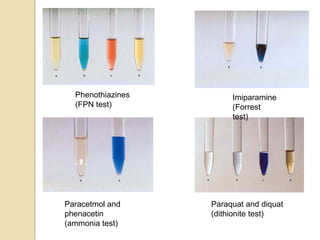
Phenothiazines
(FPN test)

Paracetmol and
phenacetin
(ammonia test)

Imiparamine
(Forrest
test)

Paraquat and diquat
(dithionite test)
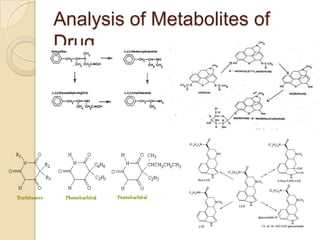
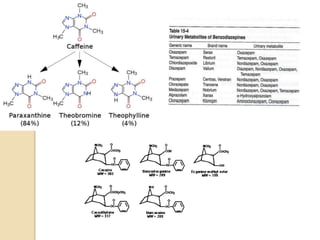
Analysis of Metabolites of
Drug
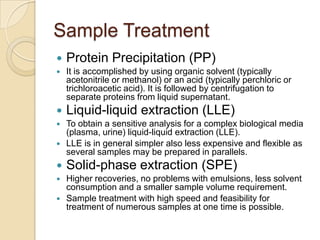
Sample Treatment


Protein Precipitation (PP)



It is accomplished by using organic solvent (typically
acetonitrile or methanol) or an acid (typically perchloric or
trichloroacetic acid). It is followed by centrifugation to
separate proteins from liquid supernatant.



Liquid-liquid extraction (LLE)



To obtain a sensitive analysis for a complex biological media
(plasma, urine) liquid-liquid extraction (LLE).
LLE is in general simpler also less expensive and flexible as
several samples may be prepared in parallels.





Solid-phase extraction (SPE)



Higher recoveries, no problems with emulsions, less solvent
consumption and a smaller sample volume requirement.
Sample treatment with high speed and feasibility for
treatment of numerous samples at one time is possible.


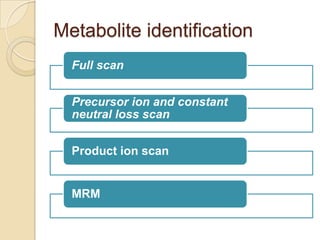
Metabolite identification
Full scan
Precursor ion and constant
neutral loss scan
Product ion scan

MRM
Metabolite Determination



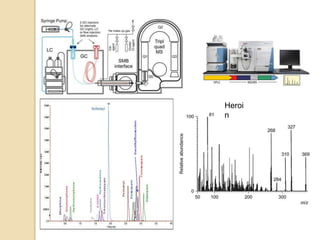
LC-MS/MS
Reversed phase chromatography

Reversed phase chromatography is most widely used technique in analysis of drugs
and their metabolites due to its extensive application to most small molecules which
are separated by their degree of hydrophobic interaction with the stationary phase.
 An increased polarity of the metabolite decreased retention on the stationary phase.
 For polar metabolites short chain bonded phases, such as C 8, phenyl or cyano are
more appropriate. Add ion-paring reagent into mobile phase.




Ultra-high performance liquid chromatography
(UHPLC)

For fast analyses using sub-2μm particle column dimensions are typically 50x2 mm.
An additional benefit of UHPLC is the low consumption of mobile phase, where it
saves at least 80% compared to HPLC.
 Advantages as enhanced separation efficiency, short analysis time and high detection
sensitivity make UHPLC coupled with MS/MS an even more powerful analytical
support in pharmacokinetic studies.

 GC-MS



The GC-MS analysis of polar compounds, such as metabolites, from biological
matrices requires analytes extraction into a volatile organic solvent.
time-consuming sample preparation including derivatization to become stable,
volatile and amenable to the ionization technique.

 Capillary electrophoresis (CE)




CE in many instances can have distinct advantages over HPLC in terms of
simplicity, rapid method development, solvent saving and minimal sample
requirement [10-30 nL injected] making this technique very interesting for rapid
and practical analyses in the biomedical field.
But have less sensitivity.

 Mass






spectrometry

Separate ion according to m/z ratio.
Currently, the QQQ using single or multiple reaction monitoring is most often
used for quantitative analysis of metabolites.
SIM suffers from insufficient selectivity in comparison with MRM.
And also much lower sensitivity.
IT and TOF analyzers are also used for metabolite determination or use
combined with QQQ (Qtrap, Q-TOF).
Heroi
n
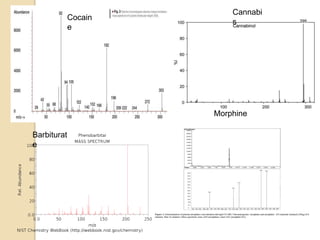
Cocain
e

Cannabi
s

Morphine

Barbiturat
e
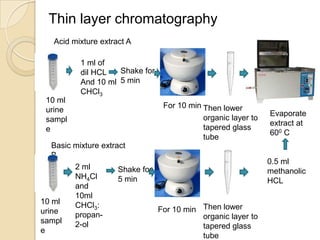
Thin layer chromatography
Acid mixture extract A

10 ml
urine
sampl
e

1 ml of
Shake for
dil HCL
And 10 ml 5 min
CHCl3
For 10 min Then lower
organic layer to
tapered glass
tube

Basic mixture extract
B
2 ml
Shake for
NH4Cl
5 min
and
10ml
10 ml
CHCl3:
For 10 min Then lower
urine
propanorganic layer to
sampl
2-ol
tapered glass
e
tube

Evaporate
extract at
600 C

0.5 ml
methanolic
HCL
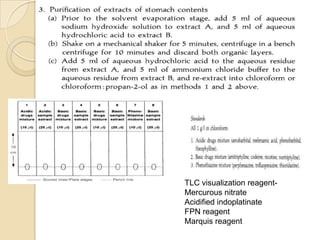
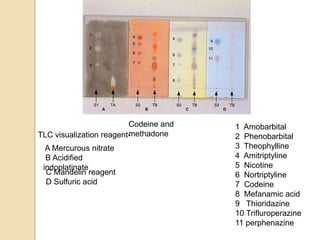
TLC visualization reagentMercurous nitrate
Acidified indoplatinate
FPN reagent
Marquis reagent
Codeine and
methadone
TLC visualization reagentA Mercurous nitrate
B Acidified
indoplatinate
C Mandelin reagent
D Sulfuric acid

1 Amobarbital
2 Phenobarbital
3 Theophylline
4 Amitriptyline
5 Nicotine
6 Nortriptyline
7 Codeine
8 Mefanamic acid
9 Thioridazine
10 Trifluroperazine
11 perphenazine
Analysis of stomach content
Clinical interpretation
Arsenic
Acute poising of Arsenic causes abdominal pain, vomiting,
bloody diarrhoea, massive haemolysis.

Mercury
Mercury vapors cause stomatitis, increased salivation,
metallic taste, diarrhoea, pneumonitis, renal failure.
Mercury salts may cause gastric pain, vomiting.
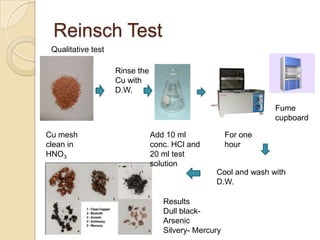
Reinsch Test
Qualitative test
Rinse the
Cu with
D.W.
Fume
cupboard

Cu mesh
clean in
HNO3

Add 10 ml
conc. HCl and
20 ml test
solution

For one
hour

Cool and wash with
D.W.
Results
Dull blackArsenic
Silvery- Mercury
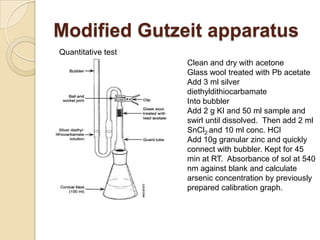
Modified Gutzeit apparatus
Quantitative test
Clean and dry with acetone
Glass wool treated with Pb acetate
Add 3 ml silver
diethyldithiocarbamate
Into bubbler
Add 2 g KI and 50 ml sample and
swirl until dissolved. Then add 2 ml
SnCl2 and 10 ml conc. HCl
Add 10g granular zinc and quickly
connect with bubbler. Kept for 45
min at RT. Absorbance of sol at 540
nm against blank and calculate
arsenic concentration by previously
prepared calibration graph.
Cyanide


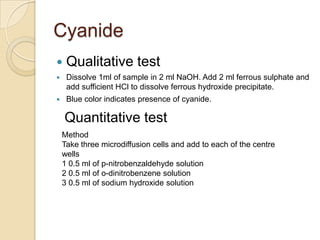
Qualitative test



Dissolve 1ml of sample in 2 ml NaOH. Add 2 ml ferrous sulphate and
add sufficient HCl to dissolve ferrous hydroxide precipitate.



Blue color indicates presence of cyanide.

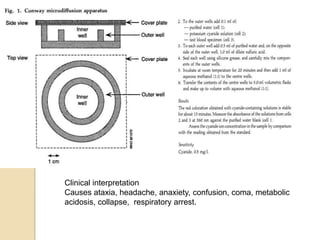
Quantitative test
Method
Take three microdiffusion cells and add to each of the centre
wells
1 0.5 ml of p-nitrobenzaldehyde solution
2 0.5 ml of o-dinitrobenzene solution
3 0.5 ml of sodium hydroxide solution
Clinical interpretation
Causes ataxia, headache, anaxiety, confusion, coma, metabolic
acidosis, collapse, respiratory arrest.
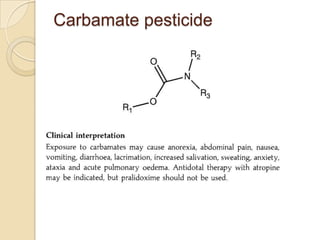
Carbamate pesticide
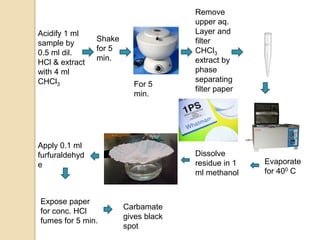
Acidify 1 ml
sample by
0.5 ml dil.
HCl & extract
with 4 ml
CHCl3

Shake
for 5
min.

For 5
min.

Apply 0.1 ml
furfuraldehyd
e

Expose paper
for conc. HCl
fumes for 5 min.

Remove
upper aq.
Layer and
filter
CHCl3
extract by
phase
separating
filter paper

Dissolve
residue in 1
ml methanol

Carbamate
gives black
spot

Evaporate
for 400 C
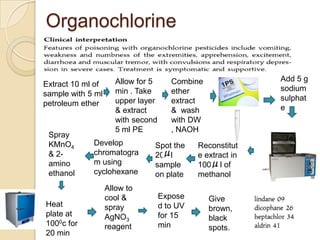
Organochlorine

Extract 10 ml of
sample with 5 ml
petroleum ether

Spray
KMnO4
& 2amino
ethanol

Heat
plate at
1000c for
20 min

Allow for 5
min . Take
upper layer
& extract
with second
5 ml PE

Add 5 g
sodium
sulphat
e

Combine
ether
extract
& wash
with DW
, NAOH

Develop
chromatogra
m using
cyclohexane

Spot the
20 l
sample
on plate

Allow to
cool &
spray
AgNO3
reagent

Expose
d to UV
for 15
min

Reconstitut
e extract in
100 l of
methanol
Give
brown,
black
spots.
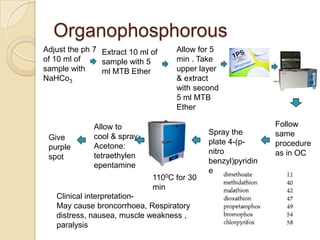
Organophosphorous
Adjust the ph 7 Extract 10 ml of
of 10 ml of
sample with 5
sample with
ml MTB Ether
NaHCo3

Give
purple
spot

Allow for 5
min . Take
upper layer
& extract
with second
5 ml MTB
Ether

Allow to
cool & spray
Acetone:
tetraethylen
epentamine
1100C for 30
min

Clinical interpretationMay cause broncorrhoea, Respiratory
distress, nausea, muscle weakness ,
paralysis

Spray the
plate 4-(pnitro
benzyl)pyridin
e

Follow
same
procedure
as in OC
Reference
www.who.int/ipcs/publications/training.../analytical_toxicology.pdf
jat.oxfordjournals.org/

http://dx.doi.org/10.5772/51676
en.wikipedia.org/wiki/Journal_of_Analytical_Toxicology
Analytical toxicology

Analytical toxicology

  • 1.
  • 3.
    Phenothiazines (FPN test) Paracetmol and phenacetin (ammoniatest) Imiparamine (Forrest test) Paraquat and diquat (dithionite test)
  • 4.
  • 6.
    Sample Treatment  Protein Precipitation(PP)  It is accomplished by using organic solvent (typically acetonitrile or methanol) or an acid (typically perchloric or trichloroacetic acid). It is followed by centrifugation to separate proteins from liquid supernatant.  Liquid-liquid extraction (LLE)  To obtain a sensitive analysis for a complex biological media (plasma, urine) liquid-liquid extraction (LLE). LLE is in general simpler also less expensive and flexible as several samples may be prepared in parallels.   Solid-phase extraction (SPE)  Higher recoveries, no problems with emulsions, less solvent consumption and a smaller sample volume requirement. Sample treatment with high speed and feasibility for treatment of numerous samples at one time is possible. 
  • 7.
    Metabolite identification Full scan Precursorion and constant neutral loss scan Product ion scan MRM
  • 8.
    Metabolite Determination   LC-MS/MS Reversed phasechromatography Reversed phase chromatography is most widely used technique in analysis of drugs and their metabolites due to its extensive application to most small molecules which are separated by their degree of hydrophobic interaction with the stationary phase.  An increased polarity of the metabolite decreased retention on the stationary phase.  For polar metabolites short chain bonded phases, such as C 8, phenyl or cyano are more appropriate. Add ion-paring reagent into mobile phase.   Ultra-high performance liquid chromatography (UHPLC) For fast analyses using sub-2μm particle column dimensions are typically 50x2 mm. An additional benefit of UHPLC is the low consumption of mobile phase, where it saves at least 80% compared to HPLC.  Advantages as enhanced separation efficiency, short analysis time and high detection sensitivity make UHPLC coupled with MS/MS an even more powerful analytical support in pharmacokinetic studies. 
  • 9.
     GC-MS   The GC-MSanalysis of polar compounds, such as metabolites, from biological matrices requires analytes extraction into a volatile organic solvent. time-consuming sample preparation including derivatization to become stable, volatile and amenable to the ionization technique.  Capillary electrophoresis (CE)   CE in many instances can have distinct advantages over HPLC in terms of simplicity, rapid method development, solvent saving and minimal sample requirement [10-30 nL injected] making this technique very interesting for rapid and practical analyses in the biomedical field. But have less sensitivity.  Mass      spectrometry Separate ion according to m/z ratio. Currently, the QQQ using single or multiple reaction monitoring is most often used for quantitative analysis of metabolites. SIM suffers from insufficient selectivity in comparison with MRM. And also much lower sensitivity. IT and TOF analyzers are also used for metabolite determination or use combined with QQQ (Qtrap, Q-TOF).
  • 10.
  • 11.
  • 12.
    Thin layer chromatography Acidmixture extract A 10 ml urine sampl e 1 ml of Shake for dil HCL And 10 ml 5 min CHCl3 For 10 min Then lower organic layer to tapered glass tube Basic mixture extract B 2 ml Shake for NH4Cl 5 min and 10ml 10 ml CHCl3: For 10 min Then lower urine propanorganic layer to sampl 2-ol tapered glass e tube Evaporate extract at 600 C 0.5 ml methanolic HCL
  • 13.
    TLC visualization reagentMercurousnitrate Acidified indoplatinate FPN reagent Marquis reagent
  • 14.
    Codeine and methadone TLC visualizationreagentA Mercurous nitrate B Acidified indoplatinate C Mandelin reagent D Sulfuric acid 1 Amobarbital 2 Phenobarbital 3 Theophylline 4 Amitriptyline 5 Nicotine 6 Nortriptyline 7 Codeine 8 Mefanamic acid 9 Thioridazine 10 Trifluroperazine 11 perphenazine
  • 15.
    Analysis of stomachcontent Clinical interpretation Arsenic Acute poising of Arsenic causes abdominal pain, vomiting, bloody diarrhoea, massive haemolysis. Mercury Mercury vapors cause stomatitis, increased salivation, metallic taste, diarrhoea, pneumonitis, renal failure. Mercury salts may cause gastric pain, vomiting.
  • 16.
    Reinsch Test Qualitative test Rinsethe Cu with D.W. Fume cupboard Cu mesh clean in HNO3 Add 10 ml conc. HCl and 20 ml test solution For one hour Cool and wash with D.W. Results Dull blackArsenic Silvery- Mercury
  • 17.
    Modified Gutzeit apparatus Quantitativetest Clean and dry with acetone Glass wool treated with Pb acetate Add 3 ml silver diethyldithiocarbamate Into bubbler Add 2 g KI and 50 ml sample and swirl until dissolved. Then add 2 ml SnCl2 and 10 ml conc. HCl Add 10g granular zinc and quickly connect with bubbler. Kept for 45 min at RT. Absorbance of sol at 540 nm against blank and calculate arsenic concentration by previously prepared calibration graph.
  • 18.
    Cyanide  Qualitative test  Dissolve 1mlof sample in 2 ml NaOH. Add 2 ml ferrous sulphate and add sufficient HCl to dissolve ferrous hydroxide precipitate.  Blue color indicates presence of cyanide. Quantitative test Method Take three microdiffusion cells and add to each of the centre wells 1 0.5 ml of p-nitrobenzaldehyde solution 2 0.5 ml of o-dinitrobenzene solution 3 0.5 ml of sodium hydroxide solution
  • 19.
    Clinical interpretation Causes ataxia,headache, anaxiety, confusion, coma, metabolic acidosis, collapse, respiratory arrest.
  • 20.
  • 21.
    Acidify 1 ml sampleby 0.5 ml dil. HCl & extract with 4 ml CHCl3 Shake for 5 min. For 5 min. Apply 0.1 ml furfuraldehyd e Expose paper for conc. HCl fumes for 5 min. Remove upper aq. Layer and filter CHCl3 extract by phase separating filter paper Dissolve residue in 1 ml methanol Carbamate gives black spot Evaporate for 400 C
  • 22.
    Organochlorine Extract 10 mlof sample with 5 ml petroleum ether Spray KMnO4 & 2amino ethanol Heat plate at 1000c for 20 min Allow for 5 min . Take upper layer & extract with second 5 ml PE Add 5 g sodium sulphat e Combine ether extract & wash with DW , NAOH Develop chromatogra m using cyclohexane Spot the 20 l sample on plate Allow to cool & spray AgNO3 reagent Expose d to UV for 15 min Reconstitut e extract in 100 l of methanol Give brown, black spots.
  • 23.
    Organophosphorous Adjust the ph7 Extract 10 ml of of 10 ml of sample with 5 sample with ml MTB Ether NaHCo3 Give purple spot Allow for 5 min . Take upper layer & extract with second 5 ml MTB Ether Allow to cool & spray Acetone: tetraethylen epentamine 1100C for 30 min Clinical interpretationMay cause broncorrhoea, Respiratory distress, nausea, muscle weakness , paralysis Spray the plate 4-(pnitro benzyl)pyridin e Follow same procedure as in OC
  • 25.