GOMATHI’S

TOXICOLOGY




TOXICOLOGY – STUDY OF POISONS
(GREEK WORDS)

TOXICAN – POISON

?

LOGOS – STUDY
………..



“All substances are poisons; there is none

which is not a poison. The right dose
differentiate a poison and a remedy”
- Paracelsus (Grand Father of Toxicology)
INTRODUCTION


Toxic – the chemical/physical
agent/substances having the characteristic of
producing an undesirable or adverse health
effects.



Toxicity – the ability of a toxic to cause
adverse effects in living organisms.
DEFINITION - TOXICOLOGY


The science that deals with the study of the
adverse effects chemicals/physical agents
may produce in living organisms under
specific conditions of exposure.



It is the science that attempts to qualitatively
identify all the hazard as well as to
quantitatively determine the exposure
conditions.
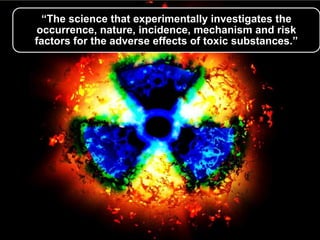
“The science that experimentally investigates the
occurrence, nature, incidence, mechanism and risk
factors for the adverse effects of toxic substances.”
HISTORY
The knowledge of poison substance (venom
& plant extracts) –ancient periods – hunting.
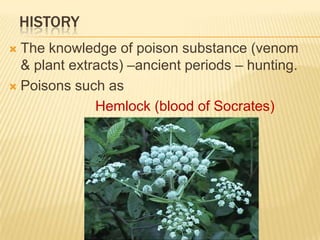
 Poisons such as
Hemlock (blood of Socrates)

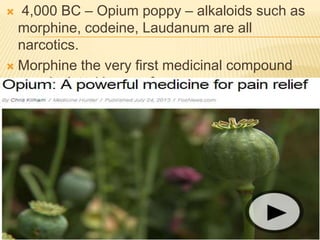
4,000 BC – Opium poppy – alkaloids such as
morphine, codeine, Laudanum are all
narcotics.
 Morphine the very first medicinal compound
ever isolated in pure form.



In 9th century Dioscorides, a Greek physician
– classified poison
1. Plant poisons
2. Animal poisons
3. Mineral poisons
Paracelsus (1493) - contributed greatly to
the fields of medicine and toxicology - the
use of chemicals and minerals in
medicine, (First Coined “Zinc”)
 Certain illnesses of the body had chemical
remedies that could cure them.
 He was, therefore, a precursor to modernday medicine and to the use of vitamins and
minerals to maintain health.

Mathieu Orfila - Modern father of toxicology
 First formal treatment – experimental
toxicology laid down great success to
pharmacology in 1813.
 In 1815 Magendia - done atopsy & chemical
toxicants and explain the mechanism of
action of emitine & strychine –
absorption, distribution of the compounds.

1850’s- advent of anesthetics & disinfectants
began to understand.
 During 1900, discovery of radioactivity &
vitamins.
 NIH- National Institute of Health assigned NIDA –
National Institute of Drug Abuse.


FDA ASSIGNED U.S PESTICIDE ACT – 1947
 1950’S additives of food, drugs, cosmetics Act
passed.
 Many toxicological
journals, professional, governmental & other
scientific organizations begins to broadcast

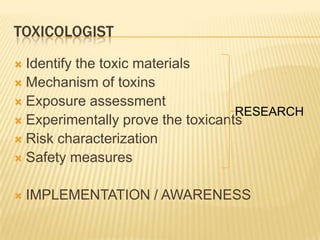
TOXICOLOGIST
Identify the toxic materials
 Mechanism of toxins
 Exposure assessment
RESEARCH
 Experimentally prove the toxicants
 Risk characterization
 Safety measures




IMPLEMENTATION / AWARENESS


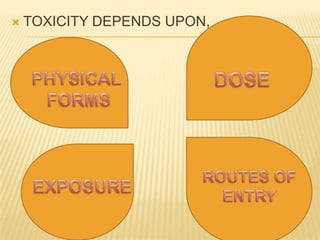
TOXICITY DEPENDS UPON,
MEASURES OF TOXICITY
 Toxicity

is measured as clinical
“endpoints” which include
 Mortality

(death)
 Teratogenicity (ability to cause birth
defects)
 Carcinogenicity (ability to cause cancer)
 Mutagenicity (ability to cause heritable
change in the DNA)
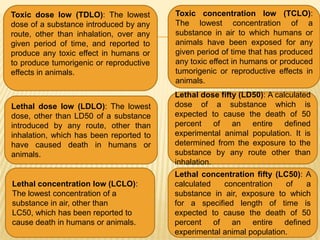
Toxic dose low (TDLO): The lowest
dose of a substance introduced by any
route, other than inhalation, over any
given period of time, and reported to
produce any toxic effect in humans or
to produce tumorigenic or reproductive
effects in animals.

Toxic concentration low (TCLO):
The lowest concentration of a
substance in air to which humans or
animals have been exposed for any
given period of time that has produced
any toxic effect in humans or produced
tumorigenic or reproductive effects in
animals.

Lethal dose low (LDLO): The lowest
dose, other than LD50 of a substance
introduced by any route, other than
inhalation, which has been reported to
have caused death in humans or
animals.

Lethal dose fifty (LD50): A calculated
dose of a substance which is
expected to cause the death of 50
percent of an entire defined
experimental animal population. It is
determined from the exposure to the
substance by any route other than
inhalation.

Lethal concentration low (LCLO):
The lowest concentration of a
substance in air, other than
LC50, which has been reported to
cause death in humans or animals.

Lethal concentration fifty (LC50): A
calculated
concentration
of
a
substance in air, exposure to which
for a specified length of time is
expected to cause the death of 50
percent of an entire defined
experimental animal population.
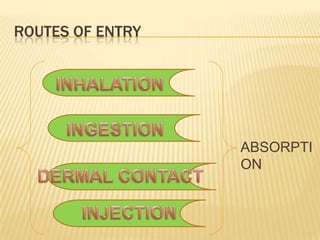
ROUTES OF ENTRY

ABSORPTI
ON
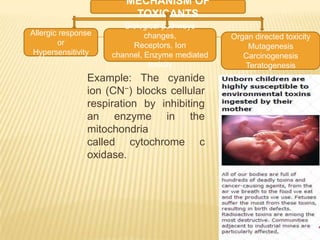
MECHANISM OF
TOXICANTS
Allergic response
or
Hypersensitivity

Biological pathways
changes,
Receptors, Ion
channel, Enzyme mediated
toxicity

Example: The cyanide
ion (CN−) blocks cellular
respiration by inhibiting
an enzyme in the
mitochondria
called cytochrome c
oxidase.

Organ directed toxicity
Mutagenesis
Carcinogenesis
Teratogenesis
R
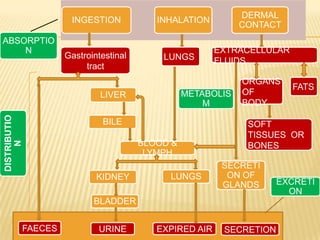
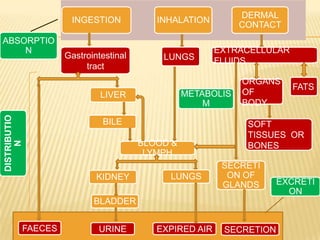
INGESTION
ABSORPTIO
N

Gastrointestinal
tract

LUNGS

DISTRIBUTIO
N

EXTRACELLULAR
FLUIDS

METABOLIS
M

LIVER
BILE
BLOOD &
LYMPH
KIDNEY

DERMAL
CONTACT

INHALATION

LUNGS

ORGANS
OF
BODY

SOFT
TISSUES OR
BONES
SECRETI
ON OF
GLANDS

BLADDER
FAECES

URINE

EXPIRED AIR

FATS

SECRETION

EXCRETI
ON
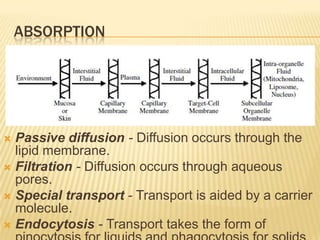
ABSORPTION

Passive diffusion - Diffusion occurs through the
lipid membrane.
 Filtration - Diffusion occurs through aqueous
pores.
 Special transport - Transport is aided by a carrier
molecule.
 Endocytosis - Transport takes the form of

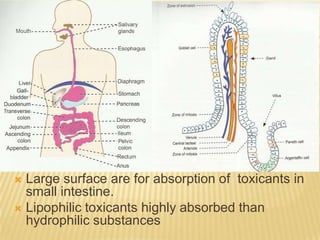
Large surface are for absorption of toxicants in
small intestine.
 Lipophilic toxicants highly absorbed than
hydrophilic substances

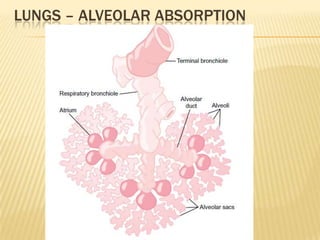
LUNGS – ALVEOLAR ABSORPTION
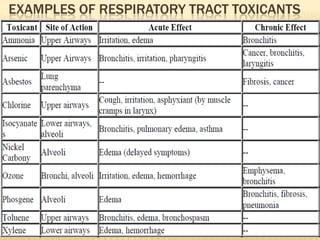
EXAMPLES OF RESPIRATORY TRACT TOXICANTS
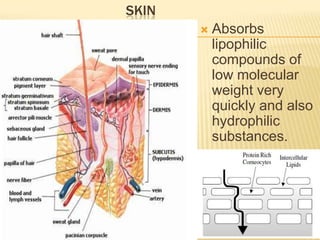
SKIN


Absorbs
lipophilic
compounds of
low molecular
weight very
quickly and also
hydrophilic
substances.
KINETICS OF ABSORPTION









Rate of absorption of toxic depends upon the nature
of chemicals and their site of administration.
Rate of absorption more for lipid – soluble molecules
and slow for strong acids and bases.
First order process: at low doses, rate of reaction is
directly proportional to the amount of toxicant
present.
Zero order process: as the concentration of
substances increase, a point may be reached at
which there is no further increase in rate of
absorption.
Extent of absorption depends on the bioavailability of
the substance.
INGESTION
ABSORPTIO
N

Gastrointestinal
tract

LUNGS

DISTRIBUTIO
N

EXTRACELLULAR
FLUIDS

METABOLIS
M

LIVER
BILE
BLOOD &
LYMPH
KIDNEY

DERMAL
CONTACT

INHALATION

LUNGS

ORGANS
OF
BODY

SOFT
TISSUES OR
BONES
SECRETI
ON OF
GLANDS

BLADDER
FAECES

URINE

EXPIRED AIR

FATS

SECRETION

EXCRETI
ON
DISTRIBUTION
Rate of distribution is rapid in plasma but slow
in tissues.
 Extent of distribution related to apparent
volume of distribution (V).
V = Ab
C
 Ab – total quantity of toxicants in the body
 C – plasma concentration
 Volume of distribution actual space in which
toxicants distributed.
Vd = D (dose
administered)
Cp

INGESTION
ABSORPTIO
N

Gastrointestinal
tract

LUNGS

DISTRIBUTIO
N

EXTRACELLULAR
FLUIDS

METABOLIS
M

LIVER
BILE
BLOOD &
LYMPH
KIDNEY

DERMAL
CONTACT

INHALATION

LUNGS

ORGANS
OF
BODY

SOFT
TISSUES OR
BONES
SECRETI
ON OF
GLANDS

BLADDER
FAECES

URINE

EXPIRED AIR

FATS

SECRETION

EXCRETI
ON
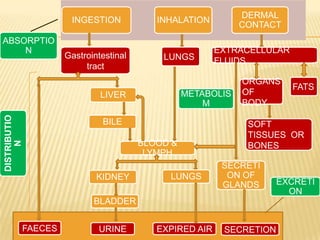
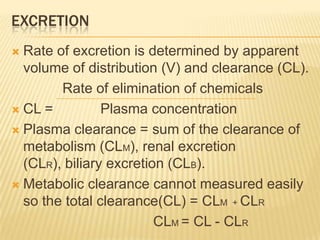
EXCRETION
Rate of excretion is determined by apparent
volume of distribution (V) and clearance (CL).
Rate of elimination of chemicals
 CL =
Plasma concentration
 Plasma clearance = sum of the clearance of
metabolism (CLM), renal excretion
(CLR), biliary excretion (CLB).
 Metabolic clearance cannot measured easily
so the total clearance(CL) = CLM + CLR
CLM = CL - CLR

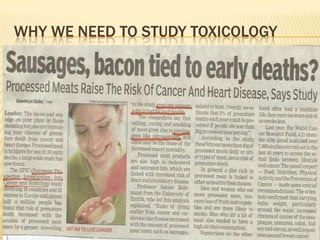
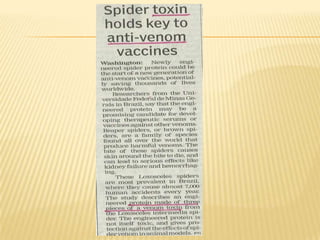
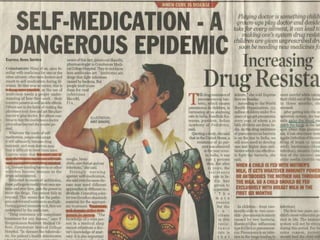
WHY WE NEED TO STUDY TOXICOLOGY
NOT FOR………….
Toxicology
Toxicology
Toxicology
Toxicology

Toxicology

  • 1.
  • 2.
      TOXICOLOGY – STUDYOF POISONS (GREEK WORDS) TOXICAN – POISON ? LOGOS – STUDY
  • 5.
    ………..  “All substances arepoisons; there is none which is not a poison. The right dose differentiate a poison and a remedy” - Paracelsus (Grand Father of Toxicology)
  • 6.
    INTRODUCTION  Toxic – thechemical/physical agent/substances having the characteristic of producing an undesirable or adverse health effects.  Toxicity – the ability of a toxic to cause adverse effects in living organisms.
  • 7.
    DEFINITION - TOXICOLOGY  Thescience that deals with the study of the adverse effects chemicals/physical agents may produce in living organisms under specific conditions of exposure.  It is the science that attempts to qualitatively identify all the hazard as well as to quantitatively determine the exposure conditions.
  • 8.
    “The science thatexperimentally investigates the occurrence, nature, incidence, mechanism and risk factors for the adverse effects of toxic substances.”
  • 9.
    HISTORY The knowledge ofpoison substance (venom & plant extracts) –ancient periods – hunting.  Poisons such as Hemlock (blood of Socrates) 
  • 10.
    4,000 BC –Opium poppy – alkaloids such as morphine, codeine, Laudanum are all narcotics.  Morphine the very first medicinal compound ever isolated in pure form. 
  • 11.
     In 9th centuryDioscorides, a Greek physician – classified poison 1. Plant poisons 2. Animal poisons 3. Mineral poisons
  • 12.
    Paracelsus (1493) -contributed greatly to the fields of medicine and toxicology - the use of chemicals and minerals in medicine, (First Coined “Zinc”)  Certain illnesses of the body had chemical remedies that could cure them.  He was, therefore, a precursor to modernday medicine and to the use of vitamins and minerals to maintain health. 
  • 13.
    Mathieu Orfila -Modern father of toxicology  First formal treatment – experimental toxicology laid down great success to pharmacology in 1813.  In 1815 Magendia - done atopsy & chemical toxicants and explain the mechanism of action of emitine & strychine – absorption, distribution of the compounds. 
  • 14.
    1850’s- advent ofanesthetics & disinfectants began to understand.  During 1900, discovery of radioactivity & vitamins.  NIH- National Institute of Health assigned NIDA – National Institute of Drug Abuse.  FDA ASSIGNED U.S PESTICIDE ACT – 1947  1950’S additives of food, drugs, cosmetics Act passed.  Many toxicological journals, professional, governmental & other scientific organizations begins to broadcast 
  • 15.
    TOXICOLOGIST Identify the toxicmaterials  Mechanism of toxins  Exposure assessment RESEARCH  Experimentally prove the toxicants  Risk characterization  Safety measures   IMPLEMENTATION / AWARENESS
  • 16.
  • 17.
    MEASURES OF TOXICITY Toxicity is measured as clinical “endpoints” which include  Mortality (death)  Teratogenicity (ability to cause birth defects)  Carcinogenicity (ability to cause cancer)  Mutagenicity (ability to cause heritable change in the DNA)
  • 18.
    Toxic dose low(TDLO): The lowest dose of a substance introduced by any route, other than inhalation, over any given period of time, and reported to produce any toxic effect in humans or to produce tumorigenic or reproductive effects in animals. Toxic concentration low (TCLO): The lowest concentration of a substance in air to which humans or animals have been exposed for any given period of time that has produced any toxic effect in humans or produced tumorigenic or reproductive effects in animals. Lethal dose low (LDLO): The lowest dose, other than LD50 of a substance introduced by any route, other than inhalation, which has been reported to have caused death in humans or animals. Lethal dose fifty (LD50): A calculated dose of a substance which is expected to cause the death of 50 percent of an entire defined experimental animal population. It is determined from the exposure to the substance by any route other than inhalation. Lethal concentration low (LCLO): The lowest concentration of a substance in air, other than LC50, which has been reported to cause death in humans or animals. Lethal concentration fifty (LC50): A calculated concentration of a substance in air, exposure to which for a specified length of time is expected to cause the death of 50 percent of an entire defined experimental animal population.
  • 19.
  • 20.
    MECHANISM OF TOXICANTS Allergic response or Hypersensitivity Biologicalpathways changes, Receptors, Ion channel, Enzyme mediated toxicity Example: The cyanide ion (CN−) blocks cellular respiration by inhibiting an enzyme in the mitochondria called cytochrome c oxidase. Organ directed toxicity Mutagenesis Carcinogenesis Teratogenesis
  • 21.
  • 22.
  • 24.
    ABSORPTION Passive diffusion -Diffusion occurs through the lipid membrane.  Filtration - Diffusion occurs through aqueous pores.  Special transport - Transport is aided by a carrier molecule.  Endocytosis - Transport takes the form of 
  • 25.
    Large surface arefor absorption of toxicants in small intestine.  Lipophilic toxicants highly absorbed than hydrophilic substances 
  • 26.
  • 27.
    EXAMPLES OF RESPIRATORYTRACT TOXICANTS
  • 28.
    SKIN  Absorbs lipophilic compounds of low molecular weightvery quickly and also hydrophilic substances.
  • 29.
    KINETICS OF ABSORPTION      Rateof absorption of toxic depends upon the nature of chemicals and their site of administration. Rate of absorption more for lipid – soluble molecules and slow for strong acids and bases. First order process: at low doses, rate of reaction is directly proportional to the amount of toxicant present. Zero order process: as the concentration of substances increase, a point may be reached at which there is no further increase in rate of absorption. Extent of absorption depends on the bioavailability of the substance.
  • 30.
  • 31.
    DISTRIBUTION Rate of distributionis rapid in plasma but slow in tissues.  Extent of distribution related to apparent volume of distribution (V). V = Ab C  Ab – total quantity of toxicants in the body  C – plasma concentration  Volume of distribution actual space in which toxicants distributed. Vd = D (dose administered) Cp 
  • 32.
  • 33.
    EXCRETION Rate of excretionis determined by apparent volume of distribution (V) and clearance (CL). Rate of elimination of chemicals  CL = Plasma concentration  Plasma clearance = sum of the clearance of metabolism (CLM), renal excretion (CLR), biliary excretion (CLB).  Metabolic clearance cannot measured easily so the total clearance(CL) = CLM + CLR CLM = CL - CLR 
  • 34.
    WHY WE NEEDTO STUDY TOXICOLOGY
  • 36.