Bule Hora University
College of Health and Medical Sciences
Department Of Pharmacy
Integrated Physical Pharmacy and Pharmaceutics I
Chapter 6
Pharmaceutical Solutions
By: Aliyi Gerina [B.pharm]
4/5/2022 Pharmaceutical Solution b yAliyi Gerina
Bule Hora University
1
Out Line
• Introduction
• Formulation of solutions (API and Excipients)
• General methods of preparation
• Solutions taken orally
• Solutions used in the mouth and throat
• Solutions instilled into body cavities
• Topical solutions
• Injectables (sterile products)
4/5/2022
Pharmaceutical Solution b yAliyi Gerina
Bule Hora University
2
Introduction
4/5/2022
Pharmaceutical Solution b yAliyi Gerina
Bule Hora University
3
Aqueous
solutions
Non-aqueous
solutions
Suspensions Colloids
Emulsions
Liquid Dosage
Forms
Monophasic
Liquid DFs
(Solutions)
Poly-phasic
Liquid DFs
4/5/2022
Pharmaceutical Solution b yAliyi Gerina
Bule Hora University
4
Introduction…
o Solution: solutions are clear Liquid preparations containing one or more
active ingredients dissolved in a suitable vehicle.
o Colloids: A system in which finely divided particles, which are 1 nm - 0.5
µm in size, are dispersed within a continuous medium in a manner that
prevents them from being settled rapidly.
o Suspension: (Solid in Liquid dispersion) Liquid preparations containing one
or more active ingredients suspended in a suitable vehicle.
o Emulsion (Liquid in Liquid dispersion): Emulsions are two phase system in
which one liquid is dispersed through out another liquid in the form of small
droplets.
4
Introduction…
 Solution:
 Is a homogeneous mixture composed of two or more substances
 One substance (solute) is dissolved in another substance (solvent).
 The solute is the component present in the smallest amount
 The solvent is the larger liquid component.
 The solute is dispersed throughout the solvent in molecular or ionic sized particles.
 It is a thermodynamically stable, one-phase system.
4/5/2022
Pharmaceutical Solution b yAliyi Gerina
Bule Hora University
5
Introduction…
 Steps in making a Solution
1) Breaking up the solute into individual components:
=>expanding the solute
1) Overcoming intermolecular forces in the solvent to make room for the
solute:
=>expanding the solvent
1) Allowing the solvent and solute to interact
=> form the solution
4/5/2022
Pharmaceutical Solution b yAliyi Gerina
Bule Hora University
6
Advantages and Disadvantages
 Advantages
 Ease of administration
 Faster absorption.
 Uniform dosage.
 Provide safe means of
administering certain substances
 like potassium iodide and bromide
that cause gastric pain if taken dry.
 Have attractive appearance-
 psychological effect.
 Dis Advantages
 They are less stable than solid DFs.
 Unpleasant flavours can be difficult
to mask.
 They are bulky to transport.
 A spoon is needed to administer the
dose.
 Accidental breakage to the container
results in complete and messy loss of
the contents..
4/5/2022
Pharmaceutical Solution b yAliyi Gerina
Bule Hora University
7
Classification of Solutions
4/5/2022
Pharmaceutical Solution b yAliyi Gerina
Bule Hora University
8
Pharma
Solutions
Used in the mouth
and throat
Applied to body
surfaces
Taken orally
Instilled into
body cavities
 Syrups
 Elixirs
 Spirits
 Linctuses
 Mouth Washes
 Gargles
 Throat Paints
 Throat Sprays
 Douches
 Enemas
 Ear Drops
 Nasal Drops
 Nasal Sprays
 Collodions
 Liniments
 Lotions
 Paints
 Based on route of administration
Classification of Solutions…
4/5/2022
Pharmaceutical Solution b yAliyi Gerina
Bule Hora University
9
Pharma
Solutions
Aqueous
solutions
Non-aqueous
solutions
 Douches
 Enemas
 Gargles
 Mouth washes
 Nasal Washes
 Sprays
 Otic Solutions
 Inhalations
 Elixirs
 Spirits
 Collodions
 Glycerins
 Lotions
 Liniments
 Based on vehicle used
Sweet or
Viscid
 Syrups
Pharmaceutical Applications
 Solutions have a wide variety of
uses in the pharmaceutical industry.
 They are used therapeutically as
vehicles for:
 Oral
 Parenteral
 Topical
 Otic
 Ophthalmic
 Nasal products
 They are also used as:
 Flavorings
 Buffers
 Preservatives and
 Suspending agents for a
variety of liquid dosage forms
4/5/2022
Pharmaceutical Solution b yAliyi Gerina
Bule Hora University
10
Solvents for solution preparation
 Solvent selection is based on:
 Solubility
 Clarity
 Toxicity
 Viscosity
 Compatibility with excipients
 Chemical inertness
 Palatability
 Odor
 Color and
 Economy.
 In most cases,
 water is the preferred solvent.
 It meets the majority of the above criteria.
4/5/2022
Pharmaceutical Solution b yAliyi Gerina
Bule Hora University
11
Solvents for solution preparation…
Water:
 The major ingredient in most of liquid dosage forms is water.
 It is used both as a vehicle and as a solvent.
Advantages:
oTastelessness,
ofreedom from irritating qualities and
olack of pharmacological activity make it ideal for such purposes.
Disadvantages:
• Favorable medium for some chemical reactions, and
• Supports the growth of microorganisms when contaminated.
4/5/2022
Pharmaceutical Solution b yAliyi Gerina
Bule Hora University
12
Solvents for solution preparation…
 The USP recognizes six types of water for the preparation of dosage
forms.
1) Purified water
2) Water for injection
3) Sterile water for injection
4) Bacteriostatic water for injection
5) Sterile water for inhalation
6) Sterile water for irrigation
4/5/2022
Pharmaceutical Solution b yAliyi Gerina
Bule Hora University
13
Solvents for solution preparation…
 Purified water:
• The preferred and most commonly used vehicle in the solutions.
 The source or feed water for the production of purified water is
drinking water.
 It must meet the requirements for ionic and organic chemical purity
 It must be protected from microbial contamination.
 It should be protected from recontamination and microbial
proliferation.
 It is used in as an excipient in the
 production of non-parenteral and non ophthalmic products.
 It is also used for
 cleaning of certain equipment’s and non-parenteral product-contact
components.
 Commonly produced by:
 Ion Exchange
 Reverse Osmosis (RO) and
 Distillation
4/5/2022
Pharmaceutical Solution b yAliyi Gerina
Bule Hora University
14
Solvents for solution preparation…
a. Distillation
o Separation method based on boiling point
difference.
o Generally, the first portion of aqueous
distillate (10% to 20%) must be discarded
o the last portion of water (10% of the original
volume of water) remaining in the distillation
apparatus must be discarded.
4/5/2022
Pharmaceutical Solution b yAliyi Gerina
Bule Hora University
15
Solvents for solution preparation…
b. Ion Exchange Method
o The ion exchange equipment generally passes water through a column of cation
and anion exchangers
o consisting of water insoluble synthetic polymerized phenolic, carboxylic, amino, or sulfonated
resins of high molecular weight.
o These resins are mainly two types:
 the cations, or acid exchangers
 the anions, or base exchangers
4/5/2022
Pharmaceutical Solution b yAliyi Gerina
Bule Hora University
16
Solvents for solution preparation…
c. Reverse Osmosis
o Cross-flow (or tangential flow) membrane filtration
o a pressurized stream of water is passed parallel to the
inner side of a filter membrane core.
o A portion of the feed water permeates the membrane as
filtrate.
4/5/2022
Pharmaceutical Solution b yAliyi Gerina
Bule Hora University
17
Solvents for solution preparation…
oDepending on their pore size, cross-flow filter membranes can remove
particles defined in the range of
 microfiltration (0.1 to 2 μm, e.g., bacteria);
 Ultrafiltration (0.01 to 0.1 μm, e.g., virus);
 nanofiltration (0.001 to 0.01 μm, e.g., organic CPDs in the mwt range of
300 to 1,000); and
 particles < 0.001 μm
oReverse osmosis removes virtually
o all viruses, bacteria, pyrogens, and
o organic molecules and 90% to 99% of ions
4/5/2022
Pharmaceutical Solution b yAliyi Gerina
Bule Hora University
18
Solvents for solution preparation…
 Water for injection (WFI):
 Conforms to the standards of purified water,
 but is also free of pyrogen.
 It contains no added substances
 May not be sterile
 It is used as a
 solvent for the preparation of parenteral solution
 Collected in sterile & pyrogen free container (glass or glass lined)
 Clear, colourless, odourless and having a pH of 5 -7.
 Must be used within 24 hour
 For products to be sterilized after preparation.
 Must store in tight container at suitable temperature
4/5/2022
Pharmaceutical Solution b yAliyi Gerina
Bule Hora University
19
Solvents for solution preparation…
 Sterile Water for injection:
 It is water for injection that
 is sterilized and
 packaged in single-dose containers of type I and II glass.
 Packed in container of 1 Liter or less
 It is designed solely
 for parenteral use only.
 It contains no antimicrobial agents or other preservatives.
 Due to sterilization may contain slightly more solid content.
 Intended to be used as a solvent, vehicle or diluent for already
sterilized & packed injectable.
 Non-pyrogenic.
 Must be added aseptically
4/5/2022
Pharmaceutical Solution b yAliyi Gerina
Bule Hora University
20
Solvents for solution preparation…
 Bacteriostatic water for injection:
 It is sterile water for injection containing one or more suitable bacteriostatic
agents.
 Sterile
 Non-pyrogenic
 0.9% (9 mg/mL) of benzyl alcohol added as a bacteriostatic preservative.
 Filled in vials/syringe in volume not more than 30ml
 Intended for small volume injectable (multi-dose vials)
 Not to be used with large volume parenteral (usually with 5ml or less).
 Repeated withdrawals may be made to dilute or dissolve drugs for injection.
 The pH is 4.5 to 7.0
 It is parenteral preparation
 Indicated only for diluting or dissolving drugs
 for intravenous, intramuscular or subcutaneous injection.
4/5/2022
Pharmaceutical Solution b yAliyi Gerina
Bule Hora University
21
Solvents for solution preparation…
 Sterile water for inhalation:
 Is water for injection that is
 packaged and rendered sterile
 It is intended for use in inhalators
 It carries a less stringent specification for bacterial endotoxins than
SWFI
 It contains no antimicrobial agents.
 Should not be used for parenteral administration.
 Sterile water for irrigation:
 It is water for injection packaged and
 sterilized in single-dose containers
 It may be larger than 1 L and allow rapid delivery of their contents
 It is not required to meet particulate matter in injections
 It contains no antimicrobial agents or other added substance.
4/5/2022
Pharmaceutical Solution b yAliyi Gerina
Bule Hora University
22
Solvents for solution preparation…
 Alcohol:
 The second most commonly used
solvent (for many organic compounds).
 A hydro-alcoholic mixture is capable of
dissolving both
 alcohol soluble and water soluble
substance.
 Alcohol is often preferred because of:
 is widely used for its miscibility with water
 ability to dissolve many water insoluble
ingredients.
also possess an antimicrobial
preservative activity.
 Glycerin: Mainly used as:
 Solvent, Sweetening agent,
Antimicrobial preservative and
Viscosity increasing agent.
 Propylene glycol:
 Solvent, Extractant, and
Preservative in a variety of liquid
pharmaceutical formulations, including
parenterals
 Can also be used as antiseptics.
4/5/2022
Pharmaceutical Solution b yAliyi Gerina
Bule Hora University
23
Formulation and manufacturing considerations
 Formulation
considerations:
1) Solubility
2) Stability
3) Preservatives
4) Pharmaceutical elegance
 Viscosity modifiers
 Sweetening agents
 Flavoring agents
 Coloring agents
Manufacturing
Consideration:
1) Raw Materials
2) Equipments
3) Manufacturing Procedure
4/5/2022
Pharmaceutical Solution b yAliyi Gerina
Bule Hora University
24
Formulation considerations
 Solubility:
 Approaches to increase the solubility of the drug:
o pH adjustment: A large number of drugs are either weak acids or weak bases. The solubility of
these agents can be markedly influenced by the pH of the environment
o Co-solvency: Weak electrolytes and non polar molecules frequently have poor water solubility.
These types of solutes are more soluble in a mixture of solvents than in one solvent alone. This
phenomenon is known as co-solvency.
o Micelle solubilization: At high concentration surfactants are forced into water to form colloidal
aggregate known as micelle. Drugs get adsorbed into micelle that increase drug solubility.
o Complexation: Solubility of a compound may be increased by complexing with a complexing
agent. e.g. solubility of para amino benzoic acid (PABA) may be increased by complexing with
caffeine.
o Micronization: The process involve size reduction of drug particle 1 to 10microns either by spray
drying or fluid energy mill
o Chemical modification of the drug: Poorly soluble drugs are chemically modified into water soluble
derivatives
4/5/2022
Pharmaceutical Solution b yAliyi Gerina
Bule Hora University
25
Formulation considerations…
 Stability:
A. Chemical stability:
Affected by
1) pH
2) Temperature
3) Ionic Strength
4) Solvent effects
5) Light
6) Oxygen
Instability can be prevented by:
1) Use of buffering agents
2) Use of antioxidants
3) Proper packaging (e.g.: use of amber
bottle for light sensitive products)
4/5/2022
Pharmaceutical Solution b yAliyi Gerina
Bule Hora University
26
B. Physical Stability
 A stable formulation retains its
viscosity, color, clarity, taste,
and odor throughout its shelf life.
Objective
evaluation
Subjective
evaluation
 Color: spectrophotometr
 Clarity- turbidity or light
scattering equipment.
 Viscosity- viscometers.
 Taste and odor can
be determined either
by pharmaceutical
investigator or by a
panel of unbiased,
taste sensitive
individuals.
Formulation considerations…
 Preservatives:
 Preservatives must have following criteria:
1) Effective against broad spectrum of microorganisms.
2) Physically, chemically and microbiologically stable for lifetime of the product.
3) Non toxic, non sensitizing, soluble, compatible and
4) With acceptable taste and odor.
 Types of Preservatives
1) Acidic : phenol, benzoic acid, sorbic acid
2) Neutral preservatives : chlorobutanol, benzyl alcohol
3) Quaternary ammonium compounds: Benzalkonium chloride
4/5/2022
Pharmaceutical Solution b yAliyi Gerina
Bule Hora University
27
Formulation considerations…
 Pharmaceutical Elegance:
 Viscosity modifiers: Enhance viscosity. E.g.: Povidone, hydroxyethylcellulose
 Sweetening agents: To enhance palatability and mask the taste of the drugs.
Eg : Sucrose, saccharin, aspartame
 Flavoring agents: To mask unpleasant taste
Taste Sensation Recommended flavor
Salt Butter scotch, maple, apricot, peach, vanilla,
Bitter Wild cherry, walnut, chocolate, mint
Sweet Fruit and berry, vanilla
Sour Citrus flavours, liquorice, raspberry
 Coloring agents: To enhance the appearance of the vehicle;
 which matches well with the flavor employed in the preparation .
E.g.: green with mint, brown with chocolate flavor etc.
4/5/2022
Pharmaceutical Solution b yAliyi Gerina
Bule Hora University
28
Manufacturing considerations
 Raw Materials :
 Incoming raw materials should be tested as per specifications that is identity,
purity, uniformity and microbial contamination.
 Equipments :
 The following types of equipments may be used in
manufacture of liquid formulations:-
1) Mixing tanks (SS 316 Stainless Steel) equipped with an agitator.
2) Measuring devices for large and small amount of solids and liquids.
3) A filtration system e.g. filter press
 Cleaning of equipments:-
 All equipments must be thoroughly cleaned and sanitized before use.
 Disinfectants used: Dilute solutions of H2O2, phenol derivatives.
 Sterilized by: Alcohol, boiling water, autoclaving, steam or dry heat.
4/5/2022
Pharmaceutical Solution b yAliyi Gerina
Bule Hora University
29
Manufacturing considerations…
 Manufacturing Process:
4/5/2022
Pharmaceutical Solution b yAliyi Gerina
Bule Hora University
30
Process Flow Control
Variables
Measured
Response
Addition of Raw Materials
(Active +Excipients as per formula)
Mixing
(Jacketed vessel with variable speed mixer)
Filtration
(Filter Press or cartridge filter)
Filling
(Automatic Filling Machine)
 Mixing time
 RPM
 Temp
 Final volume
 Pore size
 Filter integrity
 Filling machine
speed
 Clarity
 Viscosity
 Assay
 Clarity
 Volume
Preparation of Solutions…
 Methods for preparation of solutions:
1) Simple solutions:
Prepared by dissolving the solute in most of the solvent,
 mixing until dissolved, then adding sufficient solvent to bring the solution up to the
proper volume(by stirring or heating).
2) Solution by chemical reaction:
 Are prepared by reacting two or more solutes with each other in suitable
solvent.
3) Solution by extraction:
 Drugs often are extracted with water or with water containing other
substances.
 Preparations of this type more often classified as extracts.
4/5/2022
Pharmaceutical Solution b yAliyi Gerina
Bule Hora University
31
Oral solution absorption from GIT into the systemic circulation
may be expected to occur more rapidly than suspension or solid dosage
forms of the same medicinal agent.
 Liquid oral solutions are aqueous formulations.
 To be acceptable for patients,
these must be palatable.
Flavouring, colouring and sweetening agents are therefore added
 to enhance their appearance and taste.
 The dose is usually in multiples of 5 mL, and
the patient is given a 5 mL spoon with the solution.
When smaller volumes are required, oral syringes are used.
 Solution pH is usually 7.0, although a range of pH 2–9 can be tolerated.
 In formulating or compounding a pharmaceutical solution,
the pharmacist must use information on the solubility and stability of
each solute with regard to the solvent or solvent system.
 For many medicinal agents, their solubility in the usual solvents are stated in
the United States Pharmacopeia– National Formulary (USP–NF)
as well as in other reference books.
Solutions taken orally
4/5/2022
Pharmaceutical Solution b yAliyi Gerina
Bule Hora University
32
4/5/2022
Pharmaceutical Solution b yAliyi Gerina
Bule Hora University
33
Aromatic Water
33
o Aromatic waters are clear, aqueous solutions saturated with volatile oils or
other aromatic or volatile substances.
o They are used principally as flavored vehicles.
o Their odors and tastes are similar to those of the drugs or volatile substances
from which they are prepared.
o Aromatic waters were prepared from a number of volatile substances
o Includes
o chloroform water,
o Camphor water,
o peppermint water and
o anise water
Aromatic Water,…
 Chloroform water
 Diluted chloroform water is prepared by mixing 1part of double
strength chloroform water (official formulae) and 1part of water.
 Use: preservative, flavor
Camphor water
o Diluted camphor water is prepared by mixing 1part of concentrated
camphor water (official formulae) and 40 parts of water.
o Use: flavor, mild expectorant
4/5/2022
Pharmaceutical Solution b yAliyi Gerina
Bule Hora University
34
4/5/2022
Pharmaceutical Solution b yAliyi Gerina
Bule Hora University
35
Aromatic Water,…
o Aromatic water will deteriorate with time therefore:
- should be made in small quantities
- protected from intense light and excessive heat by storing in air tight, light
resistant containers.
o If they become cloudy or otherwise deteriorate;
o they should be discarded.
o Deterioration may be
o due to volatilization, decomposition or microorganism growth.
35
4/5/2022
Pharmaceutical Solution b yAliyi Gerina
Bule Hora University
36
Aromatic Water,…
● There are two official methods of preparation of aromatic waters
(a) Distillation process
(b) Solution process
(a) Distillation process:
e.g. Stronger Rose Water NF
● The aroma containing substance should be coarsely ground and mixed with
sufficient quantity of purified water in the distillation unit.
● After distillation any excess oil in the distillate is removed by filtration.
(b) Solution process
e.g. Peppermint water
● Aromatic water may be prepared by shaking volatile substance with purified water.
● The mixture is set a side for 12 hours & filtered.
Syrups
 Definition: Syrups are concentrated, viscous, aqueous solutions of 85% sugar or
a sugar substitute with or without flavors and medical substances.
 Classification based on their use:
1) Medicated syrup– When the aqueous preparation contains some added medicinal
substance
2) Non‐medicated/Flavored syrup– contained various aromatic and pleasantly
flavored substances and
is intended as a vehicle or flavor for preparations.
 Classification based on their basic formula:
1) Sugar Based syrups– sucrose and dextrose are usually employed in the
preparation of syrups
2) Artificial sweeteners– sugar‐free syrups which are intended as substitute for
sugar‐based syrups and
o are intended to be administered to persons who must regulate their sugar/calorie intake
4/5/2022
Pharmaceutical Solution b yAliyi Gerina
Bule Hora University
37
Syrups…
 Advantages:
 Appropriate for any patient,
whatever the age is
 The most natural and easiest
route of administration
 Economical and safe to the patient
 No nursing is required (the patient
can take it without help)
 Liquid DF is expected for certain types
of products like cough medicines
 Dis advantages:
 Delayed onset of action as
absorption takes time
 Not suitable in emergency and for
unconscious patients
 Not convenient for patients with GI
disorder such as diarrheas,
constipation, ulceration and hyperacidity
in stomach
 Can’t avoid first pass metabolism
4/5/2022
Pharmaceutical Solution b yAliyi Gerina
Bule Hora University
38
Syrups…
 Components of syrup:
 Medicinal agent
 Purified water
 Antimicrobial preservatives
 Sweetening agent
 Viscosity modifiers
 Flavorants
 Colorants
 Miscellaneous
 Special solvents,
 Solubilizing agents,
 Thickeners or
 Stabilizers
4/5/2022
Pharmaceutical Solution b yAliyi Gerina
Bule Hora University
39
Syrups…
Components of syrup….
 Antimicrobial Preservatives
 The amount varies with the proportions of water available.
 Among the preservatives, the most commonly used are:
1)Benzoic acid‐0.1% to 0.2%
2)Sodium benzoate –0.1 to 0.2%
3)Combination of methyl, propyl, butyl parabens totaling 0.1%
4/5/2022
Pharmaceutical Solution b yAliyi Gerina
Bule Hora University
40
Syrups…
 Sugar and other sweeteners:
 Sugar and dextrose are mostly used
 The difficulty or problem with dextrose are as follows:
1) Forms saturated solutions at 70%w/v (less viscous)
2) Dextrose dissolves more slowly
3) Dextrose is less sweet
4) Saturated solution supports growth of microorganism
 Saccharin sodium is 300 ‐550 time as sweet as sucrose.
 It may be used in concentration of 0.1 to 0.2%
 Characterized by a bitter after taste.
 Sorbitol can also be used as sweetener
4/5/2022
Pharmaceutical Solution b yAliyi Gerina
Bule Hora University
41
Syrups…
 Flavorants for syrup:
 Are used to render the syrup pleasant tasting.
 Most syrups are flavored with synthetic or naturally occurring flavorants
 E.g. volatile oil, vanillin, and others,
 The flavorants used must possess sufficient water solubility
 Colorants:
 To enhance appeal of the syrup,
 The colorant should correlate with the flavorant employed.
 The colorant used is generally
 Water‐soluble,
 Non‐reactive with other components, and
 Stable
4/5/2022
Pharmaceutical Solution b yAliyi Gerina
Bule Hora University
42
Syrups…
 Preparation of Syrups:
 Pharmaceutical syrups are produced by mixing purified water,
sweeteners, active ingredients (API), aromas, flavors and other
ingredients (thickeners) etc.
4/5/2022
Pharmaceutical Solution b yAliyi Gerina
Bule Hora University
43
Solid Ingredients
Liquid Ingredients
Dosing systems Production Tanks
Filtration
Storage Tanks
Filling Machine
Syrups…
 Preparation of Syrups:
 Syrups are generally prepared using one of the following four
techniques depending upon the physical and chemical
characteristics of the ingredients.
1) Solution with the aid of heat
2) Agitation without heat (simple admixture of liquid components)
3) Addition of sucrose to a prepared medicated liquid or a flavored liquid
4) Percolation method
4/5/2022
Pharmaceutical Solution b yAliyi Gerina
Bule Hora University
44
Syrups…
 Solution with Heat:
 This is a suitable preparation method if the constituents are
 not volatile, degraded by heat, or when it is desirable to make the syrup rapidly.
 Procedure:
 Purified water is heated to 80–85 0C
 After removing from its heat source, sucrose is added with vigorous agitation
 Heat-stable components are added to the hot syrup
 The mixture is allowed to cool
 Heat labile and volatile components (e.g. alcohol and oil) are added after cooling to
room temp.
 Volume is adjusted to by the addition of purified water.
 Caution: Do not apply excessive heat -inversion of sucrose causing discoloration
 Examples: Acacia syrup, NF; Cocoa Syrup, NF; Syrup USP (85% sugar, made by cold and hot
process, percolation)
4/5/2022
Pharmaceutical Solution b yAliyi Gerina
Bule Hora University
45
Syrups…
 Agitation without Heat.
 To avoid heat-induced inversion of sucrose
 This method is used for
 heat sensitive and
 volatile substances.
 Procedure:
1) Take a vessel of greater capacity than the volume of syrup to be prepared
2) Place sucrose and other formulation ingredients in the vessel
3) Dissolve in purified water allowing intense agitation without spillage.
 Examples: Ferrous Sulfate Syrup, Ephedrine Sulfate, Citric acid Syrup, and
Glycyrrhiza Syrup
4/5/2022
Pharmaceutical Solution b yAliyi Gerina
Bule Hora University
46
Syrups…
 Addition of sucrose to a liquid medication:
 Often used with fluid extracts (tinctures)
 Syrup made in this way usually develops precipitates
 Many such tinctures and fluid-extract contain alcohol-soluble
constituents and are prepared with alcoholic vehicles
o Alcohol is often an ingredient of the liquids, and
o the resinous and oily substances solubilized by the alcohol
precipitate when water is added.
 Examples: Senna Syrup, NF and Cherry Syrup
4/5/2022
Pharmaceutical Solution b yAliyi Gerina
Bule Hora University
47
Syrups…
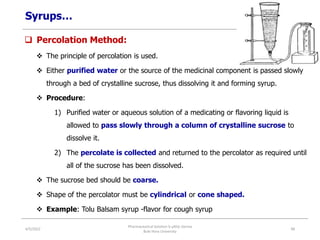
 Percolation Method:
 The principle of percolation is used.
 Either purified water or the source of the medicinal component is passed slowly
through a bed of crystalline sucrose, thus dissolving it and forming syrup.
 Procedure:
1) Purified water or aqueous solution of a medicating or flavoring liquid is
allowed to pass slowly through a column of crystalline sucrose to
dissolve it.
2) The percolate is collected and returned to the percolator as required until
all of the sucrose has been dissolved.
 The sucrose bed should be coarse.
 Shape of the percolator must be cylindrical or cone shaped.
 Example: Tolu Balsam syrup -flavor for cough syrup
4/5/2022
Pharmaceutical Solution b yAliyi Gerina
Bule Hora University
48
Syrups…
 Packaging of syrup:
 The general process
 Filling
 Sealing
 Capping
 Coding and labeling
 Wrapping
 Storage of Syrups:
 Generally, syrups are stored at
room temperature in tightly
closed bottle.
4/5/2022
Pharmaceutical Solution b yAliyi Gerina
Bule Hora University
49
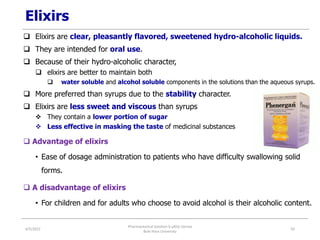
Elixirs
 Elixirs are clear, pleasantly flavored, sweetened hydro-alcoholic liquids.
 They are intended for oral use.
 Because of their hydro-alcoholic character,
 elixirs are better to maintain both
 water soluble and alcohol soluble components in the solutions than the aqueous syrups.
 More preferred than syrups due to the stability character.
 Elixirs are less sweet and viscous than syrups
 They contain a lower portion of sugar
 Less effective in masking the taste of medicinal substances
 Advantage of elixirs
• Ease of dosage administration to patients who have difficulty swallowing solid
forms.
 A disadvantage of elixirs
• For children and for adults who choose to avoid alcohol is their alcoholic content.
4/5/2022
Pharmaceutical Solution b yAliyi Gerina
Bule Hora University
50
Elixirs…
 Based on the concentration of alcohol:
1) High alcoholic elixirs:
75-78 % alcohol
1) Low alcoholic elixirs:
8-10% alcohol
NB.: Elixirs containing at least 10-12%
alcohol
• are already “self-preserving”.
 Based on their use:
o Flavored elixirs:
o are non medicated and
o used as flavors and vehicles
 E.g. Aromatic elixir, Isoalcoholic
elixir, Benzaldehyde elixir
o Medicated elixirs:
o contain potent medicament
 E.g. Diphenhydramine HCl elixir,
Phenobarbital elixir, Theophylline
Elixir.
4/5/2022
Pharmaceutical Solution b yAliyi Gerina
Bule Hora University
51
 Classification of Elixirs:
Elixirs…
Components of Elixirs
1. Vehicles:
o Alcohol and water are primary solvents
 Alcohol content may vary from 5-40 %
o If the concentration of alcohol is high,
o aqueous soluble substances may
precipitate, or
o If the concentration of water is high,
o alcohol soluble substances may
precipitate
o Sorbitol, glycerin and propylene glycol are
adjuncts.
2. Adjuvants:
o Used to improve safety, efficacy and
palatability
 Chemical stabilizers: Citric acid
and disodium editate in Neomycin
Elixir
 Preservatives: 20% alcohol, syrup
and methyl paraben and propyl
paraben
 Coloring agents: Coal tar dyes
 Sweetening agents: sucrose,
sorbitol, glycerin, saccharin
 Flavoring agents: Black current
syrup, raspberry syrup, lemon syrup
and orange syrup etc
3. Medicinal substances:
o An elixir may contain water and alcohol
soluble substances.
4/5/2022
Pharmaceutical Solution b yAliyi Gerina
Bule Hora University
52
Elixirs…
 Preparation of elixirs:
 Elixirs are usually prepared:
1) Simple solution method with agitation
2) Add mixture of two or more solutions
 Alcohol soluble and water soluble components
 are generally dissolved separately in alcohol and purified water, respectively.
 Then the aqueous solution is added to alcoholic solution rather than the reverse,
 in order to maintain the highest possible alcoholic strength at all times so that
minimal separation of alcohol- soluble components occurs.
 When the two solutions are completely mixed the mixture
 is made to volume with specified solvent or vehicle.
 Storage:
o Elixirs should be stored in tight, light resistant containers and
o protected from excessive heat because of their usual content of volatile oil and alcohol.
4/5/2022
Pharmaceutical Solution b yAliyi Gerina
Bule Hora University
53
Linctuses:
 Use:
 Demulcent,
 Sedative and
 expectorant action.
 Administration:
To obtain and prolong local action,
linctuses should be taken undiluted
and sipped and swallowed slowly.
 Dosage:
The usual dose is 5ml and part of
the doses must be diluted to this
volume.
Dilutions must be freshly prepared
and
 not more than two weeks supply should
be issued at a time, unless other wise
specified
4/5/2022
Pharmaceutical Solution b yAliyi Gerina
Bule Hora University
54
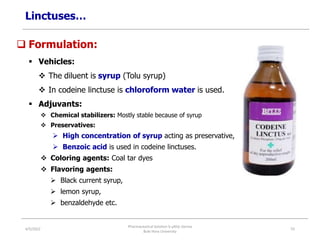
Definition: Linctuses are viscous, monophasic liquid preparation containing a high
concentration of syrup intended to sipped and swallowed slowly for treatment of
cough.
Linctuses…
 Formulation:
 Vehicles:
 The diluent is syrup (Tolu syrup)
 In codeine linctuse is chloroform water is used.
 Adjuvants:
 Chemical stabilizers: Mostly stable because of syrup
 Preservatives:
 High concentration of syrup acting as preservative,
 Benzoic acid is used in codeine linctuses.
 Coloring agents: Coal tar dyes
 Flavoring agents:
 Black current syrup,
 lemon syrup,
 benzaldehyde etc.
4/5/2022
Pharmaceutical Solution b yAliyi Gerina
Bule Hora University
55
Spirits:
 Alcoholic or hydro-alcoholic solutions of volatile substances.
 Spirits could be classified according to their uses:
• Therapeutic spirits:
 Contain therapeutic volatile substances.
 May be taken orally, applied externally, or used by inhalation.
 When taken orally, they are generally mixed with a portion of water
 to reduce the pungency of the spirit.
 E.g. Aromatic spirit of ammonia
• Flavoring spirits :
 Contain flavoring volatile substances.
 E.g. Compound orange spirit, compound cardamom spirit.
4/5/2022
Pharmaceutical Solution b yAliyi Gerina
Bule Hora University
56
Spirits…
 Volatile substances in the spirits is more than that of aromatic water.
 Spirits could also contain greater concentration of aromatic substances than the corresponding aromatic
waters.
 Generally, the alcohol concentration of spirits is rather high (usually over 60%).
 Because of the greater solubility of aromatic or volatile substances in alcohol than in water.
 Amount of alcohol differ from one spirit to another
 The lowest amount of alcohol found in internal spirits as (aromatic spirit of ammonia)
 Contain 62-68% alcohol
 While (camphor spirit) which is used externally
 contain 80-87%.
 When mixed with water or with an aqueous preparation,
 the volatile substances separate from solution and
 form a milky preparation.
4/5/2022
Pharmaceutical Solution b yAliyi Gerina
Bule Hora University
57
Spirits…
 Preparation of Spirits:
1) Simple Solution
 Majority of spirits are prepared by dissolving the solute in alcohol by
agitation.
 Filtration is generally desirable to obtain a sparking clear product.
 Example: Aromatic Spirit
2) Solution with Maceration
 Macerate the vegetable materials in a suitable substance.
 Example: Peppermint Spirit (maceration of peppermint leaves)
4/5/2022
Pharmaceutical Solution b yAliyi Gerina
Bule Hora University
58
Spirits…
3) Solution by Chemical Reaction
 Preparation of Aromatic Spirit of Ammonia NF,
 Preparation of Ethyl Nitrate Spirit
4) Distillation
 No spirits currently official are prepared by distillation,
 However, two products of historical significance which is official in
NF are prepared by distillation.
 Examples:
 Brandy (48-54% alcohol, distilled from red grapes) and
 whisky (47-53% alcohol, distilled from hops, barley and other grains)
4/5/2022
Pharmaceutical Solution b yAliyi Gerina
Bule Hora University
59
Spirits….
 Route of administration of spirits:
 Taken orally: Brandy and whisky
 Used by inhalation: Aromatic sprit of ammonia
 Applied externally.
 Uses of official spirits :
 Carminative (aromatic spirit of ammonia)
 Antacid (aromatic acid of ammonia)
 Mild reflex circulatory stimulant (camphor spirit)
 Flavoring agent (cinnamon spirit)
 Storage:
 Spirits should be stored in tight, light resistant containers and in a cool place.
4/5/2022
Pharmaceutical Solution b yAliyi Gerina
Bule Hora University
60
Solutions used in the mouth and throat
Gargles
Gargles are aqueous solutions frequently containing
antiseptics, antibiotics and/or anesthetics
used for treating the throat by forcing air from the lungs
through the gargle,
which is held in the throat; subsequently, the gargle is
expectorated.
• Many gargles must be diluted with warm water prior to use.
• The product should be labeled so that it cannot be mistaken
for preparations intended for internal administration.
“not to be swallowed in large amounts”.
4/5/2022
Pharmaceutical Solution b yAliyi Gerina
Bule Hora University
61
61
Mouthwashes
Mouthwashes can be used for therapeutic & cosmetic purposes
● Therapeutic mouthwashes can be formulated
to reduce plaque, gingivitis, dental carries.
● Cosmetic mouthwashes may be formulated
to reduce bad breath
4/5/2022
Pharmaceutical Solution b yAliyi Gerina
Bule Hora University
62
Mouthwashes …
Mouthwashes generally contain 4 groups of excipients
1. Alcohols:
o It enhances the flavor, provides sharpness to the taste,
o aids in masking the unpleasant taste of active ingredients.
o functions as
o a solubilizing agent for some flavoring agents, and
o may a preservative.
2. Humectants: such as glycerin and sorbitol
o increase the viscosity of the preparation
o enhance the sweetness of the product
o improve the preservative qualities of the product
4/5/2022
Pharmaceutical Solution b yAliyi Gerina
Bule Hora University
63
Mouthwashes,…
3. Surfactants
 Non ionic and anionic surfactants
 aid in the solubilization of flavors.
 Cationic surfactants such as cetylpyridinium chloride
 are used for their antimicrobial properties, but these tend to impart a bitter taste.
4. Flavours
 are used to overcome disagreeable tastes.
 e.gs of principal flavoring agents are peppermint, cinnamon, menthol...
5. Colouring agents
4/5/2022
Pharmaceutical Solution b yAliyi Gerina
Bule Hora University
64
64
Topical solutions
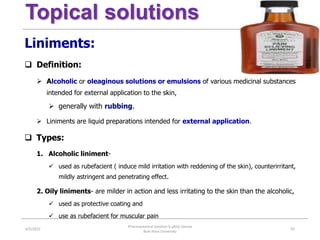
Liniments:
 Definition:
 Alcoholic or oleaginous solutions or emulsions of various medicinal substances
intended for external application to the skin,
 generally with rubbing.
 Liniments are liquid preparations intended for external application.
 Types:
1. Alcoholic liniment-
 used as rubefacient ( induce mild irritation with reddening of the skin), counterirritant,
mildly astringent and penetrating effect.
2. Oily liniments- are milder in action and less irritating to the skin than the alcoholic,
 used as protective coating and
 use as rubefacient for muscular pain
4/5/2022
Pharmaceutical Solution b yAliyi Gerina
Bule Hora University
65
Liniments…
 Two types of vehicle are used for liniments that are solutions.
 High concentration of alcohol (as in Soap Liniment)
 Oil (as in Camphor Liniment).
 Although alcohol is primarily used as a solvent,
 it aids penetration of medicaments into the skin and
 It is also potentiates their counter-irritant or rubefacient action.
 Liniments should never be applied to broken skin because
 they would be very irritating, especially if the solvent is alcohol.
 Cool storage is necessary because all Liniments have volatile ingredients.
4/5/2022
Pharmaceutical Solution b yAliyi Gerina
Bule Hora University
66
Liniments…
 Different Forms by which Liniments
can occur:-
1) As a emulsion
2) As a suspension
3) As a solution
 Methods of Preparation
o Liniments are prepared in the same
manner as
o solutions,
o emulsions or
o suspensions.
 All liniments Must Bear A Label
Indicating
1) For external use only
2) Shake well for emulsion or suspension
3) Store in tight containers
4) Not to be applied to bruises or broken
skin areas
4/5/2022
Pharmaceutical Solution b yAliyi Gerina
Bule Hora University
67
Lotions:
 Are liquid or semi liquid preparations
 meant for external application to the skin.
 The medium employed can be aqueous or alcoholic or suspensions in
aqueous medium.
 About half of the official lotions are solutions.
 Application: While
 liniments are stimulating preparations
are applied vigorously,
 lotions are usually smoothing and
are applied gently by dabbing.
 Uses:
cooling,
smoothing or
protective action to the skin.
4/5/2022
Pharmaceutical Solution b yAliyi Gerina
Bule Hora University
68
Lotions…
 Formulation:
 Medicaments
 Vehicles: Purified water, alcohol and Isopropyl alcohol
 Co-solvents: Glycerin, propylene glycol, poly ethylene glycol
 Flavoring agents: Rose water
 Preservatives: Methyl paraben, propyl paraben
 If lotions are alcoholic or hydro-alcoholic preservatives are not required
 If lotions are aqueous preservatives are incorporated
 Categories of medicaments used in lotions:
1) Antiseptics (zinc oxide, precipitated sulphur)
2) Astringents (calamine, zinc oxide, zinc sulphate, precipitated Sulphur)
3) Germicides.
4/5/2022
Pharmaceutical Solution b yAliyi Gerina
Bule Hora University
69
Lotions…
 Method of preparation
 Simple solution method
 Storage:
 Lotions should be stored in a cool
place, away from flame or heat
 because of the presence of highly
 volatile and inflammable solvents like alcohol
(95%) or industrial methylated spirit.
 Label
 For external use only
 Shake well before use
 Sore in cool place
 Direction: Apply without
rubbing or friction.
4/5/2022
Pharmaceutical Solution b yAliyi Gerina
Bule Hora University
70
Paints
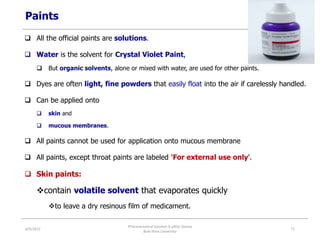
 All the official paints are solutions.
 Water is the solvent for Crystal Violet Paint,
 But organic solvents, alone or mixed with water, are used for other paints.
 Dyes are often light, fine powders that easily float into the air if carelessly handled.
 Can be applied onto
 skin and
 mucous membranes.
 All paints cannot be used for application onto mucous membrane
 All paints, except throat paints are labeled 'For external use only'.
 Skin paints:
contain volatile solvent that evaporates quickly
to leave a dry resinous film of medicament.
4/5/2022
Pharmaceutical Solution b yAliyi Gerina
Bule Hora University
71
Paints…
 Throat paints:
Are viscous due to a high content of glycerol,
Designed to prolong contact of the medicament with the affected site.
Glycerine is commonly used as a vehicle.
Are applied to the affected part with the help of cotton plug,
They should be applied as such, without dilution with water.
Medicaments used:
 Astrigents: Tannic acid, Boric acid
 Antiseptics: Iodine, Crystal violet
 Anti-infectives: Phenol
 Analgesics: Clove oil, Potassium Permanganate
4/5/2022
Pharmaceutical Solution b yAliyi Gerina
Bule Hora University
72
Paints…
 Throat paints….
 Components:
 Medicaments
 Glycerin
 Sweetening agents
 Flavoring agents
 Stabilizers
 Preservatives
 Method of preparation:
 Simple solution.
 Examples:
 Crystal violet paint
 Compound iodine throat paint
4/5/2022
Pharmaceutical Solution b yAliyi Gerina
Bule Hora University
73
 Label:
 FOR EXTERNAL USE ONLY
 STORE IN A COOL PLACE
 SHAKE WELL BEFORE USE
 NOT TOBE SWALLOWED
 KEEP THE CONTAINER TIGHTLY CLOSED
 Storage:
 In a cool and dark place.
Collodions
 Are liquid preparations containing pyroxylin (soluble gun
cotton, collodion cotton),
 dissolved in a solvent mixture usually composed of ethyl ether and
ethanol with or without medicinal substance.
 When the ether and ethanol have evaporated,
 leave a film of pyroxylin on the surface.
 Intended for external use only.
 Applied to the skin
 by means of a soft brush or other suitable applicator.
 Uses Of Collodion
1) As a protective coating to the skin.
2) As medication where a thin layer of the medication is
firmly placed against the skin.
4/5/2022
Pharmaceutical Solution b yAliyi Gerina
Bule Hora University
74
Collodions….
Can be medicated or non medicated
Salicylic Acid Collodion
Official medicated collodion
10% solution of salicylic acid in
flexible collodion.
It is used for its keratolytic effects,
especially in the removal of corns
from the toes.
Flexible collodion
a non-medicated collodion and
used as a vehicle for medicated
collodions.
is prepared by adding
2% camphor and 3% castor oil to
collodion.
The castor oil renders the
product flexible,
 permitting its comfortable use
over skin areas that are normally
moved, such as joints, fingers,
and toes.
The camphor makes the product
waterproof.
4/5/2022
Pharmaceutical Solution b yAliyi Gerina
Bule Hora University
75
Collodions….
 Storage:
Stored in small light-resistant, well closed containers at a
temperature not exceeding 20 0C.
 Label:
 ‘For external use only’
 ‘Store in a cool place’
 ‘Highly Inflammable’
 ‘Keep away from naked flames’
4/5/2022
Pharmaceutical Solution b yAliyi Gerina
Bule Hora University
76
Solutions instilled into body
cavities
Enemas
 Enemas are also known as Clyster
 Are preparations intended for introducing in the rectum for
 cleansing, therapeutic or diagnostic purposes.
 Given at body temperature
 Injected slowly with enema syringe.
 Types Of Enema:
1) Evacuation Enemas- employed to promote evacuation.
2) Retention Enemas- For local action in the rectum
a) Nutritive Enema - supply nutrient to the patient
b) Medicated Enema - supply medication for systemic effect
3)Diagnostic Enema - BaSO4 enema
4/5/2022
Pharmaceutical Solution b yAliyi Gerina
Bule Hora University
77
Douches
 A douche is an aqueous solutions which is directed into body cavity.
 It functions as
 a cleansing or antiseptic
 Usually directed using Bulb syringe.
 Types of douches
• Eye douches
• are used to remove foreign particles and discharges from the eyes.
• is directed gently at an oblique angle and
• is allowed to run from the inner to the outer corner of the eye.
• Pharyngeal douches
• are used to prepare the interior of the throat for an operation and
• to cleanse it in supportive conditions.
• Similarly, there are
• nasal and vaginal douches.
• Douches most frequently dispensed in the form of a powder
• Directions for dissolving in a specified quantity of water.
 Example: Dobell’s Solution Tablets (Compound Sodium Borate Solution NF)
 Used as nasal or pharyngeal douches.
4/5/2022
Pharmaceutical Solution b yAliyi Gerina
Bule Hora University
78
Douches…
 Among the components of douche powders are the following:
 Boric acid or sodium borate
 Astringents, e.g. potassium, ammonium, zinc sulfate
 Antimicrobials, e.g. oxyquinoline sulfate, povidone iodine
 Quaternary ammonium compounds, e.g. benzethonium chloride
 Detergents e.g., sodium lauryl sulfate
 Oxidizing agents, e.g., sodium perborate
 Salts, e.g., sodium citrate, sodium chloride
 Aromatics, e.g. menthol, thymol, eucalyptol, methyl salicylate, phenol
4/5/2022
Pharmaceutical Solution b yAliyi Gerina
Bule Hora University
79
Nasal Solutions
o solutions are usually aqueous nasal solutions
o designed to be administered to the nasal passages in drops or sprays.
o Nasal drops spread more extensively than the spray.
o Three drops cover most of the walls of the nasal cavity, with the patient in a supine position
and head tilted back and turned left and right
o The adult nasal cavity has about a 20 mL capacity with a large surface area (about 180 cm2)
for drug absorption afforded.
o Another advantage nasal deliverly is to avoids first-pass metabolism by the liver.
o The nasal tissue is highly vascularized making it an attractive site for rapid and efficient
systemic absorption.
 For some peptides and small molecular compounds, intranasal bioavailability has been
comparable to that of injections.
4/5/2022
Pharmaceutical Solution b yAliyi Gerina
Bule Hora University
80
Nasal Solutions…
o Commercial nasal preparations
o include antibiotics, antihistamines and drugs for asthma prophylaxis.
o Nasal solutions are prepared are similar in many respects to nasal secretions,
o so that normal ciliary action is maintained.
o Aqueous nasal solutions usually are isotonic and
o slightly buffered to maintain a pH of 5.5 to 6.5.
o Nasal sprays are solutions of drugs in aqueous vehicles &
o are applied to the mucous membrane of the nose by means of an atomizer
or nebulizer.
o The spray device should produce relatively coarse droplets
o if the action of the drug is to be restricted to the upper respiratory tract.
 Fine droplets tend to penetrate further into the respiratory tract than is desirable.
4/5/2022
Pharmaceutical Solution b yAliyi Gerina
Bule Hora University
81
Otic Solutions
o Otic solutions occasionally are referred to as ear or aural preparations.
o Ear preparations are usually placed in the ear canal by drops for
o the removal of excessive cerumen (ear wax) or
o the treatment of ear infections, inflammation, or pain.
o The main classes of drugs used for topical administration to the ear include
 local anesthetics, e.g. benzocaine
 antibiotics e.g. neomycin
 anti-inflammatory, e.g hydrocortisone
4/5/2022
Pharmaceutical Solution b yAliyi Gerina
Bule Hora University
82
Otic Solutions…
o These preparations include the main types of solvents used
o glycerin, propylene glycol or water.
o The viscous glycerin or PG vehicle
o permits the drug to remain in the ear for a long time
o Viscous liquids like glycerin or propylene glycol either
o are used alone or in combination with a surfactant
o to aid in the removal of ear wax
o For aqueous preparations to act,
o it is necessary for the patient to remain on his side for a few minutes so the drops
do not run out of the ear.
4/5/2022
Pharmaceutical Solution b yAliyi Gerina
Bule Hora University
83
Parenteral Solutions
 “Parenteral” comes from two Greek words,
 “Para”(outside)
 “Enteron” (intestine)
 Meaning “Beside the intestine”.
 Injected directly in to body
 It by passes alimentary canal
4/5/2022
Pharmaceutical Solution b yAliyi Gerina
Bule Hora University
84
Parenteral solutions…
 Advantages:
 Fastest method of delivering
drugs (quick onset of action)
 Provides higher concentration
of drug to bloodstream or tissues
 Vomiting and unconscious
patients can take
 Can provide fluids, electrolytes
and nutrients
 Drug action can be prolonged
by modifying the formulation
 Drugs with poor absorption or
instability in GIT
 Disadvantages:
 Traumatic injury from the insertion
of needle; pain at site
 Potential for introducing toxic
agents, microbes and pyrogens
 Impossible to retrieve if adverse
reactions occurs
 Correct syringe, needle, and
technique should be used
 Trained personnel required
 Necessity of aseptic condition in
production, compounding and
administration
 Expensive
4/5/2022 Pharmaceutical Solution b yAliyi Gerina
Bule Hora University
85
Parenteral solutions…
 Routes of administration:
 Intravenous (IV) Vein
 Intramuscular (IM) Muscle
 Subcutaneous (SC) Under the skin
 Intradermal (ID) Into the skin
4/5/2022
Pharmaceutical Solution b yAliyi Gerina
Bule Hora University
86
Parenteral solutions
 Sterility
 Pyrogen-free
 Free from particulate matter
 Clarity
 Stability
 Chemical purity
 Iso-tonicity
 Solvents and vehicles used
must meet special purity and
other standards.
 Do not use coloring agents
 Prepared under aseptic
conditions
 Special clothing (gowns, masks,
hair net, gloves).
 Laminar flow hoods placed in
special rooms
 Special and high quality
packaging
4/5/2022
Pharmaceutical Solution b yAliyi Gerina
Bule Hora University
87
Necessities for parenteral preparations:
Parenteral solutions
 Classification based on volume:
4/5/2022
Pharmaceutical Solution b yAliyi Gerina
Bule Hora University
88
Parenteral Products
(based on volume)
Small Volume
Parenterals
Large Volume
Parenterals
 Electrolytes
 Carbohydrates
 Nutritional Solutions
 Proteins
 Lipid Emulsions
 Peritoneal Dialysis
 Irrigating Solutions
 Pharmaceutical products
 Biological products
 Radiopharmaceutical products
 Liposomes and lipid products
Parenteral solutions
 Classification….
4/5/2022
Pharmaceutical Solution b yAliyi Gerina
Bule Hora University
89
Parameter SVP LVP
Volume 100 and less 101-1000 ml
Routes IV, IM, SC IV-LVP, Non IV-LVP
Dosage unit Single or multiple dose Single dose
Technique Vein puncture Venoclysis
Preservative Used Not used
Buffer Used Not used
Formulation Solution, suspension, emulsion Solution and O/W emulsion
Isotonicity Not essential Must
Example furosemide injection
Oxytocin injection
Dextrose 40%,NS,DNS and
RL
Parenteral solutions…
4/5/2022
Pharmaceutical Solution b yAliyi Gerina
Bule Hora University
90
Parenteral Formulations
(Dosage Forms)
Solutions Emulsions Suspensions
Aqueous Oil-based Aqueous Oil-based
 Injection
Ready to
use
Powders for
reconstitution
 Injectable
suspension
Ready to use Powders for
reconstitution
 For injection  For injectable
suspension
 Injectable
emulsion
 Classification based on formulation:
Parenteral solutions…
 Injection: are liquid preparations that are substances or solutions, E.g.
Insulin injection
 For injection solution: dry solids that upon addition of suitable vehicles
yield solutions, E.g. Cefuroxime for injection, USP
 Injectable emulsion: liquid preparation of drug substance dissolved or
dispersed in a suitable emulsion medium, E.g. Propofol, USP
 Injectable suspension: liquid preparation of solid suspended in a
suitable liquid medium. E.g. Methyl Prednisolone Acetate Suspension, USP
 For injectable suspension: dry solid that upon addition of a suitable
vehicle yields injectable suspensions. E.g. Imipenem/Cilastatin Injectable
Suspension, USP
4/5/2022
Pharmaceutical Solution b yAliyi Gerina
Bule Hora University
91
Parenteral solutions
Formulation of parenteral solutions:
 Active drug
 Solvents (co-solvents) and Vehicles
 Adjuvants
 Surfactants
 Polymers
 Preservatives
 Buffers
 Tonicity adjusters
 Antioxidants
 Chelating agents
 Inert gases
4/5/2022
Pharmaceutical Solution b yAliyi Gerina
Bule Hora University
92
Parenteral solutions…
 Vehicles:
 Solvents & vehicles must meet special purity & other standard to assure
sterility, stability and safety.
 Vehicle used should be:
 Pharmacologically inert,
 Non toxic and compatible with blood,
 Maintain solubility of the drug,
 Be physically and chemically stable
 Does not affect the pH.
 Must be pyrogen free.
 No particulate mater.
4/5/2022
Pharmaceutical Solution b yAliyi Gerina
Bule Hora University
93
Parenteral solutions…
Aqueous vehicles:
Water for injection, USP:
o is intended for use
o in the preparation of parenteral solutions and
o in the preparation of some bulk pharmaceutical chemicals (in the large-scale
manufacturer of injections).
o It must be protected from microbial contamination.
Sterile water for injection, USP
o It is prepared from water for injection that is sterilized and suitably packaged
o It is packaged in single-dose containers not larger than 1L
o It contains no antimicrobial agent or other added substance.
o It is used as diluents for parenteral products
4/5/2022 94
Pharmaceutical Solution b yAliyi Gerina
Bule Hora University
Parenteral solutions…
Bacteriostatic water for injection, USP:
o is sterile water for injection
o which contain one or more suitable antimicrobial agents.
o It is intended to be used as diluent for parenteral products.
o It is packaged in single or multiple-dose containers (vials), not larger
than 30 mL size
Sodium chloride injection, USP
o Is a sterile isotonic solution of sodium chloride in water for injection
o May be used as a sterile vehicle in solutions or suspensions of drugs for
parentral administration
o Contain no antimicrobial agents.
4/5/2022
Pharmaceutical Solution b yAliyi Gerina
Bule Hora University
95
Parenteral solutions…
Bacteriostatic Sodium chloride injection, USP
o Is a sterile isotonic solution of sodium chloride in water for injection.
o Contains one or more suitable antimicrobial agents.
Ringer’s injection, USP
o Is a sterile solution containing NaCl, KCl, and CaCl2 in water for injection.
o The three agents are present in concentrations similar to those of
physiological fluids.
o Used as a vehicle and as an electrolyte replenisher and plasma volume
expander.
4/5/2022 96
Pharmaceutical Solution b yAliyi Gerina
Bule Hora University
Parenteral solutions…
Non-aqueous vehicles
o Are sometimes used when there are limited water solubility of drugs or
susceptibility to hydrolysis.
o Fixed vegetable oils like corn oil, cottonseed oil, peanut oil, and sesame oil
o But not mineral oil or paraffin b/c not absorbed by body tissues.
o Alcohol;PEG, glycerol, propyl glycol,
4/5/2022 97
Pharmaceutical Solution b yAliyi Gerina
Bule Hora University
Parenteral solutions….
 Surfactants:
 Enhance drug solubility
 May be incorporated to aqueous or oil-based vehicles
 Examples: Non ionic surfactants (tweens, poloxamers)
 Polymers:
 Hydrophilic polymers to enhance drug solubility by complexation
 Example: Polyvinyl alcohol
4/5/2022
Pharmaceutical Solution b yAliyi Gerina
Bule Hora University
98
Parenteral solutions
 Preservatives:
 As a bacteriostatic
 To inhibit any microbes accidentally introduced while doses are being withdrawn.
 A must in multiple dose containers unless the drug itself is bacteriostatic
 As adjuncts in aseptic filling and in intermittent heat sterilization
 Not permitted in single doses > 15 ml
 Not for routes reaching cerebrospinal fluid or inter-ocular.
 Not for oil-based parenteral products (due to the low water activity of this medium)
 Examples:
 Benzyl alcohol (0.9% to 1.5%)
 Methylparaben (0.18% to 0.2%)
 Propylparaben (0.02%)
 Benzalkonium chloride (0.01% to 0.02%)- in ophthalmic dosage forms
 Thiomersal (0.001% to 0.01%)
 Phenolic compounds: Phenol (0.25-0.5% w/v), Chlorocresol (0.1-0.3% w/v)
4/5/2022
Pharmaceutical Solution b yAliyi Gerina
Bule Hora University
99
Parenteral solutions….
 Buffers:
 Parenteral preparations should not vary significantly form physiological pH (about 7.4)
 Acidic or alkaline solutions may be needed to
 solubilize or
 stabilize drugs.
4/5/2022
Pharmaceutical Solution b yAliyi Gerina
Bule Hora University
100
pH Buffer system Concentration
3.5-5.7 Acetic acid-acetate 1.0-2.0
2.5-6.0 Citric acid-citrate 1.0-5.0
6.0-8.2 Phosphoric acid-phosphate 0.8-2.0
8.2-10.2 Glutamic acid-glutamate 1-2
Parenteral solutions
 Tonicity adjusters:
 Can be:
 Electrolytes: NaCl
 Non-electrolytes: Glucose, mannitol, Glycerine
 An isotonic solution is one that exhibits the same effective osmotic
pressure as blood serum.
 Example of isotonic: Dextrose injection 5% and NaCl injection 0.9%
 Hypotonic Solution: is a solution of lower osmotic pressure than that of
a body fluid.
 Adjusted to isotonicity using Sodium chloride, Glucose, Mannitol
 Hypertonic solutions: the solutions having a higher osmotic pressure
than that of a body fluid.
4/5/2022
Pharmaceutical Solution b yAliyi Gerina
Bule Hora University
101
Parenteral solutions…
 Water soluble
 Sulfurous acid salts
 Ascorbic acid isomers
 Thiol derivatives
 Oil soluble:
 Propyl gallate
 Butylated hydroxyanisole
 Ascorbyl palmitate
 α-Tocopherol
4/5/2022
Pharmaceutical Solution b yAliyi Gerina
Bule Hora University
102
 Antioxidants:
 Oxidative degradation of drug in solution is mediated either
 by molecular oxygen or
 by free redicals and
 can be catalyzed by metals, heat, light and hydrogen ions.
Parenteral solutions…
 Chelating agents:
 Sequester heavy metals
 to prevent the catalysis of oxidation
reaction.
 Examples:
 Ethylenediamine tetra acetic acid
 Citric acid and
 tartaric acid
 Inert Gas
 Boiling the water
 Displacing the air in the solution
with nitrogen.
 Purging container N2 or CO2 before
filling.
 Topping off container with the gas
after sealing
 Use glass-sealed ampoules
4/5/2022
Pharmaceutical Solution b yAliyi Gerina
Bule Hora University
103
Parenteral solutions…
4/5/2022
Pharmaceutical Solution b yAliyi Gerina
Bule Hora University
104
 Manufacturing Steps in Parenteral Solutions:
Heat sensitive APIs Heat stable APIs
Preparation of parenteral products
Aseptic filtration
Aseptic filling
Cleaning of containers,
closures and equipments
Aseptic sealing
Evaluation
Labelling and Packaging
Preparation of parenteral products
Sterilization
Filling
Sealing
Evaluation
Labelling and Packaging
Sterility,
Pyrogen,
Clarity,
Leak test,
Assay
Collection of materials Collection of materials
Cleaning of containers,
closures and equipments
Filtration
Parenteral solutions…
 Parenteral packaging systems:
 Injectable formulations are packaged into containers made of glass or plastic.
 Container systems include ampoules, vials, syringes, cartridges, bottles, and
bags:
 Ampoules are all glass, whereas bags are all plastic.
 The other containers can be composed of glass or plastic and
 must include rubber materials, such as
 rubber stoppers for vials and bottles and
 rubber plungers and rubber seals for syringes and cartridges.
 Irrigation solutions
 are packaged in glass bottles with aluminum screw caps.
4/5/2022
Pharmaceutical Solution b yAliyi Gerina
Bule Hora University
105
Parenteral solutions…
 Glass:
 Is employed as the container material of choice
for most Small Volume Parenterals (SVP).
 The USP provides a classification of glass:
1) Type I, a borosilicate glass;
2) Type II, a soda-lime treated glass;
3) Type III, a soda-lime glass; and
4) Non-parenteral glass: a soda-lime glass
not suitable for containers for parenterals.
 Plastic:
 Plastic containers can also be
used
 But they face the following
problems:
 Permeation
 Sorption
 Leaching
 Softening
4/5/2022
Pharmaceutical Solution b yAliyi Gerina
Bule Hora University
106
Parenteral solutions…
 Ampoules:
 Sealed glass containers
 With an elongated neck that must
be broken off
 Most are weakened around the
neck for easy breaking
 Sealed after filling single dose of
drug /water.
 Most commonly used
 for supplying WFI.
 They are also used
 for single dose SVPs.
 A 5 micron filter needle should be
used when drawing the contents
 Vials:
 Drugs are packaged in vials either as
liquids or powders
 Made of glass or plastic
 Are sealed with a rubber stopper
 A needle is needed to add contents to
or withdraw from vials
 May be designed for single or multi-
dose use
 Multi-dose vials contain a preservative
 to inhibit bacterial contamination
 Product is easier to remove from vials
than form ampoules
4/5/2022
Pharmaceutical Solution b yAliyi Gerina
Bule Hora University
107
Parenteral solutions…
 Comparison:
Ampoules Vials
Single dose Single / multi dose
No Preservatives Preservative
Hermetically sealed (air tight) Not hermetic
Protection from air or humidity Air /humidity may permeate
Drugs more stable Drugs less stable
Difficult opening Easy opening
Risk of injury No risk of injury
Risk of glass contamination No risk of contamination
Container is not reusable Vials are reusable
4/5/2022
Pharmaceutical Solution b yAliyi Gerina
Bule Hora University
108
Parenteral solutions…
 Closures:
 To provide closure for
 multiple dose vials,
 IV fluid bottles,
 plugs for disposable syringes and
 bulbs for ophthalmic pipettes,
 rubber Closure is material of choice.
 Problems associated with rubber
closures are:
 Incompatibility
 Chemical instability
 Physical instability
 Characteristics of good pharma
rubbers:
 Good ageing qualities
 Satisfactory hardness and elasticity
 Resistance to sterilization conditions
 Impermeable to moisture and air
4/5/2022
Pharmaceutical Solution b yAliyi Gerina
Bule Hora University
109
Parenteral solutions…
 Pre-filled syringes:
 Single-dose medicine filled in syringe with fixed needle.
 Plastics / glass sometime
 Labeled properly.
 Emergency drugs are available right away.
 Ease of administration (less steps involved) .
 Self administration is possible.
 Reduction of medication error (right dose always)
 Reduction of contamination (Assurance of sterility).
 Less overfill required (economical for biopharmaceuticals)
 Good control of controlled drugs (e.g. narcotics).
4/5/2022
Pharmaceutical Solution b yAliyi Gerina
Bule Hora University
110
Parenteral solutions…
 Glass/Plastic Bottles & Plastic Bags:
 They are used for Large volume parenterals
 For IV administration.
 For the intermittent or continuous infusion of fluids
or drugs.
 Need special administration devices to permit drug
administration.
Cannula Saline Set
4/5/2022
Pharmaceutical Solution b yAliyi Gerina
Bule Hora University
111
Parenteral solutions…
 Labelling:
 Name and concentration of active substances
 Name and concentration of any added antimicrobial preservatives
 Route of administration
 Shelf- life
 Batch number
 Storage pre-cautions
 Directions for use
4/5/2022
Pharmaceutical Solution b yAliyi Gerina
Bule Hora University
112
Thank You!!!!!!!!!!!
4/5/2022
Pharmaceutical Solution b yAliyi Gerina
Bule Hora University
113

Ch6.pharmaceutical solutions

  • 1.
    Bule Hora University Collegeof Health and Medical Sciences Department Of Pharmacy Integrated Physical Pharmacy and Pharmaceutics I Chapter 6 Pharmaceutical Solutions By: Aliyi Gerina [B.pharm] 4/5/2022 Pharmaceutical Solution b yAliyi Gerina Bule Hora University 1
  • 2.
    Out Line • Introduction •Formulation of solutions (API and Excipients) • General methods of preparation • Solutions taken orally • Solutions used in the mouth and throat • Solutions instilled into body cavities • Topical solutions • Injectables (sterile products) 4/5/2022 Pharmaceutical Solution b yAliyi Gerina Bule Hora University 2
  • 3.
    Introduction 4/5/2022 Pharmaceutical Solution byAliyi Gerina Bule Hora University 3 Aqueous solutions Non-aqueous solutions Suspensions Colloids Emulsions Liquid Dosage Forms Monophasic Liquid DFs (Solutions) Poly-phasic Liquid DFs
  • 4.
    4/5/2022 Pharmaceutical Solution byAliyi Gerina Bule Hora University 4 Introduction… o Solution: solutions are clear Liquid preparations containing one or more active ingredients dissolved in a suitable vehicle. o Colloids: A system in which finely divided particles, which are 1 nm - 0.5 µm in size, are dispersed within a continuous medium in a manner that prevents them from being settled rapidly. o Suspension: (Solid in Liquid dispersion) Liquid preparations containing one or more active ingredients suspended in a suitable vehicle. o Emulsion (Liquid in Liquid dispersion): Emulsions are two phase system in which one liquid is dispersed through out another liquid in the form of small droplets. 4
  • 5.
    Introduction…  Solution:  Isa homogeneous mixture composed of two or more substances  One substance (solute) is dissolved in another substance (solvent).  The solute is the component present in the smallest amount  The solvent is the larger liquid component.  The solute is dispersed throughout the solvent in molecular or ionic sized particles.  It is a thermodynamically stable, one-phase system. 4/5/2022 Pharmaceutical Solution b yAliyi Gerina Bule Hora University 5
  • 6.
    Introduction…  Steps inmaking a Solution 1) Breaking up the solute into individual components: =>expanding the solute 1) Overcoming intermolecular forces in the solvent to make room for the solute: =>expanding the solvent 1) Allowing the solvent and solute to interact => form the solution 4/5/2022 Pharmaceutical Solution b yAliyi Gerina Bule Hora University 6
  • 7.
    Advantages and Disadvantages Advantages  Ease of administration  Faster absorption.  Uniform dosage.  Provide safe means of administering certain substances  like potassium iodide and bromide that cause gastric pain if taken dry.  Have attractive appearance-  psychological effect.  Dis Advantages  They are less stable than solid DFs.  Unpleasant flavours can be difficult to mask.  They are bulky to transport.  A spoon is needed to administer the dose.  Accidental breakage to the container results in complete and messy loss of the contents.. 4/5/2022 Pharmaceutical Solution b yAliyi Gerina Bule Hora University 7
  • 8.
    Classification of Solutions 4/5/2022 PharmaceuticalSolution b yAliyi Gerina Bule Hora University 8 Pharma Solutions Used in the mouth and throat Applied to body surfaces Taken orally Instilled into body cavities  Syrups  Elixirs  Spirits  Linctuses  Mouth Washes  Gargles  Throat Paints  Throat Sprays  Douches  Enemas  Ear Drops  Nasal Drops  Nasal Sprays  Collodions  Liniments  Lotions  Paints  Based on route of administration
  • 9.
    Classification of Solutions… 4/5/2022 PharmaceuticalSolution b yAliyi Gerina Bule Hora University 9 Pharma Solutions Aqueous solutions Non-aqueous solutions  Douches  Enemas  Gargles  Mouth washes  Nasal Washes  Sprays  Otic Solutions  Inhalations  Elixirs  Spirits  Collodions  Glycerins  Lotions  Liniments  Based on vehicle used Sweet or Viscid  Syrups
  • 10.
    Pharmaceutical Applications  Solutionshave a wide variety of uses in the pharmaceutical industry.  They are used therapeutically as vehicles for:  Oral  Parenteral  Topical  Otic  Ophthalmic  Nasal products  They are also used as:  Flavorings  Buffers  Preservatives and  Suspending agents for a variety of liquid dosage forms 4/5/2022 Pharmaceutical Solution b yAliyi Gerina Bule Hora University 10
  • 11.
    Solvents for solutionpreparation  Solvent selection is based on:  Solubility  Clarity  Toxicity  Viscosity  Compatibility with excipients  Chemical inertness  Palatability  Odor  Color and  Economy.  In most cases,  water is the preferred solvent.  It meets the majority of the above criteria. 4/5/2022 Pharmaceutical Solution b yAliyi Gerina Bule Hora University 11
  • 12.
    Solvents for solutionpreparation… Water:  The major ingredient in most of liquid dosage forms is water.  It is used both as a vehicle and as a solvent. Advantages: oTastelessness, ofreedom from irritating qualities and olack of pharmacological activity make it ideal for such purposes. Disadvantages: • Favorable medium for some chemical reactions, and • Supports the growth of microorganisms when contaminated. 4/5/2022 Pharmaceutical Solution b yAliyi Gerina Bule Hora University 12
  • 13.
    Solvents for solutionpreparation…  The USP recognizes six types of water for the preparation of dosage forms. 1) Purified water 2) Water for injection 3) Sterile water for injection 4) Bacteriostatic water for injection 5) Sterile water for inhalation 6) Sterile water for irrigation 4/5/2022 Pharmaceutical Solution b yAliyi Gerina Bule Hora University 13
  • 14.
    Solvents for solutionpreparation…  Purified water: • The preferred and most commonly used vehicle in the solutions.  The source or feed water for the production of purified water is drinking water.  It must meet the requirements for ionic and organic chemical purity  It must be protected from microbial contamination.  It should be protected from recontamination and microbial proliferation.  It is used in as an excipient in the  production of non-parenteral and non ophthalmic products.  It is also used for  cleaning of certain equipment’s and non-parenteral product-contact components.  Commonly produced by:  Ion Exchange  Reverse Osmosis (RO) and  Distillation 4/5/2022 Pharmaceutical Solution b yAliyi Gerina Bule Hora University 14
  • 15.
    Solvents for solutionpreparation… a. Distillation o Separation method based on boiling point difference. o Generally, the first portion of aqueous distillate (10% to 20%) must be discarded o the last portion of water (10% of the original volume of water) remaining in the distillation apparatus must be discarded. 4/5/2022 Pharmaceutical Solution b yAliyi Gerina Bule Hora University 15
  • 16.
    Solvents for solutionpreparation… b. Ion Exchange Method o The ion exchange equipment generally passes water through a column of cation and anion exchangers o consisting of water insoluble synthetic polymerized phenolic, carboxylic, amino, or sulfonated resins of high molecular weight. o These resins are mainly two types:  the cations, or acid exchangers  the anions, or base exchangers 4/5/2022 Pharmaceutical Solution b yAliyi Gerina Bule Hora University 16
  • 17.
    Solvents for solutionpreparation… c. Reverse Osmosis o Cross-flow (or tangential flow) membrane filtration o a pressurized stream of water is passed parallel to the inner side of a filter membrane core. o A portion of the feed water permeates the membrane as filtrate. 4/5/2022 Pharmaceutical Solution b yAliyi Gerina Bule Hora University 17
  • 18.
    Solvents for solutionpreparation… oDepending on their pore size, cross-flow filter membranes can remove particles defined in the range of  microfiltration (0.1 to 2 μm, e.g., bacteria);  Ultrafiltration (0.01 to 0.1 μm, e.g., virus);  nanofiltration (0.001 to 0.01 μm, e.g., organic CPDs in the mwt range of 300 to 1,000); and  particles < 0.001 μm oReverse osmosis removes virtually o all viruses, bacteria, pyrogens, and o organic molecules and 90% to 99% of ions 4/5/2022 Pharmaceutical Solution b yAliyi Gerina Bule Hora University 18
  • 19.
    Solvents for solutionpreparation…  Water for injection (WFI):  Conforms to the standards of purified water,  but is also free of pyrogen.  It contains no added substances  May not be sterile  It is used as a  solvent for the preparation of parenteral solution  Collected in sterile & pyrogen free container (glass or glass lined)  Clear, colourless, odourless and having a pH of 5 -7.  Must be used within 24 hour  For products to be sterilized after preparation.  Must store in tight container at suitable temperature 4/5/2022 Pharmaceutical Solution b yAliyi Gerina Bule Hora University 19
  • 20.
    Solvents for solutionpreparation…  Sterile Water for injection:  It is water for injection that  is sterilized and  packaged in single-dose containers of type I and II glass.  Packed in container of 1 Liter or less  It is designed solely  for parenteral use only.  It contains no antimicrobial agents or other preservatives.  Due to sterilization may contain slightly more solid content.  Intended to be used as a solvent, vehicle or diluent for already sterilized & packed injectable.  Non-pyrogenic.  Must be added aseptically 4/5/2022 Pharmaceutical Solution b yAliyi Gerina Bule Hora University 20
  • 21.
    Solvents for solutionpreparation…  Bacteriostatic water for injection:  It is sterile water for injection containing one or more suitable bacteriostatic agents.  Sterile  Non-pyrogenic  0.9% (9 mg/mL) of benzyl alcohol added as a bacteriostatic preservative.  Filled in vials/syringe in volume not more than 30ml  Intended for small volume injectable (multi-dose vials)  Not to be used with large volume parenteral (usually with 5ml or less).  Repeated withdrawals may be made to dilute or dissolve drugs for injection.  The pH is 4.5 to 7.0  It is parenteral preparation  Indicated only for diluting or dissolving drugs  for intravenous, intramuscular or subcutaneous injection. 4/5/2022 Pharmaceutical Solution b yAliyi Gerina Bule Hora University 21
  • 22.
    Solvents for solutionpreparation…  Sterile water for inhalation:  Is water for injection that is  packaged and rendered sterile  It is intended for use in inhalators  It carries a less stringent specification for bacterial endotoxins than SWFI  It contains no antimicrobial agents.  Should not be used for parenteral administration.  Sterile water for irrigation:  It is water for injection packaged and  sterilized in single-dose containers  It may be larger than 1 L and allow rapid delivery of their contents  It is not required to meet particulate matter in injections  It contains no antimicrobial agents or other added substance. 4/5/2022 Pharmaceutical Solution b yAliyi Gerina Bule Hora University 22
  • 23.
    Solvents for solutionpreparation…  Alcohol:  The second most commonly used solvent (for many organic compounds).  A hydro-alcoholic mixture is capable of dissolving both  alcohol soluble and water soluble substance.  Alcohol is often preferred because of:  is widely used for its miscibility with water  ability to dissolve many water insoluble ingredients. also possess an antimicrobial preservative activity.  Glycerin: Mainly used as:  Solvent, Sweetening agent, Antimicrobial preservative and Viscosity increasing agent.  Propylene glycol:  Solvent, Extractant, and Preservative in a variety of liquid pharmaceutical formulations, including parenterals  Can also be used as antiseptics. 4/5/2022 Pharmaceutical Solution b yAliyi Gerina Bule Hora University 23
  • 24.
    Formulation and manufacturingconsiderations  Formulation considerations: 1) Solubility 2) Stability 3) Preservatives 4) Pharmaceutical elegance  Viscosity modifiers  Sweetening agents  Flavoring agents  Coloring agents Manufacturing Consideration: 1) Raw Materials 2) Equipments 3) Manufacturing Procedure 4/5/2022 Pharmaceutical Solution b yAliyi Gerina Bule Hora University 24
  • 25.
    Formulation considerations  Solubility: Approaches to increase the solubility of the drug: o pH adjustment: A large number of drugs are either weak acids or weak bases. The solubility of these agents can be markedly influenced by the pH of the environment o Co-solvency: Weak electrolytes and non polar molecules frequently have poor water solubility. These types of solutes are more soluble in a mixture of solvents than in one solvent alone. This phenomenon is known as co-solvency. o Micelle solubilization: At high concentration surfactants are forced into water to form colloidal aggregate known as micelle. Drugs get adsorbed into micelle that increase drug solubility. o Complexation: Solubility of a compound may be increased by complexing with a complexing agent. e.g. solubility of para amino benzoic acid (PABA) may be increased by complexing with caffeine. o Micronization: The process involve size reduction of drug particle 1 to 10microns either by spray drying or fluid energy mill o Chemical modification of the drug: Poorly soluble drugs are chemically modified into water soluble derivatives 4/5/2022 Pharmaceutical Solution b yAliyi Gerina Bule Hora University 25
  • 26.
    Formulation considerations…  Stability: A.Chemical stability: Affected by 1) pH 2) Temperature 3) Ionic Strength 4) Solvent effects 5) Light 6) Oxygen Instability can be prevented by: 1) Use of buffering agents 2) Use of antioxidants 3) Proper packaging (e.g.: use of amber bottle for light sensitive products) 4/5/2022 Pharmaceutical Solution b yAliyi Gerina Bule Hora University 26 B. Physical Stability  A stable formulation retains its viscosity, color, clarity, taste, and odor throughout its shelf life. Objective evaluation Subjective evaluation  Color: spectrophotometr  Clarity- turbidity or light scattering equipment.  Viscosity- viscometers.  Taste and odor can be determined either by pharmaceutical investigator or by a panel of unbiased, taste sensitive individuals.
  • 27.
    Formulation considerations…  Preservatives: Preservatives must have following criteria: 1) Effective against broad spectrum of microorganisms. 2) Physically, chemically and microbiologically stable for lifetime of the product. 3) Non toxic, non sensitizing, soluble, compatible and 4) With acceptable taste and odor.  Types of Preservatives 1) Acidic : phenol, benzoic acid, sorbic acid 2) Neutral preservatives : chlorobutanol, benzyl alcohol 3) Quaternary ammonium compounds: Benzalkonium chloride 4/5/2022 Pharmaceutical Solution b yAliyi Gerina Bule Hora University 27
  • 28.
    Formulation considerations…  PharmaceuticalElegance:  Viscosity modifiers: Enhance viscosity. E.g.: Povidone, hydroxyethylcellulose  Sweetening agents: To enhance palatability and mask the taste of the drugs. Eg : Sucrose, saccharin, aspartame  Flavoring agents: To mask unpleasant taste Taste Sensation Recommended flavor Salt Butter scotch, maple, apricot, peach, vanilla, Bitter Wild cherry, walnut, chocolate, mint Sweet Fruit and berry, vanilla Sour Citrus flavours, liquorice, raspberry  Coloring agents: To enhance the appearance of the vehicle;  which matches well with the flavor employed in the preparation . E.g.: green with mint, brown with chocolate flavor etc. 4/5/2022 Pharmaceutical Solution b yAliyi Gerina Bule Hora University 28
  • 29.
    Manufacturing considerations  RawMaterials :  Incoming raw materials should be tested as per specifications that is identity, purity, uniformity and microbial contamination.  Equipments :  The following types of equipments may be used in manufacture of liquid formulations:- 1) Mixing tanks (SS 316 Stainless Steel) equipped with an agitator. 2) Measuring devices for large and small amount of solids and liquids. 3) A filtration system e.g. filter press  Cleaning of equipments:-  All equipments must be thoroughly cleaned and sanitized before use.  Disinfectants used: Dilute solutions of H2O2, phenol derivatives.  Sterilized by: Alcohol, boiling water, autoclaving, steam or dry heat. 4/5/2022 Pharmaceutical Solution b yAliyi Gerina Bule Hora University 29
  • 30.
    Manufacturing considerations…  ManufacturingProcess: 4/5/2022 Pharmaceutical Solution b yAliyi Gerina Bule Hora University 30 Process Flow Control Variables Measured Response Addition of Raw Materials (Active +Excipients as per formula) Mixing (Jacketed vessel with variable speed mixer) Filtration (Filter Press or cartridge filter) Filling (Automatic Filling Machine)  Mixing time  RPM  Temp  Final volume  Pore size  Filter integrity  Filling machine speed  Clarity  Viscosity  Assay  Clarity  Volume
  • 31.
    Preparation of Solutions… Methods for preparation of solutions: 1) Simple solutions: Prepared by dissolving the solute in most of the solvent,  mixing until dissolved, then adding sufficient solvent to bring the solution up to the proper volume(by stirring or heating). 2) Solution by chemical reaction:  Are prepared by reacting two or more solutes with each other in suitable solvent. 3) Solution by extraction:  Drugs often are extracted with water or with water containing other substances.  Preparations of this type more often classified as extracts. 4/5/2022 Pharmaceutical Solution b yAliyi Gerina Bule Hora University 31
  • 32.
    Oral solution absorptionfrom GIT into the systemic circulation may be expected to occur more rapidly than suspension or solid dosage forms of the same medicinal agent.  Liquid oral solutions are aqueous formulations.  To be acceptable for patients, these must be palatable. Flavouring, colouring and sweetening agents are therefore added  to enhance their appearance and taste.  The dose is usually in multiples of 5 mL, and the patient is given a 5 mL spoon with the solution. When smaller volumes are required, oral syringes are used.  Solution pH is usually 7.0, although a range of pH 2–9 can be tolerated.  In formulating or compounding a pharmaceutical solution, the pharmacist must use information on the solubility and stability of each solute with regard to the solvent or solvent system.  For many medicinal agents, their solubility in the usual solvents are stated in the United States Pharmacopeia– National Formulary (USP–NF) as well as in other reference books. Solutions taken orally 4/5/2022 Pharmaceutical Solution b yAliyi Gerina Bule Hora University 32
  • 33.
    4/5/2022 Pharmaceutical Solution byAliyi Gerina Bule Hora University 33 Aromatic Water 33 o Aromatic waters are clear, aqueous solutions saturated with volatile oils or other aromatic or volatile substances. o They are used principally as flavored vehicles. o Their odors and tastes are similar to those of the drugs or volatile substances from which they are prepared. o Aromatic waters were prepared from a number of volatile substances o Includes o chloroform water, o Camphor water, o peppermint water and o anise water
  • 34.
    Aromatic Water,…  Chloroformwater  Diluted chloroform water is prepared by mixing 1part of double strength chloroform water (official formulae) and 1part of water.  Use: preservative, flavor Camphor water o Diluted camphor water is prepared by mixing 1part of concentrated camphor water (official formulae) and 40 parts of water. o Use: flavor, mild expectorant 4/5/2022 Pharmaceutical Solution b yAliyi Gerina Bule Hora University 34
  • 35.
    4/5/2022 Pharmaceutical Solution byAliyi Gerina Bule Hora University 35 Aromatic Water,… o Aromatic water will deteriorate with time therefore: - should be made in small quantities - protected from intense light and excessive heat by storing in air tight, light resistant containers. o If they become cloudy or otherwise deteriorate; o they should be discarded. o Deterioration may be o due to volatilization, decomposition or microorganism growth. 35
  • 36.
    4/5/2022 Pharmaceutical Solution byAliyi Gerina Bule Hora University 36 Aromatic Water,… ● There are two official methods of preparation of aromatic waters (a) Distillation process (b) Solution process (a) Distillation process: e.g. Stronger Rose Water NF ● The aroma containing substance should be coarsely ground and mixed with sufficient quantity of purified water in the distillation unit. ● After distillation any excess oil in the distillate is removed by filtration. (b) Solution process e.g. Peppermint water ● Aromatic water may be prepared by shaking volatile substance with purified water. ● The mixture is set a side for 12 hours & filtered.
  • 37.
    Syrups  Definition: Syrupsare concentrated, viscous, aqueous solutions of 85% sugar or a sugar substitute with or without flavors and medical substances.  Classification based on their use: 1) Medicated syrup– When the aqueous preparation contains some added medicinal substance 2) Non‐medicated/Flavored syrup– contained various aromatic and pleasantly flavored substances and is intended as a vehicle or flavor for preparations.  Classification based on their basic formula: 1) Sugar Based syrups– sucrose and dextrose are usually employed in the preparation of syrups 2) Artificial sweeteners– sugar‐free syrups which are intended as substitute for sugar‐based syrups and o are intended to be administered to persons who must regulate their sugar/calorie intake 4/5/2022 Pharmaceutical Solution b yAliyi Gerina Bule Hora University 37
  • 38.
    Syrups…  Advantages:  Appropriatefor any patient, whatever the age is  The most natural and easiest route of administration  Economical and safe to the patient  No nursing is required (the patient can take it without help)  Liquid DF is expected for certain types of products like cough medicines  Dis advantages:  Delayed onset of action as absorption takes time  Not suitable in emergency and for unconscious patients  Not convenient for patients with GI disorder such as diarrheas, constipation, ulceration and hyperacidity in stomach  Can’t avoid first pass metabolism 4/5/2022 Pharmaceutical Solution b yAliyi Gerina Bule Hora University 38
  • 39.
    Syrups…  Components ofsyrup:  Medicinal agent  Purified water  Antimicrobial preservatives  Sweetening agent  Viscosity modifiers  Flavorants  Colorants  Miscellaneous  Special solvents,  Solubilizing agents,  Thickeners or  Stabilizers 4/5/2022 Pharmaceutical Solution b yAliyi Gerina Bule Hora University 39
  • 40.
    Syrups… Components of syrup…. Antimicrobial Preservatives  The amount varies with the proportions of water available.  Among the preservatives, the most commonly used are: 1)Benzoic acid‐0.1% to 0.2% 2)Sodium benzoate –0.1 to 0.2% 3)Combination of methyl, propyl, butyl parabens totaling 0.1% 4/5/2022 Pharmaceutical Solution b yAliyi Gerina Bule Hora University 40
  • 41.
    Syrups…  Sugar andother sweeteners:  Sugar and dextrose are mostly used  The difficulty or problem with dextrose are as follows: 1) Forms saturated solutions at 70%w/v (less viscous) 2) Dextrose dissolves more slowly 3) Dextrose is less sweet 4) Saturated solution supports growth of microorganism  Saccharin sodium is 300 ‐550 time as sweet as sucrose.  It may be used in concentration of 0.1 to 0.2%  Characterized by a bitter after taste.  Sorbitol can also be used as sweetener 4/5/2022 Pharmaceutical Solution b yAliyi Gerina Bule Hora University 41
  • 42.
    Syrups…  Flavorants forsyrup:  Are used to render the syrup pleasant tasting.  Most syrups are flavored with synthetic or naturally occurring flavorants  E.g. volatile oil, vanillin, and others,  The flavorants used must possess sufficient water solubility  Colorants:  To enhance appeal of the syrup,  The colorant should correlate with the flavorant employed.  The colorant used is generally  Water‐soluble,  Non‐reactive with other components, and  Stable 4/5/2022 Pharmaceutical Solution b yAliyi Gerina Bule Hora University 42
  • 43.
    Syrups…  Preparation ofSyrups:  Pharmaceutical syrups are produced by mixing purified water, sweeteners, active ingredients (API), aromas, flavors and other ingredients (thickeners) etc. 4/5/2022 Pharmaceutical Solution b yAliyi Gerina Bule Hora University 43 Solid Ingredients Liquid Ingredients Dosing systems Production Tanks Filtration Storage Tanks Filling Machine
  • 44.
    Syrups…  Preparation ofSyrups:  Syrups are generally prepared using one of the following four techniques depending upon the physical and chemical characteristics of the ingredients. 1) Solution with the aid of heat 2) Agitation without heat (simple admixture of liquid components) 3) Addition of sucrose to a prepared medicated liquid or a flavored liquid 4) Percolation method 4/5/2022 Pharmaceutical Solution b yAliyi Gerina Bule Hora University 44
  • 45.
    Syrups…  Solution withHeat:  This is a suitable preparation method if the constituents are  not volatile, degraded by heat, or when it is desirable to make the syrup rapidly.  Procedure:  Purified water is heated to 80–85 0C  After removing from its heat source, sucrose is added with vigorous agitation  Heat-stable components are added to the hot syrup  The mixture is allowed to cool  Heat labile and volatile components (e.g. alcohol and oil) are added after cooling to room temp.  Volume is adjusted to by the addition of purified water.  Caution: Do not apply excessive heat -inversion of sucrose causing discoloration  Examples: Acacia syrup, NF; Cocoa Syrup, NF; Syrup USP (85% sugar, made by cold and hot process, percolation) 4/5/2022 Pharmaceutical Solution b yAliyi Gerina Bule Hora University 45
  • 46.
    Syrups…  Agitation withoutHeat.  To avoid heat-induced inversion of sucrose  This method is used for  heat sensitive and  volatile substances.  Procedure: 1) Take a vessel of greater capacity than the volume of syrup to be prepared 2) Place sucrose and other formulation ingredients in the vessel 3) Dissolve in purified water allowing intense agitation without spillage.  Examples: Ferrous Sulfate Syrup, Ephedrine Sulfate, Citric acid Syrup, and Glycyrrhiza Syrup 4/5/2022 Pharmaceutical Solution b yAliyi Gerina Bule Hora University 46
  • 47.
    Syrups…  Addition ofsucrose to a liquid medication:  Often used with fluid extracts (tinctures)  Syrup made in this way usually develops precipitates  Many such tinctures and fluid-extract contain alcohol-soluble constituents and are prepared with alcoholic vehicles o Alcohol is often an ingredient of the liquids, and o the resinous and oily substances solubilized by the alcohol precipitate when water is added.  Examples: Senna Syrup, NF and Cherry Syrup 4/5/2022 Pharmaceutical Solution b yAliyi Gerina Bule Hora University 47
  • 48.
    Syrups…  Percolation Method: The principle of percolation is used.  Either purified water or the source of the medicinal component is passed slowly through a bed of crystalline sucrose, thus dissolving it and forming syrup.  Procedure: 1) Purified water or aqueous solution of a medicating or flavoring liquid is allowed to pass slowly through a column of crystalline sucrose to dissolve it. 2) The percolate is collected and returned to the percolator as required until all of the sucrose has been dissolved.  The sucrose bed should be coarse.  Shape of the percolator must be cylindrical or cone shaped.  Example: Tolu Balsam syrup -flavor for cough syrup 4/5/2022 Pharmaceutical Solution b yAliyi Gerina Bule Hora University 48
  • 49.
    Syrups…  Packaging ofsyrup:  The general process  Filling  Sealing  Capping  Coding and labeling  Wrapping  Storage of Syrups:  Generally, syrups are stored at room temperature in tightly closed bottle. 4/5/2022 Pharmaceutical Solution b yAliyi Gerina Bule Hora University 49
  • 50.
    Elixirs  Elixirs areclear, pleasantly flavored, sweetened hydro-alcoholic liquids.  They are intended for oral use.  Because of their hydro-alcoholic character,  elixirs are better to maintain both  water soluble and alcohol soluble components in the solutions than the aqueous syrups.  More preferred than syrups due to the stability character.  Elixirs are less sweet and viscous than syrups  They contain a lower portion of sugar  Less effective in masking the taste of medicinal substances  Advantage of elixirs • Ease of dosage administration to patients who have difficulty swallowing solid forms.  A disadvantage of elixirs • For children and for adults who choose to avoid alcohol is their alcoholic content. 4/5/2022 Pharmaceutical Solution b yAliyi Gerina Bule Hora University 50
  • 51.
    Elixirs…  Based onthe concentration of alcohol: 1) High alcoholic elixirs: 75-78 % alcohol 1) Low alcoholic elixirs: 8-10% alcohol NB.: Elixirs containing at least 10-12% alcohol • are already “self-preserving”.  Based on their use: o Flavored elixirs: o are non medicated and o used as flavors and vehicles  E.g. Aromatic elixir, Isoalcoholic elixir, Benzaldehyde elixir o Medicated elixirs: o contain potent medicament  E.g. Diphenhydramine HCl elixir, Phenobarbital elixir, Theophylline Elixir. 4/5/2022 Pharmaceutical Solution b yAliyi Gerina Bule Hora University 51  Classification of Elixirs:
  • 52.
    Elixirs… Components of Elixirs 1.Vehicles: o Alcohol and water are primary solvents  Alcohol content may vary from 5-40 % o If the concentration of alcohol is high, o aqueous soluble substances may precipitate, or o If the concentration of water is high, o alcohol soluble substances may precipitate o Sorbitol, glycerin and propylene glycol are adjuncts. 2. Adjuvants: o Used to improve safety, efficacy and palatability  Chemical stabilizers: Citric acid and disodium editate in Neomycin Elixir  Preservatives: 20% alcohol, syrup and methyl paraben and propyl paraben  Coloring agents: Coal tar dyes  Sweetening agents: sucrose, sorbitol, glycerin, saccharin  Flavoring agents: Black current syrup, raspberry syrup, lemon syrup and orange syrup etc 3. Medicinal substances: o An elixir may contain water and alcohol soluble substances. 4/5/2022 Pharmaceutical Solution b yAliyi Gerina Bule Hora University 52
  • 53.
    Elixirs…  Preparation ofelixirs:  Elixirs are usually prepared: 1) Simple solution method with agitation 2) Add mixture of two or more solutions  Alcohol soluble and water soluble components  are generally dissolved separately in alcohol and purified water, respectively.  Then the aqueous solution is added to alcoholic solution rather than the reverse,  in order to maintain the highest possible alcoholic strength at all times so that minimal separation of alcohol- soluble components occurs.  When the two solutions are completely mixed the mixture  is made to volume with specified solvent or vehicle.  Storage: o Elixirs should be stored in tight, light resistant containers and o protected from excessive heat because of their usual content of volatile oil and alcohol. 4/5/2022 Pharmaceutical Solution b yAliyi Gerina Bule Hora University 53
  • 54.
    Linctuses:  Use:  Demulcent, Sedative and  expectorant action.  Administration: To obtain and prolong local action, linctuses should be taken undiluted and sipped and swallowed slowly.  Dosage: The usual dose is 5ml and part of the doses must be diluted to this volume. Dilutions must be freshly prepared and  not more than two weeks supply should be issued at a time, unless other wise specified 4/5/2022 Pharmaceutical Solution b yAliyi Gerina Bule Hora University 54 Definition: Linctuses are viscous, monophasic liquid preparation containing a high concentration of syrup intended to sipped and swallowed slowly for treatment of cough.
  • 55.
    Linctuses…  Formulation:  Vehicles: The diluent is syrup (Tolu syrup)  In codeine linctuse is chloroform water is used.  Adjuvants:  Chemical stabilizers: Mostly stable because of syrup  Preservatives:  High concentration of syrup acting as preservative,  Benzoic acid is used in codeine linctuses.  Coloring agents: Coal tar dyes  Flavoring agents:  Black current syrup,  lemon syrup,  benzaldehyde etc. 4/5/2022 Pharmaceutical Solution b yAliyi Gerina Bule Hora University 55
  • 56.
    Spirits:  Alcoholic orhydro-alcoholic solutions of volatile substances.  Spirits could be classified according to their uses: • Therapeutic spirits:  Contain therapeutic volatile substances.  May be taken orally, applied externally, or used by inhalation.  When taken orally, they are generally mixed with a portion of water  to reduce the pungency of the spirit.  E.g. Aromatic spirit of ammonia • Flavoring spirits :  Contain flavoring volatile substances.  E.g. Compound orange spirit, compound cardamom spirit. 4/5/2022 Pharmaceutical Solution b yAliyi Gerina Bule Hora University 56
  • 57.
    Spirits…  Volatile substancesin the spirits is more than that of aromatic water.  Spirits could also contain greater concentration of aromatic substances than the corresponding aromatic waters.  Generally, the alcohol concentration of spirits is rather high (usually over 60%).  Because of the greater solubility of aromatic or volatile substances in alcohol than in water.  Amount of alcohol differ from one spirit to another  The lowest amount of alcohol found in internal spirits as (aromatic spirit of ammonia)  Contain 62-68% alcohol  While (camphor spirit) which is used externally  contain 80-87%.  When mixed with water or with an aqueous preparation,  the volatile substances separate from solution and  form a milky preparation. 4/5/2022 Pharmaceutical Solution b yAliyi Gerina Bule Hora University 57
  • 58.
    Spirits…  Preparation ofSpirits: 1) Simple Solution  Majority of spirits are prepared by dissolving the solute in alcohol by agitation.  Filtration is generally desirable to obtain a sparking clear product.  Example: Aromatic Spirit 2) Solution with Maceration  Macerate the vegetable materials in a suitable substance.  Example: Peppermint Spirit (maceration of peppermint leaves) 4/5/2022 Pharmaceutical Solution b yAliyi Gerina Bule Hora University 58
  • 59.
    Spirits… 3) Solution byChemical Reaction  Preparation of Aromatic Spirit of Ammonia NF,  Preparation of Ethyl Nitrate Spirit 4) Distillation  No spirits currently official are prepared by distillation,  However, two products of historical significance which is official in NF are prepared by distillation.  Examples:  Brandy (48-54% alcohol, distilled from red grapes) and  whisky (47-53% alcohol, distilled from hops, barley and other grains) 4/5/2022 Pharmaceutical Solution b yAliyi Gerina Bule Hora University 59
  • 60.
    Spirits….  Route ofadministration of spirits:  Taken orally: Brandy and whisky  Used by inhalation: Aromatic sprit of ammonia  Applied externally.  Uses of official spirits :  Carminative (aromatic spirit of ammonia)  Antacid (aromatic acid of ammonia)  Mild reflex circulatory stimulant (camphor spirit)  Flavoring agent (cinnamon spirit)  Storage:  Spirits should be stored in tight, light resistant containers and in a cool place. 4/5/2022 Pharmaceutical Solution b yAliyi Gerina Bule Hora University 60
  • 61.
    Solutions used inthe mouth and throat Gargles Gargles are aqueous solutions frequently containing antiseptics, antibiotics and/or anesthetics used for treating the throat by forcing air from the lungs through the gargle, which is held in the throat; subsequently, the gargle is expectorated. • Many gargles must be diluted with warm water prior to use. • The product should be labeled so that it cannot be mistaken for preparations intended for internal administration. “not to be swallowed in large amounts”. 4/5/2022 Pharmaceutical Solution b yAliyi Gerina Bule Hora University 61 61
  • 62.
    Mouthwashes Mouthwashes can beused for therapeutic & cosmetic purposes ● Therapeutic mouthwashes can be formulated to reduce plaque, gingivitis, dental carries. ● Cosmetic mouthwashes may be formulated to reduce bad breath 4/5/2022 Pharmaceutical Solution b yAliyi Gerina Bule Hora University 62
  • 63.
    Mouthwashes … Mouthwashes generallycontain 4 groups of excipients 1. Alcohols: o It enhances the flavor, provides sharpness to the taste, o aids in masking the unpleasant taste of active ingredients. o functions as o a solubilizing agent for some flavoring agents, and o may a preservative. 2. Humectants: such as glycerin and sorbitol o increase the viscosity of the preparation o enhance the sweetness of the product o improve the preservative qualities of the product 4/5/2022 Pharmaceutical Solution b yAliyi Gerina Bule Hora University 63
  • 64.
    Mouthwashes,… 3. Surfactants  Nonionic and anionic surfactants  aid in the solubilization of flavors.  Cationic surfactants such as cetylpyridinium chloride  are used for their antimicrobial properties, but these tend to impart a bitter taste. 4. Flavours  are used to overcome disagreeable tastes.  e.gs of principal flavoring agents are peppermint, cinnamon, menthol... 5. Colouring agents 4/5/2022 Pharmaceutical Solution b yAliyi Gerina Bule Hora University 64 64
  • 65.
    Topical solutions Liniments:  Definition: Alcoholic or oleaginous solutions or emulsions of various medicinal substances intended for external application to the skin,  generally with rubbing.  Liniments are liquid preparations intended for external application.  Types: 1. Alcoholic liniment-  used as rubefacient ( induce mild irritation with reddening of the skin), counterirritant, mildly astringent and penetrating effect. 2. Oily liniments- are milder in action and less irritating to the skin than the alcoholic,  used as protective coating and  use as rubefacient for muscular pain 4/5/2022 Pharmaceutical Solution b yAliyi Gerina Bule Hora University 65
  • 66.
    Liniments…  Two typesof vehicle are used for liniments that are solutions.  High concentration of alcohol (as in Soap Liniment)  Oil (as in Camphor Liniment).  Although alcohol is primarily used as a solvent,  it aids penetration of medicaments into the skin and  It is also potentiates their counter-irritant or rubefacient action.  Liniments should never be applied to broken skin because  they would be very irritating, especially if the solvent is alcohol.  Cool storage is necessary because all Liniments have volatile ingredients. 4/5/2022 Pharmaceutical Solution b yAliyi Gerina Bule Hora University 66
  • 67.
    Liniments…  Different Formsby which Liniments can occur:- 1) As a emulsion 2) As a suspension 3) As a solution  Methods of Preparation o Liniments are prepared in the same manner as o solutions, o emulsions or o suspensions.  All liniments Must Bear A Label Indicating 1) For external use only 2) Shake well for emulsion or suspension 3) Store in tight containers 4) Not to be applied to bruises or broken skin areas 4/5/2022 Pharmaceutical Solution b yAliyi Gerina Bule Hora University 67
  • 68.
    Lotions:  Are liquidor semi liquid preparations  meant for external application to the skin.  The medium employed can be aqueous or alcoholic or suspensions in aqueous medium.  About half of the official lotions are solutions.  Application: While  liniments are stimulating preparations are applied vigorously,  lotions are usually smoothing and are applied gently by dabbing.  Uses: cooling, smoothing or protective action to the skin. 4/5/2022 Pharmaceutical Solution b yAliyi Gerina Bule Hora University 68
  • 69.
    Lotions…  Formulation:  Medicaments Vehicles: Purified water, alcohol and Isopropyl alcohol  Co-solvents: Glycerin, propylene glycol, poly ethylene glycol  Flavoring agents: Rose water  Preservatives: Methyl paraben, propyl paraben  If lotions are alcoholic or hydro-alcoholic preservatives are not required  If lotions are aqueous preservatives are incorporated  Categories of medicaments used in lotions: 1) Antiseptics (zinc oxide, precipitated sulphur) 2) Astringents (calamine, zinc oxide, zinc sulphate, precipitated Sulphur) 3) Germicides. 4/5/2022 Pharmaceutical Solution b yAliyi Gerina Bule Hora University 69
  • 70.
    Lotions…  Method ofpreparation  Simple solution method  Storage:  Lotions should be stored in a cool place, away from flame or heat  because of the presence of highly  volatile and inflammable solvents like alcohol (95%) or industrial methylated spirit.  Label  For external use only  Shake well before use  Sore in cool place  Direction: Apply without rubbing or friction. 4/5/2022 Pharmaceutical Solution b yAliyi Gerina Bule Hora University 70
  • 71.
    Paints  All theofficial paints are solutions.  Water is the solvent for Crystal Violet Paint,  But organic solvents, alone or mixed with water, are used for other paints.  Dyes are often light, fine powders that easily float into the air if carelessly handled.  Can be applied onto  skin and  mucous membranes.  All paints cannot be used for application onto mucous membrane  All paints, except throat paints are labeled 'For external use only'.  Skin paints: contain volatile solvent that evaporates quickly to leave a dry resinous film of medicament. 4/5/2022 Pharmaceutical Solution b yAliyi Gerina Bule Hora University 71
  • 72.
    Paints…  Throat paints: Areviscous due to a high content of glycerol, Designed to prolong contact of the medicament with the affected site. Glycerine is commonly used as a vehicle. Are applied to the affected part with the help of cotton plug, They should be applied as such, without dilution with water. Medicaments used:  Astrigents: Tannic acid, Boric acid  Antiseptics: Iodine, Crystal violet  Anti-infectives: Phenol  Analgesics: Clove oil, Potassium Permanganate 4/5/2022 Pharmaceutical Solution b yAliyi Gerina Bule Hora University 72
  • 73.
    Paints…  Throat paints…. Components:  Medicaments  Glycerin  Sweetening agents  Flavoring agents  Stabilizers  Preservatives  Method of preparation:  Simple solution.  Examples:  Crystal violet paint  Compound iodine throat paint 4/5/2022 Pharmaceutical Solution b yAliyi Gerina Bule Hora University 73  Label:  FOR EXTERNAL USE ONLY  STORE IN A COOL PLACE  SHAKE WELL BEFORE USE  NOT TOBE SWALLOWED  KEEP THE CONTAINER TIGHTLY CLOSED  Storage:  In a cool and dark place.
  • 74.
    Collodions  Are liquidpreparations containing pyroxylin (soluble gun cotton, collodion cotton),  dissolved in a solvent mixture usually composed of ethyl ether and ethanol with or without medicinal substance.  When the ether and ethanol have evaporated,  leave a film of pyroxylin on the surface.  Intended for external use only.  Applied to the skin  by means of a soft brush or other suitable applicator.  Uses Of Collodion 1) As a protective coating to the skin. 2) As medication where a thin layer of the medication is firmly placed against the skin. 4/5/2022 Pharmaceutical Solution b yAliyi Gerina Bule Hora University 74
  • 75.
    Collodions…. Can be medicatedor non medicated Salicylic Acid Collodion Official medicated collodion 10% solution of salicylic acid in flexible collodion. It is used for its keratolytic effects, especially in the removal of corns from the toes. Flexible collodion a non-medicated collodion and used as a vehicle for medicated collodions. is prepared by adding 2% camphor and 3% castor oil to collodion. The castor oil renders the product flexible,  permitting its comfortable use over skin areas that are normally moved, such as joints, fingers, and toes. The camphor makes the product waterproof. 4/5/2022 Pharmaceutical Solution b yAliyi Gerina Bule Hora University 75
  • 76.
    Collodions….  Storage: Stored insmall light-resistant, well closed containers at a temperature not exceeding 20 0C.  Label:  ‘For external use only’  ‘Store in a cool place’  ‘Highly Inflammable’  ‘Keep away from naked flames’ 4/5/2022 Pharmaceutical Solution b yAliyi Gerina Bule Hora University 76
  • 77.
    Solutions instilled intobody cavities Enemas  Enemas are also known as Clyster  Are preparations intended for introducing in the rectum for  cleansing, therapeutic or diagnostic purposes.  Given at body temperature  Injected slowly with enema syringe.  Types Of Enema: 1) Evacuation Enemas- employed to promote evacuation. 2) Retention Enemas- For local action in the rectum a) Nutritive Enema - supply nutrient to the patient b) Medicated Enema - supply medication for systemic effect 3)Diagnostic Enema - BaSO4 enema 4/5/2022 Pharmaceutical Solution b yAliyi Gerina Bule Hora University 77
  • 78.
    Douches  A doucheis an aqueous solutions which is directed into body cavity.  It functions as  a cleansing or antiseptic  Usually directed using Bulb syringe.  Types of douches • Eye douches • are used to remove foreign particles and discharges from the eyes. • is directed gently at an oblique angle and • is allowed to run from the inner to the outer corner of the eye. • Pharyngeal douches • are used to prepare the interior of the throat for an operation and • to cleanse it in supportive conditions. • Similarly, there are • nasal and vaginal douches. • Douches most frequently dispensed in the form of a powder • Directions for dissolving in a specified quantity of water.  Example: Dobell’s Solution Tablets (Compound Sodium Borate Solution NF)  Used as nasal or pharyngeal douches. 4/5/2022 Pharmaceutical Solution b yAliyi Gerina Bule Hora University 78
  • 79.
    Douches…  Among thecomponents of douche powders are the following:  Boric acid or sodium borate  Astringents, e.g. potassium, ammonium, zinc sulfate  Antimicrobials, e.g. oxyquinoline sulfate, povidone iodine  Quaternary ammonium compounds, e.g. benzethonium chloride  Detergents e.g., sodium lauryl sulfate  Oxidizing agents, e.g., sodium perborate  Salts, e.g., sodium citrate, sodium chloride  Aromatics, e.g. menthol, thymol, eucalyptol, methyl salicylate, phenol 4/5/2022 Pharmaceutical Solution b yAliyi Gerina Bule Hora University 79
  • 80.
    Nasal Solutions o solutionsare usually aqueous nasal solutions o designed to be administered to the nasal passages in drops or sprays. o Nasal drops spread more extensively than the spray. o Three drops cover most of the walls of the nasal cavity, with the patient in a supine position and head tilted back and turned left and right o The adult nasal cavity has about a 20 mL capacity with a large surface area (about 180 cm2) for drug absorption afforded. o Another advantage nasal deliverly is to avoids first-pass metabolism by the liver. o The nasal tissue is highly vascularized making it an attractive site for rapid and efficient systemic absorption.  For some peptides and small molecular compounds, intranasal bioavailability has been comparable to that of injections. 4/5/2022 Pharmaceutical Solution b yAliyi Gerina Bule Hora University 80
  • 81.
    Nasal Solutions… o Commercialnasal preparations o include antibiotics, antihistamines and drugs for asthma prophylaxis. o Nasal solutions are prepared are similar in many respects to nasal secretions, o so that normal ciliary action is maintained. o Aqueous nasal solutions usually are isotonic and o slightly buffered to maintain a pH of 5.5 to 6.5. o Nasal sprays are solutions of drugs in aqueous vehicles & o are applied to the mucous membrane of the nose by means of an atomizer or nebulizer. o The spray device should produce relatively coarse droplets o if the action of the drug is to be restricted to the upper respiratory tract.  Fine droplets tend to penetrate further into the respiratory tract than is desirable. 4/5/2022 Pharmaceutical Solution b yAliyi Gerina Bule Hora University 81
  • 82.
    Otic Solutions o Oticsolutions occasionally are referred to as ear or aural preparations. o Ear preparations are usually placed in the ear canal by drops for o the removal of excessive cerumen (ear wax) or o the treatment of ear infections, inflammation, or pain. o The main classes of drugs used for topical administration to the ear include  local anesthetics, e.g. benzocaine  antibiotics e.g. neomycin  anti-inflammatory, e.g hydrocortisone 4/5/2022 Pharmaceutical Solution b yAliyi Gerina Bule Hora University 82
  • 83.
    Otic Solutions… o Thesepreparations include the main types of solvents used o glycerin, propylene glycol or water. o The viscous glycerin or PG vehicle o permits the drug to remain in the ear for a long time o Viscous liquids like glycerin or propylene glycol either o are used alone or in combination with a surfactant o to aid in the removal of ear wax o For aqueous preparations to act, o it is necessary for the patient to remain on his side for a few minutes so the drops do not run out of the ear. 4/5/2022 Pharmaceutical Solution b yAliyi Gerina Bule Hora University 83
  • 84.
    Parenteral Solutions  “Parenteral”comes from two Greek words,  “Para”(outside)  “Enteron” (intestine)  Meaning “Beside the intestine”.  Injected directly in to body  It by passes alimentary canal 4/5/2022 Pharmaceutical Solution b yAliyi Gerina Bule Hora University 84
  • 85.
    Parenteral solutions…  Advantages: Fastest method of delivering drugs (quick onset of action)  Provides higher concentration of drug to bloodstream or tissues  Vomiting and unconscious patients can take  Can provide fluids, electrolytes and nutrients  Drug action can be prolonged by modifying the formulation  Drugs with poor absorption or instability in GIT  Disadvantages:  Traumatic injury from the insertion of needle; pain at site  Potential for introducing toxic agents, microbes and pyrogens  Impossible to retrieve if adverse reactions occurs  Correct syringe, needle, and technique should be used  Trained personnel required  Necessity of aseptic condition in production, compounding and administration  Expensive 4/5/2022 Pharmaceutical Solution b yAliyi Gerina Bule Hora University 85
  • 86.
    Parenteral solutions…  Routesof administration:  Intravenous (IV) Vein  Intramuscular (IM) Muscle  Subcutaneous (SC) Under the skin  Intradermal (ID) Into the skin 4/5/2022 Pharmaceutical Solution b yAliyi Gerina Bule Hora University 86
  • 87.
    Parenteral solutions  Sterility Pyrogen-free  Free from particulate matter  Clarity  Stability  Chemical purity  Iso-tonicity  Solvents and vehicles used must meet special purity and other standards.  Do not use coloring agents  Prepared under aseptic conditions  Special clothing (gowns, masks, hair net, gloves).  Laminar flow hoods placed in special rooms  Special and high quality packaging 4/5/2022 Pharmaceutical Solution b yAliyi Gerina Bule Hora University 87 Necessities for parenteral preparations:
  • 88.
    Parenteral solutions  Classificationbased on volume: 4/5/2022 Pharmaceutical Solution b yAliyi Gerina Bule Hora University 88 Parenteral Products (based on volume) Small Volume Parenterals Large Volume Parenterals  Electrolytes  Carbohydrates  Nutritional Solutions  Proteins  Lipid Emulsions  Peritoneal Dialysis  Irrigating Solutions  Pharmaceutical products  Biological products  Radiopharmaceutical products  Liposomes and lipid products
  • 89.
    Parenteral solutions  Classification…. 4/5/2022 PharmaceuticalSolution b yAliyi Gerina Bule Hora University 89 Parameter SVP LVP Volume 100 and less 101-1000 ml Routes IV, IM, SC IV-LVP, Non IV-LVP Dosage unit Single or multiple dose Single dose Technique Vein puncture Venoclysis Preservative Used Not used Buffer Used Not used Formulation Solution, suspension, emulsion Solution and O/W emulsion Isotonicity Not essential Must Example furosemide injection Oxytocin injection Dextrose 40%,NS,DNS and RL
  • 90.
    Parenteral solutions… 4/5/2022 Pharmaceutical Solutionb yAliyi Gerina Bule Hora University 90 Parenteral Formulations (Dosage Forms) Solutions Emulsions Suspensions Aqueous Oil-based Aqueous Oil-based  Injection Ready to use Powders for reconstitution  Injectable suspension Ready to use Powders for reconstitution  For injection  For injectable suspension  Injectable emulsion  Classification based on formulation:
  • 91.
    Parenteral solutions…  Injection:are liquid preparations that are substances or solutions, E.g. Insulin injection  For injection solution: dry solids that upon addition of suitable vehicles yield solutions, E.g. Cefuroxime for injection, USP  Injectable emulsion: liquid preparation of drug substance dissolved or dispersed in a suitable emulsion medium, E.g. Propofol, USP  Injectable suspension: liquid preparation of solid suspended in a suitable liquid medium. E.g. Methyl Prednisolone Acetate Suspension, USP  For injectable suspension: dry solid that upon addition of a suitable vehicle yields injectable suspensions. E.g. Imipenem/Cilastatin Injectable Suspension, USP 4/5/2022 Pharmaceutical Solution b yAliyi Gerina Bule Hora University 91
  • 92.
    Parenteral solutions Formulation ofparenteral solutions:  Active drug  Solvents (co-solvents) and Vehicles  Adjuvants  Surfactants  Polymers  Preservatives  Buffers  Tonicity adjusters  Antioxidants  Chelating agents  Inert gases 4/5/2022 Pharmaceutical Solution b yAliyi Gerina Bule Hora University 92
  • 93.
    Parenteral solutions…  Vehicles: Solvents & vehicles must meet special purity & other standard to assure sterility, stability and safety.  Vehicle used should be:  Pharmacologically inert,  Non toxic and compatible with blood,  Maintain solubility of the drug,  Be physically and chemically stable  Does not affect the pH.  Must be pyrogen free.  No particulate mater. 4/5/2022 Pharmaceutical Solution b yAliyi Gerina Bule Hora University 93
  • 94.
    Parenteral solutions… Aqueous vehicles: Waterfor injection, USP: o is intended for use o in the preparation of parenteral solutions and o in the preparation of some bulk pharmaceutical chemicals (in the large-scale manufacturer of injections). o It must be protected from microbial contamination. Sterile water for injection, USP o It is prepared from water for injection that is sterilized and suitably packaged o It is packaged in single-dose containers not larger than 1L o It contains no antimicrobial agent or other added substance. o It is used as diluents for parenteral products 4/5/2022 94 Pharmaceutical Solution b yAliyi Gerina Bule Hora University
  • 95.
    Parenteral solutions… Bacteriostatic waterfor injection, USP: o is sterile water for injection o which contain one or more suitable antimicrobial agents. o It is intended to be used as diluent for parenteral products. o It is packaged in single or multiple-dose containers (vials), not larger than 30 mL size Sodium chloride injection, USP o Is a sterile isotonic solution of sodium chloride in water for injection o May be used as a sterile vehicle in solutions or suspensions of drugs for parentral administration o Contain no antimicrobial agents. 4/5/2022 Pharmaceutical Solution b yAliyi Gerina Bule Hora University 95
  • 96.
    Parenteral solutions… Bacteriostatic Sodiumchloride injection, USP o Is a sterile isotonic solution of sodium chloride in water for injection. o Contains one or more suitable antimicrobial agents. Ringer’s injection, USP o Is a sterile solution containing NaCl, KCl, and CaCl2 in water for injection. o The three agents are present in concentrations similar to those of physiological fluids. o Used as a vehicle and as an electrolyte replenisher and plasma volume expander. 4/5/2022 96 Pharmaceutical Solution b yAliyi Gerina Bule Hora University
  • 97.
    Parenteral solutions… Non-aqueous vehicles oAre sometimes used when there are limited water solubility of drugs or susceptibility to hydrolysis. o Fixed vegetable oils like corn oil, cottonseed oil, peanut oil, and sesame oil o But not mineral oil or paraffin b/c not absorbed by body tissues. o Alcohol;PEG, glycerol, propyl glycol, 4/5/2022 97 Pharmaceutical Solution b yAliyi Gerina Bule Hora University
  • 98.
    Parenteral solutions….  Surfactants: Enhance drug solubility  May be incorporated to aqueous or oil-based vehicles  Examples: Non ionic surfactants (tweens, poloxamers)  Polymers:  Hydrophilic polymers to enhance drug solubility by complexation  Example: Polyvinyl alcohol 4/5/2022 Pharmaceutical Solution b yAliyi Gerina Bule Hora University 98
  • 99.
    Parenteral solutions  Preservatives: As a bacteriostatic  To inhibit any microbes accidentally introduced while doses are being withdrawn.  A must in multiple dose containers unless the drug itself is bacteriostatic  As adjuncts in aseptic filling and in intermittent heat sterilization  Not permitted in single doses > 15 ml  Not for routes reaching cerebrospinal fluid or inter-ocular.  Not for oil-based parenteral products (due to the low water activity of this medium)  Examples:  Benzyl alcohol (0.9% to 1.5%)  Methylparaben (0.18% to 0.2%)  Propylparaben (0.02%)  Benzalkonium chloride (0.01% to 0.02%)- in ophthalmic dosage forms  Thiomersal (0.001% to 0.01%)  Phenolic compounds: Phenol (0.25-0.5% w/v), Chlorocresol (0.1-0.3% w/v) 4/5/2022 Pharmaceutical Solution b yAliyi Gerina Bule Hora University 99
  • 100.
    Parenteral solutions….  Buffers: Parenteral preparations should not vary significantly form physiological pH (about 7.4)  Acidic or alkaline solutions may be needed to  solubilize or  stabilize drugs. 4/5/2022 Pharmaceutical Solution b yAliyi Gerina Bule Hora University 100 pH Buffer system Concentration 3.5-5.7 Acetic acid-acetate 1.0-2.0 2.5-6.0 Citric acid-citrate 1.0-5.0 6.0-8.2 Phosphoric acid-phosphate 0.8-2.0 8.2-10.2 Glutamic acid-glutamate 1-2
  • 101.
    Parenteral solutions  Tonicityadjusters:  Can be:  Electrolytes: NaCl  Non-electrolytes: Glucose, mannitol, Glycerine  An isotonic solution is one that exhibits the same effective osmotic pressure as blood serum.  Example of isotonic: Dextrose injection 5% and NaCl injection 0.9%  Hypotonic Solution: is a solution of lower osmotic pressure than that of a body fluid.  Adjusted to isotonicity using Sodium chloride, Glucose, Mannitol  Hypertonic solutions: the solutions having a higher osmotic pressure than that of a body fluid. 4/5/2022 Pharmaceutical Solution b yAliyi Gerina Bule Hora University 101
  • 102.
    Parenteral solutions…  Watersoluble  Sulfurous acid salts  Ascorbic acid isomers  Thiol derivatives  Oil soluble:  Propyl gallate  Butylated hydroxyanisole  Ascorbyl palmitate  α-Tocopherol 4/5/2022 Pharmaceutical Solution b yAliyi Gerina Bule Hora University 102  Antioxidants:  Oxidative degradation of drug in solution is mediated either  by molecular oxygen or  by free redicals and  can be catalyzed by metals, heat, light and hydrogen ions.
  • 103.
    Parenteral solutions…  Chelatingagents:  Sequester heavy metals  to prevent the catalysis of oxidation reaction.  Examples:  Ethylenediamine tetra acetic acid  Citric acid and  tartaric acid  Inert Gas  Boiling the water  Displacing the air in the solution with nitrogen.  Purging container N2 or CO2 before filling.  Topping off container with the gas after sealing  Use glass-sealed ampoules 4/5/2022 Pharmaceutical Solution b yAliyi Gerina Bule Hora University 103
  • 104.
    Parenteral solutions… 4/5/2022 Pharmaceutical Solutionb yAliyi Gerina Bule Hora University 104  Manufacturing Steps in Parenteral Solutions: Heat sensitive APIs Heat stable APIs Preparation of parenteral products Aseptic filtration Aseptic filling Cleaning of containers, closures and equipments Aseptic sealing Evaluation Labelling and Packaging Preparation of parenteral products Sterilization Filling Sealing Evaluation Labelling and Packaging Sterility, Pyrogen, Clarity, Leak test, Assay Collection of materials Collection of materials Cleaning of containers, closures and equipments Filtration
  • 105.
    Parenteral solutions…  Parenteralpackaging systems:  Injectable formulations are packaged into containers made of glass or plastic.  Container systems include ampoules, vials, syringes, cartridges, bottles, and bags:  Ampoules are all glass, whereas bags are all plastic.  The other containers can be composed of glass or plastic and  must include rubber materials, such as  rubber stoppers for vials and bottles and  rubber plungers and rubber seals for syringes and cartridges.  Irrigation solutions  are packaged in glass bottles with aluminum screw caps. 4/5/2022 Pharmaceutical Solution b yAliyi Gerina Bule Hora University 105
  • 106.
    Parenteral solutions…  Glass: Is employed as the container material of choice for most Small Volume Parenterals (SVP).  The USP provides a classification of glass: 1) Type I, a borosilicate glass; 2) Type II, a soda-lime treated glass; 3) Type III, a soda-lime glass; and 4) Non-parenteral glass: a soda-lime glass not suitable for containers for parenterals.  Plastic:  Plastic containers can also be used  But they face the following problems:  Permeation  Sorption  Leaching  Softening 4/5/2022 Pharmaceutical Solution b yAliyi Gerina Bule Hora University 106
  • 107.
    Parenteral solutions…  Ampoules: Sealed glass containers  With an elongated neck that must be broken off  Most are weakened around the neck for easy breaking  Sealed after filling single dose of drug /water.  Most commonly used  for supplying WFI.  They are also used  for single dose SVPs.  A 5 micron filter needle should be used when drawing the contents  Vials:  Drugs are packaged in vials either as liquids or powders  Made of glass or plastic  Are sealed with a rubber stopper  A needle is needed to add contents to or withdraw from vials  May be designed for single or multi- dose use  Multi-dose vials contain a preservative  to inhibit bacterial contamination  Product is easier to remove from vials than form ampoules 4/5/2022 Pharmaceutical Solution b yAliyi Gerina Bule Hora University 107
  • 108.
    Parenteral solutions…  Comparison: AmpoulesVials Single dose Single / multi dose No Preservatives Preservative Hermetically sealed (air tight) Not hermetic Protection from air or humidity Air /humidity may permeate Drugs more stable Drugs less stable Difficult opening Easy opening Risk of injury No risk of injury Risk of glass contamination No risk of contamination Container is not reusable Vials are reusable 4/5/2022 Pharmaceutical Solution b yAliyi Gerina Bule Hora University 108
  • 109.
    Parenteral solutions…  Closures: To provide closure for  multiple dose vials,  IV fluid bottles,  plugs for disposable syringes and  bulbs for ophthalmic pipettes,  rubber Closure is material of choice.  Problems associated with rubber closures are:  Incompatibility  Chemical instability  Physical instability  Characteristics of good pharma rubbers:  Good ageing qualities  Satisfactory hardness and elasticity  Resistance to sterilization conditions  Impermeable to moisture and air 4/5/2022 Pharmaceutical Solution b yAliyi Gerina Bule Hora University 109
  • 110.
    Parenteral solutions…  Pre-filledsyringes:  Single-dose medicine filled in syringe with fixed needle.  Plastics / glass sometime  Labeled properly.  Emergency drugs are available right away.  Ease of administration (less steps involved) .  Self administration is possible.  Reduction of medication error (right dose always)  Reduction of contamination (Assurance of sterility).  Less overfill required (economical for biopharmaceuticals)  Good control of controlled drugs (e.g. narcotics). 4/5/2022 Pharmaceutical Solution b yAliyi Gerina Bule Hora University 110
  • 111.
    Parenteral solutions…  Glass/PlasticBottles & Plastic Bags:  They are used for Large volume parenterals  For IV administration.  For the intermittent or continuous infusion of fluids or drugs.  Need special administration devices to permit drug administration. Cannula Saline Set 4/5/2022 Pharmaceutical Solution b yAliyi Gerina Bule Hora University 111
  • 112.
    Parenteral solutions…  Labelling: Name and concentration of active substances  Name and concentration of any added antimicrobial preservatives  Route of administration  Shelf- life  Batch number  Storage pre-cautions  Directions for use 4/5/2022 Pharmaceutical Solution b yAliyi Gerina Bule Hora University 112
  • 113.
    Thank You!!!!!!!!!!! 4/5/2022 Pharmaceutical Solutionb yAliyi Gerina Bule Hora University 113