Forensic Toxicology
• The application of toxicology for the purposes of the
law.
• Greeks used hemlock as a means of state sponsored
execution. Socrates was the most famous poisoning
case by this method.
• In the U.S., forensic toxicology did not develop until the
early 20th
century.
• Dr. Alexander Gettler is considered this country’s first
forensic toxicologist.
• The efforts or activities conducted to
effectuate this purpose include but are not
limited to the following:
• Urine testing to detect drug use
• Regulatory toxicology
• Occupational disease
• Identification of causative agents causing
death or injury in humans and animals
Postmortem Forensic Toxicology
 Suspected drug intoxication cases
 homicide
 Arson fire deaths
 Motor vehicle fatalities
 Deaths due to natural causes
 Death Investigations
–Coroner
–Medical Examiner
• Investigation of toxicity-related death/injury
• The basic phases in conducting an
investigation of a suspected toxicant-
induced/related death can be viewed as
follows:
• Collection of information and specimens
• Toxicological analysis
• Data interpretation
• The primary questions to be answered are
when conducting an investigation include:
• What was the route of administration?
• What was administered dose?
• Is concentration enough to have caused death
or injury or altered the victim’s behavior
enough to cause death or injury?
• Specimens should be collected before
applying processes that may destroy evidence,
that is before embalming.
• It is possible to obtain useful specimens from
burned or burial remains. The tissue often
collected under these circumstances include
bone marrow, skeletal muscle, vitreous humor,
hair, and maggots..
• For example, from hair samples, it is possible
to detect the presence of antibiotics,
antipsychotics, and drugs of abuse. However,
the information is primarily qualitative in
nature.
• From maggots, barbiturates, barbiturates,
benzodiazepines, phenothiazines, morphine,
and malathion can be detected
Postmortem Forensic Toxicology
• Specimens
– Blood –
– Vitreous humor
– Urine
– Bile
– Liver
– Other – lung, spleen, stomach contents or brain
– Hair
Drug Concentrations and Distribution
• As a rule, the highest concentrations of a
poison are found at the site of administration.
• A large quantity of drug in the GI tract and
liver indicates oral ingestion. The
gastrointestinal (GI) tract may contain large
amounts of unabsorbed toxicant.
• Cases that involve the oral administration of
toxicants indicate analysis of GI contents.
• Higher concentrations of drug or toxicant in
the lungs compared to other tissues may
indicate inhalation,
• while compounds located in tissue
surrounding an injection site indicates a fresh
intramuscular or intravenous injection
• Urine analysis is also of great value since the
kidney is the major organ of excretion for
most toxicants
• The liver is usually the first internal organ to
be analyzed.
Postmortem Forensic Toxicology
• Approximately 50-100 mL of blood should be collected.
• Blood from subdural or epidural clots should also be
collected.These specimens could be useful when there
is some period between an event and death.
• Vitreous humor displays good stability and resides in an
anatomically isolated area. Therefore it is more
resistant to putrefactive changes than are other
specimens.
Postmortem Forensic Toxicology…
 Analytical Process
• Separation
• Identification
• Confirmation
• Quantization
• There are different screens specific for the
type of substance to be assayed.
• A given laboratory will follow an algorithm to
handle the analysis.
• The Volatile Screen (VS) is frequently used for
the detection of ethanol.
• A Drugs of Abuse Screen (DAS) is commonly
used for amphetamines, cocaine, marijuana,
and so on.
• When the cause of death is unclear, a General
Drug Screen (GDS) is employed.
• Acidic/Neutral Screen (ANS) is primarily used
to detect barbiturates, muscle relaxants, and
so on.
• Basic Drug Screens (BDS) are more specific for
the detection of drugs such as cocaine and
antidepressants.
• It is recommended that the presence of a drug
or toxicant be verified in more than one
specimen.(check the word)
Human Performance Toxicology
• This branch of forensic toxicology is concerned with
the relationship between the presence of a drug and
associated behavioral changes.
• It is generally accepted that there is a dose-effect
relationship between drugs that elicit behavioral
changes and those changes; elucidation and
quantification of such a relationship is a significant
role of the behavioral toxicologist.
• Human performance toxicology is also referred to as
behavioral toxicology.
• E.g Ethanol and driving
Breath Ethanol Testing
 Chemical
• Reaction of ethanol with potassium
dichromate/sulfuric acid solution
• Oxidation reaction with a color change from yellow
(dichromate ion) to green (chromic ion)
 IR Spectrophotometry
• Based on absorbance of light by the ethanol molecule
• Mainstay in evidential breath testing devices
 Electrochemical Oxidation
• Oxidation of ethanol to acetic acid
• Also used in evidential breath testing
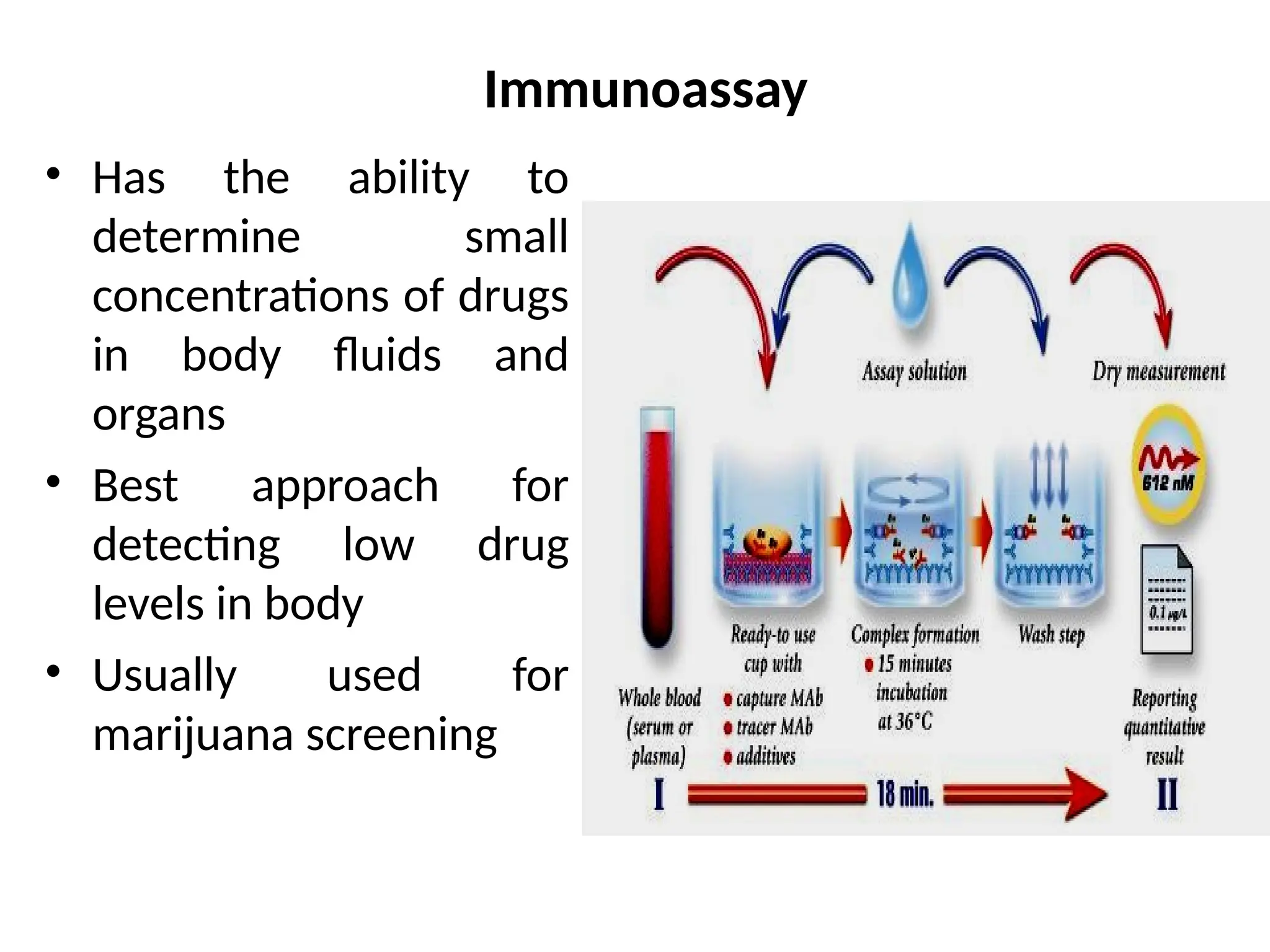
Immunoassay
• Has the ability to
determine small
concentrations of drugs
in body fluids and
organs
• Best approach for
detecting low drug
levels in body
• Usually used for
marijuana screening
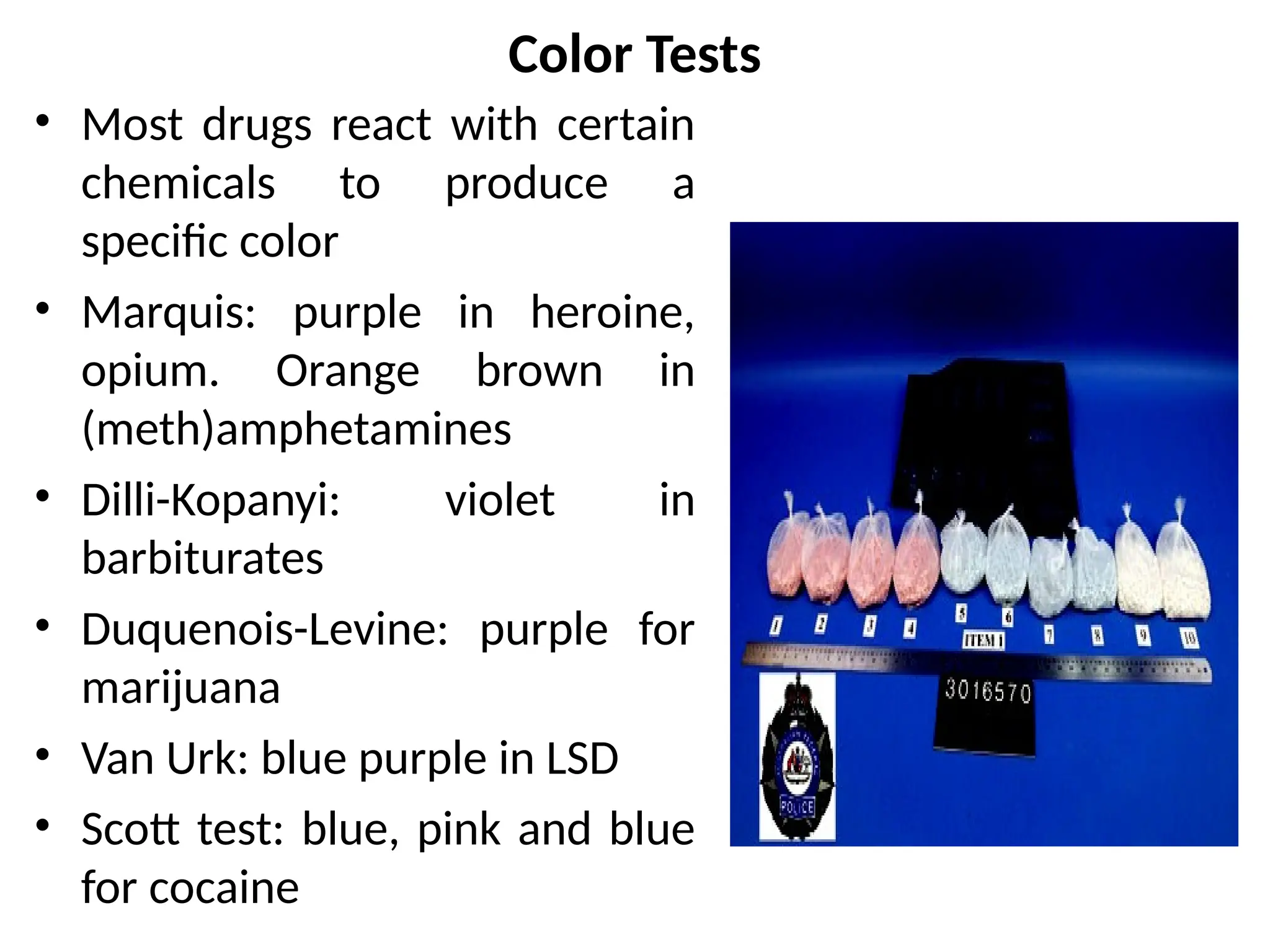
Color Tests
• Most drugs react with certain
chemicals to produce a
specific color
• Marquis: purple in heroine,
opium. Orange brown in
(meth)amphetamines
• Dilli-Kopanyi: violet in
barbiturates
• Duquenois-Levine: purple for
marijuana
• Van Urk: blue purple in LSD
• Scott test: blue, pink and blue
for cocaine
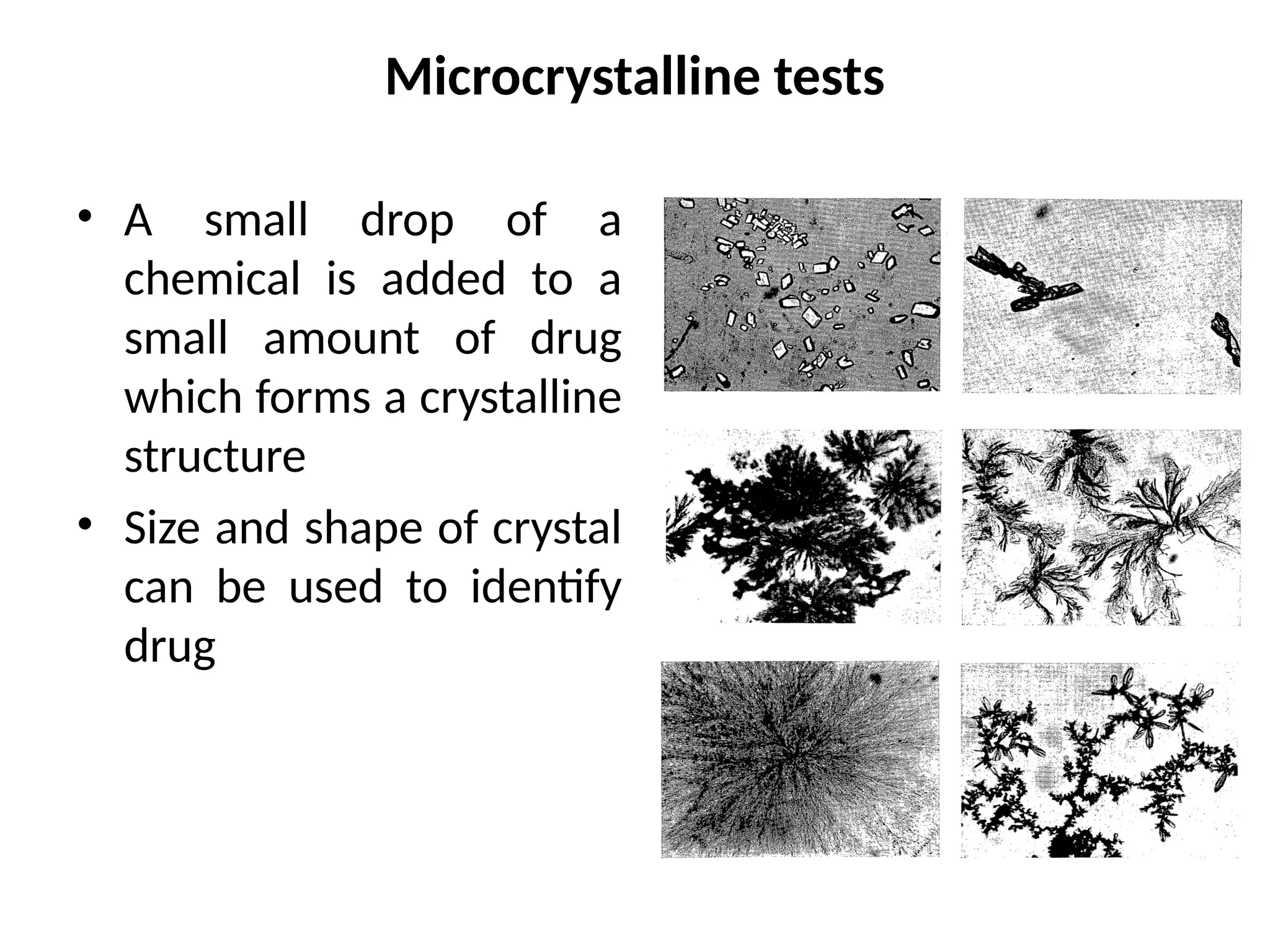
Microcrystalline tests
• A small drop of a
chemical is added to a
small amount of drug
which forms a crystalline
structure
• Size and shape of crystal
can be used to identify
drug
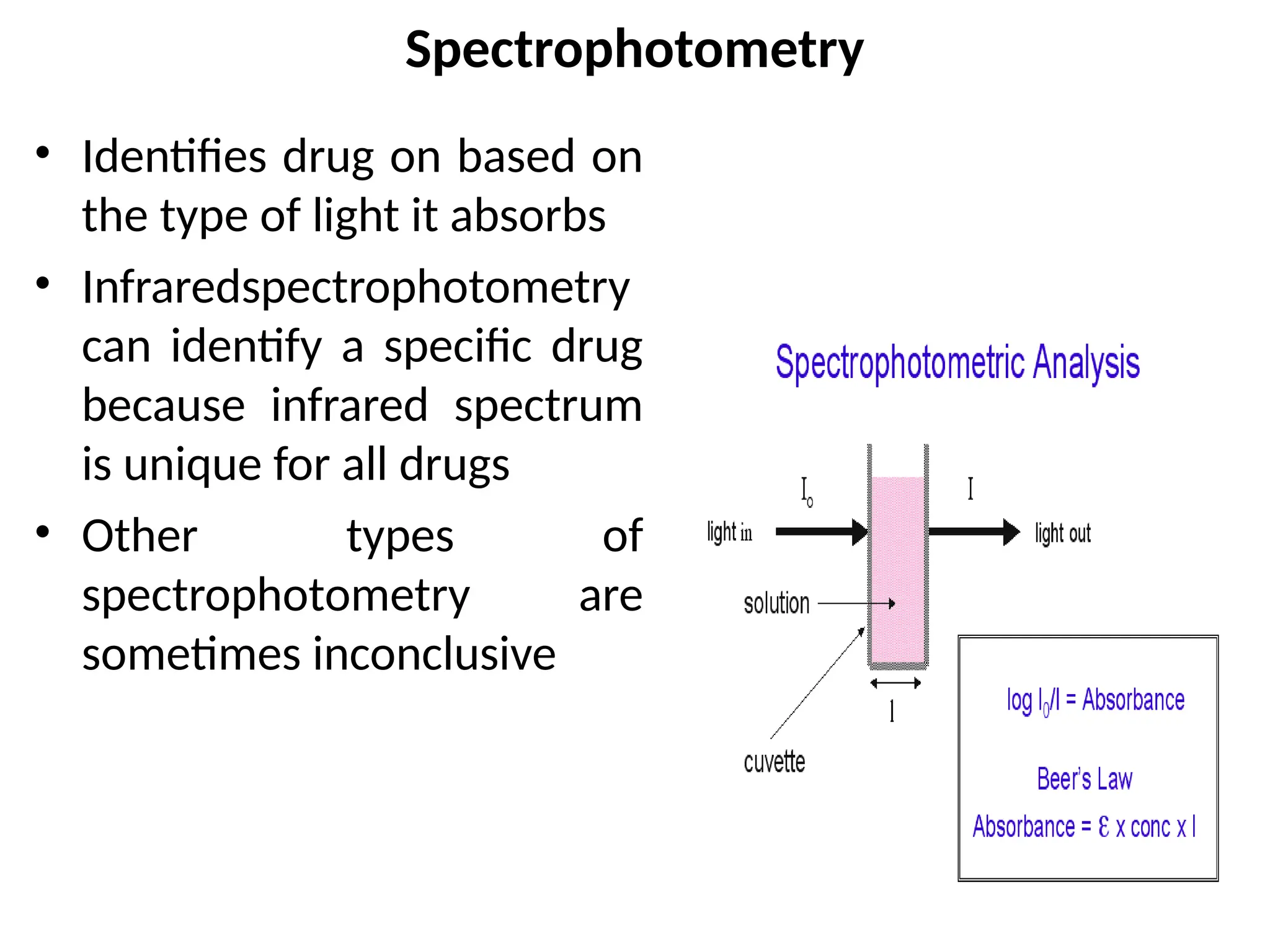
Spectrophotometry
• Identifies drug on based on
the type of light it absorbs
• Infraredspectrophotometry
can identify a specific drug
because infrared spectrum
is unique for all drugs
• Other types of
spectrophotometry are
sometimes inconclusive
Other screening test
• Thermal Desorption
• Thin-Layer Chromatography (TLC)
• Gas Chromotography (GC
• High-Performance Liquid Chromatography
(HPLC)

Application of Forensic Toxicology 8.2.ppt

  • 1.
    Forensic Toxicology • Theapplication of toxicology for the purposes of the law. • Greeks used hemlock as a means of state sponsored execution. Socrates was the most famous poisoning case by this method. • In the U.S., forensic toxicology did not develop until the early 20th century. • Dr. Alexander Gettler is considered this country’s first forensic toxicologist.
  • 2.
    • The effortsor activities conducted to effectuate this purpose include but are not limited to the following: • Urine testing to detect drug use • Regulatory toxicology • Occupational disease • Identification of causative agents causing death or injury in humans and animals
  • 3.
    Postmortem Forensic Toxicology Suspected drug intoxication cases  homicide  Arson fire deaths  Motor vehicle fatalities  Deaths due to natural causes  Death Investigations –Coroner –Medical Examiner
  • 4.
    • Investigation oftoxicity-related death/injury • The basic phases in conducting an investigation of a suspected toxicant- induced/related death can be viewed as follows: • Collection of information and specimens • Toxicological analysis • Data interpretation
  • 5.
    • The primaryquestions to be answered are when conducting an investigation include: • What was the route of administration? • What was administered dose? • Is concentration enough to have caused death or injury or altered the victim’s behavior enough to cause death or injury?
  • 6.
    • Specimens shouldbe collected before applying processes that may destroy evidence, that is before embalming. • It is possible to obtain useful specimens from burned or burial remains. The tissue often collected under these circumstances include bone marrow, skeletal muscle, vitreous humor, hair, and maggots..
  • 7.
    • For example,from hair samples, it is possible to detect the presence of antibiotics, antipsychotics, and drugs of abuse. However, the information is primarily qualitative in nature. • From maggots, barbiturates, barbiturates, benzodiazepines, phenothiazines, morphine, and malathion can be detected
  • 8.
    Postmortem Forensic Toxicology •Specimens – Blood – – Vitreous humor – Urine – Bile – Liver – Other – lung, spleen, stomach contents or brain – Hair
  • 9.
    Drug Concentrations andDistribution • As a rule, the highest concentrations of a poison are found at the site of administration. • A large quantity of drug in the GI tract and liver indicates oral ingestion. The gastrointestinal (GI) tract may contain large amounts of unabsorbed toxicant. • Cases that involve the oral administration of toxicants indicate analysis of GI contents.
  • 10.
    • Higher concentrationsof drug or toxicant in the lungs compared to other tissues may indicate inhalation, • while compounds located in tissue surrounding an injection site indicates a fresh intramuscular or intravenous injection • Urine analysis is also of great value since the kidney is the major organ of excretion for most toxicants • The liver is usually the first internal organ to be analyzed.
  • 11.
    Postmortem Forensic Toxicology •Approximately 50-100 mL of blood should be collected. • Blood from subdural or epidural clots should also be collected.These specimens could be useful when there is some period between an event and death. • Vitreous humor displays good stability and resides in an anatomically isolated area. Therefore it is more resistant to putrefactive changes than are other specimens.
  • 12.
    Postmortem Forensic Toxicology… Analytical Process • Separation • Identification • Confirmation • Quantization
  • 13.
    • There aredifferent screens specific for the type of substance to be assayed. • A given laboratory will follow an algorithm to handle the analysis. • The Volatile Screen (VS) is frequently used for the detection of ethanol. • A Drugs of Abuse Screen (DAS) is commonly used for amphetamines, cocaine, marijuana, and so on.
  • 14.
    • When thecause of death is unclear, a General Drug Screen (GDS) is employed. • Acidic/Neutral Screen (ANS) is primarily used to detect barbiturates, muscle relaxants, and so on. • Basic Drug Screens (BDS) are more specific for the detection of drugs such as cocaine and antidepressants. • It is recommended that the presence of a drug or toxicant be verified in more than one specimen.(check the word)
  • 15.
    Human Performance Toxicology •This branch of forensic toxicology is concerned with the relationship between the presence of a drug and associated behavioral changes. • It is generally accepted that there is a dose-effect relationship between drugs that elicit behavioral changes and those changes; elucidation and quantification of such a relationship is a significant role of the behavioral toxicologist. • Human performance toxicology is also referred to as behavioral toxicology. • E.g Ethanol and driving
  • 16.
    Breath Ethanol Testing Chemical • Reaction of ethanol with potassium dichromate/sulfuric acid solution • Oxidation reaction with a color change from yellow (dichromate ion) to green (chromic ion)  IR Spectrophotometry • Based on absorbance of light by the ethanol molecule • Mainstay in evidential breath testing devices  Electrochemical Oxidation • Oxidation of ethanol to acetic acid • Also used in evidential breath testing
  • 17.
    Immunoassay • Has theability to determine small concentrations of drugs in body fluids and organs • Best approach for detecting low drug levels in body • Usually used for marijuana screening
  • 18.
    Color Tests • Mostdrugs react with certain chemicals to produce a specific color • Marquis: purple in heroine, opium. Orange brown in (meth)amphetamines • Dilli-Kopanyi: violet in barbiturates • Duquenois-Levine: purple for marijuana • Van Urk: blue purple in LSD • Scott test: blue, pink and blue for cocaine
  • 19.
    Microcrystalline tests • Asmall drop of a chemical is added to a small amount of drug which forms a crystalline structure • Size and shape of crystal can be used to identify drug
  • 20.
    Spectrophotometry • Identifies drugon based on the type of light it absorbs • Infraredspectrophotometry can identify a specific drug because infrared spectrum is unique for all drugs • Other types of spectrophotometry are sometimes inconclusive
  • 21.
    Other screening test •Thermal Desorption • Thin-Layer Chromatography (TLC) • Gas Chromotography (GC • High-Performance Liquid Chromatography (HPLC)