Immunoassay tests and
forensic toxicology
By
Yasmin Aziz Badi
Higher diploma
Immunoassays
Immunoassays are chemical tests used to detect or quantify a specific substance,
the analyte , in a blood or body fluid sample, using an immunological reaction.
Immunoassays are highly sensitive and specific.
Their high specificity results from the use of antibodies and purified antigens as
reagents. An antibody is a protein (immunoglobulin) produced by B-lymphocytes
(immune cells) in response to stimulation by an antigen.
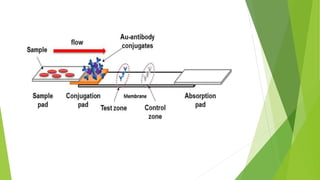
immunoassays measure the formation of antibody-antigen complexes and detect
them via an indicator reaction.
High sensitivity is achieved by using an indicator system (e.g., enzyme label) that
results in amplification of the measured product.
Immunoassays may be qualitative (positive or negative) or quantitative (amount
measured). An example of a qualitative assay is an immunoassay test for
pregnancy.
Pregnancy tests detect the presence of human chorionic gonadotropin (hCG) in
urine or serum. Highly purified antibodies can detect pregnancy within two days
of fertilization. Quantitative immunoassays are performed by measuring the
signal produced by the indicator reaction. This same test for pregnancy can be
made into a quantitative assay of hCG by measuring the concentration of product
formed.
Purpose
The purpose of an immunoassay is to measure (or, in a qualitative assay, to
detect) an analyte . Immunoassay is the method of choice for measuring
analytes normally present at very low concentrations that cannot be
determined accurately by other less expensive tests. Common uses include
measurement of drugs, hormones, specific proteins, tumor markers, and
markers of cardiac injury.
Qualitative immunoassays are often used to detect antigens on infectious
agents and antibodies that the body produces to fight them.
For example, immunoassays are used to detect antigens on Hemophilus,
Cryptococcus , and Streptococcus organisms in the cerebrospinal fluid (CSF) of
meningitis patients. They are also used to detect antigens associated with
organisms that are difficult to culture, such as hepatitis B virus and Chlamydia
trichomatis . Immunoassays for antibodies produced in viral hepatitis, HIV, and
Lyme disease are commonly used to identify patients with these diseases.
Description
There are several different methods used in immunoassay tests.
Immunoprecipitation.
The simplest immunoassay method measures the quantity of precipitate, which
forms after the reagent antibody (precipitin) has incubated with the sample and
reacted with its respective antigen to form an insoluble aggregate.
Immunoprecipitation reactions may be qualitative or quantitative.
Particle immunoassays. By linking several antibodies to the particle, the particle
is able to bind many antigen molecules simultaneously. This greatly accelerates
the speed of the visible reaction. This allows rapid and sensitive detection of
antibodies that are markers of such diseases, as infectious mononucleosis and
rheumatoid arthritis.
Immunonephelometry. The immediate union of antibody and antigen forms
immune complexes that are too small to precipitate. However, these complexes
will scatter incident light and can be measured using an instrument called a
nephelometer. The antigen concentration can be determined within minutes of the
reaction.
Forensic toxicology encompasses the determination of the presence and
concentration of drugs, other xenobiotics and their metabolites in physiological
fluids and organs and the interpretation of these findings as they may impact on
legal issues.
These include medical examiner investigations, driving under the influence and
other transportation accident investigations, workplace pre‐employment, random
and for‐cause drug testing and judicial monitoring of arrestees and parolees.
Similar techniques are employed in emergency room clinical toxicology and to
monitor the efficacy of substance abuse treatment.
The introduction of immunoassays into forensic toxicology in the early 1970s has
had a major impact on the speed and efficiency that samples can be screened for
the presence of certain drug classes.
For the most part, forensic toxicologists use commercial immunoassays
directed primarily towards abused drugs.
Commercial immunoassays developed for therapeutic monitoring of other drugs,
veterinary drugs and pesticides, as well as immunoassays developed in research
laboratories for specialized studies, may find a role in the forensic toxicology
laboratory for specialized cases.
Immunoassays used for forensic
toxicology
Most immunoassays used for forensic toxicology are competitive. An antigen
structurally similar to the target compound is conjugated to a signalling molecule
and competes with target drug in a sample for antibody binding.
Immunoassays are also classified as homogeneous and heterogeneous.
Homogeneous assays do not separate the original sample from the final detection
sample.
They must use a signal that changes when antibody is bound. Homogeneous
immunoassays include enzyme immunoassay (EIA) (enzyme activity decreases
when bound), fluorescent polarization immunoassay (FPIA) (emission in a polar
field increases when bound) and kinetic interaction of microparticles in solution
(KIMS) immunoassay (lattice formation inhibited when bound
Heterogenous immunoassays include radioimmunoassay (RIA) and enzyme‐linked
immune sorbent assay (ELISA) where unbound radiolabeled antigen and enzyme
conjugated antigen, respectively, are removed from the sample before
measurement. In general, the homogeneous immunoassays are more ameniable
to full automation, and thereby quicker throughput.
The heterogeneous immunoassays are less susceptible to matrix interference,
and thereby more versatile with non urine matrices.
Immunoassays used for
forensic toxicology
Immunoassays used for forensic
toxicology
While most commercial immunoassays have been developed for a urine matrix,
they have been applied by forensic toxicologists to other matrices, including
blood, hair, saliva, sweat, tissue homogenates, blood stains and most other
physiological samples that may be of value in the investigation.
The use of non urine matrices must contend with two factors. With the
exception of parenchymal tissues, the concentration of the target compound is
often lower and the sensitivity of the immunoassay may be limiting.
In addition, the non urine matrix usually is much more complex in its
composition.
Sample pretreatments that range from simple deproteinations to multistep
extractions to remove matrix components and/or concentrate the sample are
often required. The hetero genous RIAs and ELISAs usually require less rigorous, if
any, pretreatments.
Interpretation of immunoassay results
Interpretation of immunoassay results must take into consideration the limits of
detection of the assay, the cross‐reactivity of the antibody(ies) and the potential
for interference. Appropriate controls should be included to demonstrate
adequate signal separation from blanks (drug‐free sample in the same matrix).
The concentration of the low control is often determined by the sensitivity of the
assay, or in workplace testing programs by administratively determined cutoffs
that draw the line between a negative and presumptive positive. The ability of
the antibody to detect compounds other than the target compound (its
cross‐reactivity) can be a useful characteristic or, when the drugs that can be
confirmed are limited, a nuisance. The amphetamines, barbiturates and
benzodiazepines, in particular, all have a number of licit (and for amphetamines
illicit) analogs that could be present in a sample. Cross‐reactivities are
antibody‐source (i.e. manufacturer) dependent
Interpretation of immunoassay results
Further testing to determine the immunoreactive compound often requires
rigorous methodologies. In some instances, the potency of the drug and its
poor cross‐reactivity make detection by immunoassay difficult (e.g.
nitrosobenzodiazepines).
Interference in immunoassays may arise from compounds that appear in the
matrix during disease states, or those that are intentionally added to a
sample in the hope of negating a positive test.
These act through many different mechanisms and may decrease or increase
the immunoassay test result.
In the end
Immunoassays have added an extremely useful tool to the forensic toxicology
investigation.
They can be used to screen rapidly a large number of samples for the potential
presence of a drug group. With rare exceptions (emergencies, limited sample
volume), their use without a confirmation assay (e.g. gas or liquid
chromatography/mass spectrometry (LC/MS)) is unwarranted,
as it leads to a risk of improper test result interpretation.
Reference
1- Nadine Theofel, Sonja Roscher, Stefan Scholtis and Michael Tsokos, Wenn Leichen auf
Gerichtsmediziner treffen, Chemie in unserer Zeit, 53, 1, (40-49), (2019).Wiley Online
Library
2- Kronstrand R., Roman M., Dahlgren M., Thelander G., Wikström M., Druid H.. A
cluster of deaths involving 5-(2-aminopropyl)indole (5-IT), Journal of Analytical
Toxicology, 2013, vol. 37 (pg. 542-546)
3-Seetohul L.N., Pounder D.J.. Four fatalities involving 5-IT, Journal of Analytical
Toxicology, 2013, vol. 37 (pg. 447-451)

Immunoassay test and forensic toxicology

  • 1.
    Immunoassay tests and forensictoxicology By Yasmin Aziz Badi Higher diploma
  • 2.
    Immunoassays Immunoassays are chemicaltests used to detect or quantify a specific substance, the analyte , in a blood or body fluid sample, using an immunological reaction. Immunoassays are highly sensitive and specific. Their high specificity results from the use of antibodies and purified antigens as reagents. An antibody is a protein (immunoglobulin) produced by B-lymphocytes (immune cells) in response to stimulation by an antigen. immunoassays measure the formation of antibody-antigen complexes and detect them via an indicator reaction. High sensitivity is achieved by using an indicator system (e.g., enzyme label) that results in amplification of the measured product.
  • 4.
    Immunoassays may bequalitative (positive or negative) or quantitative (amount measured). An example of a qualitative assay is an immunoassay test for pregnancy. Pregnancy tests detect the presence of human chorionic gonadotropin (hCG) in urine or serum. Highly purified antibodies can detect pregnancy within two days of fertilization. Quantitative immunoassays are performed by measuring the signal produced by the indicator reaction. This same test for pregnancy can be made into a quantitative assay of hCG by measuring the concentration of product formed.
  • 5.
    Purpose The purpose ofan immunoassay is to measure (or, in a qualitative assay, to detect) an analyte . Immunoassay is the method of choice for measuring analytes normally present at very low concentrations that cannot be determined accurately by other less expensive tests. Common uses include measurement of drugs, hormones, specific proteins, tumor markers, and markers of cardiac injury. Qualitative immunoassays are often used to detect antigens on infectious agents and antibodies that the body produces to fight them.
  • 6.
    For example, immunoassaysare used to detect antigens on Hemophilus, Cryptococcus , and Streptococcus organisms in the cerebrospinal fluid (CSF) of meningitis patients. They are also used to detect antigens associated with organisms that are difficult to culture, such as hepatitis B virus and Chlamydia trichomatis . Immunoassays for antibodies produced in viral hepatitis, HIV, and Lyme disease are commonly used to identify patients with these diseases.
  • 7.
    Description There are severaldifferent methods used in immunoassay tests. Immunoprecipitation. The simplest immunoassay method measures the quantity of precipitate, which forms after the reagent antibody (precipitin) has incubated with the sample and reacted with its respective antigen to form an insoluble aggregate. Immunoprecipitation reactions may be qualitative or quantitative. Particle immunoassays. By linking several antibodies to the particle, the particle is able to bind many antigen molecules simultaneously. This greatly accelerates the speed of the visible reaction. This allows rapid and sensitive detection of antibodies that are markers of such diseases, as infectious mononucleosis and rheumatoid arthritis. Immunonephelometry. The immediate union of antibody and antigen forms immune complexes that are too small to precipitate. However, these complexes will scatter incident light and can be measured using an instrument called a nephelometer. The antigen concentration can be determined within minutes of the reaction.
  • 8.
    Forensic toxicology encompassesthe determination of the presence and concentration of drugs, other xenobiotics and their metabolites in physiological fluids and organs and the interpretation of these findings as they may impact on legal issues. These include medical examiner investigations, driving under the influence and other transportation accident investigations, workplace pre‐employment, random and for‐cause drug testing and judicial monitoring of arrestees and parolees. Similar techniques are employed in emergency room clinical toxicology and to monitor the efficacy of substance abuse treatment. The introduction of immunoassays into forensic toxicology in the early 1970s has had a major impact on the speed and efficiency that samples can be screened for the presence of certain drug classes. For the most part, forensic toxicologists use commercial immunoassays directed primarily towards abused drugs. Commercial immunoassays developed for therapeutic monitoring of other drugs, veterinary drugs and pesticides, as well as immunoassays developed in research laboratories for specialized studies, may find a role in the forensic toxicology laboratory for specialized cases.
  • 9.
    Immunoassays used forforensic toxicology Most immunoassays used for forensic toxicology are competitive. An antigen structurally similar to the target compound is conjugated to a signalling molecule and competes with target drug in a sample for antibody binding. Immunoassays are also classified as homogeneous and heterogeneous. Homogeneous assays do not separate the original sample from the final detection sample. They must use a signal that changes when antibody is bound. Homogeneous immunoassays include enzyme immunoassay (EIA) (enzyme activity decreases when bound), fluorescent polarization immunoassay (FPIA) (emission in a polar field increases when bound) and kinetic interaction of microparticles in solution (KIMS) immunoassay (lattice formation inhibited when bound
  • 10.
    Heterogenous immunoassays includeradioimmunoassay (RIA) and enzyme‐linked immune sorbent assay (ELISA) where unbound radiolabeled antigen and enzyme conjugated antigen, respectively, are removed from the sample before measurement. In general, the homogeneous immunoassays are more ameniable to full automation, and thereby quicker throughput. The heterogeneous immunoassays are less susceptible to matrix interference, and thereby more versatile with non urine matrices. Immunoassays used for forensic toxicology
  • 11.
    Immunoassays used forforensic toxicology While most commercial immunoassays have been developed for a urine matrix, they have been applied by forensic toxicologists to other matrices, including blood, hair, saliva, sweat, tissue homogenates, blood stains and most other physiological samples that may be of value in the investigation. The use of non urine matrices must contend with two factors. With the exception of parenchymal tissues, the concentration of the target compound is often lower and the sensitivity of the immunoassay may be limiting. In addition, the non urine matrix usually is much more complex in its composition. Sample pretreatments that range from simple deproteinations to multistep extractions to remove matrix components and/or concentrate the sample are often required. The hetero genous RIAs and ELISAs usually require less rigorous, if any, pretreatments.
  • 12.
    Interpretation of immunoassayresults Interpretation of immunoassay results must take into consideration the limits of detection of the assay, the cross‐reactivity of the antibody(ies) and the potential for interference. Appropriate controls should be included to demonstrate adequate signal separation from blanks (drug‐free sample in the same matrix). The concentration of the low control is often determined by the sensitivity of the assay, or in workplace testing programs by administratively determined cutoffs that draw the line between a negative and presumptive positive. The ability of the antibody to detect compounds other than the target compound (its cross‐reactivity) can be a useful characteristic or, when the drugs that can be confirmed are limited, a nuisance. The amphetamines, barbiturates and benzodiazepines, in particular, all have a number of licit (and for amphetamines illicit) analogs that could be present in a sample. Cross‐reactivities are antibody‐source (i.e. manufacturer) dependent
  • 13.
    Interpretation of immunoassayresults Further testing to determine the immunoreactive compound often requires rigorous methodologies. In some instances, the potency of the drug and its poor cross‐reactivity make detection by immunoassay difficult (e.g. nitrosobenzodiazepines). Interference in immunoassays may arise from compounds that appear in the matrix during disease states, or those that are intentionally added to a sample in the hope of negating a positive test. These act through many different mechanisms and may decrease or increase the immunoassay test result.
  • 14.
    In the end Immunoassayshave added an extremely useful tool to the forensic toxicology investigation. They can be used to screen rapidly a large number of samples for the potential presence of a drug group. With rare exceptions (emergencies, limited sample volume), their use without a confirmation assay (e.g. gas or liquid chromatography/mass spectrometry (LC/MS)) is unwarranted, as it leads to a risk of improper test result interpretation.
  • 15.
    Reference 1- Nadine Theofel,Sonja Roscher, Stefan Scholtis and Michael Tsokos, Wenn Leichen auf Gerichtsmediziner treffen, Chemie in unserer Zeit, 53, 1, (40-49), (2019).Wiley Online Library 2- Kronstrand R., Roman M., Dahlgren M., Thelander G., Wikström M., Druid H.. A cluster of deaths involving 5-(2-aminopropyl)indole (5-IT), Journal of Analytical Toxicology, 2013, vol. 37 (pg. 542-546) 3-Seetohul L.N., Pounder D.J.. Four fatalities involving 5-IT, Journal of Analytical Toxicology, 2013, vol. 37 (pg. 447-451)