Analytic Toxicology
10/15/2025
1
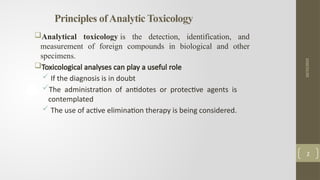
Principles ofAnalytic Toxicology
Analytical toxicology is the detection, identification, and
measurement of foreign compounds in biological and other
specimens.
Toxicological analyses can play a useful role
 If the diagnosis is in doubt
The administration of antidotes or protective agents is
contemplated
 The use of active elimination therapy is being considered.
10/15/2025
2
Cont.….
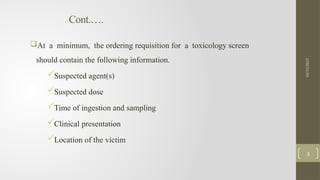
At a minimum, the ordering requisition for a toxicology screen
should contain the following information.
Suspected agent(s)
Suspected dose
Time of ingestion and sampling
Clinical presentation
Location of the victim
10/15/2025
3
Steps in undertaking an analytical toxicological
investigation
The analysis dealings with a case of poisoning are usually
divided into
pre-analytical
analytical and
post-analytical phases
10/15/2025
4
Pre-analytical phase
Pre-analytical phase
Obtain details of current admission, including
 any circumstantial evidence of poisoning and results of
biochemical and hematological investigations.
Obtain victim's medical history, if available,
ensure access to the appropriate sample(s), and
decide the priorities for the analysis.
10/15/2025
5
Cont.…
• Analytical phase
 Perform the agreed analyses.
• Post-analytical phase
Interpret the results and discuss them with the clinician
looking after the victim.
Perform additional analyses, if indicated, on the
original samples or on further samples from the victim.
10/15/2025
6
Forensic toxicology
Forensic toxicology is the use of toxicology disciplines such
as analytical chemistry, pharmacology and clinical chemistry to
aid medical or legal investigation of death, poisoning, and drug
use.
The primary concern for forensic toxicology is the obtainment
and interpretation of results.
10/15/2025
7
Cont.…
In the United States, forensic toxicology can be separated into 3
disciplines:
Postmortem toxicology (an examination of a dead body to
determine the cause of death.)
Human performance toxicology
Forensic drug testing (FDT).
10/15/2025
8
Cont.…
Postmortem toxicology includes the analysis of biological
specimens taken from an autopsy to identify the effect of drugs,
alcohol, and poisons.
A wide range of biological specimens may be analyzed to determine the
cause and manner of death.
forensic drug testing (FDT) is the detection of drug use among
individuals in the workplace, sport doping, drug-related probation,
and new job applicant screenings.
10/15/2025
9
Cont.…
In human performance toxicology, a dose-response relationship
between a drug(s) present in the body and the effects on the body
are examined.
This field of forensic toxicology is responsible for building and
implementing laws such as driving under the influence of alcohol
or drugs.
10/15/2025
10
Management of poisonING
10/15/2025
11
General considerations in the mgt of poisoning
The following general steps represent important elements of the initial clinical
encounter for a poisoned patient:
1. Stabilization of the patient
2.Clinical evaluation (history, physical, laboratory, radiology)
3.Prevention of further toxin absorption
4.Enhancement of toxin elimination
5.Administration of antidote
6.Supportive care and clinical follow up
10/15/2025
12
Cont.…
Clinical Stabilization:
The first priority in the treatment of the poisoned patient is Clinical
stabilization. This is the so-called ABCs
Airway,
Breathing
Circulation
10/15/2025
13
prevention of further absorption
1. Topical decontamination
Generally; achieved by; undressing patients and washing them
thoroughly with copious amounts of water.
Pt. should initially be in isolated area.
All towels and clothing should be put into hazardous waste bags .
Rapid decontamination is needed specially if the poison is a
corrosive or is easily absorbed from the skin.
Wash contaminated areas as well as exposed areas with warm water
or saline , with careful washing of the skin, behind ears, under nails,
and skin folds
10/15/2025
14
if the toxin was ingested
Three general methods involve removing toxin from stomach via the
mouth, binding it inside gut lumen, or mechanically flushing it
through GIT.
1. Dilution: By using water & milk immediately after poisoning.
This reduce the gastric irritation induced by many ingested poisons
and Milk provides dilution and is also a demulcent
2. Emesis: induced by Syrup of Ipecac: orally administered and
Apomorphine: given by s.c. injection (most rapid).
N.B. Do not induce vomiting if the patient is Unconscious or comatose
10/15/2025
15
CONT….
3. Gastric lavage: Gastric lavage is only effective when ingestion of the poison
is discovered within 1 hours except salicytates may be within 4-6 hours (it sticks
to the mucous membrane). Eg. bicarbonate, saline
Often reserved for patients with impaired consciousness and uncooperative
Indicated for:Heavy metals, Iron, Lithium, Sustained or delayed release
formulations.
4. Adsorbents:- Activated charcoal:
is administered orally to adsorb or bind toxins and allows them to pass from
the GIT without being absorbed into the systemic circulation.
10/15/2025
16
ENHANCEMENT OFEXCRETION
There are several methods available to enhance the elimination of
specific poisons or drugs once they have been absorbed into the
systemic circulation.
The primary methods employed for this use today include:
alkalinization of the urine,
10/15/2025
17
Alkalization of the urine
Forced Diuresis: its useful to enhance renal elimination of
poisons. Saline to expand fluid volume and furosemide may be
used to enhance diuresis.
Acid Diuresis: with ammonium chloride can enhance the
elimination of weak bases e.g. amphetamine, strychnine and
quinidine.
Alkaline Diuresis: with Sodium bicarbonate can remove weak
acids (e.g. salicylates and Phenobarbital).
10/15/2025
18
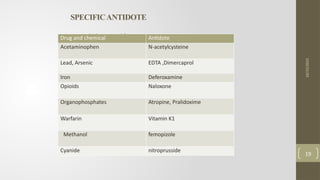
SPECIFICANTIDOTE
Poison Antidote
10/15/2025
19
Drug and chemical Antidote
Acetaminophen N-acetylcysteine
Lead, Arsenic EDTA ,Dimercaprol
Iron Deferoxamine
Opioids Naloxone
Organophosphates Atropine, Pralidoxime
Warfarin Vitamin K1
Methanol femopizole
Cyanide nitroprusside
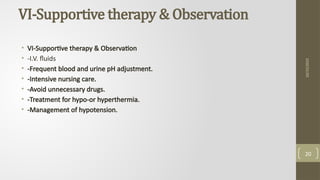
VI-Supportive therapy & Observation
• VI-Supportive therapy & Observation
• -I.V. fluids
• -Frequent blood and urine pH adjustment.
• -Intensive nursing care.
• -Avoid unnecessary drugs.
• -Treatment for hypo-or hyperthermia.
• -Management of hypotension.
10/15/2025
20
21
THANK YOU

Toxicology chapter two .pptx: analytical toxicology

  • 1.
  • 2.
    Principles ofAnalytic Toxicology Analyticaltoxicology is the detection, identification, and measurement of foreign compounds in biological and other specimens. Toxicological analyses can play a useful role  If the diagnosis is in doubt The administration of antidotes or protective agents is contemplated  The use of active elimination therapy is being considered. 10/15/2025 2
  • 3.
    Cont.…. At a minimum,the ordering requisition for a toxicology screen should contain the following information. Suspected agent(s) Suspected dose Time of ingestion and sampling Clinical presentation Location of the victim 10/15/2025 3
  • 4.
    Steps in undertakingan analytical toxicological investigation The analysis dealings with a case of poisoning are usually divided into pre-analytical analytical and post-analytical phases 10/15/2025 4
  • 5.
    Pre-analytical phase Pre-analytical phase Obtaindetails of current admission, including  any circumstantial evidence of poisoning and results of biochemical and hematological investigations. Obtain victim's medical history, if available, ensure access to the appropriate sample(s), and decide the priorities for the analysis. 10/15/2025 5
  • 6.
    Cont.… • Analytical phase Perform the agreed analyses. • Post-analytical phase Interpret the results and discuss them with the clinician looking after the victim. Perform additional analyses, if indicated, on the original samples or on further samples from the victim. 10/15/2025 6
  • 7.
    Forensic toxicology Forensic toxicologyis the use of toxicology disciplines such as analytical chemistry, pharmacology and clinical chemistry to aid medical or legal investigation of death, poisoning, and drug use. The primary concern for forensic toxicology is the obtainment and interpretation of results. 10/15/2025 7
  • 8.
    Cont.… In the UnitedStates, forensic toxicology can be separated into 3 disciplines: Postmortem toxicology (an examination of a dead body to determine the cause of death.) Human performance toxicology Forensic drug testing (FDT). 10/15/2025 8
  • 9.
    Cont.… Postmortem toxicology includesthe analysis of biological specimens taken from an autopsy to identify the effect of drugs, alcohol, and poisons. A wide range of biological specimens may be analyzed to determine the cause and manner of death. forensic drug testing (FDT) is the detection of drug use among individuals in the workplace, sport doping, drug-related probation, and new job applicant screenings. 10/15/2025 9
  • 10.
    Cont.… In human performancetoxicology, a dose-response relationship between a drug(s) present in the body and the effects on the body are examined. This field of forensic toxicology is responsible for building and implementing laws such as driving under the influence of alcohol or drugs. 10/15/2025 10
  • 11.
  • 12.
    General considerations inthe mgt of poisoning The following general steps represent important elements of the initial clinical encounter for a poisoned patient: 1. Stabilization of the patient 2.Clinical evaluation (history, physical, laboratory, radiology) 3.Prevention of further toxin absorption 4.Enhancement of toxin elimination 5.Administration of antidote 6.Supportive care and clinical follow up 10/15/2025 12
  • 13.
    Cont.… Clinical Stabilization: The firstpriority in the treatment of the poisoned patient is Clinical stabilization. This is the so-called ABCs Airway, Breathing Circulation 10/15/2025 13
  • 14.
    prevention of furtherabsorption 1. Topical decontamination Generally; achieved by; undressing patients and washing them thoroughly with copious amounts of water. Pt. should initially be in isolated area. All towels and clothing should be put into hazardous waste bags . Rapid decontamination is needed specially if the poison is a corrosive or is easily absorbed from the skin. Wash contaminated areas as well as exposed areas with warm water or saline , with careful washing of the skin, behind ears, under nails, and skin folds 10/15/2025 14
  • 15.
    if the toxinwas ingested Three general methods involve removing toxin from stomach via the mouth, binding it inside gut lumen, or mechanically flushing it through GIT. 1. Dilution: By using water & milk immediately after poisoning. This reduce the gastric irritation induced by many ingested poisons and Milk provides dilution and is also a demulcent 2. Emesis: induced by Syrup of Ipecac: orally administered and Apomorphine: given by s.c. injection (most rapid). N.B. Do not induce vomiting if the patient is Unconscious or comatose 10/15/2025 15
  • 16.
    CONT…. 3. Gastric lavage:Gastric lavage is only effective when ingestion of the poison is discovered within 1 hours except salicytates may be within 4-6 hours (it sticks to the mucous membrane). Eg. bicarbonate, saline Often reserved for patients with impaired consciousness and uncooperative Indicated for:Heavy metals, Iron, Lithium, Sustained or delayed release formulations. 4. Adsorbents:- Activated charcoal: is administered orally to adsorb or bind toxins and allows them to pass from the GIT without being absorbed into the systemic circulation. 10/15/2025 16
  • 17.
    ENHANCEMENT OFEXCRETION There areseveral methods available to enhance the elimination of specific poisons or drugs once they have been absorbed into the systemic circulation. The primary methods employed for this use today include: alkalinization of the urine, 10/15/2025 17
  • 18.
    Alkalization of theurine Forced Diuresis: its useful to enhance renal elimination of poisons. Saline to expand fluid volume and furosemide may be used to enhance diuresis. Acid Diuresis: with ammonium chloride can enhance the elimination of weak bases e.g. amphetamine, strychnine and quinidine. Alkaline Diuresis: with Sodium bicarbonate can remove weak acids (e.g. salicylates and Phenobarbital). 10/15/2025 18
  • 19.
    SPECIFICANTIDOTE Poison Antidote 10/15/2025 19 Drug andchemical Antidote Acetaminophen N-acetylcysteine Lead, Arsenic EDTA ,Dimercaprol Iron Deferoxamine Opioids Naloxone Organophosphates Atropine, Pralidoxime Warfarin Vitamin K1 Methanol femopizole Cyanide nitroprusside
  • 20.
    VI-Supportive therapy &Observation • VI-Supportive therapy & Observation • -I.V. fluids • -Frequent blood and urine pH adjustment. • -Intensive nursing care. • -Avoid unnecessary drugs. • -Treatment for hypo-or hyperthermia. • -Management of hypotension. 10/15/2025 20
  • 21.