VARSHA
M pharma Ist year Pharmaceutical chemistry
1726
DESIGNER DRUG
The Designer Drug Enforcement Act of 1986 defined a designer
drug as “a substance other than a controlled substance that has a
chemical structure substantially similar to that of a controlled
substance in schedule I or II or that was specifically designed to
produce an effect substantially similar to that of a controlled
substance in schedule I or ll. The manufacture, trafficking, and
marketing of clandestinely produced designer drugs through the
Internet has increased dramatically in recent years
Characteristics
 They are not covered by controlled substances
statutes.
 They have a psychotropic (stimulant,
hallucinogenic,sedative,anxiolytic etc.) effect very
similar to the controlled substances that are popular
among those person who recreationally drugs.
 Designer drugs do not have FDA approval and are
produced by underground chemist.
 Designer drugs are not correctly synthesise and
purified.
Table of contents
 GHB
 Ecstasy
 Ketamine
 Rohypnol
 Up and Coming
 Pharming Out
 Cocaine
 Energy Drinks
 Supplements
 Drug use brings pleasure – at first
 Altering the brain can be hazardous to your health.
 Legal and illegal drugs alter the way nerve cells in the
brain communicate by affecting neurotransmitters.
 A drug may have a medical benefit yet be abused
• Seratonin, dopamine,, GABA,
Noradrenaline,
endorphinsglutamate
• Excessive, blocked or altered
metabolic
breakdown of neurotransmitters
• Dosage determines effect.
• Illegal drugs = unknown dosage
GHB(Gamma hydroxybutyrate)
 G, Liquid E, Grevious Bodily Harm, Easy
 Lay, G-Riffick, Scoop, Salty Water, Gina Naturally
occurring
 Mostly found in brain
 ? Neurotransmitter, ? Metabolic by-product
 Acts as central nervous system depressant
Effects
 Intoxication
 Euphoria
 Relaxation
 Loss of inhibitions
 Sociable
 Affectionate and playful
 Nausea/vomiting
 Loss of muscle tone
 Impaired judgment
 Resembles alcohol intoxication
OPIOIDS
 CNS depressant
 Used to help alleviate or decrease pain
 Chemically related to opium- Substance collected
from poppy plant
 Prescription medication only
 Alter brain activity leading to dependence
Effects
 Sedation
 Sleepiness
 Lethargy
 Confusion
 Weight loss
 Respiratory depression
 Decreased GI motility– Constipation
 Nausea
 Vomiting
 Physical dependence
 Addiction
 Itching
Structure of morhine & heroin
Morphine’s side effects, such as its euphorigenic and reinforcing properties,
which result in addiction.
One early analog developed was 3,6-diacetylmorphine (A2, diamorphine
heroin). While this compound did not prove to be a better analgesic with
fewer side effects, it did become and continues to be the major opioid
compound of abuse.,
The piperidine class of opioids including
SAR studies that may have led to major
opioid “designer drugs.” Thousands of
synthetic piperidine derivatives have been
designed, synthesized,
The piperidines are presented as four
classes of analgesics related to the parent
drug . Meperidine (A3) (also known as
pethidine and Demerol), ketobemidone
(A4), picenadol (A5), and fentanyl (A6).
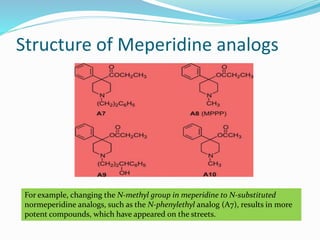
Structure of Meperidine analogs
For example, changing the N-methyl group in meperidine to N-substituted
normeperidine analogs, such as the N-phenylethyl analog (A7), results in more
potent compounds, which have appeared on the streets.
Unfortunately, many of those who used A8 developed an
irreversible Parkinsonian like syndrome due to the presence of
1-methyl- 4-phenyl-1,2,5,6-tetrahydropyridine (A11, MPTP, ) as
an impurity. It was later found that, in the body, MPTP was
converted to a neurotoxin MPP+ (A12,) that destroys
dopamine neurons, which are the same neurons lost due to
aging and possibly to other factors in Parkinson’s disease.
Structure of ketobemide analogs
Structure of fentanyl analogs
A-16 1-Methyl fentanyl A-19 2-hydroxy fentanyl
A 18 2- hydroxy, 3-methylfentanyl
Amphetamine & their analogs
Amphetamine analogs have been described as being the most popular and
extensively studied designer drugs. An example would be the street drug
“ecstasy” (MDMA, B1), the structure of which contains the -phenethylamine
(-PEA, B2) backbone. The latter, a metabolite of phenylalanine, is present in
the mammalian brain and is known to produce multiple neurobehavioral
actions including hyperactivity, induced place preference conditioning,
conditioned taste aversion, and to possess rewarding and reinforcing
properties.
Animal studies to determine the effects of these agents soon revealed
modification of the substitution pattern on the aromatic ring to have
profound effects on potency and to lead to distinct effects. Specifically it was
recognized that some phenylisopropylamines were hallucinogens, producing
LSD-like effects, while others were stimulants like amphetamine. Additional
studies led to the definition of three distinct effects (Fig. 7)—central
stimulant action (S),hallucination,& other psychotropic effects
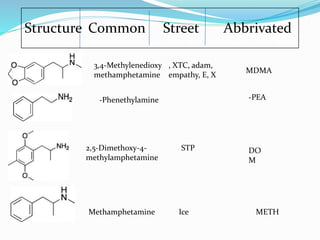
Structure Common Street Abbrivated
3,4-Methylenedioxy
methamphetamine
, XTC, adam,
empathy, E, X
MDMA
-Phenethylamine -PEA
2,5-Dimethoxy-4-
methylamphetamine
STP DO
M
Methamphetamine Ice METH
Cannabinods & analogs
Marijuana, which is the most widely used illicit drug in the United States
elicits euphoric effects and is generally without acute dire consequences.
In the decades since the structure elucidation of its active constituent,
tetrahydrocannabinol (9- THC) (C1a),62 other families of compounds
(collectively referred to as cannabinoids) that result in the constellation of
effects associated with marijuana have been discovered and designed. The
cannabinoid agonists activate the CB1 and CB2 receptors and produce the
central nervous system (CNS) effects via the CB1 receptor.
EICOSANOIDS
Pyrolle
These prepration which, have been sold as incense and
claiming “not for human consumption” under many brands
(i.e.,
Spice, K2, Serenity Now, Tribal Warrior, Spike99, ex SES, etc.)
are herbal mixtures that act as a carrier for chemically
synthesized active cannabinoid agonists. Typically, they are
smoked to intake the active volatilized ingredient.
Metabolites and analysis
Detection of the drug of abuse or its metabolites in bodily fluids
such as urine by commonly used analytical methods is pivotal in
both scientific and forensic pursuits. Assays have been reported
wherein
JWH 018 was not detected in urine, while some of its metabolites
.
Phencyclidine & analogs
under street names such as “PeaCe Pill,” “Hog,” “Angel Dust,” and numerous
others.The manufacture of legal PCP-containing products was discontinued
altogether in 1978 when PCP was designated a schedule II–controlled
substance by the DEA
Side effects
1. Delirium
2. Euphoria
3. Hallucination
4. Violent & manic behavior
Designer drug

Designer drug

  • 1.
    VARSHA M pharma Istyear Pharmaceutical chemistry 1726
  • 3.
    DESIGNER DRUG The DesignerDrug Enforcement Act of 1986 defined a designer drug as “a substance other than a controlled substance that has a chemical structure substantially similar to that of a controlled substance in schedule I or II or that was specifically designed to produce an effect substantially similar to that of a controlled substance in schedule I or ll. The manufacture, trafficking, and marketing of clandestinely produced designer drugs through the Internet has increased dramatically in recent years
  • 4.
    Characteristics  They arenot covered by controlled substances statutes.  They have a psychotropic (stimulant, hallucinogenic,sedative,anxiolytic etc.) effect very similar to the controlled substances that are popular among those person who recreationally drugs.  Designer drugs do not have FDA approval and are produced by underground chemist.  Designer drugs are not correctly synthesise and purified.
  • 5.
    Table of contents GHB  Ecstasy  Ketamine  Rohypnol  Up and Coming  Pharming Out  Cocaine  Energy Drinks  Supplements
  • 6.
     Drug usebrings pleasure – at first  Altering the brain can be hazardous to your health.  Legal and illegal drugs alter the way nerve cells in the brain communicate by affecting neurotransmitters.  A drug may have a medical benefit yet be abused
  • 7.
    • Seratonin, dopamine,,GABA, Noradrenaline, endorphinsglutamate • Excessive, blocked or altered metabolic breakdown of neurotransmitters • Dosage determines effect. • Illegal drugs = unknown dosage
  • 8.
    GHB(Gamma hydroxybutyrate)  G,Liquid E, Grevious Bodily Harm, Easy  Lay, G-Riffick, Scoop, Salty Water, Gina Naturally occurring  Mostly found in brain  ? Neurotransmitter, ? Metabolic by-product  Acts as central nervous system depressant
  • 9.
    Effects  Intoxication  Euphoria Relaxation  Loss of inhibitions  Sociable  Affectionate and playful  Nausea/vomiting  Loss of muscle tone  Impaired judgment  Resembles alcohol intoxication
  • 10.
    OPIOIDS  CNS depressant Used to help alleviate or decrease pain  Chemically related to opium- Substance collected from poppy plant  Prescription medication only  Alter brain activity leading to dependence
  • 11.
    Effects  Sedation  Sleepiness Lethargy  Confusion  Weight loss  Respiratory depression  Decreased GI motility– Constipation  Nausea  Vomiting  Physical dependence  Addiction  Itching
  • 12.
  • 13.
    Morphine’s side effects,such as its euphorigenic and reinforcing properties, which result in addiction. One early analog developed was 3,6-diacetylmorphine (A2, diamorphine heroin). While this compound did not prove to be a better analgesic with fewer side effects, it did become and continues to be the major opioid compound of abuse.,
  • 14.
    The piperidine classof opioids including SAR studies that may have led to major opioid “designer drugs.” Thousands of synthetic piperidine derivatives have been designed, synthesized, The piperidines are presented as four classes of analgesics related to the parent drug . Meperidine (A3) (also known as pethidine and Demerol), ketobemidone (A4), picenadol (A5), and fentanyl (A6).
  • 15.
    Structure of Meperidineanalogs For example, changing the N-methyl group in meperidine to N-substituted normeperidine analogs, such as the N-phenylethyl analog (A7), results in more potent compounds, which have appeared on the streets.
  • 16.
    Unfortunately, many ofthose who used A8 developed an irreversible Parkinsonian like syndrome due to the presence of 1-methyl- 4-phenyl-1,2,5,6-tetrahydropyridine (A11, MPTP, ) as an impurity. It was later found that, in the body, MPTP was converted to a neurotoxin MPP+ (A12,) that destroys dopamine neurons, which are the same neurons lost due to aging and possibly to other factors in Parkinson’s disease.
  • 17.
  • 18.
    Structure of fentanylanalogs A-16 1-Methyl fentanyl A-19 2-hydroxy fentanyl A 18 2- hydroxy, 3-methylfentanyl
  • 19.
    Amphetamine & theiranalogs Amphetamine analogs have been described as being the most popular and extensively studied designer drugs. An example would be the street drug “ecstasy” (MDMA, B1), the structure of which contains the -phenethylamine (-PEA, B2) backbone. The latter, a metabolite of phenylalanine, is present in the mammalian brain and is known to produce multiple neurobehavioral actions including hyperactivity, induced place preference conditioning, conditioned taste aversion, and to possess rewarding and reinforcing properties. Animal studies to determine the effects of these agents soon revealed modification of the substitution pattern on the aromatic ring to have profound effects on potency and to lead to distinct effects. Specifically it was recognized that some phenylisopropylamines were hallucinogens, producing LSD-like effects, while others were stimulants like amphetamine. Additional studies led to the definition of three distinct effects (Fig. 7)—central stimulant action (S),hallucination,& other psychotropic effects
  • 20.
    Structure Common StreetAbbrivated 3,4-Methylenedioxy methamphetamine , XTC, adam, empathy, E, X MDMA -Phenethylamine -PEA 2,5-Dimethoxy-4- methylamphetamine STP DO M Methamphetamine Ice METH
  • 21.
    Cannabinods & analogs Marijuana,which is the most widely used illicit drug in the United States elicits euphoric effects and is generally without acute dire consequences. In the decades since the structure elucidation of its active constituent, tetrahydrocannabinol (9- THC) (C1a),62 other families of compounds (collectively referred to as cannabinoids) that result in the constellation of effects associated with marijuana have been discovered and designed. The cannabinoid agonists activate the CB1 and CB2 receptors and produce the central nervous system (CNS) effects via the CB1 receptor. EICOSANOIDS
  • 22.
    Pyrolle These prepration which,have been sold as incense and claiming “not for human consumption” under many brands (i.e., Spice, K2, Serenity Now, Tribal Warrior, Spike99, ex SES, etc.) are herbal mixtures that act as a carrier for chemically synthesized active cannabinoid agonists. Typically, they are smoked to intake the active volatilized ingredient. Metabolites and analysis Detection of the drug of abuse or its metabolites in bodily fluids such as urine by commonly used analytical methods is pivotal in both scientific and forensic pursuits. Assays have been reported wherein JWH 018 was not detected in urine, while some of its metabolites .
  • 23.
  • 24.
    under street namessuch as “PeaCe Pill,” “Hog,” “Angel Dust,” and numerous others.The manufacture of legal PCP-containing products was discontinued altogether in 1978 when PCP was designated a schedule II–controlled substance by the DEA Side effects 1. Delirium 2. Euphoria 3. Hallucination 4. Violent & manic behavior