Distribution of tropical
storms
 Storm formation
diagram
 Storm formation
flowchart
 Graph analysis
GCSE Style Question
LO: To describe and explain the formation of tropical storms.
13/11/2018
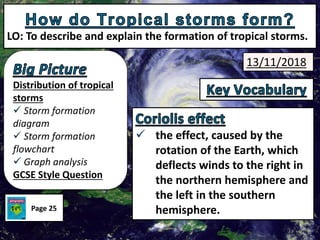
 the effect, caused by the
rotation of the Earth, which
deflects winds to the right in
the northern hemisphere and
the left in the southern
hemisphere.Page 25
 You can describe the formation of tropical storms.
 You use a limited range of specialist terms
 You have a reasonable accuracy in the use of spelling, punctuation
and grammar.
 You can explain the formation of tropical storms.
 You use a good range of specialist terms
 You have a considerable accuracy in spelling, punctuation and grammar.
 You can explain the formation of tropical storms with reference to long
and lat.
 You use a wide range of specialist terms where appropriate.
 Accurate use of spelling, punctuation and grammar.
L3 - Detailed
Answer
L2 - Clear
Answer
L1 - Basic
Answer
Learning Outcomes – Success Criteria
LO: To describe and explain the formation of tropical storms.
Produced by Mr M Colclough
LO: To describe and explain the formation of tropical storms.
 The difference in wind speed or
direction at different heights in
the atmosphere.
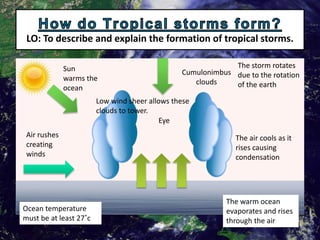
Sun
warms the
ocean
Ocean temperature
must be at least 27˚c
Air rushes
creating
winds
The warm ocean
evaporates and rises
through the air
The air cools as it
rises causing
condensation
Eye
Cumulonimbus
clouds
The storm rotates
due to the rotation
of the earth
LO: To describe and explain the formation of tropical storms.
Low wind sheer allows these
clouds to tower.
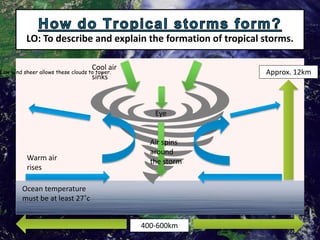
400-600km
Approx. 12km
Eye
Cool air
sinks
Warm air
rises
Air spins
around
the storm
Ocean temperature
must be at least 27˚c
LO: To describe and explain the formation of tropical storms.
Low wind sheer allows these clouds to tower.
LO: To describe and explain the formation of tropical storms.
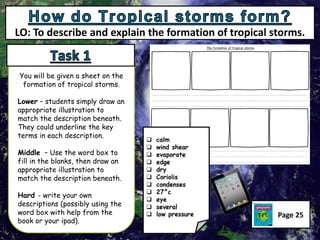
Task 1
You will be given a sheet on the
formation of tropical storms.
Lower – students simply draw an
appropriate illustration to
match the description beneath.
They could underline the key
terms in each description.
Middle – Use the word box to
fill in the blanks, then draw an
appropriate illustration to
match the description beneath.
Hard - write your own
descriptions (possibly using the
word box with help from the
book or your ipad).
Page 25
Produced by Mr M Colclough
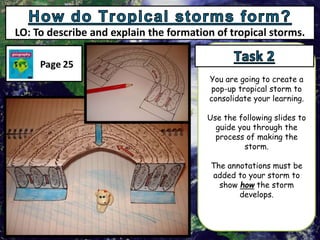
You are going to create a
pop-up tropical storm to
consolidate your learning.
Use the following slides to
guide you through the
process of making the
storm.
The annotations must be
added to your storm to
show how the storm
develops.
LO: To describe and explain the formation of tropical storms.
Produced by Mr M Colclough
LO: To describe and explain the formation of tropical storms.
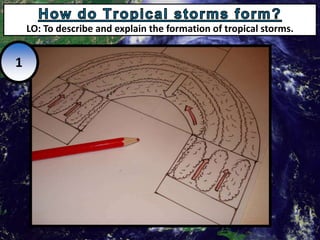
1
LO: To describe and explain the formation of tropical storms.
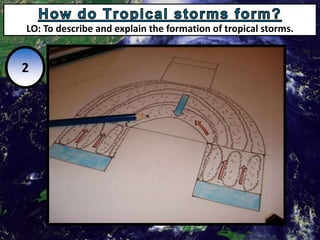
2
LO: To describe and explain the formation of tropical storms.
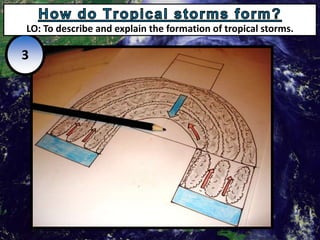
3
LO: To describe and explain the formation of tropical storms.
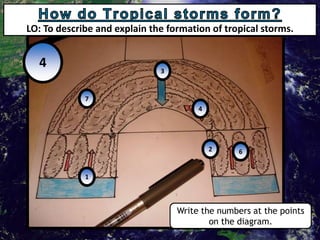
4
1
7
3
4
2 6
Write the numbers at the points
on the diagram.
LO: To describe and explain the formation of tropical storms.
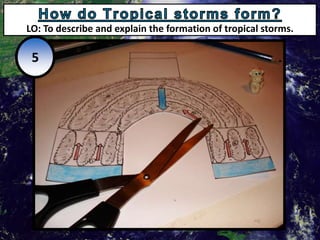
5
LO: To describe and explain the formation of tropical storms.
6
LO: To describe and explain the formation of tropical storms.
6
Stick the model into
your exercise book
LO: To describe and explain the formation of tropical storms.
7
5
LO: To describe and explain the formation of tropical storms.
8
1
7
53
4
2
6
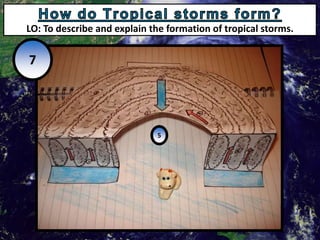
Warm moist air rising
from the ocean (above
27c).
The Eye Wall-
precipitation and wind is
greatest here, can be over
300km/h.
Cooler drier air sinking in
the eye.
The Eye- the calmest part
of the hurricane is filled
with cold, sinking air.
Warm moist air spirals in
an anti-clockwise
direction.
Tall cumulus clouds up to
30,000ft. The storm can
be 300 miles across.
A Rain Band, produces
bursts of heavy rainfall
and wind. 120km/h to be a
tropical storm
Make a key (in your
book/card) to say what
the numbers mean
Be careful!
This is not a
formation or
location
question!
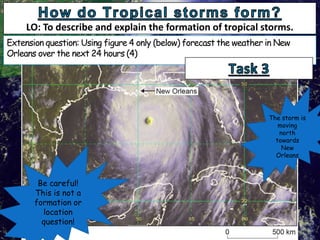
Extension question: Using figure 4 only (below) forecast the weather in New
Orleans over the next 24 hours (4)
The storm is
moving
north
towards
New
Orleans
LO: To describe and explain the formation of tropical storms.
• Cloud cover will increase over the next few hours and wind speed will pick up
dramatically as the outer part of the storm approaches.
• Winds, which will be blowing from the east, may be damaging and there will be
torrential downpours of rainfall from dark cumulonimbus clouds.
• There is a possibility of tornadoes and thunderstorms with lightning.
• A storm surge combined with the heavy rain may cause dangerous flooding in
low-lying coastal areas.
• Air pressure will drop rapidly.
• This will be followed by the centre of the storm or ‘eye’, which will only last
for a short time. The weather is likely to be fairly calm with only light winds
and fair weather.
• The winds will again increase suddenly as the second part of the storm
approaches.
• This will be accompanied by powerful winds with further heavy rain. Air
pressure will rise as the storm continues northwards, and cloud cover will
then become thinner, with more moderate winds.
• Eventually the rain will cease, although further belts of showers will occur as
the storm moves away.
LO: To describe and explain the formation of tropical storms.
Tracks and intensity of all tropical storms
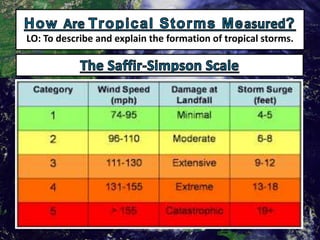
Saffir-Simpson hurricane intensity scale
The map shows the average sea
surface temperature. Look at the
map below of tropical storm
source areas. What’s the link?
Key
Blues / Purple <14o
C
Green / Yellow 15o
C - 25o
C
Orange / Red >26o
C
Average surface sea temperatures
LO: To explain the sequence of formation and development of a tropical storm and
their relationship with general atmospheric circulation.
Produced by Mr M Colclough
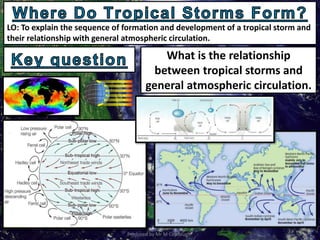
What is the relationship
between tropical storms and
general atmospheric circulation.
LO: To explain the sequence of formation and development of a tropical storm and
their relationship with general atmospheric circulation.
Explain why tropical storms are only found in
Figure 1. [2]
2 marks
L1 - Basic
Answer
Figure 1Task 3
Stick the map inside your book. You are
going to answer the question above. You
will need 2 reasons why tropical storms
form in the shaded areas.
You can explain the pattern using TEA.
Remember if there are no anomalies,
just say so!
LO: To explain the sequence of formation and development of a tropical storm and
their relationship with general atmospheric circulation.
Explain why tropical storms are only found in Figure 1. [2]
Figure 1
Explain why tropical storms are only found in Figure 1. [2]
2 marks L1 - Basic
Answer
Tropical storms only form over water that is 27 oC or
higher [1 mark]. This explains why they all form near
the equator where the water is warm due to greater
insolation from the sun. [1 mark].
Figure 1
LO: To explain the sequence of formation and development of a tropical storm and
their relationship with general atmospheric circulation.
LO: To explain the sequence of formation and development of a tropical storm.
Arlene Harvey Ophelia
Bret Irene Philippe
Cindy Jose Rita
Dennis Katrina Stan
Emily Lee Tammy
Franklin Maria Vince
Gert Nate Wilma
LO: To explain the sequence of formation and development of a tropical storm and
their relationship with general atmospheric circulation.
Outline two features of tropical storms. [2]
2 marks L1 - Basic
Answer
LO: To explain the sequence of formation and development of a tropical storm and
their relationship with general atmospheric circulation.
Produced by Mr M Colclough
Outline two features of tropical storms. [2]
L1 - Basic
Answer
Any two from:
• Tropical storms have a circular shape [1 mark].
• They are hundreds of kilometres wide [1 mark].
• Tropical storms have an eye at their centre, which is up to 50 km
across [1 mark].
• In the eye of the tropical storm, pressure is low and winds are light
[1 mark].
• There is an eye wall that surrounds the eye [1 mark].
• In the eye wall there are very strong winds, torrential rain and a low
temperature [1 mark].
2 marks
LO: To explain the sequence of formation and development of a tropical storm and
their relationship with general atmospheric circulation.

4.Tropical storm formation

  • 1.
    Distribution of tropical storms Storm formation diagram  Storm formation flowchart  Graph analysis GCSE Style Question LO: To describe and explain the formation of tropical storms. 13/11/2018  the effect, caused by the rotation of the Earth, which deflects winds to the right in the northern hemisphere and the left in the southern hemisphere.Page 25
  • 2.
     You candescribe the formation of tropical storms.  You use a limited range of specialist terms  You have a reasonable accuracy in the use of spelling, punctuation and grammar.  You can explain the formation of tropical storms.  You use a good range of specialist terms  You have a considerable accuracy in spelling, punctuation and grammar.  You can explain the formation of tropical storms with reference to long and lat.  You use a wide range of specialist terms where appropriate.  Accurate use of spelling, punctuation and grammar. L3 - Detailed Answer L2 - Clear Answer L1 - Basic Answer Learning Outcomes – Success Criteria LO: To describe and explain the formation of tropical storms.
  • 3.
    Produced by MrM Colclough LO: To describe and explain the formation of tropical storms.
  • 4.
    LO: To describeand explain the formation of tropical storms.
  • 5.
    LO: To describeand explain the formation of tropical storms.  The difference in wind speed or direction at different heights in the atmosphere.
  • 6.
    Sun warms the ocean Ocean temperature mustbe at least 27˚c Air rushes creating winds The warm ocean evaporates and rises through the air The air cools as it rises causing condensation Eye Cumulonimbus clouds The storm rotates due to the rotation of the earth LO: To describe and explain the formation of tropical storms. Low wind sheer allows these clouds to tower.
  • 7.
    400-600km Approx. 12km Eye Cool air sinks Warmair rises Air spins around the storm Ocean temperature must be at least 27˚c LO: To describe and explain the formation of tropical storms. Low wind sheer allows these clouds to tower.
  • 8.
    LO: To describeand explain the formation of tropical storms. Task 1 You will be given a sheet on the formation of tropical storms. Lower – students simply draw an appropriate illustration to match the description beneath. They could underline the key terms in each description. Middle – Use the word box to fill in the blanks, then draw an appropriate illustration to match the description beneath. Hard - write your own descriptions (possibly using the word box with help from the book or your ipad). Page 25
  • 9.
    Produced by MrM Colclough You are going to create a pop-up tropical storm to consolidate your learning. Use the following slides to guide you through the process of making the storm. The annotations must be added to your storm to show how the storm develops. LO: To describe and explain the formation of tropical storms.
  • 10.
    Produced by MrM Colclough LO: To describe and explain the formation of tropical storms.
  • 11.
    1 LO: To describeand explain the formation of tropical storms.
  • 12.
    2 LO: To describeand explain the formation of tropical storms.
  • 13.
    3 LO: To describeand explain the formation of tropical storms.
  • 14.
    4 1 7 3 4 2 6 Write thenumbers at the points on the diagram. LO: To describe and explain the formation of tropical storms.
  • 15.
    5 LO: To describeand explain the formation of tropical storms.
  • 16.
    6 LO: To describeand explain the formation of tropical storms.
  • 17.
    6 Stick the modelinto your exercise book LO: To describe and explain the formation of tropical storms.
  • 18.
    7 5 LO: To describeand explain the formation of tropical storms.
  • 19.
    8 1 7 53 4 2 6 Warm moist airrising from the ocean (above 27c). The Eye Wall- precipitation and wind is greatest here, can be over 300km/h. Cooler drier air sinking in the eye. The Eye- the calmest part of the hurricane is filled with cold, sinking air. Warm moist air spirals in an anti-clockwise direction. Tall cumulus clouds up to 30,000ft. The storm can be 300 miles across. A Rain Band, produces bursts of heavy rainfall and wind. 120km/h to be a tropical storm Make a key (in your book/card) to say what the numbers mean
  • 20.
    Be careful! This isnot a formation or location question! Extension question: Using figure 4 only (below) forecast the weather in New Orleans over the next 24 hours (4) The storm is moving north towards New Orleans LO: To describe and explain the formation of tropical storms.
  • 21.
    • Cloud coverwill increase over the next few hours and wind speed will pick up dramatically as the outer part of the storm approaches. • Winds, which will be blowing from the east, may be damaging and there will be torrential downpours of rainfall from dark cumulonimbus clouds. • There is a possibility of tornadoes and thunderstorms with lightning. • A storm surge combined with the heavy rain may cause dangerous flooding in low-lying coastal areas. • Air pressure will drop rapidly. • This will be followed by the centre of the storm or ‘eye’, which will only last for a short time. The weather is likely to be fairly calm with only light winds and fair weather. • The winds will again increase suddenly as the second part of the storm approaches. • This will be accompanied by powerful winds with further heavy rain. Air pressure will rise as the storm continues northwards, and cloud cover will then become thinner, with more moderate winds. • Eventually the rain will cease, although further belts of showers will occur as the storm moves away. LO: To describe and explain the formation of tropical storms.
  • 22.
    Tracks and intensityof all tropical storms Saffir-Simpson hurricane intensity scale The map shows the average sea surface temperature. Look at the map below of tropical storm source areas. What’s the link? Key Blues / Purple <14o C Green / Yellow 15o C - 25o C Orange / Red >26o C Average surface sea temperatures LO: To explain the sequence of formation and development of a tropical storm and their relationship with general atmospheric circulation. Produced by Mr M Colclough
  • 23.
    Produced by MrM Colclough What is the relationship between tropical storms and general atmospheric circulation. LO: To explain the sequence of formation and development of a tropical storm and their relationship with general atmospheric circulation.
  • 24.
    Explain why tropicalstorms are only found in Figure 1. [2] 2 marks L1 - Basic Answer Figure 1Task 3 Stick the map inside your book. You are going to answer the question above. You will need 2 reasons why tropical storms form in the shaded areas. You can explain the pattern using TEA. Remember if there are no anomalies, just say so! LO: To explain the sequence of formation and development of a tropical storm and their relationship with general atmospheric circulation.
  • 25.
    Explain why tropicalstorms are only found in Figure 1. [2] Figure 1
  • 26.
    Explain why tropicalstorms are only found in Figure 1. [2] 2 marks L1 - Basic Answer Tropical storms only form over water that is 27 oC or higher [1 mark]. This explains why they all form near the equator where the water is warm due to greater insolation from the sun. [1 mark]. Figure 1 LO: To explain the sequence of formation and development of a tropical storm and their relationship with general atmospheric circulation.
  • 27.
    LO: To explainthe sequence of formation and development of a tropical storm.
  • 28.
    Arlene Harvey Ophelia BretIrene Philippe Cindy Jose Rita Dennis Katrina Stan Emily Lee Tammy Franklin Maria Vince Gert Nate Wilma LO: To explain the sequence of formation and development of a tropical storm and their relationship with general atmospheric circulation.
  • 29.
    Outline two featuresof tropical storms. [2] 2 marks L1 - Basic Answer LO: To explain the sequence of formation and development of a tropical storm and their relationship with general atmospheric circulation.
  • 30.
    Produced by MrM Colclough Outline two features of tropical storms. [2] L1 - Basic Answer Any two from: • Tropical storms have a circular shape [1 mark]. • They are hundreds of kilometres wide [1 mark]. • Tropical storms have an eye at their centre, which is up to 50 km across [1 mark]. • In the eye of the tropical storm, pressure is low and winds are light [1 mark]. • There is an eye wall that surrounds the eye [1 mark]. • In the eye wall there are very strong winds, torrential rain and a low temperature [1 mark]. 2 marks LO: To explain the sequence of formation and development of a tropical storm and their relationship with general atmospheric circulation.